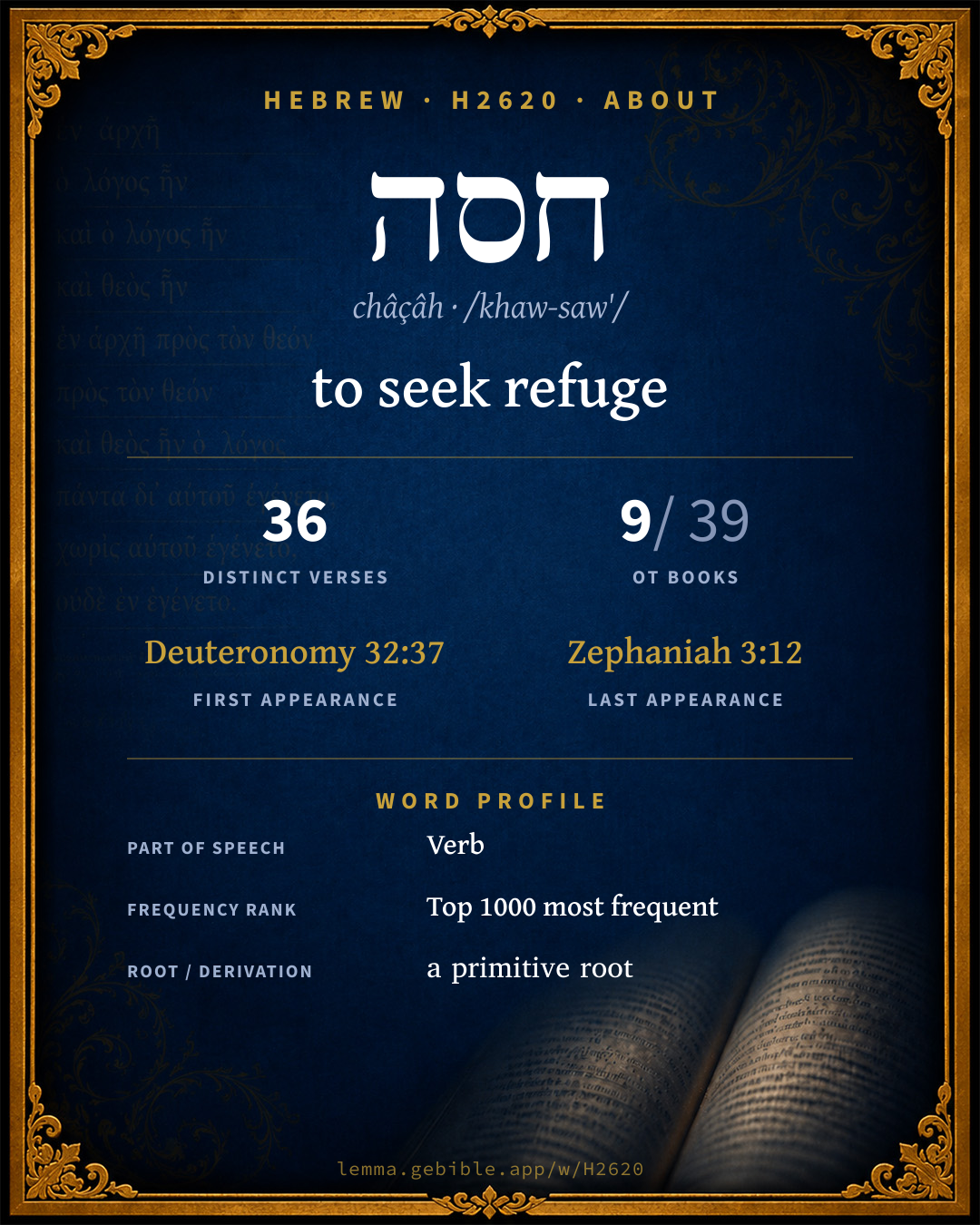
חָסָה
to seek refuge
‘to seek refuge’ is one of 2 main senses fuller range ↓
Full lexicon entry — Brown-Driver-Briggs (BDB)
From Brown-Driver-Briggs (BDB)
Where this word appears
Grammar key — what these labels mean
Part of speech
- Verb
- An action or state-of-being word.
Stem
- Qal
- The basic, simple active stem — the plain form of the verb (“he wrote”).
Form
- Perfect
- A completed action or state — Hebrew marks aspect (completeness) more than strict tense (“he wrote”).
- Imperfect
- An incomplete, ongoing, or future action (“he will / would write”).
- Infinitive Construct
- A bound verbal noun, frequently with prepositions (“to write / in writing”).
- Participle Active
- A verbal adjective expressing ongoing or characteristic action (“writing / one who writes”).
- Sequential Perfect
- A perfect with prefixed waw continuing a preceding imperfect or command (waw-consecutive perfect).
- Imperative
- A direct command (“write!”).
State
- Absolute
- The independent form of a noun, not bound to a following word.
- Construct
- A noun bound to a following noun in a possessive / “of” relationship (the construct chain).
Person
- 1st Person
- The speaker (“I / we”).
- 3rd Person
- The one spoken about (“he / she / it / they”).
- 2nd Person
- The one addressed (“you”).
Gender
- Common
- Either gender — not distinguished for this form.
- Masculine
- Grammatically masculine.
- Feminine
- Grammatically feminine.
Number
- Singular
- One.
- Plural
- More than one (in Hebrew, generally three or more).
Every verse where H2620 appears in the Book of Psalms — 24 distinct verses. Click any verse to open its interlinear word-by-word view. Verse text shown in the World English Bible for context — . Each verse’s Hebrew form is shown with its reference; the English is not keyword-highlighted, since the data carries no word-level English alignment. Use “Compare translations” on any verse to read it across multiple English versions. This concordance covers the Hebrew Bible; Septuagint (Greek Old Testament) occurrences are not indexed here.
Psalms
- Psalms 2:12 ח֥וֹסֵי Qal ptcp.act mp cs Kiss the son, lest he be angry, and you perish in the way, For his wrath will soon be kindled. Blessed are all those who take refuge in him.
- Psalms 5:11 ח֪וֹסֵי Qal ptcp.act mp cs But let all those who take refuge in you rejoice, Let them always shout for joy, because you defend them. Let them also who love your name be joyful in you.
- Psalms 7:1 חָסִ֑יתִי Qal pf 1cs Yahweh, my God, I take refuge in you. Save me from all those who pursue me, and deliver me,
- Psalms 11:1 חָסִ֗יתִי Qal pf 1cs In Yahweh, I take refuge. How can you say to my soul, "Flee as a bird to your mountain!"
- Psalms 16:1 חָסִ֥יתִי Qal pf 1cs Preserve me, God, for in you do I take refuge.
- Psalms 17:7 חוֹסִ֑ים Qal ptcp.act mp Show your marvelous loving kindness, You who save those who take refuge by your right hand from their enemies.
- Psalms 18:2 אֶֽחֱסֶה Qal impf 1cs Yahweh is my rock, my fortress, and my deliverer; My God, my rock, in whom I take refuge; My shield, and the horn of my salvation, my high tower.
- Psalms 18:30 הַ/חֹסִ֬ים ptcl def.art + Qal ptcp.act mp As for God, his way is perfect. The word of Yahweh is tried. He is a shield to all those who take refuge in him.
- Psalms 25:20 חָסִ֥יתִי Qal pf 1cs Oh keep my soul, and deliver me. Let me not be disappointed, for I take refuge in you.
- Psalms 31:1 חָ֭סִיתִי Qal pf 1cs In you, Yahweh, I take refuge. Let me never be disappointed: Deliver me in your righteousness.
- Psalms 31:19 לַ/חֹסִ֣ים prep det + Qal ptcp.act mp Oh how great is your goodness, Which you have laid up for those who fear you, Which you have worked for those who take refuge in you, Before the sons of men!
- Psalms 34:8 יֶחֱסֶה Qal impf 3ms Oh taste and see that Yahweh is good. Blessed is the man who takes refuge in him.
- Psalms 34:22 הַ/חֹסִ֥ים ptcl def.art + Qal ptcp.act mp Yahweh redeems the soul of his servants. None of those who take refuge in him shall be condemned.
- Psalms 36:7 יֶחֱסָיֽוּ/ן Qal impf 3mp + sfx n How precious is your loving kindness, God! The children of men take refuge under the shadow of your wings.
- Psalms 37:40 חָ֥סוּ Qal pf 3cp Yahweh helps them, and rescues them. He rescues them from the wicked, and saves them, Because they have taken refuge in him.
- Psalms 57:1 חָסָ֪יָה אֶחְסֶ֑ה Qal pf 3fs Qal impf 1cs Be merciful to me, God, be merciful to me, For my soul takes refuge in you. Yes, in the shadow of your wings, I will take refuge, Until disaster has passed.
- Psalms 61:4 אֶֽחֱסֶ֨ה Qal impf 1cs I will dwell in your tent forever. I will take refuge in the shelter of your wings. Selah.
- Psalms 64:10 וְ/חָ֣סָה conj + Qal pf 3ms The righteous shall be glad in Yahweh, And shall take refuge in him. All the upright in heart shall praise him!
- Psalms 71:1 חָסִ֑יתִי Qal pf 1cs In you, Yahweh, I take refuge. Never let me be disappointed.
- Psalms 91:4 תֶּחְסֶ֑ה Qal impf 2ms He will cover you with his feathers. Under his wings you will take refuge. His faithfulness is your shield and rampart.
- Psalms 118:8 לַ/חֲס֥וֹת prep + Qal inf.cs It is better to take refuge in Yahweh, Than to put confidence in man.
- Psalms 118:9 לַ/חֲס֥וֹת prep + Qal inf.cs It is better to take refuge in Yahweh, Than to put confidence in princes.
- Psalms 141:8 חָ֝סִ֗יתִי Qal pf 1cs For my eyes are on you, Yahweh, the Lord. In you, I take refuge. Don't leave my soul destitute.
- Psalms 144:2 חָסִ֑יתִי Qal pf 1cs My loving kindness, my fortress, My high tower, my deliverer, My shield, and he in whom I take refuge; Who subdues my people under me.
About this entry
At a glance — auto-summarized from this page’s data, not written by a person. Every figure links to its source below. This summary describes the numbers; it doesn’t interpret them.
חסה (châçâh) is a Hebrew verb most often rendered “to seek refuge.” Psalms dominates its distribution — 24 of 36 verses. The Hebrew Bible uses it across 36 verses — moderately common. Ranging over 2 senses, it is not a single-sense word. Its English rendering has broadened — “trust” classically, “take refuge” (Berean Standard Bible) and “i take refuge” (unfoldingWord Literal Text) in modern versions; see the renderings breakdown. The sections below give every sense, occurrence, and version rendering.
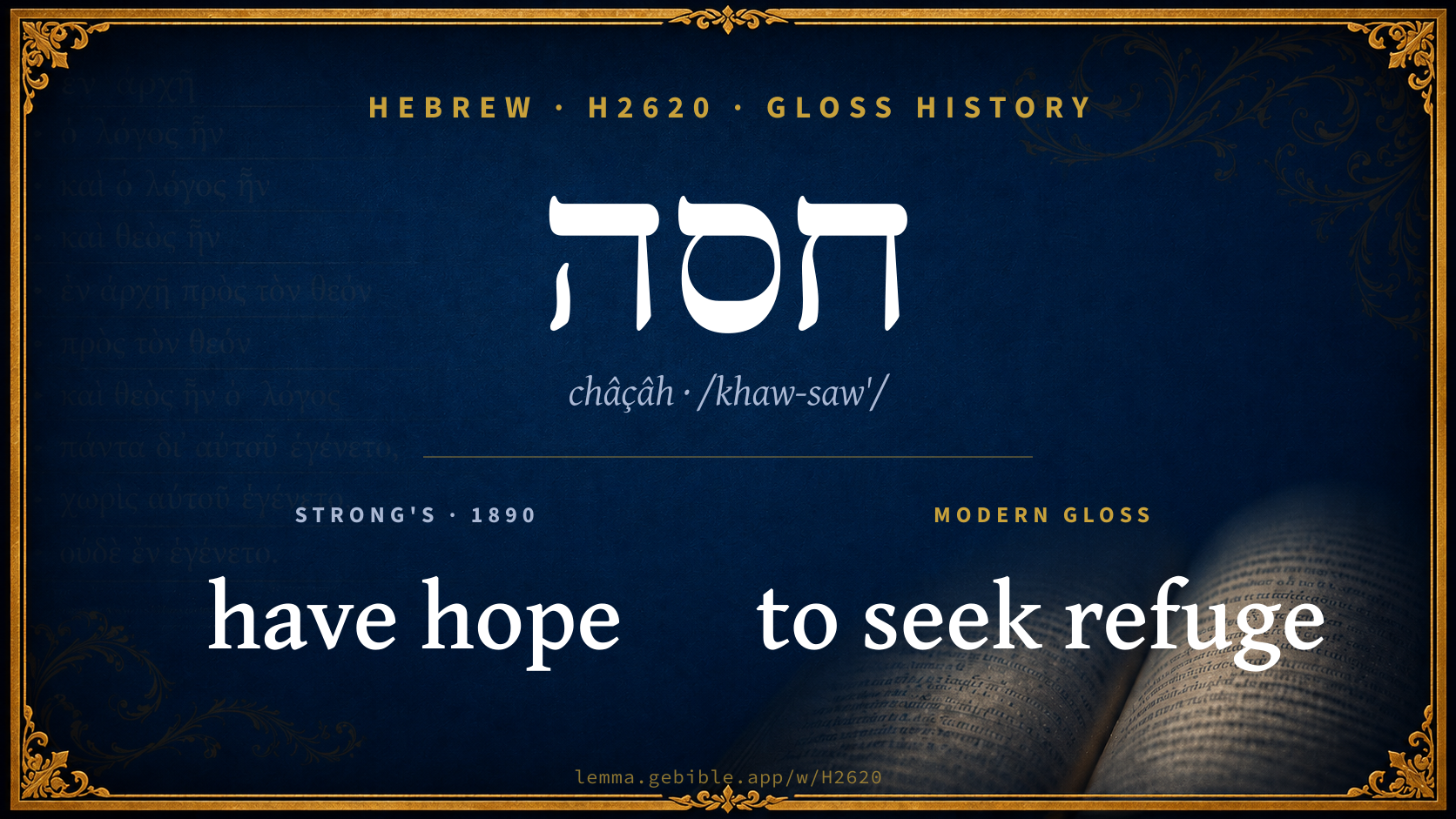
Gloss history
Strong's 1890 vs modern scholarship
About this word
Strong's H2620 catalogs a Hebrew word from the Hebrew Old Testament.
These counts are not copied from any lexicon or concordance. They are computed here, from the morphology-tagged Hebrew Old Testament. What Lemma adds →
- 36
- distinct verses
- The word appears in 36 distinct verses.
- 9 / 39
- OT books
- The word appears in 9 of 39 Old Testament books.
- #967
- by frequency
- Top 1000 most frequent Hebrew words (rank 967 of 8,640 Hebrew words by occurrence).
View all 36 occurrences in the concordance →
By section of the Old Testament
By traditional corpus
Conventional, traditional groupings — biblical authorship is debated, so this is a traditional corpus grouping, not an authorship claim. Each share is this word’s portion of its verses in that division of the Hebrew canon. Each figure is a share of the word’s 36 distinct verses.
- Writings (Ketuvim) 27 verses · 75%
- Prophets (Nevi'im) 8 verses · 22%
- Torah (Pentateuch) 1 verse · 3%
How translations render this word
Counts come from each version’s own published word-to-Strong’s tagging or interlinear alignment — an approximate guide to how each version renders this word, not a word-level alignment the data otherwise carries. Because each total is that version’s own tagged count, the per-version totals vary from one another and need not match the appearance or distinct-verse counts above. These counts may also differ from a printed concordance because Lemma counts each distinctly tagged rendering and does not collapse phrase taggings into a single head-word total. This is a fixed set of word-tagged versions (KJV, ASV, BSB, ULT) and does not change with the reading translation you choose elsewhere. Each version’s license is shown beside its name below (and on Sources).
- King James Version: Trust 6×, Put their trust 3×, Do i put my trust 2×
- American Standard Version: Take refuge 7×, All them that take refuge in him 2×, Do i take refuge 2×
- Berean Standard Bible: Take refuge 13×, I take refuge 7×, I have taken refuge 2×
- unfoldingWord Literal Text: I take refuge 10×, Take refuge 4×, Ones taking refuge 3×
King James Version Public Domain
Renders H2620 across 37 tagged occurrences — most commonly:
Plus 18 renderings that appear only once — usually multi-word phrases or single function words the recovered tagging swept in, not distinct renderings.
American Standard Version Public Domain
Renders H2620 across 37 tagged occurrences — most commonly:
Plus 18 renderings that appear only once — usually multi-word phrases or single function words the recovered tagging swept in, not distinct renderings.
Berean Standard Bible Public Domain
Renders H2620 across 37 tagged occurrences — most commonly:
Plus 13 renderings that appear only once — usually multi-word phrases or single function words the recovered tagging swept in, not distinct renderings.
unfoldingWord Literal Text CC BY-SA 4.0
Renders H2620 across 39 tagged occurrences — most commonly:
Plus 18 renderings that appear only once — usually multi-word phrases or single function words the recovered tagging swept in, not distinct renderings.
Senses in BDB
The 2 senses BDB distinguishes for this word, in lexicon order (not ranked by frequency or importance). The full entry — with sub-senses — is in the Lexicon Entry tab.
- (Qal) to seek refuge, flee for protection
- to put trust in (God), confide or hope in (God) (figuratively)
Word origin
חָסָה vb. (mostly poet. and fig.) seek refuge
— Brown-Driver-Briggs (Oxford 1906, public domain), digitized via Sefaria, supplemented by the OpenScriptures HebrewLexicon (CC BY 4.0). See Sources.
Origin: a primitive root
Forms in the corpus
The 31 distinct written forms H2620 takes in the Hebrew Bible, most frequent first — each parse links to that stem’s occurrences in the concordance. Hebrew forms include their vowel points and cantillation, so a single lemma takes many written forms.
| Form | Parsing | Example | Uses |
|---|---|---|---|
| חָסִ֑יתִי | Verb, Qal, Perfect, 1st Person, Common, Singular | Psalms 7:1 | 3 |
| לַ/חֲס֥וֹת | Verb, Qal, Infinitive Construct | Psalms 118:8 | 3 |
| הַ/חֹסִ֥ים | Verb, Qal, Participle Active, Masculine, Plural, Absolute | 2 Samuel 22:31 | 2 |
| חָסִ֥יתִי | Verb, Qal, Perfect, 1st Person, Common, Singular | Psalms 16:1 | 2 |
| אֶֽחֱסֶ֨ה | Verb, Qal, Imperfect, 1st Person, Common, Singular | Psalms 61:4 | 1 |
| אֶֽחֱסֶה | Verb, Qal, Imperfect, 1st Person, Common, Singular | Psalms 18:2 | 1 |
| אֶחְסֶ֑ה | Verb, Qal, Imperfect, 1st Person, Common, Singular | Psalms 57:1 | 1 |
| אֶחֱסֶה | Verb, Qal, Imperfect, 1st Person, Common, Singular | 2 Samuel 22:3 | 1 |
| הַ/חֹסִ֬ים | Verb, Qal, Participle Active, Masculine, Plural, Absolute | Psalms 18:30 | 1 |
| וְ/הַ/חוֹסֶ֥ה | Verb, Qal, Participle Active, Masculine, Singular, Absolute | Isaiah 57:13 | 1 |
| וְ/חָ֣סָה | Verb, Qal, Perfect, 3rd Person, Masculine, Singular | Psalms 64:10 | 1 |
| וְ/חָס֖וּ | Verb, Qal, Sequential Perfect, 3rd Person, Common, Plural | Zephaniah 3:12 | 1 |
| וְ/חֹסֶ֖ה | Verb, Qal, Participle Active, Masculine, Singular, Absolute | Proverbs 14:32 | 1 |
| וְ/לַ/חְס֖וֹת | Verb, Qal, Infinitive Construct | Isaiah 30:2 | 1 |
| ח֥וֹסֵי | Verb, Qal, Participle Active, Masculine, Plural, Construct | Psalms 2:12 | 1 |
| ח֪וֹסֵי | Verb, Qal, Participle Active, Masculine, Plural, Construct | Psalms 5:11 | 1 |
| חֲס֣וּ | Verb, Qal, Imperative, 2nd Person, Masculine, Plural | Judges 9:15 | 1 |
| חָ֝סִ֗יתִי | Verb, Qal, Perfect, 1st Person, Common, Singular | Psalms 141:8 | 1 |
| חָ֥סוּ | Verb, Qal, Perfect, 3rd Person, Common, Plural | Psalms 37:40 | 1 |
| חָ֭סִיתִי | Verb, Qal, Perfect, 1st Person, Common, Singular | Psalms 31:1 | 1 |
| חָסִ֗יתִי | Verb, Qal, Perfect, 1st Person, Common, Singular | Psalms 11:1 | 1 |
| חָסָ֥יוּ | Verb, Qal, Perfect, 3rd Person, Common, Plural | Deuteronomy 32:37 | 1 |
| חָסָ֪יָה | Verb, Qal, Perfect, 3rd Person, Feminine, Singular | Psalms 57:1 | 1 |
| חֹ֥סֵי | Verb, Qal, Participle Active, Masculine, Plural, Construct | Nahum 1:7 | 1 |
| חוֹסִ֑ים | Verb, Qal, Participle Active, Masculine, Plural, Absolute | Psalms 17:7 | 1 |
| יֶחֱס֖וּ | Verb, Qal, Imperfect, 3rd Person, Masculine, Plural | Isaiah 14:32 | 1 |
| יֶחֱסֶה | Verb, Qal, Imperfect, 3rd Person, Masculine, Singular | Psalms 34:8 | 1 |
| יֶחֱסָיֽוּ/ן | Verb, Qal, Imperfect, 3rd Person, Masculine, Plural | Psalms 36:7 | 1 |
| לַ/חֹסִ֣ים | Verb, Qal, Participle Active, Masculine, Plural, Absolute | Psalms 31:19 | 1 |
| לַֽ/חֹסִ֥ים | Verb, Qal, Participle Active, Masculine, Plural, Absolute | Proverbs 30:5 | 1 |
| תֶּחְסֶ֑ה | Verb, Qal, Imperfect, 2nd Person, Masculine, Singular | Psalms 91:4 | 1 |
Same root — word family
Other BDB entries built from the same root as H2620, grouped by Strong’s listed origin. These share a root / origin per the lexicon — not necessarily a shared meaning. Each links to that word’s own entry.
Derived from this word
Proper names from this root
People and places named from this root — a name, not an additional meaning of the word.
Compare all same-root words → 1 of the same-root words is a proper name (a person or place). They share a root, not necessarily a meaning.
Septuagint verse parallels
This word appears in 32 verses that also exist in the Greek Old Testament (Septuagint), out of the 36 Hebrew verses it occurs in. You can read those verses in Greek by switching the Old Testament edition to the Septuagint.
Read these verses in the Septuagint
- Deuteronomy 32:37
- Judges 9:15
- Ruth 2:12
- 2 Samuel 22:3
- Psalms 2:12
- Proverbs 14:32
- Isaiah 14:32
- Nahum 1:7
- Zephaniah 3:12
This is a verse-level parallel only — the same verses exist in both the Hebrew and Greek Old Testaments. No word-level Hebrew↔Greek correspondence is claimed: the data carries no such alignment, so no Greek word is shown as this Hebrew word’s translation. Coverage is not total — the Septuagint omits the deuterocanon and renumbers the Psalms, so some Hebrew verses have no direct Greek parallel.