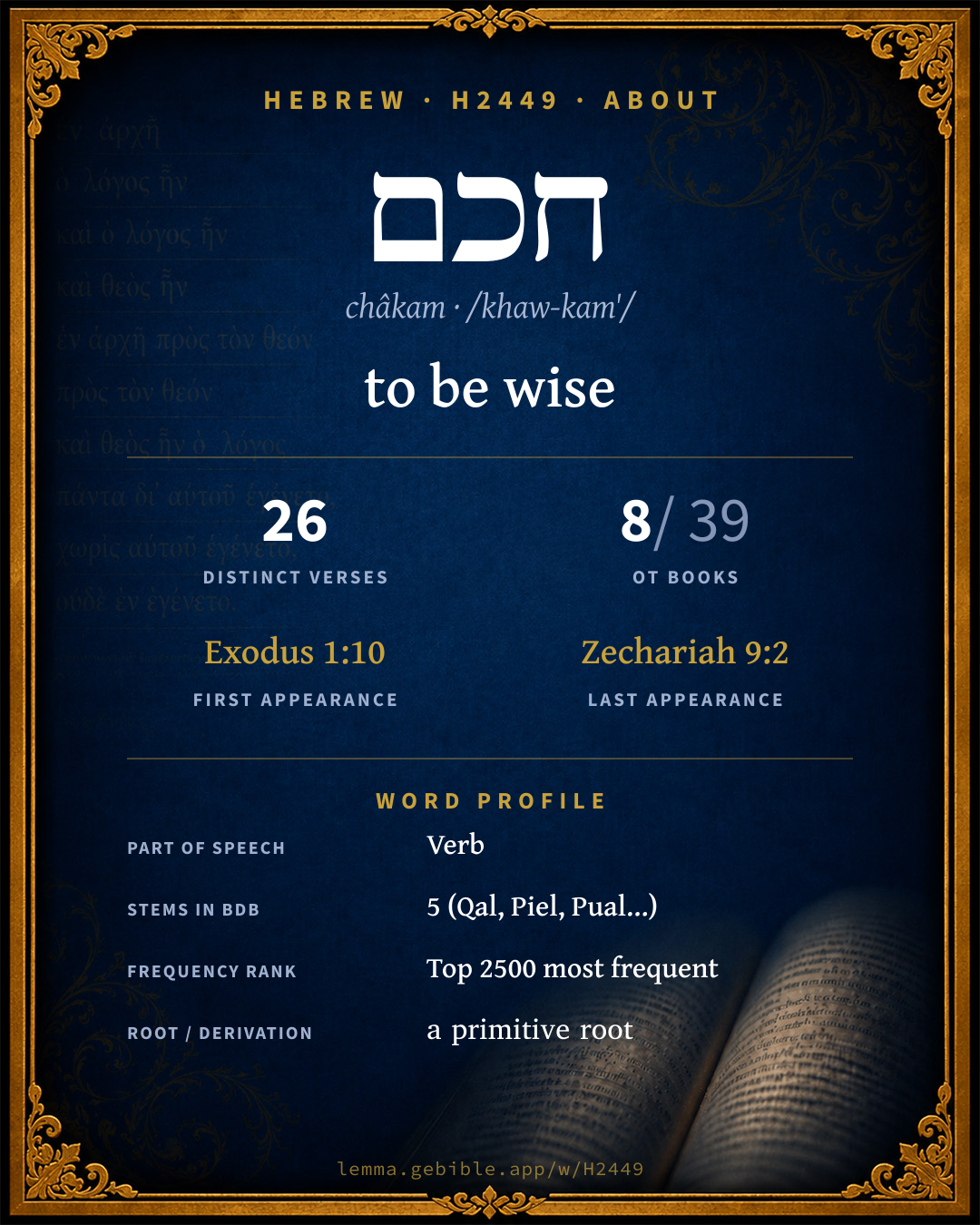
חָכַם
to be wise
‘to be wise’ is one of 6 main senses fuller range ↓
Full lexicon entry — Brown-Driver-Briggs (BDB)
From Brown-Driver-Briggs (BDB)
Where this word appears
See every Qal verb in the Hebrew Bible →
Grammar key — what these labels mean
Part of speech
- Verb
- An action or state-of-being word.
Stem
- Qal
- The basic, simple active stem — the plain form of the verb (“he wrote”).
- Pual
- The passive counterpart of the Piel. Here: ‘made wise’
- Hiphil
- The causative active stem (“he caused / brought about”). Here: ‘cstr.’
- Piel
- An intensive or resultative active stem.
- Hithpael
- The reflexive or reciprocal stem (the subject acts on itself).
Form
- Imperative
- A direct command (“write!”).
- Imperfect
- An incomplete, ongoing, or future action (“he will / would write”).
- Participle Passive
- A verbal adjective expressing action received (“written”).
- Perfect
- A completed action or state — Hebrew marks aspect (completeness) more than strict tense (“he wrote”).
- Sequential Imperfect
- An imperfect with prefixed waw — the standard past-narrative form (waw-consecutive imperfect).
- Participle Active
- A verbal adjective expressing ongoing or characteristic action (“writing / one who writes”).
- Cohortative
- A first-person volitional form expressing wish or resolve (“let me / let us write”).
- Jussive
- A third- or second-person volitional form expressing wish or command (“let him write”).
State
- Absolute
- The independent form of a noun, not bound to a following word.
- Construct
- A noun bound to a following noun in a possessive / “of” relationship (the construct chain).
Person
- 2nd Person
- The one addressed (“you”).
- 3rd Person
- The one spoken about (“he / she / it / they”).
- 1st Person
- The speaker (“I / we”).
Gender
- Masculine
- Grammatically masculine.
- Common
- Either gender — not distinguished for this form.
- Feminine
- Grammatically feminine.
Number
- Singular
- One.
- Plural
- More than one (in Hebrew, generally three or more).
1 distinct verse where H2449 appears in the Hiphil stem, across 1 book. Filtered view — show all forms. Click any verse to open its interlinear word-by-word view. Verse text shown in the World English Bible for context — . Each verse’s Hebrew form is shown with its reference; the English is not keyword-highlighted, since the data carries no word-level English alignment. Use “Compare translations” on any verse to read it across multiple English versions. This concordance covers the Hebrew Bible; Septuagint (Greek Old Testament) occurrences are not indexed here.
Psalms 1 verse
About this entry
At a glance — auto-summarized from this page’s data, not written by a person. Every figure links to its source below. This summary describes the numbers; it doesn’t interpret them.
The Hebrew verb חכם centers on the idea of “to be wise.” Different stems carry different senses — BDB groups them under 5 stems, among them Qal and Piel. It appears 26 verses across 8 books of the Hebrew Bible, among its moderately common vocabulary. The word gravitates to Proverbs (46%), then Psalms and Ecclesiastes. Debuting at Exodus 1:10, it then recurs through the corpus. Dig into 26-verse concordance and the renderings breakdown below.
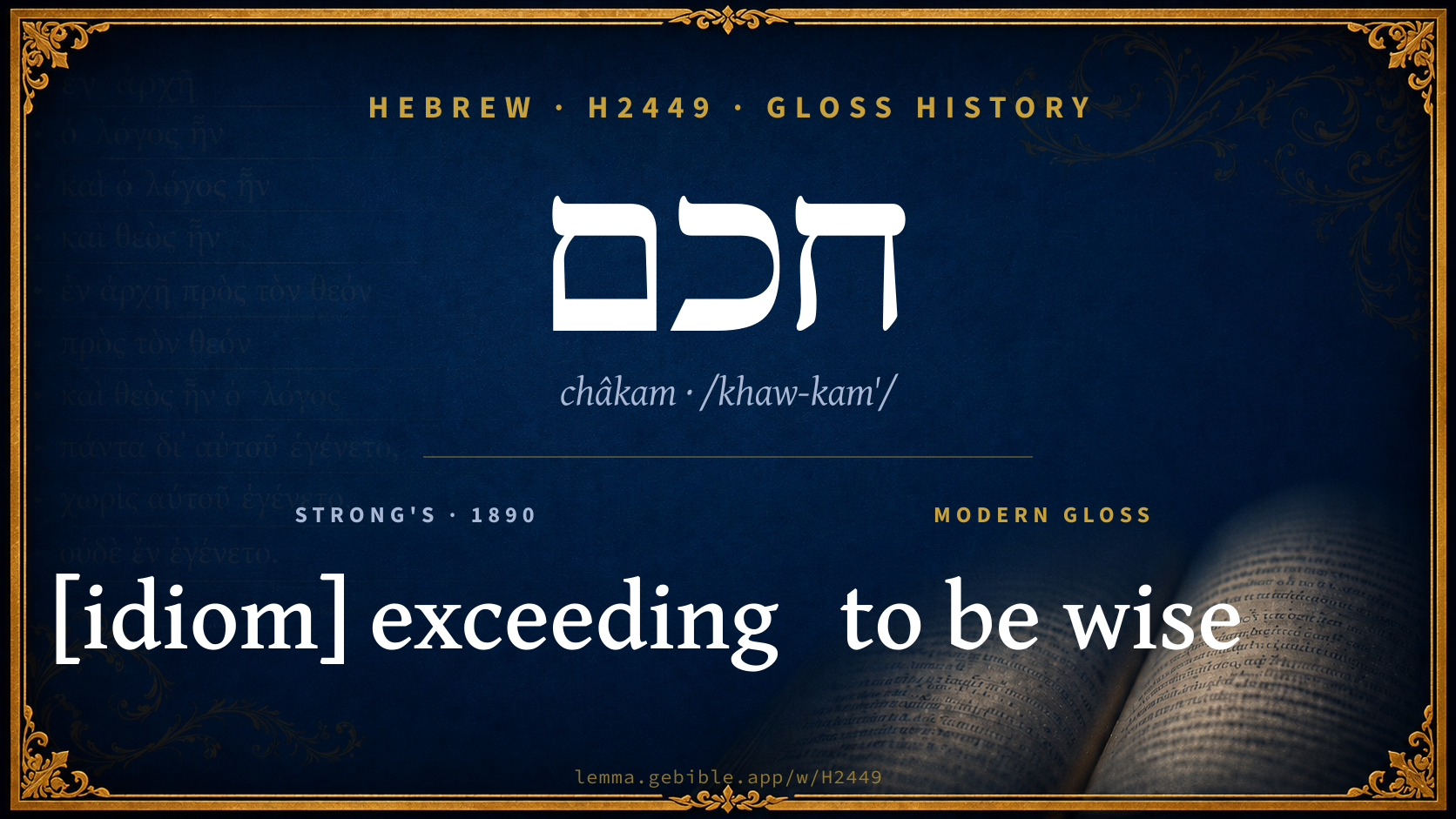
Gloss history
Strong's 1890 vs modern scholarship
About this word
Strong's H2449 catalogs a Hebrew word from the Hebrew Old Testament.
These counts are not copied from any lexicon or concordance. They are computed here, from the morphology-tagged Hebrew Old Testament. What Lemma adds →
- 26
- distinct verses
- The word appears in 26 distinct verses.
- 8 / 39
- OT books
- The word appears in 8 of 39 Old Testament books.
- #1,190
- by frequency
- Top 2500 most frequent Hebrew words (rank 1,190 of 8,640 Hebrew words by occurrence).
View all 26 occurrences in the concordance →
Most concentrated in
- Proverbs 12 verses 46%
- Psalms 4 verses 15%
- Ecclesiastes 4 verses 15%
By section of the Old Testament
By traditional corpus
Conventional, traditional groupings — biblical authorship is debated, so this is a traditional corpus grouping, not an authorship claim. Each share is this word’s portion of its verses in that division of the Hebrew canon. Each figure is a share of the word’s 26 distinct verses.
- Writings (Ketuvim) 22 verses · 85%
- Torah (Pentateuch) 2 verses · 8%
- Prophets (Nevi'im) 2 verses · 8%
How translations render this word
Counts come from each version’s own published word-to-Strong’s tagging or interlinear alignment — an approximate guide to how each version renders this word, not a word-level alignment the data otherwise carries. Because each total is that version’s own tagged count, the per-version totals vary from one another and need not match the appearance or distinct-verse counts above. These counts may also differ from a printed concordance because Lemma counts each distinctly tagged rendering and does not collapse phrase taggings into a single head-word total. This is a fixed set of word-tagged versions (KJV, ASV, BSB, ULT) and does not change with the reading translation you choose elsewhere. Each version’s license is shown beside its name below (and on Sources).
- King James Version: Be wise 5×, Wise 3×
- American Standard Version: Be wise 4×, Thou art wise 2×, Wise 2×
- Berean Standard Bible: Be wise 4×, Skillfully 2×, Wise 2×
- unfoldingWord Literal Text: Wise 5×, Be wise 4×, Being made wise 2×
King James Version Public Domain
Renders H2449 across 27 tagged occurrences — most commonly:
Plus 19 renderings that appear only once — usually multi-word phrases or single function words the recovered tagging swept in, not distinct renderings.
American Standard Version Public Domain
Renders H2449 across 27 tagged occurrences — most commonly:
Plus 19 renderings that appear only once — usually multi-word phrases or single function words the recovered tagging swept in, not distinct renderings.
Berean Standard Bible Public Domain
Renders H2449 across 27 tagged occurrences — most commonly:
Plus 17 renderings that appear only once — usually multi-word phrases or single function words the recovered tagging swept in, not distinct renderings.
unfoldingWord Literal Text CC BY-SA 4.0
Renders H2449 across 35 tagged occurrences — most commonly:
Plus 22 renderings that appear only once — usually multi-word phrases or single function words the recovered tagging swept in, not distinct renderings.
Senses in the full BDB
Hebrew verbs can shift meaning by stem (binyan): Qal is the basic action, Niphal is often passive or reflexive, Piel often intensifies or makes it factitive, and Hiphil is typically causative. The senses below are grouped under the stem BDB assigns to each. This entry also uses Pual (the passive of Piel) and Hithpael (reflexive or reciprocal).
What do BDB’s symbols mean?
BDB uses these scholarly abbreviations:
| Symbol | Meaning |
|---|---|
| 𝔊 | the Septuagint (the ancient Greek translation, LXX) |
| 𝔙 | the Vulgate (the Latin translation) |
| 𝔖 | the Syriac version (the Peshitta) |
| 𝔗 | the Targum (the Aramaic translation) |
| ψ | the Psalms |
| √ | root (the underlying root or stem) |
| ‖ | parallel passage (a synonymous or contrasted parallel) |
| † | the dagger: every passage where the word occurs is cited |
The 5 senses and sub-senses the full Brown-Driver-Briggs lexicon distinguishes for this word, in lexicon order (not ranked by frequency), with BDB’s own verbatim wording and sub-sense lettering. Shown in Hebrew script with BDB’s own scholarly abbreviations. The condensed entry is in the Lexicon Entry tab. See also the Forms in the corpus table below.
Qal
- Pf. ח׳ Pr 23:15; 3 fs. חָֽכְמָה Zc 9:2; הָכַמְתָּ Pr 9:12(×2), etc. + 3 times Pf.; Impf. יֶחְכַּם Pr 9:9; 21:11; וַיֶּחְכַּם 1 K 5:11; יֶחְכָּ֑ם Pr 20:1 +; וֶ֯חְכָּ֑ם Pr 13:20; תֶּחְכַּם Pr 19:20; אֶחְכָּ֑מָה Ec 7:23; pl. יֶחְכָּ֑מוּ Jb 32:9; Imv. חֲכַם Pr 27:11; חֲכָ֑ם Pr 6:6; 23:19 + 13:20 Kt; חֲכָ֑מוּ Pr 8:33;—be or become wise, act wisely Dt 32:29 (poet.) 1 K 5:11 Jb 32:9 Pr 6:6; 8:33; 9:9, 12(×2); 13:20; 19:20; 20:1; 21:11; 23:19; 27:11 Ec 2:15; 7:23 Zc 9:2; אם חכם לבך if thy mind be wise Pr 23:15; c. acc. שׁחכמתי Ec 2:19 wherein I have acted wisely. e.g. Proverbs 23:15
Piel
- Impf. יְחַכֵּם ψ 105:22; sf. יְחַכְּמֵנוּ Jb 35:11; תְּחַכְּמֵנִי ψ 119:98; all make wise, teach wisdom, c. acc. e.g. Psalms 105:22
Pual
- Pt. made wise, intensive, as it were the embodiment of wisdom חוֹבֵר חֲבָרִים מְחֻכָּם ψ 58:6, pl. הֵמָּה חֲכָמִים מְחֻכָּמִים Pr 30:24 (of intelligent animals). e.g. Psalms 58:6
Hiphil
- Pt. cstr. מַחְכִּימַת פֶּ֑תִי ψ 19:8 making wise the simple. e.g. Psalms 19:8
Hithpael
- Impf. נִתְחַכְּמָה לוֹ Ex 1:10 (E) let us deal wisely (shrewdly) toward it (the people); 2 ms. תִּתְחַכַּם Ec 7:16 make or shew thyself wise. e.g. Exodus 1:10
Senses from the full Brown-Driver-Briggs lexicon (Brown, Driver, Briggs; Oxford 1906 — public domain), digitized via Sefaria, supplemented by the OpenScriptures HebrewLexicon (CC BY 4.0). Full attribution on Sources.
Word origin
vb. be wise (NH id.; Aramaic ܚܟܰܡ, חֲכַם id.; Zinj. חכמה wisdom, DHMSendsch. 57; Assyrian ḫakâmu, know (with exceptional חֿ v. DlPr 178 f.); Arabic حَكَمَ restrain from acting in an evil manner, judge, govern; iv. make firm, sound, free from defect by the exercise of skill)—
— Brown-Driver-Briggs (Oxford 1906, public domain), digitized via Sefaria, supplemented by the OpenScriptures HebrewLexicon (CC BY 4.0). See Sources.
Origin: a primitive root
Jastrow Dictionary
A second Hebrew/Aramaic lexicon for comparison, covering Aramaic and post-biblical (Talmudic, Targumic, Midrashic) usage that the biblical-Hebrew BDB does not. Matched by lemma rather than by Strong’s number, so a lemma may carry more than one Jastrow headword (shown separately below), and the entries cover usage well beyond the Bible.
חָכַם
- v. חָכָם)
- 1. to be wise, to know. Nidd. 70ᵇ מה יעשה אדם ויֶחְכַּם what must one do in order to be wise?
- 2. (denom. of חָכָם) to meet for deliberation. Ib. לכשיחיו נֶחְכַּם להן when they resurrect, we shall meet to discuss their case.
- 1. to grow wise, to become a scholar. B. Bath. 25ᵇ הרוצה שיַחְכִּים he who desires to become a scholar; ib. 175ᵇ (Ber. 63ᵇ שיִתְחַכֵּם). Ab. II, 5 … לא כל … מַחְכִּים not every one that has a large trade, becomes wise (experienced); a. fr.
- 2. to make wise, to stimulate a person’s mind by ingenious suggestions, questions &c. Ḥag. 14ᵃ תלמיד המַחְכִּים וכ׳ a student who enlightens his teachers. B. Mets. 107ᵇ ומַחְכִּימַת פתי and makes the simple wise.
- 3. to subtilize, philosophize. Ex. R. s. 6, beg. ה׳ על גזרתו וכ׳ philosophized on (tried to find out the reasons for) the Lord’s law. Ib. מה שהייתי מַחְכִּים וכ׳ when I philosophised … and made myself believe …, it was all vain boast &c.
- to become wise. Ber. 63ᵇ, v. supra. B. Bath. 25ᵇ מתוך שמִתְחַכֵּם מתעשר because by becoming wise, he will get rich. Pesik. R. s. 33 beg. מאליו נתח׳ became wise by his own speculation.
חֲכַם
- (adj. with verbal inflection)
- 1. to be wise, shrewd; to be learned. Targ. I Kings V, 11. Targ. O. Ex. XV, 8 חֲכִימוּ (חַכִּ׳, h. text נערמו!). Targ. Is. XXIX, 16; a. fr.—Gitt. 56ᵇ דחַכְמִיתוּ וכ׳ that you are so wise. Taan. 23ᵇ דנִיחְכִּים טובא that we may become well-learned; a. fr.
- 2. to recognize, to know, remember. Targ. Y. II, Gen. XXXVII, 33 (some ed. חַכַּם Pa.).—Targ. II Esth. II, 18; a. fr.—Lev. R. s. 30 ח׳ את וכ׳ doest thou know anything in favor of this man?—Y. M. Kat. III, 83ᵇ top, v. בְּאַר—Y. Ber. II, 4ᵈ top וחַכְמִין אינון כלום do they (the dead) know anything?—Y. Shek. VII, 50ᶜ bot. יֶחְכְּמוּן שפייא קיטריהון let the wine-dealers identify their knots (marks on the wine bottles). Y. Keth. V, 30ᵃ bot. [read:] חֲכִים אנא לחייתא דמילדא לי (or חַכִּים) I (as an infant) recognized the midwife that assisted at my birth (when she came to nurse my mother). Y. Ter. XI, end, 48ᵇ לא אנא ח׳ לאבא I never knew my father. Y. Ḥag. II, 78ᵃ top יַחְכּוּם shall select (Y. Snh. VI, 23ᵃ bot. יטול), v. זוֹגָא.—2) (euphem. = b. h. יָדַע) to sleep with. Targ. Y. Gen. IV, 1 Ar. (ed. ידע). Targ. Y. II ib. XX, 16; a. e.—Y. Maas. Sh. IV, 55ᵇ bot.; Lam. R. to I, 1 רבתי (חד כותאי 1) a.e.
- 3. to be clear, evident. Snh. 42ᵃ, v. זָקֵן I.
- 1. to make wise, teach. Targ. Y. Deut. XXXIV, 10. Targ. Job XXXV, 11; a. e.
- 2. to outwit. Targ. O. Gen. XXVII, 36 (Rashi a. l. quotes וכמני, v. כְּמַן, v. Berl. Targ. O. II, p. 10).
- 1. to become wise. Targ. Ps. CV, 22; a. e.
- 2. to be informed, aware; to learn. Ib. XXXV, 8. Targ. Y. Ex. II, 4.
- 3. to hold counsel. Targ. O. Ex. I, 10.
- 4. to be recognized. Y. Sot. IX, 23ᶜ bot.; Y. Yeb. XVI, 15ᶜ מאן דבעי דלא מִתְחַכְּמָה he who desires to disguise himself; לא מִתְחַכְּמִין they were not recognized, v. נְחִירָא.
- to teach, make wise. Targ. Ez. III, 2; a. e.—B. Bath. 158ᵇ אוירא דא"י מַהְכּים the climate of Palestine makes wise.
חָכָם
- v. Fl. to Levy Talm. Dict. II, 2042) [retentive,]
- 1. one who knows. חֲכַם הרזים He who knows the secrets (minds of men). Ber. 58ᵃ; Tosef. ib. VII (VI), 2; Num. R. s. 21, beg.
- 2. wise man, scholar; esp. Ḥakham, a scholar’s title, less than Rabbi. Ab. IV, 1 איזהו ח׳ who is a wise man? Snh. 21ᵃ (ref. to II Sam. XIII, 3) איש ח׳ לרשעה a man wise for wickedness (artful). Gitt. 67ᵃ ח׳ וסופר is a scholar and a scribe; ח׳ לכשירצה might be a scholar, if he wanted. Hor. 13ᵇ ר"מ ח׳ R. M. was the Ḥakham (counselor); a. v. fr.—Pl. חֲכָמִים, frequ. in the sense of a number of scholars, as opposed to a single authority. Ḥull. 85ᵃ ראה רבי … ושנאו בלשון ח׳ Rabbi approving of R. Meir’s opinion …, recorded it in the Mishnah as the opinion of ‘scholars’. Ber. I, 1; a. v. fr.—חַכְמֵי אומות העולם gentile scholars (philosophers), חכמי ישראל Jewish scholars. R. Hash. 12ᵃ. Pes. 94ᵇ; a. fr.—תַּלְמִיד חָכָם (= תלמיד וח׳, cmp. חָבֵר, abbr. ת"ח) title of a student, disciple, scholar. Ḥag. 15ᵇ ת"ח אע"פ שסרח וכ׳ a scholar’s learning is not to be despised, even if he has gone astray. Ḥull. 9ᵃ ת"ח צריך וכ׳ in order to be recognised as a Talmid Ḥakham, one must have learned three things &c.; a. v. fr.—Pl. תַּלְמִידֵי חֲכָמִים. Ber. 64ᵃ ת"ה מרבים וכ׳ scholars increase the peace of the world; a. v. fr. e.g. 2 Samuel 13:3
חכם
- , Y. Erub. IX, end, 25ᵈ והח׳, read והחמם, v. חֲמָם
A Dictionary of the Targumim, the Talmud Babli and Yerushalmi, and the Midrashic Literature (Marcus Jastrow; London, Luzac, 1903) — Public Domain. Digitized via Sefaria. Digitized via Sefaria. Full attribution on Sources.
Forms in the corpus
The 28 distinct written forms H2449 takes in the Hebrew Bible, most frequent first — each parse links to that stem’s occurrences in the concordance. Hebrew forms include their vowel points and cantillation, so a single lemma takes many written forms.
Same root — word family
Other BDB entries built from the same root as H2449, grouped by Strong’s listed origin. These share a root / origin per the lexicon — not necessarily a shared meaning. Each links to that word’s own entry.
Derived from this word
Proper names from this root
People and places named from this root — a name, not an additional meaning of the word.
Compare all same-root words → Showing 4 of 5 — not the complete family. 1 of the same-root words is a proper name (a person or place). They share a root, not necessarily a meaning.
Septuagint verse parallels
This word appears in 23 verses that also exist in the Greek Old Testament (Septuagint), out of the 26 Hebrew verses it occurs in. You can read those verses in Greek by switching the Old Testament edition to the Septuagint.
Read these verses in the Septuagint
This is a verse-level parallel only — the same verses exist in both the Hebrew and Greek Old Testaments. No word-level Hebrew↔Greek correspondence is claimed: the data carries no such alignment, so no Greek word is shown as this Hebrew word’s translation. Coverage is not total — the Septuagint omits the deuterocanon and renumbers the Psalms, so some Hebrew verses have no direct Greek parallel.