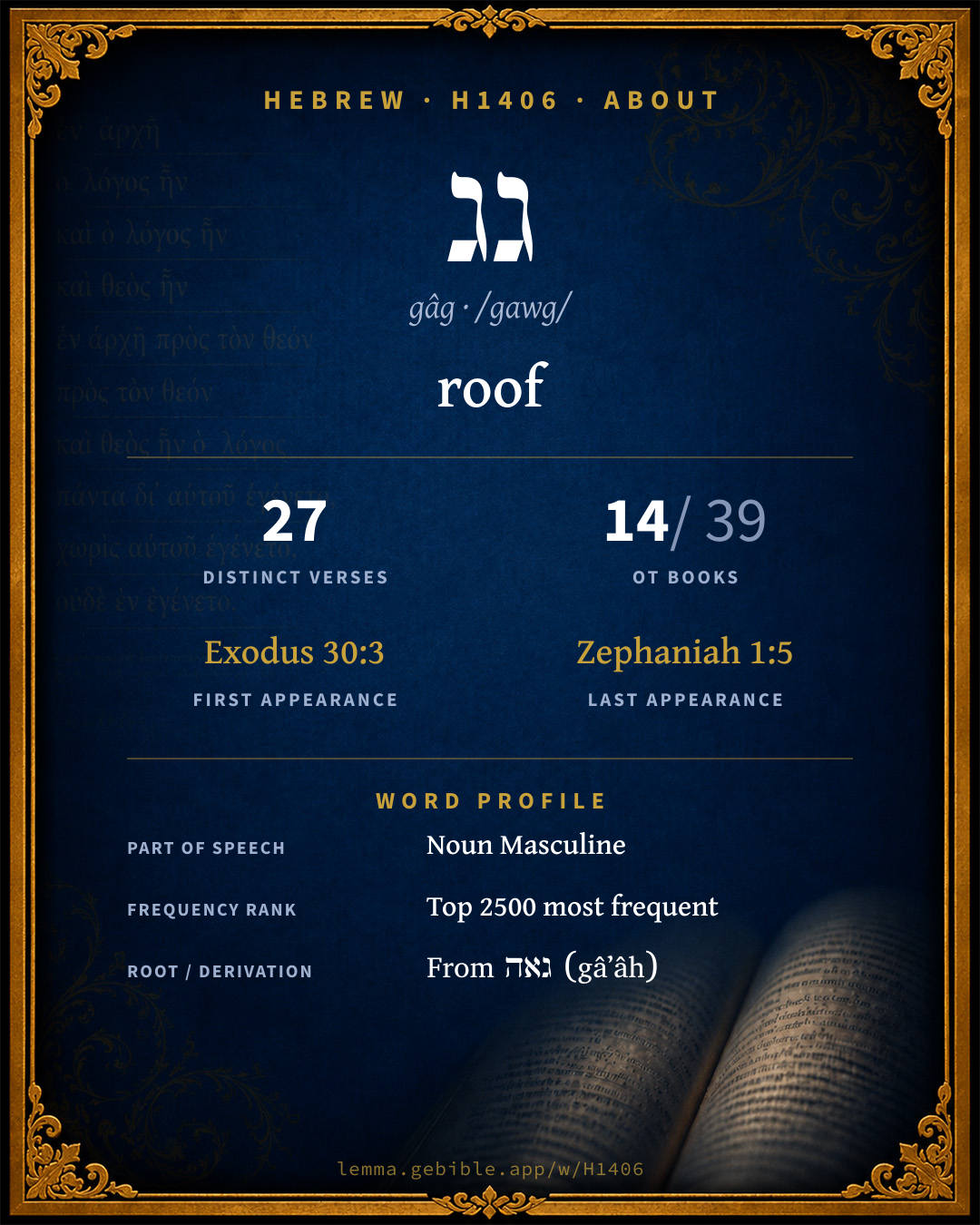
גָּג
roof
also: top, housetop fuller range ↓
Full lexicon entry — Brown-Driver-Briggs (BDB)
From Brown-Driver-Briggs (BDB)
Where this word appears
See every Absolute-state word in the Hebrew Bible →
Grammar key — what these labels mean
Part of speech
- Noun
- A naming word — a person, place, thing, or idea.
Noun type
- Common
- A common noun — a general class of person, place, or thing (“king,” “city,” “water”), not a specific name.
State
- Absolute
- The independent form of a noun, not bound to a following word.
- Construct
- A noun bound to a following noun in a possessive / “of” relationship (the construct chain).
Gender
- Masculine
- Grammatically masculine.
Number
- Singular
- One.
- Plural
- More than one (in Hebrew, generally three or more).
Grammatical forms
- Noun, Common, Masculine, Singular, Absolute 13 times (42%)
- Noun, Common, Masculine, Singular, Construct 9 times (29%)
- Noun, Common, Masculine, Plural, Absolute 5 times (16%)
- Noun, Common, Masculine, Plural, Construct 4 times (13%)
Parsed forms decoded from the imported morphology (morphhb / Westminster Leningrad Codex — WLC text public domain, morphhb tagging CC BY 4.0), counted across 31 parsed occurrences — not distinct verses.
Every verse where H1406 appears — 27 distinct verses across 14 books. Click any verse to open its interlinear word-by-word view. Verse text shown in the World English Bible for context — . Each verse’s Hebrew form is shown with its reference; the English is not keyword-highlighted, since the data carries no word-level English alignment. Use “Compare translations” on any verse to read it across multiple English versions. This concordance covers the Hebrew Bible; Septuagint (Greek Old Testament) occurrences are not indexed here.
Exodus 2 verses
- Exodus 30:3 גַּגּ֧/וֹ n c ms cs + sfx pers 3ms You shall overlay it with pure gold, the top of it, the sides of it around it, and its horns; and you shall make a gold molding around it.
- Exodus 37:26 גַּגּ֧/וֹ n c ms cs + sfx pers 3ms He overlaid it with pure gold, its top, its sides around it, and its horns. He made a gold molding around it.
Deuteronomy 1 verse
Joshua 2 verses
- Joshua 2:6 הַ/גָּ֑גָ/ה הַ/גָּֽג ptcl def.art + n c ms + sfx dem ptcl def.art + n c ms But she had brought them up to the roof, and hid them with the stalks of flax, which she had laid in order on the roof.
- Joshua 2:8 הַ/גָּֽג ptcl def.art + n c ms Before they were laid down, she came up to them on the roof;
Judges 2 verses
- Judges 9:51 גַּ֥ג n c ms cs But there was a strong tower within the city, and there fled all the men and women, and all they of the city, and shut themselves in, and got them up to the roof of the tower.
- Judges 16:27 הַ/גָּ֗ג ptcl def.art + n c ms Now the house was full of men and women; and all the lords of the Philistines were there; and there were on the roof about three thousand men and women, who saw while Samson made sport.
1 Samuel 2 verses
- 1 Samuel 9:25 הַ/גָּֽג ptcl def.art + n c ms When they were come down from the high place into the city, he talked with Saul on the housetop.
- 1 Samuel 9:26 ה/גג הַ/גָּ֣גָ/ה ptcl def.art + n c ms ptcl def.art + n c ms + sfx dem They arose early: and it happened about the spring of the day, that Samuel called to Saul on the housetop, saying, Up, that I may send you away. Saul arose, and they went out both of them, he and Samuel, abroad.
2 Samuel 3 verses
- 2 Samuel 11:2 גַּ֣ג הַ/גָּ֑ג n c ms cs ptcl def.art + n c ms It happened at evening, that David arose from off his bed, and walked on the roof of the king's house: and from the roof he saw a woman bathing; and the woman was very beautiful to look on.
- 2 Samuel 16:22 הַ/גָּ֑ג ptcl def.art + n c ms So they spread Absalom a tent on the top of the house; and Absalom went in to his father's concubines in the sight of all Israel.
- 2 Samuel 18:24 גַּ֤ג n c ms cs Now David was sitting between the two gates: and the watchman went up to the roof of the gate to the wall, and lifted up his eyes, and looked, and, behold, a man running alone.
2 Kings 2 verses
- 2 Kings 19:26 גַּגּ֔וֹת n c mp Therefore their inhabitants were of small power, they were dismayed and confounded; they were as the grass of the field, and as the green herb, as the grass on the housetops, and as grain blasted before it is grown up.
- 2 Kings 23:12 הַ/גָּג֩ ptcl def.art + n c ms The altars that were on the roof of the upper chamber of Ahaz, which the kings of Judah had made, and the altars which Manasseh had made in the two courts of the house of Yahweh, did the king break down, and beat [them] down from there, and cast the dust of them into the brook Kidron.
Nehemiah 1 verse
Psalms 2 verses
Proverbs 2 verses
Isaiah 3 verses
- Isaiah 15:3 גַּגּוֹתֶ֧י/הָ n c mp cs + sfx pers 3fs In their streets they gird themselves with sackcloth; on their housetops, and in their broad places, everyone wails, weeping abundantly.
- Isaiah 22:1 לַ/גַּגּֽוֹת prep det + n c mp The burden of the valley of vision. What ails you now, that you are wholly gone up to the housetops?
- Isaiah 37:27 גַּגּ֔וֹת n c mp Therefore their inhabitants were of small power, they were dismayed and confounded; they were as the grass of the field, and as the green herb, as the grass on the housetops, and as a field [of grain] before it is grown up.
Jeremiah 3 verses
- Jeremiah 19:13 גַּגֹּֽתֵי/הֶם֙ n c mp cs + sfx pers 3mp and the houses of Jerusalem, and the houses of the kings of Judah, which are defiled, shall be as the place of Topheth, even all the houses on whose roofs they have burned incense to all the host of the sky, and have poured out drink-offerings to other gods.
- Jeremiah 32:29 גַּגּֽוֹתֵי/הֶ֜ם n c mp cs + sfx pers 3mp and the Chaldeans, who fight against this city, shall come and set this city on fire, and burn it, with the houses, on whose roofs they have offered incense to Baal, and poured out drink-offerings to other gods, to provoke me to anger.
- Jeremiah 48:38 גַּגּ֥וֹת n c mp cs On all the housetops of Moab and in the streets of it there is lamentation every where; for I have broken Moab like a vessel in which none delights, says Yahweh.
Ezekiel 1 verse
Zephaniah 1 verse
About this entry
At a glance — auto-summarized from this page’s data, not written by a person. Every figure links to its source below. This summary describes the numbers; it doesn’t interpret them.
At its core, גג (gâg) means “roof.” Scripture first uses it in Exodus 30:3. It appears 27 verses across 14 books of the Hebrew Bible, among its moderately common vocabulary. Beyond its headline sense, its full sense range takes in “top” and “housetop”. It clusters with גאה, גאה and גאה under a shared root. Each statement above links to its evidence; the full detail follows below.
Gloss history
Strong's 1890 vs modern scholarship
About this word
Strong's H1406 catalogs a Hebrew word from the Hebrew Old Testament.
These counts are not copied from any lexicon or concordance. They are computed here, from the morphology-tagged Hebrew Old Testament. What Lemma adds →
- 27
- distinct verses
- The word appears in 27 distinct verses.
- 14 / 39
- OT books
- The word appears in 14 of 39 Old Testament books.
- #1,120
- by frequency
- Top 2500 most frequent Hebrew words (rank 1,120 of 8,640 Hebrew words by occurrence).
View all 27 occurrences in the concordance →
By section of the Old Testament
By traditional corpus
Conventional, traditional groupings — biblical authorship is debated, so this is a traditional corpus grouping, not an authorship claim. Each share is this word’s portion of its verses in that division of the Hebrew canon. Each figure is a share of the word’s 27 distinct verses.
- Prophets (Nevi'im) 19 verses · 70%
- Writings (Ketuvim) 5 verses · 19%
- Torah (Pentateuch) 3 verses · 11%
How translations render this word
Counts come from each version’s own published word-to-Strong’s tagging or interlinear alignment — an approximate guide to how each version renders this word, not a word-level alignment the data otherwise carries. Because each total is that version’s own tagged count, the per-version totals vary from one another and need not match the appearance or distinct-verse counts above. These counts may also differ from a printed concordance because Lemma counts each distinctly tagged rendering and does not collapse phrase taggings into a single head-word total. This is a fixed set of word-tagged versions (KJV, ASV, BSB, ULT) and does not change with the reading translation you choose elsewhere. Each version’s license is shown beside its name below (and on Sources).
- King James Version: Roof 9×, Housetops 5×, Top of the house 3×
- American Standard Version: Roof 9×, Housetops 6×, Housetop 4×
- Berean Standard Bible: Roof 14×, Rooftops 10×, Top 2×
- unfoldingWord Literal Text: Roof 15×, Housetops 3×, Roof of 3×
King James Version Public Domain
Renders H1406 across 30 tagged occurrences — most commonly:
Plus 7 renderings that appear only once — usually multi-word phrases or single function words the recovered tagging swept in, not distinct renderings.
American Standard Version Public Domain
Renders H1406 across 30 tagged occurrences — most commonly:
Plus 9 renderings that appear only once — usually multi-word phrases or single function words the recovered tagging swept in, not distinct renderings.
Berean Standard Bible Public Domain
Renders H1406 across 29 tagged occurrences — most commonly:
Plus 3 renderings that appear only once — usually multi-word phrases or single function words the recovered tagging swept in, not distinct renderings. Not rendered by a distinct English word in 1 further occurrence.
unfoldingWord Literal Text CC BY-SA 4.0
Renders H1406 across 28 tagged occurrences — most commonly:
Plus 2 renderings that appear only once — usually multi-word phrases or single function words the recovered tagging swept in, not distinct renderings.
Senses in the full BDB
What do BDB’s symbols mean?
BDB uses these scholarly abbreviations:
| Symbol | Meaning |
|---|---|
| 𝔊 | the Septuagint (the ancient Greek translation, LXX) |
| 𝔙 | the Vulgate (the Latin translation) |
| 𝔖 | the Syriac version (the Peshitta) |
| 𝔗 | the Targum (the Aramaic translation) |
| ψ | the Psalms |
| √ | root (the underlying root or stem) |
| ‖ | parallel passage (a synonymous or contrasted parallel) |
| † | the dagger: every passage where the word occurs is cited |
The 2 senses and sub-senses the full Brown-Driver-Briggs lexicon distinguishes for this word, in lexicon order (not ranked by frequency), with BDB’s own verbatim wording and sub-sense lettering. Shown in Hebrew script with BDB’s own scholarly abbreviations. The condensed entry is in the Lexicon Entry tab. See also the Forms in the corpus table below.
- 1. roof (of house) Dt 22:8 Jos 2:6(×2), 8 Ju 16:27 1 S 9:25, 26 2 S 11:2(×2); 16:22 2 K 19:26 = Is 37:27, Ne 8:16 ψ 102:8; 129:6 Pr 21:9; 25:24 Is 15:3; 22:1 Je 48:38; as places of idolatrous worship (especially of heavenly bodies) Je 19:13; 32:29 Zp 1:5; so הַגָּג עֲלִיַּת אָחָז 2 K 23:12, roof of tower Ju 9:51, over gate 2 S 18:24, of chamber Ez 40:13(×2) (but 𝔊 Co קיר). e.g. Deuteronomy 22:8
- 2. top of altar of incense, in tabern. Ex 30:3; 37:26 (both P). e.g. Exodus 30:3
Senses from the full Brown-Driver-Briggs lexicon (Brown, Driver, Briggs; Oxford 1906 — public domain), digitized via Sefaria, supplemented by the OpenScriptures HebrewLexicon (CC BY 4.0). Full attribution on Sources.
Word origin
n.m. roof, top (NH id.; Di comp. Ethiopic ጋግ, ጋጋ vinculum (ferreum), jugo simil. collare ferreum; √ dub.; Thes proposes גנג; perhaps גנג (= גנגן) cover Bö§ 292 Sta§ 189 a MV)—גָּג Jos 2:6 + 9 times + 1 S 9:26 Kt (Qr גָּ֫גָה), גָּ֫גָה Jos 2:6 1 S 9:26 Qr (Kt גג); cstr. Ju 9:51 + 2 times + Ez 40:13 (del. Co v. infr.); sf. גַּגֶּ֑ךָ Dt 22:8, גַּגּוֹ Ex 30:3 + 2 times + Ez 40:13 (del. Co v. infr.); pl. גַּגּוֹת Is 37:27 + 5 times; sf. גַּגּוֹתֶיהָ Is 15:3, גַּגּוֹתֵיהֶם Je 32:29, גַּגֹּתֵיהֶם Je 19:13;—
— Brown-Driver-Briggs (Oxford 1906, public domain), digitized via Sefaria, supplemented by the OpenScriptures HebrewLexicon (CC BY 4.0). See Sources.
Derived from גאה (gâʼâh) (H1342) — to rise up.
Jastrow Dictionary
A second Hebrew/Aramaic lexicon for comparison, covering Aramaic and post-biblical (Talmudic, Targumic, Midrashic) usage that the biblical-Hebrew BDB does not. Matched by lemma rather than by Strong’s number, so a lemma may carry more than one Jastrow headword (shown separately below), and the entries cover usage well beyond the Bible.
גַּג
- (b. h.)
- 1. roof. Midd. V, 3. Pes. 13ᵇ, v. אִיסְטְבָא; a. v. fr.—Yoma 47ᵃ עלה לגג excelled all, v. זֶרֶד.
- 2. in gen. upper portion, top, apex. Y. Yeb. VIII, 9ᵃ רוב גַּגָּהּ של עטרה the largest portion of the top of the membral corona, contrad. to רוב גֹּובְהָהּ, v. גֹּובַהּ; Y. Sabb. XIX, end, 17ᵇ רוב גוב׳ אטרה (corr. acc.).—Ḥull. 67ᵇ ג׳ תמרה the outer covering of a date.—Pl. גַּגֹּות. Erub. IX, 1; a. fr.—Men. X, 2 (64ᵇ), v. צְרִיפִין.
A Dictionary of the Targumim, the Talmud Babli and Yerushalmi, and the Midrashic Literature (Marcus Jastrow; London, Luzac, 1903) — Public Domain. Digitized via Sefaria. Digitized via Sefaria. Full attribution on Sources.
Forms in the corpus
The 25 distinct written forms H1406 takes in the Hebrew Bible, most frequent first — each parse links to that state’s occurrences in the concordance. Hebrew forms include their vowel points and cantillation, so a single lemma takes many written forms.
Same root — word family
Other BDB entries built from the same root as H1406, grouped by Strong’s listed origin. These share a root / origin per the lexicon — not necessarily a shared meaning. Each links to that word’s own entry.
Derives from
Shares the same root
- גאה gêʼeh H1343 proud
- גאה gêʼâh H1344 pride
- גאוה gaʼăvâh H1346 pride
- גאון gâʼôwn H1347 majesty
- גאות gêʼûwth H1348 majesty
- גאיון gaʼăyôwn H1349 proud
- גו gêv H1460 back
Proper names from this root
People and places named from this root — a name, not an additional meaning of the word.
Compare all same-root words → Showing 4 of 10 — not the complete family. 1 of the same-root words is a proper name (a person or place). They share a root, not necessarily a meaning.
Septuagint verse parallels
This word appears in 23 verses that also exist in the Greek Old Testament (Septuagint), out of the 27 Hebrew verses it occurs in. You can read those verses in Greek by switching the Old Testament edition to the Septuagint.
Read these verses in the Septuagint
- Exodus 30:3
- Deuteronomy 22:8
- Joshua 2:6
- Judges 9:51
- 1 Samuel 9:25
- 2 Samuel 11:2
- 2 Kings 19:26
- Psalms 102:7
- Proverbs 21:9
- Isaiah 15:3
- Jeremiah 19:13
- Ezekiel 40:13
This is a verse-level parallel only — the same verses exist in both the Hebrew and Greek Old Testaments. No word-level Hebrew↔Greek correspondence is claimed: the data carries no such alignment, so no Greek word is shown as this Hebrew word’s translation. Coverage is not total — the Septuagint omits the deuterocanon and renumbers the Psalms, so some Hebrew verses have no direct Greek parallel.