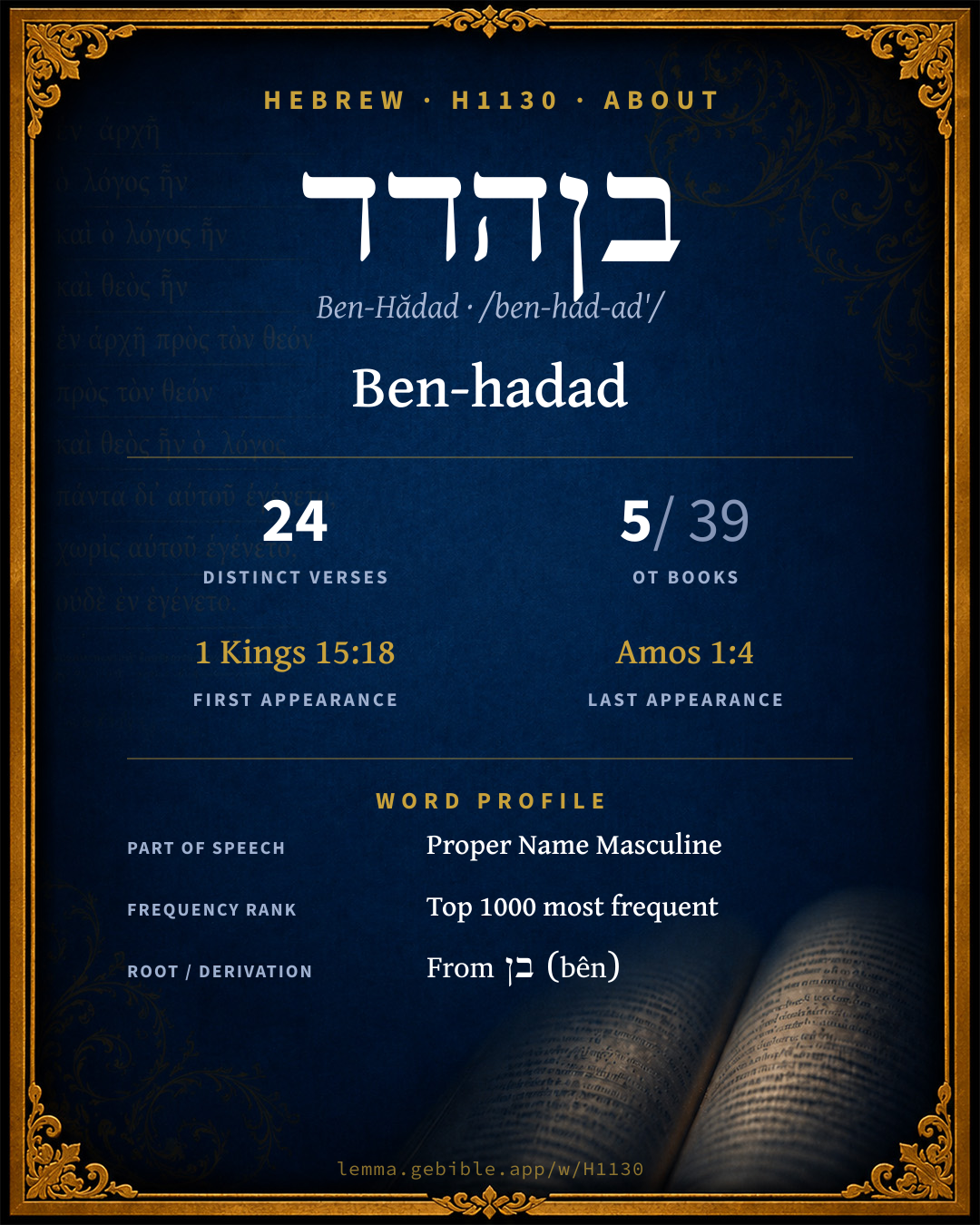
בֶּן־הֲדַד
Ben-hadad
BDB lists 3 entries for ‘Ben-hadad’ fuller range ↓
Full lexicon entry — Brown-Driver-Briggs (BDB)
From Brown-Driver-Briggs (BDB)
Where this word appears
Grammar key — what these labels mean
Part of speech
- Noun
- A naming word — a person, place, thing, or idea.
Noun type
- Proper
- A name of a specific person, place, or people (e.g. Abraham, Zion, Israel).
Every verse where H1130 appears — 24 distinct verses across 5 books. Click any verse to open its interlinear word-by-word view. Verse text shown in the World English Bible for context — . Each verse’s Hebrew form is shown with its reference; the English is not keyword-highlighted, since the data carries no word-level English alignment. Use “Compare translations” on any verse to read it across multiple English versions. This concordance covers the Hebrew Bible; Septuagint (Greek Old Testament) occurrences are not indexed here.
1 Kings 14 verses
- 1 Kings 15:18 בֶּן הֲ֠דַד n Proper n Proper Then Asa took all the silver and the gold that were left in the treasures of the house of Yahweh, and the treasures of the king's house, and delivered them into the hand of his servants; and king Asa sent them to Ben Hadad, the son of Tabrimmon, the son of Hezion, king of Syria, who lived at Damascus, saying,
- 1 Kings 15:20 בֶּן הֲדַ֜ד n Proper n Proper Ben Hadad listened to king Asa, and sent the captains of his armies against the cities of Israel, and struck Ijon, and Dan, and Abel Beth Maacah, and all Chinneroth, with all the land of Naphtali.
- 1 Kings 20:1 וּ/בֶן הֲדַ֣ד conj + n Proper n Proper Ben Hadad the king of Syria gathered all his host together; and there were thirty-two kings with him, and horses and chariots: and he went up and besieged Samaria, and fought against it.
- 1 Kings 20:2 בֶּן הֲדַ֔ד n Proper n Proper He sent messengers to Ahab king of Israel, into the city, and said to him, Thus says Ben Hadad,
- 1 Kings 20:5 בֶּן הֲדַ֖ד n Proper n Proper The messengers came again, and said, Thus speaks Ben Hadad, saying, I sent indeed to you, saying, You shall deliver me your silver, and your gold, and your wives, and your children;
- 1 Kings 20:9 בֶן הֲדַ֗ד n Proper n Proper Therefore he said to the messengers of Ben Hadad, Tell my lord the king, All that you did send for to your servant at the first I will do; but this thing I may not do. The messengers departed, and brought him word again.
- 1 Kings 20:10 בֶּן הֲדַ֔ד n Proper n Proper Ben Hadad sent to him, and said, The gods do so to me, and more also, if the dust of Samaria shall suffice for handfuls for all the people who follow me.
- 1 Kings 20:16 וּ/בֶן הֲדַד֩ conj + n Proper n Proper They went out at noon. But Ben Hadad was drinking himself drunk in the pavilions, he and the kings, the thirty-two kings who helped him.
- 1 Kings 20:17 בֶּן הֲדַ֗ד n Proper n Proper The young men of the princes of the provinces went out first; and Ben Hadad sent out, and they told him, saying, There are men come out from Samaria.
- 1 Kings 20:20 בֶּן הֲדַד֙ n Proper n Proper They killed everyone his man; and the Syrians fled, and Israel pursued them: and Ben Hadad the king of Syria escaped on a horse with horsemen.
- 1 Kings 20:26 בֶּן הֲדַ֖ד n Proper n Proper It happened at the return of the year, that Ben Hadad mustered the Syrians, and went up to Aphek, to fight against Israel.
- 1 Kings 20:30 וּ/בֶן הֲדַ֣ד conj + n Proper n Proper But the rest fled to Aphek, into the city; and the wall fell on twenty-seven thousand men who were left. Ben Hadad fled, and came into the city, into an inner chamber.
- 1 Kings 20:32 בֶן הֲדַ֛ד n Proper n Proper So they girded sackcloth on their loins, and [put] ropes on their heads, and came to the king of Israel, and said, Your servant Ben Hadad says, please let me live. He said, Is he yet alive? he is my brother.
- 1 Kings 20:33 בֶן הֲדַ֔ד בֶּן הֲדַ֔ד n Proper n Proper n Proper n Proper Now the men observed diligently, and hurried to catch whether it were his mind; and they said, Your brother Ben Hadad. Then he said, Go you, bring him. Then Ben Hadad came forth to him; and he caused him to come up into the chariot.
2 Kings 6 verses
- 2 Kings 6:24 בֶּן הֲדַ֥ד n Proper n Proper It happened after this, that Benhadad king of Syria gathered all his host, and went up, and besieged Samaria.
- 2 Kings 8:7 וּ/בֶן הֲדַ֥ד conj + n Proper n Proper Elisha came to Damascus; and Benhadad the king of Syria was sick; and it was told him, saying, The man of God is come here.
- 2 Kings 8:9 בֶן הֲדַ֤ד n Proper n Proper So Hazael went to meet him, and took a present with him, even of every good thing of Damascus, forty camels' burden, and came and stood before him, and said, Your son Benhadad king of Syria has sent me to you, saying, Shall I recover of this sickness?
- 2 Kings 13:3 בֶּן הֲדַ֥ד n Proper n Proper The anger of Yahweh was kindled against Israel, and he delivered them into the hand of Hazael king of Syria, and into the hand of Benhadad the son of Hazael, continually.
- 2 Kings 13:24 בֶּן הֲדַ֥ד n Proper n Proper Hazael king of Syria died; and Benhadad his son reigned in his place.
- 2 Kings 13:25 בֶּן הֲדַ֣ד n Proper n Proper Jehoash the son of Jehoahaz took again out of the hand of Benhadad the son of Hazael the cities which he had taken out of the hand of Jehoahaz his father by war. Three times did Joash strike him, and recovered the cities of Israel.
2 Chronicles 2 verses
- 2 Chronicles 16:2 בֶּן הֲדַד֙ n Proper n Proper Then Asa brought out silver and gold out of the treasures of the house of Yahweh and of the king's house, and sent to Ben Hadad king of Syria, who lived at Damascus, saying,
- 2 Chronicles 16:4 בֶּן הֲדַ֜ד n Proper n Proper Ben Hadad listened to king Asa, and sent the captains of his armies against the cities of Israel; and they struck Ijon, and Dan, and Abel Maim, and all the store-cities of Naphtali.
Jeremiah 1 verse
Amos 1 verse
About this entry
At a glance — auto-summarized from this page’s data, not written by a person. Every figure links to its source below. This summary describes the numbers; it doesn’t interpret them.
The Hebrew name בןהדד centers on the idea of “Ben-hadad.” The word gravitates to 1 Kings (58%), then 2 Kings and 2 Chronicles. It appears 24 verses across 5 books of the Hebrew Bible, among its uncommon vocabulary. Debuting at 1 Kings 15:18, it then recurs through the corpus. For the data behind this summary, explore 24-verse concordance and the renderings breakdown below.
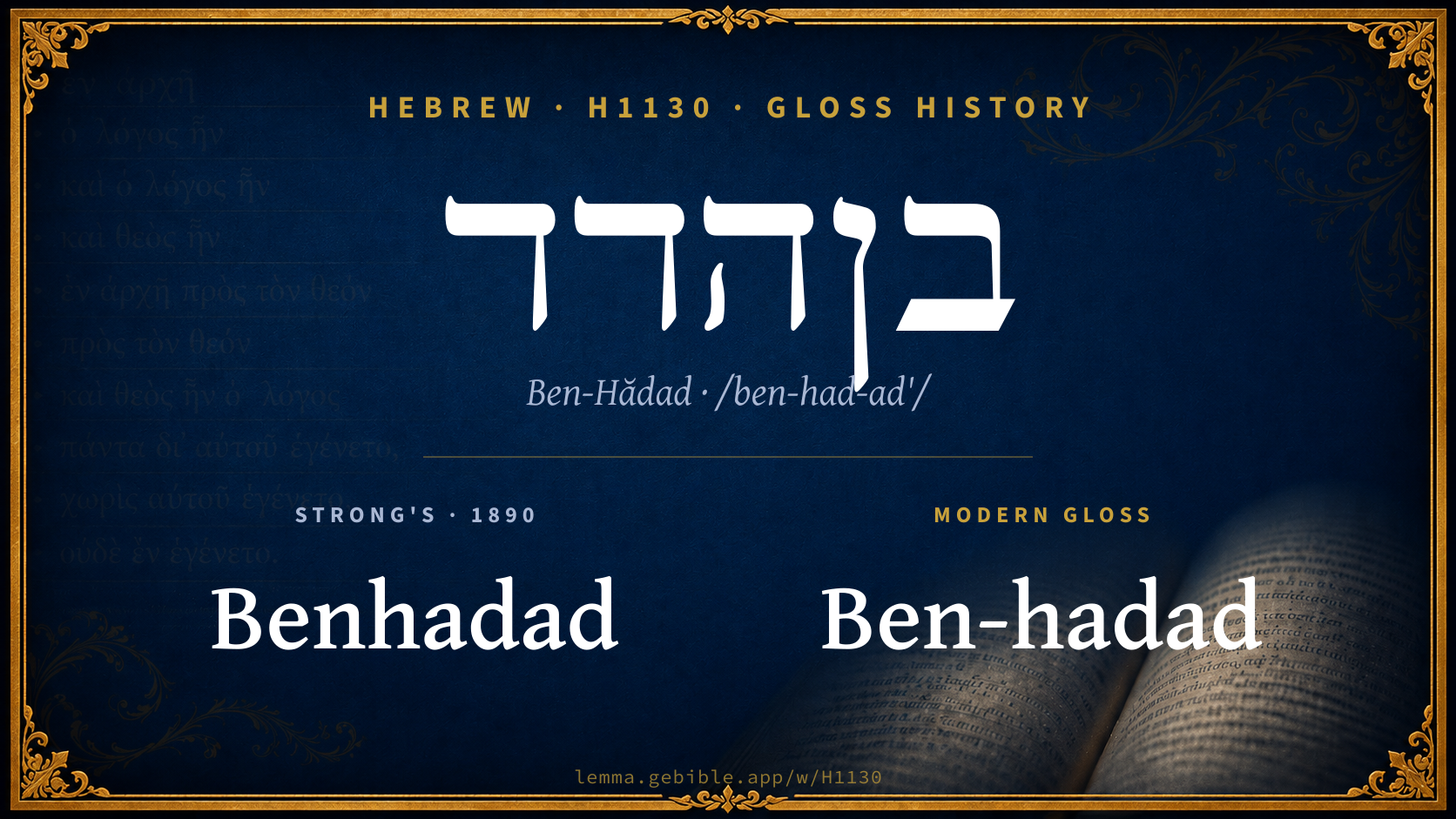
Gloss history
Strong's 1890 vs modern scholarship
About this word
Strong's H1130 catalogs a Hebrew word from the Hebrew Old Testament.
These counts are not copied from any lexicon or concordance. They are computed here, from the morphology-tagged Hebrew Old Testament. What Lemma adds →
- 24
- distinct verses
- The word appears in 24 distinct verses.
- 5 / 39
- OT books
- The word appears in 5 of 39 Old Testament books.
- #739
- by frequency
- Top 1000 most frequent Hebrew words (rank 739 of 8,640 Hebrew words by occurrence).
View all 24 occurrences in the concordance →
Most concentrated in
- 1 Kings 14 verses 58%
- 2 Kings 6 verses 25%
- 2 Chronicles 2 verses 8%
By section of the Old Testament
By traditional corpus
Conventional, traditional groupings — biblical authorship is debated, so this is a traditional corpus grouping, not an authorship claim. Each share is this word’s portion of its verses in that division of the Hebrew canon. Each figure is a share of the word’s 24 distinct verses.
- Prophets (Nevi'im) 22 verses · 92%
- Writings (Ketuvim) 2 verses · 8%
How translations render this word
Counts come from each version’s own published word-to-Strong’s tagging or interlinear alignment — an approximate guide to how each version renders this word, not a word-level alignment the data otherwise carries. Because each total is that version’s own tagged count, the per-version totals vary from one another and need not match the appearance or distinct-verse counts above. These counts may also differ from a printed concordance because Lemma counts each distinctly tagged rendering and does not collapse phrase taggings into a single head-word total. This is a fixed set of word-tagged versions (KJV, ASV, BSB, ULT) and does not change with the reading translation you choose elsewhere. Each version’s license is shown beside its name below (and on Sources).
- King James Version: Benhadad 25×
- American Standard Version: Ben-hadad 16×, Benhadad 6×
- Berean Standard Bible: Ben-hadad 23×, Now ben-hadad 2×
- unfoldingWord Literal Text: Hadad 21×, Ben 19×, Ben hadad 4×
King James Version Public Domain
Renders H1130 across 25 tagged occurrences — most commonly:
American Standard Version Public Domain
Renders H1130 across 25 tagged occurrences — most commonly:
Plus 3 renderings that appear only once — usually multi-word phrases or single function words the recovered tagging swept in, not distinct renderings.
Berean Standard Bible Public Domain
Renders H1130 across 26 tagged occurrences — most commonly:
Plus 1 rendering that appears only once — usually multi-word phrases or single function words the recovered tagging swept in, not distinct renderings. Not rendered by a distinct English word in 6 further occurrences.
unfoldingWord Literal Text CC BY-SA 4.0
Renders H1130 across 48 tagged occurrences — most commonly:
Senses in the full BDB
What do BDB’s symbols mean?
BDB uses these scholarly abbreviations:
| Symbol | Meaning |
|---|---|
| 𝔊 | the Septuagint (the ancient Greek translation, LXX) |
| 𝔙 | the Vulgate (the Latin translation) |
| 𝔖 | the Syriac version (the Peshitta) |
| 𝔗 | the Targum (the Aramaic translation) |
| ψ | the Psalms |
| √ | root (the underlying root or stem) |
| ‖ | parallel passage (a synonymous or contrasted parallel) |
| † | the dagger: every passage where the word occurs is cited |
The 3 senses and sub-senses the full Brown-Driver-Briggs lexicon distinguishes for this word, in lexicon order (not ranked by frequency), with BDB’s own verbatim wording and sub-sense lettering. Shown in Hebrew script with BDB’s own scholarly abbreviations. The condensed entry is in the Lexicon Entry tab. See also the Forms in the corpus table below.
- 1. time of Asa & Baasha 1 K 15:18, 20 = 2 Ch 16:2, 4. e.g. 1 Kings 15:18
- 2. son of 1. (cf. 1 K 20:34) Assyrian Dad-idri COT (Bir-idri Dll.c.) 1 K 20:1, 3, 5, 9, 10, 16, 17, 20, 26, 30, 32, 33(×2) 2 K 6:24; 8:7, 9. e.g. 1 Kings 20:34
- 3. son of Hazael 2 K 13:3, 24, 25 cf. Am 1:4.—Vid. הדד. e.g. 2 Kings 13:3
Senses from the full Brown-Driver-Briggs lexicon (Brown, Driver, Briggs; Oxford 1906 — public domain), digitized via Sefaria, supplemented by the OpenScriptures HebrewLexicon (CC BY 4.0). Full attribution on Sources.
Word origin
n.pr.m. (appar. son of (god) Hadad = Aramaic ܒܰܪ ܗܰܕܰܕ 𝔖 ܒܰܪ ܗܳܕܳܕ PS cf. BaeRel. 168; also Bab. Bin-addu-natan etc., PinchesPB Feb. 1883, 71; Assyrian Bir-Dadda COT 1 K 20:1 HptHbr 1885, 224, but cf. 𝔊 νἱὸς Ἄδερ, & DlZK ii. 1885, 161 f.; v. also SchrKG 375 ff. 538 f.) name for king of Aram Je 49:27; in partic.;—
— Brown-Driver-Briggs (Oxford 1906, public domain), digitized via Sefaria, supplemented by the OpenScriptures HebrewLexicon (CC BY 4.0). See Sources.
Derived from בן (bên) (H1121) — son.
Forms in the corpus
The 15 distinct written forms H1130 takes in the Hebrew Bible, most frequent first — each parse links to that state’s occurrences in the concordance. Hebrew forms include their vowel points and cantillation, so a single lemma takes many written forms.
| Form | Parsing | Example | Uses |
|---|---|---|---|
| בֶּן | Noun, Proper | Amos 1:4 | 17 |
| בֶן | Noun, Proper | 1 Kings 20:9 | 4 |
| הֲדַ֔ד | Noun, Proper | 1 Kings 20:2 | 4 |
| הֲדַ֥ד | Noun, Proper | 2 Kings 6:24 | 4 |
| וּ/בֶן | Noun, Proper | 1 Kings 20:1 | 4 |
| הֲדַ֣ד | Noun, Proper | 1 Kings 20:1 | 3 |
| הֲדַ֖ד | Noun, Proper | 1 Kings 20:5 | 2 |
| הֲדַ֗ד | Noun, Proper | 1 Kings 20:9 | 2 |
| הֲדַ֜ד | Noun, Proper | 1 Kings 15:20 | 2 |
| הֲדַד֙ | Noun, Proper | 1 Kings 20:20 | 2 |
| הֲדָֽד | Noun, Proper | Amos 1:4 | 2 |
| הֲ֠דַד | Noun, Proper | 1 Kings 15:18 | 1 |
| הֲדַ֛ד | Noun, Proper | 1 Kings 20:32 | 1 |
| הֲדַ֤ד | Noun, Proper | 2 Kings 8:9 | 1 |
| הֲדַד֩ | Noun, Proper | 1 Kings 20:16 | 1 |
Same root — word family
Other BDB entries built from the same root as H1130, grouped by Strong’s listed origin. These share a root / origin per the lexicon — not necessarily a shared meaning. Each links to that word’s own entry.
Derives from
Shares the same root
Proper names from this root
People and places named from this root — a name, not an additional meaning of the word.
- בן Bên H1122 Ben
- בןאבינדב Ben-ʼĂbîynâdâb H1125 Ben-Abinadab
- בןאוני Ben-ʼÔwnîy H1126 Ben-oni
- בןגבר Ben-Geber H1127 Ben-geber
- בןדקר Ben-Deqer H1128 Ben-dekar
- בןזוחת Ben-Zôwchêth H1132 Ben-zoheth
- בןחור Ben-Chûwr H1133 Ben-hur
- בןחיל Ben-Chayil H1134 Ben-hail
- בןחנן Ben-Chânân H1135 Ben-hanan
- בןחסד Ben-Cheçed H1136 Ben-hesed
- בניברק Bᵉnêy-Bᵉraq H1139 Bene-barak
- בני יעקן Bᵉnêy Yaʻăqân H1142 Bene-jaakan
- בנימין Binyâmîyn H1144 Benjamin
- בנינו Bᵉnîynûw H1148 Beninu
- בןעמי Ben-ʻAmmîy H1151 Ben-ami
Compare all same-root words → Showing 4 of 19 — not the complete family. 15 of the same-root words are proper names (people or places). They share a root, not necessarily a meaning.
Bible dictionary
Public-domain dictionary articles matched to this entry by name (Ben-hadad). A biblical name can be shared by more than one person or place, so an article may treat several.
Easton's Bible Dictionary · M. G. Easton, 1897
The standing title of the Syrian kings, meaning "the son of Hadad." (See HADADEZER.)
(1.) The king of Syria whom Asa, king of Judah, employed to invade Israel (1 Kings 15:18).
(2.) Son of the preceding, also king of Syria. He was long engaged in war against Israel. He was murdered probably by Hazael, by whom he was succeeded (2 Kings 8:7-15), after a reign of some thirty years.
(3.) King of Damascus, and successor of his father Hazael on the throne of Syria (2 Kings 13:3, 4). His misfortunes in war are noticed by Amos (1:4).
Smith's Bible Dictionary · William Smith, 1863
(son of Hadad), the name of three kings of Damascus. BENHADAD I., King of Damascus, which in his time was supreme in Syria. He made an alliance with Asa, and conquered a great part of the north of Israel. (1 Kings 15:18) His date is B.C. 950. BEN-HADAD II., son of the preceding, and also king of Damascus. Long wars with Israel characterized his reign. Some time after the death of Ahab, Benhadad renewed the war with Israel, attacked Samaria a second time, and pressed the siege so closely that there was a terrible famine in the city. But the Syrians broke up in the night in consequence of a sudden panic. Soon after Ben-hadad fell sick, and sent Hazael to consult Elisha as to the issue of his malady. On the day after Hazael's return Ben-hadad was murdered, probably by some of his own servants. (2 Kings 8:7-15) Ben-hadad's death was about B.C. 890, and he must have reigned some 30 years. BEN-HADAD III., son of Hazael, and his successor on the throne of Syria. When he succeeded to the throne, Jehoash recovered the cities which Jehoahaz had lost to the Syrians, and beat him in Aphek. (2 Kings 13:17,25) The date of Ben-hadad III is B.C. 840.
Hitchcock's Bible Names Dictionary · Roswell D. Hitchcock, 1869
son of Hadad, or noise
Classic public-domain reference works; full attribution on Sources.
Septuagint verse parallels
This word appears in 20 verses that also exist in the Greek Old Testament (Septuagint), out of the 24 Hebrew verses it occurs in. You can read those verses in Greek by switching the Old Testament edition to the Septuagint.
Read these verses in the Septuagint
This is a verse-level parallel only — the same verses exist in both the Hebrew and Greek Old Testaments. No word-level Hebrew↔Greek correspondence is claimed: the data carries no such alignment, so no Greek word is shown as this Hebrew word’s translation. Coverage is not total — the Septuagint omits the deuterocanon and renumbers the Psalms, so some Hebrew verses have no direct Greek parallel.