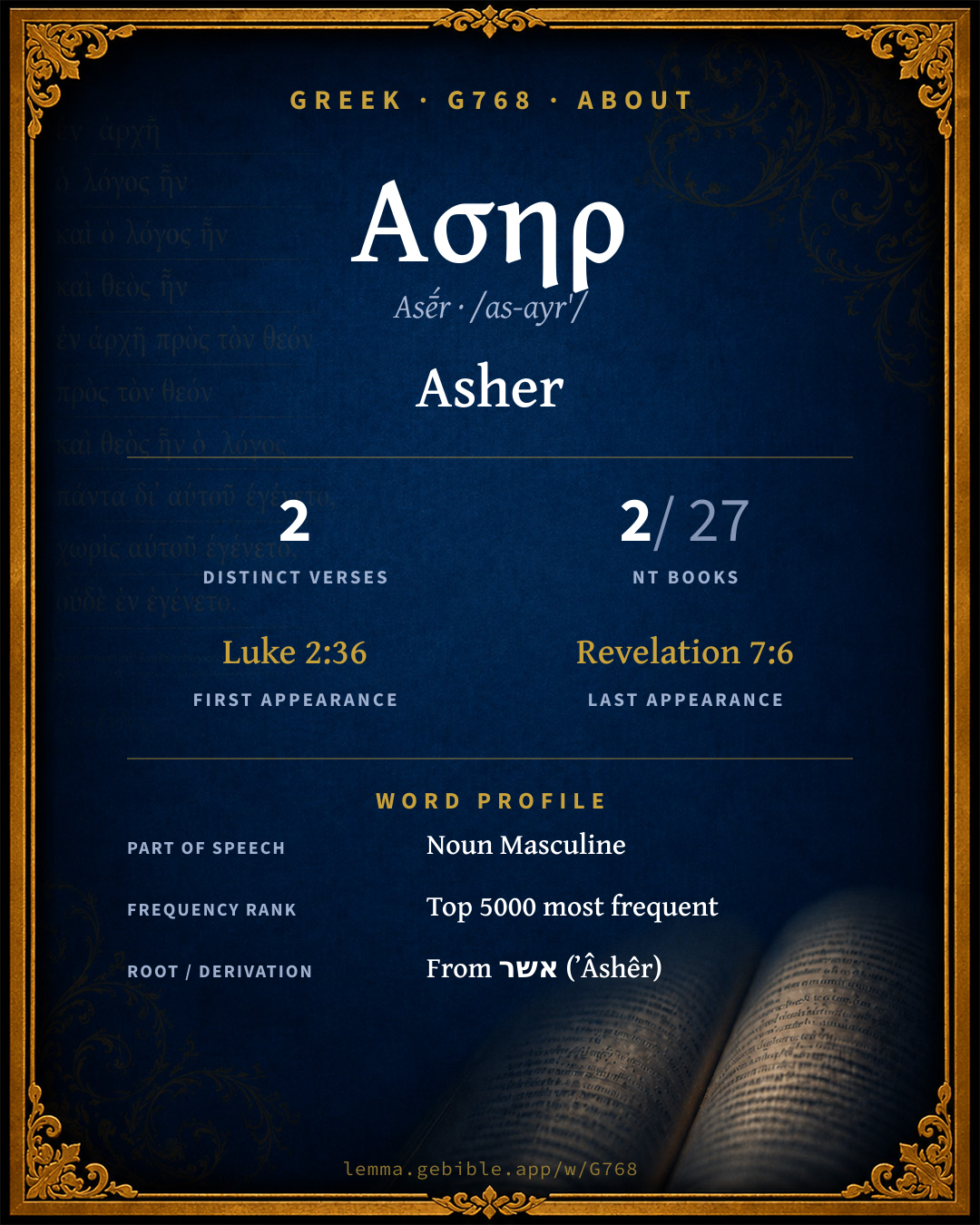
Ἀσήρ
Asher
Thayer's lists 2 entries for ‘Asher’ fuller range ↓
Full lexicon entry — Thayer's Greek Lexicon
From Thayer's Greek Lexicon
Where this word appears
Every verse where G768 appears — 2 distinct verses across 2 books. Click any verse to open its interlinear word-by-word view. Verse text shown in the World English Bible for context — . Each verse’s Greek form is shown with its reference; the English is not keyword-highlighted, since the data carries no word-level English alignment. Use “Compare translations” on any verse to read it across multiple English versions. This concordance covers the Greek New Testament; Septuagint (Greek Old Testament) occurrences of this word are not indexed here.
Luke 1 verse
Revelation 1 verse
About this entry
At a glance — auto-summarized from this page’s data, not written by a person. Every figure links to its source below. This summary describes the numbers; it doesn’t interpret them.
Ασηρ — transliterated Asḗr — is a Greek name carrying the sense “Asher.” With only 2 verses it sits in the long tail of Greek New Testament vocabulary. More than half of its appearances fall in Luke. Its earliest occurrence is Luke 2:36. The sections below give every occurrence and version rendering.
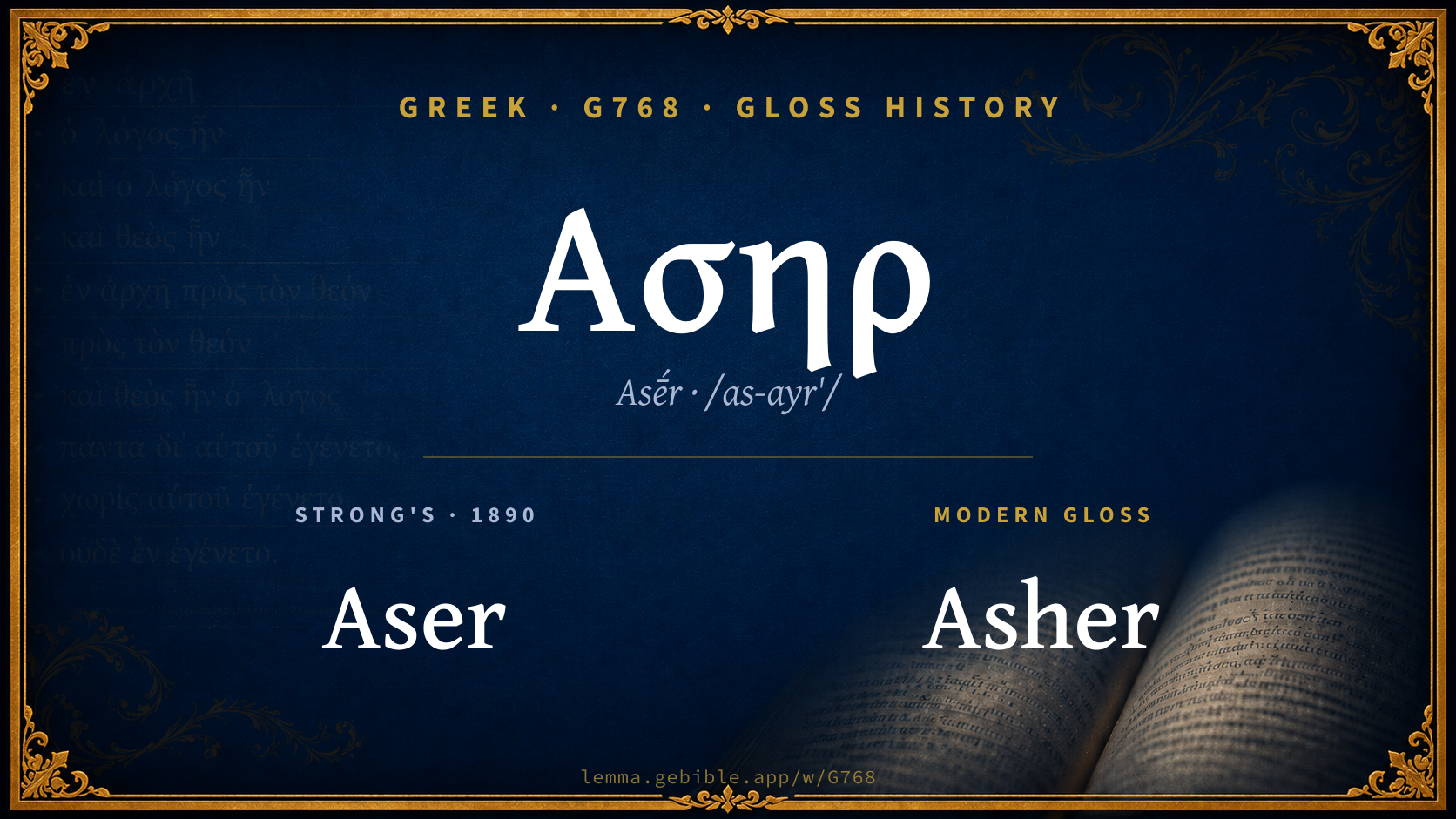
Gloss history
Strong's 1890 vs modern scholarship
About this word
Strong's G768 catalogs a Greek word from the Greek New Testament.
These counts are not copied from any lexicon or concordance. They are computed here, from the morphology-tagged Greek New Testament. What Lemma adds →
- 2
- distinct verses
- The word appears in 2 distinct verses.
- 2 / 27
- NT books
- The word appears in 2 of 27 New Testament books.
- #2,678
- by frequency
- Top 5000 most frequent Greek words (rank 2,678 of 5,347 Greek words by occurrence).
View all 2 occurrences in the concordance →
Most concentrated in
- Luke 1 verse 50%
- Revelation 1 verse 50%
By section of the New Testament
By traditional corpus
Conventional, traditional groupings — biblical authorship is debated, so this is a traditional corpus grouping, not an authorship claim. Some books belong to more than one corpus (Luke is in both the Gospels and the Lukan corpus, and so on), so these shares overlap and need not total 100%. Each figure is a share of the word’s 2 distinct verses.
- Gospels 1 verse · 50%
- Lukan (Luke–Acts) 1 verse · 50%
- Johannine 1 verse · 50%
- Revelation 1 verse · 50%
How translations render this word
Counts come from each version’s own published word-to-Strong’s tagging or interlinear alignment — an approximate guide to how each version renders this word, not a word-level alignment the data otherwise carries. Because each total is that version’s own tagged count, the per-version totals vary from one another and need not match the appearance or distinct-verse counts above. These counts may also differ from a printed concordance because Lemma counts each distinctly tagged rendering and does not collapse phrase taggings into a single head-word total. This is a fixed set of word-tagged versions (KJV, ASV, BSB, ULT) and does not change with the reading translation you choose elsewhere. Each version’s license is shown beside its name below (and on Sources).
- King James Version: Aser 2×
- American Standard Version: Asher 2×
- Berean Standard Bible: Asher 2×
- unfoldingWord Literal Text: Asher 2×
King James Version Public Domain
Renders G768 across 2 tagged occurrences — most commonly:
American Standard Version Public Domain
Renders G768 across 2 tagged occurrences — most commonly:
Berean Standard Bible Public Domain
Renders G768 across 2 tagged occurrences — most commonly:
unfoldingWord Literal Text CC BY-SA 4.0
Renders G768 across 2 tagged occurrences — most commonly:
Senses in Thayer's
The 2 senses Thayer's distinguishes for this word, in lexicon order (not ranked by frequency or importance). The full entry — with sub-senses — is in the Lexicon Entry tab.
- Asher = "blessed"
- the eighth son of Jacob
Word origin
Derived from אשר (ʼÂshêr) (H836) — Asher.
Of hebrew origin [ H836 ]; Aser (that is Asher ) an Israelite tribe : - Aser.
— Strong’s Exhaustive Concordance (1890), public domain.
Forms in the corpus
The 2 distinct written forms G768 takes in the Greek New Testament, most frequent first — each parse links to that case’s occurrences in the concordance.
| Form | Parsing | Example | Uses |
|---|---|---|---|
| Ἀσήρ Asḗr | Noun, Proper, indeclinable | Luke 2:36 | 1 |
| Ἀσὴρ Asḕr | Noun, Proper, indeclinable | Revelation 7:6 | 1 |
Same root — word family
Other Thayer's entries built from the same root as G768, grouped by Strong’s listed origin. These share a root / origin per the lexicon — not necessarily a shared meaning. Each links to that word’s own entry.
Derives from
Proper names from this root
People and places named from this root — a name, not an additional meaning of the word.
Compare all same-root words → 2 of the same-root words are proper names (people or places). They share a root, not necessarily a meaning.
Bible dictionary
Public-domain dictionary articles matched to this entry by name (Asher). A biblical name can be shared by more than one person or place, so an article may treat several.
Easton's Bible Dictionary · M. G. Easton, 1897
Happy, Jacob's eigth son; his mother was Zilpah, Leah's handmaid (Gen. 30:13). Of the tribe founded by him nothing is recorded beyond its holding a place in the list of the tribes (35:26; 46:17; Ex. 1:4, etc.) It increased in numbers twenty-nine percent, during the thirty-eight years' wanderings. The place of this tribe during the march through the desert was between Dan and Naphtali (Num. 2:27). The boundaries of the inheritance given to it, which contained some of the richest soil in Palestine, and the names of its towns, are recorded in Josh. 19:24-31; Judg. 1:31, 32. Asher and Simeon were the only tribes west of the Jordan which furnished no hero or judge for the nation. Anna the prophetess was of this tribe (Luke 2:36).
Smith's Bible Dictionary · William Smith, 1863
a place which formed one boundary of the tribe of Manasseh on the south. (Joshua 17:7) Mr. Porter suggests that Teyasir may be the Asher of Manasseh. Handbook, p.348.
Apocrypha and New Testament, A'ser (blessed), the eighth son of Jacob, by Zilpah, Leah's handmaid. (Genesis 30:13) (B.C. 1753.) The general position of his tribe was on the seashore from Carmel northward with Manasseh on the south, Zebulun and Issachar on the southeast, and Naphtali on the north-east. (Joshua 19:24-31; 17:10,11) and Judg 1:31,32 They possessed the maritime portion of the rich plain of Esdraelon;, probably for a distance of 8 or 10 miles from the shore. This territory contained some of the richest soil in all Palestine.
Hitchcock's Bible Names Dictionary · Roswell D. Hitchcock, 1869
happiness
Classic public-domain reference works; full attribution on Sources.
Septuagint usage
The same Greek word Ασηρ appears 42 times in the Greek Old Testament (Septuagint), across 40 verses in 9 books.
- 42
- LXX occurrences
- Tagged occurrences of this Greek word in the Septuagint.
- 40
- verses
- Distinct Septuagint verses containing this word.
- 9 / 39
- OT books
- The word appears in 9 of the 39 Old Testament books.
Sample Septuagint occurrences
- Genesis 30:13 ασηρ
- Exodus 1:4 ασηρ
- Numbers 1:13 ασηρ
- Deuteronomy 27:13 ασηρ
- Joshua 17:10 ασηρ
- Judges 1:31 ασηρ
- 1 Chronicles 2:2 ασηρ
- 2 Chronicles 30:11 ασηρ
- Ezekiel 48:2 ασηρ
Septuagint occurrences (same lexeme)
Every verse where the same Strong’s number (G768) appears in the Greek Septuagint. Verse text shown in the World English Bible for context; the Greek form is the matched word — the English is not keyword-highlighted.
- Genesis 30:13 ασηρ Leah said, "Happy am I, for the daughters will call me happy." She named him Asher.
- Genesis 35:26 ασηρ The sons of Zilpah (Leah's handmaid): Gad and Asher. These are the sons of Jacob, who were born to him in Paddan Aram.
- Genesis 46:17 ασηρ The sons of Asher: Imnah, Ishvah, Ishvi, Beriah, and Serah their sister. The sons of Beriah: Heber and Malchiel.
- Genesis 49:20 ασηρ Out of Asher his bread will be fat, He will yield royal dainties.
- Exodus 1:4 ασηρ Dan and Naphtali, Gad and Asher.
- Numbers 1:13 ασηρ Of Asher: Pagiel the son of Ochran.
- Numbers 1:40 ασηρ Of the children of Asher, their generations, by their families, by their fathers' houses, according to the number of the names, from twenty years old and upward, all who were able to go forth to war;
- Numbers 1:41 ασηρ those who were numbered of them, of the tribe of Asher, were forty-one thousand five hundred.
- Numbers 2:27 ασηρ "Those who encamp next to him shall be the tribe of Asher: and the prince of the children of Asher shall be Pagiel the son of Ochran.
- Numbers 7:72 ασηρ On the eleventh day Pagiel the son of Ochran, prince of the children of Asher
- Numbers 10:26 ασηρ Over the host of the tribe of the children of Asher was Pagiel the son of Ochran.
- Numbers 13:13 ασηρ Of the tribe of Asher, Sethur the son of Michael.
- Numbers 26:28 ασηρ The sons of Joseph after their families: Manasseh and Ephraim.
- Numbers 26:30 ασηρ These are the sons of Gilead: [of] Iezer, the family of the Iezerites; of Helek, the family of the Helekites;
- Numbers 26:31 ασηρ and [of] Asriel, the family of the Asrielites; and [of] Shechem, the family of the Shechemites;
- Numbers 34:27 ασηρ Of the tribe of the children of Asher a prince, Ahihud the son of Shelomi.
- Deuteronomy 27:13 ασηρ These shall stand on Mount Ebal for the curse: Reuben, Gad, and Asher, and Zebulun, Dan, and Naphtali.
- Deuteronomy 33:24 ασηρ Of Asher he said, Blessed be Asher with children; Let him be acceptable to his brothers, Let him dip his foot in oil.
- Joshua 17:10 ασηρ southward it was Ephraim's, and northward it was Manasseh's, and the sea was his border; and they reached to Asher on the north, and to Issachar on the east.
- Joshua 17:11 ασηρ Manasseh had in Issachar and in Asher Beth-shean and its towns, and Ibleam and its towns, and the inhabitants of Dor and its towns, and the inhabitants of En-dor and its towns, and the inhabitants of Taanach and its towns, and the inhabitants of Megiddo and its towns, even the three heights.
- Joshua 19:24 ασηρ The fifth lot came out for the tribe of the children of Asher according to their families.
- Joshua 19:31 ασηρ This is the inheritance of the tribe of the children of Asher according to their families, these cities with their villages.
- Joshua 19:34 ασηρ and the border turned westward to Aznoth Tabor, and went out from there to Hukkok; and it reached to Zebulun on the south, and reached to Asher on the west, and to Judah at the Jordan toward the sunrise.
- Joshua 21:6 ασηρ The children of Gershon had by lot out of the families of the tribe of Issachar, and out of the tribe of Asher, and out of the tribe of Naphtali, and out of the half-tribe of Manasseh in Bashan, thirteen cities.
- Joshua 21:30 ασηρ Out of the tribe of Asher, Mishal with its suburbs, Abdon with its suburbs,
- Judges 1:31 ασηρ Asher didn't drive out the inhabitants of Acco, nor the inhabitants of Sidon, nor of Ahlab, nor of Achzib, nor of Helbah, nor of Aphik, nor of Rehob;
- Judges 1:32 ασηρ but the Asherites lived among the Canaanites, the inhabitants of the land; for they did not drive them out.
- Judges 5:17 ασηρ Gilead abode beyond the Jordan: Dan, why did he remain in ships? Asher sat still at the haven of the sea, Abode by his creeks.
- Judges 6:35 ασηρ He sent messengers throughout all Manasseh; and they also were gathered together after him: and he sent messengers to Asher, and to Zebulun, and to Naphtali; and they came up to meet them.
- Judges 7:23 ασηρ The men of Israel were gathered together out of Naphtali, and out of Asher, and out of all Manasseh, and pursued after Midian.
- 1 Chronicles 2:2 ασηρ Dan, Joseph, and Benjamin, Naphtali, Gad, and Asher.
- 1 Chronicles 6:47 ασηρ the son of Mahli, the son of Mushi, the son of Merari, the son of Levi.
- 1 Chronicles 6:59 ασηρ and Ashan with its suburbs, and Beth-shemesh with its suburbs;
- 1 Chronicles 7:30 ασηρ The sons of Asher: Imnah, and Ishvah, and Ishvi, and Beriah, and Serah their sister.
- 1 Chronicles 7:40 ασηρ All these were the children of Asher, heads of the fathers' houses, choice and mighty men of valor, chief of the princes. The number of them reckoned by genealogy for service in war was twenty-six thousand men.
- 1 Chronicles 12:37 ασηρ On the other side of the Jordan, of the Reubenites, and the Gadites, and of the half-tribe of Manasseh, with all manner of instruments of war for the battle, one hundred twenty thousand.
- 2 Chronicles 30:11 ασηρ Nevertheless certain men of Asher and Manasseh and of Zebulun humbled themselves, and came to Jerusalem.
- Ezekiel 48:2 ασηρ By the border of Dan, from the east side to the west side, Asher, one [portion].
- Ezekiel 48:3 ασηρ By the border of Asher, from the east side even to the west side, Naphtali, one [portion].
- Ezekiel 48:34 ασηρ At the west side four thousand and five hundred [reeds], with their three gates: the gate of Gad, one; the gate of Asher, one; the gate of Naphtali, one.
These are occurrences of the same Greek lexeme (G768) in the Septuagint — not a translation of any one Hebrew word. The store carries no word-level Hebrew↔Greek alignment, so no Hebrew original is asserted here. Counts come from the recovered LXX Strong's tagging — high-frequency vocabulary is well covered, while rare or late forms may be untagged — so they reflect tagged occurrences and may slightly undercount.