
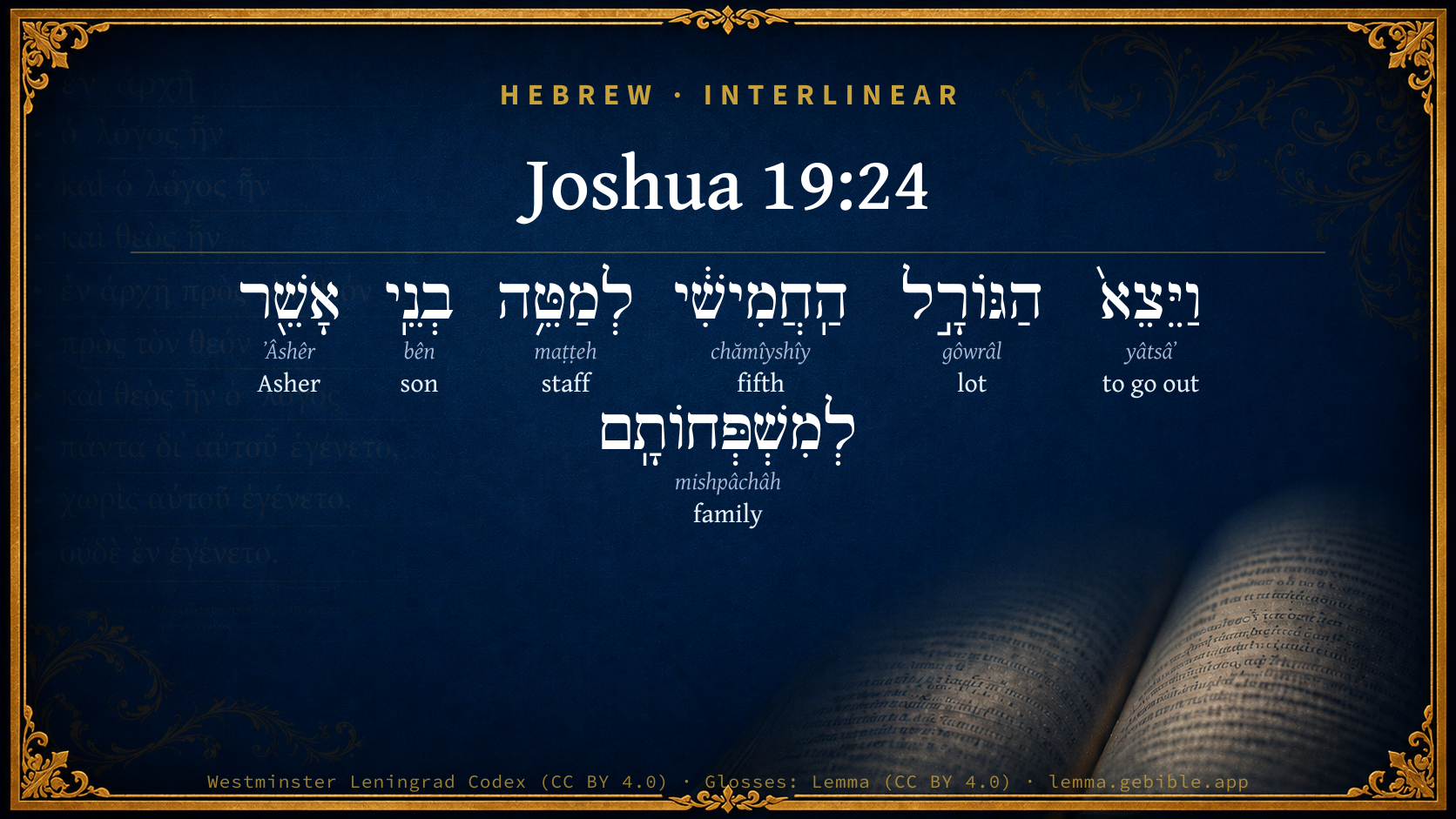
Joshua 19:24

Hebrew (Westminster Leningrad Codex) Joshua 19:24 appears in the Hebrew Old Testament. The text above is from the Westminster Leningrad Codex. Each word links to its Strong’s number, a concise gloss, and parsing drawn from the Open Scriptures Hebrew Bible morphology. Click any word for its full Brown-Driver-Briggs (BDB) entry.
Download image
Cite this verse

Joshua 19:24 (World English Bible). Public Domain. Lemma interlinear Bible study tool, https://lemma.gebible.app/v/joshua/19/24.

Show BibTeX & RIS
BibTeX
RIS
English Translation
The fifth lot came out for the tribe of the children of Asher according to their families.
World English Bible · Public Domain
Download a study sheet

One document with this verse’s original text, its word-by-word gloss line, the meaning frame, cross-references with their text, attributed commentary, and full source and license credits — printable, and it pastes into notes with its structure intact.

This verse Autodidact and up

Study sheet (.html) Plain text (.txt)

A passage Seminary Student

Up to 50 verses in one chapter. A passage sheet keeps up to 6 commentary sources and 12 cross-references per verse, in the order this page ranks them, and says so on the sheet whenever that leaves anything out. Ask for a single verse and you get the Autodidact verse sheet above.

Everything on this page stays free to read, with no account — the sheet is a download of what is already on screen, not access to it.

Want to remove ads? Support Godless Engineer
Compare translations 3

The same verse in 3 English versions, stacked beneath the original-language interlinear above. Click any original word for its lexicon entry.

Each is an independent rendering of the whole verse — the interlinear is not word-aligned to these translations.

Highlighted words mark where these versions differ — a whole-verse word diff, not a word-by-word alignment.

  • World English Bible Public Domain
    The fifth lot came out for the tribe of the children of Asher according to their families.
  • King James Version Public Domain
    And the fifth lot came out for the tribe of the children of Asher according to their families.
  • unfoldingWord Literal Text CC BY-SA 4.0
    And the fifth lot came out for the tribe of the sons of Asher according to their clans.

unfoldingWord Literal Text — © unfoldingWord, licensed CC BY-SA 4.0. Word-aligned USFM3 via Door43 (git.door43.org/unfoldingWord/en_ult).

Versions to compare (up to 4)

3 of 4 selected

Show all 18 translations

Every available English version of this verse, each an independent rendering of the whole verse.

  • World English Bible Public Domain
    The fifth lot came out for the tribe of the children of Asher according to their families.
  • Berean Standard Bible Public Domain
    The fifth lot came out for the clans of the tribe of Asher:
  • Majority Standard Bible Public Domain
    The fifth lot came out for the clans of the tribe of Asher:
  • King James Version Public Domain
    And the fifth lot came out for the tribe of the children of Asher according to their families.
  • American Standard Version (1901) Public Domain
    And the fifth lot came out for the tribe of the children of Asher according to their families.
  • Revised Version (1885) Public Domain
    And the fifth lot came out for the tribe of the children of Asher according to their families.
  • Geneva Bible (1599) Public Domain
    Also the fift lot came out for the tribe of the children of Asher according to their families.
  • Douay-Rheims (1899) Public Domain
    And the fifth lot fell to the tribe of the children of Aser by their kindreds:
  • Young's Literal Translation Public Domain
    And the fifth lot goeth out for the tribe of the sons of Asher, for their families;
  • Literal Standard Version CC BY-SA 4.0
    And the fifth lot goes out for the tribe of the sons of Asher, for their families;
  • Unlocked Literal Bible CC BY-SA 4.0
    The fifth casting of lots fell to the tribe of Asher, clan by clan.
  • unfoldingWord Literal Text CC BY-SA 4.0
    And the fifth lot came out for the tribe of the sons of Asher according to their clans.
  • Darby Bible Public Domain
    And the fifth lot came forth for the tribe of the children of Asher according to their families.
  • World Messianic Bible Public Domain
    The fifth lot came out for the tribe of the children of Asher according to their families.
  • Webster's Bible Public Domain
    And the fifth lot came out for the tribe of the children of Asher according to their families.
  • Free Bible Version CC BY-SA 4.0
    The fifth lot cast went to the tribe of Asher, by families.
  • Bible in Basic English Public Domain
    And the fifth heritage came out for the tribe of Asher by their families.
  • JPS Tanakh (1917) Public Domain
    And the fifth lot came out for the tribe of the children of Asher according to their families.

Literal Standard Version (2020), Covenant Press — licensed CC BY-SA 4.0. Text via the HelloAO Bible API (eBible.org). Unlocked Literal Bible (unfoldingWord) — licensed CC BY-SA 4.0. Text via the HelloAO Bible API (eBible.org). unfoldingWord Literal Text — © unfoldingWord, licensed CC BY-SA 4.0. Word-aligned USFM3 via Door43 (git.door43.org/unfoldingWord/en_ult). Free Bible Version, Dr. Jonathan Gallagher — licensed CC BY-SA 4.0. Text via the HelloAO Bible API (eBible.org).

Word by word

More ways to search: Search by grammar → Find every occurrence → Compare this word →

Practice this passage: Drill this verse → Learn its vocabulary →

About this verse

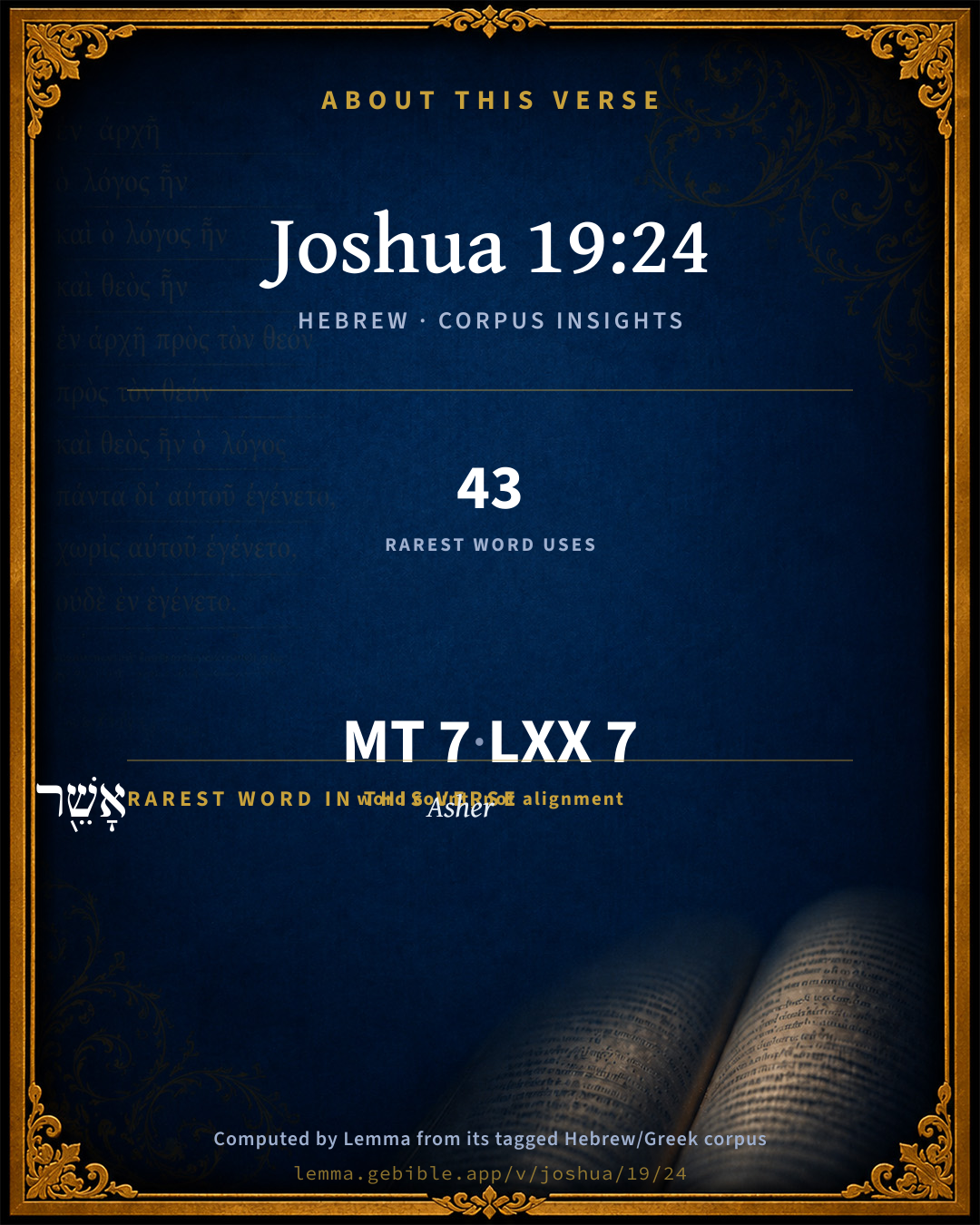
These counts appear in no published source. They are computed here, from the morphology-tagged text and Lemma’s own curated glosses. What Lemma adds →

7
words
7
distinct lemmas
Historical
section

Shared distinctive vocabulary

אָשֵׁ֖ר Asher H836 occurs in 41 verses of the Hebrew Bible. Also found in:

Grammatical profile

  • 1 verb
  • 5 nouns
  • 1 adjective

Verb forms

  • וַיֵּצֵא֙ Qal · Sequential Imperfect

Hebrew & Septuagint length

In English translation the verse runs 17 words from the Hebrew and 12 from the Septuagint (LXX English) — the Septuagint runs noticeably shorter here. See the side-by-side →

A rough comparison of the two English renderings, which tokenize alike — not a word-level alignment.

Word counts can differ between the Hebrew and the Greek without any difference in meaning — e.g. the Hebrew direct-object marker אֵת has no separate Greek word, and Greek often adds the article ὁ.

In the original languages it is 7 Hebrew tokens and 7 Greek tokens — but the two are counted differently (Hebrew bundles its prefixes and suffixes into one token; the Greek is in lemma form), so that isn’t a like-for-like length.

Cross-references

1

Topical passages linked to Joshua 19:24 in the Treasury of Scripture Knowledge — connected by theme and wording, ordered by reader-vote popularity; previews shown in the World English Bible.

  • Luke 2:26–38 It had been revealed to him by the Holy Spirit that he should not see death before he had seen the Lord's Christ.

Cross-references courtesy of OpenBible.info (CC BY 4.0).

Hebrew and Greek witnesses Masoretic Hebrew ↔ Greek Septuagint

The same verse in the two great witnesses to the Old Testament, shown verse-for-verse.

Here the Septuagint runs noticeably shorter than the Hebrew — LXX2012 (modern English Septuagint) 12 words vs World English Bible 17. A rough length comparison of the two English translations, not a word-level alignment — read both below.

These are two independent witnesses, not word-aligned to each other, and the Septuagint is shown in lemma (dictionary) form.

Hebrew Joshua 19:24 Masoretic · Westminster Leningrad Codex

וַיֵּצֵא֙ הַגּוֹרָ֣ל הַֽחֲמִישִׁ֔י לְמַטֵּ֥ה בְנֵֽי אָשֵׁ֖ר לְמִשְׁפְּחוֹתָֽם

The fifth lot came out for the tribe of the children of Asher according to their families.

World English Bible · Public Domain

Greek LXX Joshua 19:24 Septuagint · lemma form

καί ἐκἔρχομαι ὁ κλῆρος ὁ πέμπτος ασηρ

And the fifth lot came out to Aser according to their families.

LXX2012 (modern English Septuagint) · Public Domain

On this verse, Keil & Delitzsch discusses the Septuagint’s reading. Read the note in Commentary ↓

Hebrew: Westminster Leningrad Codex (CC BY 4.0). Greek: Septuagint (public domain); English from LXX2012 (modern English Septuagint) (Public Domain). How the Septuagint differs from the Hebrew →

Targum (Aramaic paraphrase)

1

The Targum is the ancient Jewish Aramaic paraphrase of the Hebrew Scriptures — an interpretive translation, not the Hebrew text itself. Onkelos (literal) and Pseudo-Jonathan (expansive) render the Torah, and Jonathan the Prophets. Coverage is partial: where no permissively-licensed English translation exists for a verse, only the Aramaic is shown. This is verse-level text, not a word-by-word alignment to the Hebrew.

  1. Targum Jonathan Prophets (Joshua–Malachi)
    וּנְפַק עַדְבָא חֲמִישָׁאָה לְשִׁבְטָא דִבְנֵי אָשֵׁר לְזַרְעֲיַתְהוֹן:

    (no public-domain English translation for this verse)

    Targum Jonathan — Aramaic: “Mikraot Gedolot” (public domain). English: “Sefaria Community Translation” (CC0 1.0 (public-domain dedication)); “London "Chaldee Paraphrase," 1871” (public domain). Text via Sefaria.

Commentary

Notes on Joshua 19:24 from classic Christian and Jewish commentators (each source and its license shown beneath its notes). The classic Christian expositions comment on the surrounding passage and are grouped to its opening verse, so a note may address several verses; the Jewish commentaries on the Tanakh (Rashi and others) are per-verse, so they appear only where the commentator wrote on this verse.

Lemma curates 59 commentaries, every one of them public domain or Creative Commons licensed, each selected and text-cleaned for this edition rather than reprinted as found. About our sources →

Jamieson, Fausset & Brown

Robert Jamieson, A. R. Fausset & David Brown

OF ASHER. (Jos 19:24-31)

the fifth lot came out for the tribe of the children of Asher--The western boundary is traced from north to south through the cities mentioned; the site of them, however, is unknown.

Jamieson, Fausset & Brown — Commentary Critical and Explanatory on the Whole Bible (1871) — public domain (CC PDM 1.0). Text via the HelloAO Bible API.

Whedon's Commentary on the Bible

Daniel D. Whedon

LOT OF ASHER, Jos_19:24-31.

[The position of Asher may be generally described as extending along the shore of the Mediterranean from Tantura, on the south of Mount Carmel, to Zidon on the north, and bounded on the east by Zebulun and Naphtali. His territory included the rich plain of Phenicia, and some of the most celebrated cities of antiquity. Truly did Jacob prophesy: “His bread shall be fat, and he shall yield royal dainties,” (Gen_49:20;) and Moses: “He shall dip his foot in oil; his shoes shall be iron and brass.” Deu_33:24-25. The great Phenician plain near Acre was rich in corn and wine and oil, and in the Zidonian metallic manufactories probably many Asherites learned to be skilful workmen in iron and brass. Compare 1Ki_7:14. When other tribes were at war with Jabin’s hosts, Asher dwelt quietly by his harbours. Jdg_5:17. Asher never conquered the Phenician territory, but was content to dwell among the Canaanites and learn their ways. See Jdg_1:31-32. Stanley remarks; “One name only of the tribe of Asher shines out of the general obscurity — the aged widow who, in the very close of the Jewish history, departed not from the Temple at Jerusalem, but served God with prayers and fastings night and day. (Luk_2:36, where see notes.) So insignificant was the tribe to which was assigned the fortress which Napoleon called the key of Palestine.”]

Daniel D. Whedon (gen. ed.), Commentary on the Old and New Testaments (1874–1909) — public domain. Text from a community e-Sword module.

Tyndale Open Study Notes

Tyndale Open Resources

19:24-31 The land allocated to the tribe of Asher included the Plain of Acco on the Mediterranean coast and western Galilee. To the southwest, Asher touched Carmel, sharing at least a short common border with land allotted to the tribe of Manasseh. To the north, the Phoenician cities of Tyre and Sidon limited Asher’s expansion.

Tyndale Open Study Notes — © Tyndale Open Resources, licensed CC BY-SA 4.0. Text via the HelloAO Bible API.

Matthew Henry's Commentary

The lot of Asher lay upon the coast of the great sea. We read not of any famous person of this tribe but Anna the prophetess, who was a constant resident in the temple at the time of our Saviour's birth, Luk 2:36. Nor were there many famous places in this tribe. Aphek (mentioned Jos 19:30) was the place near which Benhadad was beaten by Ahad, Kg1 20:30. But close adjoining to this tribe were the celebrated sea-port towns of Tyre and Sidon, which we read so much of. Tyre is called here that strong city (Jos 19:29), but Bishop Patrick thinks it was not the same Tyre that we read of afterwards, for that was built on an island; this old strong city was on the continent. And it is conjectured by some that into these two strong-holds, Sidon and Tzor, or Tyre, many of the people of Canaan fled and took shelter when Joshua invaded them.

Matthew Henry's Commentary on the Whole Bible (1708–1710) — public domain (CC PDM 1.0). Text via the HelloAO Bible API.

Ellicott's Commentary for English Readers

(24) The fifth lot . . . for . . . Asher . . . (and Jos_19:32) the sixth . . . for . . . Naphtali.—Asher and Naphtali had been associated with Dan in the exodus, and with him had encamped on the north side of the tabernacle, and had brought up the rear. These two, each dissociated from his own brother (viz., Asher from Gad and Naphtali from Dan), are paired together in their inheritance in Palestine (comp. Naphtali and Manasseh in Revelation 7, and see Names on the Gates of Pearl, pp. 199, 200). The tribe of Asher was more akin to the house of Judah, for Zilpah, the mother of Asher, was Leah’s handmaid; and the tribe of to the house of Joseph, for Bilhah, Naphtali’s mother, was Rachel’s handmaid. But in all cases the lot of the inheritance of the tribe seems to have fallen in such a way as to favour the construction of a united Israel—a Dodecaphulon, to use St. Paul’s word—an organised body of twelve tribes.

A Bible Commentary for English Readers, edited by Charles John Ellicott (1878–1897) — public domain. Text from a community e-Sword module.

The Cambridge Bible for Schools and Colleges

gen. ed. J. J. S. Perowne

24–31. The Inheritance of the Tribe of Asher

24. And the fifth lot came out for the tribe of the children of Asher] who were descended from the eighth son of Jacob, and in the march through the desert closed the long procession side by side with Dan and Naphtali, with the standard of Dan, an “eagle with a serpent in its talons.”

The Cambridge Bible for Schools and Colleges (gen. ed. J. J. S. Perowne; Cambridge University Press, 1878–1918) — public domain. Text from a community e-Sword module.

John Gill's Exposition

And their border was Helkath,.... Helkath seems to be the same with Hukok, Ch1 6:75; and according to Masius it lay ten or twelve miles above Ptolemais:

and Hali, of which we read nowhere else.

and Beten is by Jerom (h) called Bathne, and was in his time a village by the name of Bethebem, eight miles from Ptolemais to the east. Reland (i) seems to think it might be the Ecbatana of Pliny (k), which he speaks of as near Mount Carmel, and not far from Ptolemais:

and Achshaph was a royal city, whose king was taken by Joshua; see Gill on Jos 11:1.

(h) De loc. Heb. fol. 89. H. (i) Palestin. Illustrat. tom. 2. p. 617. (k) Nat. Hist. l. 5. c. 19.

John Gill's Exposition of the Whole Bible (1746–1763) — public domain (CC PDM 1.0). Text via the HelloAO Bible API.

Keil & Delitzsch

C. F. Keil & F. Delitzsch

The Inheritance of Asher. - Asher received its territory along the Mediterranean Sea from Carmel to the northern boundary of Canaan itself. The description commences with the central portion, viz., the neighbourhood of Acco (Jos 19:25), going first of all towards the south (Jos 19:26, Jos 19:27), and then to the north (Jos 19:28, Jos 19:30).

Jos 19:25

The territory of the Asherites was as follows. Helkath, which was given up to the Levites (Jos 21:31, and Ch1 6:75, where Hukok is an old copyist's error), is the present Jelka, three hours to the east of Acco (Akka: Scholz, Reise, p. 257), or Jerka, a Druse village situated upon an eminence, and judging from the remains, an ancient place (Van de Velde, R. i. p. 214; Rob. iii. App.). Hali, according to Knobel possibly Julis, between Jerka and Akka, in which case the present name arose from the form Halit, and t was changed into s. Beten, according to the Onom. (s. v. Βατναι%: Bathne) as vicus Bethbeten, eight Roman miles to the east of Ptolemais, has not yet been found. Achshaph is also unknown (see at Jos 11:1). The Onom. (s. v. Achsaph) says nothing more about its situation than that it was in tribu Aser, whilst the statement made s. v. Acsaph (Ἀκσάφ), that it was villula Chasalus (κώμη Ἐξάδους), eight Roman miles from Diocaesarea ad radicem montis Thabor, leads into the territory of Zebulun.

Jos 19:26

Alammalech has been preserved, so far as the name is concerned, in the Wady Malek or Malik (Rob. Bibl. Res. p. 110), which runs into the Kishon, since in all probability the wady was named after a place either near it or within it. Amad is supposed by Knobel to be the present Haifa, about three hours to the south of Acre, on the sea, and this he identifies with the sycamore city mentioned by Strabo (xvi. 758), Ptolemy (v. 15, 5), and Pliny (h. n. v. 17), which was called Epha in the time of the Fathers (see Ritter, Erdk. xvi. pp. 722ff.). In support of this he adduces the fact that the Hebrew name resembles the Arabic noun for sycamore-an argument the weakness of which does not need to be pointed out. Misheal was assigned to the Levites (Jos 21:30, and Ch1 6:74, where it is called Mashal). According to the Onom. (s. v. Masan) it was on the sea-coast near to Carmel, which is in harmony with the next clause, "and reacheth to Carmel westwards, and to Shihor-libnath." Carmel (i.e., fruit-field), which has acquired celebrity from the history of Elijah (Kg1 18:17.), is a wooded mountain ridge which stretches in a north-westerly direction on the southern side of the Kishon, and projects as a promontory into the sea. Its name, "fruit-field," is well chosen; for whilst the lower part is covered with laurels and olive trees, the upper abounds in figs and oaks, and the whole mountain is full of the most beautiful flowers. There are also many caves about it (vid., v. Raumer, Pal. pp. 43ff.; and Ritter, Erdk. xvi. pp. 705-6). The Shihor-libnath is not the Belus, or glass-river, in the neighbourhood of Acre, but is to be sought for on the south of Carmel, where Asher was bounded by Manasseh (Jos 17:10), i.e., to the south of Dor, which the Manassites received in the territory of Asher (Jos 17:11); it is therefore in all probability the Nahr Zerka, possibly the crocodile river of Pliny (Reland, Pal. p. 730), which is three hours to the south of Dor, and whose name (blue) might answer both to shihor (black) and libnath (white).

Jos 19:27

From this point the boundary "turned towards the east," probably following the river Libnath for a short distance upwards, "to Beth-dagon," which has not yet been discovered, and must not be identified with Beit Dejan between Yafa and Ludd (Diospolis), "and touched Zebulun and the valley of Jiphtah-el on the north of Beth-emek, and Nehil, and went out on the left of Cabul," i.e., on the northern side of it. The north-west boundary went from Zebulun into the valley of Jiphtah-el, i.e., the upper part of the Wady Abiln (Jos 19:14). Here therefore the eastern boundary of Asher, which ran northwards from Wady Zerka past the western side of Issachar and Zebulun, touched the north-west corner of Zebulun. The two places, Beth-emek and Nehil (the latter possibly the same as Neah in Jos 19:13), which were situated at the south of the valley of Jiphtah-el, have not been discovered; they may, however, have been upon the border of Zebulun and yet have belonged to Ashwer. Cabul, the κώμη Χαβωλώ of Josephus (Vit. 43), in the district of Ptolemais, has been preserved in the village of Kabul, four hours to the south-east of Acre (Rob. Bibl. Res. p. 88, and Van de Velde, R. i. p. 218).

Jos 19:28-30

In Jos 19:28-30 the towns and boundaries in the northern part of the territory of Asher, on the Phoenician frontier, are given, and the Phoenician cities Sidon, Tyre, and Achzib are mentioned as marking the boundary. First of all we have four towns in Jos 19:28, reaching as far as Sidon, no doubt in the northern district of Asher. Ebron has not yet been traced. As Abdon occurs among the towns which Asher gave up to the Levites (Jos 21:30; Ch1 6:59), and in this verse also twenty MSS have the reading Abdon, many writers, like Reland (Pal. p. 514), regard Ebron as a copyist's error for Abdon. This is possible enough, but it is by no means certain. As the towns of Asher are not all given in this list, since Acco, Achlab, and Helba (Jdg 1:31) are wanting, Abdon may also have been omitted. But we cannot attach any importance to the reading of the twenty MSS, as it may easily have arisen from Jos 21:30; and in addition to the Masoretic text, it has against it the authority of all the ancient versions, in which the reading Ebron is adopted. But even Abdon cannot be traced with certainty. On the supposition that Abdon is to be read for Ebron, Knobel connects it with the present Abbadiyeh, on the east of Beirut (Rob. iii. App.; Ritter, Erdk. xvii. pp. 477 and 710), or with Abidat, on the east (not the north) of Jobail (Byblus), mentioned by Burckhardt (Syr. p. 296) and Robinson (iii. App.); though he cannot adduce any other argument in support of the identity of Abdon with these two places, which are only known by name at present, except the resemblance in their names. On the supposition, however, that Abdon is not the same as Ebron, Van de Velde's conjecture is a much more natural one; namely, that it is to be found in the ruins of Abdeh, on the Wady Kurn, to the north of Acca. Rehob cannot be traced. The name occurs again in Jos 19:30, from which it is evident that there were two towns of this name in the territory of Asher (see at Jos 19:30). Schultz and Van de Velde connect it with the village of Haml by the wady of that name, between Ras el Abyad and Ras en Nakura; but this is too far south to be included in the district which reached to great Sidon. Knobel's suggestion would be a more probable one, namely, that it is connected with the village of Hammana, on the east of Beirut, in the district of el Metn, on the heights of Lebanon, where there is now a Maronite monastery (vid., Seetzen, i. p. 260; Rob. iii. App.; and Ritter, xvii. pp. 676 and 710), if it could only be shown that the territory of Asher reached as far to the east as this. Kanah cannot be the village of Kna, not far from Tyre (Rob. iii. p. 384), but must have been farther north, and near to Sidon, though it has not yet been discovered. For the supposition that it is connected with the existing place called Ain Kanieh (Rob. iii. App.; Ritter, xvii. pp. 94 and 703), on the north of Jezzin, is overthrown by the fact that that place is too far to the east to be thought of in this connection; and neither Robinson nor Ritter makes any allusion to "Ain Kana, in the neighbourhood of Jurjera, six hours to the south-east of Sidon," which Knobel mentions without quoting his authority, so that the existence of such a place is very questionable. On Sidon, now Saida, see at Jos 11:8.

Jos 19:29-31

"And the boundary turned (probably from the territory of Sidon) to Ramah, to the fortified town of Zor." Robinson supposes that Rama is to be found in the village of Rameh, on the south-east of Tyre, where several ancient sarcophagi are to be seen (Bibl. Res. p. 63). "The fortified town of Zor," i.e., Tyre, is not the insular Tyre, but the town of Tyre, which was on the mainland, the present Sur, which is situated by the sea-coast, in a beautiful and fertile plain (see Ritter, Erdk. xvii. p. 320, and Movers, Phnizier, ii. 1, pp. 118ff.). "And the boundary turned to Hosah, and the outgoings thereof were at the sea, by the side of the district of Achzib." Hosah is unknown, as the situation of Kausah, near to the Rameh already mentioned (Rob. Bibl. Res. p. 61), does not suit in this connection. מחבל, lit. from the district, i.e., by the side of it. Achzib, where the Asherites dwelt with the Canaanites (Jdg 1:31-32), is the Ekdippa of the Greeks and Romans, according to the Onom. (s. v. Achziph) nine Roman miles, or according to the Itiner. Hieros. p. 584, twelve miles to the north of Acco by the sea, the present Zib, a very large village, three good hours to the north of Acre, - a place on the sea-coast, with considerable ruins of antiquity (see Ges. Thes. p. 674; Seetzen, ii. p. 109; Ritter, xvi. pp. 811-12). - In Jos 19:30 three separate towns are mentioned, which were probably situated in the eastern part of the northern district of Asher, whereas the border towns mentioned in Jos 19:28 and Jos 19:29 describe this district in its western half. Ummah (lxx Ἀμμά) may perhaps have been preserved in Kefr Ammeih, upon the Lebanon, to the south of Hammana, in the district of Jurd (Rob. iii. App.; Ritter, xvii. p. 710). Aphek is the present Afka (see at Jos 13:4). Rehob cannot be traced with certainty. If it is Hub, as Knobel supposes, and the name Hub, which is borne by a Maronite monastery upon Lebanon, in the diocese of el-Jebail (to the north-east of Jebail), is a corruption of Rehob, this would be the northernmost town of Asher (see Seetzen, i. pp. 187ff., and Ritter, xvii. p. 791). The number "twenty-two towns and their villages" does not tally, as there are twenty-three towns mentioned in Jos 19:26-30, if we include Sidon, Tyre, and Achzib, according to Jdg 1:31-32. The only way in which the numbers can be made to agree is to reckon Nehiel (Jos 19:27) as identical with Neah (Jos 19:13). But this point cannot be determined with certainty, as the Asherites received other towns, such as Acco and Aclaph, which are wanting in this list, and may possibly have simply fallen out.

Keil & Delitzsch — Biblical Commentary on the Old Testament (1861–1891) — public domain (CC PDM 1.0). Text via the HelloAO Bible API. (Old Testament only.)

unfoldingWord translationNotes

Door43 World Missions Community

The fifth casting of lots

See how you translated this phrase in Joshua 19:1.

The fifth

number five in a list (See: Ordinal Numbers)

Helkath, Hali, Beten, Akshaph, Allammelek, Amad, and Mishall ... Shihor Libnath

These are the names of cities. (See: How to Translate Names)

translationWords

Asher

Carmel

unfoldingWord translationNotes — © Distant Shores Media and the Door43 World Missions Community, licensed CC BY-SA 4.0. Source: git.door43.org/Door43/en_tn.

Lesson kit

Teaching starters — assembled from the data on this page, not authored interpretation. Every prompt links to the verse data it draws on. Edit before teaching.

Joshua, in the Historical, opens this verse with 7 words (7 distinct Hebrew lemmas). Its most distinctive word is ʼÂshêr (“Asher”). The Greek Septuagint runs shorter here. A historical commentator’s framing appears above. Read the whole chapter for the surrounding context.

Discussion questions

  1. The word ʼÂshêr carries the sense “Asher.” How does it shape the verse?
  2. Genesis 30:13 shares the word «Asher» with this verse. How do the two illuminate each other?
  3. Compared with the Hebrew, the Septuagint runs shorter here. What questions does that raise?
  4. These translations render this verse differently; the difference is in the English rendering, not the original. What questions does that raise?
  5. The verb «וַיֵּצֵא֙» is Qal Sequential Imperfect. How does its form color the action?
  6. Reading how Jamieson, Fausset & Brown and Whedon's Commentary on the Bible read this verse, where do the two commentators agree and where do they part?

Things to notice

Reading settings

Reading text

Shown beneath each verse's original-language words.

Old Testament
Old Testament edition

Read the OT as the Masoretic Hebrew (MT) or the Greek Septuagint (LXX).

English shown for the Greek Septuagint (in the Hebrew ↔ Greek comparison).

Comparing translations? Open the Compare panel on any verse page to stack up to four side by side.