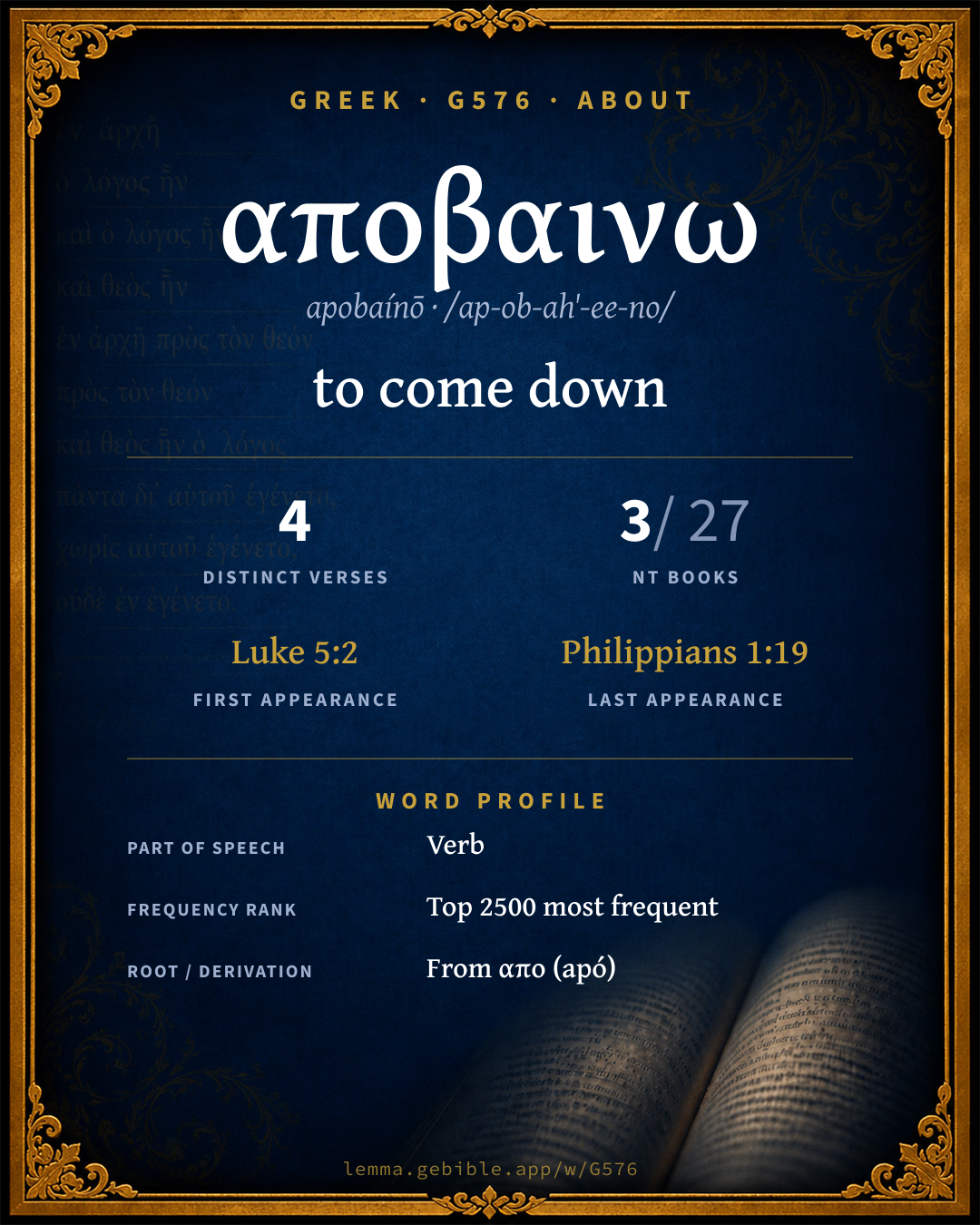
ἀποβαίνω
to come down
‘to come down’ is one of 2 main senses fuller range ↓
Full lexicon entry — Thayer's Greek Lexicon
From Thayer's Greek Lexicon
Where this word appears
Grammar key — what these labels mean
Part of speech
- Verb
- An action or state-of-being word.
Tense
- Future
- Action expected in future time.
- Aorist
- Action viewed as a simple whole, without regard to duration — often past (perfective aspect).
Voice
- Middle deponent
- Middle in form but active in meaning.
- Active
- The subject performs the action.
Mood
- Indicative
- States a fact or asks a factual question (the mood of reality).
- Participle
- A verbal adjective (“writing,” “having written”).
Case
- Nominative
- The case of the subject (and the predicate nominative).
Person
- 3rd person
- The one spoken about (“he / she / it / they”).
Gender
- Masculine
- Grammatically masculine.
Number
- Singular
- One.
- Plural
- More than one.
Every verse where G576 appears in the Book of Philippians — 1 distinct verse. Click any verse to open its interlinear word-by-word view. Verse text shown in the World English Bible for context — . Each verse’s Greek form is shown with its reference; the English is not keyword-highlighted, since the data carries no word-level English alignment. Use “Compare translations” on any verse to read it across multiple English versions. This concordance covers the Greek New Testament; Septuagint (Greek Old Testament) occurrences of this word are not indexed here.
Philippians
About this entry
At a glance — auto-summarized from this page’s data, not written by a person. Every figure links to its source below. This summary describes the numbers; it doesn’t interpret them.
αποβαινω (apobaínō) is a Greek verb most often rendered “to come down.” With only 4 verses it sits in the long tail of Greek New Testament vocabulary. It clusters heavily in Luke, which alone accounts for 50% of its uses. Scripture first uses it in Luke 5:2. Ranging over 2 senses, it is not a single-sense word. For the data behind this summary, explore the sense tree and the renderings breakdown below.
Gloss history
Strong's 1890 vs modern scholarship

About this word
Strong's G576 catalogs a Greek word from the Greek New Testament.
These counts are not copied from any lexicon or concordance. They are computed here, from the morphology-tagged Greek New Testament. What Lemma adds →
- 4
- distinct verses
- The word appears in 4 distinct verses.
- 3 / 27
- NT books
- The word appears in 3 of 27 New Testament books.
- #1,877
- by frequency
- Top 2500 most frequent Greek words (rank 1,877 of 5,347 Greek words by occurrence).
View all 4 occurrences in the concordance →
Most concentrated in
- Luke 2 verses 50%
- John 1 verse 25%
- Philippians 1 verse 25%
By section of the New Testament
By traditional corpus
Conventional, traditional groupings — biblical authorship is debated, so this is a traditional corpus grouping, not an authorship claim. Some books belong to more than one corpus (Luke is in both the Gospels and the Lukan corpus, and so on), so these shares overlap and need not total 100%. Each figure is a share of the word’s 4 distinct verses.
- Gospels 3 verses · 75%
- Lukan (Luke–Acts) 2 verses · 50%
- Johannine 1 verse · 25%
- Pauline corpus 1 verse · 25%
How translations render this word
Counts come from each version’s own published word-to-Strong’s tagging or interlinear alignment — an approximate guide to how each version renders this word, not a word-level alignment the data otherwise carries. Because each total is that version’s own tagged count, the per-version totals vary from one another and need not match the appearance or distinct-verse counts above. These counts may also differ from a printed concordance because Lemma counts each distinctly tagged rendering and does not collapse phrase taggings into a single head-word total. This is a fixed set of word-tagged versions (KJV, ASV, BSB, ULT) and does not change with the reading translation you choose elsewhere. Each version’s license is shown beside its name below (and on Sources).
- King James Version: Shall turn 2×
- American Standard Version: Shall turn 2×
- Berean Standard Bible: Had left 1×, They landed 1×, Will be your opportunity 1×
- unfoldingWord Literal Text: Had gotten out 1×, They got out 1×, Will result 1×
King James Version Public Domain
Renders G576 across 4 tagged occurrences — most commonly:
Plus 2 renderings that appear only once — usually multi-word phrases or single function words the recovered tagging swept in, not distinct renderings.
American Standard Version Public Domain
Renders G576 across 4 tagged occurrences — most commonly:
Plus 2 renderings that appear only once — usually multi-word phrases or single function words the recovered tagging swept in, not distinct renderings.
Berean Standard Bible Public Domain
Renders G576 across 4 tagged occurrences — most commonly:
unfoldingWord Literal Text CC BY-SA 4.0
Renders G576 across 4 tagged occurrences — most commonly:
Senses in Thayer's
The 2 senses Thayer's distinguishes for this word, in lexicon order (not ranked by frequency or importance). The full entry — with sub-senses — is in the Lexicon Entry tab.
- to come down from, i.e. a ship
- to turn out, result, to be the outcome
Word origin
Derived from απο (apó) (G575) — from.
Forms in the corpus
The 3 distinct written forms G576 takes in the Greek New Testament, most frequent first — each parse links to that tense’s occurrences in the concordance.
| Form | Parsing | Example | Uses |
|---|---|---|---|
| ἀποβήσεται apobḗsetai | Verb, Future, Middle deponent, Indicative, 3rd person, Singular | Luke 21:13 | 2 |
| ἀπέβησαν apébēsan | Verb, Aorist, Active, Indicative, 3rd person, Plural | John 21:9 | 1 |
| ἀποβάντες apobántes | Verb, Aorist, Active, Participle, Nominative, Plural, Masculine | Luke 5:2 | 1 |
Same root — word family
Other Thayer's entries built from the same root as G576, grouped by Strong’s listed origin. These share a root / origin per the lexicon — not necessarily a shared meaning. Each links to that word’s own entry.
Derives from
Shares the same root
- απαγγελλω apangéllō G518 to report
- απαγχομαι apánchomai G519 to strangle
- απαγω apágō G520 to lead away
- απαιρω apaírō G522 to take away
- απαιτεω apaitéō G523 to demand back
- απαλγεω apalgéō G524 to cease grieving
- απαλλασσω apallássō G525 to depart
- απαλλοτριοω apallotrióō G526 to estrange
- απανταω apantáō G528 to meet
- απαρνεομαι aparnéomai G533 to deny
- απαρτι apárti G534 henceforth
- απαρχη aparchḗ G536 to offer firstfruits
- απαυγασμα apaúgasma G541 brightness
- απειδω apeídō G542 to look away
- απειμι ápeimi G548 to depart
- απειμι ápeimi G549 to depart
- απειπομην apeipómēn G550 to declare
- απεκδεχομαι apekdéchomai G553 waiting for
- απεκδυομαι apekdýomai G554 to despoil
- απελαυνω apelaúnō G556 to drive away
- απελεγμος apelegmós G557 censure
- απελευθερος apeleútheros G558 freedman
- απελπιζω apelpízō G560 not despairing
- απεναντι apénanti G561 opposite
+85 more words share this root (not shown).
Compare all same-root words → Showing 4 of 111 — not the complete family. They share a root, not necessarily a meaning.
Septuagint usage
The same Greek word αποβαινω appears 17 times in the Greek Old Testament (Septuagint), across 17 verses in 3 books.
- 17
- LXX occurrences
- Tagged occurrences of this Greek word in the Septuagint.
- 17
- verses
- Distinct Septuagint verses containing this word.
- 3 / 39
- OT books
- The word appears in 3 of the 39 Old Testament books.
Sample Septuagint occurrences
- Exodus 2:4 ἀποβαίνω
- Job 8:14 ἀποβαίνω
- Proverbs 9:12 ἀποβαίνω
Septuagint occurrences (same lexeme)
Every verse where the same Strong’s number (G576) appears in the Greek Septuagint. Verse text shown in the World English Bible for context; the Greek form is the matched word — the English is not keyword-highlighted.
- Exodus 2:4 ἀποβαίνω His sister stood far off, to see what would be done to him.
- Job 8:14 ἀποβαίνω Whose confidence shall break apart, Whose trust is a spider's web.
- Job 9:20 ἀποβαίνω Though I am righteous, my own mouth shall condemn me. Though I am blameless, it shall prove me perverse.
- Job 11:6 ἀποβαίνω That he would show you the secrets of wisdom! For true wisdom has two sides. Know therefore that God exacts of you less than your iniquity deserves.
- Job 13:5 ἀποβαίνω Oh that you would be completely silent! Then you would be wise.
- Job 13:12 ἀποβαίνω Your memorable sayings are proverbs of ashes, Your defenses are defenses of clay.
- Job 13:16 ἀποβαίνω This also shall be my salvation, That a godless man shall not come before him.
- Job 15:31 ἀποβαίνω Let him not trust in emptiness, deceiving himself; For emptiness shall be his reward.
- Job 15:35 ἀποβαίνω They conceive mischief, and bring forth iniquity. Their heart prepares deceit."
- Job 17:6 ἀποβαίνω "But he has made me a byword of the people. They spit in my face.
- Job 18:5 ἀποβαίνω "Yes, the light of the wicked shall be put out, The spark of his fire shall not shine.
- Job 22:11 ἀποβαίνω Or darkness, so that you can not see, And floods of waters cover you.
- Job 24:5 ἀποβαίνω Behold, as wild donkeys in the desert, They go forth to their work, seeking diligently for food; The wilderness yields them bread for their children.
- Job 27:18 ἀποβαίνω He builds his house as the moth, As a booth which the watchman makes.
- Job 30:31 ἀποβαίνω Therefore is my harp turned to mourning, And my pipe into the voice of those who weep.
- Job 34:20 ἀποβαίνω In a moment they die, even at midnight; The people are shaken and pass away, The mighty are taken away without hand.
- Proverbs 9:12 ἀποβαίνω If you are wise, you are wise for yourself. If you mock, you alone will bear it.
These are occurrences of the same Greek lexeme (G576) in the Septuagint — not a translation of any one Hebrew word. The store carries no word-level Hebrew↔Greek alignment, so no Hebrew original is asserted here. Counts come from the recovered LXX Strong's tagging — high-frequency vocabulary is well covered, while rare or late forms may be untagged — so they reflect tagged occurrences and may slightly undercount.