
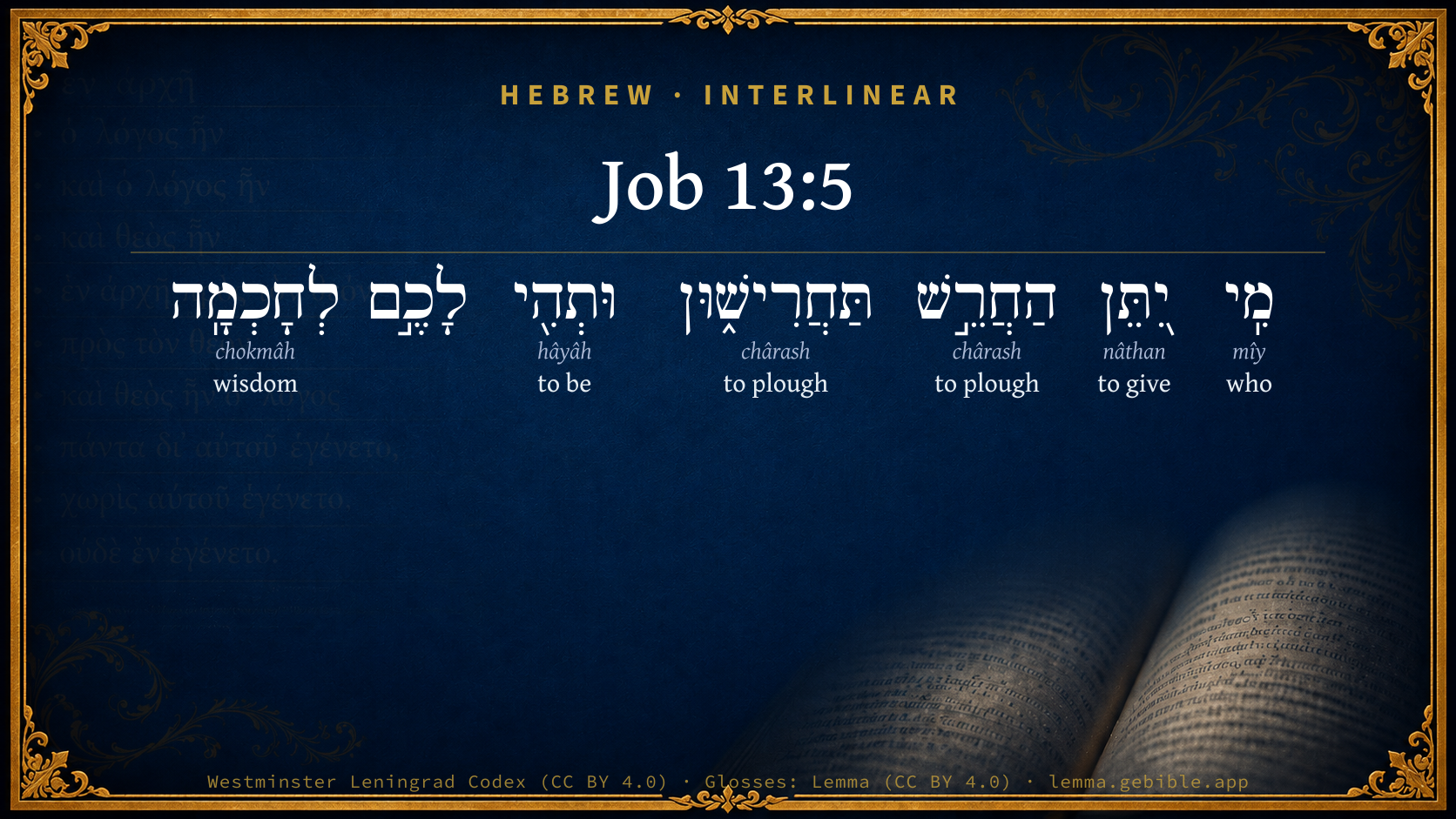
Job 13:5

Hebrew (Westminster Leningrad Codex) Job 13:5 appears in the Hebrew Old Testament. The text above is from the Westminster Leningrad Codex. Each word links to its Strong’s number, a concise gloss, and parsing drawn from the Open Scriptures Hebrew Bible morphology. Click any word for its full Brown-Driver-Briggs (BDB) entry.
Download image
Cite this verse

Job 13:5 (World English Bible). Public Domain. Lemma interlinear Bible study tool, https://lemma.gebible.app/v/job/13/5.

Show BibTeX & RIS
BibTeX
RIS
English Translation
Oh that you would be completely silent! Then you would be wise.
World English Bible · Public Domain
Download a study sheet

One document with this verse’s original text, its word-by-word gloss line, the meaning frame, cross-references with their text, attributed commentary, and full source and license credits — printable, and it pastes into notes with its structure intact.

This verse Autodidact and up

Study sheet (.html) Plain text (.txt)

A passage Seminary Student

Up to 50 verses in one chapter. A passage sheet keeps up to 6 commentary sources and 12 cross-references per verse, in the order this page ranks them, and says so on the sheet whenever that leaves anything out. Ask for a single verse and you get the Autodidact verse sheet above.

Everything on this page stays free to read, with no account — the sheet is a download of what is already on screen, not access to it.

Want to remove ads? Support Godless Engineer
Compare translations 3

The same verse in 3 English versions, stacked beneath the original-language interlinear above. Click any original word for its lexicon entry.

Each is an independent rendering of the whole verse — the interlinear is not word-aligned to these translations.

Highlighted words mark where these versions differ — a whole-verse word diff, not a word-by-word alignment.

  • World English Bible Public Domain
    Oh that you would be completely silent! Then you would be wise.
  • King James Version Public Domain
    O that ye would altogether hold your peace! and it should be your wisdom.
  • unfoldingWord Literal Text CC BY-SA 4.0
    Who will give being silent, you will be silent? And it will be to you for wisdom.

unfoldingWord Literal Text — © unfoldingWord, licensed CC BY-SA 4.0. Word-aligned USFM3 via Door43 (git.door43.org/unfoldingWord/en_ult).

Versions to compare (up to 4)

3 of 4 selected

Show all 18 translations

Every available English version of this verse, each an independent rendering of the whole verse.

  • World English Bible Public Domain
    Oh that you would be completely silent! Then you would be wise.
  • Berean Standard Bible Public Domain
    If only you would remain silent; for that would be your wisdom!
  • Majority Standard Bible Public Domain
    If only you would remain silent; for that would be your wisdom!
  • King James Version Public Domain
    O that ye would altogether hold your peace! and it should be your wisdom.
  • American Standard Version (1901) Public Domain
    Oh that ye would altogether hold your peace! And it would be your wisdom.
  • Revised Version (1885) Public Domain
    Oh that ye would altogether hold your peace! and it should be your wisdom.
  • Geneva Bible (1599) Public Domain
    Oh, that you woulde holde your tongue, that it might be imputed to you for wisedome!
  • Douay-Rheims (1899) Public Domain
    And I wish you would hold your peace, that you might be thought to be wise men..
  • Young's Literal Translation Public Domain
    O that ye would keep perfectly silent, And it would be to you for wisdom.
  • Literal Standard Version CC BY-SA 4.0
    O that you would keep perfectly silent, || And it would be to you for wisdom.
  • Unlocked Literal Bible CC BY-SA 4.0
    Oh, that you would altogether hold your peace! That would be your wisdom.
  • unfoldingWord Literal Text CC BY-SA 4.0
    Who will give being silent, you will be silent? And it will be to you for wisdom.
  • Darby Bible Public Domain
    Oh that ye would be altogether silent! and it would be your wisdom.
  • World Messianic Bible Public Domain
    Oh that you would be completely silent! Then you would be wise.
  • Webster's Bible Public Domain
    O that ye would altogether hold your peace and it would be your wisdom.
  • Free Bible Version CC BY-SA 4.0
    I wish you would all be quiet! That would be the wisest thing for you to do.
  • Bible in Basic English Public Domain
    If only you would keep quiet, it would be a sign of wisdom!
  • JPS Tanakh (1917) Public Domain
    Oh that ye would altogether hold your peace! and it would be your wisdom.

Literal Standard Version (2020), Covenant Press — licensed CC BY-SA 4.0. Text via the HelloAO Bible API (eBible.org). Unlocked Literal Bible (unfoldingWord) — licensed CC BY-SA 4.0. Text via the HelloAO Bible API (eBible.org). unfoldingWord Literal Text — © unfoldingWord, licensed CC BY-SA 4.0. Word-aligned USFM3 via Door43 (git.door43.org/unfoldingWord/en_ult). Free Bible Version, Dr. Jonathan Gallagher — licensed CC BY-SA 4.0. Text via the HelloAO Bible API (eBible.org).

Word by word

More ways to search: Search by grammar → Find every occurrence → Compare this word →

Practice this passage: Drill this verse → Learn its vocabulary →

הַחֲרֵ֣שׁ
chârash
H2790
“to plough”
Verb, Hiphil, Infinitive Absolute
Part of Speech
Verb
Stem
Hiphil
Form
Infinitive Absolute
Full BDB Definition

Origin: a primitive root

TWOT: 760 , 761

to cut in, plough, engrave, devise - (Qal) - to cut in, engrave - to plough - to devise - (Niphal) to be ploughed - (Hiphil) to plot evil - to be silent, be dumb, be speechless, be deaf - (Qal) - to be silent - to be deaf - (Hiphil) - to be silent, keep quiet - to make silent - to be deaf, show deafness - (Hithpael) to remain silent
  1. מִֽי mîy H4310 “who” Particle, Interrogative
  2. יִ֭תֵּן nâthan H5414 “to give” Verb, Qal, Imperfect, 3rd Person, Masculine, Singular
  3. תַּחֲרִישׁ֑וּן chârash H2790 “to plough” Verb, Hiphil, Imperfect, 2nd Person, Masculine, Plural + Suffix, n
  4. וּתְהִ֖י hâyâh H1961 “and · to be” Conjunction + Verb, Qal, Imperfect, 3rd Person, Feminine, Singular
  5. לְחָכְמָֽה chokmâh H2451 “to/for · wisdom” Preposition + Noun, Common, Feminine, Singular, Absolute

About this verse

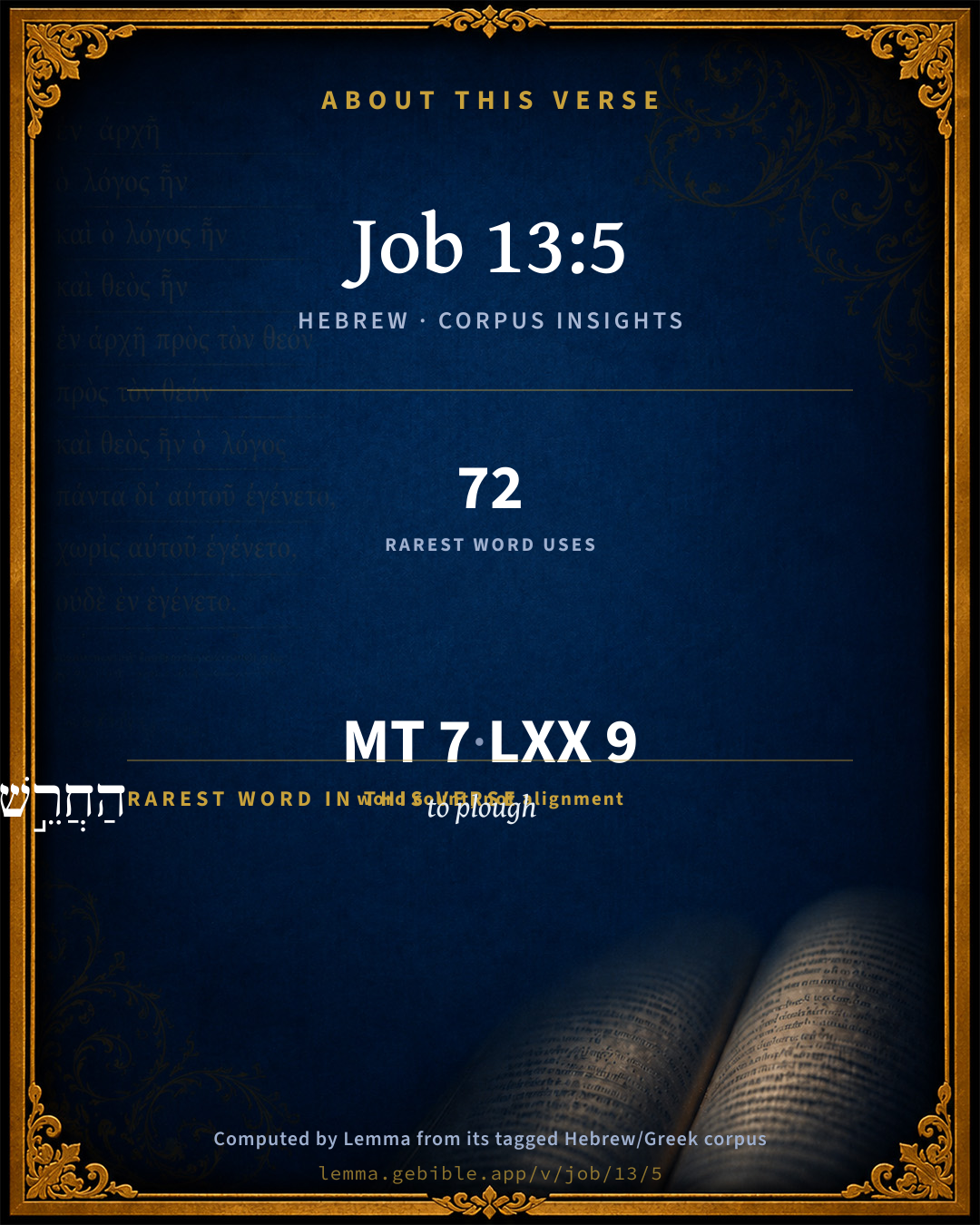
These counts appear in no published source. They are computed here, from the morphology-tagged text and Lemma’s own curated glosses. What Lemma adds →

7
words
5
distinct lemmas
Wisdom
section

Grammatical profile

  • 4 verbs
  • 1 noun
  • 1 preposition
  • 1 particle

Verb forms

  • יִ֭תֵּן Qal · Imperfect
  • הַחֲרֵ֣שׁ Hiphil · Infinitive Absolute
  • תַּחֲרִישׁ֑וּן Hiphil · Imperfect
  • וּתְהִ֖י Qal · Imperfect

Repetition

A word recurs within this verse — often emphatic in Hebrew:

  • הַחֲרֵ֣שׁ to plough H2790 ×2

Hebrew & Septuagint length

In English translation the verse runs 12 words from the Hebrew and 16 from the Septuagint (LXX English) — closely comparable.

A rough comparison of the two English renderings, which tokenize alike — not a word-level alignment.

Word counts can differ between the Hebrew and the Greek without any difference in meaning — e.g. the Hebrew direct-object marker אֵת has no separate Greek word, and Greek often adds the article ὁ.

In the original languages it is 7 Hebrew tokens and 9 Greek tokens — but the two are counted differently (Hebrew bundles its prefixes and suffixes into one token; the Greek is in lemma form), so that isn’t a like-for-like length.

Cross-references

11

Topical passages linked to Job 13:5 in the Treasury of Scripture Knowledge — connected by theme and wording, ordered by reader-vote popularity; previews shown in the World English Bible.

  • Proverbs 17:28 Even a fool, when he keeps silent, is counted wise. When he shuts his lips, he is thought to be discerning.
  • James 1:19 So, then, my beloved brothers, let every man be swift to hear, slow to speak, and slow to anger;
  • Job 13:13 "Be silent, leave me alone, that I may speak. Let come on me what will.
  • Ecclesiastes 5:3 For as a dream comes with a multitude of cares, so a fool's speech with a multitude of words.
  • Job 11:3 Should your boastings make men hold their peace? When you mock, shall no man make you ashamed?
  • Job 16:3 Shall vain words have an end? Or what provokes you that you answer?
  • Job 18:2 "How long will you hunt for words? Consider, and afterwards we will speak.
  • Job 19:2 "How long will you torment me, And crush me with words?
  • Job 21:2–3 "Listen diligently to my speech. Let this be your consolation.
  • Job 32:1 So these three men ceased to answer Job, because he was righteous in his own eyes.
  • Amos 5:13 Therefore he who is prudent shall keep silence in such a time; For it is an evil time.

Cross-references courtesy of OpenBible.info (CC BY 4.0).

Hebrew and Greek witnesses Masoretic Hebrew ↔ Greek Septuagint

The same verse in the two great witnesses to the Old Testament, shown verse-for-verse.

These are two independent witnesses, not word-aligned to each other, and the Septuagint is shown in lemma (dictionary) form.

Hebrew Job 13:5 Masoretic · Westminster Leningrad Codex

מִֽי יִ֭תֵּן הַחֲרֵ֣שׁ תַּחֲרִישׁ֑וּן וּתְהִ֖י לָכֶ֣ם לְחָכְמָֽה

Oh that you would be completely silent! Then you would be wise.

World English Bible · Public Domain

Greek LXX Job 13:5 Septuagint · lemma form

εἰμί δέ σύ κωφεύω καί ἀποβαίνω σύ εἰς σοφία

But would that you⌃ were silent, and it would be wisdom to you in the end.

LXX2012 (modern English Septuagint) · Public Domain

Hebrew: Westminster Leningrad Codex (CC BY 4.0). Greek: Septuagint (public domain); English from LXX2012 (modern English Septuagint) (Public Domain). How the Septuagint differs from the Hebrew →

Commentary

Notes on Job 13:5 from classic Christian and Jewish commentators (each source and its license shown beneath its notes). The classic Christian expositions comment on the surrounding passage and are grouped to its opening verse, so a note may address several verses; the Jewish commentaries on the Tanakh (Rashi and others) are per-verse, so they appear only where the commentator wrote on this verse.

Lemma curates 59 commentaries, every one of them public domain or Creative Commons licensed, each selected and text-cleaned for this edition rather than reprinted as found. About our sources →

Trapp's Complete Commentary

John Trapp

Job 13:5 O that ye would altogether hold your peace! and it should be your wisdom.

Ver. 5. O that you would altogether hold your peace] Heb. In being silent, would be silent: q.d. I thought much of your seven days’ silence, Job 2:13, and now I am no less troubled at your speeches. Oh that you had either continued your silence, or else would frame to say something better than silence: for hitherto ye have spoken much, but said little. I could heartily wish, therefore, that you would now stop your mouths, and open your ears, as Job 13:6, that you would be as mute as fishes, since I can hear nothing from you but what speaks you to be mere mutes, ciphers, nullities’ as Job 13:4.

And it should be your wisdom] For "even a fool when he holdeth his peace is counted wise; and he that shutteth his lips is esteemed a man of understanding," Pro 17:28.

Pας τις απαιδευτος φρονιμωτατος εστι σιωπων.

As when the door is shut it cannot be seen what is within the house; so the mouth, being shut by silence, the folly that is within lieth undiscovered; and as in glasses and vessels, so in men, the sound which they make showeth whether they be cracked or sound. An ass is known by his ears (saith the Dutch proverb), and so is a fool by his talk. As a bird is known by his note, and a bell by his clapper, so is a man by his discourse. Plutarch tells us, that Megabysus, a nobleman of Persia, coming into Apelles’, the painter’s, workshop, took upon him to speak something there concerning the art of painting and limning, but he did it so absurdly, that the apprentices jeered him, and the master could not bear with him (Plut. de Tranq.).

John Trapp, A Commentary or Exposition upon All the Books of the Old and New Testament (1647–1656) — public domain. Text from a community e-Sword module.

Jamieson, Fausset & Brown

Robert Jamieson, A. R. Fausset & David Brown

(Pro 17:28). The Arabs say, "The wise are dumb; silence is wisdom."

Jamieson, Fausset & Brown — Commentary Critical and Explanatory on the Whole Bible (1871) — public domain (CC PDM 1.0). Text via the HelloAO Bible API.

Adam Clarke's Commentary

Verse 5. Hold your peace! and it should be your wisdom.] In Pr 17:28 we have the following apophtheym: "Even a fool, when he holdeth his peace, is counted wise; and he that shutteth his lips, a man of understanding." There is no reason to say that Solomon quotes from Job: I have already expressed my opinion that the high antiquity attributed to this book is perfectly unfounded, and that there is much more evidence that Solomon was its author, than there is that it was the composition of Moses. But, whenever Job lived, whether before Abraham or after Moses, the book was not written till the time of Solomon, if not later. But as to the saying in question, it is a general apophthegm, and may be found among the wise sayings of all nations.

I may observe here, that a silent man is not likely to be a fool; for a fool will be always prating, or, according to another adage, a fool's bolt is soon shot. The Latins have the same proverb: Vir sapit, qui pauca loquitur, "A wise man speaks little."

Adam Clarke's Commentary on the Bible (1810–1826) — public domain. Text from a community e-Sword/MySword module.

Ellicott's Commentary for English Readers

(5) O that ye would altogether hold your peace! is singularly like the sentiment of Pro_17:28. Their wisdom will consist in listening to his wisdom rather than displaying their own folly.

A Bible Commentary for English Readers, edited by Charles John Ellicott (1878–1897) — public domain. Text from a community e-Sword module.

The Cambridge Bible for Schools and Colleges

gen. ed. J. J. S. Perowne

5. This verse is suggested by the last clause of the preceding—their impotence to help was such that their silence would be the most helpful thing they could offer. There is a final sarcasm at Zophar’s speech in the reference to “wisdom”; cf. Pro_17:28, Even a fool when he holdeth his peace is counted wise; and the si tacuisses, philosophus mansisses, quoted by all the commentators.

The Cambridge Bible for Schools and Colleges (gen. ed. J. J. S. Perowne; Cambridge University Press, 1878–1918) — public domain. Text from a community e-Sword module.

John Gill's Exposition

And that ye would altogether hold your peace,.... Since what they said of him was not true, nor anything to the purpose, or that tended to the comfort of his afflicted soul, but the reverse; and therefore he could have wished they had never broke silence, but continued as they were the first seven days of their visit; and now, since they had spoken, and had done no good by speaking, but hurt, he desires for the future they would be silent, and say no more:

and it should be your wisdom: it would be the greatest evidence of it they could give; they had shown none by speaking; it would be a proof of some in them, should they hold their peace; a very biting expression this see Pro 17:28.

John Gill's Exposition of the Whole Bible (1746–1763) — public domain (CC PDM 1.0). Text via the HelloAO Bible API.

Albert Barnes' Notes on the Bible

Oh that ye would altogether hold your peace! - You would show your wisdom by silence. Since you can say nothing that is adapted to give comfort, or to explain the true state of the case, it would be wise to say nothing; compare Pro 17:28 : “Even a fool when he holdeth his peace is counted wise.”

Albert Barnes' Notes on the Bible (1834–1885) — public domain. Text from a community e-Sword/MySword module.

Haydock's Catholic Bible Commentary

Men. Proverbs xvii. 28. If you had been silent, you might still have had the reputation of wisdom. (Calmet)

George Leo Haydock (1774–1849), Haydock's Catholic Family Bible and Commentary, 1859 edition — public domain. Excludes Psalms (Douay-Rheims chapter numbering differs from Protestant) and Deuterocanonical books (Catholic canon only).

Matthew Poole's English Annotations

For then your ignorance and folly had been concealed, which is now manifest. Compare Pro 17:28.

Matthew Poole's English Annotations on the Holy Bible (1683–1685) — public domain. Text from a community e-Sword/MySword module.

Whedon's Commentary on the Bible

Daniel D. Whedon

5. Wisdom — The Arabs say, “The wise are dumb, and silence is wisdom,” “Silence gains love,” “To repent after silence is better than to repent after wisdom.” — Cited by Erpenius.

Daniel D. Whedon (gen. ed.), Commentary on the Old and New Testaments (1874–1909) — public domain. Text from a community e-Sword module.

The Pulpit Commentary

Oh that ye would altogether hold your peace! The friends had "held their peace" for seven days after their arrival. (Job_2:13) Oh that they would have held it altogether! Their words had done nothing but exasperate and goad almost to madness. There is a mournful pathos in Job"s entreaties to them to be silent (comp ver. 13). And it should be your wisdom. "Speech," it has been said, "is silvern, silence is golden." No doubt" there is a time for everything... a time to keep silence, and a time to speak"; (Ecc_3:1, Ecc_3:7) nor is the rule of La Trappe altogether a wise one. But probably ten times as much harm is done in the world by speaking as by keeping silence. "Words for God" need especial care and caution. If they do not do good, the harm that they may do is incalculable.

The Pulpit Commentary (1880–1919), ed. H.D.M. Spence-Jones & Joseph S. Exell — public domain. Text from a community e-Sword module.

Lesson kit

Teaching starters — assembled from the data on this page, not authored interpretation. Every prompt links to the verse data it draws on. Edit before teaching.

Job, in the Wisdom, opens this verse with 7 words (5 distinct Hebrew lemmas). Its most distinctive word is chârash (“to plough”). A historical commentator’s framing appears above. Read the whole chapter for the surrounding context.

Discussion questions

  1. The word chârash carries the sense “to plough.” How does it shape the verse?
  2. Proverbs 17:28 shares this passage’s theme. How do the two illuminate each other?
  3. “to plough” occurs 2× in this one verse. What is the effect of the repetition?
  4. These translations render this verse differently. What is at stake in choosing one wording over another?
  5. The verb «יִ֭תֵּן» is Qal Imperfect. How does its form color the action?
  6. Reading how Trapp's Complete Commentary and Jamieson, Fausset & Brown read this verse, where do the two commentators agree and where do they part?

Things to notice

Reading settings

Reading text

Shown beneath each verse's original-language words.

Old Testament
Old Testament edition

Read the OT as the Masoretic Hebrew (MT) or the Greek Septuagint (LXX).

English shown for the Greek Septuagint (in the Hebrew ↔ Greek comparison).

Comparing translations? Open the Compare panel on any verse page to stack up to four side by side.