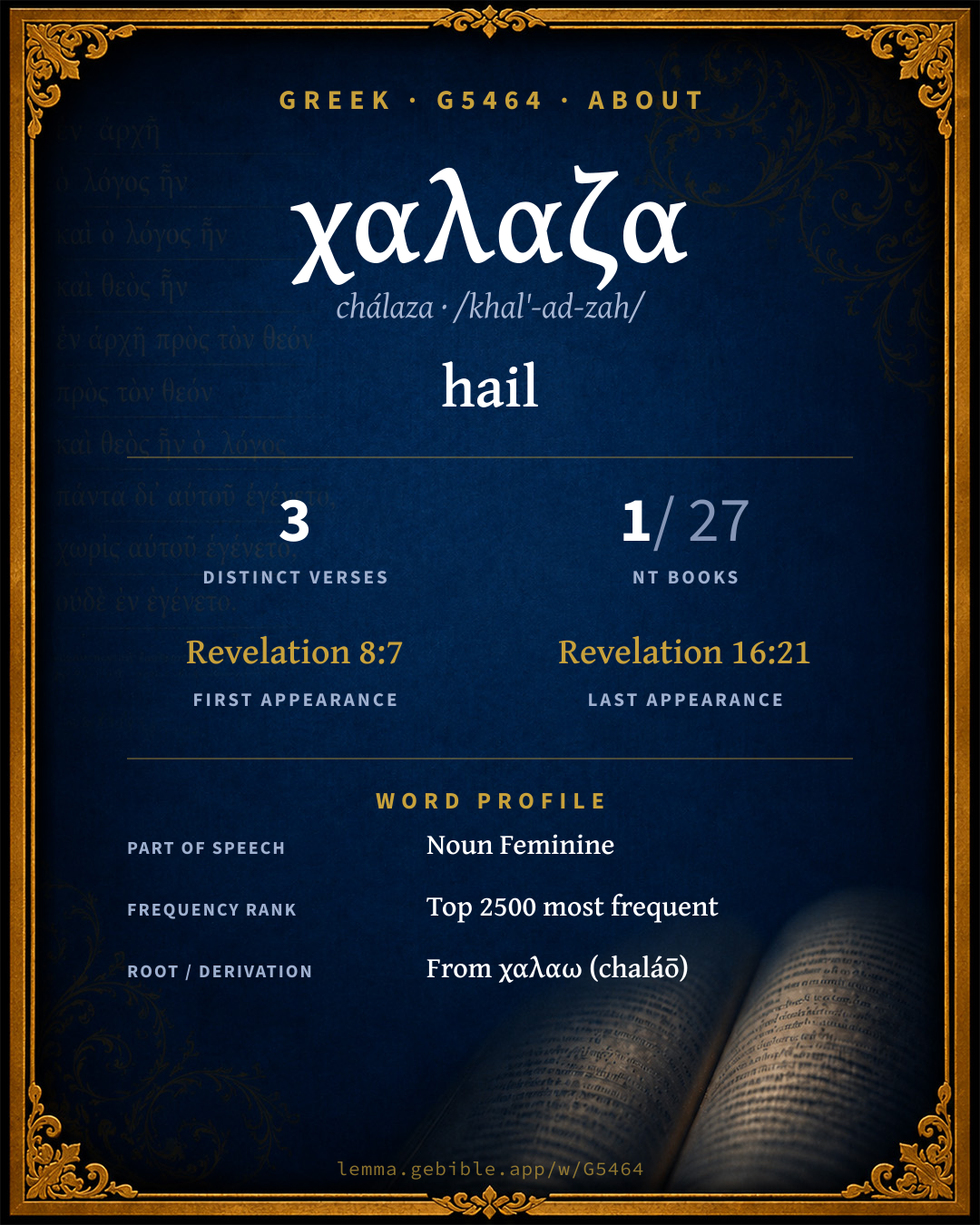
χάλαζα
hail
Full lexicon entry — Thayer's Greek Lexicon
From Thayer's Greek Lexicon
Where this word appears
See every Nominative-case word in the Greek New Testament →
Grammar key — what these labels mean
Part of speech
- Noun
- A naming word — a person, place, thing, or idea.
Case
- Nominative
- The case of the subject (and the predicate nominative).
- Genitive
- The case of source, possession, or “of” — answers “whose / from what.”
Gender
- Feminine
- Grammatically feminine.
Number
- Singular
- One.
Grammatical forms
- Noun, Nominative, Singular, Feminine 3 times (75%)
- Noun, Genitive, Singular, Feminine 1 time (25%)
Parsed forms decoded from the imported morphology (Robinson–Tischendorf, public domain), counted across 4 parsed occurrences — not distinct verses.
Every verse where G5464 appears — 3 distinct verses across 1 book. Click any verse to open its interlinear word-by-word view. Verse text shown in the World English Bible for context — . Each verse’s Greek form is shown with its reference; the English is not keyword-highlighted, since the data carries no word-level English alignment. Use “Compare translations” on any verse to read it across multiple English versions. This concordance covers the Greek New Testament; Septuagint (Greek Old Testament) occurrences of this word are not indexed here.
Revelation 3 verses
- Revelation 8:7 χάλαζα n nom sg fem The first sounded, and there followed hail and fire, mixed with blood, and they were thrown to the earth. One third of the earth was burnt up, and one third of the trees were burnt up, and all green grass was burnt up.
- Revelation 11:19 χάλαζα n nom sg fem God's temple that is in heaven was opened, and the ark of the Lord's covenant was seen in his temple. Lightnings, sounds, thunders, an earthquake, and great hail followed.
- Revelation 16:21 χάλαζα χαλάζης n nom sg fem n gen sg fem Great hailstones, about the weight of a talent, came down out of the sky on people. People blasphemed God because of the plague of the hail, for this plague is exceedingly severe.
About this entry
At a glance — auto-summarized from this page’s data, not written by a person. Every figure links to its source below. This summary describes the numbers; it doesn’t interpret them.
“hail” is the headline sense of the Greek noun χαλαζα (chálaza). With only 3 verses it sits in the long tail of Greek New Testament vocabulary. It clusters heavily in Revelation, which alone accounts for 100% of its uses. Scripture first uses it in Revelation 8:7. From the same root come χαλαω, χαλεπος and χαλινος. For the data behind this summary, explore the sense tree and the renderings breakdown below.
Gloss history
Strong's 1890 vs modern scholarship

About this word
Strong's G5464 catalogs a Greek word from the Greek New Testament.
These counts are not copied from any lexicon or concordance. They are computed here, from the morphology-tagged Greek New Testament. What Lemma adds →
- 3
- distinct verses
- The word appears in 3 distinct verses.
- 1 / 27
- NT books
- The word appears in 1 of 27 New Testament books.
- #1,877
- by frequency
- Top 2500 most frequent Greek words (rank 1,877 of 5,347 Greek words by occurrence).
View all 3 occurrences in the concordance →
Most concentrated in
- Revelation 3 verses 100%
By section of the New Testament
By traditional corpus
Conventional, traditional groupings — biblical authorship is debated, so this is a traditional corpus grouping, not an authorship claim. Some books belong to more than one corpus (Luke is in both the Gospels and the Lukan corpus, and so on), so these shares overlap and need not total 100%. Each figure is a share of the word’s 3 distinct verses.
- Johannine 3 verses · 100%
- Revelation 3 verses · 100%
How translations render this word
Counts come from each version’s own published word-to-Strong’s tagging or interlinear alignment — an approximate guide to how each version renders this word, not a word-level alignment the data otherwise carries. Because each total is that version’s own tagged count, the per-version totals vary from one another and need not match the appearance or distinct-verse counts above. These counts may also differ from a printed concordance because Lemma counts each distinctly tagged rendering and does not collapse phrase taggings into a single head-word total. This is a fixed set of word-tagged versions (KJV, ASV, BSB, ULT) and does not change with the reading translation you choose elsewhere. Each version’s license is shown beside its name below (and on Sources).
- King James Version: Hail 4×
- American Standard Version: Hail 4×
- Berean Standard Bible: Hail 2×
- unfoldingWord Literal Text: Hail 3×
King James Version Public Domain
Renders G5464 across 4 tagged occurrences — most commonly:
American Standard Version Public Domain
Renders G5464 across 4 tagged occurrences — most commonly:
Berean Standard Bible Public Domain
Renders G5464 across 4 tagged occurrences — most commonly:
Plus 2 renderings that appear only once — usually multi-word phrases or single function words the recovered tagging swept in, not distinct renderings.
unfoldingWord Literal Text CC BY-SA 4.0
Renders G5464 across 5 tagged occurrences — most commonly:
Plus 2 renderings that appear only once — usually multi-word phrases or single function words the recovered tagging swept in, not distinct renderings.
Senses in Thayer's
The 1 sense Thayer's distinguishes for this word, in lexicon order (not ranked by frequency or importance). The full entry — with sub-senses — is in the Lexicon Entry tab.
- hail
Word origin
Derived from χαλαω (chaláō) (G5465) — to relax.
Probably from G5465 ; hail : - hail.
— Strong’s Exhaustive Concordance (1890), public domain.
Forms in the corpus
The 2 distinct written forms G5464 takes in the Greek New Testament, most frequent first — each parse links to that case’s occurrences in the concordance.
| Form | Parsing | Example | Uses |
|---|---|---|---|
| χάλαζα chálaza | Noun, Nominative, Singular, Feminine | Revelation 8:7 | 3 |
| χαλάζης chalázēs | Noun, Genitive, Singular, Feminine | Revelation 16:21 | 1 |
Same root — word family
Other Thayer's entries built from the same root as G5464, grouped by Strong’s listed origin. These share a root / origin per the lexicon — not necessarily a shared meaning. Each links to that word’s own entry.
Derives from
Shares the same root
Compare all same-root words → Showing 4 of 5 — not the complete family. They share a root, not necessarily a meaning.
Septuagint usage
The same Greek word χαλαζα appears 32 times in the Greek Old Testament (Septuagint), across 26 verses in 7 books.
- 32
- LXX occurrences
- Tagged occurrences of this Greek word in the Septuagint.
- 26
- verses
- Distinct Septuagint verses containing this word.
- 7 / 39
- OT books
- The word appears in 7 of the 39 Old Testament books.
Sample Septuagint occurrences
- Exodus 9:18 χάλαζα
- Joshua 10:11 χάλαζα
- Ezra 21:5 χαλαζα
- Job 38:22 χαλάζα
- Psalms 17:13 χάλαζα
- Isaiah 28:2 χάλαζα
- Ezekiel 38:22 χάλαζα
Septuagint occurrences (same lexeme)
Every verse where the same Strong’s number (G5464) appears in the Greek Septuagint. Verse text shown in the World English Bible for context; the Greek form is the matched word — the English is not keyword-highlighted.
- Exodus 9:18 χάλαζα Behold, tomorrow about this time I will cause it to rain a very grievous hail, such as has not been in Egypt since the day it was founded even until now.
- Exodus 9:19 χάλαζα Now therefore command that all of your cattle and all that you have in the field be brought into shelter. Every man and animal that is found in the field, and isn't brought home, the hail shall come down on them, and they shall die."'"
- Exodus 9:22 χάλαζα Yahweh said to Moses, "Stretch forth your hand toward the sky, that there may be hail in all the land of Egypt, on man, and on animal, and on every herb of the field, throughout the land of Egypt."
- Exodus 9:23 χάλαζα Moses stretched forth his rod toward the heavens, and Yahweh sent thunder, hail, and lightning flashed down to the earth. Yahweh rained hail on the land of Egypt.
- Exodus 9:24 χάλαζα So there was very severe hail, and lightning mixed with the hail, such as had not been in all the land of Egypt since it became a nation.
- Exodus 9:25 χάλαζα The hail struck throughout all the land of Egypt all that was in the field, both man and animal; and the hail struck every herb of the field, and broke every tree of the field.
- Exodus 9:26 χάλαζα Only in the land of Goshen, where the children of Israel were, there was no hail.
- Exodus 9:28 χάλαζα Pray to Yahweh; for there has been enough of mighty thunderings and hail. I will let you go, and you shall stay no longer."
- Exodus 9:29 χάλαζα Moses said to him, "As soon as I have gone out of the city, I will spread abroad my hands to Yahweh. The thunders shall cease, neither shall there be any more hail; that you may know that the earth is Yahweh's.
- Exodus 9:33 χάλαζα Moses went out of the city from Pharaoh, and spread abroad his hands to Yahweh; and the thunders and hail ceased, and the rain was not poured on the earth.
- Exodus 9:34 χάλαζα When Pharaoh saw that the rain and the hail and the thunders were ceased, he sinned yet more, and hardened his heart, he and his servants.
- Exodus 10:5 χάλαζα and they shall cover the surface of the earth, so that one won't be able to see the earth. They shall eat the residue of that which has escaped, which remains to you from the hail, and shall eat every tree which grows for you out of the field.
- Exodus 10:12 χάλαζα Yahweh said to Moses, "Stretch out your hand over the land of Egypt for the locusts, that they may come up on the land of Egypt, and eat every herb of the land, even all that the hail has left."
- Exodus 10:15 χάλαζα For they covered the surface of the whole earth, so that the land was darkened, and they ate every herb of the land, and all the fruit of the trees which the hail had left. There remained nothing green, either tree or herb of the field, through all the land of Egypt.
- Joshua 10:11 χάλαζα It happened, as they fled from before Israel, while they were at the descent of Beth Horon, that Yahweh cast down great stones from the sky on them to Azekah, and they died: they were more who died with the hailstones than they whom the children of Israel killed with the sword.
- Ezra 21:5 χαλαζα
- Job 38:22 χαλάζα Have you entered the treasuries of the snow, Or have you seen the treasures of the hail,
- Psalms 17:13 χάλαζα Arise, Yahweh, Confront him, cast him down. Deliver my soul from the wicked by your sword;
- Psalms 77:47 χάλαζα
- Psalms 77:48 χάλαζα
- Psalms 104:32 χάλαζα He looks at the earth, and it trembles. He touches the mountains, and they smoke.
- Psalms 148:8 χάλαζα Lightning and hail, snow and clouds; Stormy wind, fulfilling his word;
- Isaiah 28:2 χάλαζα Behold, the Lord has a mighty and strong one; as a tempest of hail, a destroying storm, as a tempest of mighty waters overflowing, will he cast down to the earth with the hand.
- Isaiah 30:30 χάλαζα Yahweh will cause his glorious voice to be heard, and will show the lighting down of his arm, with the indignation of [his] anger, and the flame of a devouring fire, with a blast, and tempest, and hailstones.
- Isaiah 32:19 χάλαζα But it shall hail in the downfall of the forest; and the city shall be utterly laid low.
- Ezekiel 38:22 χάλαζα With pestilence and with blood will I enter into judgment with him; and I will rain on him, and on his hordes, and on the many peoples who are with him, an overflowing shower, and great hailstones, fire, and sulfur.
These are occurrences of the same Greek lexeme (G5464) in the Septuagint — not a translation of any one Hebrew word. The store carries no word-level Hebrew↔Greek alignment, so no Hebrew original is asserted here. Counts come from the recovered LXX Strong's tagging — high-frequency vocabulary is well covered, while rare or late forms may be untagged — so they reflect tagged occurrences and may slightly undercount.