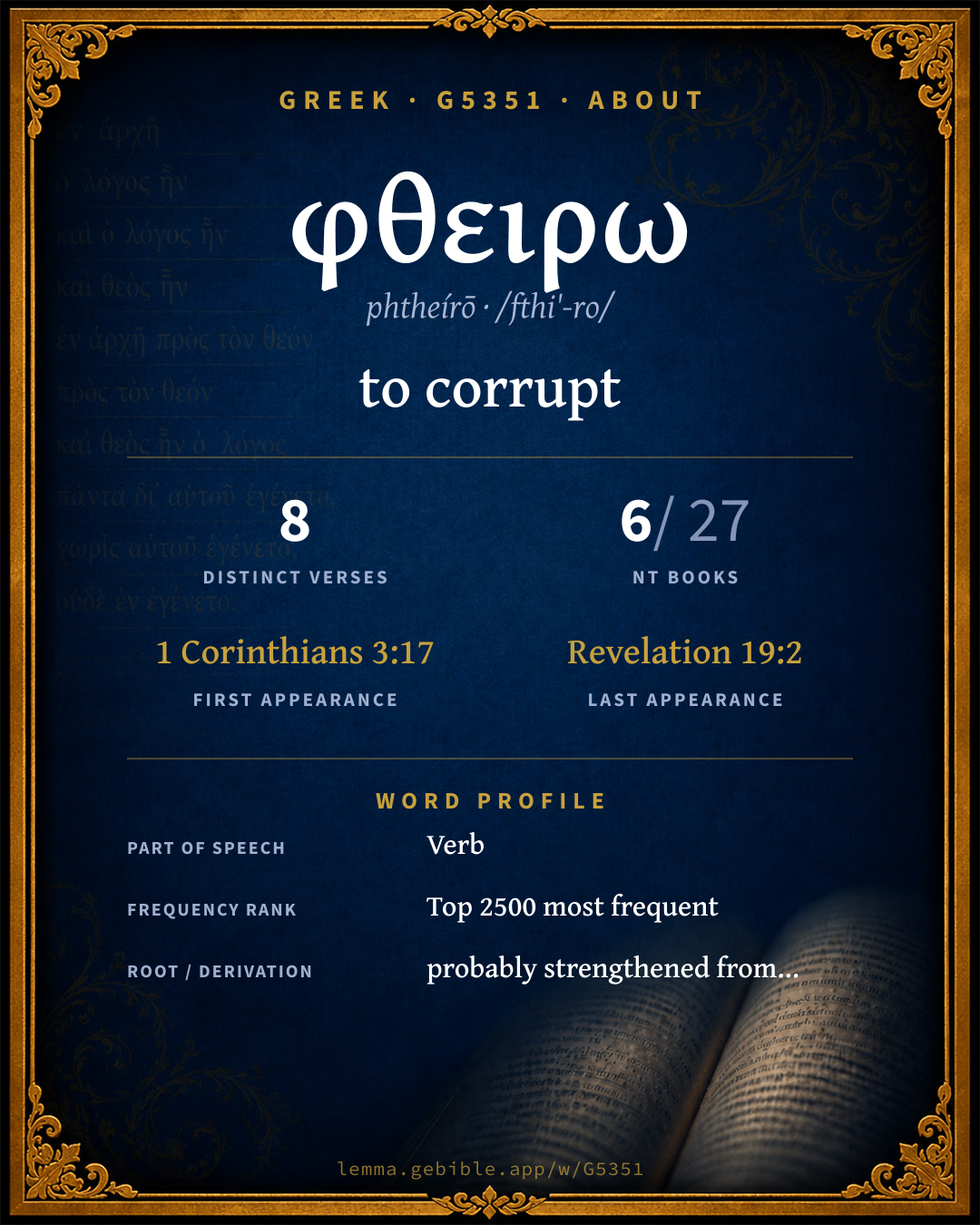
φθείρω
to corrupt
‘to corrupt’ is one of 4 main senses fuller range ↓
Full lexicon entry — Thayer's Greek Lexicon
From Thayer's Greek Lexicon
Where this word appears
See every Present-tense verb in the Greek New Testament →
Grammar key — what these labels mean
Part of speech
- Verb
- An action or state-of-being word.
Tense
- Aorist
- Action viewed as a simple whole, without regard to duration — often past (perfective aspect).
- Future
- Action expected in future time.
- Imperfect
- Continuous or repeated action in past time (“was writing”).
- Present
- Ongoing or general action in present time (imperfective aspect).
Voice
- Passive
- The subject receives the action.
- Active
- The subject performs the action.
Mood
- Subjunctive
- Expresses probability, purpose, or possibility (the mood of contingency).
- Indicative
- States a fact or asks a factual question (the mood of reality).
- Participle
- A verbal adjective (“writing,” “having written”).
Case
- Accusative
- The case of the direct object and of extent.
Person
- 3rd person
- The one spoken about (“he / she / it / they”).
- 1st person
- The speaker (“I / we”).
Gender
- Masculine
- Grammatically masculine.
Number
- Singular
- One.
- Plural
- More than one.
1 distinct verse where G5351 appears in the Imperfect tense, across 1 book. Filtered view — show all forms. Click any verse to open its interlinear word-by-word view. Verse text shown in the World English Bible for context — . Each verse’s Greek form is shown with its reference; the English is not keyword-highlighted, since the data carries no word-level English alignment. Use “Compare translations” on any verse to read it across multiple English versions. This concordance covers the Greek New Testament; Septuagint (Greek Old Testament) occurrences of this word are not indexed here.
Revelation 1 verse
About this entry
At a glance — auto-summarized from this page’s data, not written by a person. Every figure links to its source below. This summary describes the numbers; it doesn’t interpret them.
φθειρω — transliterated phtheírō — is a Greek verb carrying the sense “to corrupt.” Thayer's distinguishes 4 senses for it. With 8 verses in 6 books, it is an uncommon word in the Greek New Testament. Its uses concentrate in 1 Corinthians (25% of all occurrences). Debuting at 1 Corinthians 3:17, it then recurs through the corpus. See the sense tree, 8-verse concordance, and the renderings breakdown below.
Gloss history
Strong's 1890 vs modern scholarship
About this word
Strong's G5351 catalogs a Greek word from the Greek New Testament.
These counts are not copied from any lexicon or concordance. They are computed here, from the morphology-tagged Greek New Testament. What Lemma adds →
- 8
- distinct verses
- The word appears in 8 distinct verses.
- 6 / 27
- NT books
- The word appears in 6 of 27 New Testament books.
- #1,140
- by frequency
- Top 2500 most frequent Greek words (rank 1,140 of 5,347 Greek words by occurrence).
View all 8 occurrences in the concordance →
Most concentrated in
- 1 Corinthians 2 verses 25%
- 2 Corinthians 2 verses 25%
- Ephesians 1 verse 13%
By section of the New Testament
By traditional corpus
Conventional, traditional groupings — biblical authorship is debated, so this is a traditional corpus grouping, not an authorship claim. Some books belong to more than one corpus (Luke is in both the Gospels and the Lukan corpus, and so on), so these shares overlap and need not total 100%. Each figure is a share of the word’s 8 distinct verses.
- Pauline corpus 5 verses · 63%
- General (Catholic) Epistles 2 verses · 25%
- Johannine 1 verse · 13%
- Revelation 1 verse · 13%
How translations render this word
Counts come from each version’s own published word-to-Strong’s tagging or interlinear alignment — an approximate guide to how each version renders this word, not a word-level alignment the data otherwise carries. Because each total is that version’s own tagged count, the per-version totals vary from one another and need not match the appearance or distinct-verse counts above. These counts may also differ from a printed concordance because Lemma counts each distinctly tagged rendering and does not collapse phrase taggings into a single head-word total. This is a fixed set of word-tagged versions (KJV, ASV, BSB, ULT) and does not change with the reading translation you choose elsewhere. Each version’s license is shown beside its name below (and on Sources).
- King James Version: Corrupt 1×, Defile 1×, Destroy 1×
- American Standard Version: Corrupt 1×, Corrupted 1×, Destroy 1×
- Berean Standard Bible: Corrupted 1×, Corrupts 1×, Destroys 1×
- unfoldingWord Literal Text: Be destroyed 1×, Being corrupted 1×, Corrupts 1×
King James Version Public Domain
Renders G5351 across 9 tagged occurrences — most commonly:
American Standard Version Public Domain
Renders G5351 across 8 tagged occurrences — most commonly:
Berean Standard Bible Public Domain
Renders G5351 across 9 tagged occurrences — most commonly:
unfoldingWord Literal Text CC BY-SA 4.0
Renders G5351 across 10 tagged occurrences — most commonly:
Senses in Thayer's
The 4 senses Thayer's distinguishes for this word, in lexicon order (not ranked by frequency or importance). The full entry — with sub-senses — is in the Lexicon Entry tab.
- in the opinion of the Jews…
- to lead away a Christian church from that state of knowledge and holiness in which it ought to abide
- to be destroyed, to perish
- in an ethical sense, to corrupt, deprave
Word origin
Origin: probably strengthened from phthio (to pine or waste)
Probably strengthened from φθίω phthiō (to pine or waste ): properly to shrivel or wither that is to spoil (by any process) or (genitive) to ruin (especially figuratively by moral influences to deprave ): - corrupt (self) defile destroy.
— Strong’s Exhaustive Concordance (1890), public domain.
Forms in the corpus
The 9 distinct written forms G5351 takes in the Greek New Testament, most frequent first — each parse links to that tense’s occurrences in the concordance.
| Form | Parsing | Example | Uses |
|---|---|---|---|
| φθαρήσονται phtharḗsontai | Verb, Future, Passive, Indicative, 3rd person, Singular | 2 Peter 2:12 | 1 |
| φθαρῇ phtharē̂ | Verb, Aorist, Passive, Subjunctive, 3rd person, Singular | 2 Corinthians 11:3 | 1 |
| φθείρει phtheírei | Verb, Present, Active, Indicative, 3rd person, Singular | 1 Corinthians 3:17 | 1 |
| φθείρονται phtheírontai | Verb, Present, Passive, Indicative, 3rd person, Plural | Jude 1:10 | 1 |
| φθείρουσιν phtheírousin | Verb, Present, Active, Indicative, 3rd person, Plural | 1 Corinthians 15:33 | 1 |
| φθειρόμενον phtheirómenon | Verb, Present, Passive, Participle, Accusative, Singular, Masculine | Ephesians 4:22 | 1 |
| φθερεῖ phthereî | Verb, Future, Active, Indicative, 3rd person, Singular | 1 Corinthians 3:17 | 1 |
| ἐφθείραμεν ephtheíramen | Verb, Aorist, Active, Indicative, 1st person, Plural | 2 Corinthians 7:2 | 1 |
| ἔφθειρεν éphtheiren | Verb, Imperfect, Active, Indicative, 3rd person, Singular | Revelation 19:2 | 1 |
Same root — word family
Other Thayer's entries built from the same root as G5351, grouped by Strong’s listed origin. These share a root / origin per the lexicon — not necessarily a shared meaning. Each links to that word’s own entry.
Derived from this word
Compare all same-root words → They share a root, not necessarily a meaning.
Septuagint usage
The same Greek word φθειρω appears 18 times in the Greek Old Testament (Septuagint), across 17 verses in 11 books.
- 18
- LXX occurrences
- Tagged occurrences of this Greek word in the Septuagint.
- 17
- verses
- Distinct Septuagint verses containing this word.
- 11 / 39
- OT books
- The word appears in 11 of the 39 Old Testament books.
Sample Septuagint occurrences
- Genesis 6:11 φθείρω
- Exodus 10:15 φθείρω
- Leviticus 19:27 φθείρω
- Deuteronomy 34:7 φθείρω
- 1 Chronicles 20:1 φθείρω
- Job 15:32 φθείρω
- Isaiah 24:3 φθείρω
- Jeremiah 13:9 φθείρω
- Ezekiel 16:52 φθείρω
- Daniel 2:44 φθείρω
- Hosea 9:9 φθείρω
Septuagint occurrences (same lexeme)
Every verse where the same Strong’s number (G5351) appears in the Greek Septuagint. Verse text shown in the World English Bible for context; the Greek form is the matched word — the English is not keyword-highlighted.
- Genesis 6:11 φθείρω The earth was corrupt before God, and the earth was filled with violence.
- Exodus 10:15 φθείρω For they covered the surface of the whole earth, so that the land was darkened, and they ate every herb of the land, and all the fruit of the trees which the hail had left. There remained nothing green, either tree or herb of the field, through all the land of Egypt.
- Leviticus 19:27 φθείρω You shall not cut the hair on the sides of your heads, neither shall you clip off the edge of your beard.
- Deuteronomy 34:7 φθείρω Moses was one hundred twenty years old when he died: his eye was not dim, nor his natural force abated.
- 1 Chronicles 20:1 φθείρω It happened, at the time of the return of the year, at the time when kings go out [to battle], that Joab led forth the army, and wasted the country of the children of Ammon, and came and besieged Rabbah. But David stayed at Jerusalem. Joab struck Rabbah, and overthrew it.
- Job 15:32 φθείρω It shall be accomplished before his time. His branch shall not be green.
- Isaiah 24:3 φθείρω The earth shall be utterly emptied, and utterly laid waste; for Yahweh has spoken this word.
- Isaiah 24:4 φθείρω The earth mourns and fades away, the world languishes and fades away, the lofty people of the earth do languish.
- Isaiah 54:16 φθείρω Behold, I have created the smith who blows the fire of coals, and brings forth a weapon for his work; and I have created the waster to destroy.
- Jeremiah 13:9 φθείρω Thus says Yahweh, After this manner will I mar the pride of Judah, and the great pride of Jerusalem.
- Ezekiel 16:52 φθείρω You also, bear you your own shame, in that you have given judgment for your sisters; through your sins that you have committed more abominable than they, they are more righteous that you: yes, be also confounded, and bear your shame, in that you have justified your sisters.
- Daniel 2:44 φθείρω In the days of those kings shall the God of heaven set up a kingdom which shall never be destroyed, nor shall the sovereignty of it be left to another people; but it shall break in pieces and consume all these kingdoms, and it shall stand forever.
- Daniel 7:14 φθείρω There was given him dominion, and glory, and a kingdom, that all the peoples, nations, and languages should serve him: his dominion is an everlasting dominion, which shall not pass away, and his kingdom that which shall not be destroyed.
- Daniel 8:24 φθείρω His power shall be mighty, but not by his own power; and he shall destroy wonderfully, and shall prosper and do [his pleasure]; and he shall destroy the mighty ones and the holy people.
- Daniel 9:26 φθείρω After the sixty-two weeks the Anointed One shall be cut off, and shall have nothing: and the people of the prince who shall come shall destroy the city and the sanctuary; and the end of it shall be with a flood, and even to the end shall be war; desolations are determined.
- Daniel 11:17 φθείρω He shall set his face to come with the strength of his whole kingdom, and with him equitable conditions; and he shall perform them: and he shall give him the daughter of women, to corrupt her; but she shall not stand, neither be for him.
- Hosea 9:9 φθείρω They have deeply corrupted themselves, As in the days of Gibeah. He will remember their iniquity. He will punish them for their sins.
These are occurrences of the same Greek lexeme (G5351) in the Septuagint — not a translation of any one Hebrew word. The store carries no word-level Hebrew↔Greek alignment, so no Hebrew original is asserted here. Counts come from the recovered LXX Strong's tagging — high-frequency vocabulary is well covered, while rare or late forms may be untagged — so they reflect tagged occurrences and may slightly undercount.