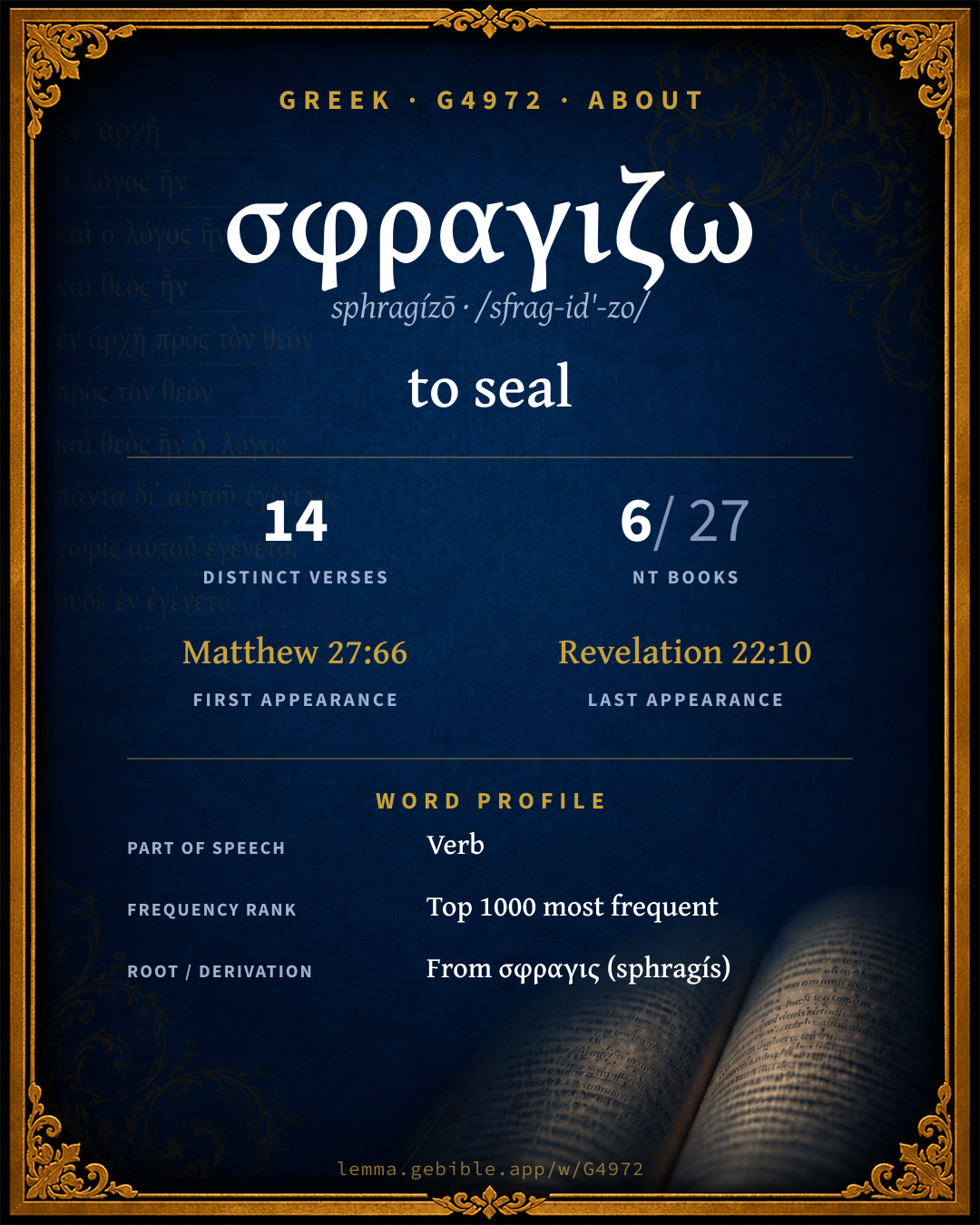
σφραγίζω
to seal
Full lexicon entry — Thayer's Greek Lexicon
From Thayer's Greek Lexicon
Where this word appears
Grammar key — what these labels mean
Part of speech
- Verb
- An action or state-of-being word.
Tense
- Aorist
- Action viewed as a simple whole, without regard to duration — often past (perfective aspect).
- Perfect
- A completed past action with continuing present results.
Voice
- Active
- The subject performs the action.
- Passive
- The subject receives the action.
- Middle
- The subject acts on or for itself, or with special interest in the action.
Mood
- Indicative
- States a fact or asks a factual question (the mood of reality).
- Participle
- A verbal adjective (“writing,” “having written”).
- Imperative
- Expresses a command or request.
- Subjunctive
- Expresses probability, purpose, or possibility (the mood of contingency).
Case
- Nominative
- The case of the subject (and the predicate nominative).
- Genitive
- The case of source, possession, or “of” — answers “whose / from what.”
Person
- 3rd person
- The one spoken about (“he / she / it / they”).
- 2nd person
- The one addressed (“you”).
- 1st person
- The speaker (“I / we”).
Gender
- Masculine
- Grammatically masculine.
Number
- Singular
- One.
- Plural
- More than one.
Every verse where G4972 appears in the Book of Ephesians — 2 distinct verses. Click any verse to open its interlinear word-by-word view. Verse text shown in the World English Bible for context — . Each verse’s Greek form is shown with its reference; the English is not keyword-highlighted, since the data carries no word-level English alignment. Use “Compare translations” on any verse to read it across multiple English versions. This concordance covers the Greek New Testament; Septuagint (Greek Old Testament) occurrences of this word are not indexed here.
Ephesians
- Ephesians 1:13 ἐσφραγίσθητε aor pass ind 2pl in whom you also, having heard the word of the truth, the Gospel of your salvation,--in whom, having also believed, you were sealed with the Holy Spirit of promise,
- Ephesians 4:30 ἐσφραγίσθητε aor pass ind 2pl Don't grieve the Holy Spirit of God, in whom you were sealed for the day of redemption.
About this entry
At a glance — auto-summarized from this page’s data, not written by a person. Every figure links to its source below. This summary describes the numbers; it doesn’t interpret them.
σφραγιζω — transliterated sphragízō — is a Greek verb carrying the sense “to seal.” Its uses cluster heavily in Revelation (50% of all occurrences). With 14 verses in 6 books, it is an uncommon word in the Greek New Testament. It first appears in Matthew 27:66. See the sense tree, 14-verse concordance, and the renderings breakdown below.
Gloss history
Strong's 1890 vs modern scholarship

About this word
Strong's G4972 catalogs a Greek word from the Greek New Testament.
These counts are not copied from any lexicon or concordance. They are computed here, from the morphology-tagged Greek New Testament. What Lemma adds →
- 14
- distinct verses
- The word appears in 14 distinct verses.
- 6 / 27
- NT books
- The word appears in 6 of 27 New Testament books.
- #768
- by frequency
- Top 1000 most frequent Greek words (rank 768 of 5,347 Greek words by occurrence).
View all 14 occurrences in the concordance →
Most concentrated in
- Revelation 7 verses 50%
- John 2 verses 14%
- Ephesians 2 verses 14%
By section of the New Testament
By traditional corpus
Conventional, traditional groupings — biblical authorship is debated, so this is a traditional corpus grouping, not an authorship claim. Some books belong to more than one corpus (Luke is in both the Gospels and the Lukan corpus, and so on), so these shares overlap and need not total 100%. Each figure is a share of the word’s 14 distinct verses.
- Johannine 9 verses · 64%
- Revelation 7 verses · 50%
- Pauline corpus 4 verses · 29%
- Gospels 3 verses · 21%
How translations render this word
Counts come from each version’s own published word-to-Strong’s tagging or interlinear alignment — an approximate guide to how each version renders this word, not a word-level alignment the data otherwise carries. Because each total is that version’s own tagged count, the per-version totals vary from one another and need not match the appearance or distinct-verse counts above. These counts may also differ from a printed concordance because Lemma counts each distinctly tagged rendering and does not collapse phrase taggings into a single head-word total. This is a fixed set of word-tagged versions (KJV, ASV, BSB, ULT) and does not change with the reading translation you choose elsewhere. Each version’s license is shown beside its name below (and on Sources).
- King James Version: Were sealed 14×, Hath 2×, Sealed 2×
- American Standard Version: Sealed 4×, Were sealed 3×, Seal 2×
- Berean Standard Bible: Were sealed 3×
- unfoldingWord Literal Text: Having sealed 3×, Having been sealed 2×, Seal 2×
King James Version Public Domain
Renders G4972 across 28 tagged occurrences — most commonly:
Plus 10 renderings that appear only once — usually multi-word phrases or single function words the recovered tagging swept in, not distinct renderings. Not rendered by a distinct English word in 1 further occurrence.
American Standard Version Public Domain
Renders G4972 across 17 tagged occurrences — most commonly:
Plus 6 renderings that appear only once — usually multi-word phrases or single function words the recovered tagging swept in, not distinct renderings.
Berean Standard Bible Public Domain
Renders G4972 across 13 tagged occurrences — most commonly:
Plus 10 renderings that appear only once — usually multi-word phrases or single function words the recovered tagging swept in, not distinct renderings. Not rendered by a distinct English word in 2 further occurrences.
unfoldingWord Literal Text CC BY-SA 4.0
Renders G4972 across 16 tagged occurrences — most commonly:
Plus 9 renderings that appear only once — usually multi-word phrases or single function words the recovered tagging swept in, not distinct renderings.
Senses in Thayer's
The 1 sense Thayer's distinguishes for this word, in lexicon order (not ranked by frequency or importance). The full entry — with sub-senses — is in the Lexicon Entry tab.
- to set a seal upon, mark with a seal, to seal
Word origin
Derived from σφραγις (sphragís) (G4973) — seal.
From G4973 ; to stamp (with a signet or private mark) for security or preservation (literally or figuratively); by implication to keep secret to attest : - (set a set to) seal up stop.
— Strong’s Exhaustive Concordance (1890), public domain.
Forms in the corpus
The 9 distinct written forms G4972 takes in the Greek New Testament, most frequent first — each parse links to that tense’s occurrences in the concordance.
| Form | Parsing | Example | Uses |
|---|---|---|---|
| ἐσφράγισεν esphrágisen | Verb, Aorist, Active, Indicative, 3rd person, Singular | John 3:33 | 3 |
| ἐσφραγισμένοι esphragisménoi | Verb, Perfect, Passive, Participle, Nominative, Plural, Masculine | Revelation 7:4 | 3 |
| σφραγισάμενος sphragisámenos | Verb, Aorist, Middle, Participle, Nominative, Singular, Masculine | Romans 15:28 | 2 |
| ἐσφραγίσθητε esphragísthēte | Verb, Aorist, Passive, Indicative, 2nd person, Plural | Ephesians 1:13 | 2 |
| σφράγισον sphrágison | Verb, Aorist, Active, Imperative, 2nd person, Singular | Revelation 10:4 | 1 |
| σφραγίσαντες sphragísantes | Verb, Aorist, Active, Participle, Nominative, Plural, Masculine | Matthew 27:66 | 1 |
| σφραγίσωμεν sphragísōmen | Verb, Aorist, Active, Subjunctive, 1st person, Plural | Revelation 7:3 | 1 |
| σφραγίσῃς sphragísēs | Verb, Aorist, Active, Subjunctive, 2nd person, Singular | Revelation 22:10 | 1 |
| ἐσφραγισμένων esphragisménōn | Verb, Perfect, Passive, Participle, Genitive, Plural, Masculine | Revelation 7:4 | 1 |
Septuagint usage
The same Greek word σφραγιζω appears 21 times in the Greek Old Testament (Septuagint), across 19 verses in 10 books.
- 21
- LXX occurrences
- Tagged occurrences of this Greek word in the Septuagint.
- 19
- verses
- Distinct Septuagint verses containing this word.
- 10 / 39
- OT books
- The word appears in 10 of the 39 Old Testament books.
Sample Septuagint occurrences
- Deuteronomy 32:34 σφραγίζω
- 1 Kings 20:8 σφραγίζω
- 2 Kings 22:4 σφραγίζω
- Ezra 20:2 σφραγίζω
- Esther 3:10 σφραγίζω
- Job 14:17 σφραγίζω
- Song of Solomon 4:12 σφραγίζω
- Isaiah 8:16 σφραγίζω
- Jeremiah 39:10 σφραγίζω
- Daniel 6:18 σφραγίζω
Septuagint occurrences (same lexeme)
Every verse where the same Strong’s number (G4972) appears in the Greek Septuagint. Verse text shown in the World English Bible for context; the Greek form is the matched word — the English is not keyword-highlighted.
- Deuteronomy 32:34 σφραγίζω Isn't this laid up in store with me, Sealed up among my treasures?
- 1 Kings 20:8 σφραγίζω All the elders and all the people said to him, Don't you listen, neither consent.
- 2 Kings 22:4 σφραγίζω Go up to Hilkiah the high priest, that he may sum the money which is brought into the house of Yahweh, which the keepers of the threshold have gathered of the people:
- Ezra 20:2 σφραγίζω
- Esther 3:10 σφραγίζω The king took his ring from his hand, and gave it to Haman the son of Hammedatha the Agagite, the Jews' enemy.
- Esther 8:8 σφραγίζω Write you also to the Jews, as it pleases you, in the king's name, and seal it with the king's ring; for the writing which is written in the king's name, and sealed with the king's ring, may no man reverse.
- Esther 8:10 σφραγίζω He wrote the name of king Ahasuerus, and sealed it with the king's ring, and sent letters by post on horseback, riding on swift steeds that were used in the king's service, bred of the stud:
- Job 14:17 σφραγίζω My disobedience is sealed up in a bag. You fasten up my iniquity.
- Job 24:16 σφραγίζω In the dark they dig through houses. They shut themselves up in the daytime. They don't know the light.
- Song of Solomon 4:12 σφραγίζω A locked up garden is my sister, my bride; A locked up spring, A sealed fountain.
- Isaiah 8:16 σφραγίζω Bind up the testimony, seal the law among my disciples.
- Isaiah 29:11 σφραγίζω All vision is become to you as the words of a book that is sealed, which men deliver to one who is learned, saying, Read this, I pray you; and he says, I can't, for it is sealed:
- Jeremiah 39:10 σφραγίζω But Nebuzaradan the captain of the guard left of the poor of the people, who had nothing, in the land of Judah, and gave them vineyards and fields at the same time.
- Jeremiah 39:11 σφραγίζω Now Nebuchadrezzar king of Babylon gave charge concerning Jeremiah to Nebuzaradan the captain of the guard, saying,
- Jeremiah 39:25 σφραγίζω
- Jeremiah 39:44 σφραγίζω
- Daniel 6:18 σφραγίζω Then the king went to his palace, and passed the night fasting; neither were instruments of music brought before him: and his sleep fled from him.
- Daniel 12:4 σφραγίζω But you, Daniel, shut up the words, and seal the book, even to the time of the end: many shall run back and forth, and knowledge shall be increased."
- Daniel 12:9 σφραγίζω He said, Go your way, Daniel; for the words are shut up and sealed until the time of the end.
These are occurrences of the same Greek lexeme (G4972) in the Septuagint — not a translation of any one Hebrew word. The store carries no word-level Hebrew↔Greek alignment, so no Hebrew original is asserted here. Counts come from the recovered LXX Strong's tagging — high-frequency vocabulary is well covered, while rare or late forms may be untagged — so they reflect tagged occurrences and may slightly undercount.