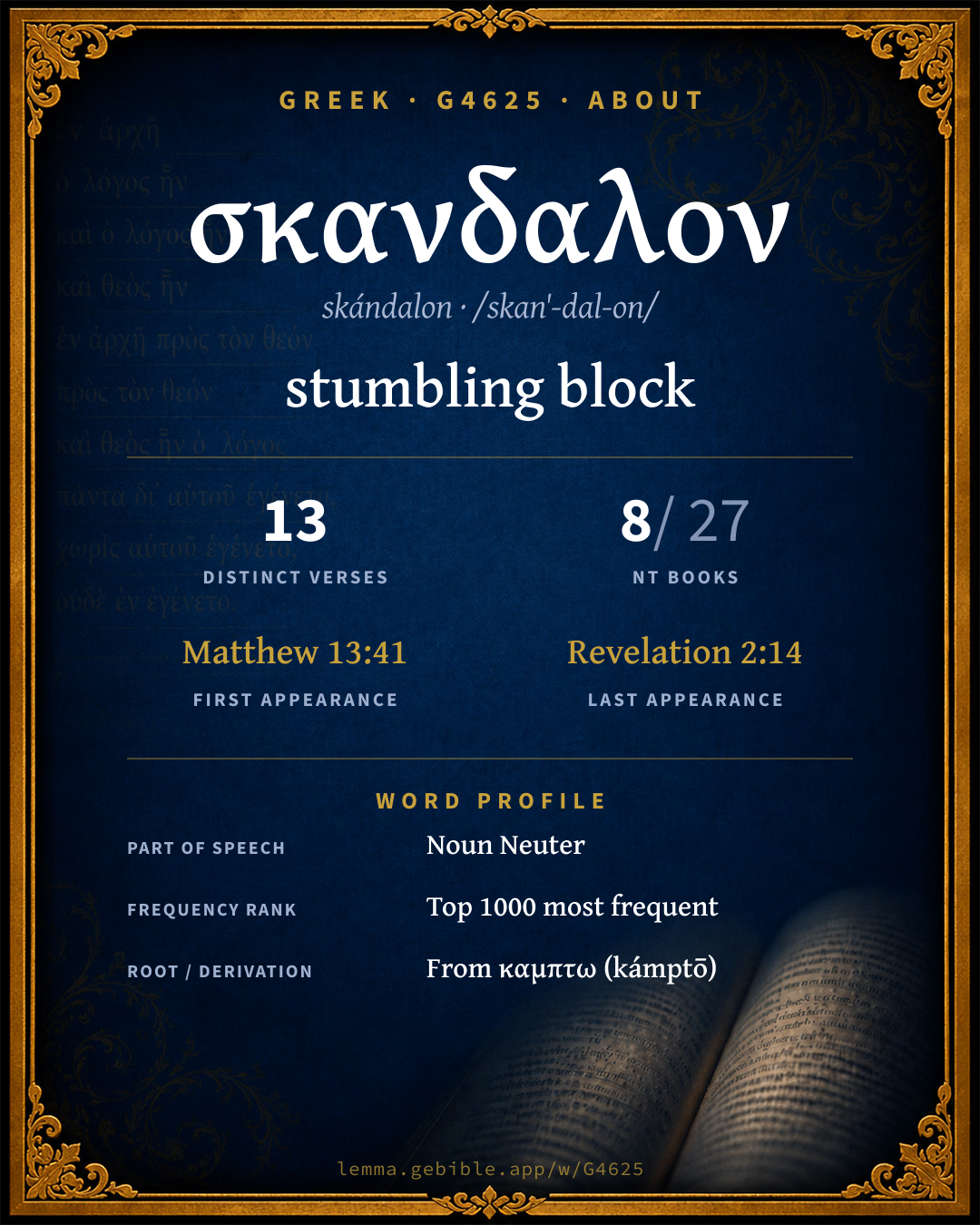
σκάνδαλον
stumbling block
‘stumbling block’ is one of 2 main senses fuller range ↓
Full lexicon entry — Thayer's Greek Lexicon
From Thayer's Greek Lexicon
Where this word appears
See every Accusative-case word in the Greek New Testament →
Grammar key — what these labels mean
Part of speech
- Noun
- A naming word — a person, place, thing, or idea.
Case
- Accusative
- The case of the direct object and of extent.
- Nominative
- The case of the subject (and the predicate nominative).
- Genitive
- The case of source, possession, or “of” — answers “whose / from what.”
Gender
- Neuter
- Grammatically neuter.
Number
- Plural
- More than one.
- Singular
- One.
Grammatical forms
- Noun, Accusative, Plural, Neuter 4 times (27%)
- Noun, Accusative, Singular, Neuter 4 times (27%)
- Noun, Nominative, Singular, Neuter 4 times (27%)
- Noun, Genitive, Singular, Neuter 2 times (13%)
- Noun, Genitive, Plural, Neuter 1 time (7%)
Parsed forms decoded from the imported morphology (Robinson–Tischendorf, public domain), counted across 15 parsed occurrences — not distinct verses.
Every verse where G4625 appears — 13 distinct verses across 8 books. Click any verse to open its interlinear word-by-word view. Verse text shown in the World English Bible for context — . Each verse’s Greek form is shown with its reference; the English is not keyword-highlighted, since the data carries no word-level English alignment. Use “Compare translations” on any verse to read it across multiple English versions. This concordance covers the Greek New Testament; Septuagint (Greek Old Testament) occurrences of this word are not indexed here.
Matthew 3 verses
- Matthew 13:41 σκάνδαλα n acc pl neut The Son of Man will send out his angels, and they will gather out of his Kingdom all things that cause stumbling, and those who do iniquity,
- Matthew 16:23 σκάνδαλον n nom sg neut But he turned, and said to Peter, "Get behind me, Satan! You are a stumbling-block to me, for you are not setting your mind on the things of God, but on the things of men."
- Matthew 18:7 σκανδάλων σκάνδαλα σκάνδαλον n gen pl neut n acc pl neut n nom sg neut "Woe to the world because of occasions of stumbling! For it must be that the occasions come, but woe to that person through whom the occasion comes!
Luke 1 verse
Romans 4 verses
- Romans 9:33 σκανδάλου n gen sg neut even as it is written, "Behold, I lay in Zion a stumbling stone and a rock of offense; And no one who believes in him will be disappointed."
- Romans 11:9 σκάνδαλον n acc sg neut David says, "Let their table be made a snare, and a trap, A stumbling block, and a retribution to them.
- Romans 14:13 σκάνδαλον n acc sg neut Therefore let's not judge one another any more, but judge this rather, that no man put a stumbling block in his brother's way, or an occasion for falling.
- Romans 16:17 σκάνδαλα n acc pl neut Now I beg you, brothers, look out for those who are causing the divisions and occasions of stumbling, contrary to the doctrine which you learned, and turn away from them.
1 Corinthians 1 verse
Galatians 1 verse
1 Peter 1 verse
1 John 1 verse
Revelation 1 verse
About this entry
At a glance — auto-summarized from this page’s data, not written by a person. Every figure links to its source below. This summary describes the numbers; it doesn’t interpret them.
σκανδαλον — transliterated skándalon — is a Greek noun carrying the sense “stumbling block.” Where the King James Version says “offence,” newer translations reach for “stumbling block” (unfoldingWord Literal Text); the renderings breakdown has the detail. It appears 13 verses across 8 books of the Greek New Testament, among its uncommon vocabulary. More than a quarter of its appearances fall in Romans. Its lexical range runs to 2 senses. See the sense tree, 13-verse concordance, and the renderings breakdown below.
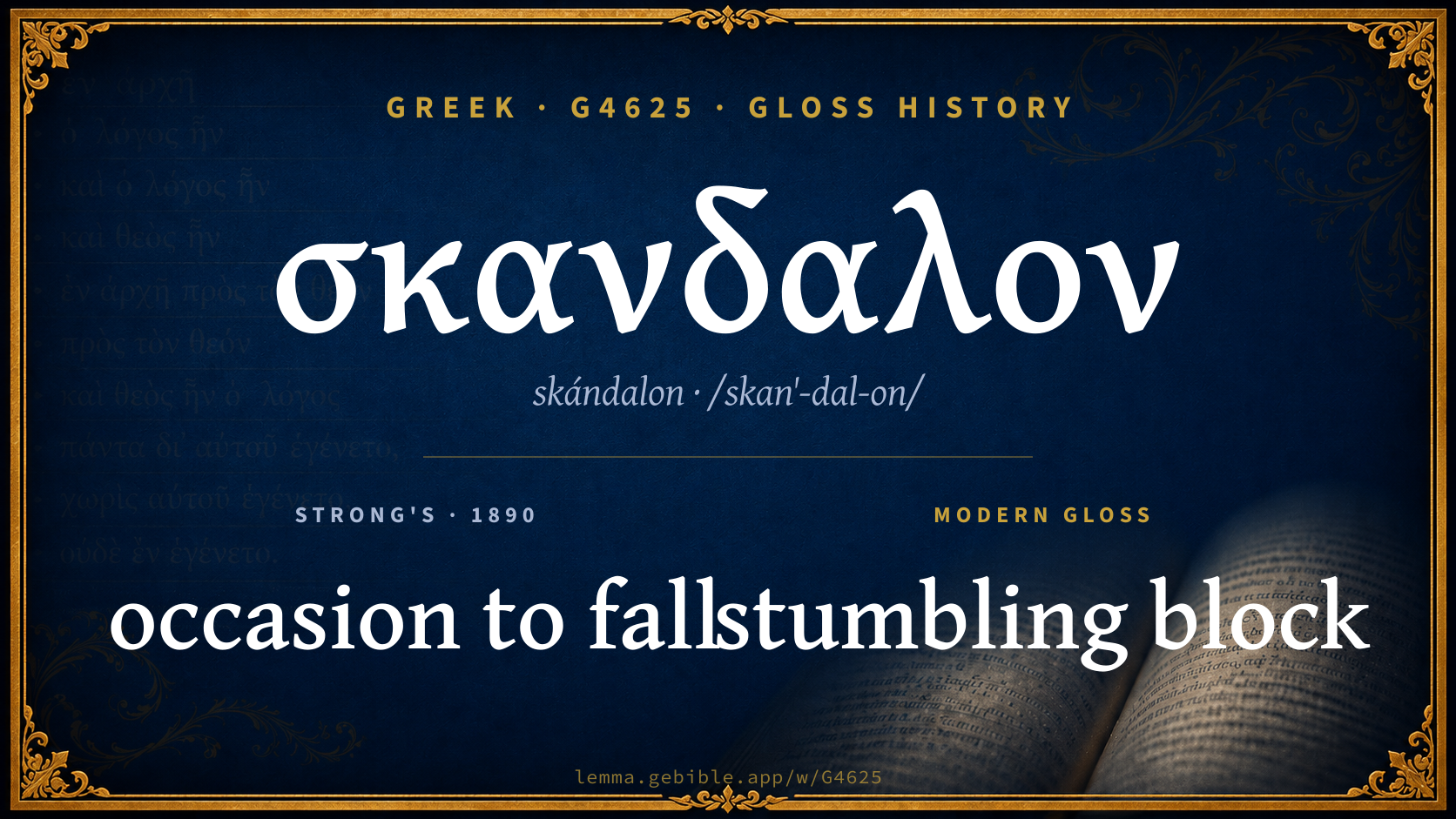
Gloss history
Strong's 1890 vs modern scholarship
About this word
Strong's G4625 catalogs a Greek word from the Greek New Testament.
These counts are not copied from any lexicon or concordance. They are computed here, from the morphology-tagged Greek New Testament. What Lemma adds →
- 13
- distinct verses
- The word appears in 13 distinct verses.
- 8 / 27
- NT books
- The word appears in 8 of 27 New Testament books.
- #768
- by frequency
- Top 1000 most frequent Greek words (rank 768 of 5,347 Greek words by occurrence).
View all 13 occurrences in the concordance →
By section of the New Testament
By traditional corpus
Conventional, traditional groupings — biblical authorship is debated, so this is a traditional corpus grouping, not an authorship claim. Some books belong to more than one corpus (Luke is in both the Gospels and the Lukan corpus, and so on), so these shares overlap and need not total 100%. Each figure is a share of the word’s 13 distinct verses.
- Pauline corpus 6 verses · 46%
- Gospels 4 verses · 31%
- Johannine 2 verses · 15%
- General (Catholic) Epistles 2 verses · 15%
- Lukan (Luke–Acts) 1 verse · 8%
- Revelation 1 verse · 8%
How translations render this word
Counts come from each version’s own published word-to-Strong’s tagging or interlinear alignment — an approximate guide to how each version renders this word, not a word-level alignment the data otherwise carries. Because each total is that version’s own tagged count, the per-version totals vary from one another and need not match the appearance or distinct-verse counts above. These counts may also differ from a printed concordance because Lemma counts each distinctly tagged rendering and does not collapse phrase taggings into a single head-word total. This is a fixed set of word-tagged versions (KJV, ASV, BSB, ULT) and does not change with the reading translation you choose elsewhere. Each version’s license is shown beside its name below (and on Sources).
- King James Version: Offence 5×, Offences 4×
- American Standard Version: Occasions of stumbling 3×, Offence 2×, Stumbling-block 2×
- Berean Standard Bible: Stumbling block 4×, Offense 3×, Stumbling blocks 2×
- unfoldingWord Literal Text: Stumbling block 7×, Stumbling blocks 4×, Offense 2×
King James Version Public Domain
Renders G4625 across 13 tagged occurrences — most commonly:
Plus 4 renderings that appear only once — usually multi-word phrases or single function words the recovered tagging swept in, not distinct renderings. Not rendered by a distinct English word in 2 further occurrences.
American Standard Version Public Domain
Renders G4625 across 15 tagged occurrences — most commonly:
Plus 6 renderings that appear only once — usually multi-word phrases or single function words the recovered tagging swept in, not distinct renderings.
Berean Standard Bible Public Domain
Renders G4625 across 14 tagged occurrences — most commonly:
Plus 5 renderings that appear only once — usually multi-word phrases or single function words the recovered tagging swept in, not distinct renderings. Not rendered by a distinct English word in 1 further occurrence.
unfoldingWord Literal Text CC BY-SA 4.0
Renders G4625 across 15 tagged occurrences — most commonly:
Plus 2 renderings that appear only once — usually multi-word phrases or single function words the recovered tagging swept in, not distinct renderings.
Senses in Thayer's
The 2 senses Thayer's distinguishes for this word, in lexicon order (not ranked by frequency or importance). The full entry — with sub-senses — is in the Lexicon Entry tab.
- the movable stick or trigger of a trap, a trap stick
- any person or thing by which one is (entrapped) drawn into error or sin
Word origin
Derived from καμπτω (kámptō) (G2578) — to bow.
A scandal; probably from a derivative of G2578 ; a trap stick ( bent sapling) that is snare (figuratively cause of displeasure or sin): - occasion to fall (of stumbling) offence thing that offends stumbling-block.
— Strong’s Exhaustive Concordance (1890), public domain.
Forms in the corpus
The 4 distinct written forms G4625 takes in the Greek New Testament, most frequent first — each parse links to that case’s occurrences in the concordance.
| Form | Parsing | Example | Uses |
|---|---|---|---|
| σκάνδαλον skándalon | Noun, Accusative, Singular, Neuter | Romans 11:9 | 8 |
| σκάνδαλα skándala | Noun, Accusative, Plural, Neuter | Matthew 13:41 | 4 |
| σκανδάλου skandálou | Noun, Genitive, Singular, Neuter | Romans 9:33 | 2 |
| σκανδάλων skandálōn | Noun, Genitive, Plural, Neuter | Matthew 18:7 | 1 |
Same root — word family
Other Thayer's entries built from the same root as G4625, grouped by Strong’s listed origin. These share a root / origin per the lexicon — not necessarily a shared meaning. Each links to that word’s own entry.
Derives from
Derived from this word
Compare all same-root words → They share a root, not necessarily a meaning.
Septuagint usage
The same Greek word σκανδαλον appears 13 times in the Greek Old Testament (Septuagint), across 13 verses in 6 books.
- 13
- LXX occurrences
- Tagged occurrences of this Greek word in the Septuagint.
- 13
- verses
- Distinct Septuagint verses containing this word.
- 6 / 39
- OT books
- The word appears in 6 of the 39 Old Testament books.
Sample Septuagint occurrences
- Leviticus 19:14 σκάνδαλον
- Joshua 23:13 σκάνδαλον
- Judges 2:3 σκάνδαλον
- 1 Samuel 18:11 σκάνδαλον
- Psalms 48:14 σκάνδαλον
- Hosea 4:17 σκάνδαλον
Septuagint occurrences (same lexeme)
Every verse where the same Strong’s number (G4625) appears in the Greek Septuagint. Verse text shown in the World English Bible for context; the Greek form is the matched word — the English is not keyword-highlighted.
- Leviticus 19:14 σκάνδαλον "'You shall not curse the deaf, nor put a stumbling block before the blind; but you shall fear your God. I am Yahweh.
- Joshua 23:13 σκάνδαλον know for a certainty that Yahweh your God will no more drive these nations from out of your sight; but they shall be a snare and a trap to you, and a scourge in your sides, and thorns in your eyes, until you perish from off this good land which Yahweh your God has given you.
- Judges 2:3 σκάνδαλον Therefore I also said, I will not drive them out from before you; but they shall be [as thorns] in your sides, and their gods shall be a snare to you.
- 1 Samuel 18:11 σκάνδαλον and Saul cast the spear; for he said, I will strike David even to the wall. David avoided out of his presence twice.
- 1 Samuel 25:31 σκάνδαλον that this shall be no grief to you, nor offense of heart to my lord, either that you have shed blood without cause, or that my lord has avenged himself. When Yahweh shall have dealt well with my lord, then remember your handmaid.
- Psalms 48:14 σκάνδαλον For this God is our God forever and ever. He will be our guide even to death.
- Psalms 49:20 σκάνδαλον A man who has riches without understanding, Is like the animals that perish.
- Psalms 68:23 σκάνδαλον That you may crush them, dipping your foot in blood, That the tongues of your dogs may have their portion from your enemies."
- Psalms 105:36 σκάνδαλον He struck also all the firstborn in their land, The first fruits of all their manhood.
- Psalms 118:165 σκάνδαλον
- Psalms 139:6 σκάνδαλον This knowledge is beyond me. It's lofty. I can't attain it.
- Psalms 140:9 σκάνδαλον As for the head of those who surround me, Let the mischief of their own lips cover them.
- Hosea 4:17 σκάνδαλον Ephraim is joined to idols. Leave him alone!
These are occurrences of the same Greek lexeme (G4625) in the Septuagint — not a translation of any one Hebrew word. The store carries no word-level Hebrew↔Greek alignment, so no Hebrew original is asserted here. Counts come from the recovered LXX Strong's tagging — high-frequency vocabulary is well covered, while rare or late forms may be untagged — so they reflect tagged occurrences and may slightly undercount.