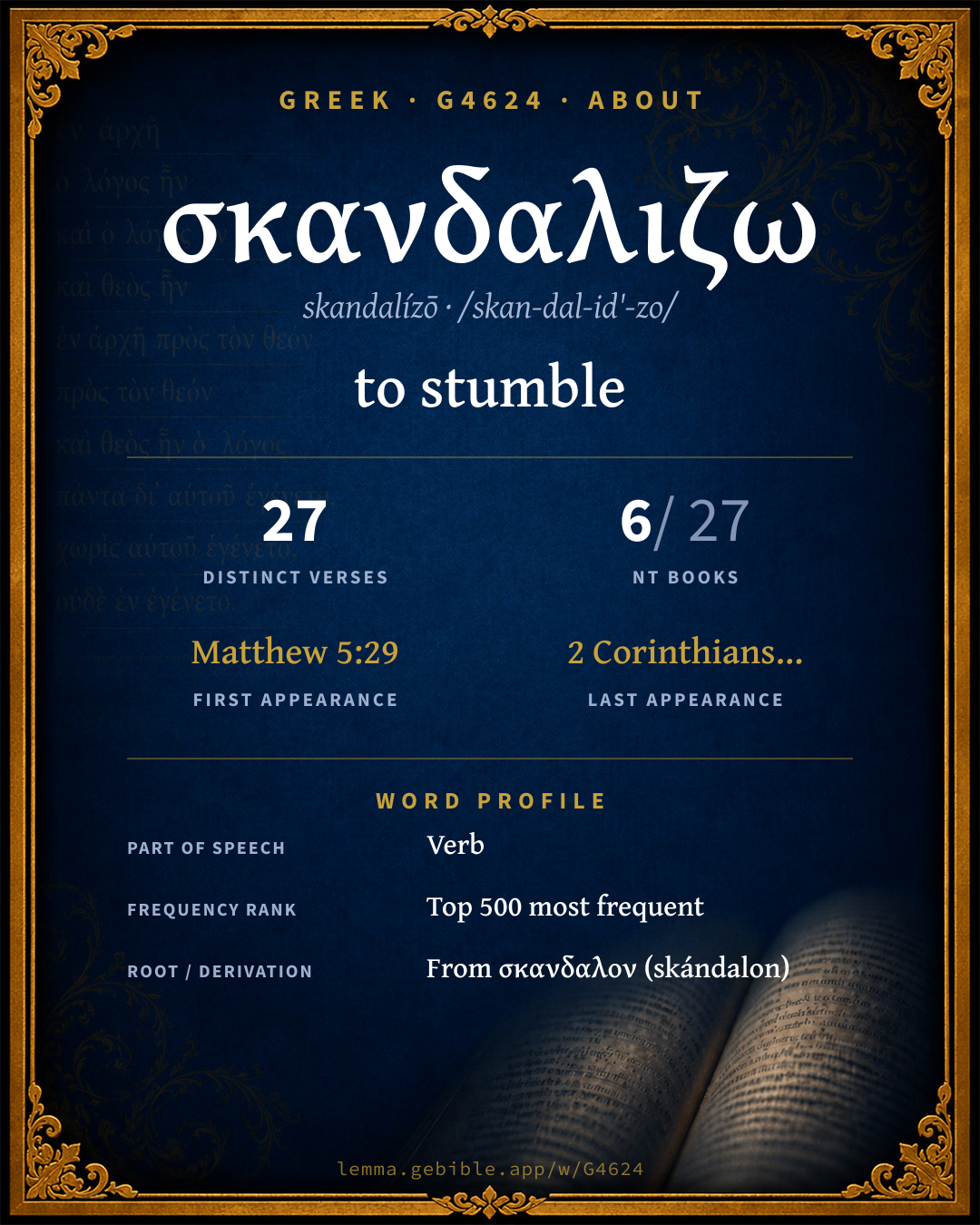
σκανδαλίζω
to stumble
Full lexicon entry — Thayer's Greek Lexicon
From Thayer's Greek Lexicon
Where this word appears
See every Present-tense verb in the Greek New Testament →
Grammar key — what these labels mean
Part of speech
- Verb
- An action or state-of-being word.
Tense
- Present
- Ongoing or general action in present time (imperfective aspect).
- Aorist
- Action viewed as a simple whole, without regard to duration — often past (perfective aspect).
- Future
- Action expected in future time.
- Imperfect
- Continuous or repeated action in past time (“was writing”).
Voice
- Active
- The subject performs the action.
- Passive
- The subject receives the action.
Mood
- Indicative
- States a fact or asks a factual question (the mood of reality).
- Subjunctive
- Expresses probability, purpose, or possibility (the mood of contingency).
Person
- 3rd person
- The one spoken about (“he / she / it / they”).
- 2nd person
- The one addressed (“you”).
- 1st person
- The speaker (“I / we”).
Number
- Singular
- One.
- Plural
- More than one.
Grammatical forms 14 distinct
- Verb, Present, Active, Indicative, 3rd person, Singular 6 times (21%)
- Verb, Aorist, Active, Subjunctive, 3rd person, Singular 4 times (14%)
- Verb, Future, Passive, Indicative, 3rd person, Plural 3 times (10%)
- Verb, Aorist, Passive, Subjunctive, 3rd person, Singular 2 times (7%)
- Verb, Future, Passive, Indicative, 2nd person, Plural 2 times (7%)
- Verb, Imperfect, Passive, Indicative, 3rd person, Plural 2 times (7%)
- Verb, Present, Active, Subjunctive, 3rd person, Singular 2 times (7%)
- Verb, Present, Passive, Indicative, 3rd person, Singular 2 times (7%)
+6 more forms (6 occurrences)
Parsed forms decoded from the imported morphology (Robinson–Tischendorf, public domain), counted across 29 parsed occurrences — not distinct verses.
Every verse where G4624 appears — 27 distinct verses across 6 books. Click any verse to open its interlinear word-by-word view. Verse text shown in the World English Bible for context — . Each verse’s Greek form is shown with its reference; the English is not keyword-highlighted, since the data carries no word-level English alignment. Use “Compare translations” on any verse to read it across multiple English versions. This concordance covers the Greek New Testament; Septuagint (Greek Old Testament) occurrences of this word are not indexed here.
Matthew 13 verses
- Matthew 5:29 σκανδαλίζει pres act ind 3sg If your right eye causes you to stumble, pluck it out and throw it away from you. For it is more profitable for you that one of your members should perish, than for your whole body to be cast into Gehenna.
- Matthew 5:30 σκανδαλίζει pres act ind 3sg If your right hand causes you to stumble, cut it off, and throw it away from you: for it is profitable for you that one of your members should perish, and not your whole body be thrown into Gehenna.
- Matthew 11:6 σκανδαλισθῇ aor pass subj 3sg Blessed is he who finds no occasion for stumbling in me."
- Matthew 13:21 σκανδαλίζεται pres pass ind 3sg yet he has no root in himself, but endures for a while. When oppression or persecution arises because of the word, immediately he stumbles.
- Matthew 13:57 ἐσκανδαλίζοντο impf pass ind 3pl They were offended by him. But Jesus said to them, "A prophet is not without honor, except in his own country, and in his own house."
- Matthew 15:12 ἐσκανδαλίσθησαν aor pass ind 3pl Then the disciples came, and said to him, "Do you know that the Pharisees were offended, when they heard this saying?"
- Matthew 17:27 σκανδαλίσωμεν aor act subj 1pl But, lest we cause them to stumble, go to the sea, and cast a hook, and take up the first fish that comes up. When you have opened its mouth, you will find a stater coin. Take that, and give it to them for me and you."
- Matthew 18:6 σκανδαλίσῃ aor act subj 3sg but whoever causes one of these little ones who believe in me to stumble, it would be better for him that a huge millstone should be hung around his neck, and that he should be sunk in the depths of the sea.
- Matthew 18:8 σκανδαλίζει pres act ind 3sg If your hand or your foot causes you to stumble, cut it off, and cast it from you. It is better for you to enter into life maimed or crippled, rather than having two hands or two feet to be cast into the eternal fire.
- Matthew 18:9 σκανδαλίζει pres act ind 3sg If your eye causes you to stumble, pluck it out, and cast it from you. It is better for you to enter into life with one eye, rather than having two eyes to be cast into the Gehenna of fire.
- Matthew 24:10 σκανδαλισθήσονται fut pass ind 3pl Then many will stumble, and will deliver up one another, and will hate one another.
- Matthew 26:31 σκανδαλισθήσεσθε fut pass ind 2pl Then Jesus said to them, "All of you will be made to stumble because of me tonight, for it is written, 'I will strike the shepherd, and the sheep of the flock will be scattered.'
- Matthew 26:33 σκανδαλισθήσονται σκανδαλισθήσομαι fut pass ind 3pl fut pass ind 1sg But Peter answered him, "Even if all will be made to stumble because of you, I will never be made to stumble."
Mark 8 verses
- Mark 4:17 σκανδαλίζονται pres pass ind 3pl They have no root in themselves, but are short-lived. When oppression or persecution arises because of the word, immediately they stumble.
- Mark 6:3 ἐσκανδαλίζοντο impf pass ind 3pl Isn't this the carpenter, the son of Mary, and brother of James, Joses, Judas, and Simon? Aren't his sisters here with us?" They were offended at him.
- Mark 9:42 σκανδαλίσῃ aor act subj 3sg Whoever will cause one of these little ones who believe in me to stumble, it would be better for him if he was thrown into the sea with a millstone hung around his neck.
- Mark 9:43 σκανδαλίσῃ aor act subj 3sg If your hand causes you to stumble, cut it off. It is better for you to enter into life maimed, rather than having your two hands to go into Gehenna, into the unquenchable fire,
- Mark 9:45 σκανδαλίζῃ pres act subj 3sg If your foot causes you to stumble, cut it off. It is better for you to enter into life lame, rather than having your two feet to be cast into Gehenna, into the fire that will never be quenched--
- Mark 9:47 σκανδαλίζῃ pres act subj 3sg If your eye causes you to stumble, cast it out. It is better for you to enter into the Kingdom of God with one eye, rather than having two eyes to be cast into the Gehenna of fire,
- Mark 14:27 σκανδαλισθήσεσθε fut pass ind 2pl Jesus said to them, "All of you will be made to stumble because of me tonight, for it is written, 'I will strike the shepherd, and the sheep will be scattered.'
- Mark 14:29 σκανδαλισθήσονται fut pass ind 3pl But Peter said to him, "Although all will be offended, yet I will not."
Luke 2 verses
John 2 verses
1 Corinthians 1 verse
2 Corinthians 1 verse
About this entry
At a glance — auto-summarized from this page’s data, not written by a person. Every figure links to its source below. This summary describes the numbers; it doesn’t interpret them.
σκανδαλιζω — transliterated skandalízō — is a Greek verb carrying the sense “to stumble.” Where the King James Version says “offend,” newer translations reach for “causes you to sin” (Berean Standard Bible) and “stumble” (unfoldingWord Literal Text); the renderings breakdown has the detail. The Greek New Testament uses it across 27 verses — moderately common. More than a third of its appearances fall in Matthew. Debuting at Matthew 5:29, it then recurs through the corpus. Each statement above links to its evidence; the full detail follows below.
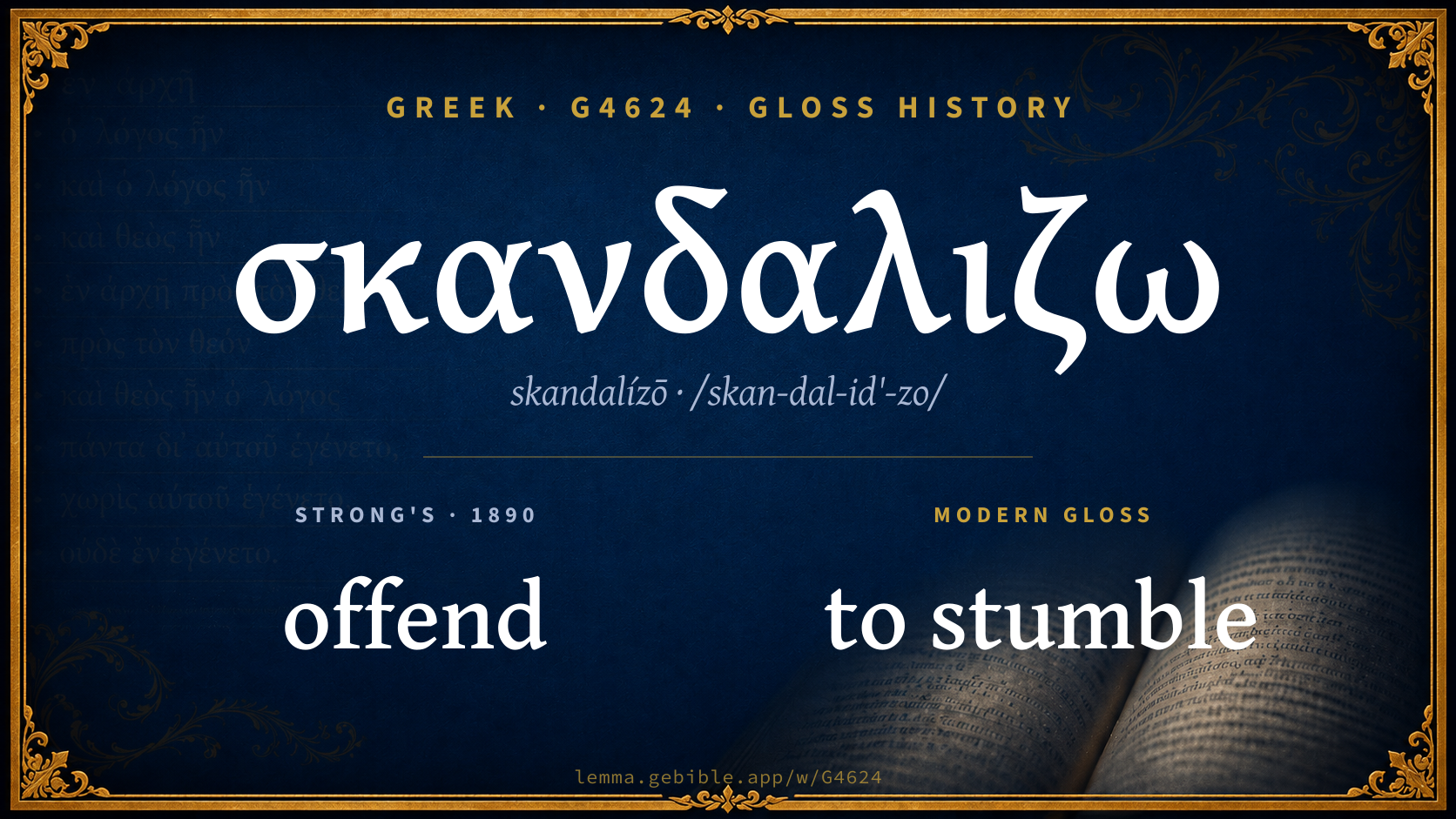
Gloss history
Strong's 1890 vs modern scholarship
About this word
Strong's G4624 catalogs a Greek word from the Greek New Testament.
These counts are not copied from any lexicon or concordance. They are computed here, from the morphology-tagged Greek New Testament. What Lemma adds →
- 27
- distinct verses
- The word appears in 27 distinct verses.
- 6 / 27
- NT books
- The word appears in 6 of 27 New Testament books.
- #471
- by frequency
- Top 500 most frequent Greek words (rank 471 of 5,347 Greek words by occurrence).
View all 27 occurrences in the concordance →
By section of the New Testament
By traditional corpus
Conventional, traditional groupings — biblical authorship is debated, so this is a traditional corpus grouping, not an authorship claim. Some books belong to more than one corpus (Luke is in both the Gospels and the Lukan corpus, and so on), so these shares overlap and need not total 100%. Each figure is a share of the word’s 27 distinct verses.
- Gospels 25 verses · 93%
- Lukan (Luke–Acts) 2 verses · 7%
- Johannine 2 verses · 7%
- Pauline corpus 2 verses · 7%
How translations render this word
Counts come from each version’s own published word-to-Strong’s tagging or interlinear alignment — an approximate guide to how each version renders this word, not a word-level alignment the data otherwise carries. Because each total is that version’s own tagged count, the per-version totals vary from one another and need not match the appearance or distinct-verse counts above. These counts may also differ from a printed concordance because Lemma counts each distinctly tagged rendering and does not collapse phrase taggings into a single head-word total. This is a fixed set of word-tagged versions (KJV, ASV, BSB, ULT) and does not change with the reading translation you choose elsewhere. Each version’s license is shown beside its name below (and on Sources).
- King James Version: Offend 9×, Be offended 5×, Shall be offended 3×
- American Standard Version: Stumble 14×, Shall be offended 3×, Occasion of stumbling 2×
- Berean Standard Bible: Causes you to sin 7×, Causes 3×, Does not fall away 2×
- unfoldingWord Literal Text: Stumble 13×, Causes 10×, Will be caused to stumble 6×
King James Version Public Domain
Renders G4624 across 35 tagged occurrences — most commonly:
Plus 10 renderings that appear only once — usually multi-word phrases or single function words the recovered tagging swept in, not distinct renderings.
American Standard Version Public Domain
Renders G4624 across 36 tagged occurrences — most commonly:
Plus 13 renderings that appear only once — usually multi-word phrases or single function words the recovered tagging swept in, not distinct renderings.
Berean Standard Bible Public Domain
Renders G4624 across 29 tagged occurrences — most commonly:
Plus 13 renderings that appear only once — usually multi-word phrases or single function words the recovered tagging swept in, not distinct renderings.
unfoldingWord Literal Text CC BY-SA 4.0
Renders G4624 across 50 tagged occurrences — most commonly:
Plus 13 renderings that appear only once — usually multi-word phrases or single function words the recovered tagging swept in, not distinct renderings.
Senses in Thayer's
The 1 sense Thayer's distinguishes for this word, in lexicon order (not ranked by frequency or importance). The full entry — with sub-senses — is in the Lexicon Entry tab.
- to put a stumbling block or impediment in the way, upon which another may trip and fall, metaph. to offend
Word origin
Derived from σκανδαλον (skándalon) (G4625) — stumbling block.
To scandalize; from G4625 ; to entrap that is trip up (figuratively stumble [transitively] or entice to sin apostasy or displeasure): - (make to) offend.
— Strong’s Exhaustive Concordance (1890), public domain.
Forms in the corpus
The 14 distinct written forms G4624 takes in the Greek New Testament, most frequent first — each parse links to that tense’s occurrences in the concordance.