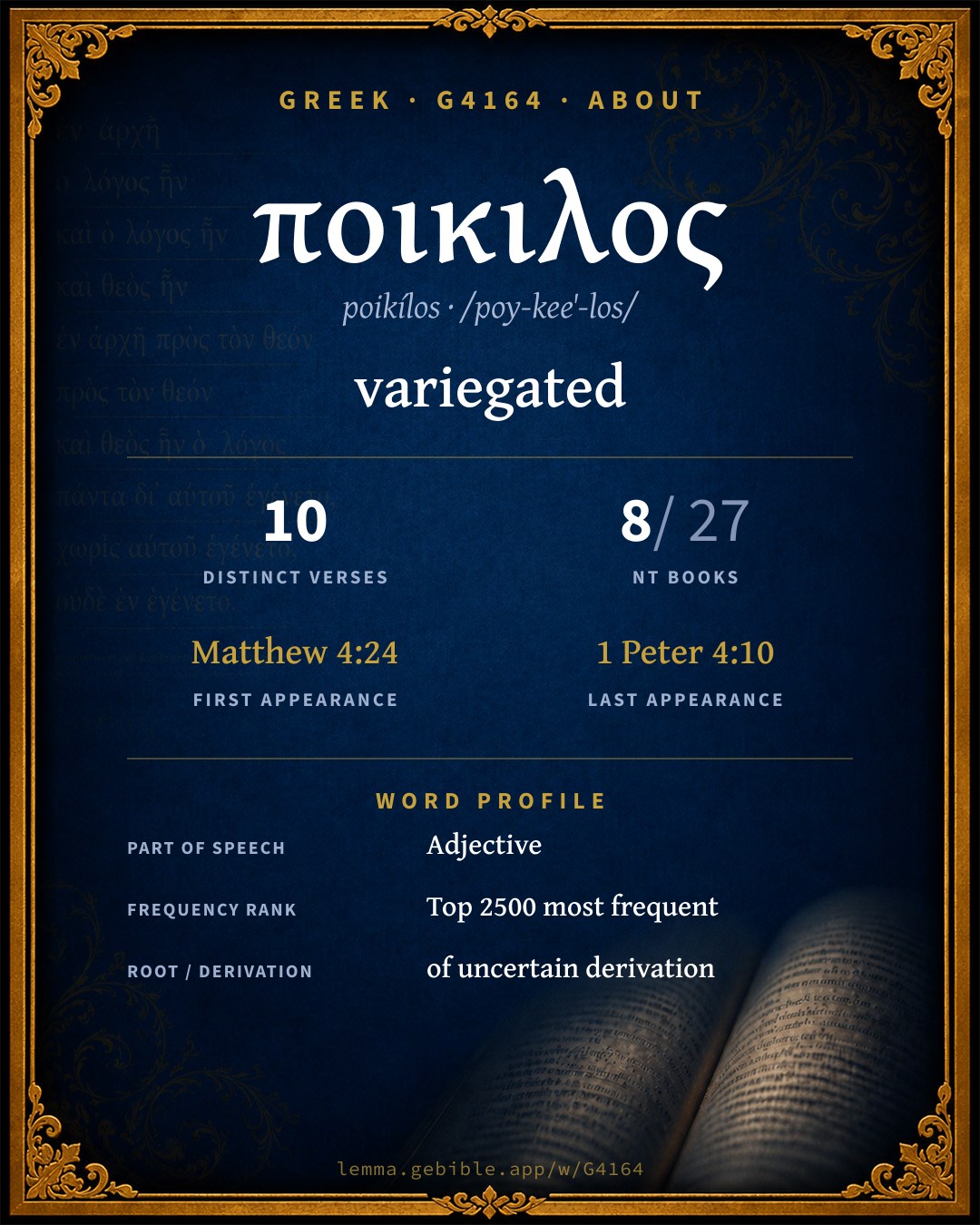
ποικίλος
variegated
‘variegated’ is one of 2 main senses fuller range ↓
Full lexicon entry — Thayer's Greek Lexicon
From Thayer's Greek Lexicon
Where this word appears
Grammar key — what these labels mean
Part of speech
- Adjective
- A word that describes or qualifies a noun.
Case
- Dative
- The case of the indirect object, means, or location — “to / for / with / in.”
- Genitive
- The case of source, possession, or “of” — answers “whose / from what.”
Gender
- Feminine
- Grammatically feminine.
- Masculine
- Grammatically masculine.
Number
- Plural
- More than one.
- Singular
- One.
Every verse where G4164 appears in the Book of Hebrews — 2 distinct verses. Click any verse to open its interlinear word-by-word view. Verse text shown in the World English Bible for context — . Each verse’s Greek form is shown with its reference; the English is not keyword-highlighted, since the data carries no word-level English alignment. Use “Compare translations” on any verse to read it across multiple English versions. This concordance covers the Greek New Testament; Septuagint (Greek Old Testament) occurrences of this word are not indexed here.
Hebrews
- Hebrews 2:4 ποικίλαις adj dat pl fem God also bearing witness with them, both by signs and wonders, and by various works of power, and by gifts of the Holy Spirit, according to his own will?
- Hebrews 13:9 ποικίλαις adj dat pl fem Don't be carried away by various and strange teachings, for it is good that the heart be established by grace, not by food, through which those who were so occupied were not benefited.
About this entry
At a glance — auto-summarized from this page’s data, not written by a person. Every figure links to its source below. This summary describes the numbers; it doesn’t interpret them.
The Greek adjective ποικιλος centers on the idea of “variegated.” Where the King James Version says “divers,” newer translations reach for “various” (Berean Standard Bible); the renderings breakdown has the detail. The Greek New Testament uses it across 10 verses — uncommon. First canonically at Matthew 4:24, it enters the text early. Lexicons map it across 2 senses. For the data behind this summary, explore the sense tree and the renderings breakdown below.
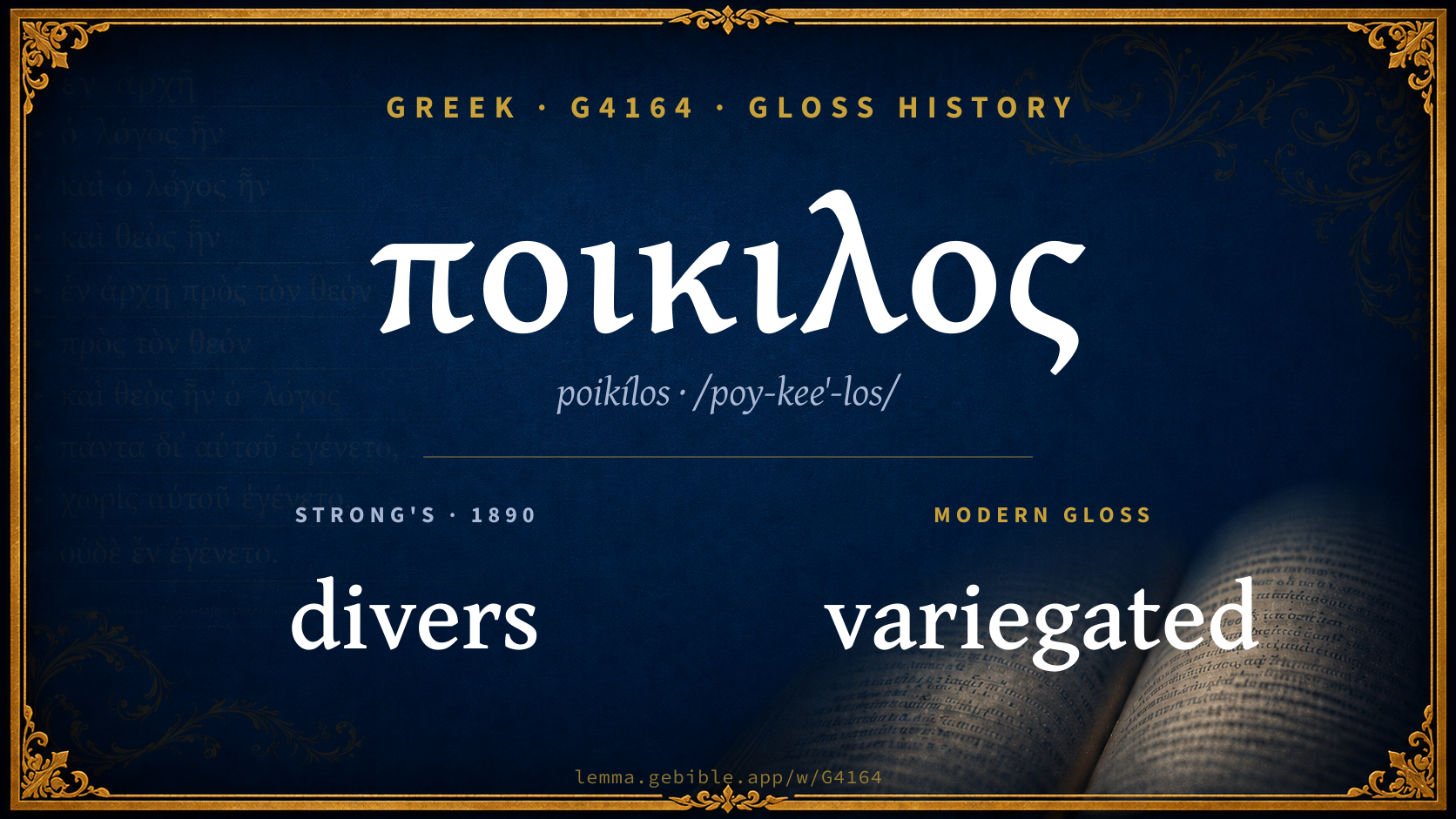
Gloss history
Strong's 1890 vs modern scholarship
About this word
Strong's G4164 catalogs a Greek word from the Greek New Testament.
These counts are not copied from any lexicon or concordance. They are computed here, from the morphology-tagged Greek New Testament. What Lemma adds →
- 10
- distinct verses
- The word appears in 10 distinct verses.
- 8 / 27
- NT books
- The word appears in 8 of 27 New Testament books.
- #1,056
- by frequency
- Top 2500 most frequent Greek words (rank 1,056 of 5,347 Greek words by occurrence).
View all 10 occurrences in the concordance →
By section of the New Testament
By traditional corpus
Conventional, traditional groupings — biblical authorship is debated, so this is a traditional corpus grouping, not an authorship claim. Some books belong to more than one corpus (Luke is in both the Gospels and the Lukan corpus, and so on), so these shares overlap and need not total 100%. Each figure is a share of the word’s 10 distinct verses.
- Gospels 3 verses · 30%
- General (Catholic) Epistles 3 verses · 30%
- Pauline corpus 2 verses · 20%
- Hebrews 2 verses · 20%
- Lukan (Luke–Acts) 1 verse · 10%
How translations render this word
Counts come from each version’s own published word-to-Strong’s tagging or interlinear alignment — an approximate guide to how each version renders this word, not a word-level alignment the data otherwise carries. Because each total is that version’s own tagged count, the per-version totals vary from one another and need not match the appearance or distinct-verse counts above. These counts may also differ from a printed concordance because Lemma counts each distinctly tagged rendering and does not collapse phrase taggings into a single head-word total. This is a fixed set of word-tagged versions (KJV, ASV, BSB, ULT) and does not change with the reading translation you choose elsewhere. Each version’s license is shown beside its name below (and on Sources).
- King James Version: Divers 8×, Manifold 2×
- American Standard Version: Divers 6×, Manifold 4×
- Berean Standard Bible: Various 6×
- unfoldingWord Literal Text: Various 9×
King James Version Public Domain
Renders G4164 across 10 tagged occurrences — most commonly:
American Standard Version Public Domain
Renders G4164 across 10 tagged occurrences — most commonly:
Berean Standard Bible Public Domain
Renders G4164 across 10 tagged occurrences — most commonly:
Plus 4 renderings that appear only once — usually multi-word phrases or single function words the recovered tagging swept in, not distinct renderings.
unfoldingWord Literal Text CC BY-SA 4.0
Renders G4164 across 10 tagged occurrences — most commonly:
Plus 1 rendering that appears only once — usually multi-word phrases or single function words the recovered tagging swept in, not distinct renderings.
Senses in Thayer's
The 2 senses Thayer's distinguishes for this word, in lexicon order (not ranked by frequency or importance). The full entry — with sub-senses — is in the Lexicon Entry tab.
- a various colours, variegated
- of various sorts
Word origin
Origin: of uncertain derivation
Of uncertain derivation; motley that is various in character : - divers manifold.
— Strong’s Exhaustive Concordance (1890), public domain.
Forms in the corpus
The 3 distinct written forms G4164 takes in the Greek New Testament, most frequent first — each parse links to that case’s occurrences in the concordance.
| Form | Parsing | Example | Uses |
|---|---|---|---|
| ποικίλαις poikílais | Adjective, Dative, Plural, Feminine | Matthew 4:24 | 7 |
| ποικίλοις poikílois | Adjective, Dative, Plural, Masculine | James 1:2 | 2 |
| ποικίλης poikílēs | Adjective, Genitive, Singular, Feminine | 1 Peter 4:10 | 1 |
Septuagint usage
The same Greek word ποικιλος appears 19 times in the Greek Old Testament (Septuagint), across 18 verses in 5 books.
- 19
- LXX occurrences
- Tagged occurrences of this Greek word in the Septuagint.
- 18
- verses
- Distinct Septuagint verses containing this word.
- 5 / 39
- OT books
- The word appears in 5 of the 39 Old Testament books.
Sample Septuagint occurrences
- Genesis 30:37 ποικίλος
- Joshua 7:21 ποικίλος
- 1 Chronicles 29:2 ποικίλος
- Ezekiel 16:10 ποικίλος
- Zechariah 1:8 ποικίλος
Septuagint occurrences (same lexeme)
Every verse where the same Strong’s number (G4164) appears in the Greek Septuagint. Verse text shown in the World English Bible for context; the Greek form is the matched word — the English is not keyword-highlighted.
- Genesis 30:37 ποικίλος Jacob took to himself rods of fresh poplar, almond, plane tree, peeled white streaks in them, and made the white appear which was in the rods.
- Genesis 30:39 ποικίλος The flocks conceived before the rods, and the flocks brought forth streaked, speckled, and spotted.
- Genesis 30:40 ποικίλος Jacob separated the lambs, and set the faces of the flocks toward the streaked and all the black in the flock of Laban: and he put his own droves apart, and didn't put them into Laban's flock.
- Genesis 31:8 ποικίλος If he said this, 'The speckled will be your wages,' then all the flock bore speckled. If he said this, 'The streaked will be your wages,' then all the flock bore streaked.
- Genesis 31:10 ποικίλος It happened at the time that the flock conceive, that I lifted up my eyes, and saw in a dream, and behold, the male goats which leaped on the flock were streaked, speckled, and grizzled.
- Genesis 31:12 ποικίλος He said, 'Now lift up your eyes, and behold, all the male goats which leap on the flock are streaked, speckled, and grizzled, for I have seen all that Laban does to you.
- Genesis 37:3 ποικίλος Now Israel loved Joseph more than all his children, because he was the son of his old age, and he made him a coat of many colors.
- Genesis 37:23 ποικίλος It happened, when Joseph came to his brothers, that they stripped Joseph of his coat, the coat of many colors that was on him;
- Genesis 37:32 ποικίλος They took the coat of many colors, and they brought it to their father, and said, "We have found this. Examine it, now, whether it is your son's coat or not."
- Joshua 7:21 ποικίλος when I saw among the spoil a goodly Babylonian mantle, and two hundred shekels of silver, and a wedge of gold of fifty shekels weight, then I coveted them, and took them; and, behold, they are hid in the earth in the midst of my tent, and the silver under it.
- 1 Chronicles 29:2 ποικίλος Now I have prepared with all my might for the house of my God the gold for the [things of] gold, and the silver for the [things of] silver, and the brass for the [things of] brass, the iron for the [things of] iron, and wood for the [things of] wood; onyx stones, and [stones] to be set, stones for inlaid work, and of various colors, and all manner of precious stones, and marble stones in abundance.
- Ezekiel 16:10 ποικίλος I clothed you also with embroidered work, and shod you with sealskin, and I girded you about with fine linen, and covered you with silk.
- Ezekiel 16:13 ποικίλος Thus was you decked with gold and silver; and your clothing was of fine linen, and silk, and embroidered work; you ate fine flour, and honey, and oil; and you were exceeding beautiful, and you did prosper to royal estate.
- Ezekiel 16:18 ποικίλος and you took your embroidered garments, and covered them, and did set my oil and my incense before them.
- Ezekiel 26:16 ποικίλος Then all the princes of the sea shall come down from their thrones, and lay aside their robes, and strip off their embroidered garments: they shall clothe themselves with trembling; they shall sit on the ground, and shall tremble every moment, and be astonished at you.
- Zechariah 1:8 ποικίλος "I had a vision in the night, and, behold, a man riding on a red horse, and he stood among the myrtle trees that were in a ravine; and behind him there were red, brown, and white horses.
- Zechariah 6:3 ποικίλος in the third chariot white horses; and in the fourth chariot dappled horses, all of them powerful.
- Zechariah 6:6 ποικίλος The one with the black horses goes out toward the north country; and the white went out after them; and the dappled went forth toward the south country."
These are occurrences of the same Greek lexeme (G4164) in the Septuagint — not a translation of any one Hebrew word. The store carries no word-level Hebrew↔Greek alignment, so no Hebrew original is asserted here. Counts come from the recovered LXX Strong's tagging — high-frequency vocabulary is well covered, while rare or late forms may be untagged — so they reflect tagged occurrences and may slightly undercount.