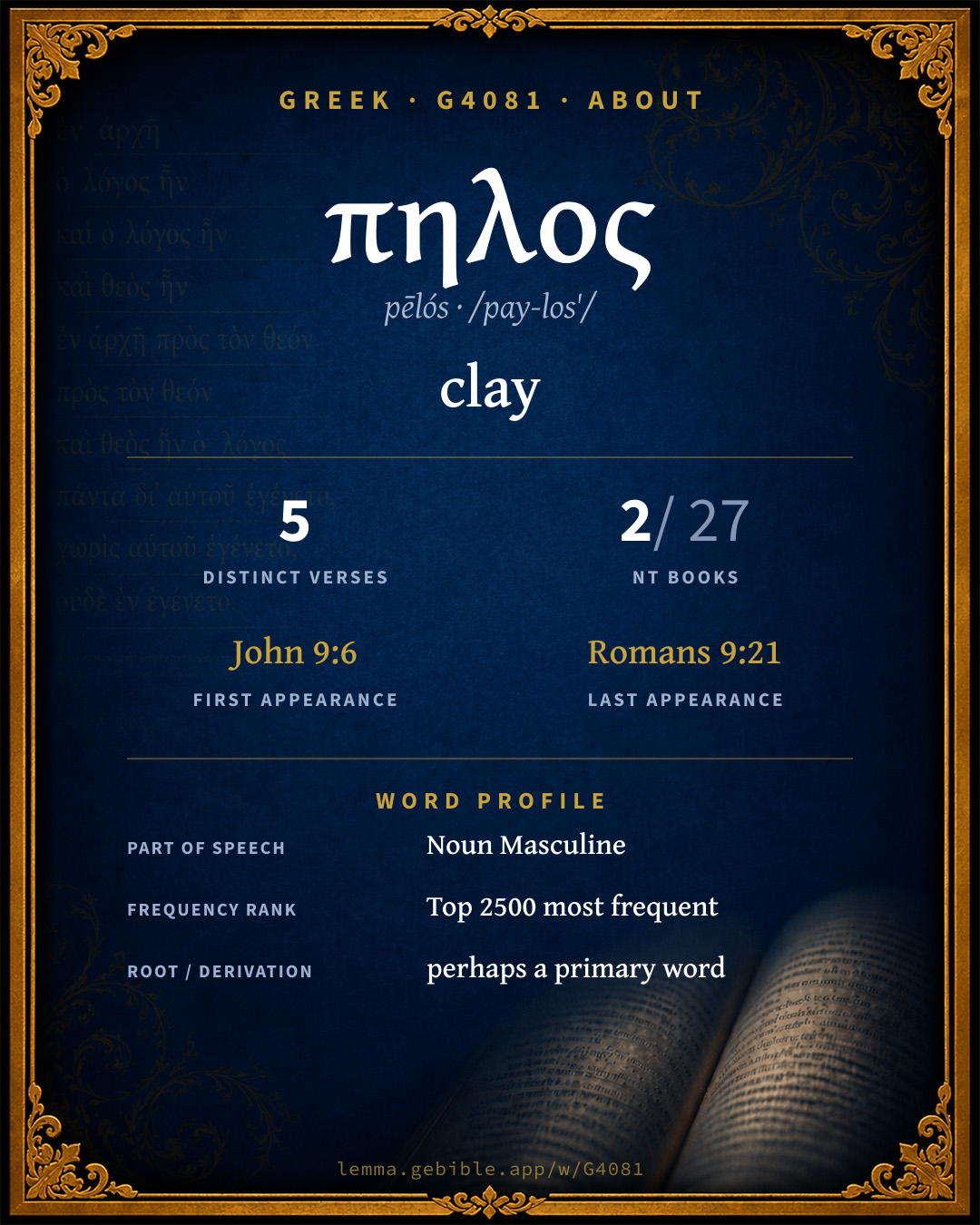
πηλός
clay
‘clay’ is one of 2 main senses fuller range ↓
Full lexicon entry — Thayer's Greek Lexicon
From Thayer's Greek Lexicon
Where this word appears
See every Accusative-case word in the Greek New Testament →
Grammar key — what these labels mean
Part of speech
- Noun
- A naming word — a person, place, thing, or idea.
Case
- Accusative
- The case of the direct object and of extent.
- Genitive
- The case of source, possession, or “of” — answers “whose / from what.”
Gender
- Masculine
- Grammatically masculine.
Number
- Singular
- One.
1 distinct verse where G4081 appears in the Genitive case, across 1 book. Filtered view — show all forms. Click any verse to open its interlinear word-by-word view. Verse text shown in the World English Bible for context — . Each verse’s Greek form is shown with its reference; the English is not keyword-highlighted, since the data carries no word-level English alignment. Use “Compare translations” on any verse to read it across multiple English versions. This concordance covers the Greek New Testament; Septuagint (Greek Old Testament) occurrences of this word are not indexed here.
Romans 1 verse
About this entry
At a glance — auto-summarized from this page’s data, not written by a person. Every figure links to its source below. This summary describes the numbers; it doesn’t interpret them.
“clay” is the headline sense of the Greek noun πηλος (pēlós). A scarce word — 5 verses in all of the Greek New Testament. It clusters heavily in John, which alone accounts for 80% of its uses. Catalogued under 2 senses, its meaning is not single-sense. The King James Version usually renders it “clay,” while modern versions prefer “mud” (unfoldingWord Literal Text) — see the renderings breakdown. See the sense tree, 5-verse concordance, and the renderings breakdown below.
Gloss history
Strong's 1890 vs modern scholarship
About this word
Strong's G4081 catalogs a Greek word from the Greek New Testament.
These counts are not copied from any lexicon or concordance. They are computed here, from the morphology-tagged Greek New Testament. What Lemma adds →
- 5
- distinct verses
- The word appears in 5 distinct verses.
- 2 / 27
- NT books
- The word appears in 2 of 27 New Testament books.
- #1,476
- by frequency
- Top 2500 most frequent Greek words (rank 1,476 of 5,347 Greek words by occurrence).
View all 5 occurrences in the concordance →
By traditional corpus
Conventional, traditional groupings — biblical authorship is debated, so this is a traditional corpus grouping, not an authorship claim. Some books belong to more than one corpus (Luke is in both the Gospels and the Lukan corpus, and so on), so these shares overlap and need not total 100%. Each figure is a share of the word’s 5 distinct verses.
- Gospels 4 verses · 80%
- Johannine 4 verses · 80%
- Pauline corpus 1 verse · 20%
How translations render this word
Counts come from each version’s own published word-to-Strong’s tagging or interlinear alignment — an approximate guide to how each version renders this word, not a word-level alignment the data otherwise carries. Because each total is that version’s own tagged count, the per-version totals vary from one another and need not match the appearance or distinct-verse counts above. These counts may also differ from a printed concordance because Lemma counts each distinctly tagged rendering and does not collapse phrase taggings into a single head-word total. This is a fixed set of word-tagged versions (KJV, ASV, BSB, ULT) and does not change with the reading translation you choose elsewhere. Each version’s license is shown beside its name below (and on Sources).
- King James Version: Clay 5×
- American Standard Version: Clay 5×
- Berean Standard Bible: Mud 4×
- unfoldingWord Literal Text: Mud 5×
King James Version Public Domain
Renders G4081 across 6 tagged occurrences — most commonly:
Plus 1 rendering that appears only once — usually multi-word phrases or single function words the recovered tagging swept in, not distinct renderings.
American Standard Version Public Domain
Renders G4081 across 6 tagged occurrences — most commonly:
Plus 1 rendering that appears only once — usually multi-word phrases or single function words the recovered tagging swept in, not distinct renderings.
Berean Standard Bible Public Domain
Renders G4081 across 5 tagged occurrences — most commonly:
Plus 1 rendering that appears only once — usually multi-word phrases or single function words the recovered tagging swept in, not distinct renderings. Not rendered by a distinct English word in 1 further occurrence.
unfoldingWord Literal Text CC BY-SA 4.0
Renders G4081 across 6 tagged occurrences — most commonly:
Plus 1 rendering that appears only once — usually multi-word phrases or single function words the recovered tagging swept in, not distinct renderings.
Senses in Thayer's
The 2 senses Thayer's distinguishes for this word, in lexicon order (not ranked by frequency or importance). The full entry — with sub-senses — is in the Lexicon Entry tab.
- clay, which potters uses
- mud (wet clay)
Word origin
Origin: perhaps a primary word
Perhaps a primary word; clay : - clay.
— Strong’s Exhaustive Concordance (1890), public domain.
Forms in the corpus
The 2 distinct written forms G4081 takes in the Greek New Testament, most frequent first — each parse links to that case’s occurrences in the concordance.
| Form | Parsing | Example | Uses |
|---|---|---|---|
| πηλὸν pēlòn | Noun, Accusative, Singular, Masculine | John 9:6 | 5 |
| πηλοῦ pēloû | Noun, Genitive, Singular, Masculine | Romans 9:21 | 1 |
Septuagint usage
The same Greek word πηλος appears 25 times in the Greek Old Testament (Septuagint), across 23 verses in 10 books.
- 25
- LXX occurrences
- Tagged occurrences of this Greek word in the Septuagint.
- 23
- verses
- Distinct Septuagint verses containing this word.
- 10 / 39
- OT books
- The word appears in 10 of the 39 Old Testament books.
Sample Septuagint occurrences
- Genesis 11:3 πηλός
- Exodus 1:14 πηλός
- 2 Samuel 22:43 πηλός
- Job 4:19 πηλός
- Psalms 17:43 πηλός
- Isaiah 14:23 πηλός
- Jeremiah 18:6 πηλός
- Micah 7:10 πηλός
- Nahum 3:14 πηλός
- Zechariah 9:3 πηλός
Septuagint occurrences (same lexeme)
Every verse where the same Strong’s number (G4081) appears in the Greek Septuagint. Verse text shown in the World English Bible for context; the Greek form is the matched word — the English is not keyword-highlighted.
- Genesis 11:3 πηλός They said one to another, "Come, let's make brick, and burn them thoroughly." They had brick for stone, and they used tar for mortar.
- Exodus 1:14 πηλός and they made their lives bitter with hard service, in mortar and in brick, and in all manner of service in the field, all their service, in which they ruthlessly made them serve.
- 2 Samuel 22:43 πηλός Then did I beat them small as the dust of the earth, I did crush them as the mire of the streets, and did spread them abroad.
- Job 4:19 πηλός How much more, those who dwell in houses of clay, Whose foundation is in the dust, Who are crushed before the moth!
- Job 10:9 πηλός Remember, I beg you, that you have fashioned me as clay. Will you bring me into dust again?
- Job 27:16 πηλός Though he heap up silver as the dust, And prepare clothing as the clay;
- Job 30:19 πηλός He has cast me into the mire. I have become like dust and ashes.
- Job 33:6 πηλός Behold, I am toward God even as you are: I am also formed out of the clay.
- Job 38:14 πηλός It is changed as clay under the seal, And stands forth as a garment.
- Job 41:22 πηλός In his neck there is strength. Terror dances before him.
- Psalms 17:43 πηλός
- Psalms 39:3 πηλός My heart was hot within me. While I meditated, the fire burned: I spoke with my tongue:
- Psalms 68:15 πηλός The mountains of Bashan are majestic mountains. The mountains of Bashan are rugged.
- Isaiah 14:23 πηλός I will also make it a possession for the porcupine, and pools of water: and I will sweep it with the broom of destruction, says Yahweh of Hosts.
- Isaiah 29:16 πηλός You turn things upside down! Shall the potter be esteemed as clay; that the thing made should say of him who made it, He didn't make me; or the thing formed say of him who formed it, He has no understanding?
- Isaiah 41:25 πηλός I have raised up one from the north, and he has come; from the rising of the sun one who calls on my name: and he shall come on rulers as on mortar, and as the potter treads clay.
- Isaiah 45:9 πηλός Woe to him who strives with his Maker--a potsherd among the potsherds of the earth! Shall the clay ask him who fashions it, "What are you making?" or your work, "He has no hands?"
- Isaiah 64:7 πηλός There is none who calls on your name, who stirs up himself to take hold of you; for you have hid your face from us, and have consumed us by means of our iniquities.
- Jeremiah 18:6 πηλός House of Israel, can't I do with you as this potter? says Yahweh. Behold, as the clay in the potter's hand, so are you in my hand, house of Israel.
- Micah 7:10 πηλός Then my enemy will see it, And shame will cover her who said to me, Where is Yahweh your God? Then my enemy will see me and will cover her shame. Now she will be trodden down like the mire of the streets.
- Nahum 3:14 πηλός Draw water for the siege. Strengthen your fortresses. Go into the clay, and tread the mortar. Make the brick kiln strong.
- Zechariah 9:3 πηλός Tyre built herself a stronghold, And heaped up silver like the dust, And fine gold like the mire of the streets.
- Zechariah 10:5 πηλός They shall be as mighty men, Treading down muddy streets in the battle; And they shall fight, because Yahweh is with them; And the riders on horses will be confounded.
These are occurrences of the same Greek lexeme (G4081) in the Septuagint — not a translation of any one Hebrew word. The store carries no word-level Hebrew↔Greek alignment, so no Hebrew original is asserted here. Counts come from the recovered LXX Strong's tagging — high-frequency vocabulary is well covered, while rare or late forms may be untagged — so they reflect tagged occurrences and may slightly undercount.