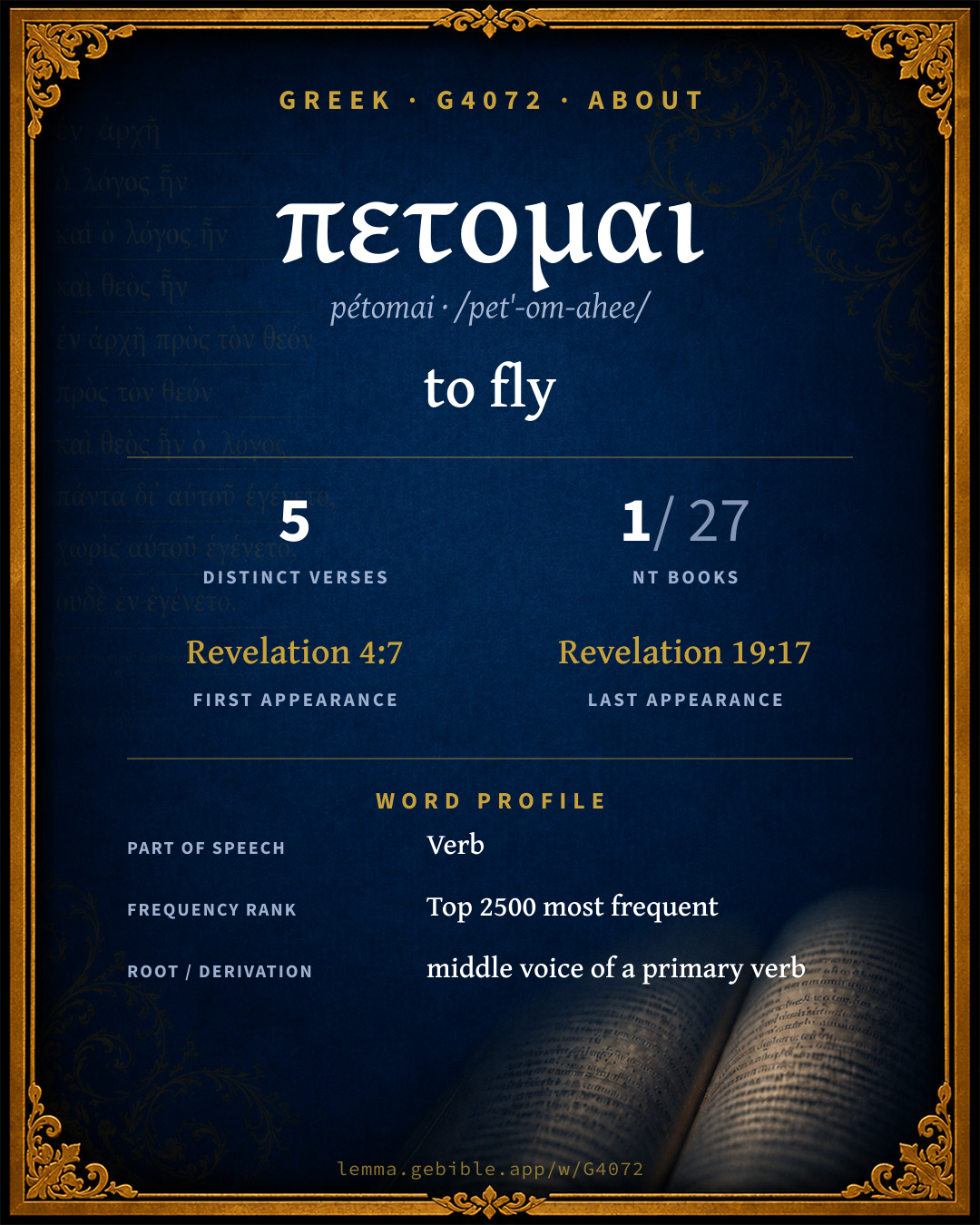
πετομαι
to fly
Full lexicon entry — Thayer's Greek Lexicon
From Thayer's Greek Lexicon
Where this word appears
Grammar key — what these labels mean
Part of speech
- Verb
- An action or state-of-being word.
Tense
- Present
- Ongoing or general action in present time (imperfective aspect).
Voice
- Middle or Passive deponent
- Middle/passive in form but active in meaning.
Mood
- Participle
- A verbal adjective (“writing,” “having written”).
- Subjunctive
- Expresses probability, purpose, or possibility (the mood of contingency).
Case
- Accusative
- The case of the direct object and of extent.
- Dative
- The case of the indirect object, means, or location — “to / for / with / in.”
- Genitive
- The case of source, possession, or “of” — answers “whose / from what.”
Person
- 3rd person
- The one spoken about (“he / she / it / they”).
Gender
- Masculine
- Grammatically masculine.
- Neuter
- Grammatically neuter.
Number
- Singular
- One.
- Plural
- More than one.
Grammatical forms
- Verb, Present, Middle or Passive deponent, Participle, Accusative, Singular, Masculine 1 time (20%)
- Verb, Present, Middle or Passive deponent, Participle, Dative, Plural, Neuter 1 time (20%)
- Verb, Present, Middle or Passive deponent, Participle, Dative, Singular, Masculine 1 time (20%)
- Verb, Present, Middle or Passive deponent, Participle, Genitive, Singular, Masculine 1 time (20%)
- Verb, Present, Middle or Passive deponent, Subjunctive, 3rd person, Singular 1 time (20%)
Parsed forms decoded from the imported morphology (Robinson–Tischendorf, public domain), counted across 5 parsed occurrences — not distinct verses.
Every verse where G4072 appears — 5 distinct verses across 1 book. Click any verse to open its interlinear word-by-word view. Verse text shown in the World English Bible for context — . Each verse’s Greek form is shown with its reference; the English is not keyword-highlighted, since the data carries no word-level English alignment. Use “Compare translations” on any verse to read it across multiple English versions. This concordance covers the Greek New Testament; Septuagint (Greek Old Testament) occurrences of this word are not indexed here.
Revelation 5 verses
- Revelation 4:7 πετομένῳ pres mid/pass.dep ptcp dat sg masc The first creature was like a lion, and the second creature like a calf, and the third creature had a face like a man, and the fourth was like a flying eagle.
- Revelation 8:13 πετομένου pres mid/pass.dep ptcp gen sg masc I saw, and I heard an eagle, flying in mid heaven, saying with a loud voice, "Woe! Woe! Woe for those who dwell on the earth, because of the other voices of the trumpets of the three angels, who are yet to sound!"
- Revelation 12:14 πέτηται pres mid/pass.dep subj 3sg Two wings of the great eagle were given to the woman, that she might fly into the wilderness to her place, so that she might be nourished for a time, and times, and half a time, from the face of the serpent.
- Revelation 14:6 πετόμενον pres mid/pass.dep ptcp acc sg masc I saw an angel flying in mid heaven, having an eternal Gospel to proclaim to those who dwell on the earth, and to every nation, tribe, language, and people.
- Revelation 19:17 πετομένοις pres mid/pass.dep ptcp dat pl neut I saw an angel standing in the sun. He cried with a loud voice, saying to all the birds that fly in the sky, "Come! Be gathered together to the great supper of God,
About this entry
At a glance — auto-summarized from this page’s data, not written by a person. Every figure links to its source below. This summary describes the numbers; it doesn’t interpret them.
“to fly” is the headline sense of the Greek verb πετομαι (pétomai). A scarce word — 5 verses in all of the Greek New Testament. More than three-quarters of its appearances fall in Revelation. Scripture first uses it in Revelation 4:7. It shares a root with πετεινον, πιπτω and πτερυξ. See the sense tree, 5-verse concordance, and the renderings breakdown below.
Gloss history
Strong's 1890 vs modern scholarship
About this word
Strong's G4072 catalogs a Greek word from the Greek New Testament.
These counts are not copied from any lexicon or concordance. They are computed here, from the morphology-tagged Greek New Testament. What Lemma adds →
- 5
- distinct verses
- The word appears in 5 distinct verses.
- 1 / 27
- NT books
- The word appears in 1 of 27 New Testament books.
- #1,648
- by frequency
- Top 2500 most frequent Greek words (rank 1,648 of 5,347 Greek words by occurrence).
View all 5 occurrences in the concordance →
Most concentrated in
- Revelation 5 verses 100%
By section of the New Testament
By traditional corpus
Conventional, traditional groupings — biblical authorship is debated, so this is a traditional corpus grouping, not an authorship claim. Some books belong to more than one corpus (Luke is in both the Gospels and the Lukan corpus, and so on), so these shares overlap and need not total 100%. Each figure is a share of the word’s 5 distinct verses.
- Johannine 5 verses · 100%
- Revelation 5 verses · 100%
How translations render this word
Counts come from each version’s own published word-to-Strong’s tagging or interlinear alignment — an approximate guide to how each version renders this word, not a word-level alignment the data otherwise carries. Because each total is that version’s own tagged count, the per-version totals vary from one another and need not match the appearance or distinct-verse counts above. These counts may also differ from a printed concordance because Lemma counts each distinctly tagged rendering and does not collapse phrase taggings into a single head-word total. This is a fixed set of word-tagged versions (KJV, ASV, BSB, ULT) and does not change with the reading translation you choose elsewhere. Each version’s license is shown beside its name below (and on Sources).
- King James Version: Fly 2×, Flying 2×
- American Standard Version: Flying 3×
- Berean Standard Bible: Flying 3×
- unfoldingWord Literal Text: Flying 4×
King James Version Public Domain
Renders G4072 across 5 tagged occurrences — most commonly:
Plus 1 rendering that appears only once — usually multi-word phrases or single function words the recovered tagging swept in, not distinct renderings.
American Standard Version Public Domain
Renders G4072 across 5 tagged occurrences — most commonly:
Plus 2 renderings that appear only once — usually multi-word phrases or single function words the recovered tagging swept in, not distinct renderings.
Berean Standard Bible Public Domain
Renders G4072 across 5 tagged occurrences — most commonly:
Plus 2 renderings that appear only once — usually multi-word phrases or single function words the recovered tagging swept in, not distinct renderings.
unfoldingWord Literal Text CC BY-SA 4.0
Renders G4072 across 5 tagged occurrences — most commonly:
Plus 1 rendering that appears only once — usually multi-word phrases or single function words the recovered tagging swept in, not distinct renderings.
Senses in Thayer's
The 1 sense Thayer's distinguishes for this word, in lexicon order (not ranked by frequency or importance). The full entry — with sub-senses — is in the Lexicon Entry tab.
- to fly
Word origin
Origin: middle voice of a primary verb
Including the prolonged form (second form) and contraction (third form) of the middle voice of a primary verb; to fly : - fly (-ing).
— Strong’s Exhaustive Concordance (1890), public domain.
Forms in the corpus
The 5 distinct written forms G4072 takes in the Greek New Testament, most frequent first — each parse links to that tense’s occurrences in the concordance.
| Form | Parsing | Example | Uses |
|---|---|---|---|
| πέτηται pétētai | Verb, Present, Middle or Passive deponent, Subjunctive, 3rd person, Singular | Revelation 12:14 | 1 |
| πετομένοις petoménois | Verb, Present, Middle or Passive deponent, Participle, Dative, Plural, Neuter | Revelation 19:17 | 1 |
| πετομένου petoménou | Verb, Present, Middle or Passive deponent, Participle, Genitive, Singular, Masculine | Revelation 8:13 | 1 |
| πετομένῳ petoménō | Verb, Present, Middle or Passive deponent, Participle, Dative, Singular, Masculine | Revelation 4:7 | 1 |
| πετόμενον petómenon | Verb, Present, Middle or Passive deponent, Participle, Accusative, Singular, Masculine | Revelation 14:6 | 1 |
Same root — word family
Other Thayer's entries built from the same root as G4072, grouped by Strong’s listed origin. These share a root / origin per the lexicon — not necessarily a shared meaning. Each links to that word’s own entry.
Derived from this word
- πετεινον peteinón G4071 winged
- πιπτω píptō G4098 to fall
- πτερυξ ptéryx G4420 wing
- πτυσσω ptýssō G4428 to roll up
Compare all same-root words → Showing 4 of 5 — not the complete family. They share a root, not necessarily a meaning.
Septuagint usage
The same Greek word πετομαι appears 17 times in the Greek Old Testament (Septuagint), across 17 verses in 8 books.
- 17
- LXX occurrences
- Tagged occurrences of this Greek word in the Septuagint.
- 17
- verses
- Distinct Septuagint verses containing this word.
- 8 / 39
- OT books
- The word appears in 8 of the 39 Old Testament books.
Sample Septuagint occurrences
- Genesis 1:20 πέτομαι
- Job 5:7 πέτομαι
- Psalms 90:5 πέτομαι
- Proverbs 9:12 πέτομαι
- Isaiah 6:2 πέτομαι
- Ezekiel 32:10 πέτομαι
- Habakkuk 1:8 πέτομαι
- Zechariah 5:1 πέτομαι
Septuagint occurrences (same lexeme)
Every verse where the same Strong’s number (G4072) appears in the Greek Septuagint. Verse text shown in the World English Bible for context; the Greek form is the matched word — the English is not keyword-highlighted.
- Genesis 1:20 πέτομαι God said, "Let the waters swarm with swarms of living creatures, and let birds fly above the earth in the open expanse of sky."
- Job 5:7 πέτομαι But man is born to trouble, As the sparks fly upward.
- Job 9:26 πέτομαι They have passed away as the swift ships, As the eagle that swoops on the prey.
- Job 20:8 πέτομαι He shall fly away as a dream, and shall not be found: Yes, he shall be chased away like a vision of the night.
- Psalms 90:5 πέτομαι You sweep them away as they sleep. In the morning they sprout like new grass.
- Proverbs 9:12 πέτομαι If you are wise, you are wise for yourself. If you mock, you alone will bear it.
- Proverbs 30:19 πέτομαι The way of an eagle in the air; The way of a serpent on a rock; The way of a ship in the midst of the sea; And the way of a man with a maiden.
- Isaiah 6:2 πέτομαι Above him stood the seraphim. Each one had six wings. With two he covered his face. With two he covered his feet. With two he flew.
- Isaiah 11:14 πέτομαι They shall fly down on the shoulder of the Philistines on the west; together shall they despoil the children of the east: they shall put forth their hand on Edom and Moab; and the children of Ammon shall obey them.
- Isaiah 14:29 πέτομαι Don't rejoice, O Philistia, all of you, because the rod that struck you is broken; for out of the serpent's root shall come forth an adder, and his fruit shall be a fiery flying serpent.
- Isaiah 30:6 πέτομαι The burden of the animals of the South. Through the land of trouble and anguish, from whence come the lioness and the lion, the viper and fiery flying serpent, they carry their riches on the shoulders of young donkeys, and their treasures on the humps of camels, to a people that shall not profit [them].
- Isaiah 31:5 πέτομαι As birds hovering, so will Yahweh of Hosts protect Jerusalem; he will protect and deliver [it], he will pass over and preserve [it].
- Isaiah 60:8 πέτομαι Who are these who fly as a cloud, and as the doves to their windows?
- Ezekiel 32:10 πέτομαι Yes, I will make many peoples amazed at you, and their kings shall be horribly afraid for you, when I shall brandish my sword before them; and they shall tremble at every moment, every man for his own life, in the day of your fall.
- Habakkuk 1:8 πέτομαι Their horses also are swifter than leopards, and are more fierce than the evening wolves. Their horsemen press proudly on. Yes, their horsemen come from afar. They fly as an eagle that hurries to devour.
- Zechariah 5:1 πέτομαι Then again I lifted up my eyes, and saw, and, behold, a flying scroll.
- Zechariah 5:2 πέτομαι He said to me, "What do you see?" I answered, "I see a flying scroll; its length is twenty cubits, and its breadth ten cubits."
These are occurrences of the same Greek lexeme (G4072) in the Septuagint — not a translation of any one Hebrew word. The store carries no word-level Hebrew↔Greek alignment, so no Hebrew original is asserted here. Counts come from the recovered LXX Strong's tagging — high-frequency vocabulary is well covered, while rare or late forms may be untagged — so they reflect tagged occurrences and may slightly undercount.