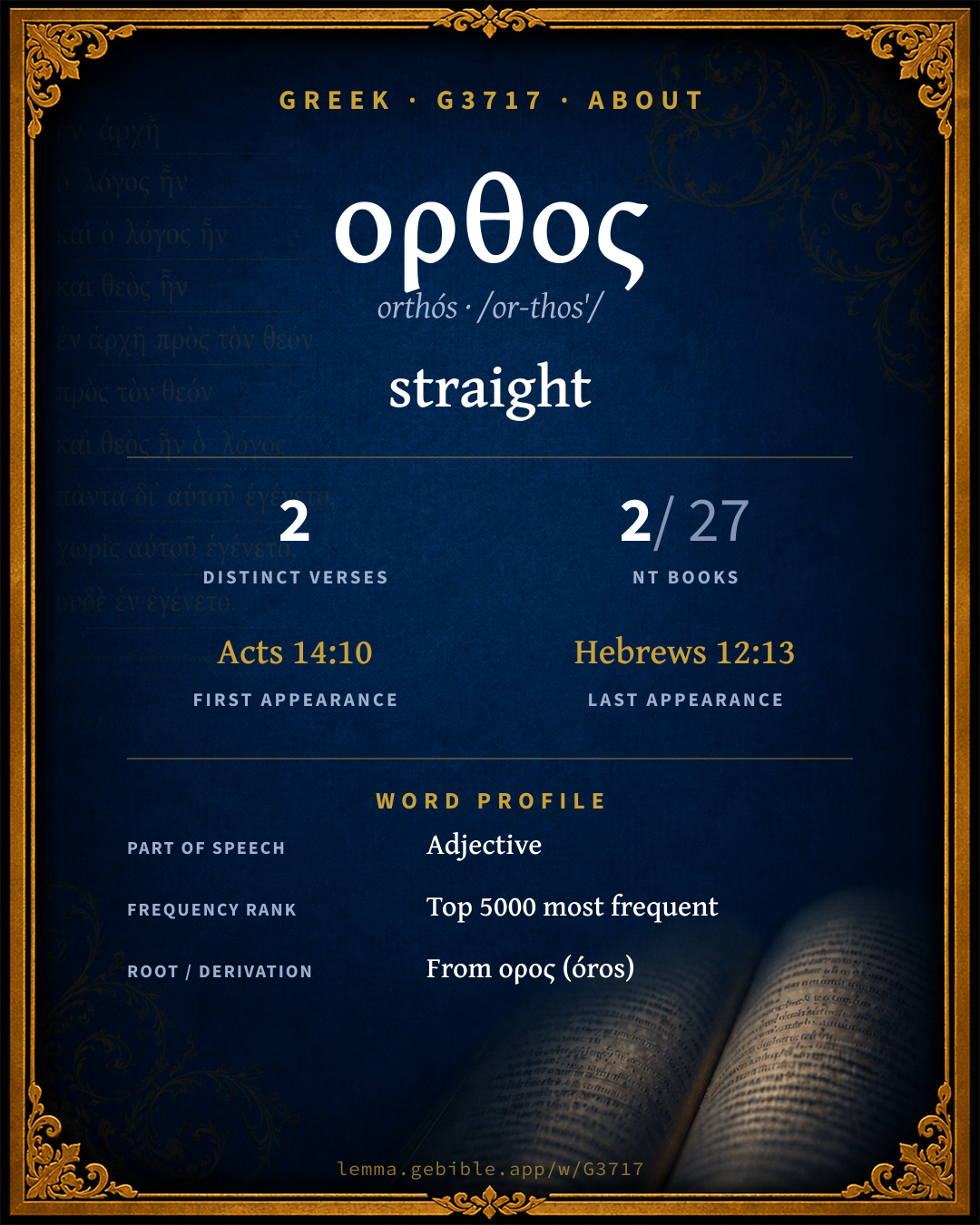
ὀρθός
straight
Full lexicon entry — Thayer's Greek Lexicon
From Thayer's Greek Lexicon
Where this word appears
Grammar key — what these labels mean
Part of speech
- Adjective
- A word that describes or qualifies a noun.
Case
- Accusative
- The case of the direct object and of extent.
- Nominative
- The case of the subject (and the predicate nominative).
Gender
- Feminine
- Grammatically feminine.
- Masculine
- Grammatically masculine.
Number
- Plural
- More than one.
- Singular
- One.
Every verse where G3717 appears in the Book of Acts — 1 distinct verse. Click any verse to open its interlinear word-by-word view. Verse text shown in the World English Bible for context — . Each verse’s Greek form is shown with its reference; the English is not keyword-highlighted, since the data carries no word-level English alignment. Use “Compare translations” on any verse to read it across multiple English versions. This concordance covers the Greek New Testament; Septuagint (Greek Old Testament) occurrences of this word are not indexed here.
Acts
About this entry
At a glance — auto-summarized from this page’s data, not written by a person. Every figure links to its source below. This summary describes the numbers; it doesn’t interpret them.
The Greek adjective ορθος centers on the idea of “straight.” A scarce word — 2 verses in all of the Greek New Testament. Acts dominates its distribution — 1 of 2 verses. Debuting at Acts 14:10, it then recurs through the corpus. Sharing its root, it stands alongside ορος, ορεγομαι and ορεινος. Dig into 2-verse concordance and the renderings breakdown below.
Gloss history
Strong's 1890 vs modern scholarship
About this word
Strong's G3717 catalogs a Greek word from the Greek New Testament.
These counts are not copied from any lexicon or concordance. They are computed here, from the morphology-tagged Greek New Testament. What Lemma adds →
- 2
- distinct verses
- The word appears in 2 distinct verses.
- 2 / 27
- NT books
- The word appears in 2 of 27 New Testament books.
- #2,678
- by frequency
- Top 5000 most frequent Greek words (rank 2,678 of 5,347 Greek words by occurrence).
View all 2 occurrences in the concordance →
By traditional corpus
Conventional, traditional groupings — biblical authorship is debated, so this is a traditional corpus grouping, not an authorship claim. Some books belong to more than one corpus (Luke is in both the Gospels and the Lukan corpus, and so on), so these shares overlap and need not total 100%. Each figure is a share of the word’s 2 distinct verses.
- Lukan (Luke–Acts) 1 verse · 50%
- Hebrews 1 verse · 50%
How translations render this word
Counts come from each version’s own published word-to-Strong’s tagging or interlinear alignment — an approximate guide to how each version renders this word, not a word-level alignment the data otherwise carries. Because each total is that version’s own tagged count, the per-version totals vary from one another and need not match the appearance or distinct-verse counts above. These counts may also differ from a printed concordance because Lemma counts each distinctly tagged rendering and does not collapse phrase taggings into a single head-word total. This is a fixed set of word-tagged versions (KJV, ASV, BSB, ULT) and does not change with the reading translation you choose elsewhere. Each version’s license is shown beside its name below (and on Sources).
- King James Version: Straight 1×, Upright 1×
- American Standard Version: Straight 1×, Upright 1×
- Berean Standard Bible: Straight 1×, Up 1×
- unfoldingWord Literal Text: Straight 1×, Upright 1×
King James Version Public Domain
Renders G3717 across 2 tagged occurrences — most commonly:
American Standard Version Public Domain
Renders G3717 across 2 tagged occurrences — most commonly:
Berean Standard Bible Public Domain
Renders G3717 across 2 tagged occurrences — most commonly:
unfoldingWord Literal Text CC BY-SA 4.0
Renders G3717 across 2 tagged occurrences — most commonly:
Senses in Thayer's
The 1 sense Thayer's distinguishes for this word, in lexicon order (not ranked by frequency or importance). The full entry — with sub-senses — is in the Lexicon Entry tab.
- straight, erect
Word origin
Derived from ορος (óros) (G3735) — mountain.
Probably from the base of G3735 ; right (as rising ) that is (perpendicularly) erect (figuratively honest ) or (horizontally) level or direct : - straight upright.
— Strong’s Exhaustive Concordance (1890), public domain.
Forms in the corpus
The 2 distinct written forms G3717 takes in the Greek New Testament, most frequent first — each parse links to that case’s occurrences in the concordance.
| Form | Parsing | Example | Uses |
|---|---|---|---|
| ὀρθός orthós | Adjective, Nominative, Singular, Masculine | Acts 14:10 | 1 |
| ὀρθὰς orthàs | Adjective, Accusative, Plural, Feminine | Hebrews 12:13 | 1 |
Same root — word family
Other Thayer's entries built from the same root as G3717, grouped by Strong’s listed origin. These share a root / origin per the lexicon — not necessarily a shared meaning. Each links to that word’s own entry.
Derives from
Shares the same root
- ορεγομαι orégomai G3713 to stretch out
- ορεινος oreinós G3714 mountainous
- ορθρος órthros G3722 dawn
- ορνις órnis G3733 bird
- ουρανος ouranós G3772 heaven
Derived from this word
- ορθοποδεω orthopodéō G3716 to walk straight
- ορθοτομεω orthotoméō G3718 to cut straight
- ορθως orthōs G3723 rightly
Compare all same-root words → Showing 4 of 10 — not the complete family. They share a root, not necessarily a meaning.
Septuagint usage
The same Greek word ορθος appears 23 times in the Greek Old Testament (Septuagint), across 23 verses in 6 books.
- 23
- LXX occurrences
- Tagged occurrences of this Greek word in the Septuagint.
- 23
- verses
- Distinct Septuagint verses containing this word.
- 6 / 39
- OT books
- The word appears in 6 of the 39 Old Testament books.
Sample Septuagint occurrences
- Judges 15:5 ὀρθός
- 1 Kings 21:11 ὀρθός
- Proverbs 4:11 ὀρθός
- Jeremiah 38:9 ὀρθός
- Ezekiel 1:7 ὀρθός
- Micah 2:3 ὀρθός
Septuagint occurrences (same lexeme)
Every verse where the same Strong’s number (G3717) appears in the Greek Septuagint. Verse text shown in the World English Bible for context; the Greek form is the matched word — the English is not keyword-highlighted.
- Judges 15:5 ὀρθός When he had set the brands on fire, he let them go into the standing grain of the Philistines, and burnt up both the shocks and the standing grain, and also the olive groves.
- 1 Kings 21:11 ὀρθός The men of his city, even the elders and the nobles who lived in his city, did as Jezebel had sent to them, according as it was written in the letters which she had sent to them.
- Proverbs 4:11 ὀρθός I have taught you in the way of wisdom. I have led you in straight paths.
- Proverbs 4:25 ὀρθός Let your eyes look straight ahead. Fix your gaze directly before you.
- Proverbs 4:26 ὀρθός Make the path of your feet level. Let all of your ways be established.
- Proverbs 4:27 ὀρθός Don't turn to the right hand nor to the left. Remove your foot from evil.
- Proverbs 8:6 ὀρθός Hear, for I will speak excellent things. The opening of my lips is for right things.
- Proverbs 8:9 ὀρθός They are all plain to him who understands, Right to those who find knowledge.
- Proverbs 11:6 ὀρθός The righteousness of the upright shall deliver them, But the unfaithful will be trapped by evil desires.
- Proverbs 12:6 ὀρθός The words of the wicked are about lying in wait for blood, But the speech of the upright rescues them.
- Proverbs 12:15 ὀρθός The way of a fool is right in his own eyes, But he who is wise listens to counsel.
- Proverbs 14:12 ὀρθός There is a way which seems right to a man, But in the end it leads to death.
- Proverbs 15:14 ὀρθός The heart of one who has understanding seeks knowledge, But the mouths of fools feed on folly.
- Proverbs 16:9 ὀρθός A man's heart plans his course, But Yahweh directs his steps.
- Proverbs 16:21 ὀρθός The wise in heart shall be called prudent. Pleasantness of the lips promotes instruction.
- Proverbs 21:8 ὀρθός The way of the guilty is devious, But the conduct of the innocent is upright.
- Proverbs 23:16 ὀρθός Yes, my heart will rejoice, When your lips speak what is right.
- Proverbs 31:5 ὀρθός Lest they drink, and forget the law, And pervert the justice due to anyone who is afflicted.
- Jeremiah 38:9 ὀρθός My lord the king, these men have done evil in all that they have done to Jeremiah the prophet, whom they have cast into the dungeon; and he is likely to die in the place where he is, because of the famine; for there is no more bread in the city.
- Ezekiel 1:7 ὀρθός Their feet were straight feet; and the sole of their feet was like the sole of a calf's foot; and they sparkled like burnished brass.
- Micah 2:3 ὀρθός Therefore thus says Yahweh: "Behold, I am planning against these people a disaster, From which you will not remove your necks, Neither will you walk haughtily; For it is an evil time.
- Micah 2:7 ὀρθός Shall it be said, O house of Jacob: "Is the Spirit of Yahweh angry? Are these his doings? Don't my words do good to him who walks blamelessly?"
- Micah 3:9 ὀρθός Please listen to this, you heads of the house of Jacob, And rulers of the house of Israel, Who abhor justice, And pervert all equity.
These are occurrences of the same Greek lexeme (G3717) in the Septuagint — not a translation of any one Hebrew word. The store carries no word-level Hebrew↔Greek alignment, so no Hebrew original is asserted here. Counts come from the recovered LXX Strong's tagging — high-frequency vocabulary is well covered, while rare or late forms may be untagged — so they reflect tagged occurrences and may slightly undercount.