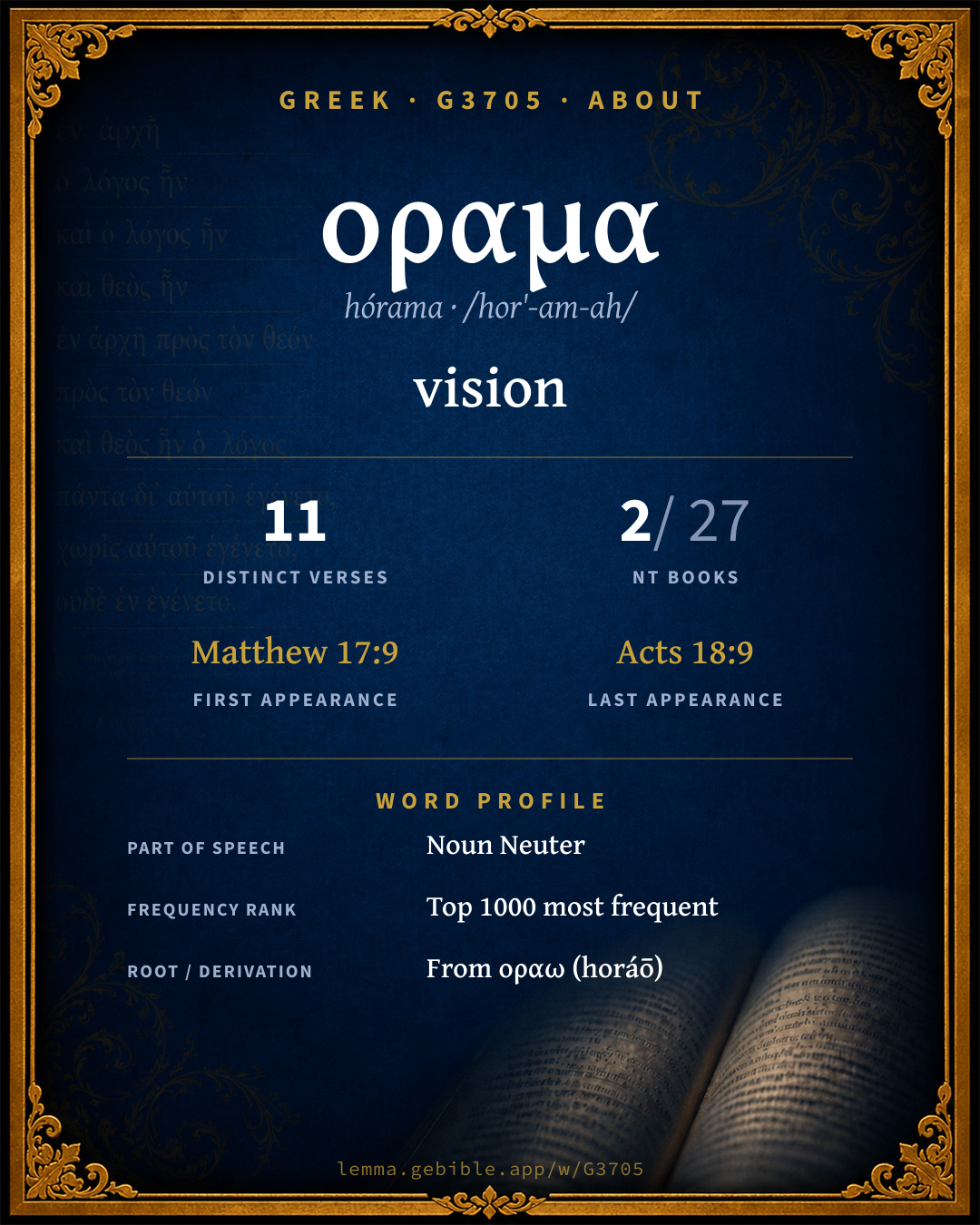
ὅραμα
vision
‘vision’ is one of 2 main senses fuller range ↓
Full lexicon entry — Thayer's Greek Lexicon
From Thayer's Greek Lexicon
Where this word appears
See every Accusative-case word in the Greek New Testament →
Grammar key — what these labels mean
Part of speech
- Noun
- A naming word — a person, place, thing, or idea.
Case
- Accusative
- The case of the direct object and of extent.
- Dative
- The case of the indirect object, means, or location — “to / for / with / in.”
- Genitive
- The case of source, possession, or “of” — answers “whose / from what.”
- Nominative
- The case of the subject (and the predicate nominative).
Gender
- Neuter
- Grammatically neuter.
Number
- Singular
- One.
2 verses where G3705 appears in the Nominative case in the Book of Acts. Filtered view — show all forms. Click any verse to open its interlinear word-by-word view. Verse text shown in the World English Bible for context — . Each verse’s Greek form is shown with its reference; the English is not keyword-highlighted, since the data carries no word-level English alignment. Use “Compare translations” on any verse to read it across multiple English versions. This concordance covers the Greek New Testament; Septuagint (Greek Old Testament) occurrences of this word are not indexed here.
Acts
- Acts 10:17 ὅραμα n nom sg neut Now while Peter was very perplexed in himself what the vision which he had seen might mean, behold, the men who were sent by Cornelius, having made inquiry for Simon's house, stood before the gate,
- Acts 16:9 ὅραμα n nom sg neut A vision appeared to Paul in the night. There was a man of Macedonia standing, begging him, and saying, "Come over into Macedonia and help us."
About this entry
At a glance — auto-summarized from this page’s data, not written by a person. Every figure links to its source below. This summary describes the numbers; it doesn’t interpret them.
οραμα — transliterated hórama — is a Greek noun carrying the sense “vision.” Its uses cluster heavily in Acts (91% of all occurrences). Spanning 11 verses in 2 books, it ranks among the uncommon words of the Greek New Testament. Its earliest occurrence is Matthew 17:9. Thayer's distinguishes 2 senses for it. Each statement above links to its evidence; the full detail follows below.
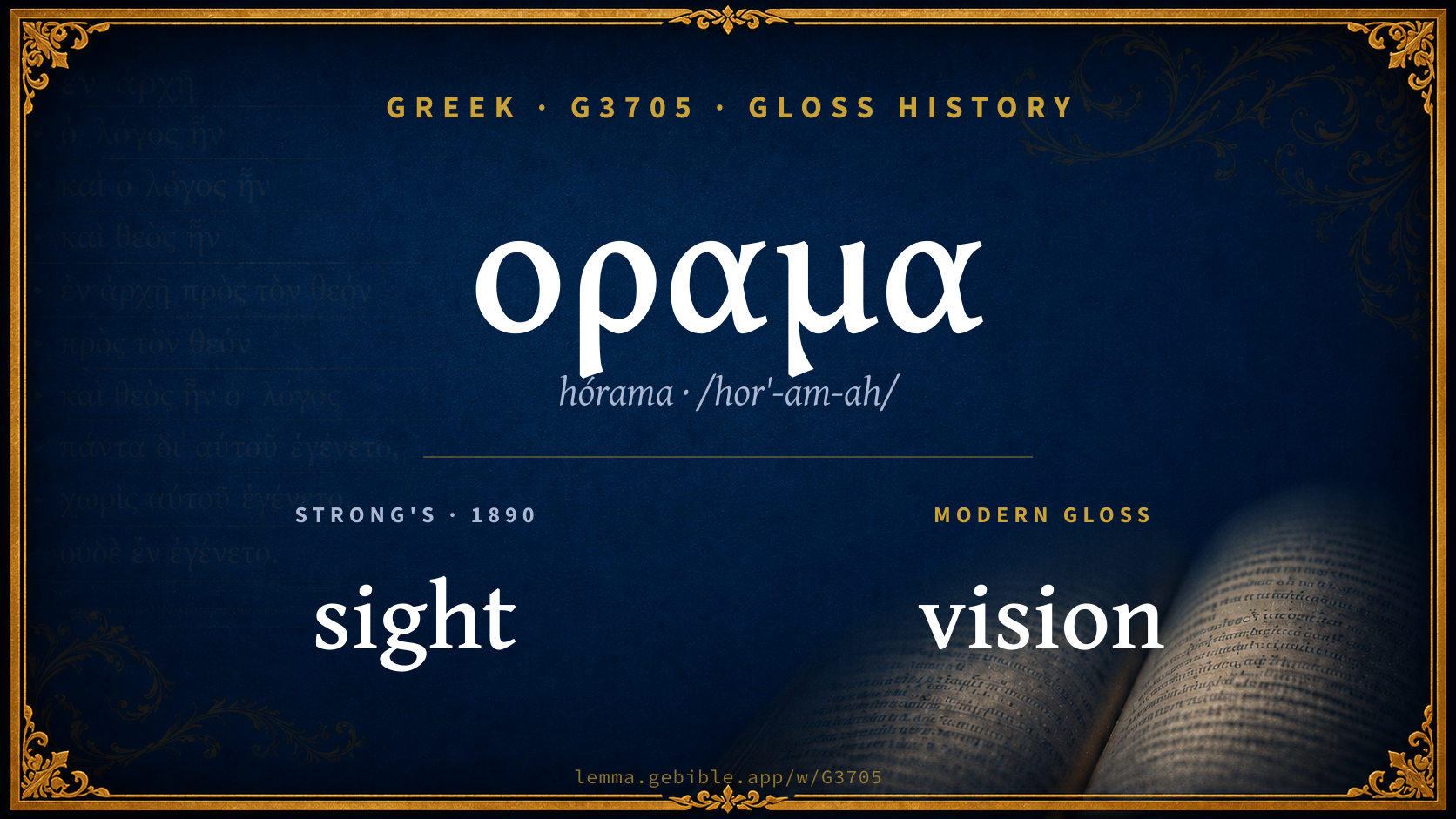
Gloss history
Strong's 1890 vs modern scholarship
About this word
Strong's G3705 catalogs a Greek word from the Greek New Testament.
These counts are not copied from any lexicon or concordance. They are computed here, from the morphology-tagged Greek New Testament. What Lemma adds →
- 11
- distinct verses
- The word appears in 11 distinct verses.
- 2 / 27
- NT books
- The word appears in 2 of 27 New Testament books.
- #978
- by frequency
- Top 1000 most frequent Greek words (rank 978 of 5,347 Greek words by occurrence).
View all 11 occurrences in the concordance →
By traditional corpus
Conventional, traditional groupings — biblical authorship is debated, so this is a traditional corpus grouping, not an authorship claim. Some books belong to more than one corpus (Luke is in both the Gospels and the Lukan corpus, and so on), so these shares overlap and need not total 100%. Each figure is a share of the word’s 11 distinct verses.
- Lukan (Luke–Acts) 10 verses · 91%
- Gospels 1 verse · 9%
How translations render this word
Counts come from each version’s own published word-to-Strong’s tagging or interlinear alignment — an approximate guide to how each version renders this word, not a word-level alignment the data otherwise carries. Because each total is that version’s own tagged count, the per-version totals vary from one another and need not match the appearance or distinct-verse counts above. These counts may also differ from a printed concordance because Lemma counts each distinctly tagged rendering and does not collapse phrase taggings into a single head-word total. This is a fixed set of word-tagged versions (KJV, ASV, BSB, ULT) and does not change with the reading translation you choose elsewhere. Each version’s license is shown beside its name below (and on Sources).
- King James Version: Vision 11×
- American Standard Version: Vision 9×
- Berean Standard Bible: Vision 10×
- unfoldingWord Literal Text: Vision 11×
King James Version Public Domain
Renders G3705 across 12 tagged occurrences — most commonly:
Plus 1 rendering that appears only once — usually multi-word phrases or single function words the recovered tagging swept in, not distinct renderings.
American Standard Version Public Domain
Renders G3705 across 11 tagged occurrences — most commonly:
Plus 2 renderings that appear only once — usually multi-word phrases or single function words the recovered tagging swept in, not distinct renderings.
Berean Standard Bible Public Domain
Renders G3705 across 11 tagged occurrences — most commonly:
Plus 1 rendering that appears only once — usually multi-word phrases or single function words the recovered tagging swept in, not distinct renderings. Not rendered by a distinct English word in 1 further occurrence.
unfoldingWord Literal Text CC BY-SA 4.0
Renders G3705 across 12 tagged occurrences — most commonly:
Plus 1 rendering that appears only once — usually multi-word phrases or single function words the recovered tagging swept in, not distinct renderings.
Senses in Thayer's
The 2 senses Thayer's distinguishes for this word, in lexicon order (not ranked by frequency or importance). The full entry — with sub-senses — is in the Lexicon Entry tab.
- that which is seen, spectacle
- a sight divinely granted in an ecstasy or in a sleep, a vision
Word origin
Derived from οραω (horáō) (G3708) — to see.
From G3708 ; something gazed at that is a spectacle (especially supernatural): - sight vision.
— Strong’s Exhaustive Concordance (1890), public domain.
Forms in the corpus
The 3 distinct written forms G3705 takes in the Greek New Testament, most frequent first — each parse links to that case’s occurrences in the concordance.
| Form | Parsing | Example | Uses |
|---|---|---|---|
| ὅραμα hórama | Noun, Accusative, Singular, Neuter | Matthew 17:9 | 7 |
| ὁράματι horámati | Noun, Dative, Singular, Neuter | Acts 9:10 | 2 |
| ὁράματος horámatos | Noun, Genitive, Singular, Neuter | Acts 10:19 | 2 |
Same root — word family
Other Thayer's entries built from the same root as G3705, grouped by Strong’s listed origin. These share a root / origin per the lexicon — not necessarily a shared meaning. Each links to that word’s own entry.
Derives from
Shares the same root
Compare all same-root words → Showing 4 of 5 — not the complete family. They share a root, not necessarily a meaning.
Septuagint usage
The same Greek word οραμα appears 41 times in the Greek Old Testament (Septuagint), across 37 verses in 9 books.
- 41
- LXX occurrences
- Tagged occurrences of this Greek word in the Septuagint.
- 37
- verses
- Distinct Septuagint verses containing this word.
- 9 / 39
- OT books
- The word appears in 9 of the 39 Old Testament books.
Sample Septuagint occurrences
- Genesis 15:1 ὅραμα
- Exodus 3:3 ὅραμα
- Numbers 12:6 ὅραμα
- Deuteronomy 4:34 ὅραμα
- Job 7:14 ὅραμα
- Ecclesiastes 6:9 ὅραμα
- Isaiah 21:1 ὅραμα
- Jeremiah 39:21 ὅραμα
- Daniel 1:17 ὅραμα
Septuagint occurrences (same lexeme)
Every verse where the same Strong’s number (G3705) appears in the Greek Septuagint. Verse text shown in the World English Bible for context; the Greek form is the matched word — the English is not keyword-highlighted.
- Genesis 15:1 ὅραμα After these things the word of Yahweh came to Abram in a vision, saying, "Don't be afraid, Abram. I am your shield, your exceedingly great reward."
- Genesis 46:2 ὅραμα God spoke to Israel in the visions of the night, and said, "Jacob, Jacob!" He said, "Here I am."
- Exodus 3:3 ὅραμα Moses said, I will turn aside now, and see this great sight, why the bush is not burnt.
- Numbers 12:6 ὅραμα He said, Hear now my words: if there be a prophet among you, I Yahweh will make myself known to him in a vision, I will speak with him in a dream.
- Deuteronomy 4:34 ὅραμα Or has God tried to go and take him a nation from the midst of [another] nation, by trials, by signs, and by wonders, and by war, and by a mighty hand, and by an outstretched arm, and by great terrors, according to all that Yahweh your God did for you in Egypt before your eyes?
- Deuteronomy 26:8 ὅραμα and Yahweh brought us forth out of Egypt with a mighty hand, and with an outstretched arm, and with great terror, and with signs, and with wonders;
- Deuteronomy 28:34 ὅραμα so that you shall be mad for the sight of your eyes which you shall see.
- Deuteronomy 28:67 ὅραμα In the morning you shall say, Would it were even! and at even you shall say, Would it were morning! for the fear of your heart which you shall fear, and for the sight of your eyes which you shall see.
- Job 7:14 ὅραμα Then you scar me with dreams, And terrify me through visions:
- Ecclesiastes 6:9 ὅραμα Better is the sight of the eyes than the wandering of the desire. This also is vanity and a chasing after wind.
- Isaiah 21:1 ὅραμα The burden of the wilderness of the sea. As whirlwinds in the South sweep through, it comes from the wilderness, from an awesome land.
- Isaiah 21:2 ὅραμα A grievous vision is declared to me; the treacherous man deals treacherously, and the destroyer destroys. Go up, Elam; besiege, Media; all the sighing of it have I made to cease.
- Isaiah 21:11 ὅραμα The burden of Dumah. One calls to me out of Seir, Watchman, what of the night? Watchman, what of the night?
- Isaiah 23:1 ὅραμα The burden of Tyre. Howl, you ships of Tarshish; for it is laid waste, so that there is no house, no entering in: from the land of Kittim it is revealed to them.
- Isaiah 30:10 ὅραμα who tell the seers, "Don't see;" and to the prophets, "Don't prophesy to us right things, speak to us smooth things, prophesy deceits,
- Jeremiah 39:21 ὅραμα
- Daniel 1:17 ὅραμα Now as for these four youths, God gave them knowledge and skill in all learning and wisdom: and Daniel had understanding in all visions and dreams.
- Daniel 2:1 ὅραμα In the second year of the reign of Nebuchadnezzar, Nebuchadnezzar dreamed dreams; and his spirit was troubled, and his sleep went from him.
- Daniel 2:7 ὅραμα They answered the second time and said, Let the king tell his servants the dream, and we will show the interpretation.
- Daniel 2:19 ὅραμα Then was the secret revealed to Daniel in a vision of the night. Then Daniel blessed the God of heaven.
- Daniel 2:26 ὅραμα The king answered Daniel, whose name was Belteshazzar, Are you able to make known to me the dream which I have seen, and the interpretation of it?
- Daniel 2:28 ὅραμα but there is a God in heaven who reveals secrets, and he has made known to the king Nebuchadnezzar what shall be in the latter days. Your dream, and the visions of your head on your bed, are these:
- Daniel 2:36 ὅραμα This is the dream; and we will tell the interpretation of it before the king.
- Daniel 2:45 ὅραμα Because you saw that a stone was cut out of the mountain without hands, and that it broke in pieces the iron, the brass, the clay, the silver, and the gold; the great God has made known to the king what shall happen hereafter: and the dream is certain, and the interpretation of it sure.
- Daniel 4:21 ὅραμα whose leaves were beautiful, and the fruit of it much, and in it was food for all; under which the animals of the field lived, and on whose branches the birds of the sky had their habitation:
- Daniel 7:1 ὅραμα In the first year of Belshazzar king of Babylon Daniel had a dream and visions of his head on his bed: then he wrote the dream and told the sum of the matters.
- Daniel 7:7 ὅραμα After this I saw in the night-visions, and, behold, a fourth animal, awesome and powerful, and strong exceedingly; and it had great iron teeth; it devoured and broke in pieces, and stamped the residue with its feet: and it was diverse from all the animals that were before it; and it had ten horns.
- Daniel 7:13 ὅραμα I saw in the night-visions, and, behold, there came with the clouds of the sky one like a son of man, and he came even to the ancient of days, and they brought him near before him.
- Daniel 7:15 ὅραμα As for me, Daniel, my spirit was grieved in the midst of my body, and the visions of my head troubled me.
- Daniel 8:2 ὅραμα I saw in the vision; now it was so, that when I saw, I was in Shushan the palace, which is in the province of Elam; and I saw in the vision, and I was by the river Ulai.
- Daniel 8:13 ὅραμα Then I heard a holy one speaking; and another holy one said to that certain one who spoke, How long shall be the vision [concerning] the continual [burnt-offering], and the disobedience that makes desolate, to give both the sanctuary and the host to be trodden under foot?
- Daniel 8:15 ὅραμα It happened, when I, even I Daniel, had seen the vision, that I sought to understand it; and, behold, there stood before me as the appearance of a man.
- Daniel 8:17 ὅραμα So he came near where I stood; and when he came, I was frightened, and fell on my face: but he said to me, Understand, son of man; for the vision belongs to the time of the end.
- Daniel 8:26 ὅραμα The vision of the evenings and mornings which has been told is true: but seal up the vision; for it belongs to many days [to come].
- Daniel 8:27 ὅραμα I, Daniel, fainted, and was sick certain days; then I rose up, and did the king's business: and I wondered at the vision, but none understood it.
- Daniel 9:24 ὅραμα Seventy weeks are decreed on your people and on your holy city, to finish disobedience, and to make an end of sins, and to make reconciliation for iniquity, and to bring in everlasting righteousness, and to seal up vision and prophecy, and to anoint the most holy.
- Daniel 10:1 ὅραμα In the third year of Cyrus king of Persia a thing was revealed to Daniel, whose name was called Belteshazzar; and the thing was true, even a great warfare: and he understood the thing, and had understanding of the vision.
These are occurrences of the same Greek lexeme (G3705) in the Septuagint — not a translation of any one Hebrew word. The store carries no word-level Hebrew↔Greek alignment, so no Hebrew original is asserted here. Counts come from the recovered LXX Strong's tagging — high-frequency vocabulary is well covered, while rare or late forms may be untagged — so they reflect tagged occurrences and may slightly undercount.