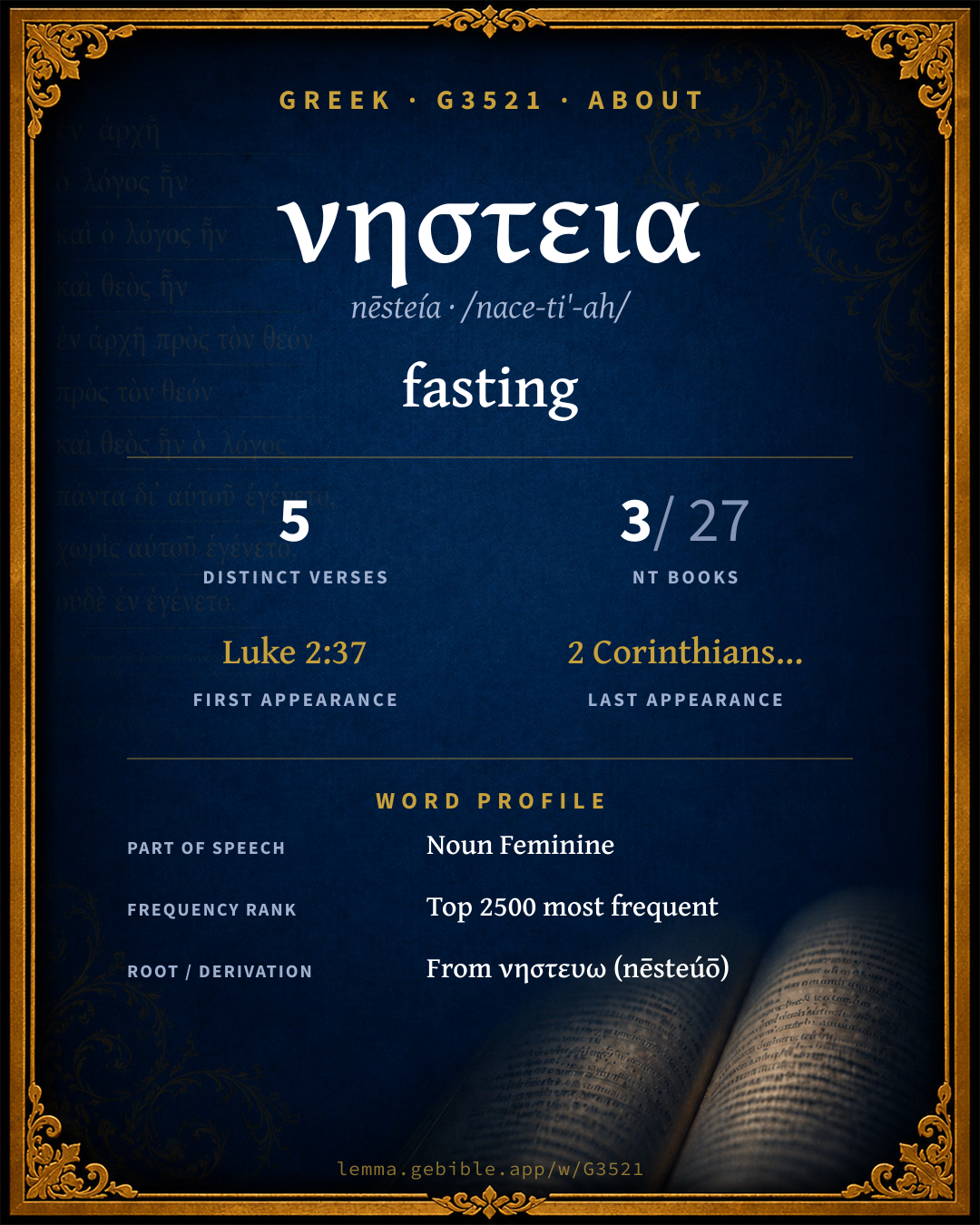
νηστεία
fasting
‘fasting’ is one of 2 main senses fuller range ↓
Full lexicon entry — Thayer's Greek Lexicon
From Thayer's Greek Lexicon
Where this word appears
See every Dative-case word in the Greek New Testament →
Grammar key — what these labels mean
Part of speech
- Noun
- A naming word — a person, place, thing, or idea.
Case
- Dative
- The case of the indirect object, means, or location — “to / for / with / in.”
- Accusative
- The case of the direct object and of extent.
- Genitive
- The case of source, possession, or “of” — answers “whose / from what.”
Gender
- Feminine
- Grammatically feminine.
Number
- Plural
- More than one.
- Singular
- One.
Grammatical forms
- Noun, Dative, Plural, Feminine 3 times (60%)
- Noun, Accusative, Singular, Feminine 1 time (20%)
- Noun, Genitive, Plural, Feminine 1 time (20%)
Parsed forms decoded from the imported morphology (Robinson–Tischendorf, public domain), counted across 5 parsed occurrences — not distinct verses.
Every verse where G3521 appears — 5 distinct verses across 3 books. Click any verse to open its interlinear word-by-word view. Verse text shown in the World English Bible for context — . Each verse’s Greek form is shown with its reference; the English is not keyword-highlighted, since the data carries no word-level English alignment. Use “Compare translations” on any verse to read it across multiple English versions. This concordance covers the Greek New Testament; Septuagint (Greek Old Testament) occurrences of this word are not indexed here.
Luke 1 verse
Acts 2 verses
- Acts 14:23 νηστειῶν n gen pl fem When they had appointed elders for them in every assembly, and had prayed with fasting, they commended them to the Lord, on whom they had believed.
- Acts 27:9 νηστείαν n acc sg fem When much time had passed and the voyage was now dangerous, because the Fast had now already gone by, Paul admonished them,
2 Corinthians 2 verses
About this entry
At a glance — auto-summarized from this page’s data, not written by a person. Every figure links to its source below. This summary describes the numbers; it doesn’t interpret them.
At its core, νηστεια (nēsteía) means “fasting.” A scarce word — 5 verses in all of the Greek New Testament. The word gravitates to Acts (40%), then 2 Corinthians and Luke. It first appears in Luke 2:37. Ranging over 2 senses, it is not a single-sense word. Each statement above links to its evidence; the full detail follows below.
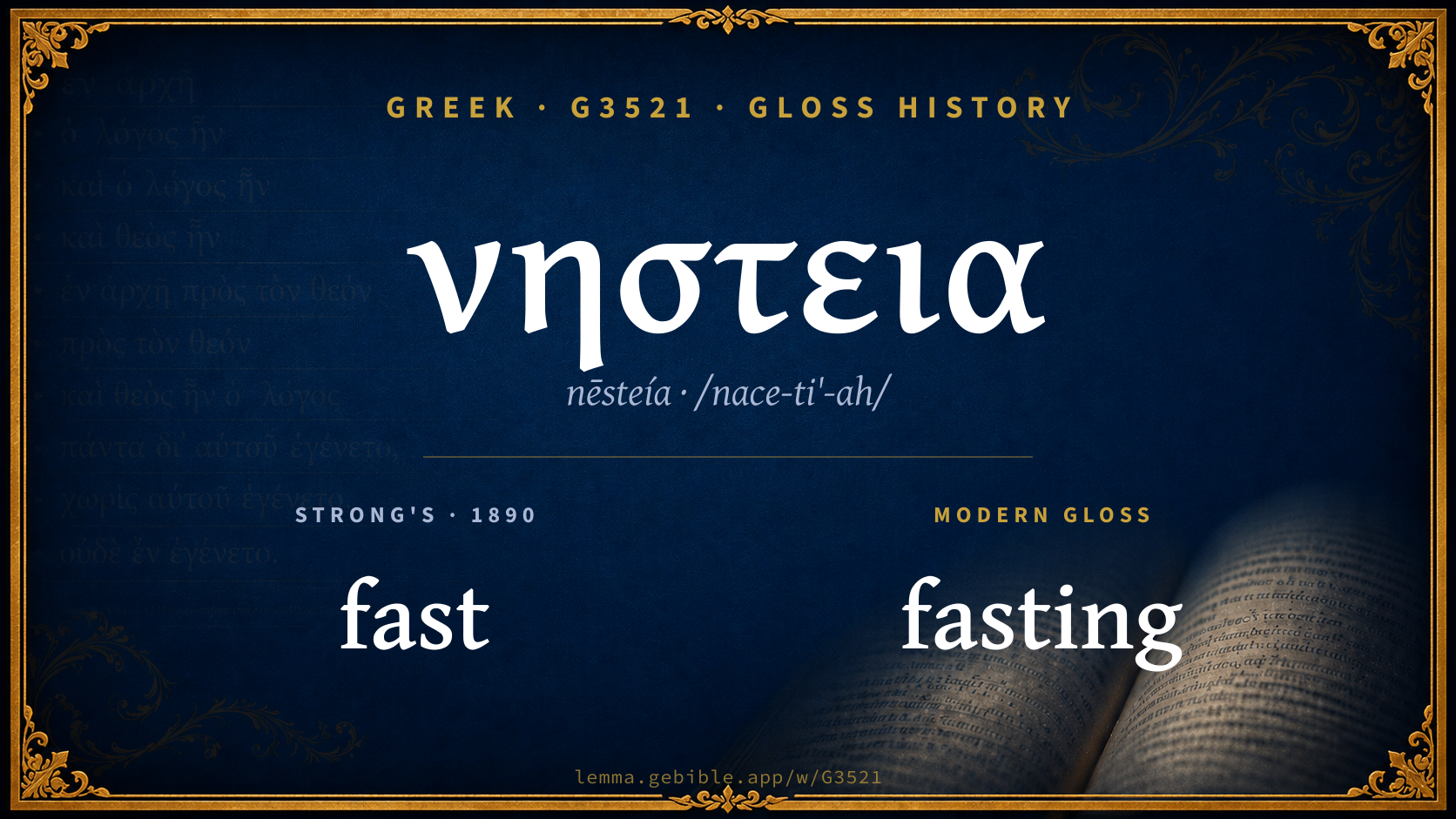
Gloss history
Strong's 1890 vs modern scholarship
About this word
Strong's G3521 catalogs a Greek word from the Greek New Testament.
These counts are not copied from any lexicon or concordance. They are computed here, from the morphology-tagged Greek New Testament. What Lemma adds →
- 5
- distinct verses
- The word appears in 5 distinct verses.
- 3 / 27
- NT books
- The word appears in 3 of 27 New Testament books.
- #1,648
- by frequency
- Top 2500 most frequent Greek words (rank 1,648 of 5,347 Greek words by occurrence).
View all 5 occurrences in the concordance →
Most concentrated in
- Acts 2 verses 40%
- 2 Corinthians 2 verses 40%
- Luke 1 verse 20%
By section of the New Testament
By traditional corpus
Conventional, traditional groupings — biblical authorship is debated, so this is a traditional corpus grouping, not an authorship claim. Some books belong to more than one corpus (Luke is in both the Gospels and the Lukan corpus, and so on), so these shares overlap and need not total 100%. Each figure is a share of the word’s 5 distinct verses.
- Lukan (Luke–Acts) 3 verses · 60%
- Pauline corpus 2 verses · 40%
- Gospels 1 verse · 20%
How translations render this word
Counts come from each version’s own published word-to-Strong’s tagging or interlinear alignment — an approximate guide to how each version renders this word, not a word-level alignment the data otherwise carries. Because each total is that version’s own tagged count, the per-version totals vary from one another and need not match the appearance or distinct-verse counts above. These counts may also differ from a printed concordance because Lemma counts each distinctly tagged rendering and does not collapse phrase taggings into a single head-word total. This is a fixed set of word-tagged versions (KJV, ASV, BSB, ULT) and does not change with the reading translation you choose elsewhere. Each version’s license is shown beside its name below (and on Sources).
- King James Version: Fasting 4×, Fastings 2×
- American Standard Version: Fastings 3×
- Berean Standard Bible: Fasting 2×
- unfoldingWord Literal Text: Fasting 4×
King James Version Public Domain
Renders G3521 across 8 tagged occurrences — most commonly:
Plus 2 renderings that appear only once — usually multi-word phrases or single function words the recovered tagging swept in, not distinct renderings.
American Standard Version Public Domain
Renders G3521 across 5 tagged occurrences — most commonly:
Plus 2 renderings that appear only once — usually multi-word phrases or single function words the recovered tagging swept in, not distinct renderings.
Berean Standard Bible Public Domain
Renders G3521 across 5 tagged occurrences — most commonly:
Plus 3 renderings that appear only once — usually multi-word phrases or single function words the recovered tagging swept in, not distinct renderings.
unfoldingWord Literal Text CC BY-SA 4.0
Renders G3521 across 7 tagged occurrences — most commonly:
Plus 3 renderings that appear only once — usually multi-word phrases or single function words the recovered tagging swept in, not distinct renderings.
Senses in Thayer's
The 2 senses Thayer's distinguishes for this word, in lexicon order (not ranked by frequency or importance). The full entry — with sub-senses — is in the Lexicon Entry tab.
- a voluntary, as a religious exercise
- a fasting caused by want or poverty
Word origin
Derived from νηστευω (nēsteúō) (G3522) — to fast.
From G3522 ; abstinence (from lack of food or voluntary and religious); specifically the fast of the Day of Atonement : - fast (-ing.)
— Strong’s Exhaustive Concordance (1890), public domain.
Forms in the corpus
The 3 distinct written forms G3521 takes in the Greek New Testament, most frequent first — each parse links to that case’s occurrences in the concordance.
| Form | Parsing | Example | Uses |
|---|---|---|---|
| νηστείαις nēsteíais | Noun, Dative, Plural, Feminine | Luke 2:37 | 3 |
| νηστείαν nēsteían | Noun, Accusative, Singular, Feminine | Acts 27:9 | 1 |
| νηστειῶν nēsteiō̂n | Noun, Genitive, Plural, Feminine | Acts 14:23 | 1 |
Septuagint usage
The same Greek word νηστεια appears 27 times in the Greek Old Testament (Septuagint), across 23 verses in 11 books.
- 27
- LXX occurrences
- Tagged occurrences of this Greek word in the Septuagint.
- 23
- verses
- Distinct Septuagint verses containing this word.
- 11 / 39
- OT books
- The word appears in 11 of the 39 Old Testament books.
Sample Septuagint occurrences
- 2 Samuel 12:16 νηστεία
- 1 Kings 20:9 νηστεία
- 2 Chronicles 20:3 νηστεία
- Ezra 8:21 νηστεία
- Psalms 34:13 νηστεία
- Isaiah 1:13 νηστεία
- Jeremiah 43:6 νηστεία
- Daniel 2:18 νηστεία
- Joel 1:14 νηστεία
- Jonah 3:5 νηστεία
- Zechariah 7:5 νηστεία
Septuagint occurrences (same lexeme)
Every verse where the same Strong’s number (G3521) appears in the Greek Septuagint. Verse text shown in the World English Bible for context; the Greek form is the matched word — the English is not keyword-highlighted.
- 2 Samuel 12:16 νηστεία David therefore begged God for the child; and David fasted, and went in, and lay all night on the earth.
- 1 Kings 20:9 νηστεία Therefore he said to the messengers of Ben Hadad, Tell my lord the king, All that you did send for to your servant at the first I will do; but this thing I may not do. The messengers departed, and brought him word again.
- 1 Kings 20:12 νηστεία It happened, when [Ben Hadad] heard this message, as he was drinking, he and the kings, in the pavilions, that he said to his servants, Set [yourselves in array]. They set [themselves in array] against the city.
- 2 Chronicles 20:3 νηστεία Jehoshaphat feared, and set himself to seek to Yahweh; and he proclaimed a fast throughout all Judah.
- Ezra 8:21 νηστεία Then I proclaimed a fast there, at the river Ahava, that we might humble ourselves before our God, to seek of him a straight way for us, and for our little ones, and for all our substance.
- Ezra 19:1 νηστεία
- Psalms 34:13 νηστεία Keep your tongue from evil, And your lips from speaking lies.
- Psalms 68:11 νηστεία The Lord announced the word. The ones who proclaim it are a great company.
- Psalms 108:24 νηστεία
- Isaiah 1:13 νηστεία Bring no more vain offerings. Incense is an abomination to me; New moons, Sabbaths, and convocations: I can't bear with evil assemblies.
- Isaiah 58:3 νηστεία Why have we fasted, [say they], and you don't see? [why] have we afflicted our soul, and you take no knowledge? Behold, in the day of your fast you find [your own] pleasure, and exact all your labors.
- Isaiah 58:5 νηστεία Is such the fast that I have chosen? the day for a man to afflict his soul? Is it to bow down his head as a rush, and to spread sackcloth and ashes under him? will you call this a fast, and an acceptable day to Yahweh?
- Isaiah 58:6 νηστεία Isn't this the fast that I have chosen: to loose the bonds of wickedness, to undo the bands of the yoke, and to let the oppressed go free, and that you break every yoke?
- Jeremiah 43:6 νηστεία the men, and the women, and the children, and the king's daughters, and every person who Nebuzaradan the captain of the guard had left with Gedaliah the son of Ahikam, the son of Shaphan; and Jeremiah the prophet, and Baruch the son of Neriah;
- Jeremiah 43:9 νηστεία Take great stones in your hand, and hide them in mortar in the brick work, which is at the entry of Pharaoh's house in Tahpanhes, in the sight of the men of Judah;
- Daniel 2:18 νηστεία that they would desire mercies of the God of heaven concerning this secret; that Daniel and his companions should nor perish with the rest of the wise men of Babylon.
- Daniel 9:3 νηστεία I set my face to the Lord God, to seek by prayer and petitions, with fasting and sackcloth and ashes.
- Joel 1:14 νηστεία Sanctify a fast. Call a solemn assembly. Gather the elders, And all the inhabitants of the land, to the house of Yahweh, your God, And cry to Yahweh.
- Joel 2:12 νηστεία "Yet even now," says Yahweh, "turn to me with all your heart, And with fasting, and with weeping, and with mourning."
- Joel 2:15 νηστεία Blow the trumpet in Zion! Sanctify a fast. Call a solemn assembly.
- Jonah 3:5 νηστεία The people of Nineveh believed God; and they proclaimed a fast, and put on sackcloth, from the greatest of them even to the least of them.
- Zechariah 7:5 νηστεία "Speak to all the people of the land, and to the priests, saying, 'When you fasted and mourned in the fifth and in the seventh month for these seventy years, did you at all fast to me, really to me?
- Zechariah 8:19 νηστεία Thus says Yahweh of Hosts: "The fasts of the fourth fifth, seventh, and tenth months shall be for the house of Judah joy and gladness, and cheerful feasts. Therefore love truth and peace."
These are occurrences of the same Greek lexeme (G3521) in the Septuagint — not a translation of any one Hebrew word. The store carries no word-level Hebrew↔Greek alignment, so no Hebrew original is asserted here. Counts come from the recovered LXX Strong's tagging — high-frequency vocabulary is well covered, while rare or late forms may be untagged — so they reflect tagged occurrences and may slightly undercount.