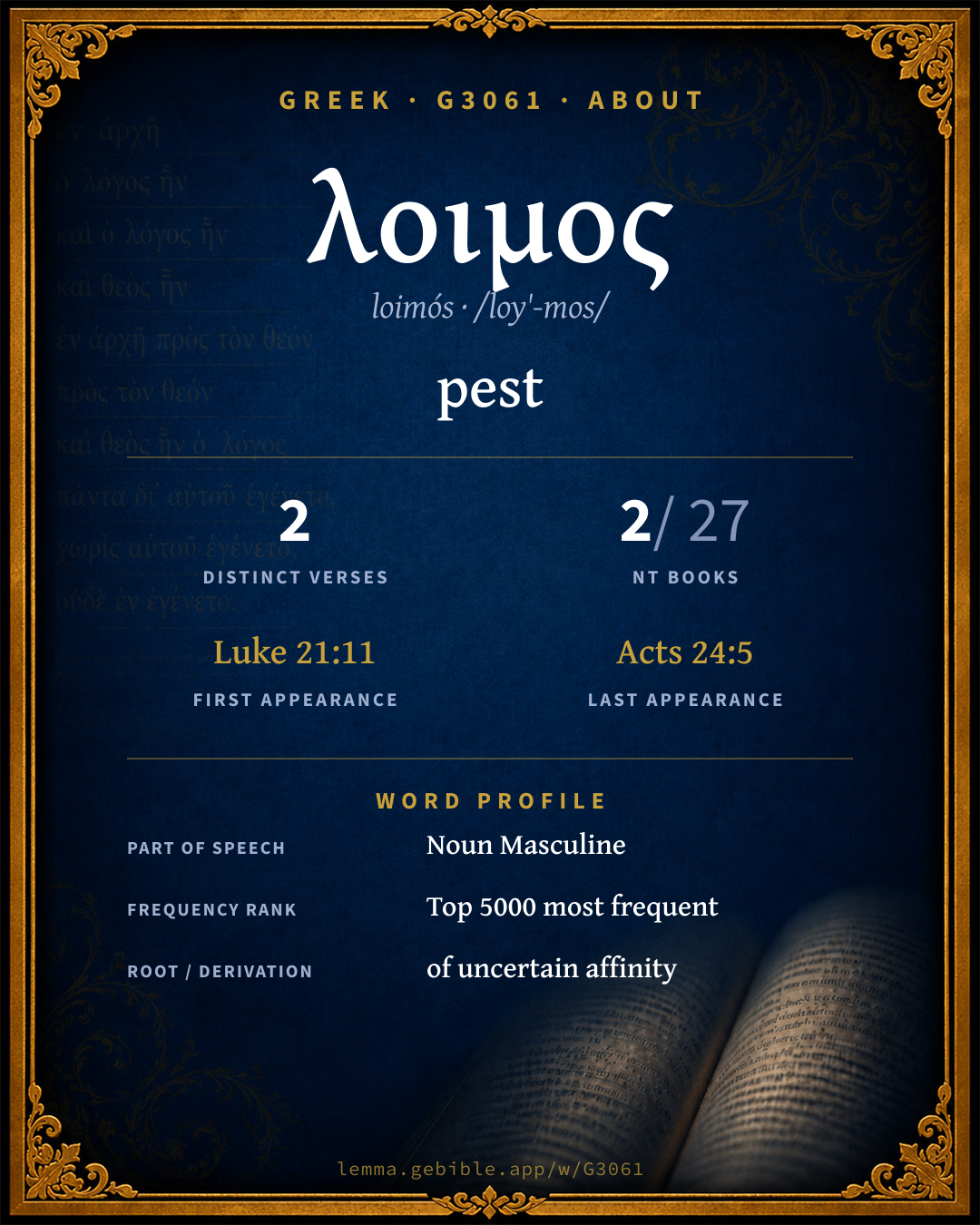
λοιμός
pest
‘pest’ is one of 2 main senses fuller range ↓
Full lexicon entry — Thayer's Greek Lexicon
From Thayer's Greek Lexicon
Where this word appears
See every Accusative-case word in the Greek New Testament →
Grammar key — what these labels mean
Part of speech
- Noun
- A naming word — a person, place, thing, or idea.
Case
- Accusative
- The case of the direct object and of extent.
- Nominative
- The case of the subject (and the predicate nominative).
Gender
- Masculine
- Grammatically masculine.
Number
- Singular
- One.
- Plural
- More than one.
1 distinct verse where G3061 appears in the Accusative case, across 1 book. Filtered view — show all forms. Click any verse to open its interlinear word-by-word view. Verse text shown in the World English Bible for context — . Each verse’s Greek form is shown with its reference; the English is not keyword-highlighted, since the data carries no word-level English alignment. Use “Compare translations” on any verse to read it across multiple English versions. This concordance covers the Greek New Testament; Septuagint (Greek Old Testament) occurrences of this word are not indexed here.
Acts 1 verse
About this entry
At a glance — auto-summarized from this page’s data, not written by a person. Every figure links to its source below. This summary describes the numbers; it doesn’t interpret them.
At its core, λοιμος (loimós) means “pest.” It occurs a mere 2 verses across Scripture. The word gravitates to Luke (50%), then Acts. Scripture first uses it in Luke 21:11. Ranging over 2 senses, it is not a single-sense word. Each statement above links to its evidence; the full detail follows below.
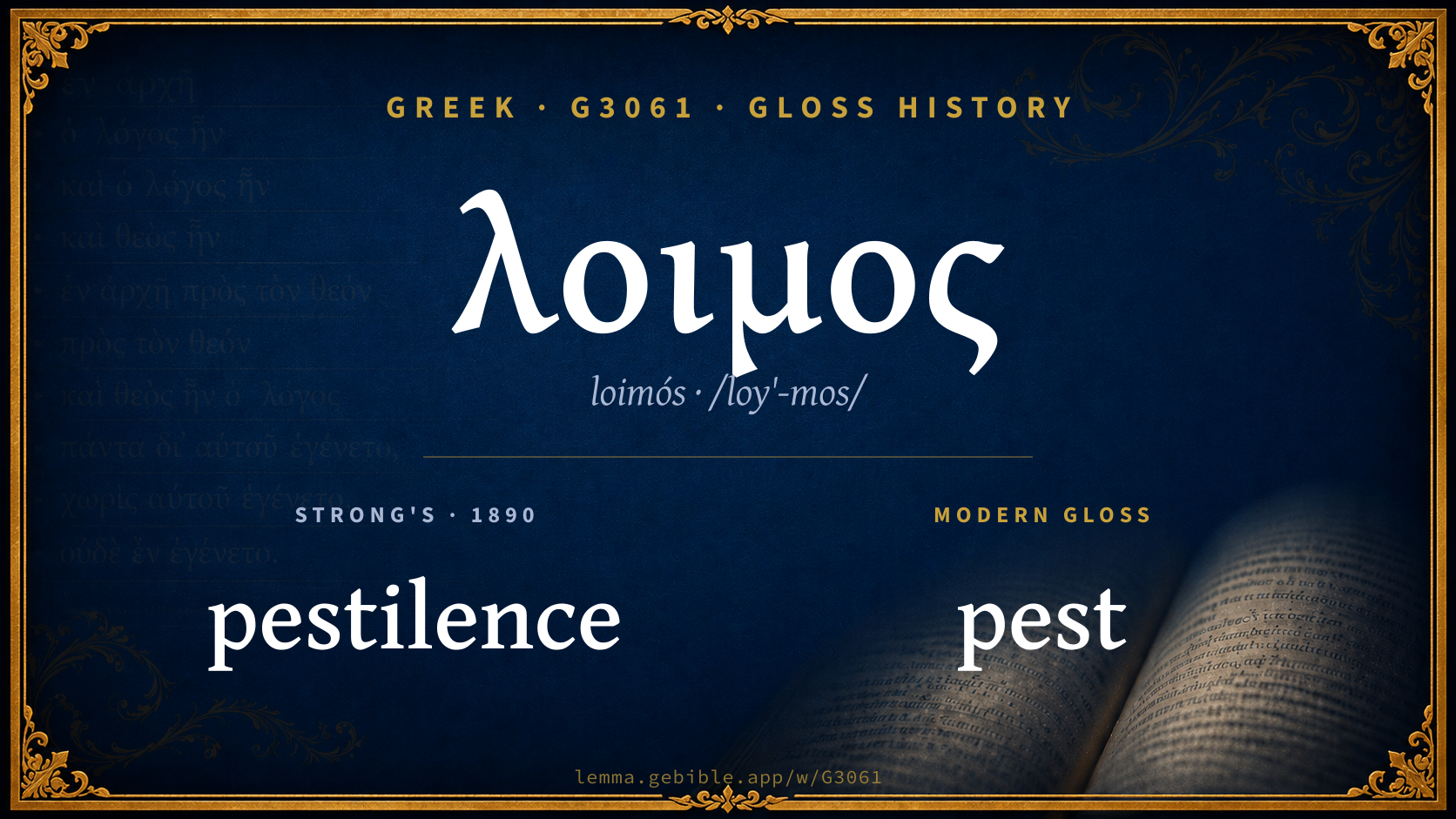
Gloss history
Strong's 1890 vs modern scholarship
About this word
Strong's G3061 catalogs a Greek word from the Greek New Testament.
These counts are not copied from any lexicon or concordance. They are computed here, from the morphology-tagged Greek New Testament. What Lemma adds →
- 2
- distinct verses
- The word appears in 2 distinct verses.
- 2 / 27
- NT books
- The word appears in 2 of 27 New Testament books.
- #2,678
- by frequency
- Top 5000 most frequent Greek words (rank 2,678 of 5,347 Greek words by occurrence).
View all 2 occurrences in the concordance →
By traditional corpus
Conventional, traditional groupings — biblical authorship is debated, so this is a traditional corpus grouping, not an authorship claim. Some books belong to more than one corpus (Luke is in both the Gospels and the Lukan corpus, and so on), so these shares overlap and need not total 100%. Each figure is a share of the word’s 2 distinct verses.
- Lukan (Luke–Acts) 2 verses · 100%
- Gospels 1 verse · 50%
How translations render this word
Counts come from each version’s own published word-to-Strong’s tagging or interlinear alignment — an approximate guide to how each version renders this word, not a word-level alignment the data otherwise carries. Because each total is that version’s own tagged count, the per-version totals vary from one another and need not match the appearance or distinct-verse counts above. These counts may also differ from a printed concordance because Lemma counts each distinctly tagged rendering and does not collapse phrase taggings into a single head-word total. This is a fixed set of word-tagged versions (KJV, ASV, BSB, ULT) and does not change with the reading translation you choose elsewhere. Each version’s license is shown beside its name below (and on Sources).
- King James Version: Pestilences 2×
- American Standard Version: Pestilences 1×, Pestilent 1×
- Berean Standard Bible: Pestilence 1×, Pestilences 1×
- unfoldingWord Literal Text: Finally 3×
King James Version Public Domain
Renders G3061 across 3 tagged occurrences — most commonly:
Plus 1 rendering that appears only once — usually multi-word phrases or single function words the recovered tagging swept in, not distinct renderings.
American Standard Version Public Domain
Renders G3061 across 2 tagged occurrences — most commonly:
Berean Standard Bible Public Domain
Renders G3061 across 2 tagged occurrences — most commonly:
unfoldingWord Literal Text CC BY-SA 4.0
Renders G3061 across 7 tagged occurrences — most commonly:
Plus 4 renderings that appear only once — usually multi-word phrases or single function words the recovered tagging swept in, not distinct renderings.
Senses in Thayer's
The 2 senses Thayer's distinguishes for this word, in lexicon order (not ranked by frequency or importance). The full entry — with sub-senses — is in the Lexicon Entry tab.
- pestilence
- a pestilent fellow, pest, plague
Word origin
Origin: of uncertain affinity
Of uncertain affinity; a plague (literally the disease or figuratively a pest ): - pestilence (-t).
— Strong’s Exhaustive Concordance (1890), public domain.
Forms in the corpus
The 2 distinct written forms G3061 takes in the Greek New Testament, most frequent first — each parse links to that case’s occurrences in the concordance.
| Form | Parsing | Example | Uses |
|---|---|---|---|
| λοιμοὶ loimoì | Noun, Nominative, Plural, Masculine | Luke 21:11 | 1 |
| λοιμὸν loimòn | Noun, Accusative, Singular, Masculine | Acts 24:5 | 1 |
Septuagint usage
The same Greek word λοιμος appears 24 times in the Greek Old Testament (Septuagint), across 24 verses in 9 books.
- 24
- LXX occurrences
- Tagged occurrences of this Greek word in the Septuagint.
- 24
- verses
- Distinct Septuagint verses containing this word.
- 9 / 39
- OT books
- The word appears in 9 of the 39 Old Testament books.
Sample Septuagint occurrences
- 1 Samuel 1:16 λοιμός
- 2 Chronicles 13:7 λοιμός
- Psalms 1:1 λοιμός
- Proverbs 19:25 λοιμός
- Isaiah 5:14 λοιμός
- Jeremiah 15:21 λοιμός
- Ezekiel 7:21 λοιμός
- Hosea 7:5 λοιμός
- Amos 4:2 λοιμός
Septuagint occurrences (same lexeme)
Every verse where the same Strong’s number (G3061) appears in the Greek Septuagint. Verse text shown in the World English Bible for context; the Greek form is the matched word — the English is not keyword-highlighted.
- 1 Samuel 1:16 λοιμός Don't count your handmaid for a wicked woman; for out of the abundance of my complaint and my provocation have I spoken hitherto.
- 1 Samuel 2:12 λοιμός Now the sons of Eli were base men; they didn't know Yahweh.
- 1 Samuel 10:27 λοιμός But certain worthless fellows said, How shall this man save us? They despised him, and brought him no present. But he held his peace.
- 1 Samuel 25:17 λοιμός Now therefore know and consider what you will do; for evil is determined against our master, and against all his house: for he is such a worthless fellow that one can't speak to him.
- 1 Samuel 25:25 λοιμός Please don't let my lord regard this worthless fellow, even Nabal; for as his name is, so is he; Nabal is his name, and folly is with him: but I your handmaid didn't see the young men of my lord, whom you did send.
- 1 Samuel 29:10 λοιμός Therefore now rise up early in the morning with the servants of your lord who have come with you; and as soon as you are up early in the morning, and have light, depart.
- 1 Samuel 30:22 λοιμός Then answered all the wicked men and base fellows, of those who went with David, and said, Because they didn't go with us, we will not give them anything of the spoil that we have recovered, except to every man his wife and his children, that he may lead them away, and depart.
- 2 Chronicles 13:7 λοιμός There were gathered to him worthless men, base fellows, who strengthened themselves against Rehoboam the son of Solomon, when Rehoboam was young and tender-hearted, and could not withstand them.
- Psalms 1:1 λοιμός Blessed is the man who doesn't walk in the counsel of the wicked, Nor stand in the way of sinners, Nor sit in the seat of scoffers;
- Proverbs 19:25 λοιμός Flog a scoffer, and the simple will learn prudence; Rebuke one who has understanding, and he will gain knowledge.
- Proverbs 21:24 λοιμός The proud and haughty man, "scoffer" is his name; He works in the arrogance of pride.
- Proverbs 22:10 λοιμός Drive out the mocker, and strife will go out; Yes, quarrels and insults will stop.
- Proverbs 24:9 λοιμός The schemes of folly are sin. The mocker is detested by men.
- Proverbs 29:8 λοιμός Mockers stir up a city, But wise men turn away anger.
- Isaiah 5:14 λοιμός Therefore Sheol has enlarged its desire, And opened its mouth without measure; And their glory, their multitude, their pomp, and he who rejoices among them, descend into it.
- Jeremiah 15:21 λοιμός I will deliver you out of the hand of the wicked, and I will redeem you out of the hand of the terrible.
- Ezekiel 7:21 λοιμός I will give it into the hands of the strangers for a prey, and to the wicked of the earth for a spoil; and they shall profane it.
- Ezekiel 18:10 λοιμός If he fathers a son who is a robber, a shedder of blood, and who does any one of these things,
- Ezekiel 28:7 λοιμός therefore, behold, I will bring strangers on you, the terrible of the nations; and they shall draw their swords against the beauty of your wisdom, and they shall defile your brightness.
- Ezekiel 30:11 λοιμός He and his people with him, the terrible of the nations, shall be brought in to destroy the land; and they shall draw their swords against Egypt, and fill the land with the slain.
- Ezekiel 31:12 λοιμός Strangers, the terrible of the nations, have cut him off, and have left him: on the mountains and in all the valleys his branches are fallen, and his boughs are broken by all the watercourses of the land; and all the peoples of the earth are gone down from his shadow, and have left him.
- Ezekiel 32:12 λοιμός By the swords of the mighty will I cause your multitude to fall; the terrible of the nations are they all: and they shall bring to nothing the pride of Egypt, and all the multitude of it shall be destroyed.
- Hosea 7:5 λοιμός On the day of our king, the princes made themselves sick with the heat of wine. He joined his hand with mockers.
- Amos 4:2 λοιμός The Lord Yahweh has sworn by his holiness that behold, "The days shall come on you that they will take you away with hooks, And the last of you with fish hooks.
These are occurrences of the same Greek lexeme (G3061) in the Septuagint — not a translation of any one Hebrew word. The store carries no word-level Hebrew↔Greek alignment, so no Hebrew original is asserted here. Counts come from the recovered LXX Strong's tagging — high-frequency vocabulary is well covered, while rare or late forms may be untagged — so they reflect tagged occurrences and may slightly undercount.