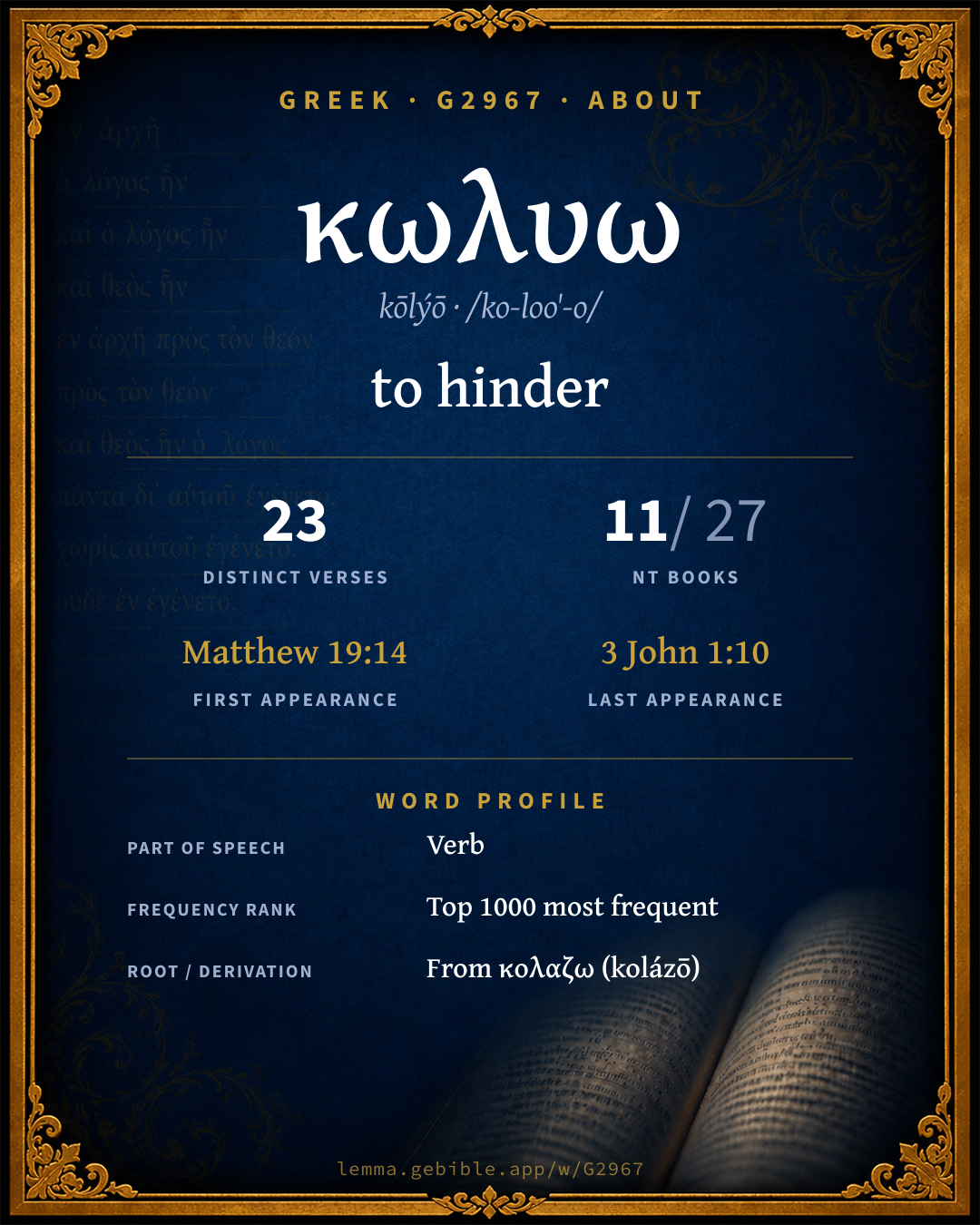
κωλύω
to hinder
‘to hinder’ is one of 3 main senses fuller range ↓
Full lexicon entry — Thayer's Greek Lexicon
From Thayer's Greek Lexicon
Where this word appears
See every Aorist-tense verb in the Greek New Testament →
Grammar key — what these labels mean
Part of speech
- Verb
- An action or state-of-being word.
Tense
- Present
- Ongoing or general action in present time (imperfective aspect).
- Aorist
- Action viewed as a simple whole, without regard to duration — often past (perfective aspect).
- Imperfect
- Continuous or repeated action in past time (“was writing”).
Voice
- Active
- The subject performs the action.
- Passive
- The subject receives the action.
Mood
- Imperative
- Expresses a command or request.
- Indicative
- States a fact or asks a factual question (the mood of reality).
- Infinitive
- A verbal noun (“to write”), unmarked for person or number.
- Participle
- A verbal adjective (“writing,” “having written”).
- Subjunctive
- Expresses probability, purpose, or possibility (the mood of contingency).
Case
- Genitive
- The case of source, possession, or “of” — answers “whose / from what.”
- Nominative
- The case of the subject (and the predicate nominative).
- Accusative
- The case of the direct object and of extent.
Person
- 2nd person
- The one addressed (“you”).
- 3rd person
- The one spoken about (“he / she / it / they”).
- 1st person
- The speaker (“I / we”).
Gender
- Masculine
- Grammatically masculine.
Number
- Plural
- More than one.
- Singular
- One.
4 verses where G2967 appears in the Aorist tense in the Book of Acts. Filtered view — show all forms. Click any verse to open its interlinear word-by-word view. Verse text shown in the World English Bible for context — . Each verse’s Greek form is shown with its reference; the English is not keyword-highlighted, since the data carries no word-level English alignment. Use “Compare translations” on any verse to read it across multiple English versions. This concordance covers the Greek New Testament; Septuagint (Greek Old Testament) occurrences of this word are not indexed here.
Acts
- Acts 10:47 κωλῦσαί aor act inf "Can any man forbid the water, that these who have received the Holy Spirit as well as we should not be baptized?"
- Acts 11:17 κωλῦσαι aor act inf If then God gave to them the same gift as us, when we believed in the Lord Jesus Christ, who was I, that I could withstand God?"
- Acts 16:6 κωλυθέντες aor pass ptcp nom pl masc When they had gone through the region of Phrygia and Galatia, they were forbidden by the Holy Spirit to speak the word in Asia.
- Acts 27:43 ἐκώλυσεν aor act ind 3sg But the centurion, desiring to save Paul, stopped them from their purpose, and commanded that those who could swim should throw themselves overboard first to go toward the land;
About this entry
At a glance — auto-summarized from this page’s data, not written by a person. Every figure links to its source below. This summary describes the numbers; it doesn’t interpret them.
κωλυω (kōlýō) is a Greek verb most often rendered “to hinder.” Older and newer Bibles part ways — “forbid” in the King James Version, “do” (unfoldingWord Literal Text) in modern versions. See the renderings breakdown. It turns up in 23 verses across 11 books, an uncommon footprint. It concentrates in Luke, which alone accounts for 26% of its uses. Ranging over 3 senses, it is not a single-sense word. For the data behind this summary, explore the sense tree and the renderings breakdown below.
Gloss history
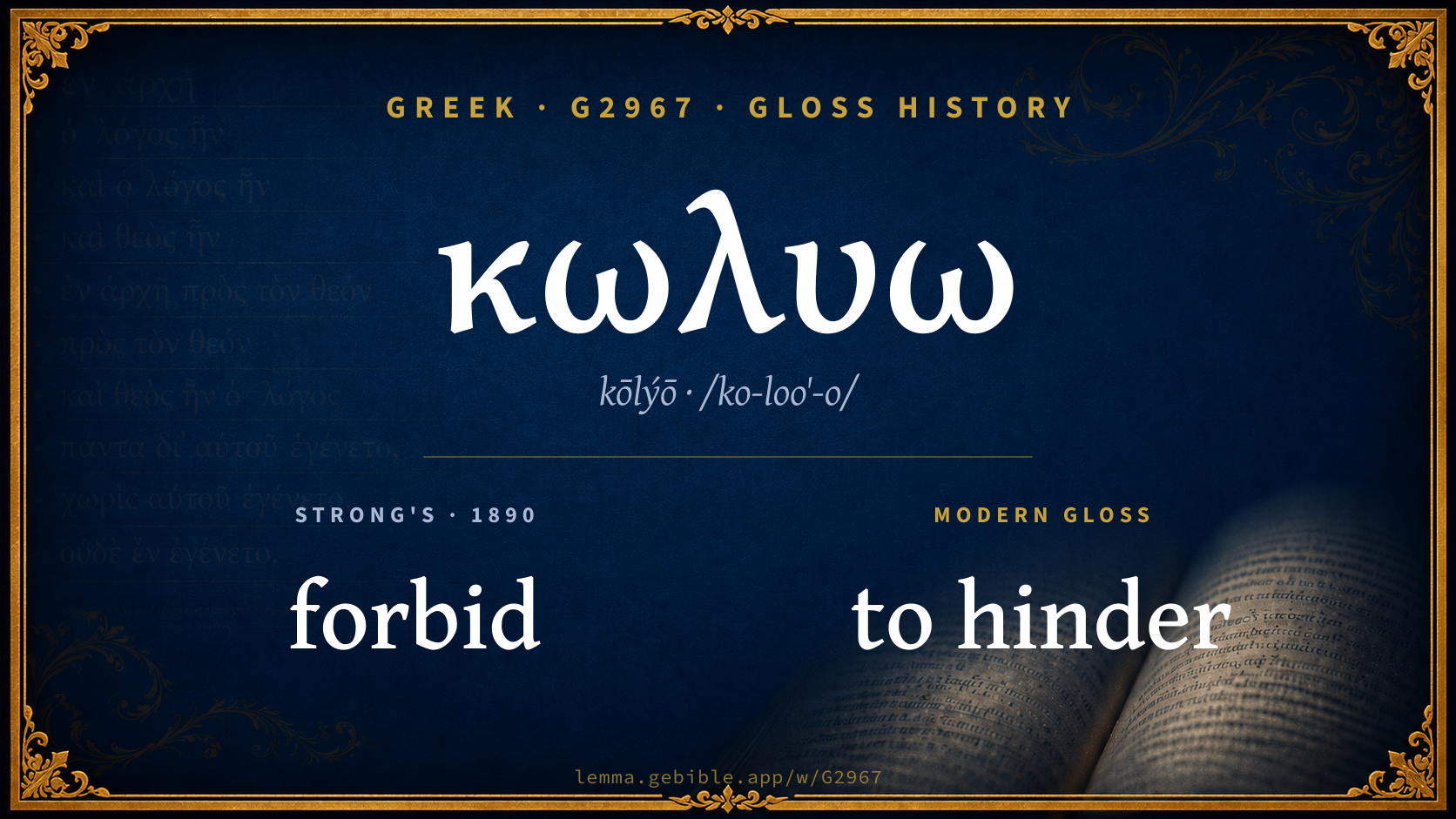
Strong's 1890 vs modern scholarship
About this word
Strong's G2967 catalogs a Greek word from the Greek New Testament.
These counts are not copied from any lexicon or concordance. They are computed here, from the morphology-tagged Greek New Testament. What Lemma adds →
- 23
- distinct verses
- The word appears in 23 distinct verses.
- 11 / 27
- NT books
- The word appears in 11 of 27 New Testament books.
- #563
- by frequency
- Top 1000 most frequent Greek words (rank 563 of 5,347 Greek words by occurrence).
View all 23 occurrences in the concordance →
By section of the New Testament
By traditional corpus
Conventional, traditional groupings — biblical authorship is debated, so this is a traditional corpus grouping, not an authorship claim. Some books belong to more than one corpus (Luke is in both the Gospels and the Lukan corpus, and so on), so these shares overlap and need not total 100%. Each figure is a share of the word’s 23 distinct verses.
- Lukan (Luke–Acts) 12 verses · 52%
- Gospels 10 verses · 43%
- Pauline corpus 4 verses · 17%
- General (Catholic) Epistles 2 verses · 9%
- Johannine 1 verse · 4%
- Hebrews 1 verse · 4%
How translations render this word
Counts come from each version’s own published word-to-Strong’s tagging or interlinear alignment — an approximate guide to how each version renders this word, not a word-level alignment the data otherwise carries. Because each total is that version’s own tagged count, the per-version totals vary from one another and need not match the appearance or distinct-verse counts above. These counts may also differ from a printed concordance because Lemma counts each distinctly tagged rendering and does not collapse phrase taggings into a single head-word total. This is a fixed set of word-tagged versions (KJV, ASV, BSB, ULT) and does not change with the reading translation you choose elsewhere. Each version’s license is shown beside its name below (and on Sources).
- King James Version: Forbid 8×, Forbidding 3×, We forbad 2×
- American Standard Version: Forbid 7×, Forbidding 3×, Stayed 2×
- Berean Standard Bible: Hinder 3×, Stop 2×, We tried to stop 2×
- unfoldingWord Literal Text: Do 7×, Forbid 5×, Forbidding 3×
King James Version Public Domain
Renders G2967 across 23 tagged occurrences — most commonly:
Plus 10 renderings that appear only once — usually multi-word phrases or single function words the recovered tagging swept in, not distinct renderings.
American Standard Version Public Domain
Renders G2967 across 23 tagged occurrences — most commonly:
Plus 9 renderings that appear only once — usually multi-word phrases or single function words the recovered tagging swept in, not distinct renderings.
Berean Standard Bible Public Domain
Renders G2967 across 23 tagged occurrences — most commonly:
Plus 14 renderings that appear only once — usually multi-word phrases or single function words the recovered tagging swept in, not distinct renderings.
unfoldingWord Literal Text CC BY-SA 4.0
Renders G2967 across 31 tagged occurrences — most commonly:
Plus 10 renderings that appear only once — usually multi-word phrases or single function words the recovered tagging swept in, not distinct renderings.
Senses in Thayer's
The 3 senses Thayer's distinguishes for this word, in lexicon order (not ranked by frequency or importance). The full entry — with sub-senses — is in the Lexicon Entry tab.
- to hinder, prevent forbid
- to withhold a thing from anyone
- to deny or refuse one a thing
Word origin
Derived from κολαζω (kolázō) (G2849) — to punish.
From the base of G2849 ; to estop that is prevent (by word or act): - forbid hinder keep from let not suffer withstand.
— Strong’s Exhaustive Concordance (1890), public domain.
Forms in the corpus
The 15 distinct written forms G2967 takes in the Greek New Testament, most frequent first — each parse links to that tense’s occurrences in the concordance.
Same root — word family
Other Thayer's entries built from the same root as G2967, grouped by Strong’s listed origin. These share a root / origin per the lexicon — not necessarily a shared meaning. Each links to that word’s own entry.
Derives from
Shares the same root
- κολασις kólasis G2851 punishment
- κολαφιζω kolaphízō G2852 to strike
- κολοβοω kolobóō G2856 to shorten
- κωλον kōlon G2966 member
Compare all same-root words → Showing 4 of 6 — not the complete family. They share a root, not necessarily a meaning.
Septuagint usage
The same Greek word κωλυω appears 13 times in the Greek Old Testament (Septuagint), across 13 verses in 11 books.
- 13
- LXX occurrences
- Tagged occurrences of this Greek word in the Septuagint.
- 13
- verses
- Distinct Septuagint verses containing this word.
- 11 / 39
- OT books
- The word appears in 11 of the 39 Old Testament books.
Sample Septuagint occurrences
- Genesis 23:6 κωλύω
- Exodus 36:6 κωλύω
- Numbers 11:28 κωλύω
- 1 Samuel 25:26 κωλύω
- 2 Samuel 13:13 κωλύω
- Job 12:15 κωλύω
- Psalms 39:10 κωλύω
- Ecclesiastes 8:8 κωλύω
- Isaiah 28:6 κωλύω
- Ezekiel 31:15 κωλύω
- Micah 2:4 κωλύω
Septuagint occurrences (same lexeme)
Every verse where the same Strong’s number (G2967) appears in the Greek Septuagint. Verse text shown in the World English Bible for context; the Greek form is the matched word — the English is not keyword-highlighted.
- Genesis 23:6 κωλύω "Hear us, my lord. You are a prince of God among us. In the choice of our tombs bury your dead. None of us will withhold from you his tomb, but that you may bury your dead."
- Exodus 36:6 κωλύω Moses gave commandment, and they caused it to be proclaimed throughout the camp, saying, "Let neither man nor woman make anything else for the offering for the sanctuary." So the people were restrained from bringing.
- Numbers 11:28 κωλύω Joshua the son of Nun, the minister of Moses, one of his chosen men, answered, My lord Moses, forbid them.
- 1 Samuel 25:26 κωλύω Now therefore, my lord, as Yahweh lives, and as your soul lives, seeing Yahweh has withheld you from blood guiltiness, and from avenging yourself with your own hand, now therefore let your enemies, and those who seek evil to my lord, be as Nabal.
- 2 Samuel 13:13 κωλύω I, where shall I carry my shame? and as for you, you will be as one of the fools in Israel. Now therefore, please speak to the king; for he will not withhold me from you.
- Job 12:15 κωλύω Behold, he withholds the waters, and they dry up; Again, he sends them out, and they overturn the earth.
- Psalms 39:10 κωλύω Remove your scourge away from me. I am overcome by the blow of your hand.
- Psalms 118:101 κωλύω
- Ecclesiastes 8:8 κωλύω There is no man who has power over the spirit to contain the spirit; neither does he have power over the day of death. There is no discharge in war; neither shall wickedness deliver those who practice it.
- Isaiah 28:6 κωλύω and a spirit of justice to him who sits in judgment, and strength to those who turn back the battle at the gate.
- Isaiah 43:6 κωλύω I will tell the north, Give up; and to the south, Don't keep back; bring my sons from far, and my daughters from the end of the earth;
- Ezekiel 31:15 κωλύω Thus says the Lord Yahweh: In the day when he went down to Sheol I caused a mourning: I covered the deep for him, and I restrained the rivers of it; and the great waters were stayed; and I caused Lebanon to mourn for him, and all the trees of the field fainted for him.
- Micah 2:4 κωλύω In that day they will take up a parable against you, And lament with a doleful lamentation, saying, 'We are utterly ruined! My people's possession is divided up. Indeed he takes it from me and assigns our fields to traitors!'"
These are occurrences of the same Greek lexeme (G2967) in the Septuagint — not a translation of any one Hebrew word. The store carries no word-level Hebrew↔Greek alignment, so no Hebrew original is asserted here. Counts come from the recovered LXX Strong's tagging — high-frequency vocabulary is well covered, while rare or late forms may be untagged — so they reflect tagged occurrences and may slightly undercount.