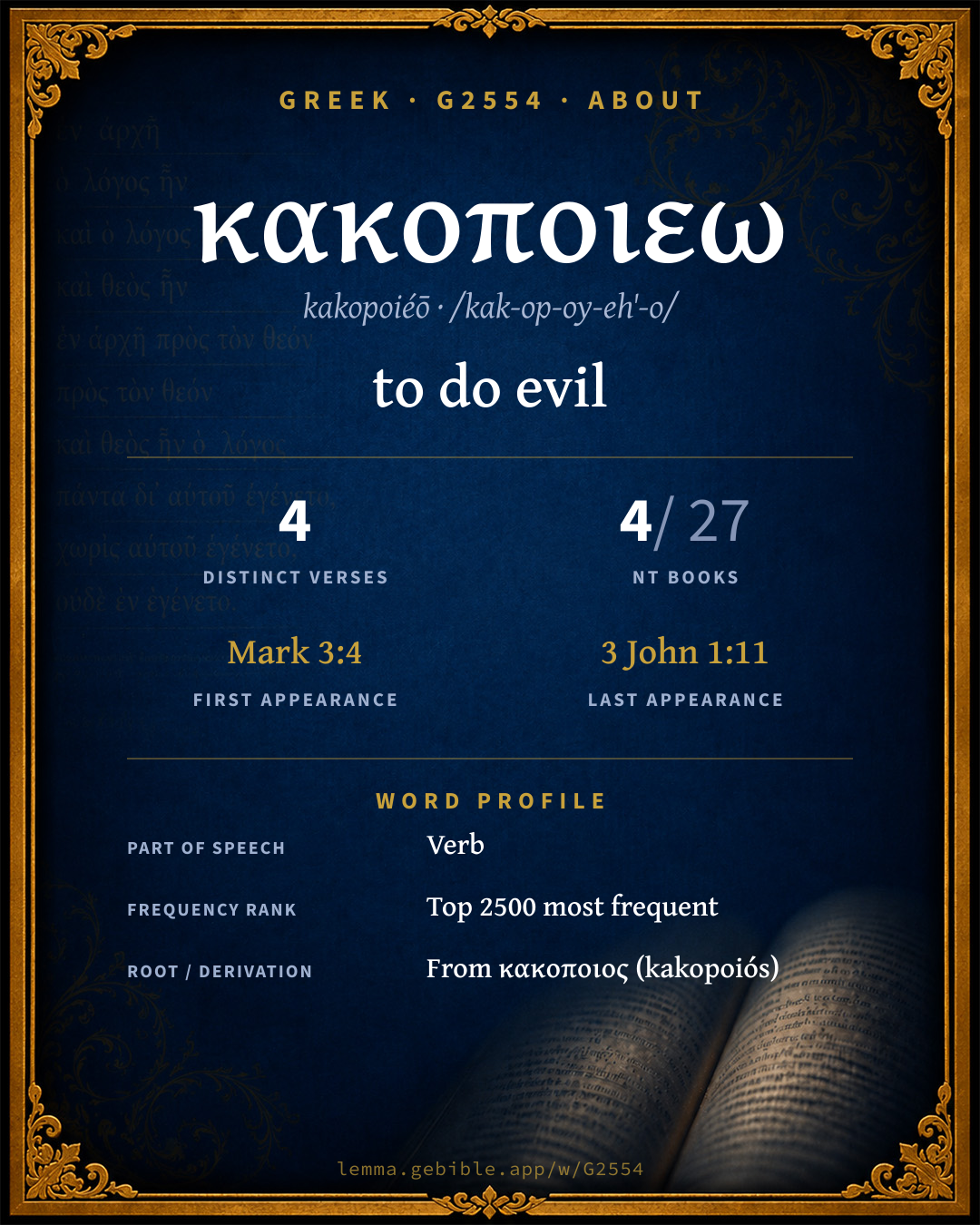
κακοποιέω
to do evil
‘to do evil’ is one of 2 main senses fuller range ↓
Full lexicon entry — Thayer's Greek Lexicon
From Thayer's Greek Lexicon
Where this word appears
Grammar key — what these labels mean
Part of speech
- Verb
- An action or state-of-being word.
Tense
- Aorist
- Action viewed as a simple whole, without regard to duration — often past (perfective aspect).
- Present
- Ongoing or general action in present time (imperfective aspect).
Voice
- Active
- The subject performs the action.
Mood
- Infinitive
- A verbal noun (“to write”), unmarked for person or number.
- Participle
- A verbal adjective (“writing,” “having written”).
Case
- Accusative
- The case of the direct object and of extent.
- Nominative
- The case of the subject (and the predicate nominative).
Gender
- Masculine
- Grammatically masculine.
Number
- Plural
- More than one.
- Singular
- One.
Every verse where G2554 appears in the Book of 1 Peter — 1 distinct verse. Click any verse to open its interlinear word-by-word view. Verse text shown in the World English Bible for context — . Each verse’s Greek form is shown with its reference; the English is not keyword-highlighted, since the data carries no word-level English alignment. Use “Compare translations” on any verse to read it across multiple English versions. This concordance covers the Greek New Testament; Septuagint (Greek Old Testament) occurrences of this word are not indexed here.
1 Peter
About this entry
At a glance — auto-summarized from this page’s data, not written by a person. Every figure links to its source below. This summary describes the numbers; it doesn’t interpret them.
The Greek verb κακοποιεω centers on the idea of “to do evil.” With only 4 verses it sits in the long tail of Greek New Testament vocabulary. The word gravitates to Mark (25%), then Luke and 1 Peter. Debuting at Mark 3:4, it then recurs through the corpus. Thayer's distinguishes 2 senses for it. For the data behind this summary, explore the sense tree and the renderings breakdown below.
Gloss history
Strong's 1890 vs modern scholarship
About this word
Strong's G2554 catalogs a Greek word from the Greek New Testament.
These counts are not copied from any lexicon or concordance. They are computed here, from the morphology-tagged Greek New Testament. What Lemma adds →
- 4
- distinct verses
- The word appears in 4 distinct verses.
- 4 / 27
- NT books
- The word appears in 4 of 27 New Testament books.
- #1,877
- by frequency
- Top 2500 most frequent Greek words (rank 1,877 of 5,347 Greek words by occurrence).
View all 4 occurrences in the concordance →
By section of the New Testament
By traditional corpus
Conventional, traditional groupings — biblical authorship is debated, so this is a traditional corpus grouping, not an authorship claim. Some books belong to more than one corpus (Luke is in both the Gospels and the Lukan corpus, and so on), so these shares overlap and need not total 100%. Each figure is a share of the word’s 4 distinct verses.
- Gospels 2 verses · 50%
- General (Catholic) Epistles 2 verses · 50%
- Lukan (Luke–Acts) 1 verse · 25%
- Johannine 1 verse · 25%
How translations render this word
Counts come from each version’s own published word-to-Strong’s tagging or interlinear alignment — an approximate guide to how each version renders this word, not a word-level alignment the data otherwise carries. Because each total is that version’s own tagged count, the per-version totals vary from one another and need not match the appearance or distinct-verse counts above. These counts may also differ from a printed concordance because Lemma counts each distinctly tagged rendering and does not collapse phrase taggings into a single head-word total. This is a fixed set of word-tagged versions (KJV, ASV, BSB, ULT) and does not change with the reading translation you choose elsewhere. Each version’s license is shown beside its name below (and on Sources).
- King James Version: Do evil 2×
- American Standard Version: Do harm 2×
- Berean Standard Bible: Do evil 2×
- unfoldingWord Literal Text: Do harm 2×
King James Version Public Domain
Renders G2554 across 4 tagged occurrences — most commonly:
Plus 2 renderings that appear only once — usually multi-word phrases or single function words the recovered tagging swept in, not distinct renderings.
American Standard Version Public Domain
Renders G2554 across 4 tagged occurrences — most commonly:
Plus 2 renderings that appear only once — usually multi-word phrases or single function words the recovered tagging swept in, not distinct renderings.
Berean Standard Bible Public Domain
Renders G2554 across 4 tagged occurrences — most commonly:
Plus 2 renderings that appear only once — usually multi-word phrases or single function words the recovered tagging swept in, not distinct renderings.
unfoldingWord Literal Text CC BY-SA 4.0
Renders G2554 across 4 tagged occurrences — most commonly:
Plus 2 renderings that appear only once — usually multi-word phrases or single function words the recovered tagging swept in, not distinct renderings.
Senses in Thayer's
The 2 senses Thayer's distinguishes for this word, in lexicon order (not ranked by frequency or importance). The full entry — with sub-senses — is in the Lexicon Entry tab.
- to do harm
- to do evil, do wrong
Word origin
Derived from κακοποιος (kakopoiós) (G2555) — evildoer.
From G2555 ; to be a bad doer that is (objectively) to injure or (generally) to sin : - do (-ing) evil.
— Strong’s Exhaustive Concordance (1890), public domain.
Forms in the corpus
The 3 distinct written forms G2554 takes in the Greek New Testament, most frequent first — each parse links to that tense’s occurrences in the concordance.
| Form | Parsing | Example | Uses |
|---|---|---|---|
| κακοποιῆσαι kakopoiē̂sai | Verb, Aorist, Active, Infinitive | Mark 3:4 | 2 |
| κακοποιοῦντας kakopoioûntas | Verb, Present, Active, Participle, Accusative, Plural, Masculine | 1 Peter 3:17 | 1 |
| κακοποιῶν kakopoiō̂n | Verb, Present, Active, Participle, Nominative, Singular, Masculine | 3 John 1:11 | 1 |
Septuagint usage
The same Greek word κακοποιεω appears 23 times in the Greek Old Testament (Septuagint), across 22 verses in 12 books.
- 23
- LXX occurrences
- Tagged occurrences of this Greek word in the Septuagint.
- 22
- verses
- Distinct Septuagint verses containing this word.
- 12 / 39
- OT books
- The word appears in 12 of the 39 Old Testament books.
Sample Septuagint occurrences
- Genesis 31:7 κακοποιέω
- Leviticus 5:4 κακοποιέω
- Numbers 35:23 κακοποιέω
- Judges 19:23 κακοποιέω
- 1 Samuel 12:25 κακοποιέω
- 2 Samuel 20:6 κακοποιέω
- 1 Kings 16:33 κακοποιέω
- 1 Chronicles 21:17 κακοποιέω
- Ezra 4:13 κακοποιέω
- Proverbs 4:16 κακοποιέω
- Isaiah 11:9 κακοποιέω
- Jeremiah 4:22 κακοποιέω
Septuagint occurrences (same lexeme)
Every verse where the same Strong’s number (G2554) appears in the Greek Septuagint. Verse text shown in the World English Bible for context; the Greek form is the matched word — the English is not keyword-highlighted.
- Genesis 31:7 κακοποιέω Your father has deceived me, and changed my wages ten times, but God didn't allow him to hurt me.
- Genesis 31:29 κακοποιέω It is in the power of my hand to hurt you, but the God of your father spoke to me last night, saying, 'Take heed to yourself that you don't speak to Jacob either good or bad.'
- Genesis 43:6 κακοποιέω Israel said, "Why did you treat me so badly, telling the man that you had another brother?"
- Leviticus 5:4 κακοποιέω "'Or if anyone swears rashly with his lips to do evil, or to do good, whatever it is that a man might utter rashly with an oath, and it is hidden from him; when he knows of it, then he shall be guilty of one of these.
- Numbers 35:23 κακοποιέω or with any stone, by which a man may die, not seeing him, and cast it on him, so that he died, and he was not his enemy, neither sought his harm;
- Judges 19:23 κακοποιέω The man, the master of the house, went out to them, and said to them, No, my brothers, please don't act so wickedly; seeing that this man is come into my house, don't do this folly.
- 1 Samuel 12:25 κακοποιέω But if you shall still do wickedly, you shall be consumed, both you and your king."
- 1 Samuel 25:34 κακοποιέω For in very deed, as Yahweh, the God of Israel, lives, who has withheld me from hurting you, except you had hurried and come to meet me, surely there wouldn't have been left to Nabal by the morning light so much as one man-child.
- 1 Samuel 26:21 κακοποιέω Then said Saul, I have sinned: return, my son David; for I will no more do you harm, because my life was precious in your eyes this day: behold, I have played the fool, and have erred exceedingly.
- 2 Samuel 20:6 κακοποιέω David said to Abishai, Now will Sheba the son of Bichri do us more harm than did Absalom: take your lord's servants, and pursue after him, lest he get him fortified cities, and escape out of our sight.
- 2 Samuel 24:17 κακοποιέω David spoke to Yahweh when he saw the angel who struck the people, and said, Behold, I have sinned, and I have done perversely; but these sheep, what have they done? Please let your hand be against me, and against my father's house.
- 1 Kings 16:33 κακοποιέω Ahab made the Asherah; and Ahab did yet more to provoke Yahweh, the God of Israel, to anger than all the kings of Israel who were before him.
- 1 Chronicles 21:17 κακοποιέω David said to God, Isn't it I who commanded the people to be numbered? It is even I who have sinned and done very wickedly; but these sheep, what have they done? Please let your hand, O Yahweh my God, be against me, and against my father's house; but not against your people, that they should be plagued.
- Ezra 4:13 κακοποιέω Be it known now to the king that if this city is built, and the walls finished, they will not pay tribute, custom, or toll, and in the end it will be hurtful to the kings.
- Ezra 4:15 κακοποιέω that search may be made in the book of the records of your fathers: so shall you find in the book of the records, and know that this city is a rebellious city, and hurtful to kings and provinces, and that they have moved sedition within the same of old time; for which cause was this city laid waste.
- Proverbs 4:16 κακοποιέω For they don't sleep, unless they do evil. Their sleep is taken away, unless they make someone fall.
- Proverbs 6:18 κακοποιέω A heart that devises wicked schemes, Feet that are swift in running to mischief,
- Proverbs 11:15 κακοποιέω He who is collateral for a stranger will suffer for it, But he who refuses pledges of collateral is secure.
- Proverbs 19:7 κακοποιέω All the relatives of the poor shun him: How much more do his friends avoid him! He pursues them with pleas, but they are gone.
- Isaiah 11:9 κακοποιέω They shall not hurt nor destroy in all my holy mountain; for the earth shall be full of the knowledge of Yahweh, as the waters cover the sea.
- Jeremiah 4:22 κακοποιέω For my people are foolish, they don't know me; they are foolish children, and they have no understanding; they are wise to do evil, but to do good they have no knowledge.
- Jeremiah 10:10 κακοποιέω But Yahweh is the true God; he is the living God, and an everlasting King: at his wrath the earth trembles, and the nations are not able to abide his indignation.
These are occurrences of the same Greek lexeme (G2554) in the Septuagint — not a translation of any one Hebrew word. The store carries no word-level Hebrew↔Greek alignment, so no Hebrew original is asserted here. Counts come from the recovered LXX Strong's tagging — high-frequency vocabulary is well covered, while rare or late forms may be untagged — so they reflect tagged occurrences and may slightly undercount.