
Ezekiel 28:6

Hebrew (Westminster Leningrad Codex) Ezekiel 28:6 appears in the Hebrew Old Testament. The text above is from the Westminster Leningrad Codex. Each word links to its Strong’s number, a concise gloss, and parsing drawn from the Open Scriptures Hebrew Bible morphology. Click any word for its full Brown-Driver-Briggs (BDB) entry.
Download image
Cite this verse

Ezekiel 28:6 (World English Bible). Public Domain. Lemma interlinear Bible study tool, https://lemma.gebible.app/v/ezekiel/28/6.

Show BibTeX & RIS
BibTeX
RIS
English Translation
therefore thus says the Lord Yahweh: Because you have set your heart as the heart of God,
World English Bible · Public Domain
Download a study sheet

One document with this verse’s original text, its word-by-word gloss line, the meaning frame, cross-references with their text, attributed commentary, and full source and license credits — printable, and it pastes into notes with its structure intact.

This verse Autodidact and up

Study sheet (.html) Plain text (.txt)

A passage Seminary Student

Up to 50 verses in one chapter. A passage sheet keeps up to 6 commentary sources and 12 cross-references per verse, in the order this page ranks them, and says so on the sheet whenever that leaves anything out. Ask for a single verse and you get the Autodidact verse sheet above.

Everything on this page stays free to read, with no account — the sheet is a download of what is already on screen, not access to it.

Want to remove ads? Support Godless Engineer
Compare translations 3

The same verse in 3 English versions, stacked beneath the original-language interlinear above. Click any original word for its lexicon entry.

Each is an independent rendering of the whole verse — the interlinear is not word-aligned to these translations.

Highlighted words mark where these versions differ — a whole-verse word diff, not a word-by-word alignment.

  • World English Bible Public Domain
    therefore thus says the Lord Yahweh: Because you have set your heart as the heart of God,
  • King James Version Public Domain
    Therefore thus saith the Lord GOD; Because thou hast set thine heart as the heart of God;
  • unfoldingWord Literal Text CC BY-SA 4.0
    Therefore, the Lord Yahweh says this: Because you have made your heart like the heart of a god,

unfoldingWord Literal Text — © unfoldingWord, licensed CC BY-SA 4.0. Word-aligned USFM3 via Door43 (git.door43.org/unfoldingWord/en_ult).

Versions to compare (up to 4)

3 of 4 selected

Show all 18 translations

Every available English version of this verse, each an independent rendering of the whole verse.

  • World English Bible Public Domain
    therefore thus says the Lord Yahweh: Because you have set your heart as the heart of God,
  • Berean Standard Bible Public Domain
    Therefore this is what the Lord GOD says: Because you regard your heart as the heart of a god,
  • Majority Standard Bible Public Domain
    Therefore this is what the Lord GOD says: Because you regard your heart as the heart of a god,
  • King James Version Public Domain
    Therefore thus saith the Lord GOD; Because thou hast set thine heart as the heart of God;
  • American Standard Version (1901) Public Domain
    therefore thus saith the Lord Jehovah: Because thou hast set thy heart as the heart of God,
  • Revised Version (1885) Public Domain
    therefore thus saith the Lord GOD: Because thou hast set thine heart as the heart of God;
  • Geneva Bible (1599) Public Domain
    Therefore thus sayeth the Lord God, Because thou didest thinke in thine heart, that thou wast equall with God,
  • Douay-Rheims (1899) Public Domain
    Therefore, thus saith the Lord God: Because thy heart is lifted up as the heart of God:
  • Young's Literal Translation Public Domain
    Therefore, thus said the Lord Jehovah: Because of thy giving out thy heart as the heart of God,
  • Literal Standard Version CC BY-SA 4.0
    Therefore, thus said Lord YHWH: Because of your giving out your heart as the heart of God,
  • Unlocked Literal Bible CC BY-SA 4.0
    Therefore, the Lord Yahweh says this: Because you have made your heart like the heart of a god,
  • unfoldingWord Literal Text CC BY-SA 4.0
    Therefore, the Lord Yahweh says this: Because you have made your heart like the heart of a god,
  • Darby Bible Public Domain
    Therefore thus saith the Lord Jehovah: Because thou hast set thy heart as the heart of God,
  • World Messianic Bible Public Domain
    “‘therefore the Lord GOD says: “Because you have set your heart as the heart of God,
  • Webster's Bible Public Domain
    Therefore thus saith the Lord GOD; Because thou hast set thy heart as the heart of God;
  • Free Bible Version CC BY-SA 4.0
    So this is what the Lord God says: Because you think that you're a god,
  • Bible in Basic English Public Domain
    For this cause the Lord has said: Because you have made your heart as the heart of God,
  • JPS Tanakh (1917) Public Domain
    Therefore thus saith the Lord GOD: Because thou hast set thy heart as the heart of God;

Literal Standard Version (2020), Covenant Press — licensed CC BY-SA 4.0. Text via the HelloAO Bible API (eBible.org). Unlocked Literal Bible (unfoldingWord) — licensed CC BY-SA 4.0. Text via the HelloAO Bible API (eBible.org). unfoldingWord Literal Text — © unfoldingWord, licensed CC BY-SA 4.0. Word-aligned USFM3 via Door43 (git.door43.org/unfoldingWord/en_ult). Free Bible Version, Dr. Jonathan Gallagher — licensed CC BY-SA 4.0. Text via the HelloAO Bible API (eBible.org).

Word by word

More ways to search: Search by grammar → Find every occurrence → Compare this word →

Practice this passage: Drill this verse → Learn its vocabulary →

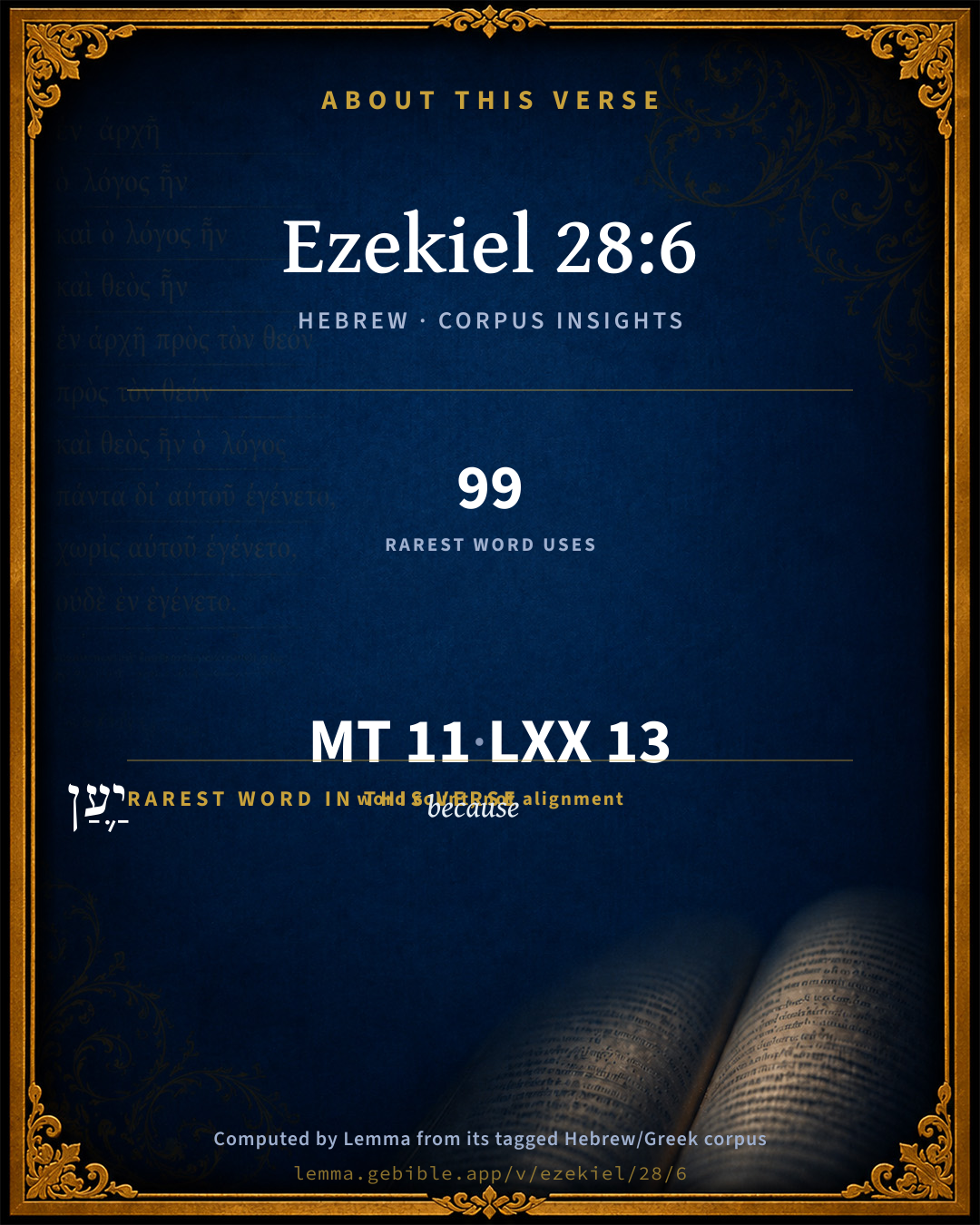
יַ֛עַן
yaʻan
H3282
“because”
Conjunction
Part of Speech
Conjunction
Full BDB Definition

Origin: from an unused root meaning to pay attention

TWOT: 1650e

because, therefore, because that, on account of (conjunction) - because of, on account of (preposition) - why (with interrogative pronoun) (preposition)
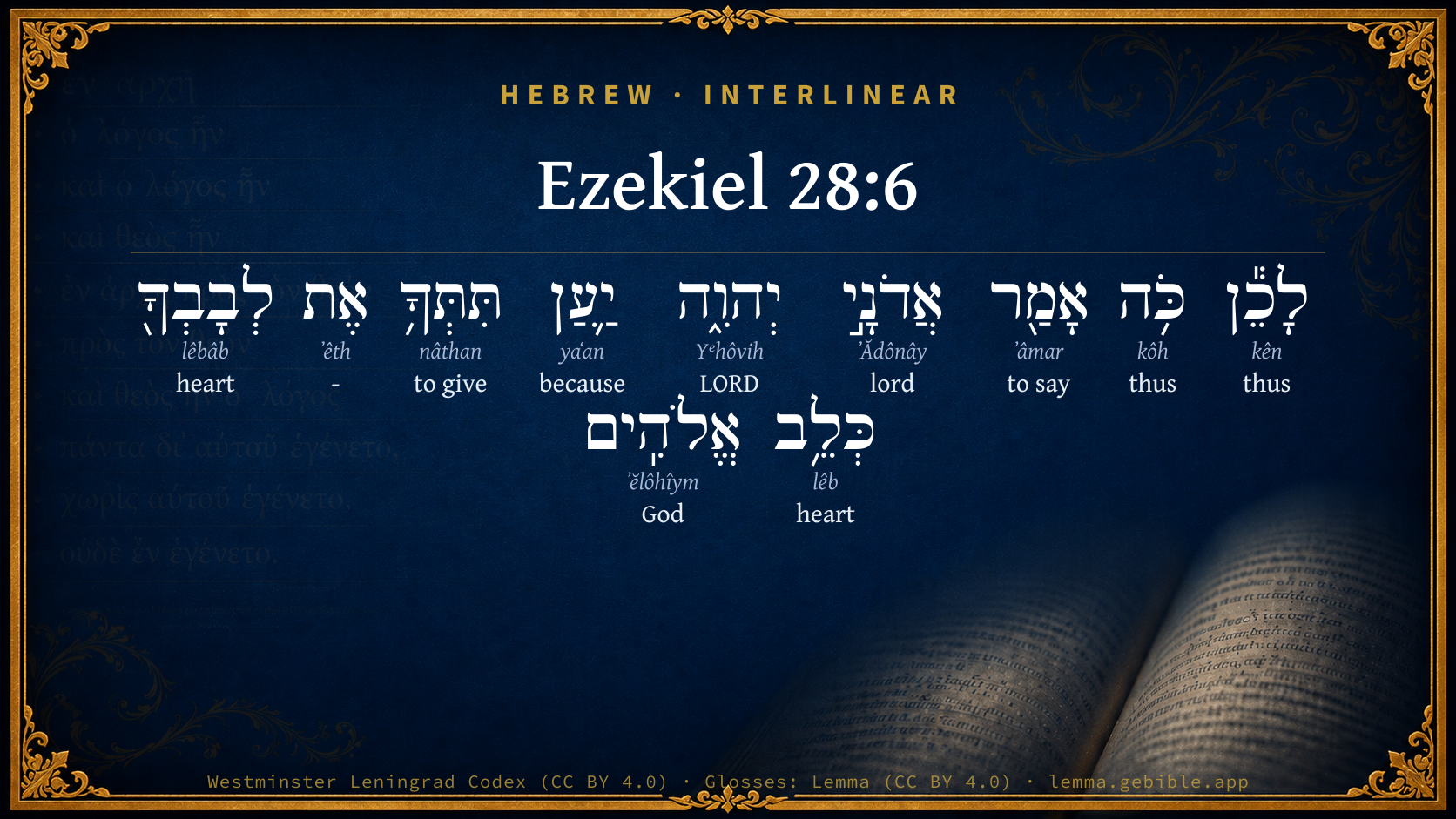
  1. לָכֵ֕ן kên H3651 “to/for · thus” Preposition + Adverb
  2. כֹּ֥ה kôh H3541 “thus” Adverb
  3. אָמַ֖ר ʼâmar H559 “to say” Verb, Qal, Perfect, 3rd Person, Masculine, Singular
  4. אֲדֹנָ֣י ʼĂdônây H136 “Lord · my” Noun, Common, Masculine, Plural, Construct + Suffix, Personal, 1st Person, Common, Singular
  5. יְהוִ֑ה Yᵉhôvih H3069 “LORD” Noun, Proper
  6. תִּתְּךָ֥ nâthan H5414 “to give · you” Verb, Qal, Infinitive Construct + Suffix, Personal, 2nd Person, Masculine, Singular
  7. אֶת ʼêth H853 “-” Particle, Direct Object
  8. לְבָבְךָ֖ lêbâb H3824 “heart · your” Noun, Common, Masculine, Singular, Construct + Suffix, Personal, 2nd Person, Masculine, Singular
  9. כְּלֵ֥ב lêb H3820 “like/as · heart of” Preposition + Noun, Common, Masculine, Singular, Construct
  10. אֱלֹהִֽים ʼĕlôhîym H430 “God(s)” Noun, Common, Masculine, Plural, Absolute

About this verse

These counts appear in no published source. They are computed here, from the morphology-tagged text and Lemma’s own curated glosses. What Lemma adds →

11
words
11
distinct lemmas
Prophets
section

Grammatical profile

  • 2 verbs
  • 5 nouns
  • 1 conjunction
  • 2 adverbs
  • 1 particle

Verb forms

  • אָמַ֖ר Qal · Perfect
  • תִּתְּךָ֥ Qal · Infinitive Construct

Hebrew & Septuagint length

In English translation the verse runs 17 words from the Hebrew and 16 from the Septuagint (LXX English) — closely comparable.

A rough comparison of the two English renderings, which tokenize alike — not a word-level alignment.

Word counts can differ between the Hebrew and the Greek without any difference in meaning — e.g. the Hebrew direct-object marker אֵת has no separate Greek word, and Greek often adds the article ὁ.

In the original languages it is 11 Hebrew tokens and 13 Greek tokens — but the two are counted differently (Hebrew bundles its prefixes and suffixes into one token; the Greek is in lemma form), so that isn’t a like-for-like length.

Cross-references

7

Topical passages linked to Ezekiel 28:6 in the Treasury of Scripture Knowledge — connected by theme and wording, ordered by reader-vote popularity; previews shown in the World English Bible.

  • Ezekiel 28:2 Son of man, tell the prince of Tyre, Thus says the Lord Yahweh: Because your heart is lifted up, and you have said, I am a god, I sit in the seat of God, in the midst of the seas; yet you are man, and not God, though you did set your heart as the heart of God;-
  • Exodus 9:17 as you still exalt yourself against my people, that you won't let them go.
  • Job 9:4 God who is wise in heart, and mighty in strength: Who has hardened himself against him, and prospered?
  • Job 40:9–12 Or have you an arm like God? Can you thunder with a voice like him?
  • 1 Corinthians 10:22 Or do we provoke the Lord to jealousy? Are we stronger than he?
  • 2 Thessalonians 2:4 he who opposes and exalts himself against all that is called God or that is worshiped; so that he sits as God in the temple of God, setting himself up as God.
  • James 1:11 For the sun arises with the scorching wind, and withers the grass, and the flower in it falls, and the beauty of its appearance perishes. So also will the rich man fade away in his pursuits.

Cross-references courtesy of OpenBible.info (CC BY 4.0).

Hebrew and Greek witnesses Masoretic Hebrew ↔ Greek Septuagint

The same verse in the two great witnesses to the Old Testament, shown verse-for-verse.

These are two independent witnesses, not word-aligned to each other, and the Septuagint is shown in lemma (dictionary) form.

Hebrew Ezekiel 28:6 Masoretic · Westminster Leningrad Codex

לָכֵ֕ן כֹּ֥ה אָמַ֖ר אֲדֹנָ֣י יְהוִ֑ה יַ֛עַן תִּתְּךָ֥ אֶת לְבָבְךָ֖ כְּלֵ֥ב אֱלֹהִֽים

therefore thus says the Lord Yahweh: Because you have set your heart as the heart of God,

World English Bible · Public Domain

Greek LXX Ezekiel 28:6 Septuagint · lemma form

διά οὗτος ὅδε λέγω κύριος ἐπειδή δίδωμι ὁ καρδία σύ ὡς καρδία θεός

Therefore thus says the Lord; Since you have set your heart as the hart of God;

LXX2012 (modern English Septuagint) · Public Domain

On this verse, Fairbairn on Ezekiel, Jonah & the Pastoral Epistles discusses the Septuagint’s reading. Read the note in Commentary ↓

Hebrew: Westminster Leningrad Codex (CC BY 4.0). Greek: Septuagint (public domain); English from LXX2012 (modern English Septuagint) (Public Domain). How the Septuagint differs from the Hebrew →

Targum (Aramaic paraphrase)

1

The Targum is the ancient Jewish Aramaic paraphrase of the Hebrew Scriptures — an interpretive translation, not the Hebrew text itself. Onkelos (literal) and Pseudo-Jonathan (expansive) render the Torah, and Jonathan the Prophets. Coverage is partial: where no permissively-licensed English translation exists for a verse, only the Aramaic is shown. This is verse-level text, not a word-by-word alignment to the Hebrew.

  1. Targum Jonathan Prophets (Joshua–Malachi)
    בְּכֵן כִּדְנַן אֲמַר יְיָ אֱלֹהִים חֲלַף דַחֲשַׁבְתָּא בְּלִבָּךְ דְאַתְּ דַחֲלָא:

    (no public-domain English translation for this verse)

    Targum Jonathan — Aramaic: “Mikraot Gedolot” (public domain). English: “Sefaria Community Translation” (CC0 1.0 (public-domain dedication)); “London "Chaldee Paraphrase," 1871” (public domain). Text via Sefaria.

Commentary

Notes on Ezekiel 28:6 from classic Christian and Jewish commentators (each source and its license shown beneath its notes). The classic Christian expositions comment on the surrounding passage and are grouped to its opening verse, so a note may address several verses; the Jewish commentaries on the Tanakh (Rashi and others) are per-verse, so they appear only where the commentator wrote on this verse.

Lemma curates 59 commentaries, every one of them public domain or Creative Commons licensed, each selected and text-cleaned for this edition rather than reprinted as found. About our sources →

Trapp's Complete Commentary

John Trapp

Eze 28:6 Therefore thus saith the Lord GOD; Because thou hast set thine heart as the heart of God;

Ver. 6. Because thou hast set thine heart as the heart of God.] Thou thinkest thy wisdom to be divine, and thyself the only one. The Tyrians were famous for their great wisdom, {Zec 9:2} and they are said to be the inventors of many arts; yet should they not have overly weaned themselves in this sort; which because they did, let them hear their doom.

John Trapp, A Commentary or Exposition upon All the Books of the Old and New Testament (1647–1656) — public domain. Text from a community e-Sword module.

Fairbairn on Ezekiel, Jonah & the Pastoral Epistles

Patrick Fairbairn

Eze 28:6. Therefore, thus saith the Lord Jehovah, Because thou hast set thine heart as the heart of God,

Eze 28:7. Therefore, behold, I bring upon thee strangers, the terrible of the nations; and they shall draw their swords against the beauty of thy wisdom, and pierce through thy splendour:

Eze 28:8. To the pit shall they bring thee down, and thou shalt die the deaths (Why deaths here, and in Eze 28:10, and not rather death? Because, say some, various kinds of death are referred to; or, because the abstract idea (as made up of the several particulars) is thus denoted when raised to its highest form. No, says Häv., “the plural is only used of death when several persons are spoken of.” This is not so clear. Isa 53:9 is not quite easily explained on that principle. And certainly the apostle Paul, whose style of thought was quite Hebraistic, used the plural in reference to different kinds, when he says, “in deaths oft.” ) of the pierced-through in the midst of the seas.

Eze 28:9. Wilt thou indeed say, I am God, in the presence of him that slays thee? and thou art man (that is, thou art assuredly man), and not God, in the land of him that pierces thee through. 10. The deaths of the uncircumcised thou shalt die by the hand of strangers: for I have spoken, saith the Lord Jehovah.

The judgment to be executed on the king of Tyre was thus to be exactly adapted to his guilt; it was to be such as would force on him the conviction that he had not the might and wisdom of God at his command, but, like other frail and erring mortals, was liable to be overcome and brought to destruction. This judgment, it is simply declared, was going to be executed by the hand of strangers, the terrible ones of the nations—an epithet elsewhere given to the Chaldeans (Eze 30:11, Eze 31:12); though there is no necessity here for absolutely confining it to them. Here it only intimates that terrible instruments of vengeance should be provided, fit for executing the Divine purpose of retribution; so that destruction would surely come in its appointed time—the death, as of persons given up to the slaughter, or as of the uncircumcised, who had no interest in the covenant of Heaven, and were doomed to perish.

The delineation we have considered, first of the high presumption and peerless glory of the king of Tyre, and then of his Divine chastisement and utter ruin, is followed by another in which precisely the same topics are again handled, and in the same order. The representation, however, at the beginning, of the king’s greatness and glory, while it is drawn in the same ironical vein as in the former case, is cast in an entirely different mould, and is intended to exhibit this proud monarch as a kind of normal or primeval man, the type of humanity in its best and most divine-like form; but only for the purpose of showing how incapable he was of bearing the glory, and how necessary it was that he should be visited with Divine chastisement, and brought to final ruin. The passage is not without its difficulties; but these have often been greatly aggravated by not perceiving the exact point of view from which the delineation is drawn; and hence, from the LXX. downwards, all manner of liberties have been taken with the original.

Patrick Fairbairn — An Exposition of Ezekiel (1851), Jonah (1849), and The Pastoral Epistles (1874) — public domain. Text from a community e-Sword module.

Tyndale Open Study Notes

Tyndale Open Resources

28:6-7 The prince of Tyre’s pride was the precursor to his fall (Prov 16:18). His claim to wisdom and power would be empty when the Lord brought the Babylonian army against him; they would draw their swords and cut him down to size.

Tyndale Open Study Notes — © Tyndale Open Resources, licensed CC BY-SA 4.0. Text via the HelloAO Bible API.

Jamieson, Fausset & Brown

Robert Jamieson, A. R. Fausset & David Brown

Because, &c.--resumptive of Eze 28:2.

Jamieson, Fausset & Brown — Commentary Critical and Explanatory on the Whole Bible (1871) — public domain (CC PDM 1.0). Text via the HelloAO Bible API.

Ellicott's Commentary for English Readers

(6) Set thine heart as the heart of God.—The same expression as in Eze_28:2. (Comp. Oba_1:3, “The pride of thine heart hath deceived thee.”) The meaning is plain: thou hast entertained thoughts and purposes fitting only to the Supreme.

A Bible Commentary for English Readers, edited by Charles John Ellicott (1878–1897) — public domain. Text from a community e-Sword module.

John Gill's Exposition

Therefore thus saith the Lord God,.... Now follows the punishment threatened, because of all this pride, haughtiness, and blasphemy:

because thou hast set thine heart as the heart of God; seeking thine own glory; setting up thyself above all others; assuming that to thyself which belongs to God; and making thyself equal to him, or showing thyself as if thou wast God; See Gill on Eze 28:2.

John Gill's Exposition of the Whole Bible (1746–1763) — public domain (CC PDM 1.0). Text via the HelloAO Bible API.

Matthew Poole's English Annotations

Hast set thine heart: see Eze 28:2.

As the heart of God, who doth, as justly he may, design himself, his own glory, in all he designeth and worketh, and take the glory to himself; thou hast done so too, designed thy own greatness, and gloried in it.

Matthew Poole's English Annotations on the Holy Bible (1683–1685) — public domain. Text from a community e-Sword/MySword module.

unfoldingWord translationNotes

Door43 World Missions Community

Connecting Statement:

Yahweh continues giving Ezekiel his message to the ruler of Tyre.

General Information:

The words "you" and "your" in these verses refer to the ruler of Tyre.

you have made your heart like the heart of a god

Here "heart" represents the mind or thinking. A god thinks of himself as better than people. See how you translated the similar phrase in Ezekiel 28:2. (See: Metonymy and Simile)

the beauty of your wisdom

The abstract nouns "beauty" and "wisdom" can be translated using the adjective "beautiful" and the adverb "wisely." AT: "the beautiful things that you have so wisely made" (See: Abstract Nouns)

profane your splendor

The abstract noun "splendor" can be translated using the adjective "splendid." AT: "profane how splendid you are" or "defile how majestic you are" (See: Abstract Nouns)

translationWords

heart

alien

nation

sword

wise

profane

splendor

unfoldingWord translationNotes — © Distant Shores Media and the Door43 World Missions Community, licensed CC BY-SA 4.0. Source: git.door43.org/Door43/en_tn.

Lesson kit

Teaching starters — assembled from the data on this page, not authored interpretation. Every prompt links to the verse data it draws on. Edit before teaching.

Ezekiel, in the Prophets, opens this verse with 11 words (11 distinct Hebrew lemmas). Its most distinctive word is yaʻan (“because”). A historical commentator’s framing appears above. Read the whole chapter for the surrounding context.

Discussion questions

  1. The word yaʻan carries the sense “because.” How does it shape the verse?
  2. How does Ezekiel 28:2, which shares this passage’s theme, read alongside this verse?
  3. These translations render this verse differently; the difference is in the English rendering, not the original. What questions does that raise?
  4. «אָמַ֖ר» is a Qal Perfect verb. How does that grammatical form shape the action described?
  5. Compare how Trapp's Complete Commentary and Fairbairn on Ezekiel, Jonah & the Pastoral Epistles read this verse. Where do they agree or differ?

Things to notice

Reading settings

Reading text

Shown beneath each verse's original-language words.

Old Testament
Old Testament edition

Read the OT as the Masoretic Hebrew (MT) or the Greek Septuagint (LXX).

English shown for the Greek Septuagint (in the Hebrew ↔ Greek comparison).

Comparing translations? Open the Compare panel on any verse page to stack up to four side by side.