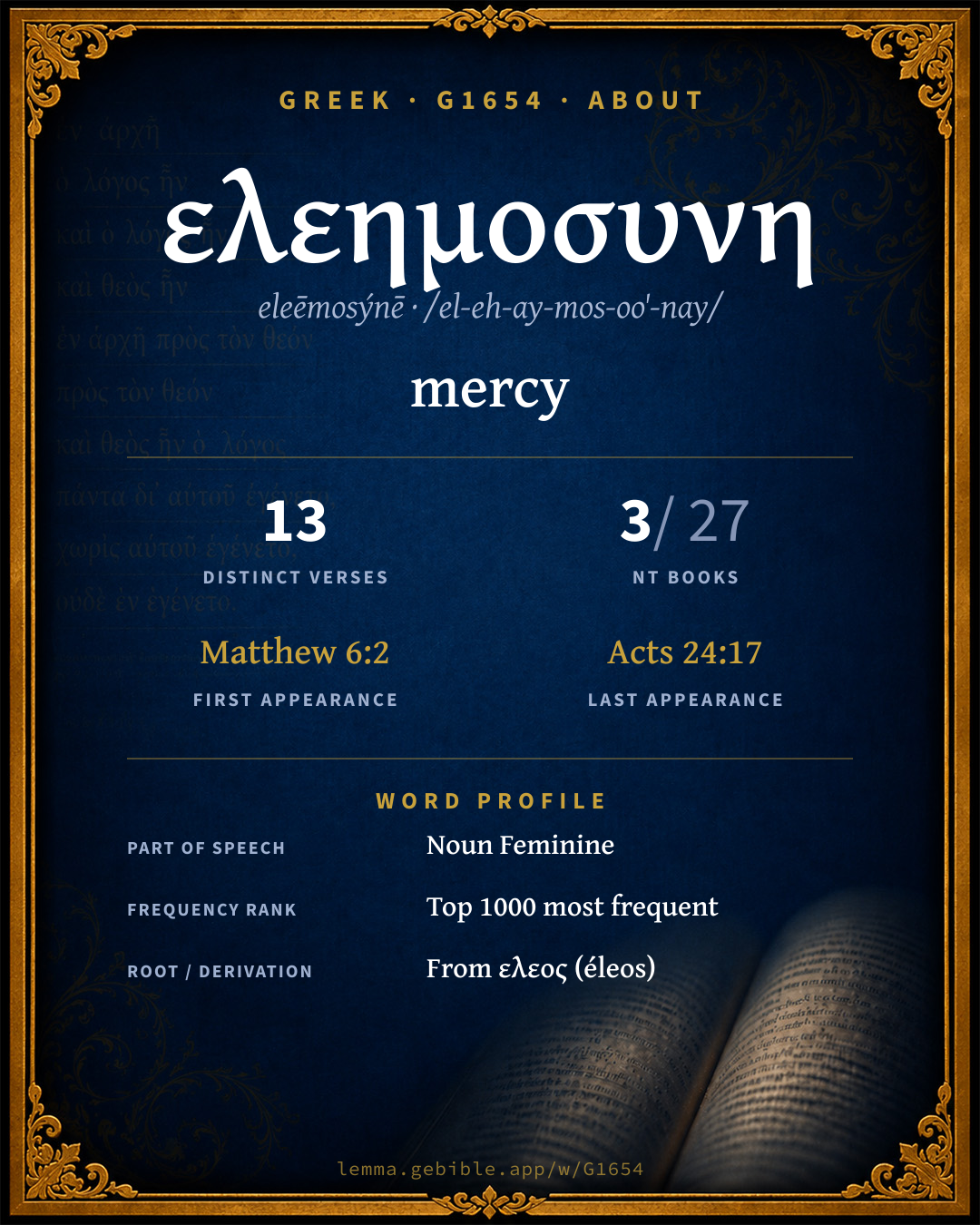
ἐλεημοσύνη
mercy
‘mercy’ is one of 2 main senses fuller range ↓
Full lexicon entry — Thayer's Greek Lexicon
From Thayer's Greek Lexicon
Where this word appears
See every Accusative-case word in the Greek New Testament →
Grammar key — what these labels mean
Part of speech
- Noun
- A naming word — a person, place, thing, or idea.
Case
- Accusative
- The case of the direct object and of extent.
- Nominative
- The case of the subject (and the predicate nominative).
- Genitive
- The case of source, possession, or “of” — answers “whose / from what.”
Gender
- Feminine
- Grammatically feminine.
Number
- Singular
- One.
- Plural
- More than one.
1 distinct verse where G1654 appears in the Genitive case, across 1 book. Filtered view — show all forms. Click any verse to open its interlinear word-by-word view. Verse text shown in the World English Bible for context — . Each verse’s Greek form is shown with its reference; the English is not keyword-highlighted, since the data carries no word-level English alignment. Use “Compare translations” on any verse to read it across multiple English versions. This concordance covers the Greek New Testament; Septuagint (Greek Old Testament) occurrences of this word are not indexed here.
Acts 1 verse
About this entry
At a glance — auto-summarized from this page’s data, not written by a person. Every figure links to its source below. This summary describes the numbers; it doesn’t interpret them.
“mercy” is the headline sense of the Greek noun ελεημοσυνη (eleēmosýnē). More than half of its appearances fall in Acts. The Greek New Testament uses it across 13 verses — uncommon. First canonically at Matthew 6:2, it enters the text early. Catalogued under 2 senses, its meaning is not single-sense. The sections below give every sense, occurrence, and version rendering.
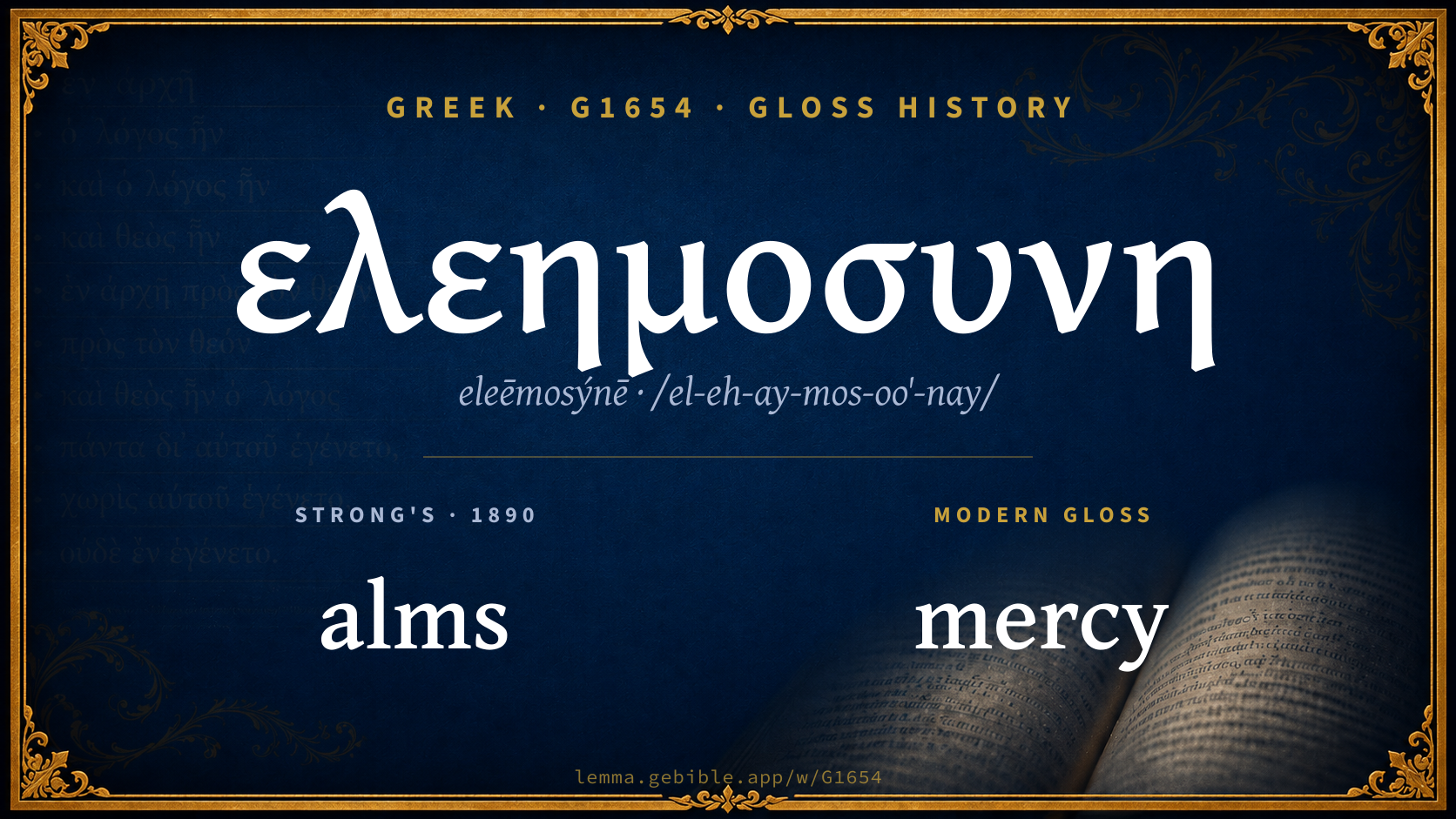
Gloss history
Strong's 1890 vs modern scholarship
About this word
Strong's G1654 catalogs a Greek word from the Greek New Testament.
These counts are not copied from any lexicon or concordance. They are computed here, from the morphology-tagged Greek New Testament. What Lemma adds →
- 13
- distinct verses
- The word appears in 13 distinct verses.
- 3 / 27
- NT books
- The word appears in 3 of 27 New Testament books.
- #863
- by frequency
- Top 1000 most frequent Greek words (rank 863 of 5,347 Greek words by occurrence).
View all 13 occurrences in the concordance →
By section of the New Testament
By traditional corpus
Conventional, traditional groupings — biblical authorship is debated, so this is a traditional corpus grouping, not an authorship claim. Some books belong to more than one corpus (Luke is in both the Gospels and the Lukan corpus, and so on), so these shares overlap and need not total 100%. Each figure is a share of the word’s 13 distinct verses.
- Lukan (Luke–Acts) 10 verses · 77%
- Gospels 5 verses · 38%
How translations render this word
Counts come from each version’s own published word-to-Strong’s tagging or interlinear alignment — an approximate guide to how each version renders this word, not a word-level alignment the data otherwise carries. Because each total is that version’s own tagged count, the per-version totals vary from one another and need not match the appearance or distinct-verse counts above. These counts may also differ from a printed concordance because Lemma counts each distinctly tagged rendering and does not collapse phrase taggings into a single head-word total. This is a fixed set of word-tagged versions (KJV, ASV, BSB, ULT) and does not change with the reading translation you choose elsewhere. Each version’s license is shown beside its name below (and on Sources).
- King James Version: Alms 13×
- American Standard Version: Alms 11×
- Berean Standard Bible: Alms 2×, Gifts to the poor 2×
- unfoldingWord Literal Text: Alms 10×
King James Version Public Domain
Renders G1654 across 14 tagged occurrences — most commonly:
Plus 1 rendering that appears only once — usually multi-word phrases or single function words the recovered tagging swept in, not distinct renderings.
American Standard Version Public Domain
Renders G1654 across 14 tagged occurrences — most commonly:
Plus 3 renderings that appear only once — usually multi-word phrases or single function words the recovered tagging swept in, not distinct renderings.
Berean Standard Bible Public Domain
Renders G1654 across 8 tagged occurrences — most commonly:
Plus 4 renderings that appear only once — usually multi-word phrases or single function words the recovered tagging swept in, not distinct renderings. Not rendered by a distinct English word in 5 further occurrences.
unfoldingWord Literal Text CC BY-SA 4.0
Renders G1654 across 13 tagged occurrences — most commonly:
Plus 3 renderings that appear only once — usually multi-word phrases or single function words the recovered tagging swept in, not distinct renderings.
Senses in Thayer's
The 2 senses Thayer's distinguishes for this word, in lexicon order (not ranked by frequency or importance). The full entry — with sub-senses — is in the Lexicon Entry tab.
- mercy, pity
- the benefaction itself, a donation to the poor, alms
Word origin
Derived from ελεος (éleos) (G1656) — mercy.
From G1656 ; compassionateness that is (as exercised towards the poor) beneficence or (concretely) a benefaction : - alms (-deeds).
— Strong’s Exhaustive Concordance (1890), public domain.
Forms in the corpus
The 5 distinct written forms G1654 takes in the Greek New Testament, most frequent first — each parse links to that case’s occurrences in the concordance.
| Form | Parsing | Example | Uses |
|---|---|---|---|
| ἐλεημοσύνην eleēmosýnēn | Noun, Accusative, Singular, Feminine | Matthew 6:2 | 7 |
| ἐλεημοσύναι eleēmosýnai | Noun, Nominative, Plural, Feminine | Acts 10:4 | 2 |
| ἐλεημοσύνας eleēmosýnas | Noun, Accusative, Plural, Feminine | Acts 10:2 | 2 |
| ἐλεημοσυνῶν eleēmosynō̂n | Noun, Genitive, Plural, Feminine | Acts 9:36 | 1 |
| ἐλεημοσύνη eleēmosýnē | Noun, Nominative, Singular, Feminine | Matthew 6:4 | 1 |
Same root — word family
Other Thayer's entries built from the same root as G1654, grouped by Strong’s listed origin. These share a root / origin per the lexicon — not necessarily a shared meaning. Each links to that word’s own entry.
Derives from
Shares the same root
Compare all same-root words → They share a root, not necessarily a meaning.
Septuagint usage
The same Greek word ελεημοσυνη appears 18 times in the Greek Old Testament (Septuagint), across 18 verses in 6 books.
- 18
- LXX occurrences
- Tagged occurrences of this Greek word in the Septuagint.
- 18
- verses
- Distinct Septuagint verses containing this word.
- 6 / 39
- OT books
- The word appears in 6 of the 39 Old Testament books.
Sample Septuagint occurrences
- Genesis 47:29 ἐλεημοσύνη
- Deuteronomy 6:25 ἐλεημοσύνη
- Psalms 23:5 ἐλεημοσύνη
- Proverbs 3:3 ἐλεημοσύνη
- Isaiah 1:27 ἐλεημοσύνη
- Daniel 4:20 ἐλεημοσύνη
Septuagint occurrences (same lexeme)
Every verse where the same Strong’s number (G1654) appears in the Greek Septuagint. Verse text shown in the World English Bible for context; the Greek form is the matched word — the English is not keyword-highlighted.
- Genesis 47:29 ἐλεημοσύνη The time drew near that Israel must die, and he called his son Joseph, and said to him, "If now I have found favor in your sight, please put your hand under my thigh, and deal kindly and truly with me. Please don't bury me in Egypt,
- Deuteronomy 6:25 ἐλεημοσύνη It shall be righteousness to us, if we observe to do all this commandment before Yahweh our God, as he has commanded us.
- Deuteronomy 24:13 ἐλεημοσύνη you shall surely restore to him the pledge when the sun goes down, that he may sleep in his garment, and bless you: and it shall be righteousness to you before Yahweh your God.
- Psalms 23:5 ἐλεημοσύνη You prepare a table before me in the presence of my enemies. You anoint my head with oil. My cup runs over.
- Psalms 32:5 ἐλεημοσύνη I acknowledged my sin to you. I didn't hide my iniquity. I said, I will confess my transgressions to Yahweh, And you forgave the iniquity of my sin. Selah.
- Psalms 102:6 ἐλεημοσύνη I am like a pelican of the wilderness. I have become as an owl of the waste places.
- Proverbs 3:3 ἐλεημοσύνη Don't let kindness and truth forsake you. Bind them around your neck. Write them on the tablet of your heart.
- Proverbs 14:22 ἐλεημοσύνη Don't they go astray who plot evil? But love and faithfulness belong to those who plan good.
- Proverbs 15:27 ἐλεημοσύνη He who is greedy for gain troubles his own house, But he who hates bribes will live.
- Proverbs 19:22 ἐλεημοσύνη That which makes a man to be desired is his kindness. A poor man is better than a liar.
- Proverbs 20:19 ἐλεημοσύνη He who goes about as a tale-bearer reveals secrets; Therefore don't keep company with him who opens wide his lips.
- Proverbs 21:21 ἐλεημοσύνη He who follows after righteousness and kindness Finds life, righteousness, and honor.
- Proverbs 31:28 ἐλεημοσύνη Her children rise up and call her blessed. Her husband also praises her:
- Isaiah 1:27 ἐλεημοσύνη Zion shall be redeemed with justice, And her converts with righteousness.
- Isaiah 28:17 ἐλεημοσύνη I will make justice the line, and righteousness the plummet; and the hail shall sweep away the refuge of lies, and the waters shall overflow the hiding-place.
- Isaiah 38:18 ἐλεημοσύνη For Sheol can't praise you, death can't celebrate you: Those who go down into the pit can't hope for your truth.
- Isaiah 59:16 ἐλεημοσύνη He saw that there was no man, and wondered that there was no intercessor: therefore his own arm brought salvation to him; and his righteousness, it upheld him.
- Daniel 4:20 ἐλεημοσύνη The tree that you saw, which grew, and was strong, whose height reached to the sky, and the sight of it to all the earth;
These are occurrences of the same Greek lexeme (G1654) in the Septuagint — not a translation of any one Hebrew word. The store carries no word-level Hebrew↔Greek alignment, so no Hebrew original is asserted here. Counts come from the recovered LXX Strong's tagging — high-frequency vocabulary is well covered, while rare or late forms may be untagged — so they reflect tagged occurrences and may slightly undercount.