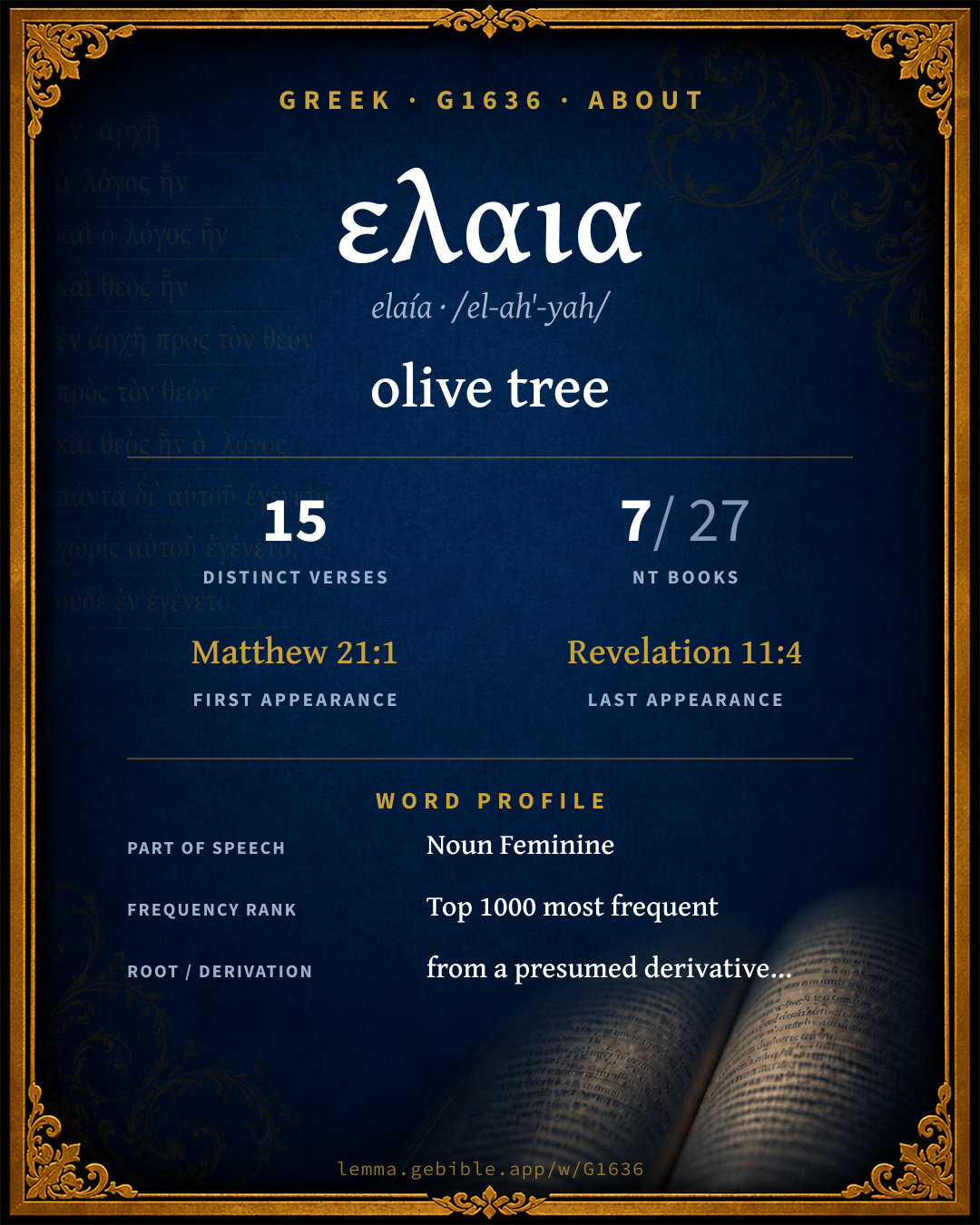
ἐλαία
olive tree
‘olive tree’ is one of 2 main senses fuller range ↓
Full lexicon entry — Thayer's Greek Lexicon
From Thayer's Greek Lexicon
Where this word appears
Grammar key — what these labels mean
Part of speech
- Noun
- A naming word — a person, place, thing, or idea.
Case
- Genitive
- The case of source, possession, or “of” — answers “whose / from what.”
- Accusative
- The case of the direct object and of extent.
- Dative
- The case of the indirect object, means, or location — “to / for / with / in.”
- Nominative
- The case of the subject (and the predicate nominative).
Gender
- Feminine
- Grammatically feminine.
Number
- Plural
- More than one.
- Singular
- One.
Every verse where G1636 appears in the Book of Matthew — 3 distinct verses. Click any verse to open its interlinear word-by-word view. Verse text shown in the World English Bible for context — . Each verse’s Greek form is shown with its reference; the English is not keyword-highlighted, since the data carries no word-level English alignment. Use “Compare translations” on any verse to read it across multiple English versions. This concordance covers the Greek New Testament; Septuagint (Greek Old Testament) occurrences of this word are not indexed here.
Matthew
- Matthew 21:1 ἐλαιῶν n gen pl fem When they drew near to Jerusalem, and came to Bethsphage, to the Mount of Olives, then Jesus sent two disciples,
- Matthew 24:3 ἐλαιῶν n gen pl fem As he sat on the Mount of Olives, the disciples came to him privately, saying, "Tell us, when will these things be? What is the sign of your coming, and of the end of the age?"
- Matthew 26:30 ἐλαιῶν n gen pl fem When they had sung a hymn, they went out to the Mount of Olives.
About this entry
At a glance — auto-summarized from this page’s data, not written by a person. Every figure links to its source below. This summary describes the numbers; it doesn’t interpret them.
At its core, ελαια (elaía) means “olive tree.” Scripture first uses it in Matthew 21:1. It appears 15 verses across 7 books of the Greek New Testament, among its uncommon vocabulary. The word gravitates to Luke (27%), then Matthew and Mark. Ranging over 2 senses, it is not a single-sense word. Dig into 15-verse concordance and the renderings breakdown below.
Gloss history
Strong's 1890 vs modern scholarship
About this word
Strong's G1636 catalogs a Greek word from the Greek New Testament.
These counts are not copied from any lexicon or concordance. They are computed here, from the morphology-tagged Greek New Testament. What Lemma adds →
- 15
- distinct verses
- The word appears in 15 distinct verses.
- 7 / 27
- NT books
- The word appears in 7 of 27 New Testament books.
- #768
- by frequency
- Top 1000 most frequent Greek words (rank 768 of 5,347 Greek words by occurrence).
View all 15 occurrences in the concordance →
By section of the New Testament
By traditional corpus
Conventional, traditional groupings — biblical authorship is debated, so this is a traditional corpus grouping, not an authorship claim. Some books belong to more than one corpus (Luke is in both the Gospels and the Lukan corpus, and so on), so these shares overlap and need not total 100%. Each figure is a share of the word’s 15 distinct verses.
- Gospels 11 verses · 73%
- Lukan (Luke–Acts) 4 verses · 27%
- Johannine 2 verses · 13%
- Pauline corpus 2 verses · 13%
- General (Catholic) Epistles 1 verse · 7%
- Revelation 1 verse · 7%
How translations render this word
Counts come from each version’s own published word-to-Strong’s tagging or interlinear alignment — an approximate guide to how each version renders this word, not a word-level alignment the data otherwise carries. Because each total is that version’s own tagged count, the per-version totals vary from one another and need not match the appearance or distinct-verse counts above. These counts may also differ from a printed concordance because Lemma counts each distinctly tagged rendering and does not collapse phrase taggings into a single head-word total. This is a fixed set of word-tagged versions (KJV, ASV, BSB, ULT) and does not change with the reading translation you choose elsewhere. Each version’s license is shown beside its name below (and on Sources).
- King James Version: Olives 9×, Mount of olives 2×, Olive tree 2×
- American Standard Version: Olives 10×, Olive tree 2×, Olivet 2×
- Berean Standard Bible: Olives 12×
- unfoldingWord Literal Text: Olives 10×, Olive tree 2×
King James Version Public Domain
Renders G1636 across 15 tagged occurrences — most commonly:
Plus 2 renderings that appear only once — usually multi-word phrases or single function words the recovered tagging swept in, not distinct renderings.
American Standard Version Public Domain
Renders G1636 across 15 tagged occurrences — most commonly:
Plus 1 rendering that appears only once — usually multi-word phrases or single function words the recovered tagging swept in, not distinct renderings.
Berean Standard Bible Public Domain
Renders G1636 across 15 tagged occurrences — most commonly:
Plus 3 renderings that appear only once — usually multi-word phrases or single function words the recovered tagging swept in, not distinct renderings.
unfoldingWord Literal Text CC BY-SA 4.0
Renders G1636 across 13 tagged occurrences — most commonly:
Plus 1 rendering that appears only once — usually multi-word phrases or single function words the recovered tagging swept in, not distinct renderings.
Senses in Thayer's
The 2 senses Thayer's distinguishes for this word, in lexicon order (not ranked by frequency or importance). The full entry — with sub-senses — is in the Lexicon Entry tab.
- an olive tree
- an olive, the fruit of an olive tree
Word origin
Origin: from a presumed derivative from an obsolete primary
Feminine of a presumed derivative from an obsolete primary; an olive (the tree or the fruit): - olive (berry tree).
— Strong’s Exhaustive Concordance (1890), public domain.
Forms in the corpus
The 4 distinct written forms G1636 takes in the Greek New Testament, most frequent first — each parse links to that case’s occurrences in the concordance.
| Form | Parsing | Example | Uses |
|---|---|---|---|
| ἐλαιῶν elaiō̂n | Noun, Genitive, Plural, Feminine | Matthew 21:1 | 11 |
| ἐλαίας elaías | Noun, Accusative, Plural, Feminine | James 3:12 | 2 |
| ἐλαίᾳ elaía | Noun, Dative, Singular, Feminine | Romans 11:24 | 1 |
| ἐλαῖαι elaîai | Noun, Nominative, Plural, Feminine | Revelation 11:4 | 1 |
Same root — word family
Other Thayer's entries built from the same root as G1636, grouped by Strong’s listed origin. These share a root / origin per the lexicon — not necessarily a shared meaning. Each links to that word’s own entry.
Derived from this word
Compare all same-root words → They share a root, not necessarily a meaning.
Septuagint usage
The same Greek word ελαια appears 26 times in the Greek Old Testament (Septuagint), across 24 verses in 14 books.
- 26
- LXX occurrences
- Tagged occurrences of this Greek word in the Septuagint.
- 24
- verses
- Distinct Septuagint verses containing this word.
- 14 / 39
- OT books
- The word appears in 14 of the 39 Old Testament books.
Sample Septuagint occurrences
- Genesis 8:11 ἐλαία
- Deuteronomy 8:8 ἐλαία
- Judges 9:8 ἐλαία
- 2 Samuel 15:18 ἐλαία
- 2 Kings 18:32 ἐλαία
- Ezra 15:11 ἐλαία
- Job 15:33 ἐλαία
- Psalms 51:10 ἐλαία
- Isaiah 17:6 ἐλαία
- Hosea 14:7 ἐλαία
- Micah 6:15 ἐλαία
- Habakkuk 3:17 ἐλαία
Septuagint occurrences (same lexeme)
Every verse where the same Strong’s number (G1636) appears in the Greek Septuagint. Verse text shown in the World English Bible for context; the Greek form is the matched word — the English is not keyword-highlighted.
- Genesis 8:11 ἐλαία The dove came back to him at evening, and, behold, in her mouth was an olive leaf plucked off. So Noah knew that the waters were abated from off the earth.
- Deuteronomy 8:8 ἐλαία a land of wheat and barley, and vines and fig trees and pomegranates; a land of olive trees and honey;
- Deuteronomy 28:40 ἐλαία You shall have olive trees throughout all your borders, but you shall not anoint yourself with the oil; for your olive shall cast [its fruit].
- Judges 9:8 ἐλαία The trees went forth on a time to anoint a king over them; and they said to the olive tree, Reign you over us.
- Judges 9:9 ἐλαία But the olive tree said to them, Should I leave my fatness, with which by me they honor God and man, and go to wave back and forth over the trees?
- Judges 15:5 ἐλαία When he had set the brands on fire, he let them go into the standing grain of the Philistines, and burnt up both the shocks and the standing grain, and also the olive groves.
- 2 Samuel 15:18 ἐλαία All his servants passed on beside him; and all the Cherethites, and all the Pelethites, and all the Gittites, six hundred men who came after him from Gath, passed on before the king.
- 2 Samuel 15:30 ἐλαία David went up by the ascent of the [Mount of] Olives, and wept as he went up; and he had his head covered, and went barefoot: and all the people who were with him covered every man his head, and they went up, weeping as they went up.
- 2 Kings 18:32 ἐλαία Until I come and take you away to a land like your own land, a land of grain and new wine, a land of bread and vineyards, a land of olive trees and of honey, that you may live, and not die: and don't listen to Hezekiah, when he persuades you, saying, Yahweh will deliver us.
- Ezra 15:11 ἐλαία
- Ezra 18:15 ἐλαία
- Job 15:33 ἐλαία He shall shake off his unripe grape as the vine, And shall cast off his flower as the olive tree.
- Psalms 51:10 ἐλαία Create in me a clean heart, O God. Renew a right spirit within me.
- Psalms 127:3 ἐλαία Behold, children are a heritage of Yahweh. The fruit of the womb is his reward.
- Isaiah 17:6 ἐλαία Yet there shall be left therein gleanings, as the shaking of an olive tree, two or three berries in the top of the uppermost bough, four or five in the outmost branches of a fruitful tree, says Yahweh, the God of Israel.
- Isaiah 24:13 ἐλαία For thus shall it be in the midst of the earth among the peoples, as the shaking of an olive tree, as the gleanings when the vintage is done.
- Hosea 14:7 ἐλαία Men will dwell in his shade. They will revive like the grain, And blossom like the vine. Their fragrance will be like the wine of Lebanon.
- Micah 6:15 ἐλαία You will sow, but won't reap. You will tread the olives, but won't anoint yourself with oil; And crush grapes, but won't drink the wine.
- Habakkuk 3:17 ἐλαία For though the fig tree doesn't flourish, Nor fruit be in the vines; The labor of the olive fails, The fields yield no food; The flocks are cut off from the fold, And there is no herd in the stalls:
- Haggai 2:19 ἐλαία Is the seed yet in the barn? Yes, the vine, the fig tree, the pomegranate, and the olive tree haven't brought forth. From this day will I bless you.'"
- Zechariah 4:3 ἐλαία and two olive trees by it, one on the right side of the bowl, and the other on the left side of it."
- Zechariah 4:11 ἐλαία Then I asked him, "What are these two olive trees on the right side of the lampstand and on the left side of it?"
- Zechariah 4:12 ἐλαία I asked him the second time, "What are these two olive-branches, which are beside the two golden spouts, that pour the golden oil out of themselves?"
- Zechariah 14:4 ἐλαία His feet will stand in that day on the Mount of Olives, which is before Jerusalem on the east; and the Mount of Olives will be split in two, from east to west, making a very great valley. Half of the mountain will move toward the north, and half of it toward the south.
These are occurrences of the same Greek lexeme (G1636) in the Septuagint — not a translation of any one Hebrew word. The store carries no word-level Hebrew↔Greek alignment, so no Hebrew original is asserted here. Counts come from the recovered LXX Strong's tagging — high-frequency vocabulary is well covered, while rare or late forms may be untagged — so they reflect tagged occurrences and may slightly undercount.