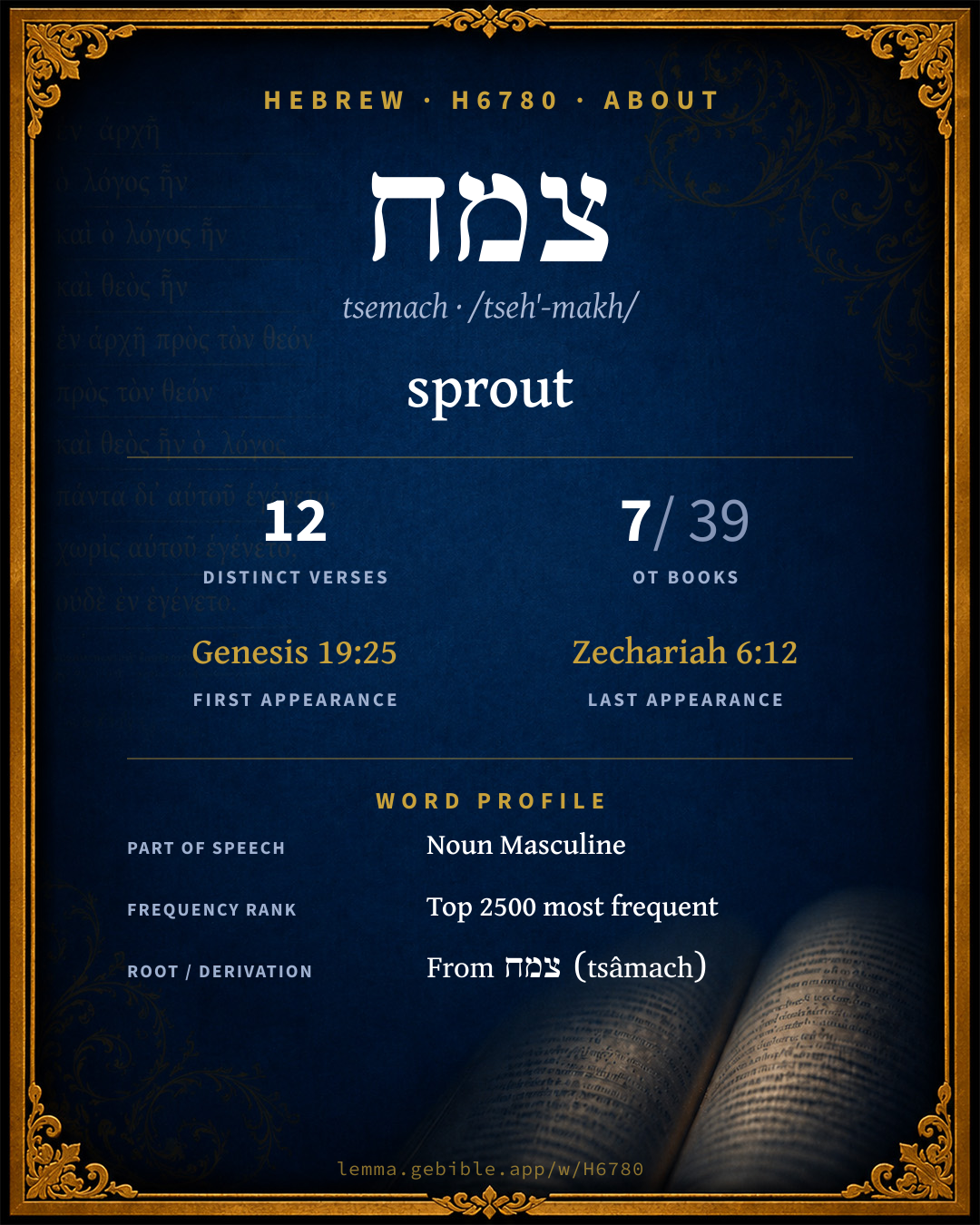
צֶ֫מַח
sprout
also: growth, branch fuller range ↓
Full lexicon entry — Brown-Driver-Briggs (BDB)
From Brown-Driver-Briggs (BDB)
Where this word appears
See every Construct-state word in the Hebrew Bible →
Grammar key — what these labels mean
Part of speech
- Noun
- A naming word — a person, place, thing, or idea.
Noun type
- Common
- A common noun — a general class of person, place, or thing (“king,” “city,” “water”), not a specific name.
State
- Absolute
- The independent form of a noun, not bound to a following word.
- Construct
- A noun bound to a following noun in a possessive / “of” relationship (the construct chain).
Gender
- Masculine
- Grammatically masculine.
Number
- Singular
- One.
Grammatical forms
- Noun, Common, Masculine, Singular, Construct 8 times (67%)
- Noun, Common, Masculine, Singular, Absolute 4 times (33%)
Parsed forms decoded from the imported morphology (morphhb / Westminster Leningrad Codex — WLC text public domain, morphhb tagging CC BY 4.0), counted across 12 parsed occurrences — not distinct verses.
Every verse where H6780 appears — 12 distinct verses across 7 books. Click any verse to open its interlinear word-by-word view. Verse text shown in the World English Bible for context — . Each verse’s Hebrew form is shown with its reference; the English is not keyword-highlighted, since the data carries no word-level English alignment. Use “Compare translations” on any verse to read it across multiple English versions. This concordance covers the Hebrew Bible; Septuagint (Greek Old Testament) occurrences are not indexed here.
Genesis 1 verse
Psalms 1 verse
Isaiah 2 verses
- Isaiah 4:2 צֶ֣מַח n c ms cs In that day, Yahweh's branch will be beautiful and glorious, and the fruit of the land will be the beauty and glory of the survivors of Israel.
- Isaiah 61:11 צִמְחָ֔/הּ n c ms cs + sfx pers 3fs For as the earth brings forth its bud, and as the garden causes the things that are sown in it to spring forth; so the Lord Yahweh will cause righteousness and praise to spring forth before all the nations.
Jeremiah 2 verses
- Jeremiah 23:5 צֶ֣מַח n c ms Behold, the days come, says Yahweh, that I will raise to David a righteous Branch, and he shall reign as king and deal wisely, and shall execute justice and righteousness in the land.
- Jeremiah 33:15 צֶ֣מַח n c ms cs In those days, and at that time, will I cause a Branch of righteousness to grow up to David; and he shall execute justice and righteousness in the land.
Ezekiel 3 verses
- Ezekiel 16:7 כְּ/צֶ֤מַח prep + n c ms cs I caused you to multiply as that which grows in the field, and you increased and grew great, and you attained to excellent ornament; your breasts were fashioned, and your hair was grown; yet you were naked and bare.
- Ezekiel 17:9 צִמְחָ/הּ֙ n c ms cs + sfx pers 3fs Say you, Thus says the Lord Yahweh: Shall it prosper? shall he not pull up the roots of it, and cut off the fruit of it, that it may wither; that all its fresh springing leaves may wither? and not by a strong arm or much people can it be raised from the roots of it.
- Ezekiel 17:10 צִמְחָ֖/הּ n c ms cs + sfx pers 3fs Yes, behold, being planted, shall it prosper? shall it not utterly wither, when the east wind touches it? it shall wither in the beds where it grew.
Hosea 1 verse
Zechariah 2 verses
- Zechariah 3:8 צֶֽמַח n c ms Hear now, Joshua the high priest, you and your fellows who sit before you; for they are men who are a sign: for, behold, I will bring forth my servant, the Branch.
- Zechariah 6:12 צֶ֤מַח n c ms and speak to him, saying, 'Thus says Yahweh of Hosts, "Behold, the man whose name is the Branch: and he shall grow up out of his place; and he shall build the temple of Yahweh;
About this entry
At a glance — auto-summarized from this page’s data, not written by a person. Every figure links to its source below. This summary describes the numbers; it doesn’t interpret them.
At its core, צמח (tsemach) means “sprout.” Not a single-sense word: its full sense range also takes in “growth” and “branch”. It appears 12 verses across 7 books of the Hebrew Bible, among its uncommon vocabulary. The word gravitates to Ezekiel (25%), then Isaiah and Jeremiah. First canonically at Genesis 19:25, it enters the text early. Each statement above links to its evidence; the full detail follows below.
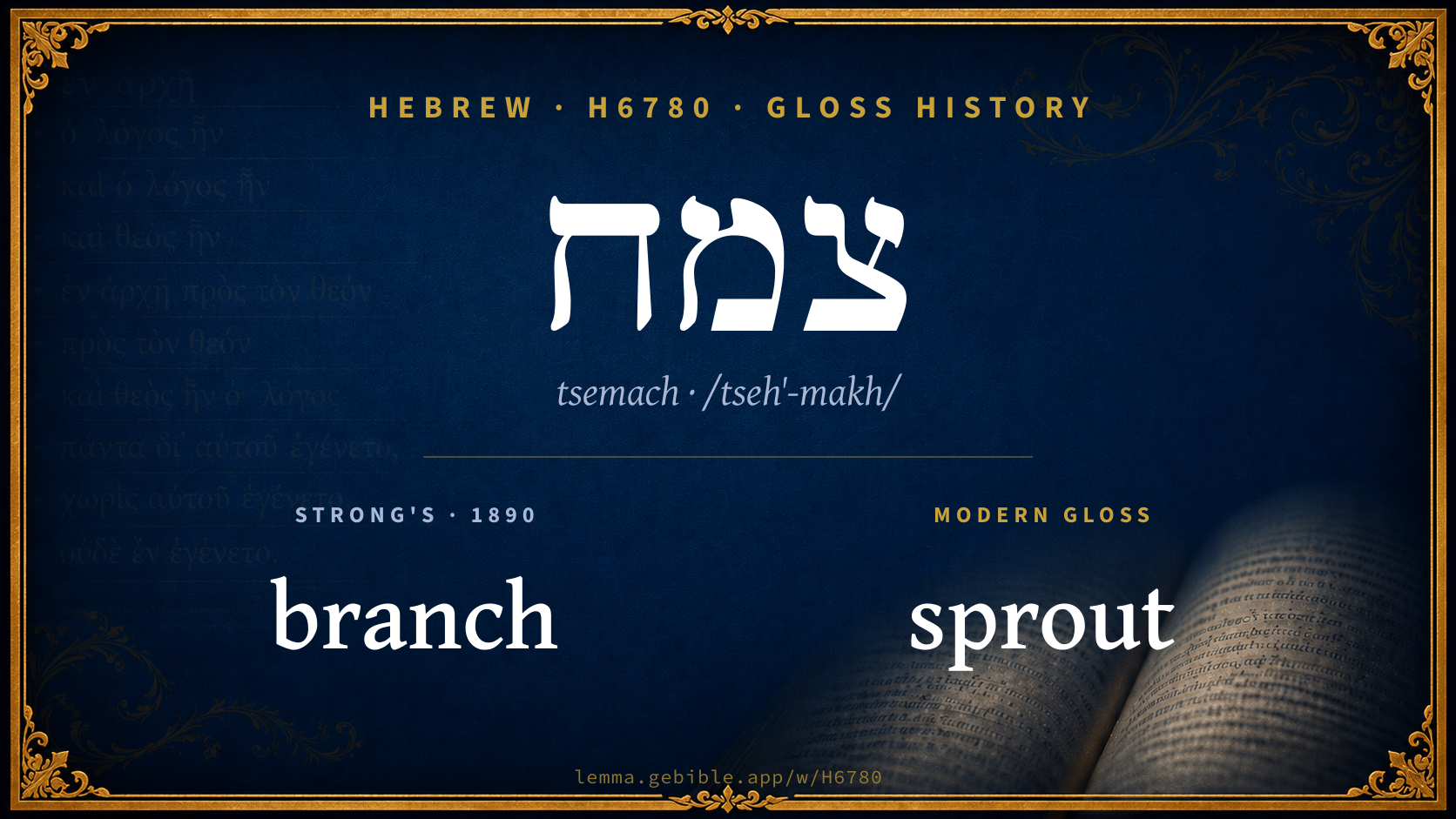
Gloss history
Strong's 1890 vs modern scholarship
About this word
Strong's H6780 catalogs a Hebrew word from the Hebrew Old Testament.
These counts are not copied from any lexicon or concordance. They are computed here, from the morphology-tagged Hebrew Old Testament. What Lemma adds →
- 12
- distinct verses
- The word appears in 12 distinct verses.
- 7 / 39
- OT books
- The word appears in 7 of 39 Old Testament books.
- #2,101
- by frequency
- Top 2500 most frequent Hebrew words (rank 2,101 of 8,640 Hebrew words by occurrence).
View all 12 occurrences in the concordance →
By section of the Old Testament
By traditional corpus
Conventional, traditional groupings — biblical authorship is debated, so this is a traditional corpus grouping, not an authorship claim. Each share is this word’s portion of its verses in that division of the Hebrew canon. Each figure is a share of the word’s 12 distinct verses.
- Prophets (Nevi'im) 10 verses · 83%
- Torah (Pentateuch) 1 verse · 8%
- Writings (Ketuvim) 1 verse · 8%
How translations render this word
Counts come from each version’s own published word-to-Strong’s tagging or interlinear alignment — an approximate guide to how each version renders this word, not a word-level alignment the data otherwise carries. Because each total is that version’s own tagged count, the per-version totals vary from one another and need not match the appearance or distinct-verse counts above. These counts may also differ from a printed concordance because Lemma counts each distinctly tagged rendering and does not collapse phrase taggings into a single head-word total. This is a fixed set of word-tagged versions (KJV, ASV, BSB, ULT) and does not change with the reading translation you choose elsewhere. Each version’s license is shown beside its name below (and on Sources).
- King James Version: Bud 3×, Branch 2×, Grew 2×
- American Standard Version: Branch 2×, Grew 2×
- Berean Standard Bible: Branch 5×, Growth 2×
- unfoldingWord Literal Text: Branch 3×, Growth 2×
King James Version Public Domain
Renders H6780 across 12 tagged occurrences — most commonly:
Plus 5 renderings that appear only once — usually multi-word phrases or single function words the recovered tagging swept in, not distinct renderings.
American Standard Version Public Domain
Renders H6780 across 12 tagged occurrences — most commonly:
Plus 8 renderings that appear only once — usually multi-word phrases or single function words the recovered tagging swept in, not distinct renderings.
Berean Standard Bible Public Domain
Renders H6780 across 11 tagged occurrences — most commonly:
Plus 4 renderings that appear only once — usually multi-word phrases or single function words the recovered tagging swept in, not distinct renderings. Not rendered by a distinct English word in 1 further occurrence.
unfoldingWord Literal Text CC BY-SA 4.0
Renders H6780 across 12 tagged occurrences — most commonly:
Plus 7 renderings that appear only once — usually multi-word phrases or single function words the recovered tagging swept in, not distinct renderings.
Senses in the full BDB
What do BDB’s symbols mean?
BDB uses these scholarly abbreviations:
| Symbol | Meaning |
|---|---|
| 𝔊 | the Septuagint (the ancient Greek translation, LXX) |
| 𝔙 | the Vulgate (the Latin translation) |
| 𝔖 | the Syriac version (the Peshitta) |
| 𝔗 | the Targum (the Aramaic translation) |
| ψ | the Psalms |
| √ | root (the underlying root or stem) |
| ‖ | parallel passage (a synonymous or contrasted parallel) |
| † | the dagger: every passage where the word occurs is cited |
The 3 senses and sub-senses the full Brown-Driver-Briggs lexicon distinguishes for this word, in lexicon order (not ranked by frequency), with BDB’s own verbatim wording and sub-sense lettering. Shown in Hebrew script with BDB’s own scholarly abbreviations. The condensed entry is in the Lexicon Entry tab. See also the Forms in the corpus table below.
- 1. coll. sprouting, growth, צ׳ הָאֲדָמָה Gn 19:25 (J), צ׳ הַשָּׂדֶה Ez 16:7 (sim.), cf. Is 61:11 ψ 65:11; so צ׳ יהוה Is 4:2, צ׳ abs. Ho 8:7; growth (= foliage) of vine, טַרְפֵּי צ׳ Ez 17:9. e.g. Genesis 19:25
- 2. process of growth, of vine, עֲרֻגֹת צִמְחָהּ Ez 17:10 = the beds where it grew. e.g. Ezekiel 17:10
- 3. future ruler, under fig. of sprout from Davidic tree (cf. ψ 132:17) וַהֲקִמֹתִי לְדָוִד צ׳ צַדִּיק Je 23:5 a righteous sprout, shoot, = אַצְמִיחַ לְדָוִד צ׳ צְדָקָה 33:15; hence (as n.pr.) עַבְדִּי צ׳ Ze 3:8, of Joshua אִישׁ צ׳ שְׁמוֹ 6:12. e.g. Psalms 132:17
Senses from the full Brown-Driver-Briggs lexicon (Brown, Driver, Briggs; Oxford 1906 — public domain), digitized via Sefaria, supplemented by the OpenScriptures HebrewLexicon (CC BY 4.0). Full attribution on Sources.
Word origin
n.m. Je 23:5 sprout, growth;—abs. צ׳ Ho 8:7 +, צֶ֑מַח Zc 3:8; cstr. צֶ֫מַח Gn 19:25 +; sf. צִמְחָהּ Ez 17:9 +;—
— Brown-Driver-Briggs (Oxford 1906, public domain), digitized via Sefaria, supplemented by the OpenScriptures HebrewLexicon (CC BY 4.0). See Sources.
Derived from צמח (tsâmach) (H6779) — to sprout.
Jastrow Dictionary
A second Hebrew/Aramaic lexicon for comparison, covering Aramaic and post-biblical (Talmudic, Targumic, Midrashic) usage that the biblical-Hebrew BDB does not. Matched by lemma rather than by Strong’s number, so a lemma may carry more than one Jastrow headword (shown separately below), and the entries cover usage well beyond the Bible.
צָמַח
- (b. h.) to break forth, shine; to bloom, sprout, grow. Cant. R. to III, 6 היה … ועמוד אש צוֹמֵחַ the pillar of cloud came down, and the pillar of fire grew brighter. Ḥull. 60ᵇ יצאו דשאים … וצָמְחוּ the plants came out and stood at the opening of the ground, until Adam prayed, when rain came down, and they came forth. Pesik. R. s. 46 צָמְחָה כפרתו his pardon was revealed. Y. Shebi. IX, 38ᵈ top אם צמחו מוצאי וכ׳ if the leaves came out after the Sabbatical year. Ib. אם צימח וכ׳ if it (the lof in the ground) sprouted again &c. Maasr. I, 3 התלתן כדי שתִּצְמַח Ms. M. fenugrec is subject to tithes when it is so far advanced that the seeds can be planted and will grow; R. Hash. 12ᵇ, expl. משתצמח לזרעים when it has grown sufficiently to be planted (Rashi: when its seeds begin to develop). Neg. X, 3 הצומח a black hair that grows out of the sore (Lev. XIII, 37). Tosef. ib. IV, 1 שתי שערות צומחות two black hairs of recent growth. Ib. אחת צוֹמַחַת וכ׳ one of recent growth, and the other (of old standing) surrounded with flesh; a. fr. e.g. Leviticus 13:37
- to be made to grow forth; to grow. Midr. Till. to Ps. XXII נ׳ להם גואל וכ׳ a redeemer grew up for them and redeemed them. Pirké d’R. El. ch. XII נִצְמָהִין מאליהן grew of themselves (without being planted); a. e.
- to grow. Y. Shebi. l. c., v. supra. Y. Maasr. I, 49ᵃ top (ref. to Deut. XIV, 22) דבר שהוא נזרע ומְצַמֵּחַ (R. S. to Maasr. I, 3 ומצְמִיחִ) that (is subject to tithes) which is sufficiently advanced to grow when planted (v. supra); a. e. e.g. Deuteronomy 14:22
- 1. same, v. same, v. Pi.
- to cause to grow, produce. Sifré Deut. 307, v. צִידּוּק.
צְמַח
- Targ. Gen. II, 5. Targ. Ez. VII, 10; a. fr.—Ḥull. 60ᵇ שדי … ולא צ׳ he put seed in it, but it did not sprout, אתא מיטרא וצ׳ a rain came, and it sprouted. Y. Kil. II, 27ᵈ מן דזרע צַמְחִין after he had sown, they (the vines which had been cut down) grew up again. Y. Maas. Sh. IV, end, 55ᶜ צמחין the wheat in the storehouse will sprout (and be ruined).
- 1. same. Targ. O. Ex. X, 5 (Y. Pe.).
- 2. to cause to grow, produce. Targ. O. Gen. II, 9. Targ. Ps. CXXXII, 17; a. e.—Lam. R. to I, 1 רבתי (חד כות׳ 1) דאינון מַצְמְחִין עשבין וכ׳ that they (the wheat stores) shall produce sproutings, and this man (thou) shall have no benefit of them.
צֶמַח I
- preced.) growth, sprout, plant. Pirké d’R. El. ch. V לברך צִמְחָהּ של ארץ to bless the growth of the earth. Ib. הארץ מתעברת וצמחה כאשה וכ׳ the earth becomes pregnant, and what she produces is like the issue of a widow that conceived in whoredom. Ib. וצמחה … ברכה and what she produces is a blessed seed. Tanḥ. Ki Thetsé 4 and the people say, זה צ׳ רשע this is a wicked growth (the father of a wicked son); a. e.—Pl. צְמָחִים, צְמָהִין. Y. Shek. I, beg. 45ᵈ לא כדי שיהו הצ׳ ניכרין is it not (necessary to wait with the examination) until the growths are sufficiently advanced to be distinguishable?; a. e.—Trnsf. morbid growths, swellings, ulcers, eruptions. B. Kam. 85ᵃ אם עלו בו צ׳ מחמת המכה וכ׳ if ulcers grew on his body in consequence of the wound, so that the wound is covered up. Ḥull. 48ᵃ העלתה צ׳ if the lungs have ulcers (or blisters); a. e.
צֶמַח II
- Tsemaḥ, allegorical name of the future Messiah. Y. Ber. II, 5ᵃ top צ׳ שמו his name is Ts. (by ref. to Zech. VI, 12). Ib. הוא צ׳ הוא מנחם the numerical value of the letters צמח is the same as that of the letters of מנהם (138); Lam. R. to I, 16. e.g. Zechariah 6:12
צֶמַח III
- K’far Tsemaḥ, in the district of Susitha (v. סוּסִיתָא). Tosef. Shebi. IV, 10; Y. Dem. II, 22ᵈ top.
A Dictionary of the Targumim, the Talmud Babli and Yerushalmi, and the Midrashic Literature (Marcus Jastrow; London, Luzac, 1903) — Public Domain. Digitized via Sefaria. Digitized via Sefaria. Full attribution on Sources.
Forms in the corpus
The 10 distinct written forms H6780 takes in the Hebrew Bible, most frequent first — each parse links to that state’s occurrences in the concordance. Hebrew forms include their vowel points and cantillation, so a single lemma takes many written forms.
| Form | Parsing | Example | Uses |
|---|---|---|---|
| צֶ֣מַח | Noun, Common, Masculine, Singular, Construct | Isaiah 4:2 | 3 |
| וְ/צֶ֖מַח | Noun, Common, Masculine, Singular, Construct | Genesis 19:25 | 1 |
| כְּ/צֶ֤מַח | Noun, Common, Masculine, Singular, Construct | Ezekiel 16:7 | 1 |
| צִמְחָ/הּ֙ | Noun, Common, Masculine, Singular, Construct | Ezekiel 17:9 | 1 |
| צִמְחָ֔/הּ | Noun, Common, Masculine, Singular, Construct | Isaiah 61:11 | 1 |
| צִמְחָ֖/הּ | Noun, Common, Masculine, Singular, Construct | Ezekiel 17:10 | 1 |
| צִמְחָ֥/הּ | Noun, Common, Masculine, Singular, Construct | Psalms 65:10 | 1 |
| צֶ֚מַח | Noun, Common, Masculine, Singular, Absolute | Hosea 8:7 | 1 |
| צֶ֤מַח | Noun, Common, Masculine, Singular, Absolute | Zechariah 6:12 | 1 |
| צֶֽמַח | Noun, Common, Masculine, Singular, Absolute | Zechariah 3:8 | 1 |
Septuagint verse parallels
This word appears in 12 verses that also exist in the Greek Old Testament (Septuagint), out of the 12 Hebrew verses it occurs in. You can read those verses in Greek by switching the Old Testament edition to the Septuagint.
Read these verses in the Septuagint
This is a verse-level parallel only — the same verses exist in both the Hebrew and Greek Old Testaments. No word-level Hebrew↔Greek correspondence is claimed: the data carries no such alignment, so no Greek word is shown as this Hebrew word’s translation. Coverage is not total — the Septuagint omits the deuterocanon and renumbers the Psalms, so some Hebrew verses have no direct Greek parallel.