
Psalms 77:13

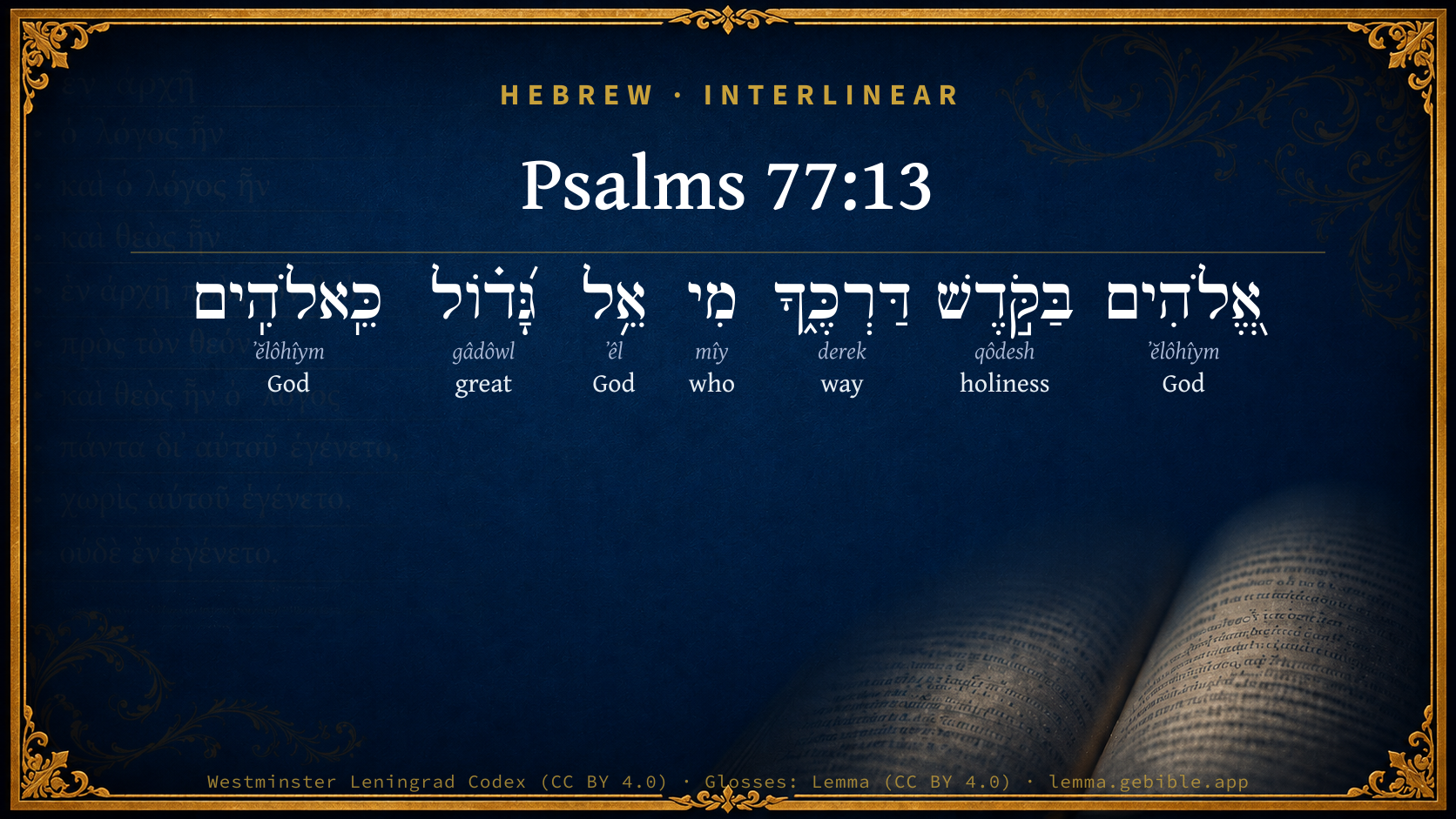
Hebrew (Westminster Leningrad Codex) Psalms 77:13 appears in the Hebrew Old Testament. The text above is from the Westminster Leningrad Codex. Each word links to its Strong’s number, a concise gloss, and parsing drawn from the Open Scriptures Hebrew Bible morphology. Click any word for its full Brown-Driver-Briggs (BDB) entry.
Download image
Cite this verse

Psalms 77:13 (World English Bible). Public Domain. Lemma interlinear Bible study tool, https://lemma.gebible.app/v/psalms/77/13.

Show BibTeX & RIS
BibTeX
RIS
English Translation
Your way, God, is in the sanctuary. What god is great like God?
World English Bible · Public Domain
Download a study sheet

One document with this verse’s original text, its word-by-word gloss line, the meaning frame, cross-references with their text, attributed commentary, and full source and license credits — printable, and it pastes into notes with its structure intact.

This verse Autodidact and up

Study sheet (.html) Plain text (.txt)

A passage Seminary Student

Up to 50 verses in one chapter. A passage sheet keeps up to 6 commentary sources and 12 cross-references per verse, in the order this page ranks them, and says so on the sheet whenever that leaves anything out. Ask for a single verse and you get the Autodidact verse sheet above.

Everything on this page stays free to read, with no account — the sheet is a download of what is already on screen, not access to it.

Want to remove ads? Support Godless Engineer
Compare translations 3

The same verse in 3 English versions, stacked beneath the original-language interlinear above. Click any original word for its lexicon entry.

Each is an independent rendering of the whole verse — the interlinear is not word-aligned to these translations.

Highlighted words mark where these versions differ — a whole-verse word diff, not a word-by-word alignment.

  • World English Bible Public Domain
    Your way, God, is in the sanctuary. What god is great like God?
  • King James Version Public Domain
    Thy way, O God, is in the sanctuary: who is so great a God as our God?
  • unfoldingWord Literal Text CC BY-SA 4.0
    Your way, God, is in holiness; what god is great like God?

unfoldingWord Literal Text — © unfoldingWord, licensed CC BY-SA 4.0. Word-aligned USFM3 via Door43 (git.door43.org/unfoldingWord/en_ult).

Versions to compare (up to 4)

3 of 4 selected

Show all 18 translations

Every available English version of this verse, each an independent rendering of the whole verse.

  • World English Bible Public Domain
    Your way, God, is in the sanctuary. What god is great like God?
  • Berean Standard Bible Public Domain
    Your way, O God, is holy. What god is so great as our God?
  • Majority Standard Bible Public Domain
    Your way, O God, is holy. What god is so great as our God?
  • King James Version Public Domain
    Thy way, O God, is in the sanctuary: who is so great a God as our God?
  • American Standard Version (1901) Public Domain
    Thy way, O God, is in the sanctuary: Who is a great god like unto God?
  • Revised Version (1885) Public Domain
    Thy way, O God, is in the sanctuary: who is a great god like unto God?
  • Geneva Bible (1599) Public Domain
    Thy way, O God, is in the Sanctuarie: who is so great a God as our God!
  • Douay-Rheims (1899) Public Domain
    And I will meditate on all thy works: and will be employed in thy inventions.
  • Young's Literal Translation Public Domain
    O God, in holiness `is' Thy way, Who `is' a great god like God?
  • Literal Standard Version CC BY-SA 4.0
    O God, Your way [is] in holiness, || Who [is] a great god like God?
  • Unlocked Literal Bible CC BY-SA 4.0
    Your way, God, is holy; what god compares to our great God?
  • unfoldingWord Literal Text CC BY-SA 4.0
    Your way, God, is in holiness; what god is great like God?
  • Darby Bible Public Domain
    O God, thy way is in the sanctuary: who is so great a ùgod as God?
  • World Messianic Bible Public Domain
    Your way, God, is in the sanctuary. What god is great like God?
  • Webster's Bible Public Domain
    \\77:12\\I will meditate also of all thy work, and talk of thy doings.
  • Free Bible Version CC BY-SA 4.0
    God, your ways are holy; is any god as great as you?
  • Bible in Basic English Public Domain
    Your way, O God, is holy: what god is so great as our God?
  • JPS Tanakh (1917) Public Domain
    (77-14) O God, Thy way is in holiness; who is a great god like unto God?

Literal Standard Version (2020), Covenant Press — licensed CC BY-SA 4.0. Text via the HelloAO Bible API (eBible.org). Unlocked Literal Bible (unfoldingWord) — licensed CC BY-SA 4.0. Text via the HelloAO Bible API (eBible.org). unfoldingWord Literal Text — © unfoldingWord, licensed CC BY-SA 4.0. Word-aligned USFM3 via Door43 (git.door43.org/unfoldingWord/en_ult). Free Bible Version, Dr. Jonathan Gallagher — licensed CC BY-SA 4.0. Text via the HelloAO Bible API (eBible.org).

Word by word

More ways to search: Search by grammar → Find every occurrence → Compare this word →

Practice this passage: Drill this verse → Learn its vocabulary →

About this verse

These counts appear in no published source. They are computed here, from the morphology-tagged text and Lemma’s own curated glosses. What Lemma adds →

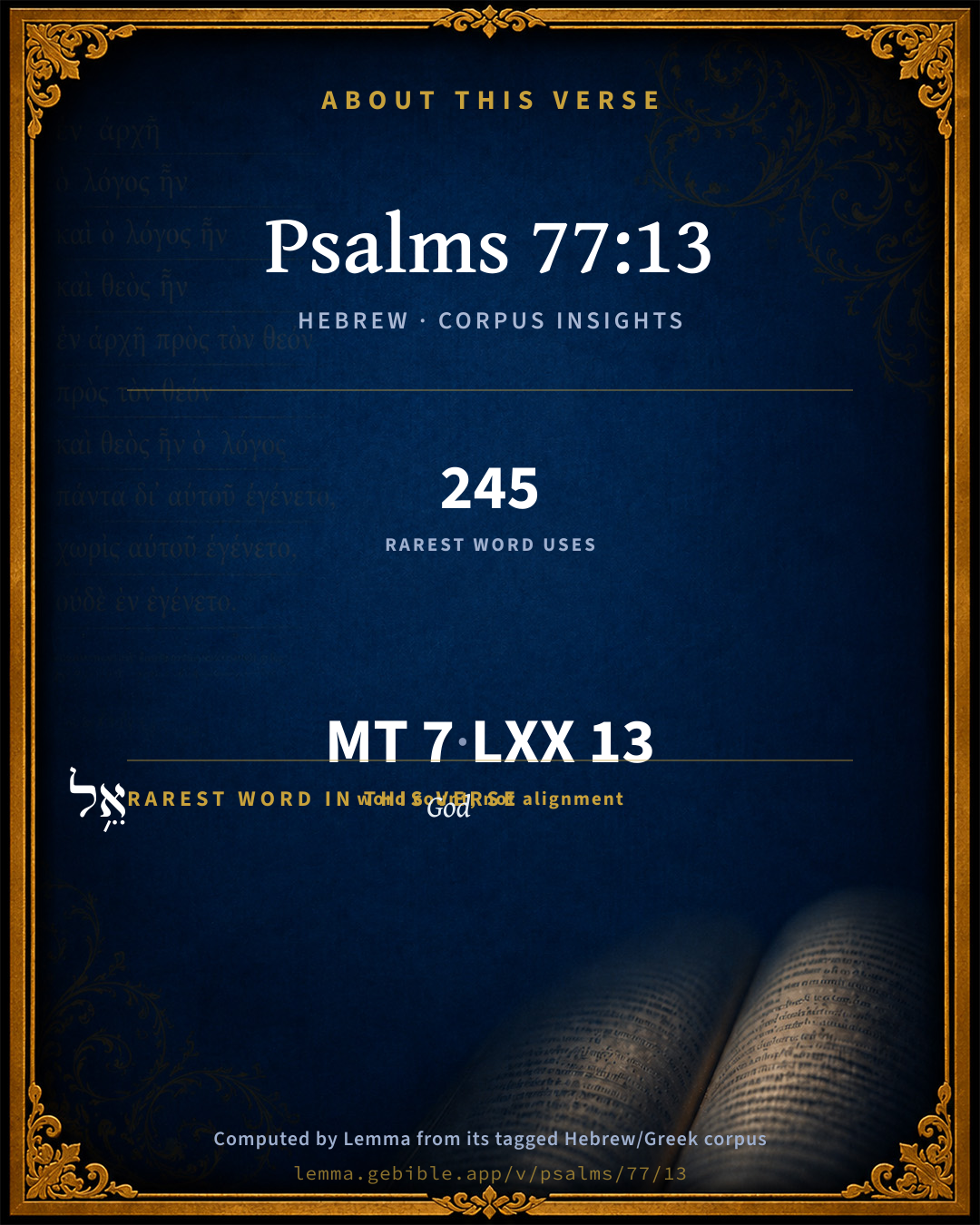
7
words
6
distinct lemmas
Wisdom
section

Grammatical profile

  • 5 nouns
  • 1 adjective
  • 1 particle

Repetition

A word recurs within this verse — often emphatic in Hebrew:

  • אֱ֭לֹהִים God H430 ×2

Hebrew & Septuagint length

In English translation the verse runs 13 words from the Hebrew and 16 from the Septuagint (LXX English) — closely comparable.

A rough comparison of the two English renderings, which tokenize alike — not a word-level alignment.

Word counts can differ between the Hebrew and the Greek without any difference in meaning — e.g. the Hebrew direct-object marker אֵת has no separate Greek word, and Greek often adds the article ὁ.

In the original languages it is 7 Hebrew tokens and 13 Greek tokens — but the two are counted differently (Hebrew bundles its prefixes and suffixes into one token; the Greek is in lemma form), so that isn’t a like-for-like length.

Cross-references

12

Topical passages linked to Psalms 77:13 in the Treasury of Scripture Knowledge — connected by theme and wording, ordered by reader-vote popularity; previews shown in the World English Bible.

  • Exodus 15:11 Who is like you, Yahweh, among the gods? Who is like you, glorious in holiness, Fearful in praises, doing wonders?
  • Psalms 73:17 Until I entered God's sanctuary, And considered their latter end.
  • Deuteronomy 32:31 For their rock is not as our Rock, Even our enemies themselves being judges.
  • Psalms 89:6–8 For who in the skies can be compared to Yahweh? Who among the sons of the heavenly beings is like Yahweh,
  • Isaiah 40:18 To whom then will you liken God? or what likeness will you compare to him?
  • Isaiah 40:25 To whom then will you liken me, that I should be equal [to him]? says the Holy One.
  • Psalms 27:4 One thing I have asked of Yahweh, that I will seek after, That I may dwell in the house of Yahweh all the days of my life, To see Yahweh's beauty, And to inquire in his temple.
  • Psalms 63:2 So I have seen you in the sanctuary, Watching your power and your glory.
  • Isaiah 46:5 To whom will you liken me, and make me equal, and compare me, that we may be like?
  • Psalms 71:19 Your righteousness also, God, reaches to the heavens; You have done great things. God, who is like you?
  • Psalms 86:8 There is no one like you among the gods, Lord, Nor any deeds like your deeds.
  • Psalms 68:25 The singers went before, the minstrels followed after, In the midst of the ladies playing with tambourines,

Cross-references courtesy of OpenBible.info (CC BY 4.0).

Hebrew and Greek witnesses Masoretic Hebrew ↔ Greek Septuagint

The same verse in the two great witnesses to the Old Testament, shown verse-for-verse.

You’re reading Greek Psalm 76 (Hebrew Psalm 77). The Septuagint counts the superscription, so verse numbers can differ from the Hebrew — chapter-level alignment, not verse-by-verse. Numbering follows Rahlfs.

These are two independent witnesses, not word-aligned to each other, and the Septuagint is shown in lemma (dictionary) form.

Hebrew Psalms 77:13 Masoretic · Westminster Leningrad Codex

אֱ֭לֹהִים בַּקֹּ֣דֶשׁ דַּרְכֶּ֑ךָ מִי אֵ֥ל גָּ֝ד֗וֹל כֵּֽאלֹהִֽים

Your way, God, is in the sanctuary. What god is great like God?

World English Bible · Public Domain

Greek LXX Greek Psalm 76:13 Septuagint · lemma form

καί μελετάω ἐν πᾶς ὁ ἔργον σύ καί ἐν ὁ ἐπιτήδευμα σύ ἀδολεσχέω

O God, your way is in the sanctuary; who is a great God as our God?

LXX2012 (modern English Septuagint) · Public Domain

Hebrew: Westminster Leningrad Codex (CC BY 4.0). Greek: Septuagint (public domain); English from LXX2012 (modern English Septuagint) (Public Domain). How the Septuagint differs from the Hebrew →

Commentary

Notes on Psalms 77:13 from classic Christian and Jewish commentators (each source and its license shown beneath its notes). The classic Christian expositions comment on the surrounding passage and are grouped to its opening verse, so a note may address several verses; the Jewish commentaries on the Tanakh (Rashi and others) are per-verse, so they appear only where the commentator wrote on this verse.

Lemma curates 59 commentaries, every one of them public domain or Creative Commons licensed, each selected and text-cleaned for this edition rather than reprinted as found. About our sources →

Trapp's Complete Commentary

John Trapp

Psa 77:13 Thy way, O God, [is] in the sanctuary: who [is so] great a God as [our] God?

Ver. 13. Thy way, O God, is in the sanctuary] There it is only that I can get satisfaction about thy proceedings, Psa 73:17. There I am taught, that thou art righteous in all thy ways, and holy in all thy works, Psa 145:17. Some render this text, Thy way, O God, is in holiness. Some by sanctuary understand heaven; q.d. Thy way is in heaven, far above man’s reach.

Who is so great a God as our God?] And therefore no wonder his ways are so incomprehensible.

John Trapp, A Commentary or Exposition upon All the Books of the Old and New Testament (1647–1656) — public domain. Text from a community e-Sword module.

The Biblical Illustrator

Joseph S. Exell

Psa_77:13

Thy, way, O God, is in the sanctuary.

Gods way revealed in the sanctuary

I. Gods way of creation.

II. His way of providence.

III. The way of grace.

IV. The way of human well-being. The light that is run up at the masthead does not require the vessel to stop sailing in order that it may shine. And so a living religion will show the light in the shop, in the street, in the business, in town to-morrow as well as in the sanctuary on the Sabbath day. And so the Church must stand closely related to all that is dear to the interest of humanity. The sanctuary, then, is the way of highest happiness; it is the way of joy and peace. It is the way of consolation, for evil and distress haunt every pathway of life, but Gods house is the house of comfort. Again, it is the way of communion with God. Jehovah says, There I will meet with thee, etc. (H. Johnstone, M. A.)

Gods way in the sanctuary

I. Secrecy.

1. In nature.

2. In providence. Pain and misery abounding; virtue suffering; vice triumphant.

3. In grace. God is behind the veil. Your best knowledge is the consciousness of ignorance, and your privilege it is to be sure that he who believes honours more than he who understands.

II. Beauty. The loveliness of nature we all have seen; the bloom of infancy, the fresh flower of the early spring, or the wavings of the yellow corn. And some of us have felt the greater loveliness of grace; the unfoldings of the Christian character; the budding of a soft and tender gentleness; the humility; the chastened love; the hope that soars away to brighter worlds;--but has it ever occurred to you to think, if that is the porch, and this the holy place, what must be the sanctuary of God? What shall be that world which is as far better than grace, as grace is better than nature?

III. Holiness. There never went a prayer from earth fit to be presented before God in the sanctuary--there never passed a thought through your soul to which there was not clinging a sin; for nothing is pleasing before God, not the sanctuary itself, except as He sees it in Christ; and all this is true of our holiest action, were it ten thousand times holier than ever it was.

IV. Refuge. The self-condemning soul flies from the holiness to the love of God, and seeks a shelter from His wrath by throwing himself on His mercy. (J. Vaughan, M. A.)

Gods way in the sanctuary

God designed, in the fulness of time, to gather all things into His Son, and to set Him forth as the alone source or channel of blessing; therefore did He make the temple, which typified that Son, the home of all His operations, the focus into which were condensed, and from which diverged, the various rays of His attributes and dealings. And this suggests to us a point of great importance, the consistency of the several parts of revelation. There is never the point at which we are brought to a pause by the manifest contradiction of one part to another. But we would now observe that, by the sanctuary, we may probably understand the holy of holies; for it was in that veiled and mysterious recess that the Shekinah shone, the visible token of the Almightys presence. He who thought on the holy of holies thought on a solitude which was inaccessible to him, though close at hand; inaccessible, even as the remotest depth of infinite space, though a single step might have taken him into its midst; but, at the same time, a solitude where, as he well knew, everything breathed holiness, everything glowed with the lustre of that Being who is of purer eyes than to look upon iniquity. And to say of God that His way was in this sanctuary, what was it but to say that God works in an impenetrable secrecy, but that, nevertheless, in that secrecy He orders everything in righteousness? Certainly it is not the obscurity which there may be round the ways of the Lord which should induce a suspicion that those ways are not righteous. If God work in a place of secrecy, we know that it is equally a place of sanctity; we can be sure, therefore, of whatsoever comes forth from that place, that, if involved in clouds, it is invested with equity. We may not be able to discover Gods reasons: but we can be certain from His attributes, attributes which shine through the veil, though that veil be impenetrable, that we should approve them if discovered. And if it be an evidence of the greatness of God, that His way is hidden, we scarcely need say that it is a further evidence of this greatness, that His way is holy. He contracts no impurity, but keeps travelling, as it were, in the sanctuary, even whilst moving to and fro amid those who have defiled themselves and their dwelling-place--what is this but proof that He is immeasurably separated by difference of nature, from all finite being? The veil, whilst it hides, reveals Deity: nay, it reveals by hiding; it teaches the sublimity of God, inapproachable; His independence, none with Him in His workings; and yet His righteousness, for it is the awful purity of the place which warns back all intruders. Then there is enough to make us both discover, and rejoice in, the supremacy of our God. With a tongue of fear, for we are almost staggered by the mysteriousness of His workings, we will confess, Thy way, O God, is in the sanctuary; but with a tongue of triumph, for His very concealments are tokens of His Almightiness, we will give utterance to the challenge, Who is so great a God as our God? But there can be no reason why we should confine the illustrations of our text to the Jewish temple and dispensation. We may bring down the verse to our own day, understand by the sanctuary our own churches, and still found on the confession in the first clause the challenge which is uttered in the second. His way is in the sanctuary. It is in buildings devoted to the purposes of His worship, and through the ministrations of His ordained servants, that He commonly carries on His work of turning sinners from the error of their ways, and building up His people in their faith. We are always much struck with the expression of St. Paul to Timothy, in doing this, thou shelf both save thyself, and them that hear thee. If God worked by mighty instruments such as angels; if the engines employed were, to all appearance, adequate to the ends to be effected; the honour of success would at least be divided, and the ambassador might be thought to have helped forward, by his own power, the designs of Him by whom he had been sent. But, as the case now stands, the services of the sanctuary all go to the demonstrating the supremacy of God, because, while undoubtedly instrumental to the effecting vast results, they are manifestly insufficient in themselves for any such achievement. And not only does God employ men in preference to angels, but He commonly acts through what is weak in men, and not through what is strong. It is, perhaps, a single sentence in a sermon, a text which is quoted, which makes its way into the soul of an unconverted hearer. God will oftentimes pass by, as it were, and set aside an array of argument which has been constructed with great care, and, seizing on the sentence which the speaker thinks the weakest, or the paragraph, will throw it into the soul as the germ of a genuine and permanent piety. And all this goes to the making good what we are anxious to prove, that the challenge in the second clause of our text is altogether borne out by the assertion in the first. There is no finer proof of the power of an author, than that he can compass great designs by inconsiderable means. Now, we think that in the successive illustrations of our text, which have thus been advanced, there has been much to suggest practical reflections of no common worth. Was Gods way in the Jewish temple of old? Was He passing, in all the sacrifices and ceremonies of the temple, to the completion of the work of our redemption? Then let us not fail to study with all diligence the law: in the law was the germ, or bud of the Gospel; and it will aid us much in understanding the system, when fully laid open, to examine it attentively whilst being gradually unfolded. Is it again true that Gods way was in the sanctuary, in the holy of holies, that place of dread secrecy and sanctity? Then let us be satisfied that Gods dealings are righteous, however incomprehensible. And lastly, is Gods way still in the sanctuary Is it in the sanctuary, the house devoted to His service, that He specially reveals Himself, and communicates supplies of His grace? Shall we not then learn to set a high worth on the public services of religion? (H. Melvill, B. D.)

The Biblical Illustrator, edited by Joseph S. Exell (c. 1880s–1900s) — public domain. Text from a community e-Sword module.

Joseph Benson's Commentary

Psa 77:13. Thy way, O God — That is, thy doings, or, the course of thy providence; the various methods and causes of thy dealings with thy people; is in the sanctuary — Is there contained and declared. As the prosperity of wicked men, so also the afflictions and troubles of God’s people, are great riddles and stumbling-blocks to the ignorant and ungodly world, but a full and satisfactory resolution of them may be had from God’s sanctuary, as is observed in the former case, Psa 73:16-17, and here in the latter. Or, בקדשׁ, bakkodesh, may be rendered, in holiness; and so the sense is, God is holy, and just, and true in all his works; yea, even in his judgments upon his people, and in the afflictions and troubles wherewith he chastises or tries individuals of them. Who is so great a God as our God — So able to save or to destroy?

Joseph Benson's Commentary on the Old and New Testaments (1811–1818) — public domain. Text from a community e-Sword module.

J. A. Alexander on Psalms

Joseph Addison Alexander

14. (Psa 77:13). O God, in holiness is thy way. What Mighty (One) is great like God? The common version, in the sanctuary, yields a good sense; but the other is entitled to the preference on account of Exo 15:11, to which place there is evident allusion. Holiness here means the divine perfection, all that distinguishes the Maker from his creatures. See above, on Psa 22:3. Thy way, i.e. thy mode of dealing with thy creatures, and particularly with thy people. The use of the name El is again significant. Who is there like God, even among the mightiest and most exalted beings?

Joseph Addison Alexander, The Psalms Translated and Explained (1850) — public domain. Text from a community e-Sword module.

Tyndale Open Study Notes

Tyndale Open Resources

77:13-15 This central section of the poem reflects on God as the holy and powerful redeemer.

Tyndale Open Study Notes — © Tyndale Open Resources, licensed CC BY-SA 4.0. Text via the HelloAO Bible API.

Geneva Bible (1599)

Geneva Bible translators

He condemneth all that worship anything save the only true God, whose glory appeareth through the world.

That is in heaven, whereunto we must ascend by faith, if we will know the ways of God.

Geneva Bible (1599) marginal notes — public domain. Text via Bolls.life.

Adam Clarke's Commentary

Verse 13. Thy way - is in the sanctuary] See Ps 73:17. I must go to the sanctuary now to get comfort, as I went before to get instruction. What a mercy to have the privilege of drawing near to God in his ordinances! How many doubts have been solved, fears dissipated, hearts comforted, darknesses dispelled, and snares broken, while waiting on God in the means of grace!

Some understand the words, Thy way is in holiness - all thy dispensations, words, and works are holy, just and true. And as is thy majesty, so is thy mercy! O, who is so great a God as our God?

Adam Clarke's Commentary on the Bible (1810–1826) — public domain. Text from a community e-Sword/MySword module.

John Calvin's Commentaries

13. Thy ways, O God! are in the sanctuary. Some translate in holiness, and they are led to do this, because it seems to them a cold and meagre form of expression to say, that God’s ways are in his sanctuary But as the rules of grammar will not easily admit of this, we must inquire whether a profitable truth may not be drawn from the term sanctuary, which is the proper signification of the original word בקדש, bakkodesh. Some are of opinion that this is an abrupt exclamation, as if it had been said, O God, who art in the sanctuary! O thy ways! but of this I do not approve; for they do violence to the words of the prophet. The clause should be read in one connected sentence, and the word sanctuary is to be taken either for heaven or for the temple. I am rather inclined to refer it to heaven, conceiving the meaning to be, that the ways of God rise high above the world, so that if we are truly desirous to know them, we must ascend above all heavens. Although the works of God are in part manifest to us, yet all our knowledge of them comes far short of their immeasurable height. Besides, it is to be observed, that none enjoy the least taste of his works but those who by faith rise up to heaven. And yet, the utmost point to which we can ever attain is, to contemplate with admiration and reverence the hidden wisdom and power of God, which, while they shine forth in his works, yet far surpass the limited powers of our understanding. If it is objected, that it is wrong to attempt to confine to heaven the ways of God, which are extended through the whole world, the answer is easy; for although there is not a single corner of the globe in which God does not exhibit some proof of his power and operation, yet the wonderful character of his works escapes the eyes of men. If any would rather understand sanctuary as meaning the temple, it may be noticed, that we have met with an almost similar sentence in Psalm 73:16, 17,

“When I thought to know this, it was too painful for me, until I went into the sanctuary of God.”

The temple, indeed, in which God manifested himself was, as it were, a heaven on earth. It is now obvious that the meaning of the inspired writer is, that as at the commencement he had uttered distressing complaints, so now, having attained to a calm and settled state of mind, he admires and adores the high ways of God, and conscious of his own weakness, quietly and modestly keeps himself within the bounds prescribed to him, not permitting himself to judge or pass sentence upon the secret judgments of God according to the dictates of his carnal understanding. He therefore immediately after exclaims, Who is so great a God as our God? By this comparison, he does not mean that there are many gods, but he indirectly rebukes the deep infatuation of the world who, not contented with the only true God whose glory is so conspicuous, invent for themselves many gods. If men would look upon the works of God with pure eyes, they would be led without much difficulty to rest with satisfaction in him alone.

John Calvin's Commentaries (1540-1563) — public domain. Text from the Calvin Translation Society English edition (1840s-50s) via the Christian Classics Ethereal Library (ccel.org). Calvin's coverage is partial (roughly two-thirds of the Bible); uncommented books and verses are honest gaps, never fabricated. The 19th-century editor's footnotes and remarks are omitted so the notes are faithfully Calvin's own voice.

Ellicott's Commentary for English Readers

(13) In the sanctuary.—Rather, with the holy, i.e., with “Israel,” the “saint” of God.

A Bible Commentary for English Readers, edited by Charles John Ellicott (1878–1897) — public domain. Text from a community e-Sword module.

The Cambridge Bible for Schools and Colleges

gen. ed. J. J. S. Perowne

13. in the sanctuary] Better, in holiness. Cp. Exo_15:11. All the plan and method of God’s dealings in the world moves in the sphere of holiness, separate from all sin and imperfection, in accord with the perfection of His Nature. Cp. Habakkuk’s appeal to God’s holiness (Hab_1:12.)

who &c.] Who is a great god (El) like God (Elohim)? For Elohim no doubt originally stood Jehovah as in the passage of Moses’ song, which the Psalmist has in mind (Exo_15:11).

The Cambridge Bible for Schools and Colleges (gen. ed. J. J. S. Perowne; Cambridge University Press, 1878–1918) — public domain. Text from a community e-Sword module.

John Gill's Exposition

Thy way, O God, is in the sanctuary,.... Or "in holiness" (y); that is, is holy, so the Syriac version, and to which the Targum agrees.

"O God, how holy are thy ways,''

see Psa 145:17, or "in the sanctuary", the temple, the church of God, where he takes his walks, and manifests himself, and where the reasons of his providence, and dealing with his people, are opened and made known unto them, see Psa 68:24,

who is so great a God as our God? the Targum is, as the God of Israel; he is great in his persons, perfections, and works, and is greatly to be loved, feared, and praised.

(y) "in sanctitate", Pagninus, Montanus, Tigurine version, Junius & Tremellius, Gejerus, Michaelis.

John Gill's Exposition of the Whole Bible (1746–1763) — public domain (CC PDM 1.0). Text via the HelloAO Bible API.

Albert Barnes' Notes on the Bible

Thy way, O God, is in the sanctuary - Luther renders this, “O God, thy way is holy.” Prof. Alexander, “O God, in holiness is thy way.” DeWette, “O God, holy is thy way.” The word rendered “sanctuary” - קדשׁ qôdesh - means properly “holiness.” It is not the same word which in Psa 73:17 is rendered “sanctuary” - מקדשׁ miqdâsh. The word here employed, however, may mean a holy place, a sanctuary, as the tabernacle Exo 28:43; Exo 29:30, or the temple 1Ki 8:8; 2Ch 29:7. In this passage the word is ambiguous. It means either that the way of God is holy, or in holiness; or, that it is in the sanctuary, or holy place. If the former, it is a statement of the result to which the psalmist came in regard to the divine character, from a contemplation of his doings. If the latter, it means that the way of God - the true principles of the divine administration - are to be learned in the place where he is worshipped, and from the principles which are there set forth. Compare the notes at Psa 73:17. It seems to me that the former is the correct interpretation, as it accords better with the scope of the passage.

Who is so great a God as our God - In greatness no one can be compared with him. He is supreme over all. This is the first reflection of the psalmist in regard to God - that he is great; that he is superior to all other beings; that no one can be compared with him. The evident inference from this in the mind of the psalmist, as bearing on the subject of his inquiry, is, that it is to be expected that there will be things in his administration which man cannot hope to understand; that a rash and sudden judgment should not be formed in regard to him from his doings; that people should wait for the developments of his plans; that he should not be condemned because there are things which we cannot comprehend, or which seem to be inconsistent with goodness. This is a consideration which ought always to influence us in our views of God and his government.

Albert Barnes' Notes on the Bible (1834–1885) — public domain. Text from a community e-Sword/MySword module.

Matthew Poole's English Annotations

Thy way, i.e. thy doings, or the course of thy providence, which is oft called God’s way; the various methods and causes of thy dealings with thy people.

In the sanctuary; is there contained and declared. As the prosperity of wicked men, so also the grievous calamities of God’s people, are great riddles and stumbling-blocks to the ignorant and ungodly world; but a full and satisfactory resolution of them may be had from God’s sanctuary, as is observed in the former case by this same Asaph, Psa 73:16,17, and here in the latter. Or, is in holiness. So the sense is, God is holy, and just, and true in all his works; yea, even in his judgments upon his own people, as will evidently appear from the issue of them.

Who is so great a God as our God? And although our God at present suspends his power, and doth not put it forth to deliver his people out of the hands of their idolatrous enemies, who thence take occasion to blaspheme his name, and to exalt their idol gods above him; yet he is still infinitely superior in power, both to them and to their gods, and can and will in his due time rescue his people from them.

Matthew Poole's English Annotations on the Holy Bible (1683–1685) — public domain. Text from a community e-Sword/MySword module.

The Treasury of David

Charles H. Spurgeon

Ver. 13. Thy way, O God, is in the sanctuary, or in holiness. In the holy place we understand our God, and rest assured that all his ways are just and right. When we cannot trace his way, because it is "in the sea, "it is a rich consolation that we can trust it, for it is in holiness. We must have fellowship with holiness if we would understand "the ways of God to man." He who would be wise must worship. The pure in heart shall see God, and pure worship is the way to the philosophy of providence.

Who is so great a God as our God? In him the good and the great are blended. He surpasses in both. None can for a moment be compared with the mighty One of Israel.

Whole Psalm. See Psalms on "Ps 77:1" for further information.

Ver. 13. Thy way, O God, is in the sanctuary. The word sanctuary is to be taken either for heaven or for the temple. I am rather inclined to refer it to heaven, conceiving the meaning to be, that the ways of God rise high above the world, so that if we are truly desirous to know them, we must ascend above all heavens. Although the works of God are in part manifest to us, yet all our knowledge of them comes far short of their immeasurable height. Besides, it is to be observed, that none enjoy the least taste of his works but those who by faith rise up to heaven. And yet, the utmost point to which we can ever attain is, to contemplate with admiration and reverence the hidden wisdom and power of God, which, while they shine forth in his works, yet far surpass the limited powers of our understanding. John Calvin.

Ver. 13. Thy way is in the sanctuary. That is, every one of the elect may and ought to learn in thy church the conduct and proceedings of thy providence towards those that were thine. John Diodati.

Ver. 13,19. In the sanctuary and In the sea. His way is in the sanctuary, and His wayis in the sea. Now there is a great difference between these two things. First of all, God's way is in the sanctuary, where all is light, all is clear. There is no mistake there. There is nothing, in the least degree, that is a harass to the spirit. On the contrary, it is when the poor, troubled one enters into the sanctuary, and views things there in the light of God, that he sees the end of all else-- everything that is entangled, the end of which he cannot find on the earth. But not only is God's way in the sanctuary (and when we are there, all is bright and happy); but God's way is in the "sea." He walks where we cannot always trace his footsteps. God moves mysteriously by times, as we all know. There are ways of God which are purposely to try us. I need not say that it is not at all as if God had pleasure in our perplexities. Nor is it as if we had no sanctuary to draw near to, where we can rise above it. But, still, there is a great deal in the ways of God that must be left entirely in his own hands. The way of God is thus not only in the sanctuary, but also in the sea. And yet, what we find even in connection with his footsteps being in the sea is, "Thou leddest thy people like a flock, by the hand of Moses and Aaron." That was through the sea; afterwards, it was through the wilderness. But it had been through the sea. The beginnings of the ways of God with his people were there; because, from first to last, God must be the confidence of the saint. It may be an early lesson of his soul, but it never ceases to be the thing to learn. How happy to know that, while the sanctuary is open to us, yet God himself is nearer still--and to him we are brought now. As it is said (1 Peter 3), "Christ also hath once suffered for sins, the just for the unjust, to bring us to God." This is a most precious thing; because there we are in the sanctuary at once, and brought to God himself. And I am bold to say, that heaven itself would be but a small matter if it were not to God that we are brought. It is better than any freedom from trial--better than any blessing, to be in the presence of the One we belong to; who is himself the source of all blessing and joy. That we are brought to him now is infinitely precious. There we are in the sanctuary brought to God. But, still, there are other ways of God outside the sanctuary --In the sea. And there we often find ourselves at a loss. If we are occupied with the sea itself, and with trying to scan God's footsteps there, then they are not known. But confidence in God himself is always the strength of faith. May the Lord grant us increasing simplicity and quietness in the midst of all that we pass through, for his name's sake. From "Things New and Old." 1865.

Ver. 13,19. In the sea, in the sanctuary. God's way incomprehensible, though undoubtedly right: in his holiness lies the answer to its enigmas.

Psalms 77:14*

Ver. 13,19. In the sea, in the sanctuary. God's way incomprehensible, though undoubtedly right: in his holiness lies the answer to its enigmas.

Charles H. Spurgeon's The Treasury of David (1869–1885) — public domain. Psalms only. Text from a community e-Sword/MySword module.

Whedon's Commentary on the Bible

Daniel D. Whedon

13. Thy way—The way of God is his historical path, or mode of dispensation, especially in redemption.

In the sanctuary—The word is rarely used in the abstract for holiness, but almost always in the concrete for holy name, person, or place. So here it is to be understood of the holy place, or sanctuary. God’s way is in his sanctuary, where is the oracle, the living word. See Psa_73:17

Daniel D. Whedon (gen. ed.), Commentary on the Old and New Testaments (1874–1909) — public domain. Text from a community e-Sword module.

The Pulpit Commentary

Thy way, O God, is in the sanctuary; rather, in holiness. God"s "way his conduct, his proceedings however strange and mysterious it may seem to us, is always holy, i.e. just and right. (comp. Gen_18:25 Job_8:3) Who is so great a God as our God? God is both good and great; just in himself, and able to execute justice.

God"s way in the sanctuary.

This verse is capable of different renderings. We take the one here given, as in the main true, and rich in sacred suggestion. God"s way is in the sanctuary because

I IT IS SEES THERE. The character, mind, and heart of God are revealed there. His holiness, that nothing unclean may approach him; yet also his mercy and compassion, as seen in the forgiveness through sacrifice proclaimed there; the worship he delights in and demands; the surrender of the self to him, symbolized by the shedding of the blood of the sacrifices, for "the blood is the life." So must the heart, the will, the real self, of the worshipper be presented to God; the transforming power of the Holy Spirit which he will give to us who thus come in full sin render to him, for the fire which consumed the sacrifice was no man-enkindled flame, but came down from heaven, and set forth how the blessed Holy Spirit of God would take hold of our poor dead fleshly nature, and transform it and uplift it heavenward, Godward, as did the fire the sacrifice. Thus was God"s way of saving sinful men set forth and shown.

II LEADS THERE. All his dealings with us are to lead us to his own presence, to bring us back to himself. We have got away into the far country, poor sinful ones that we are, and God"s way with us is all to lead us to turn and say, "I will arise and go to my Father, and will say," etc.

III IS LIKE WHAT IS THERE holy, just, and good. God can ask, "Are not my ways holy?" They are in harmony with the spirit of the sanctuary. He is holy in all his ways. One rendering of the text is, "O God, thy way is holy." The records of history, of experience, of conscience, all assert the righteousness and holiness of God.

IV IS UNDERSTOOD THERE. (Cf. Psa_73:17) There we get light sufficient, and, better still, the acquiescent, submissive mind, that learns to rest in the Lord and wait patiently lee him (cf. Hannah, 1Sa_1:13 Luk_18:10). Ah! how often has the wearied, much tried child of God found in the holy sanctuary that there have come such messages from God to his soul, through prayer, or psalm, or hymn, or God-inspired word, that he has gone down to his home comforted!

V IS TRANSFIGURED THERE. It may have been a terribly hard, difficult, rough way; the man"s lot in life may be heavily burdened with care, but "in the sanctuary," as he waits upon God and pours out his soul before the Lord, lo, these very trials and cares become transfigured and changed in fashion, so that they become as wings on which his soul mounts up nearer to God than ever he had attained to before, and he comes to confess, "It was good for me that I was afflicted.

CONCLUSION. Then do we know the way of the sanctuary? Would we enter there? The path leads by the altar. The soul that would enter in and know the blessedness of the sanctuary of God, must come along that path; the path of lowly penitence and trust and heart surrender, so that on him may come the blessed fire of the Holy Spirit, bringing him into the presence of God. S.C.

The holiness of Divine dealings.

"O God, thy way is holy! Who is so great a God as our God?" Comp. Exo_15:11, "Who is like unto thee, O Jehovah, among the gods? who is like thee, glorious in holiness, fearful in praises, doing wonders?" For "in the sanctuary" there is the various rendering "in holiness." It is evident that the term "holy," as applied to God, must include much more than it does when applied to men. We must try to find what was especially in the psalmist"s mind, and so what he put, as his meaning, into this word. He began thinking of God"s ways with his people Israel, especially in the rescue from Egypt, and deliverance at the Red Sea. This recalled the song of Moses, and the striking contrast between the gods of the heathen and the God of Israel. The first thing that arrests attention whenever that contrast is made is that the God of Israel has character, and puts character into his works; but the idol gods cannot be said to have any character. This the psalmist expresses by saying, "O God, thy way is holy;" or, "Thy doings bear a character, they have an aim and purpose, and that is a moral aim." We may take suggestions of a division from the passage in Exodus which presents three points in which Jehovah is unapproachable holiness, awefulness, and miraculous power.

I GOD IS "GLORIOUS IN HOLINESS;" that is, in character. We may read the story of God"s dealings in either of two ways.

1. We may study it in order to find out what God is in himself.

2. We may bring our knowledge of what God is in himself to help us in explaining the meaning and mystery of his dealings. This latter is the higher work. When we are fully satisfied with the character of God, we begin to trace purposes of holiness and love in all his doings. We see that God"s way is right, because he is right. If he is holy, we can trust him, if we cannot trace his way.

II GOD IS "FEARFUL IN PRAISES." The proper object of the pro foundest awe, even to those who approach him with praise and thanksgiving. They who are duly impressed with the Divine holiness never permit any growth of knowledge, any acquaintance with God"s ways, to nourish undue familiarities with his sacred Name. Think what we may of God"s dealings, we must keep in our souls due reverence for God himself. No awe can attach to the gods of man"s creation. It is the unique response of man to adequate impressions of the Divine holiness.

III GOD "DOETH WONDERS." "Both through nature, and on occasions overruling nature, accomplishing the most astonishing results," which are seen to be most astonishing when viewed in the moral issues which they accomplish. R.T.

The Pulpit Commentary (1880–1919), ed. H.D.M. Spence-Jones & Joseph S. Exell — public domain. Text from a community e-Sword module.

John Wesley's Explanatory Notes

In holiness - God is holy and just, and true in all his works.

John Wesley, Explanatory Notes Upon the Whole Bible (1754–1765) — public domain. Text via the GEBible commentary corpus.

unfoldingWord translationNotes

Door43 World Missions Community

General Information:

The writer continues to speak to Yahweh.

what god compares to our great God?

This can be translated as a statement. AT: "no god compares to our great God." (See: Rhetorical Question)

revealed your strength among the peoples

The abstract noun "strength" can be translated with an adjective. AT: "shown people from many people groups how strong you are" (See: Abstract Nouns)

gave your people victory ... the descendants

"gave us, your people, victory ... us who are the descendants"

gave your people victory

The abstract noun "victory" can be translated with an adjective. AT: "caused your people to be victorious" (See: Abstract Nouns)

the descendants of Jacob and Joseph

This refers to the entire nation of Israel.

translationWords

holy

false god

miracle

reveal

strength

people group

power

descend

Jacob

Joseph (OT)

selah

unfoldingWord translationNotes — © Distant Shores Media and the Door43 World Missions Community, licensed CC BY-SA 4.0. Source: git.door43.org/Door43/en_tn.

Rashi

Rabbi Shlomo Yitzchaki (Rashi)

And I meditate over all Your works that You have already done for us.

Rashi on the Tanakh — English translations: “The Judaica Press complete Tanach with Rashi, translated by A. J. Rosenberg” (CC BY 4.0); “Pentateuch with Rashi's commentary by M. Rosenbaum and A.M. Silbermann, 1929-1934” (public domain); “The Metsudah Tanach series, Lakewood, N.J” (CC BY 4.0); and “The Book of Joshua, Metsudah Publications, 1997” (CC BY 4.0). Text via Sefaria.

Lesson kit

Teaching starters — assembled from the data on this page, not authored interpretation. Every prompt links to the verse data it draws on. Edit before teaching.

Psalms, in the Wisdom, opens this verse with 7 words (6 distinct Hebrew lemmas). Its most distinctive word is ʼêl (“God”). A historical commentator’s framing appears above. Read the whole chapter for the surrounding context.

Discussion questions

  1. How does “God” (ʼêl) shape what this verse is saying?
  2. Exodus 15:11 shares this passage’s theme. How do the two illuminate each other?
  3. “God” occurs 2× in this one verse. What is the effect of the repetition?
  4. These translations render this verse differently. What is at stake in choosing one wording over another?
  5. Reading how Trapp's Complete Commentary and The Biblical Illustrator read this verse, where do the two commentators agree and where do they part?

Things to notice

Reading settings

Reading text

Shown beneath each verse's original-language words.

Old Testament
Old Testament edition

Read the OT as the Masoretic Hebrew (MT) or the Greek Septuagint (LXX).

English shown for the Greek Septuagint (in the Hebrew ↔ Greek comparison).

Comparing translations? Open the Compare panel on any verse page to stack up to four side by side.