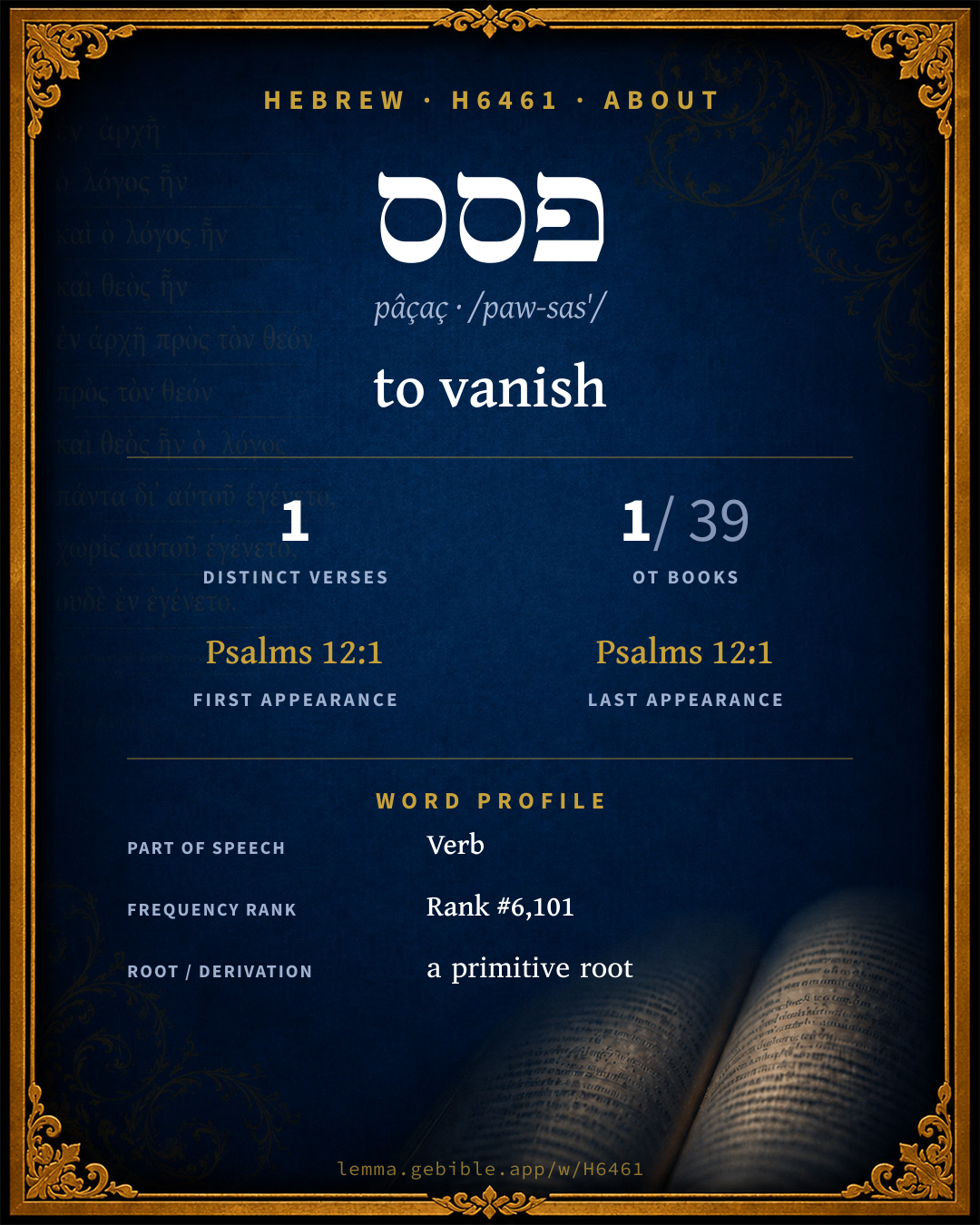
פָּסַס
to vanish
‘to vanish’ is one of 2 main senses fuller range ↓
Full lexicon entry — Brown-Driver-Briggs (BDB)
From Brown-Driver-Briggs (BDB)
Where this word appears
Grammar key — what these labels mean
Part of speech
- Verb
- An action or state-of-being word.
Stem
- Qal
- The basic, simple active stem — the plain form of the verb (“he wrote”).
Form
- Perfect
- A completed action or state — Hebrew marks aspect (completeness) more than strict tense (“he wrote”).
Person
- 3rd Person
- The one spoken about (“he / she / it / they”).
Gender
- Common
- Either gender — not distinguished for this form.
Number
- Plural
- More than one (in Hebrew, generally three or more).
Every verse where H6461 appears — 1 distinct verse across 1 book. Click any verse to open its interlinear word-by-word view. Verse text shown in the World English Bible for context — . Each verse’s Hebrew form is shown with its reference; the English is not keyword-highlighted, since the data carries no word-level English alignment. Use “Compare translations” on any verse to read it across multiple English versions. This concordance covers the Hebrew Bible; Septuagint (Greek Old Testament) occurrences are not indexed here.
Psalms 1 verse
About this entry
At a glance — auto-summarized from this page’s data, not written by a person. Every figure links to its source below. This summary describes the numbers; it doesn’t interpret them.
The Hebrew verb פסס centers on the idea of “to vanish.” A scarce word — 1 verse in all of the Hebrew Bible. Psalms dominates its distribution — 1 of 1 verses. Its lone occurrence is Psalms 12:1. Lexicons map it across 2 senses. For the data behind this summary, explore the sense tree and the renderings breakdown below.
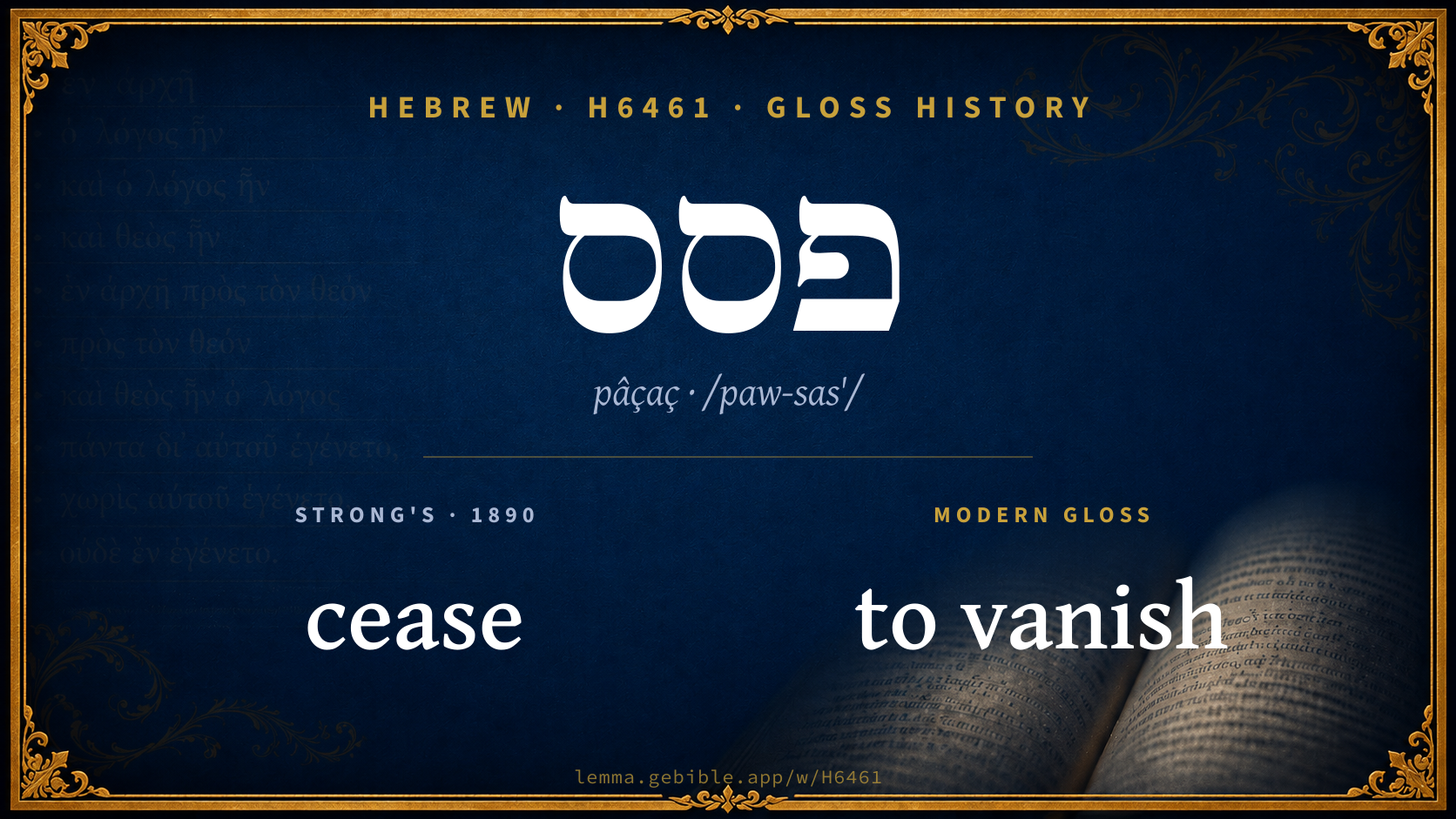
Gloss history
Strong's 1890 vs modern scholarship
About this word
Strong's H6461 catalogs a Hebrew word from the Hebrew Old Testament.
These counts are not copied from any lexicon or concordance. They are computed here, from the morphology-tagged Hebrew Old Testament. What Lemma adds →
- 1
- distinct verses
- The word appears in 1 distinct verse.
- 1 / 39
- OT books
- The word appears in 1 of 39 Old Testament books.
- #6,101
- by frequency
- Rank #6,101 (rank 6,101 of 8,640 Hebrew words by occurrence).
View all 1 occurrence in the concordance →
Most concentrated in
- Psalms 1 verse 100%
By section of the Old Testament
By traditional corpus
Conventional, traditional groupings — biblical authorship is debated, so this is a traditional corpus grouping, not an authorship claim. Each share is this word’s portion of its verses in that division of the Hebrew canon. Each figure is a share of the word’s 1 distinct verse.
- Writings (Ketuvim) 1 verse · 100%
How translations render this word
Counts come from each version’s own published word-to-Strong’s tagging or interlinear alignment — an approximate guide to how each version renders this word, not a word-level alignment the data otherwise carries. Because each total is that version’s own tagged count, the per-version totals vary from one another and need not match the appearance or distinct-verse counts above. These counts may also differ from a printed concordance because Lemma counts each distinctly tagged rendering and does not collapse phrase taggings into a single head-word total. This is a fixed set of word-tagged versions (KJV, ASV, BSB, ULT) and does not change with the reading translation you choose elsewhere. Each version’s license is shown beside its name below (and on Sources).
- King James Version: Fail 1×
- American Standard Version: Fail 1×
- Berean Standard Bible: Have vanished 1×
- unfoldingWord Literal Text: Have vanished 1×
King James Version Public Domain
Renders H6461 across 1 tagged occurrence — most commonly:
American Standard Version Public Domain
Renders H6461 across 1 tagged occurrence — most commonly:
Berean Standard Bible Public Domain
Renders H6461 across 1 tagged occurrence — most commonly:
unfoldingWord Literal Text CC BY-SA 4.0
Renders H6461 across 1 tagged occurrence — most commonly:
Senses in BDB
The 2 senses BDB distinguishes for this word, in lexicon order (not ranked by frequency or importance). The full entry — with sub-senses — is in the Lexicon Entry tab.
- to disappear, vanish, cease, fail
- (Qal) to vanish
Word origin
[ פָּסַס ] vb. disappear, vanish;— ψ 12:2
— Brown-Driver-Briggs (Oxford 1906, public domain), digitized via Sefaria, supplemented by the OpenScriptures HebrewLexicon (CC BY 4.0). See Sources.
Origin: a primitive root
Jastrow Dictionary
A second Hebrew/Aramaic lexicon for comparison, covering Aramaic and post-biblical (Talmudic, Targumic, Midrashic) usage that the biblical-Hebrew BDB does not. Matched by lemma rather than by Strong’s number, so a lemma may carry more than one Jastrow headword (shown separately below), and the entries cover usage well beyond the Bible.
פָּסַס
- 1. (b. h.) (b. h.) to be cut off, be gone. Tanḥ. Haăz. 7 (play on נח̇ב̇י בן ופ̇ס̇י, Num. XIII, 14) החב̇יא האמת ופַ֗סָּ֗ה האמונה מפיו he hid the truth, and faith was gone from his mouth. e.g. Numbers 13:14
- 2. to cut into stripes, divide, v. פַּס.
- 3. to distribute (with the shovel, v. פַּס ch. 4). Tosef. Ukts. I, 5 תבואה שפְּסָסָהּ בגורן (Var. ed. Zuck. שנִפְסְסָה) grain which one distributed in the barn (forming separate piles). Ukts. I, 5 שפְּסָסָן Ar. s. v. פספס (v. בָּסַס).—Gen. R. s. 31 [read:] והיה פוֹסְסָן מן הצד and he shovelled them (the excrements) sideways (out into the water); Yalk. ib. 54 והיה פותחין (corr. acc.), v. קָטָרַקְטִין.
- to be spread, shovelled, v. supra.
- 1. to distribute, spread; ה׳ מורסא to distribute an ulcer by manipulation, to pass over with the hand (פַּס). Eduy. II, 5; Tosef. ib. I, 8 המֵיפֵיס מורסא וכ׳ he who manipulates an abscess on the Sabbath, if for the purpose (of peeling or) of making a head to it as the physicians do &c.; Sabb. 107ᵇ; a. e.
- 2. (v. פִּיס) to break, weaken. Pes. 107ᵃ, v. פִּיס.
פְּסַס
- , to distribute. Targ. Hos. IV, 8 כהניא פַסּוּ וכ׳ the priests distribute (the sacrifices among themselves) &c.—Gen. R. s. 17 אנן פַּסִּין לה פירקא וכ׳ Ar. (read פורנא) we shall apportion (among ourselves, pay each his share towards) her dowry, and you divorce her (ed. יהבינן לה פורנא); Lev. R. s. 34 אנן פסקינן, v. פְּסַק).
- to break, weaken; to desecrate, v. פִּיס.
- to be weakened, be degraded. Targ. Job XV, 20, v. פִּיס, a. תְּפַס II.
A Dictionary of the Targumim, the Talmud Babli and Yerushalmi, and the Midrashic Literature (Marcus Jastrow; London, Luzac, 1903) — Public Domain. Digitized via Sefaria. Digitized via Sefaria. Full attribution on Sources.
Same root — word family
Other BDB entries built from the same root as H6461, grouped by Strong’s listed origin. These share a root / origin per the lexicon — not necessarily a shared meaning. Each links to that word’s own entry.
Derived from this word
Proper names from this root
People and places named from this root — a name, not an additional meaning of the word.
Compare all same-root words → Showing 4 of 5 — not the complete family. 1 of the same-root words is a proper name (a person or place). They share a root, not necessarily a meaning.
Septuagint verse parallels
This word appears in 1 verse that also exists in the Greek Old Testament (Septuagint), out of the 1 Hebrew verse it occurs in. You can read those verses in Greek by switching the Old Testament edition to the Septuagint.
Read these verses in the Septuagint
This is a verse-level parallel only — the same verses exist in both the Hebrew and Greek Old Testaments. No word-level Hebrew↔Greek correspondence is claimed: the data carries no such alignment, so no Greek word is shown as this Hebrew word’s translation. Coverage is not total — the Septuagint omits the deuterocanon and renumbers the Psalms, so some Hebrew verses have no direct Greek parallel.