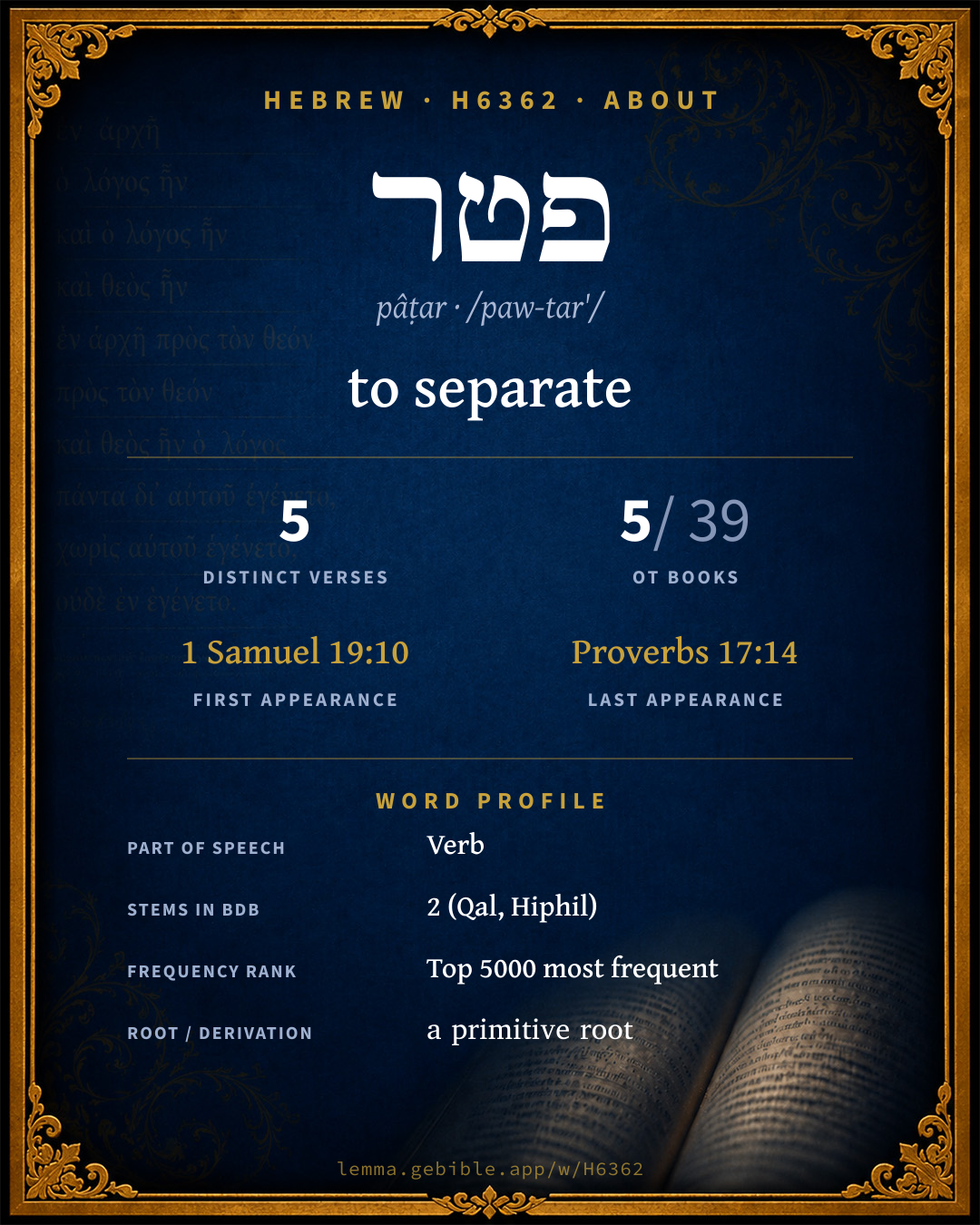
פָּטַר
to separate
also: set free, remove, open, escape fuller range ↓
Full lexicon entry — Brown-Driver-Briggs (BDB)
From Brown-Driver-Briggs (BDB)
Where this word appears
See every Qal verb in the Hebrew Bible →
Grammar key — what these labels mean
Part of speech
- Verb
- An action or state-of-being word.
Stem
- Qal
- The basic, simple active stem — the plain form of the verb (“he wrote”). Here: ‘intrans. remove oneself’
- Hiphil
- The causative active stem (“he caused / brought about”).
Form
- Sequential Imperfect
- An imperfect with prefixed waw — the standard past-narrative form (waw-consecutive imperfect).
- Imperfect
- An incomplete, ongoing, or future action (“he will / would write”).
- Perfect
- A completed action or state — Hebrew marks aspect (completeness) more than strict tense (“he wrote”).
- Participle Active
- A verbal adjective expressing ongoing or characteristic action (“writing / one who writes”).
- Participle Passive
- A verbal adjective expressing action received (“written”).
State
- Construct
- A noun bound to a following noun in a possessive / “of” relationship (the construct chain).
- Absolute
- The independent form of a noun, not bound to a following word.
Person
- 3rd Person
- The one spoken about (“he / she / it / they”).
Gender
- Masculine
- Grammatically masculine.
Number
- Singular
- One.
- Plural
- More than one (in Hebrew, generally three or more).
Grammatical forms
- Verb, Qal, Sequential Imperfect, 3rd Person, Masculine, Singular 1 time (20%)
- Verb, Hiphil, Imperfect, 3rd Person, Masculine, Plural 1 time (20%)
- Verb, Qal, Perfect, 3rd Person, Masculine, Singular 1 time (20%)
- Verb, Qal, Participle Active, Masculine, Singular, Construct 1 time (20%)
- Verb, Qal, Participle Passive, Masculine, Plural, Absolute 1 time (20%)
Parsed forms decoded from the imported morphology (morphhb / Westminster Leningrad Codex — WLC text public domain, morphhb tagging CC BY 4.0), counted across 5 parsed occurrences — not distinct verses.
Every verse where H6362 appears — 5 distinct verses across 5 books. Click any verse to open its interlinear word-by-word view. Verse text shown in the World English Bible for context — . Each verse’s Hebrew form is shown with its reference; the English is not keyword-highlighted, since the data carries no word-level English alignment. Use “Compare translations” on any verse to read it across multiple English versions. This concordance covers the Hebrew Bible; Septuagint (Greek Old Testament) occurrences are not indexed here.
1 Samuel 1 verse
1 Chronicles 1 verse
2 Chronicles 1 verse
Psalms 1 verse
Proverbs 1 verse
About this entry
At a glance — auto-summarized from this page’s data, not written by a person. Every figure links to its source below. This summary describes the numbers; it doesn’t interpret them.
At its core, פטר (pâṭar) means “to separate.” With only 5 verses it sits in the long tail of Hebrew Bible vocabulary. Scripture first uses it in 1 Samuel 19:10. Different stems carry different senses — BDB groups them under 2 stems, among them Qal and Hiphil. It clusters with פטור, פטיר and פטר under a shared root. Each statement above links to its evidence; the full detail follows below.
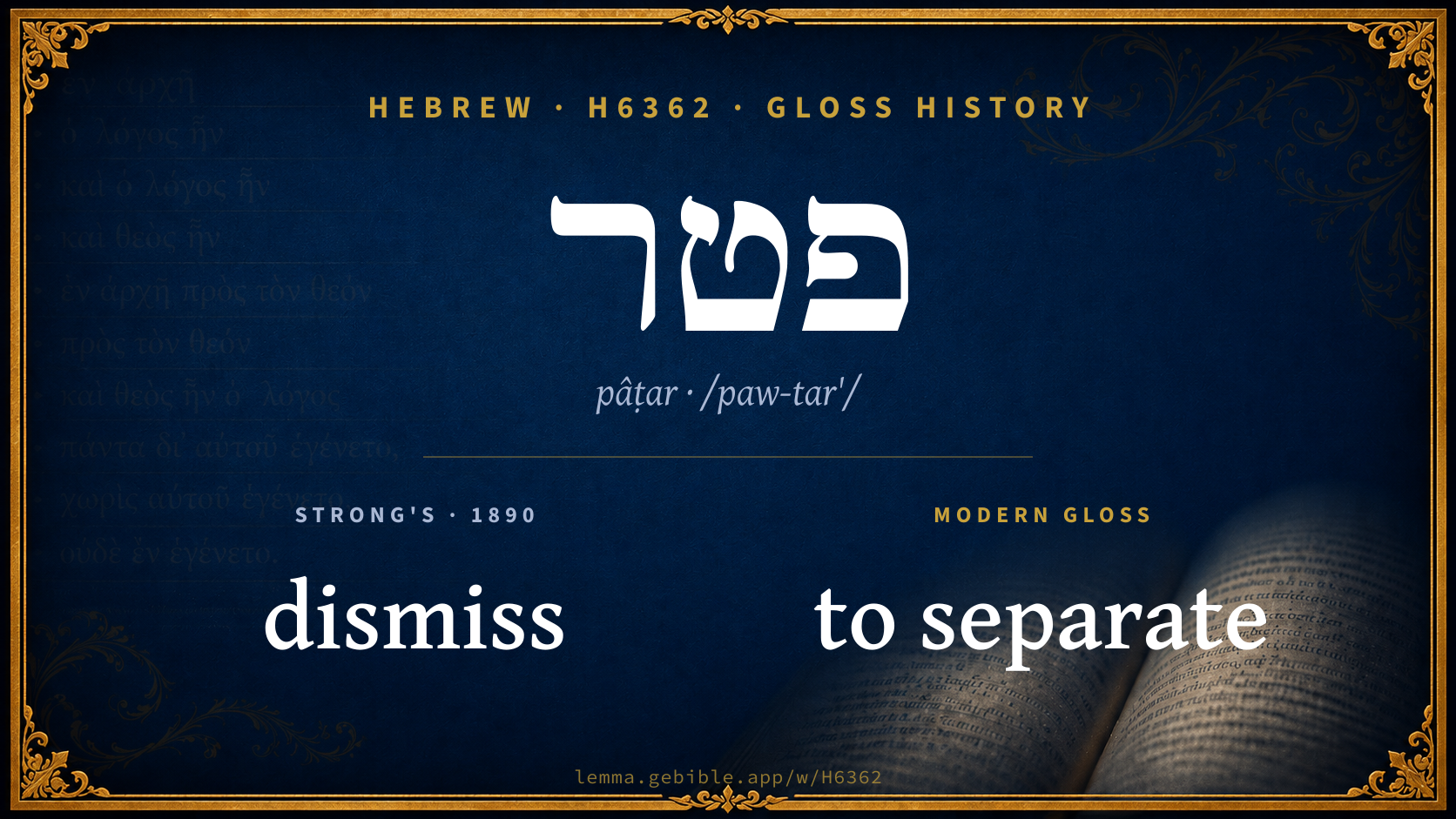
Gloss history
Strong's 1890 vs modern scholarship
About this word
Strong's H6362 catalogs a Hebrew word from the Hebrew Old Testament.
These counts are not copied from any lexicon or concordance. They are computed here, from the morphology-tagged Hebrew Old Testament. What Lemma adds →
- 5
- distinct verses
- The word appears in 5 distinct verses.
- 5 / 39
- OT books
- The word appears in 5 of 39 Old Testament books.
- #3,337
- by frequency
- Top 5000 most frequent Hebrew words (rank 3,337 of 8,640 Hebrew words by occurrence).
View all 5 occurrences in the concordance →
Most concentrated in
- 1 Samuel 1 verse 20%
- 1 Chronicles 1 verse 20%
- 2 Chronicles 1 verse 20%
By section of the Old Testament
By traditional corpus
Conventional, traditional groupings — biblical authorship is debated, so this is a traditional corpus grouping, not an authorship claim. Each share is this word’s portion of its verses in that division of the Hebrew canon. Each figure is a share of the word’s 5 distinct verses.
- Writings (Ketuvim) 4 verses · 80%
- Prophets (Nevi'im) 1 verse · 20%
How translations render this word
Counts come from each version’s own published word-to-Strong’s tagging or interlinear alignment — an approximate guide to how each version renders this word, not a word-level alignment the data otherwise carries. Because each total is that version’s own tagged count, the per-version totals vary from one another and need not match the appearance or distinct-verse counts above. These counts may also differ from a printed concordance because Lemma counts each distinctly tagged rendering and does not collapse phrase taggings into a single head-word total. This is a fixed set of word-tagged versions (KJV, ASV, BSB, ULT) and does not change with the reading translation you choose elsewhere. Each version’s license is shown beside its name below (and on Sources).
- King James Version: Open 4×
- American Standard Version: Open 4×
- Berean Standard Bible: Open 4×
- unfoldingWord Literal Text: Did 1×, He escaped 1×, Is the releasing of 1×
King James Version Public Domain
Renders H6362 across 7 tagged occurrences — most commonly:
Plus 3 renderings that appear only once — usually multi-word phrases or single function words the recovered tagging swept in, not distinct renderings.
American Standard Version Public Domain
Renders H6362 across 7 tagged occurrences — most commonly:
Plus 3 renderings that appear only once — usually multi-word phrases or single function words the recovered tagging swept in, not distinct renderings.
Berean Standard Bible Public Domain
Renders H6362 across 8 tagged occurrences — most commonly:
Plus 4 renderings that appear only once — usually multi-word phrases or single function words the recovered tagging swept in, not distinct renderings.
unfoldingWord Literal Text CC BY-SA 4.0
Renders H6362 across 6 tagged occurrences — most commonly:
Senses in the full BDB
Hebrew verbs can shift meaning by stem (binyan): Qal is the basic action, Niphal is often passive or reflexive, Piel often intensifies or makes it factitive, and Hiphil is typically causative. The senses below are grouped under the stem BDB assigns to each.
What do BDB’s symbols mean?
BDB uses these scholarly abbreviations:
| Symbol | Meaning |
|---|---|
| 𝔊 | the Septuagint (the ancient Greek translation, LXX) |
| 𝔙 | the Vulgate (the Latin translation) |
| 𝔖 | the Syriac version (the Peshitta) |
| 𝔗 | the Targum (the Aramaic translation) |
| ψ | the Psalms |
| √ | root (the underlying root or stem) |
| ‖ | parallel passage (a synonymous or contrasted parallel) |
| † | the dagger: every passage where the word occurs is cited |
The 4 senses and sub-senses the full Brown-Driver-Briggs lexicon distinguishes for this word, in lexicon order (not ranked by frequency), with BDB’s own verbatim wording and sub-sense lettering. Shown in Hebrew script with BDB’s own scholarly abbreviations. The condensed entry is in the Lexicon Entry tab. See also the Forms in the corpus table below.
Qal
- Pf. 3 ms. פ׳ 2 Ch 23:8; Impf. 3 ms. וַיִּפְטַר 1 S 19:10; Pt. act. פּוֹטֵר Pr 17:14; pass. פְּטוּרִים 1 Ch 9:33 Qr (Kt פטירים); cstr. פְּטוּרֵי 1 K 6:18, 29, 32, פְּטֻרֵי v 35;— e.g. 2 Chronicles 23:8
- 1. intrans. remove oneself, specif. escape 1 S 19:10 (מִפְּנֵי, cf. Dr). e.g. 1 Samuel 19:10
- 2. trans. set free from duty 2 Ch 23:8 (acc. pers.), so pass. 1 Ch 9:33 Qr (Kt פטירים adj. or Aramaic pt., same meaning); פ׳ מַיִם Pr 17:14 set free, let out; pass. פְּטוּרֵי צִצִּים term. techn. of ornament in temple, dub., usually out-spread (garlands) of flowers 1 K 6:18, 29, 32, 35. e.g. 2 Chronicles 23:8
Hiphil
- Impf. 3 ms. יַפְטִירוּ בְשָׂפָה ψ 22:8 they separate with the lip, i.e. open mouth wide (insultingly).* e.g. Psalms 22:8
Senses from the full Brown-Driver-Briggs lexicon (Brown, Driver, Briggs; Oxford 1906 — public domain), digitized via Sefaria, supplemented by the OpenScriptures HebrewLexicon (CC BY 4.0). Full attribution on Sources.
Word origin
vb. separate, remove, set free (NH depart, set free, Niph. also die; Ph. פטר CIS 102a, 2 depart (die?); Assyrian Paṭâru, split, break through, ipṭiru, ransom, TelAm. escape, set free (perhaps Canaanit.); Arabic فَطَرَ cleave, split, also create; Ethiopic ፈጠረ create, fabricate; Aramaic פְּטַר, ܦܛܰܪ withdraw, depart);—
— Brown-Driver-Briggs (Oxford 1906, public domain), digitized via Sefaria, supplemented by the OpenScriptures HebrewLexicon (CC BY 4.0). See Sources.
Origin: a primitive root
Jastrow Dictionary
A second Hebrew/Aramaic lexicon for comparison, covering Aramaic and post-biblical (Talmudic, Targumic, Midrashic) usage that the biblical-Hebrew BDB does not. Matched by lemma rather than by Strong’s number, so a lemma may carry more than one Jastrow headword (shown separately below), and the entries cover usage well beyond the Bible.
פָּטַר
- (b. h.)
- 1. to break through, open. Bekh. VIII, 1 (46ᵃ) (ref. to Ex. XIII, 2) עד שיִפְטְרוּ רחם מישראל (not שיפטרוה) provided they open the womb when the mother is an Israelite (although she conceived before her conversion); ib. 47ᵃ.—2) to send off, discharge, dismiss. Keth. XIII, 5, a. fr. או כנוס או פְּטוֹר (the betrothed has a right to say) either marry or release (me by divorce). Gitt. VI, 5 פִּטְרוּהָ … לא אמר כלום if one says to friends, ‘release her’ … he has said nothing (they are not authorized to write a letter of divorce, as it might mean, release her of her debts &c.); ib. 65ᵇ ר׳ נתן אומר פַּטְּרוּהָ דבריו קיימין פִּיטְרוּהָ לא אמר כלום R. N. says, if he said paṭṭ’ruha (Pi.), his words stand (a divorce is meant), but if he says piṭruha (Kal) &c. Ib. ר׳ נתן דבבלאה … בין פיטרוה לפטרוה וכ׳ R. N. who is a Babylonian, draws a distinction between piṭruha and paṭṭ’ruha; our Tannai (in the Mishnah) being a Palestinian does not &c. Ib. VIII, 4. פּוֹטֵר … בגט ישן a man may divorce his wife with an old letter of divorce (having been closeted with her after he had written it); Tosef. ib. VIII (VI), 3 אינו פוטר וכ׳ he must not divorce with an old letter, in order that the letter of divorce may not date farther back than (the conception of) her child; a. fr. e.g. Exodus 13:2
- 3. to dismiss, give leave, let go. Sot. IX, 6 ופְטַרְנוּהוּ בלא מזון and we let him (the stranger) go without provision. Midr. Till. to Ps. XCI מי גדול הפּוֹטֵר או הנִפְטָר which is the superior of the two? he who gives leave, or he who takes leave? Ib. (ref. to Gen. XXXII, 27) הרי יעקב פוטר למלאך behold, Jacob gives leave to the angel; a. fr. e.g. Genesis 32:27
- 4. (law) to discharge, acquit; (ritual) to exempt from obligation, to declare free from punishment, eventually from sacrificial atonement, opp. חִיֵּיב. Erub. 65ᵃ יכול אני לִפְטוֹר וכ׳ I can (by my plea) release from judgment the whole world (all Israelites) from the destruction of the Temple to the present time, for we read (Is. LI, 21), Hear now this, thou afflicted and drunken &c. (a drunken person is irresponsible); ib. מאי יכולני לפטור נמי מדין תפלה this ‘I can release’ means also from responsibility for neglect of prayer (the drunken not being permitted to pray). Succ. 45ᵇ. Sabb. II, 5 ר׳ יוסי פוטר בכלן וכ׳ R. J. declares (him that did it) free from punishment or eventual sacrifice in all those cases, except &c. Ker. IV, 2 ר׳ יהושע פוטר R. J. absolves him from bringing a sin-offering, opp. מחייב חטאת. Snh. V, 5 אם מצאו לו זכות פְּטָרוּהוּ if they found evidence in his favor, they (the court) acquitted him; a. v. fr.—Trnsf. to cause exemption; to cover, include. Ber. VI, 5 ברך על היין … פ׳ את היין וכ׳ if he recited the blessing over wine before the meal, he has therewith exempted the wine offered after the meal (from an additional blessing). Ib. 7 מברך על העיקר ופוטר את הטפלה he says the blessing over the chief dish, and with this he covers that which goes with it (v. טְפֵלָה). Yeb. I, 1 חמש … פּוֹטְרוֹת צרותיהן fifteen women (of various kinship with the yabam, by which he is prevented from marrying any of them) cover their rivals (making them free from dependence on the yabam for marriage or discharge); a. fr.—Part. pass. פָּטוּר; f. פְּטוּרָה; pl. פְּטוּרִים, פְּטוּרִין; פְּטוּרוֹת (is, are) exempt, free, opp. חַיָּיב. Peah I, 6 ופ׳ מן המעשרות וכ׳ and he need not give the tithes, until &c. B. Mets. VIII, 1 פ׳ (sub. מלשלם) he is free from indemnity. Ib. VII, 10 מתנה … להיות פ׳ משבועה may have an agreement to be eventually exempt from making oath; להיות פ׳ מלשלם to be exempt from responsibility. Kidd. I, 7 כל מצות הבן על האב … ונשים פ׳ to all paternal duties men are bound, but women (mothers) are exempt from them. Yeb. I, 2 כשם שבתו פ׳ כך צרתה פ׳ as well as his (the yabam’s) daughter is exempt (from the law of levirate marriage, because the yabam cannot marry her), so her rival is exempt; a. v. fr. e.g. Isaiah 51:21
- to dismiss; to divorce. Gitt. 65ᵇ, v. supra. Kidd. 31ᵇ פַּטְּרוּנִי dismiss (escort) me; a. e.
- 1. to be exempted, freed. Bekh. II, 1 לא נִפְטְרוּ מבכור וכ׳ they (the Levites) have not been exempted from consecrating the firstborn of clean animals, but only from redeeming their firstborn sons and the firstborn of asses; a. e.
- 2. to be dismissed, take leave, depart. Yoma I, 5 נפטרו והלכו להם they took leave and went. Sot. IX, 5. Ber. 64ᵃ הנ׳ מחבירו וכ׳ he who leaves his friend (after escorting him a distance) must not say, ‘go in peace’, but, ‘go to peace’; הנ׳ מן המת וכ׳ he who takes leave of the dead (after burial) &c. Ib. 31ᵃ; Erub. 64ᵃ לא יִפָּטֵר אדם וכ׳ one must not leave a friend otherwise than with a word of tradition (on legal or religious subjects), by which he may remember him; a. fr.—Esp. to depart this world, to die. Ber. 17ᵃ גדל בשם טוב ונ׳ בשם טוב מן העולם who grew (lived) with a good name, and left the world with a good name. Tem. 16ᵃ בשעה שנ׳ משה רבינו לגן עדן when Moses our teacher was to depart for paradise. Gen. R. s. 96; a. fr.—Yalk. Koh. 989 בשעה … מִתְפַּטְּרִים וכ׳ when the children are dismissed from school.
- 1. to discard; ה׳ בשפה to discard with the lip, to spurn. Pesik. R. s. 37 מחרקין … ומַפְטִירִים בשפתותיהם gnashed their teeth … and spurned with their lips (ref. to Ps. XXII, 8). Treat. Der. Er. ch. II מפְטִּירֵי שפה (= מפטירין בשפה). e.g. Psalms 22:8
- 2. to dismiss, adjourn a meeting. Y. Ber. IV, 7ᵈ top הַפְטֵר את העם dismiss the people (adjourn the meeting). M. Kat. 5ᵇ, v. בָּכָה. Ḥull. 51ᵃ מַפְטִיר כנסיות one who dismisses the assemblies, janitor, v. כְּנֶסֶת.—Pes. X, 8, v. אֶפִּיקוֹמָן; a. e.
- 3. [to recite before dismissal,] to conclude the reading from the Law by reading a portion of the Prophets, to read the Hafṭarah (v. הַפְטָרָה). Meg. IV, 1 בשני … ואין מַפְטִירִין בנביא on Mondays, Thursdays and Saturday afternoons three persons read from the Law …, and we do not close with a lesson from the Prophets. Ib. 5 המפטיר בנביא הוא וכ׳ he who concludes with the prophetic lesson (being the last of those called up) has the privilege of &c., v. פָּרַס; a. fr.
פְּטַר
- , to free, dismiss, let go; to divorce. Targ. Gen. XLIII, 14. Targ. Y. Num. V, 2, sq. Targ. O. Deut. XXIV, 1; a. fr.—Bekh. 4ᵃ אינהו פַּטְרֵי אדם אדם פטר בהמה בהמה פטרי they (the Levites) released (the firstborn Israelites) by substituting man for man, but the firstborn beasts were redeemed through their beasts.—V. פַּטִּיר.
- same, esp. to divorce. Targ. Koh. VII, 26 יְפַטֵּיר (ed. Vien. יַפְטִיר Af.).—Gitt. 85ᵇ היך פלני … פַּטַּר ותריך וכי (or פְּטַר) how N. N. divorced and sent away N. N. his wife &c.
- 1. to dismiss. Targ. Koh. l. c., v. supra.—Num. R. s. 12 דיהוון מַפְטִירִין טלייא וכ׳ that they should dismiss the school children at the fourth hour of the day (during the summer heat); Lam. R. to I, 3 מפטרין רב טלאי (corr. acc.).
- 2. to deliver a funeral address. Y. Ber. II, 5ᶜ top על׳ … וא׳ עילוי וכ׳ R. Z. came in, and spoke of him (as follows) &c. Ib.ᵇ bot. ואיפטר (corr. acc.). Koh. R. to V, 11 עול ואַפְטוֹר עלוי go and deliver the address over him. Ib. א׳ עלוי הדין פסוקא he started his address with this verse &c.; a. fr.
- 3. to take leave. Tanḥ. B’resh. 13 אַפְטְרוּ מיניה באורתא they took leave of him in the evening; בצפרא אתו וקא מַפְטְרֵי מיניה in the morning they came and again took leave of him; מי לא אַפְטְרִיתוּ קמאי מאתמול did you not take leave of me last night? Erub. 64ᵃ (Ms. M. מִיפַּטְרֵי Ithpe.) were taking leave of one another; a. fr.
- 4. to read the Hafṭarah. Meg. 31ᵇ מאי מַפְטִירִינָן what do we read as Hafṭarah?; ib.ᵃ אַפְטוּרֵי מאי מפטירינן (not מפטירין). Ib. 30ᵇ קרו ומַפְטְרֵי (not קרא) they read from the Law and recited the Hafṭarah; a. fr.—Ber. 53ᵇ מפטרייהו, v. מִפְטָרָא.
- , אִפְּ׳
- 1. to escape (a thrust), slip away. Targ. I Sam. XIX, 10.
- 2. to be divorced, v. מִפְטְרָא.
- 3. to be sent off, be escorted. Targ. Gen. XLIV, 3.—Esp. to be escorted to the burying place, be buried. Targ. Koh. VII, 1.—Lam. R. to I, 1 נח (רבתי) נפשיה וא׳ לבית עלמין he died and was carried to the burying place; a. e.
- 4. to take leave, part. Erub. l. c., v. supra.
- 5. to be exempted. Bekh. 4ᵃ אפי׳ מבכור בהמה נמי נִיפַּטְרוּ let them also be exempt from consecrating the firstborn of cattle; a. e.
פֶּטֶר
- preced. wds.) [opening of the womb,] firstborn, firstbirth. Bekh. I, 6, v. פִּדְיוֹן. Ib. II, 1; a. v. fr.—Pl. פְּטָרִים, constr. פִּטְרֵי, פִּי׳. Ib. 6ᵃ פ׳ סוסים וגמלים the first-births of horses or camels. Ib. 11ᵃ פי׳ חמורות; a. e.
פטר
- , Y. Kidd. I, 61ᵇ top פ׳ בולי, v. פַּטְרוֹבּוּלִי
A Dictionary of the Targumim, the Talmud Babli and Yerushalmi, and the Midrashic Literature (Marcus Jastrow; London, Luzac, 1903) — Public Domain. Digitized via Sefaria. Digitized via Sefaria. Full attribution on Sources.
Forms in the corpus
The 5 distinct written forms H6362 takes in the Hebrew Bible, most frequent first — each parse links to that stem’s occurrences in the concordance. Hebrew forms include their vowel points and cantillation, so a single lemma takes many written forms.
| Form | Parsing | Example | Uses |
|---|---|---|---|
| וַ/יִּפְטַר֙ | Verb, Qal, Sequential Imperfect, 3rd Person, Masculine, Singular | 1 Samuel 19:10 | 1 |
| יַפְטִ֥ירוּ | Verb, Hiphil, Imperfect, 3rd Person, Masculine, Plural | Psalms 22:7 | 1 |
| פָטַ֛ר | Verb, Qal, Perfect, 3rd Person, Masculine, Singular | 2 Chronicles 23:8 | 1 |
| פּ֣וֹטֵֽר | Verb, Qal, Participle Active, Masculine, Singular, Construct | Proverbs 17:14 | 1 |
| פְּטוּרִ֑ים | Verb, Qal, Participle Passive, Masculine, Plural, Absolute | 1 Chronicles 9:33 | 1 |
Same root — word family
Other BDB entries built from the same root as H6362, grouped by Strong’s listed origin. These share a root / origin per the lexicon — not necessarily a shared meaning. Each links to that word’s own entry.
Derived from this word
Compare all same-root words → They share a root, not necessarily a meaning.
Septuagint verse parallels
This word appears in 4 verses that also exist in the Greek Old Testament (Septuagint), out of the 5 Hebrew verses it occurs in. You can read those verses in Greek by switching the Old Testament edition to the Septuagint.
Read these verses in the Septuagint
This is a verse-level parallel only — the same verses exist in both the Hebrew and Greek Old Testaments. No word-level Hebrew↔Greek correspondence is claimed: the data carries no such alignment, so no Greek word is shown as this Hebrew word’s translation. Coverage is not total — the Septuagint omits the deuterocanon and renumbers the Psalms, so some Hebrew verses have no direct Greek parallel.