
Isaiah 37:34

Hebrew (Westminster Leningrad Codex) Isaiah 37:34 appears in the Hebrew Old Testament. The text above is from the Westminster Leningrad Codex. Each word links to its Strong’s number, a concise gloss, and parsing drawn from the Open Scriptures Hebrew Bible morphology. Click any word for its full Brown-Driver-Briggs (BDB) entry.
Download image
Cite this verse

Isaiah 37:34 (World English Bible). Public Domain. Lemma interlinear Bible study tool, https://lemma.gebible.app/v/isaiah/37/34.

Show BibTeX & RIS
BibTeX
RIS
English Translation
By the way that he came, by the same shall he return, and he shall not come to this city, says Yahweh.
World English Bible · Public Domain
Download a study sheet

One document with this verse’s original text, its word-by-word gloss line, the meaning frame, cross-references with their text, attributed commentary, and full source and license credits — printable, and it pastes into notes with its structure intact.

This verse Autodidact and up

Study sheet (.html) Plain text (.txt)

A passage Seminary Student

Up to 50 verses in one chapter. A passage sheet keeps up to 6 commentary sources and 12 cross-references per verse, in the order this page ranks them, and says so on the sheet whenever that leaves anything out. Ask for a single verse and you get the Autodidact verse sheet above.

Everything on this page stays free to read, with no account — the sheet is a download of what is already on screen, not access to it.

Want to remove ads? Support Godless Engineer
Compare translations 3

The same verse in 3 English versions, stacked beneath the original-language interlinear above. Click any original word for its lexicon entry.

Each is an independent rendering of the whole verse — the interlinear is not word-aligned to these translations.

Highlighted words mark where these versions differ — a whole-verse word diff, not a word-by-word alignment.

  • World English Bible Public Domain
    By the way that he came, by the same shall he return, and he shall not come to this city, says Yahweh.
  • King James Version Public Domain
    By the way that he came, by the same shall he return, and shall not come into this city, saith the LORD.
  • unfoldingWord Literal Text CC BY-SA 4.0
    He will return by the way on which he came, and he will not come to this city’—the declaration of Yahweh—

unfoldingWord Literal Text — © unfoldingWord, licensed CC BY-SA 4.0. Word-aligned USFM3 via Door43 (git.door43.org/unfoldingWord/en_ult).

Versions to compare (up to 4)

3 of 4 selected

Show all 18 translations

Every available English version of this verse, each an independent rendering of the whole verse.

  • World English Bible Public Domain
    By the way that he came, by the same shall he return, and he shall not come to this city, says Yahweh.
  • Berean Standard Bible Public Domain
    He will go back the way he came, and he will not enter this city,’ declares the LORD.
  • Majority Standard Bible Public Domain
    He will go back the way he came, and he will not enter this city,’ declares the LORD.
  • King James Version Public Domain
    By the way that he came, by the same shall he return, and shall not come into this city, saith the LORD.
  • American Standard Version (1901) Public Domain
    By the way that he came, by the same shall he return, and he shall not come unto this city, saith Jehovah.
  • Revised Version (1885) Public Domain
    By the way that he came, by the same shall he return, and he shall not come unto this city, saith the LORD.
  • Geneva Bible (1599) Public Domain
    By the same way that he came, he shall returne, and not come into this citie, saith the Lord.
  • Douay-Rheims (1899) Public Domain
    By the way that he came, he shall return, and into this city he shall not come, saith the Lord.
  • Young's Literal Translation Public Domain
    In the way that he came, in it he turneth back, And unto this city he doth not come in, An affirmation of Jehovah,
  • Literal Standard Version CC BY-SA 4.0
    In the way that he came, in it he turns back, || And to this city he does not come in, || A declaration of YHWH,
  • Unlocked Literal Bible CC BY-SA 4.0
    The way by which he came will be the same way he will leave; he will not enter this city—this is Yahweh's declaration.
  • unfoldingWord Literal Text CC BY-SA 4.0
    He will return by the way on which he came, and he will not come to this city’—the declaration of Yahweh—
  • Darby Bible Public Domain
    By the way that he came, by the same shall he return, and shall not come into this city, saith Jehovah.
  • World Messianic Bible Public Domain
    He will return the way that he came, and he won’t come to this city,’ says the LORD.
  • Webster's Bible Public Domain
    By the way that he came, by the same shall he return, and shall not come into this city, saith the LORD.
  • Free Bible Version CC BY-SA 4.0
    He shall return the same way he came, and he shall not enter this city, says the Lord.
  • Bible in Basic English Public Domain
    By the way he came he will go back, and he will not get into this town.
  • JPS Tanakh (1917) Public Domain
    By the way that he came, by the same shall he return, and he shall not come unto this city, saith the LORD.

Literal Standard Version (2020), Covenant Press — licensed CC BY-SA 4.0. Text via the HelloAO Bible API (eBible.org). Unlocked Literal Bible (unfoldingWord) — licensed CC BY-SA 4.0. Text via the HelloAO Bible API (eBible.org). unfoldingWord Literal Text — © unfoldingWord, licensed CC BY-SA 4.0. Word-aligned USFM3 via Door43 (git.door43.org/unfoldingWord/en_ult). Free Bible Version, Dr. Jonathan Gallagher — licensed CC BY-SA 4.0. Text via the HelloAO Bible API (eBible.org).

Word by word

More ways to search: Search by grammar → Find every occurrence → Compare this word →

Practice this passage: Drill this verse → Learn its vocabulary →

נְאֻם
nᵉʼum
H5002
“utterance of”
Noun, Common, Masculine, Singular, Construct
Part of Speech
Noun
Type
Common
Gender
Masculine
Number
Singular
State
Construct
Full BDB Definition

Origin: from H5001

TWOT: 1272a

(Qal) utterance, declaration (of prophet) - utterance, declaration, revelation (of prophet in ecstatic state) - utterance, declaration (elsewhere always preceding divine name)
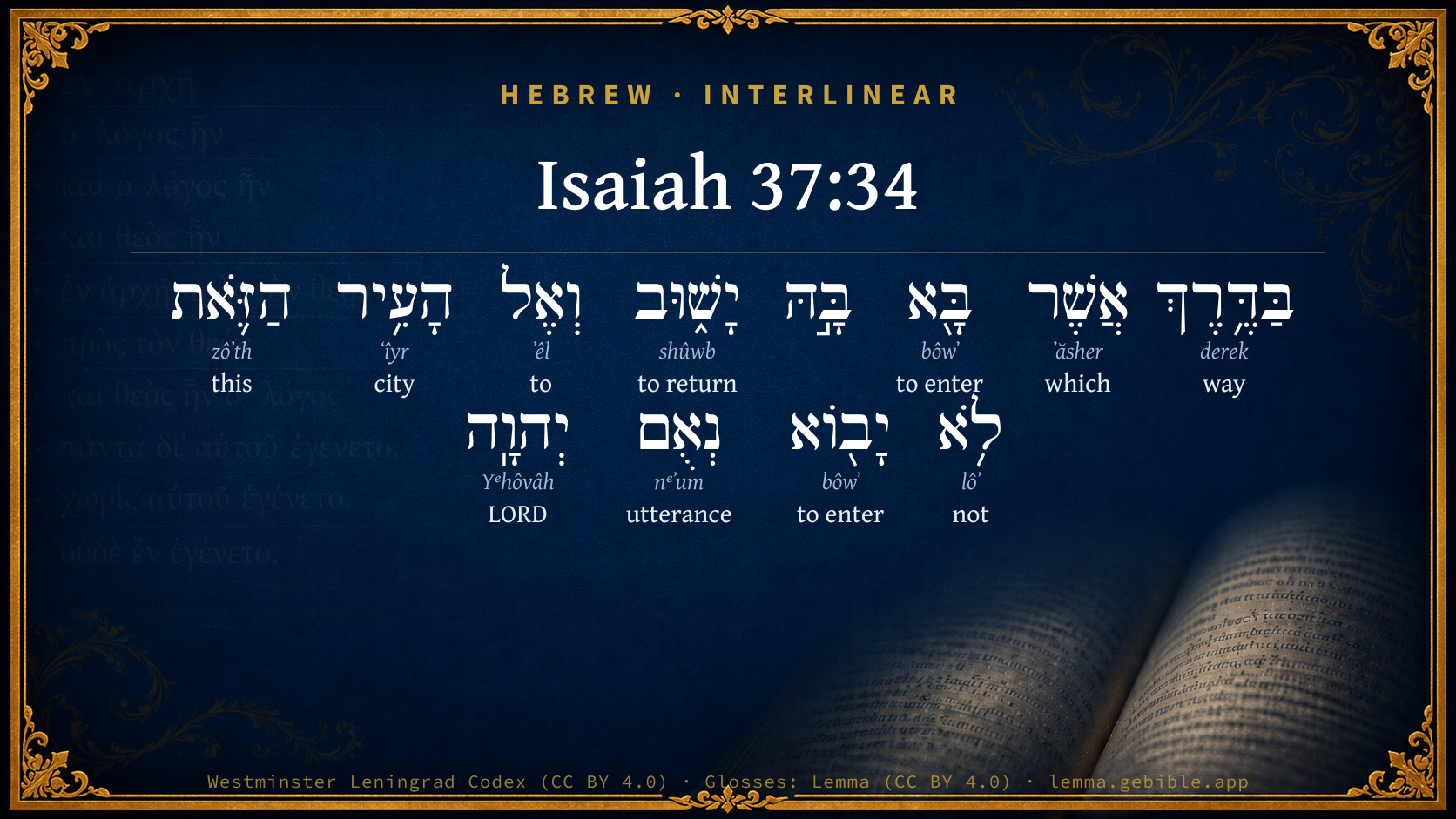
  1. בַּדֶּ֥רֶךְ derek H1870 “in/at the · way” Preposition, Determined + Noun, Common, Both, Singular, Absolute
  2. אֲשֶׁר ʼăsher H834 “which” Particle, Relative
  3. בָּ֖א bôwʼ H935 “to enter” Verb, Qal, Perfect, 3rd Person, Masculine, Singular
  4. יָשׁ֑וּב shûwb H7725 “to return” Verb, Qal, Imperfect, 3rd Person, Masculine, Singular
  5. וְאֶל ʼêl H413 “and · to” Conjunction + Preposition
  6. הָעִ֥יר ʻîyr H5892 “the · city” Particle, Definite Article + Noun, Common, Feminine, Singular, Absolute
  7. הַזֹּ֛את zôʼth H2063 “the · this” Particle, Definite Article + Pronoun, Demonstrative, Feminine, Singular
  8. לֹ֥א lôʼ H3808 “not” Particle, Negative
  9. יָב֖וֹא bôwʼ H935 “to enter” Verb, Qal, Imperfect, 3rd Person, Masculine, Singular
  10. יְהוָֽה Yᵉhôvâh H3068 “LORD” Noun, Proper

About this verse

These counts appear in no published source. They are computed here, from the morphology-tagged text and Lemma’s own curated glosses. What Lemma adds →

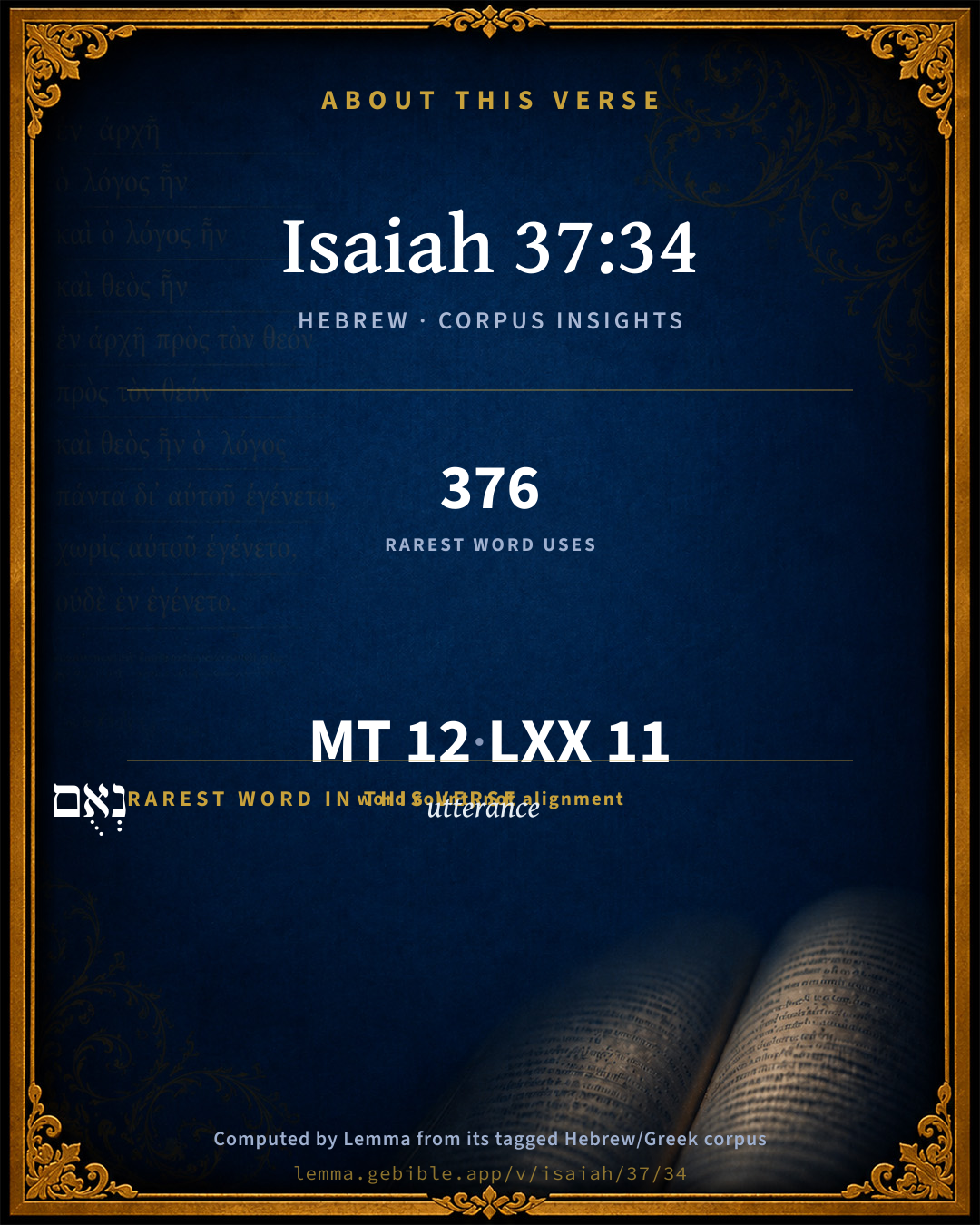
12
words
10
distinct lemmas
Prophets
section

Grammatical profile

  • 3 verbs
  • 4 nouns
  • 1 pronoun
  • 2 prepositions
  • 2 particles

Verb forms

  • בָּ֖א Qal · Perfect
  • יָשׁ֑וּב Qal · Imperfect
  • יָב֖וֹא Qal · Imperfect

Repetition

A word recurs within this verse — often emphatic in Hebrew:

  • בָּ֖א to enter H935 ×2

Hebrew & Septuagint length

In English translation the verse runs 22 words from the Hebrew and 24 from the Septuagint (LXX English) — closely comparable.

A rough comparison of the two English renderings, which tokenize alike — not a word-level alignment.

Word counts can differ between the Hebrew and the Greek without any difference in meaning — e.g. the Hebrew direct-object marker אֵת has no separate Greek word, and Greek often adds the article ὁ.

In the original languages it is 12 Hebrew tokens and 11 Greek tokens — but the two are counted differently (Hebrew bundles its prefixes and suffixes into one token; the Greek is in lemma form), so that isn’t a like-for-like length.

Cross-references

2

Topical passages linked to Isaiah 37:34 in the Treasury of Scripture Knowledge — connected by theme and wording, ordered by reader-vote popularity; previews shown in the World English Bible.

  • Isaiah 37:29 Because of your raging against me, and because your arrogance is come up into my ears, therefore will I put my hook in your nose, and my bridle in your lips, and I will turn you back by the way by which you came.
  • Proverbs 21:30 There is no wisdom nor understanding Nor counsel against Yahweh.

Cross-references courtesy of OpenBible.info (CC BY 4.0).

Hebrew and Greek witnesses Masoretic Hebrew ↔ Greek Septuagint

The same verse in the two great witnesses to the Old Testament, shown verse-for-verse.

These are two independent witnesses, not word-aligned to each other, and the Septuagint is shown in lemma (dictionary) form.

Hebrew Isaiah 37:34 Masoretic · Westminster Leningrad Codex

בַּדֶּ֥רֶךְ אֲשֶׁר בָּ֖א בָּ֣הּ יָשׁ֑וּב וְאֶל הָעִ֥יר הַזֹּ֛את לֹ֥א יָב֖וֹא נְאֻם יְהוָֽה

By the way that he came, by the same shall he return, and he shall not come to this city, says Yahweh.

World English Bible · Public Domain

Greek LXX Isaiah 37:34 Septuagint · lemma form

ἀλλά ὁ ὁδός ὅς ἔρχομαι ἐν αὐτός ἀποστρέφω ὅδε λέγω κύριος

But by the way by which he came, by it shall he return, and shall not enter into this city: thus says the Lord.

LXX2012 (modern English Septuagint) · Public Domain

Hebrew: Westminster Leningrad Codex (CC BY 4.0). Greek: Septuagint (public domain); English from LXX2012 (modern English Septuagint) (Public Domain). How the Septuagint differs from the Hebrew →

Targum (Aramaic paraphrase)

1

The Targum is the ancient Jewish Aramaic paraphrase of the Hebrew Scriptures — an interpretive translation, not the Hebrew text itself. Onkelos (literal) and Pseudo-Jonathan (expansive) render the Torah, and Jonathan the Prophets. Coverage is partial: where no permissively-licensed English translation exists for a verse, only the Aramaic is shown. This is verse-level text, not a word-by-word alignment to the Hebrew.

  1. Targum Jonathan Prophets (Joshua–Malachi)
    בְּאוֹרְחָא דַאֲתָא בָה יְתוּב וּלְקַרְתָּא הָדָא לָא יֵעוּל אֲמַר יְיָ:

    By the way that he came, by the same he shall return, and he shall not come into this city, saith the Lord.

    Targum Jonathan — Aramaic: “Mikraot Gedolot” (public domain). English: “Sefaria Community Translation” (CC0 1.0 (public-domain dedication)); “London "Chaldee Paraphrase," 1871” (public domain). Text via Sefaria.

Commentary

Notes on Isaiah 37:34 from classic Christian and Jewish commentators (each source and its license shown beneath its notes). The classic Christian expositions comment on the surrounding passage and are grouped to its opening verse, so a note may address several verses; the Jewish commentaries on the Tanakh (Rashi and others) are per-verse, so they appear only where the commentator wrote on this verse.

Lemma curates 59 commentaries, every one of them public domain or Creative Commons licensed, each selected and text-cleaned for this edition rather than reprinted as found. About our sources →

Jamieson, Fausset & Brown

Robert Jamieson, A. R. Fausset & David Brown

(See Isa 37:29, Isa 37:37; Isa 29:5-8).

Jamieson, Fausset & Brown — Commentary Critical and Explanatory on the Whole Bible (1871) — public domain (CC PDM 1.0). Text via the HelloAO Bible API.

The Cambridge Bible for Schools and Colleges

gen. ed. J. J. S. Perowne

34. Cf. Isa_37:7; Isa_37:29.

The Cambridge Bible for Schools and Colleges (gen. ed. J. J. S. Perowne; Cambridge University Press, 1878–1918) — public domain. Text from a community e-Sword module.

John Gill's Exposition

Then the angel of the Lord went forth,.... From heaven, at the command of the Lord, being one of his ministering spirits, sent forth by him, as for the protection of his people, so for the destruction of their enemies; this was the same night, either in which the Assyrian army sat down before Jerusalem, as say the Jews (x); or, however the same night in which the message was sent to Hezekiah; see Kg2 19:35,

and smote in the camp of the Assyrians an hundred and fourscore and five thousand men: a prodigious slaughter indeed! which shows the power and strength of an angel. Josephus (y) says they were smitten with a pestilential disease; but other Jewish writers say it was by fire from heaven, which took away their lives, but did not consume their bodies, nor burn their clothes; but, be that as it will, destroyed they were:

and when they arose early in the morning: those of the army that survived; Sennacherib, and his servants about him; or Hezekiah, and the inhabitants of Jerusalem, that were besieged:

behold, they were all dead corpses; the whole army, excepting a few; this may well be expressed with a note of admiration, "behold!" for a very wonderful thing it was.

(x) T. Bab. Sanhedrin: fol. 95. 1. (y) Antiqu. l. 10. c. 1. sect. 5.

John Gill's Exposition of the Whole Bible (1746–1763) — public domain (CC PDM 1.0). Text via the HelloAO Bible API.

Albert Barnes' Notes on the Bible

By the way that he came - (Isa 37:29; compare Isa 37:37).

And shall not come into this city - (Isa 37:33; compare Isa 29:6-8).

Albert Barnes' Notes on the Bible (1834–1885) — public domain. Text from a community e-Sword/MySword module.

The Pulpit Commentary

By the way that he came. It is clear that Sennacherib on this occasion had marched by the usual coast route, through Sharon and the Shefeleh, upon Lachish, leaving Jerusalem far to his left. From Laehish he sent Rabshakeh to Hezekiah with a threatening message, and (as our version has it) with a great army;" rather, "with a strong force." Rabshakeh, having delivered his message, returned to his master, (Isa_37:8) doubtless with his escort. Sennacherib then sent a letter by messengers, but without an army, so far as we are told, to renew his threats. Meanwhile from Lachish he went to Libnah, after which we know nothing of his movements, unless we accept the Egyptian account, which was, that he advanced to Pelusium. The declaration, "By the way that he came, by the same shall he return" (comp. ver. 29) was the most comforting that Hezekiah could possibly receive. It assured him that he would not even be confronted with his enemy. Into this city; rather, unto this city (as in ver. 32).

Returning on our way.

"By the way that he came, by the same shall he return.

I THE RETURN WHICH IS IMPOSSIBLE. Our departure from this world is often spoken of as a return. We "return to the grave." We ascend and descend the hill of life; but we go down that hill on the other side. Old age is indeed "a second childhood;" but how different a childhood it is! with the experience, and the carefulness, and the sad consciousness of failure which childhood has not, but without the eager-heartedness, buoyancy, simplicity, trustfulness, which childhood has. It may be said of every part and passage of our human experience, "Thou hast not gone this way heretofore." We never live over again even a single day of our life.

II THE RETURN WITH WHICH WE ARE THREATENED. God, in his holy and wise providence, may defeat our purpose, as he did that of Sennacherib, and in this sense may cause us to return on our way. Again and again is this the case with:

1. Unrighteous aggression, or some other design which is positively sinful.

2. Unhallowed ambition; when men set themselves to achieve some great thing for their own enrichment or aggrandizement, and God breaks their schemes. He sends them back to the starting-point of emptiness or poverty from which they set out. When God thus interposes, men may well ask what it is that he me, his them to learn.

3. Unwise endeavour; as when men offer themselves for the work of teaching, or preaching, or labouring in the field of foreign missions, when they are unfitted lop the post.

III THE RETURN WHICH IS OUR DUTY.

1. That which awaits the Christian man,

(1) when he has entered on a business which he finds he cannot conduct with a clear conscience;

(2) when he has adopted a course of training his family or directing his establishment which he finds inefficient and disappointing;

(3) when he has associated himself with a company of men, or with a Church of Christ, which he finds ungenial and unsatisfactory.

2. That which belongs to the unchristian man. To him, in the "far country"of estrangement, comes ever the commanding, but yet. the entreating voice of the heavenly Father, saying, "Return unto me, and I will return unto you." Well is it, indeed, when the heart"s response is found in the heaven-gladdening words, "I will arise, and go to my Father. C.

The Pulpit Commentary (1880–1919), ed. H.D.M. Spence-Jones & Joseph S. Exell — public domain. Text from a community e-Sword module.

J. A. Alexander on Isaiah

Joseph Addison Alexander

“By the way that he came shall he return, and to this city shall he not come, saith Jehovah.” The first clause may simply mean that he shall go back whence he came, or more specifically, that he shall retreat without turning aside to attack Jerusalem, either for the first or second time.

Joseph Addison Alexander, The Prophecies of Isaiah (1846–1847; New York: Scribner, 1870–1878) — public domain. Text from a community e-Sword module.

Lesson kit

Teaching starters — assembled from the data on this page, not authored interpretation. Every prompt links to the verse data it draws on. Edit before teaching.

Isaiah, in the Prophets, opens this verse with 12 words (10 distinct Hebrew lemmas). Its most distinctive word is nᵉʼum (“utterance”). A historical commentator’s framing appears above. Read the whole chapter for the surrounding context.

Discussion questions

  1. How does “utterance” (nᵉʼum) shape what this verse is saying?
  2. Isaiah 37:29 shares this passage’s theme. How do the two illuminate each other?
  3. “to enter” occurs 2× in this one verse. What is the effect of the repetition?
  4. The translations on this page render this verse differently — a whole-verse word diff, not a word-by-word alignment. What might account for the different wordings?
  5. The verb «בָּ֖א» is Qal Perfect. How does its form color the action?
  6. Reading how Jamieson, Fausset & Brown and The Cambridge Bible for Schools and Colleges read this verse, where do the two commentators agree and where do they part?

Things to notice

Reading settings

Reading text

Shown beneath each verse's original-language words.

Old Testament
Old Testament edition

Read the OT as the Masoretic Hebrew (MT) or the Greek Septuagint (LXX).

English shown for the Greek Septuagint (in the Hebrew ↔ Greek comparison).

Comparing translations? Open the Compare panel on any verse page to stack up to four side by side.