
Proverbs 23:22

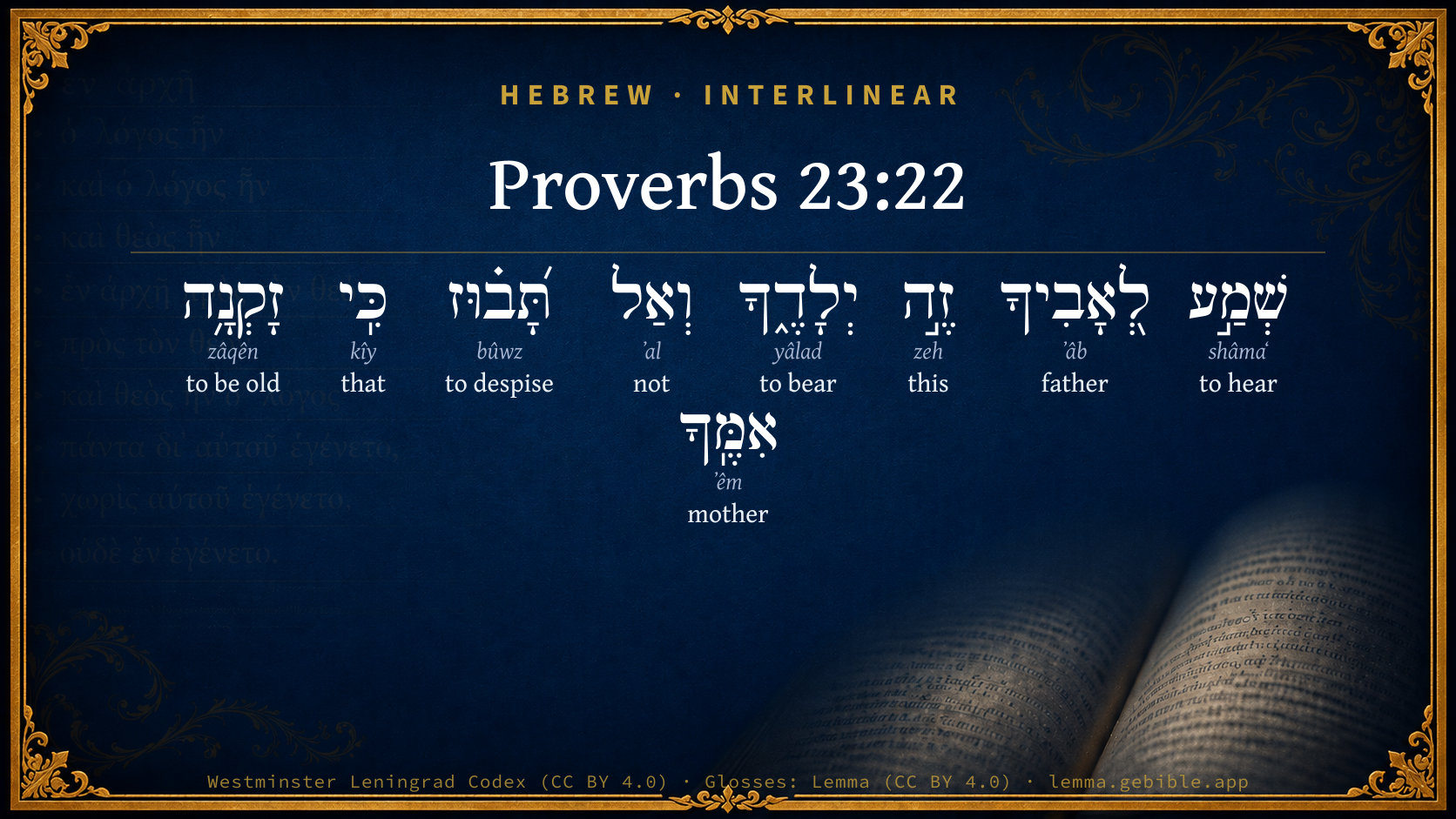
Hebrew (Westminster Leningrad Codex) Proverbs 23:22 appears in the Hebrew Old Testament. The text above is from the Westminster Leningrad Codex. Each word links to its Strong’s number, a concise gloss, and parsing drawn from the Open Scriptures Hebrew Bible morphology. Click any word for its full Brown-Driver-Briggs (BDB) entry.
Download image
Cite this verse

Proverbs 23:22 (World English Bible). Public Domain. Lemma interlinear Bible study tool, https://lemma.gebible.app/v/proverbs/23/22.

Show BibTeX & RIS
BibTeX
RIS
English Translation
Listen to your father who gave you life, And don't despise your mother when she is old.
World English Bible · Public Domain
Download a study sheet

One document with this verse’s original text, its word-by-word gloss line, the meaning frame, cross-references with their text, attributed commentary, and full source and license credits — printable, and it pastes into notes with its structure intact.

This verse Autodidact and up

Study sheet (.html) Plain text (.txt)

A passage Seminary Student

Up to 50 verses in one chapter. A passage sheet keeps up to 6 commentary sources and 12 cross-references per verse, in the order this page ranks them, and says so on the sheet whenever that leaves anything out. Ask for a single verse and you get the Autodidact verse sheet above.

Everything on this page stays free to read, with no account — the sheet is a download of what is already on screen, not access to it.

Want to remove ads? Support Godless Engineer
Compare translations 3

The same verse in 3 English versions, stacked beneath the original-language interlinear above. Click any original word for its lexicon entry.

Each is an independent rendering of the whole verse — the interlinear is not word-aligned to these translations.

Highlighted words mark where these versions differ — a whole-verse word diff, not a word-by-word alignment.

  • World English Bible Public Domain
    Listen to your father who gave you life, And don't despise your mother when she is old.
  • King James Version Public Domain
    Hearken unto thy father that begat thee, and despise not thy mother when she is old.
  • unfoldingWord Literal Text CC BY-SA 4.0
    Listen to your father, this begot you, and do not despise your mother when she old.

unfoldingWord Literal Text — © unfoldingWord, licensed CC BY-SA 4.0. Word-aligned USFM3 via Door43 (git.door43.org/unfoldingWord/en_ult).

Versions to compare (up to 4)

3 of 4 selected

Show all 18 translations

Every available English version of this verse, each an independent rendering of the whole verse.

  • World English Bible Public Domain
    Listen to your father who gave you life, And don't despise your mother when she is old.
  • Berean Standard Bible Public Domain
    Listen to your father who gave you life, and do not despise your mother when she is old.
  • Majority Standard Bible Public Domain
    Listen to your father who gave you life, and do not despise your mother when she is old.
  • King James Version Public Domain
    Hearken unto thy father that begat thee, and despise not thy mother when she is old.
  • American Standard Version (1901) Public Domain
    Hearken unto thy father that begat thee, And despise not thy mother when she is old.
  • Revised Version (1885) Public Domain
    Hearken unto thy father that begat thee, and despise not thy mother when she is old.
  • Geneva Bible (1599) Public Domain
    Obey thy father that hath begotten thee, and despise not thy mother when she is olde.
  • Douay-Rheims (1899) Public Domain
    Hearken to thy father, that beget thee: and despise not thy mother when she is old.
  • Young's Literal Translation Public Domain
    Hearken to thy father, who begat thee, And despise not thy mother when she hath become old.
  • Literal Standard Version CC BY-SA 4.0
    Listen to your father, who begot you, || And do not despise your mother when she has become old.
  • Unlocked Literal Bible CC BY-SA 4.0
    Listen to your father who begot you and do not despise your mother when she is old.
  • unfoldingWord Literal Text CC BY-SA 4.0
    Listen to your father, this begot you, and do not despise your mother when she old.
  • Darby Bible Public Domain
    Hearken unto thy father that begat thee, and despise not thy mother when she is old.
  • World Messianic Bible Public Domain
    Listen to your father who gave you life, and don’t despise your mother when she is old.
  • Webster's Bible Public Domain
    Hearken to thy father that begat thee, and despise not thy mother when she is old.
  • Free Bible Version CC BY-SA 4.0
    Pay attention to your father, and don't disregard your mother when she's old.
  • Bible in Basic English Public Domain
    Give ear to your father whose child you are, and do not keep honour from your mother when she is old.
  • JPS Tanakh (1917) Public Domain
    Hearken unto thy father that begot thee, and despise not thy mother when she is old.

Literal Standard Version (2020), Covenant Press — licensed CC BY-SA 4.0. Text via the HelloAO Bible API (eBible.org). Unlocked Literal Bible (unfoldingWord) — licensed CC BY-SA 4.0. Text via the HelloAO Bible API (eBible.org). unfoldingWord Literal Text — © unfoldingWord, licensed CC BY-SA 4.0. Word-aligned USFM3 via Door43 (git.door43.org/unfoldingWord/en_ult). Free Bible Version, Dr. Jonathan Gallagher — licensed CC BY-SA 4.0. Text via the HelloAO Bible API (eBible.org).

Word by word

More ways to search: Search by grammar → Find every occurrence → Compare this word →

Practice this passage: Drill this verse → Learn its vocabulary →

תָּ֝ב֗וּז
bûwz
H936
“to despise”
Verb, Qal, Jussive, 2nd Person, Masculine, Singular
Part of Speech
Verb
Stem
Qal
Form
Jussive
Person
2nd Person
Gender
Masculine
Number
Singular
Full BDB Definition

Origin: a primitive root

TWOT: 213

to despise, hold in contempt, hold as insignificant - (Qal) to despise, show despite toward
  1. שְׁמַ֣ע shâmaʻ H8085 “hear” Verb, Qal, Imperative, 2nd Person, Masculine, Singular
  2. לְ֭אָבִיךָ ʼâb H1 “to/for · father · your” Preposition + Noun, Common, Masculine, Singular, Construct + Suffix, Personal, 2nd Person, Masculine, Singular
  3. זֶ֣ה zeh H2088 “this” Pronoun, Demonstrative, Masculine, Singular
  4. יְלָדֶ֑ךָ yâlad H3205 “to bear · you” Verb, Qal, Perfect, 3rd Person, Masculine, Singular + Suffix, Personal, 2nd Person, Masculine, Singular
  5. וְאַל ʼal H408 “and · not” Conjunction + Particle, Negative
  6. כִּֽי kîy H3588 “that” Conjunction
  7. זָקְנָ֥ה zâqên H2204 “to be old” Verb, Qal, Perfect, 3rd Person, Feminine, Singular
  8. אִמֶּֽךָ ʼêm H517 “mother · your” Noun, Common, Feminine, Singular, Construct + Suffix, Personal, 2nd Person, Masculine, Singular

About this verse

These counts appear in no published source. They are computed here, from the morphology-tagged text and Lemma’s own curated glosses. What Lemma adds →

9
words
9
distinct lemmas
Wisdom
section

Notable vocabulary

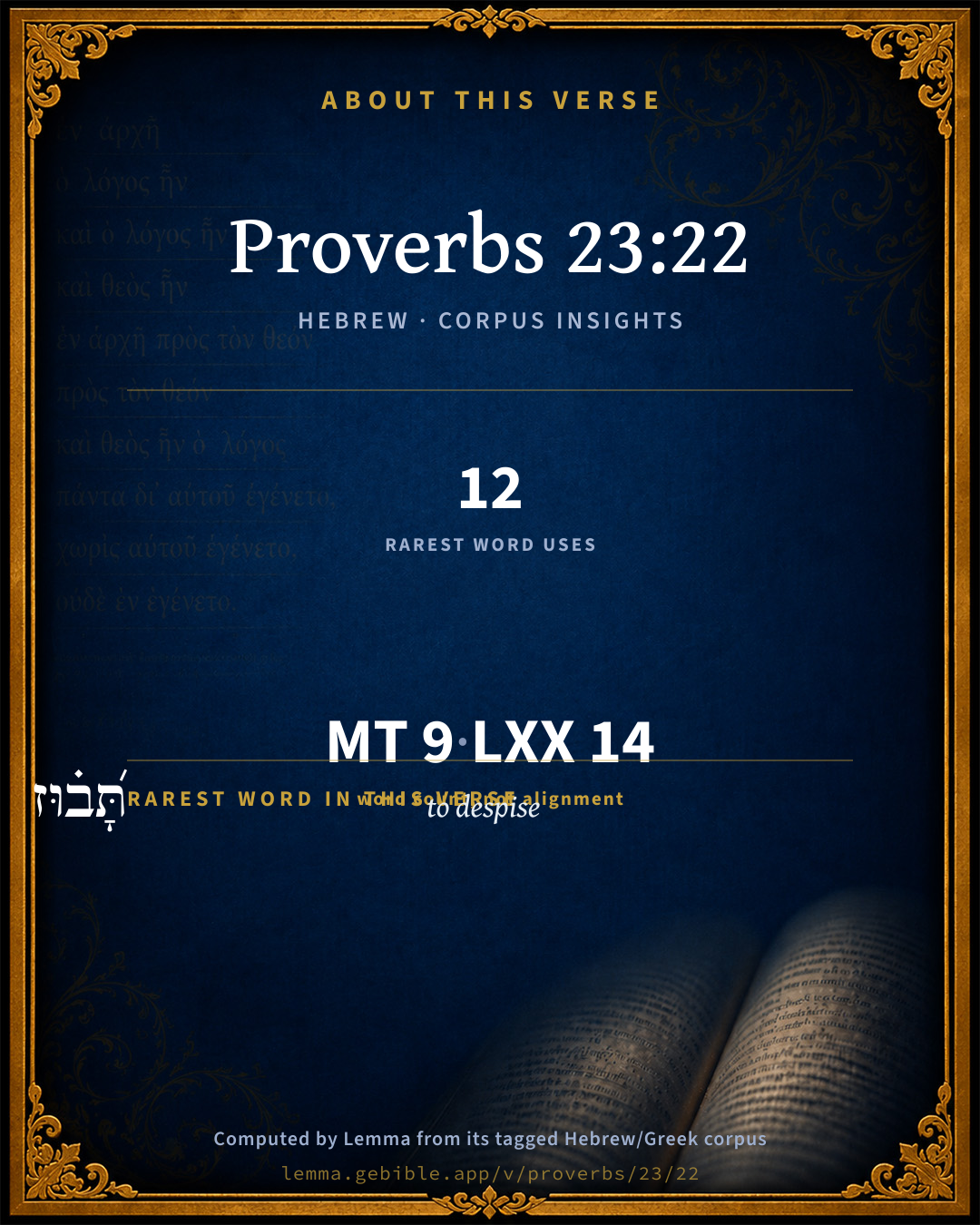
The rarest word here is תָּ֝ב֗וּז to despise H936 — appearing just 12 times in the whole Hebrew Bible.

Shared distinctive vocabulary

תָּ֝ב֗וּז to despise H936 occurs in 11 verses of the Hebrew Bible. Also found in:

Grammatical profile

  • 4 verbs
  • 2 nouns
  • 1 pronoun
  • 1 conjunction
  • 1 particle

Verb forms

  • שְׁמַ֣ע Qal · Imperative
  • יְלָדֶ֑ךָ Qal · Perfect
  • תָּ֝ב֗וּז Qal · Jussive
  • זָקְנָ֥ה Qal · Perfect

Hebrew & Septuagint length

In English translation the verse runs 17 words from the Hebrew and 19 from the Septuagint (LXX English) — closely comparable.

A rough comparison of the two English renderings, which tokenize alike — not a word-level alignment.

Word counts can differ between the Hebrew and the Greek without any difference in meaning — e.g. the Hebrew direct-object marker אֵת has no separate Greek word, and Greek often adds the article ὁ.

In the original languages it is 9 Hebrew tokens and 14 Greek tokens — but the two are counted differently (Hebrew bundles its prefixes and suffixes into one token; the Greek is in lemma form), so that isn’t a like-for-like length.

Cross-references

11

Topical passages linked to Proverbs 23:22 in the Treasury of Scripture Knowledge — connected by theme and wording, ordered by reader-vote popularity; previews shown in the World English Bible.

  • Proverbs 30:17 The eye that mocks at his father, And scorns obedience to his mother: The ravens of the valley shall pick it out, The young eagles shall eat it.
  • Proverbs 1:8 My son, listen to your father's instruction, And don't forsake your mother's teaching:
  • John 19:26–27 Therefore when Jesus saw his mother, and the disciple whom he loved standing there, he said to his mother, "Woman, behold your son!"
  • Proverbs 6:20 My son, keep your father's commandment, And don't forsake your mother's teaching.
  • Ephesians 6:1–2 Children, obey your parents in the Lord, for this is right.
  • Deuteronomy 27:16 Cursed be he who sets light by his father or his mother. All the people shall say, Amen.
  • Leviticus 19:3 "'Each one of you shall respect his mother and his father. You shall keep my Sabbaths. I am Yahweh your God.
  • Deuteronomy 21:18–21 If a man have a stubborn and rebellious son, who will not obey the voice of his father, or the voice of his mother, and, though they chasten him, will not listen to them;
  • Proverbs 30:11 There is a generation that curses their father, And doesn't bless their mother.
  • Matthew 15:4–6 For God commanded, 'Honor your father and your mother,' and, 'He who speaks evil of father or mother, let him be put to death.'
  • Mark 7:10 For Moses said, 'Honor your father and your mother;' and, 'He who speaks evil of father or mother, let him be put to death.'

Cross-references courtesy of OpenBible.info (CC BY 4.0).

Hebrew and Greek witnesses Masoretic Hebrew ↔ Greek Septuagint

The same verse in the two great witnesses to the Old Testament, shown verse-for-verse.

These are two independent witnesses, not word-aligned to each other, and the Septuagint is shown in lemma (dictionary) form.

Hebrew Proverbs 23:22 Masoretic · Westminster Leningrad Codex

שְׁמַ֣ע לְ֭אָבִיךָ זֶ֣ה יְלָדֶ֑ךָ וְאַל תָּ֝ב֗וּז כִּֽי זָקְנָ֥ה אִמֶּֽךָ

Listen to your father who gave you life, And don't despise your mother when she is old.

World English Bible · Public Domain

Greek LXX Proverbs 23:22 Septuagint · lemma form

ἀκούω υἱός πατήρ ὁ γεννάω σύ καί μή καταφρονέω ὅτι γηράσκω σύ ὁ μήτηρ

Listen, my son, to your father which begot you, and despise not your mother because she is grown old.

LXX2012 (modern English Septuagint) · Public Domain

On this verse, Keil & Delitzsch discusses the Septuagint’s reading. Read the note in Commentary ↓

Hebrew: Westminster Leningrad Codex (CC BY 4.0). Greek: Septuagint (public domain); English from LXX2012 (modern English Septuagint) (Public Domain). How the Septuagint differs from the Hebrew →

Commentary

Notes on Proverbs 23:22 from classic Christian and Jewish commentators (each source and its license shown beneath its notes). The classic Christian expositions comment on the surrounding passage and are grouped to its opening verse, so a note may address several verses; the Jewish commentaries on the Tanakh (Rashi and others) are per-verse, so they appear only where the commentator wrote on this verse.

Lemma curates 59 commentaries, every one of them public domain or Creative Commons licensed, each selected and text-cleaned for this edition rather than reprinted as found. About our sources →

Trapp's Complete Commentary

John Trapp

Pro 23:22 Hearken unto thy father that begat thee, and despise not thy mother when she is old.

Ver. 22. Hearken to thy father, &c.] {See Trapp on "Pro 1:8"}

And despise not thy mother when she is old,] Dr Taylor, martyr, said to his son, among other things, when he was to suffer: When thy mother is waxed old, forsake her not, but provide for her to thy power, and see that she lack nothing; for so will God bless thee, and give thee long life upon earth, and prosperity. {a}

{a} Acts and Mon.

John Trapp, A Commentary or Exposition upon All the Books of the Old and New Testament (1647–1656) — public domain. Text from a community e-Sword module.

Joseph Benson's Commentary

Pro 23:22-25. Hearken unto thy father that begat thee — And who, therefore, desires and seeks thy good in all his counsels; and despise not thy mother when she is old — When the infirmity of age is added to that of her sex, which is apt to produce contempt. Buy the truth — Purchase a true and saving knowledge of God, and his will concerning thy salvation, upon any terms; spare no pains nor cost to obtain it; and sell it not — Do not forget it, nor forsake it for any worldly advantages, as unthinking backsliders frequently do; also wisdom and understanding — Whereby thou mayest be enabled to love and practice the truths known and received. The father of the righteous shall greatly rejoice — “For there is no greater joy a parent can have than to see his son take virtuous ways; which, as it is the only wisdom, so it gives both parents and children the highest pleasure and satisfaction.” Thy father and thy mother shall be glad — “Let not thy father and mother then want this singular pleasure; but, by thy well-doing, fill the heart of her that bare thee with joy and triumph; who, for all the pains and care she hath had in thy birth, and about thy education, desires no other requital but only this.” — Bishop Patrick. Thus Solomon twice urges the same consideration, as a powerful argument to prevail with all children, that are not void of natural affection, to labour to be wise and good, that so they may rejoice the hearts of their parents, to whom they are under such high and indelible obligations.

Joseph Benson's Commentary on the Old and New Testaments (1811–1818) — public domain. Text from a community e-Sword module.

Keil & Delitzsch

C. F. Keil & F. Delitzsch

The parainesis begins anew, and the division is open to question. Pro 23:22-24 can of themselves be independent distichs; but this is not the case with Pro 23:25, which, in the resumption of the address and in expression, leans back on Pro 23:22. The author of this appendix may have met with Pro 23:23 and Pro 23:24 (although here also his style, as conformed to that of Pro 1:9, is noticeable, cf. 23b with Pro 1:2), but Pro 23:22 and Pro 23:25 are the form which he has given to them.

Thus Pro 23:22-25 are a whole: -

22 Hearken to thy father, to him who hath begotten thee,

And despise not thy mother when she has grown old.

23 Buy the truth, and sell it not,

Wisdom and discipline and understanding.

24 The father of a righteous man rejoiceth greatly;

(And) he that is the father of a wise man - he will rejoice.

25 Let thy father and thy mother be glad;

And her that bare thee exult.

The octastich begins with a call to childlike obedience, for שׁמע ל, to listen to any one, is equivalent to, to obey him, e.g., Psa 81:9, Psa 81:14 (cf. "hearken to his voice," Psa 95:7). זה ילדך is a relative clause (cf. Deu 32:18, without זה or אשׁר), according to which it is rightly accentuated (cf. on the contrary, Psa 78:54). 22b, strictly taken, is not to be translated neve contemne cum senuerit matrem tuam (Fleischer), but cum senuerit mater tua, for the logical object to אל־תּבוּז is attracted as subj. of זקנה (Hitzig). There now follows the exhortation comprehending all, and formed after Pro 4:7, to buy wisdom, i.e., to shun no expense, no effort, no privation, in order to attain to the possession of wisdom; and not to sell it, i.e., not to place it over against any earthly possession, worldly gain, sensual enjoyment; not to let it be taken away by any intimidation, argued away by false reasoning, or prevailed against by enticements into the way of vice, and not to become unfaithful to it by swimming with the great stream (Exo 23:2); for truth, אמת, is that which endures and proves itself in all spheres, the moral as well as the intellectual. In 23b, in like manner as Pro 1:3; Pro 22:4, a threefold object is given to קנה instead of אמת: there are three properties which are peculiar to truth, the three powers which handle it: חכמה is knowledge solid, pressing into the essence of things; מוּסר is moral culture; and בּינה the central faculty of proving and distinguishing (vid., Pro 1:3-5). Now Pro 23:24 says what consequences are for the parents when the son, according to the exhortation of Pro 23:23, makes truth his aim, to which all is subordinated. Because in אמת the ideas of practical and theoretical truth are inter-connected. צדּיק and חכם are also here parallel to one another. The Chethı̂b of 24a is גּול יגוּל, which Schultens finds tenable in view of (Arab.) jal, fut jajûlu (to turn round; Heb. to turn oneself for joy) but the Heb. usus loq. knows elsewhere only גּיל יגיל, as the Kerı̂ corrects. The lxx, misled by the Chethı̂b, translates καλῶς ἐκτρέφει (incorrect ἐκτρυφήσει), i.e., גּדּל יגדּל. In 24b, וישׂמח is of the nature of a pred. of the conclusion (cf. Gen 22:24; Psa 115:7), as if the sentence were: has one begotten a wise man, then (cf. Pro 17:21) he has joy of him; but the Kerı̂ effaces this Vav apodosis, and assigns it to יולד as Vav copul. - an unnecessary mingling of the syntactically possible, more emphatic expression. This proverbial whole now rounds itself off in Pro 23:25 by a reference to Pro 23:22 - the Optative here corresponding to the Impr. and Prohib. there: let thy father and thy mother rejoice (lxx εὐφρανέσθω), and let her that bare thee exult (here where it is possible the Optat. form ותגל).

Keil & Delitzsch — Biblical Commentary on the Old Testament (1861–1891) — public domain (CC PDM 1.0). Text via the HelloAO Bible API. (Old Testament only.)

Tyndale Open Study Notes

Tyndale Open Resources

23:22-25 Saying 16: This saying is an exhortation to pursue the wisdom that a godly father and mother provide. Unlike other ancient Near East wisdom texts, Proverbs attributes wisdom to both father and mother (1:8; 6:20).

Tyndale Open Study Notes — © Tyndale Open Resources, licensed CC BY-SA 4.0. Text via the HelloAO Bible API.

Jamieson, Fausset & Brown

Robert Jamieson, A. R. Fausset & David Brown

Hearken--that is, obey (Pro 1:8; Eph 6:1).

despise . . . old--Adults revere the parents whom, as children, they once obeyed.

Jamieson, Fausset & Brown — Commentary Critical and Explanatory on the Whole Bible (1871) — public domain (CC PDM 1.0). Text via the HelloAO Bible API.

Adam Clarke's Commentary

Verse 22. Despise not thy mother when she is old.] A very necessary caution, as very old women are generally helpless, useless, and burdensome: yet these circumstances do not at all lessen the child's duty. And this duty is strengthened by the Divine command here given.

Adam Clarke's Commentary on the Bible (1810–1826) — public domain. Text from a community e-Sword/MySword module.

John Gill's Exposition

Hearken unto thy father that begat thee,.... And who has a true and hearty affection for thee, and whatever he says is for thy good and welfare, which he studies and has at heart; and who therefore also has an authority over thee, and what he enjoins ought to be strictly regarded; and, having lived longer in the world, must be thought to have a larger experience and knowledge of things, and therefore should be hearkened unto;

and despise not thy mother when she is old; despise not her counsels, instructions, and advice, though she is old; and because she is so, do not reject them as old wives' fables, or as the silly talk of an old woman, as young men are too apt to do.

John Gill's Exposition of the Whole Bible (1746–1763) — public domain (CC PDM 1.0). Text via the HelloAO Bible API.

Matthew Poole's English Annotations

That begat thee; and therefore desires and seeks thy good in all his counsels.

When she is old; when the infirmity of age is added to that of her sex, which is apt to breed contempt.

Matthew Poole's English Annotations on the Holy Bible (1683–1685) — public domain. Text from a community e-Sword/MySword module.

Whedon's Commentary on the Bible

Daniel D. Whedon

22. Despise not thy mother — A negative for a positive precept — pay to thine aged mother all due deference and respect.

When… old — Some read, because she is old. Let not the infirmities of age lessen thy esteem for her.

Daniel D. Whedon (gen. ed.), Commentary on the Old and New Testaments (1874–1909) — public domain. Text from a community e-Sword module.

The Pulpit Commentary

Vers. 22-25. An octastich, containing an earnest exhortation to the disciple.

That begat thee. This is a claim on the attention and obedience of the son. When she is old. When old age with its consequent infirmities comes upon thy mother, despise her not, but rather thank God for giving her long life, and profit by her love and long experience (comp. Ecc_3:1, etc., where the exhortation to honour parents is very full and touching).

The mighty Redeemer.

I THE HELPLESS NEED A MIGHTY REDEEMER. In simple, rough times some provision had to be made to protect the weak from the overbearing insolence and tyranny of the strong. When the arm of the law was not capable of maintaining justice, private friends were required and authorized to take up the cause of the wronged. The goel, or avenger, was then needed to stand up for his helpless kinsfolk. But there were extreme cases in which no such assistance could bring deliverance, either because no relative was living who could undertake the task, or because the distress was so desperate that no human hand could relieve it. This might happen with heartbroken widows robbed of husband, children, and land, and left penniless and friendless. But even such cases of the utmost distress are not so desperate as that of the soul in its sin and wretchedness, utterly and hopelessly undone unless some mighty hand of redemption is stretched out to save it.

II GOD IS A MIGHTY REDEEMER. Two essential conditions were required in the redeemer. He must have a right to interfere, and he must have power to succeed. God has both.

1. The right. The right of the old Hebrew redeemer was blood relationship. The nearest kinsman was called to act as goel. God is nearly related to man. He is the Father of all. The friendless poor have One left who regards them as of his family. Christ came as a brother man to be the Redeemer of the human race.

2. The power.

(1) God has power as the Almighty. He can overthrow the greatest. If the poor man has God on his side, he need not fear the most imperious tyranny; it is as child"s play before the majesty of heaven.

(2) Christ has power as the crucified Saviour. The great redemption from man"s worst enemy, sin, is won by the cross of Christ. Now he is able to save unto the uttermost.

III GOD"S MIGHTY REDEMPTION IS AVAILABLE. He is not only a mighty Redeemer; he is willing to help, and he does afford succour.

1. He acts in justice. "Shall not the Judge of all the earth do right?". (Gen_18:25) At present we witness cruel injustice. The poor are oppressed by the strong. Hard toiling men, women, and children in manufacturing centres are ground into penury by the fierce mill of competition, while ruthless "middle men" fatten on their ill-paid labour. The few in prosperity revel in luxury that they wring out of the many in penury. God will not permit such cruel wrongs to last forever. The Redeemer is an Avenger. The blood of the victims of those who make haste to be rich at the expense of their starving brethren cries out to heaven for vengeance. It will not always cry in vain.

(1) Meanwhile, seeing that the Redeemer of the poor is mighty, it would be well for the reckless oppressors to repent before the sword of judgment is unsheathed.

(2) They who are working at the apparently hopeless task of helping the poor and oppressed have a great encouragement. God, the mighty Avenger, is on their side.

2. He acts in mercy. He pities the suffering poor. They are his children, and he will not forget their needs. Love is the inspiration of Divine redemption.

This is the secret of Christ"s great redemption of sinners. Justice is ultimately satisfied here; but the first motive is mercy, for the helpless are also the ill-deserving. Yet even their Redeemer is mighty.

The Pulpit Commentary (1880–1919), ed. H.D.M. Spence-Jones & Joseph S. Exell — public domain. Text from a community e-Sword module.

Bridges on Proverbs

Charles Bridges

"We have had fathers of our flesh, and we gave them reverence." (Heb 12:9 .) Such is the rule of nature. Such is the law of God.†1 The wise man here enforces its special application to an aged parent — thy mother when she is old. Then surely love and reverence are doubly due. ’A thing comely and pleasant to see’ — says Bishop Hall — ’and worthy of honor from the beholder, is a child understanding the eye of his parent.’†2 More lovely still is this filial exercise, when the age of the child has naturally loosened the restraints of authority. Respect is then the effect of principle and gratitude. The child no more feels at liberty to despise his parent’s wishes, than if he were subject to their early discipline. The Scripture examples are beautiful patterns for our imitation. Isaac with Abraham;†3 Jacob with both his parents;†4 Joseph’s deference to his aged father, and desiring his blessing on his own children;†5 Moses with his father-in-law;†6 Ruth with her mother-in-law;†7 Solomon in the grandeur of royalty paying respect to his mother;†8 the Rechabites hearkening to their deceased father’s command;†9 and — above all the rest — the Savior’s tender care for his mother in his own dying agonies.†10

The contrary conduct is marked with the most awful reprobation.†11 It forms a part of the dark mass of heathen depravity,†12 and one of the signs of the "perilous times in the last days." (2Ti 3:1-2 .) The spectacle will ever bring a blot upon the child’s name and character. (Pro 19:26 .)

But is not this trial of neglect the Lord’s chastening of foolish fondness of our children when young, of our unwise treatment, or inconsistent conduct? Sinful indulgence will always in the end make us despised in their eyes, and lay our authority in the dust for them to trample under foot. Christian dignity and consistency, on the other hand, command respect, even where they fail of producing the full practical results. (Pro 31:28 .) Oh! what need have we of Divine grace and wisdom, honorably to maintain parental responsibility!

Footnotes:

†1 Exo 20:12. Lev 19:3 . Eph 6:1-2 . Compare Pro 1:8 ; Pro 6:20 .

†2 Holy Observations, v.

†3 Gen 22:9.

†4 Gen 28:1-5.

†5 Gen 48:9-14.

†6 Exo 18:13-24.

†7 Rth 2:22-23.

†8 1Ki 2:19 .

†9 Jer 35:6.

†10 Joh 19:26-27. Dr. Taylor’s ’godly exhortations to his son,’ as Foxe writes in his exquisite Biography, ’is worthy of all youth to be marked’ - ’When thy mother is waxed old, forsake her not; but provide for her to thy power, and see that she lack nothing; for so will God bless thee, give thee long life upon earth, and prosperity, which I pray God to grant thee.’ Vol. vi. 692. Compare Sir 3:8-14 .

†11 Pro 20:20; Pro 30:17 . Deu 21:18-21 ; Deu 27:16 . Isa 3:5 .

†12 Rom 1:30.

Charles Bridges, An Exposition of the Book of Proverbs (1846) — public domain. Text from a community e-Sword module.

Kretzmann's Popular Commentary

Paul E. Kretzmann

v. 22. Hearken unto thy father that begat thee, in ready obedience to all his commands, and despise not thy mother when she is old, it being the tendency of young people to be ashamed of their aged parents and no longer to heed their counsel.

Paul E. Kretzmann, Popular Commentary of the Bible (1921–1924) — public domain. Text from a community e-Sword module.

unfoldingWord translationNotes

Door43 World Missions Community

General Information:

These verses continue the "thirty sayings" (Proverbs 22:20).

do not despise

This can be stated positively. AT: "show respect for" (See: Litotes)

Buy the truth, but do not sell it; buy wisdom, instruction, and understanding

Another possible meaning is "Buy the truth, and do not sell wisdom, instruction, or understanding." The words "truth," "wisdom," "instruction," and "understanding" are abstract nouns that are spoken of as if they were physical items that a person can buy and sell in a market. They can be translated as verbs. AT: "Do what you need to do so you can know what is true, so you can be wise, so you can learn how to act, and so you can tell good from bad; never think of anything else as more important than these things" (See: Abstract Nouns and Metaphor)

translationWords

true

wise

unfoldingWord translationNotes — © Distant Shores Media and the Door43 World Missions Community, licensed CC BY-SA 4.0. Source: git.door43.org/Door43/en_tn.

Lesson kit

Teaching starters — assembled from the data on this page, not authored interpretation. Every prompt links to the verse data it draws on. Edit before teaching.

Proverbs, in the Wisdom, opens this verse with 9 words (9 distinct Hebrew lemmas). Its most distinctive word is bûwz (“to despise”). A historical commentator’s framing appears above. Read the whole chapter for the surrounding context.

Discussion questions

  1. What does “to despise” (bûwz) contribute to the verse as a whole?
  2. Proverbs 1:7 shares the word «to despise» with this verse. How do the two illuminate each other?
  3. The translations on this page render this verse differently — a whole-verse word diff, not a word-by-word alignment. What might account for the different wordings?
  4. The verb «שְׁמַ֣ע» is Qal Imperative. How does its form color the action?
  5. Reading how Trapp's Complete Commentary and Joseph Benson's Commentary read this verse, where do the two commentators agree and where do they part?

Things to notice

Reading settings

Reading text

Shown beneath each verse's original-language words.

Old Testament
Old Testament edition

Read the OT as the Masoretic Hebrew (MT) or the Greek Septuagint (LXX).

English shown for the Greek Septuagint (in the Hebrew ↔ Greek comparison).

Comparing translations? Open the Compare panel on any verse page to stack up to four side by side.