
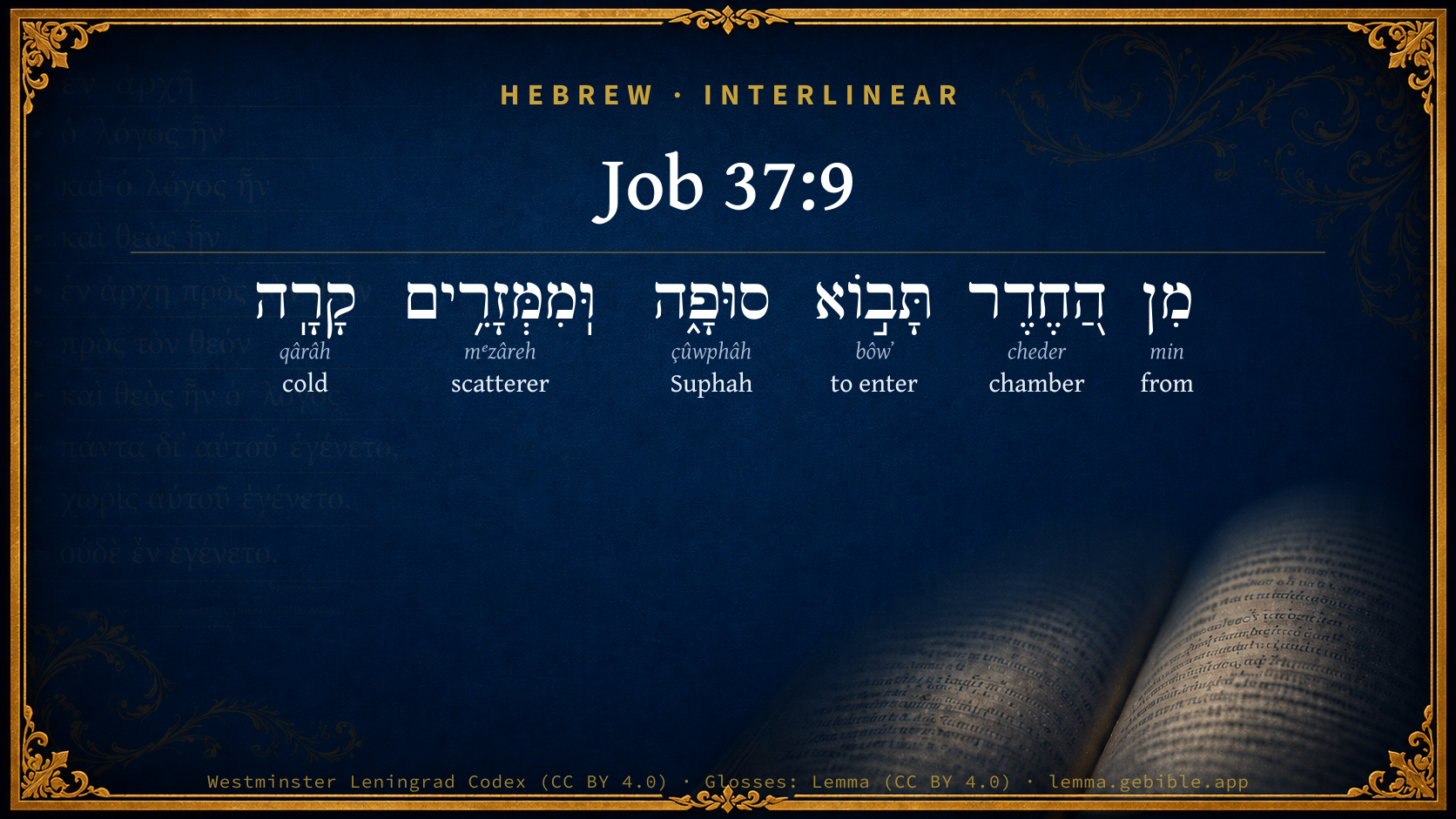
Job 37:9

Hebrew (Westminster Leningrad Codex) Job 37:9 appears in the Hebrew Old Testament. The text above is from the Westminster Leningrad Codex. Each word links to its Strong’s number, a concise gloss, and parsing drawn from the Open Scriptures Hebrew Bible morphology. Click any word for its full Brown-Driver-Briggs (BDB) entry.
Download image
Cite this verse

Job 37:9 (World English Bible). Public Domain. Lemma interlinear Bible study tool, https://lemma.gebible.app/v/job/37/9.

Show BibTeX & RIS
BibTeX
RIS
English Translation
Out of its chamber comes the storm, And cold out of the north.
World English Bible · Public Domain
Highlights
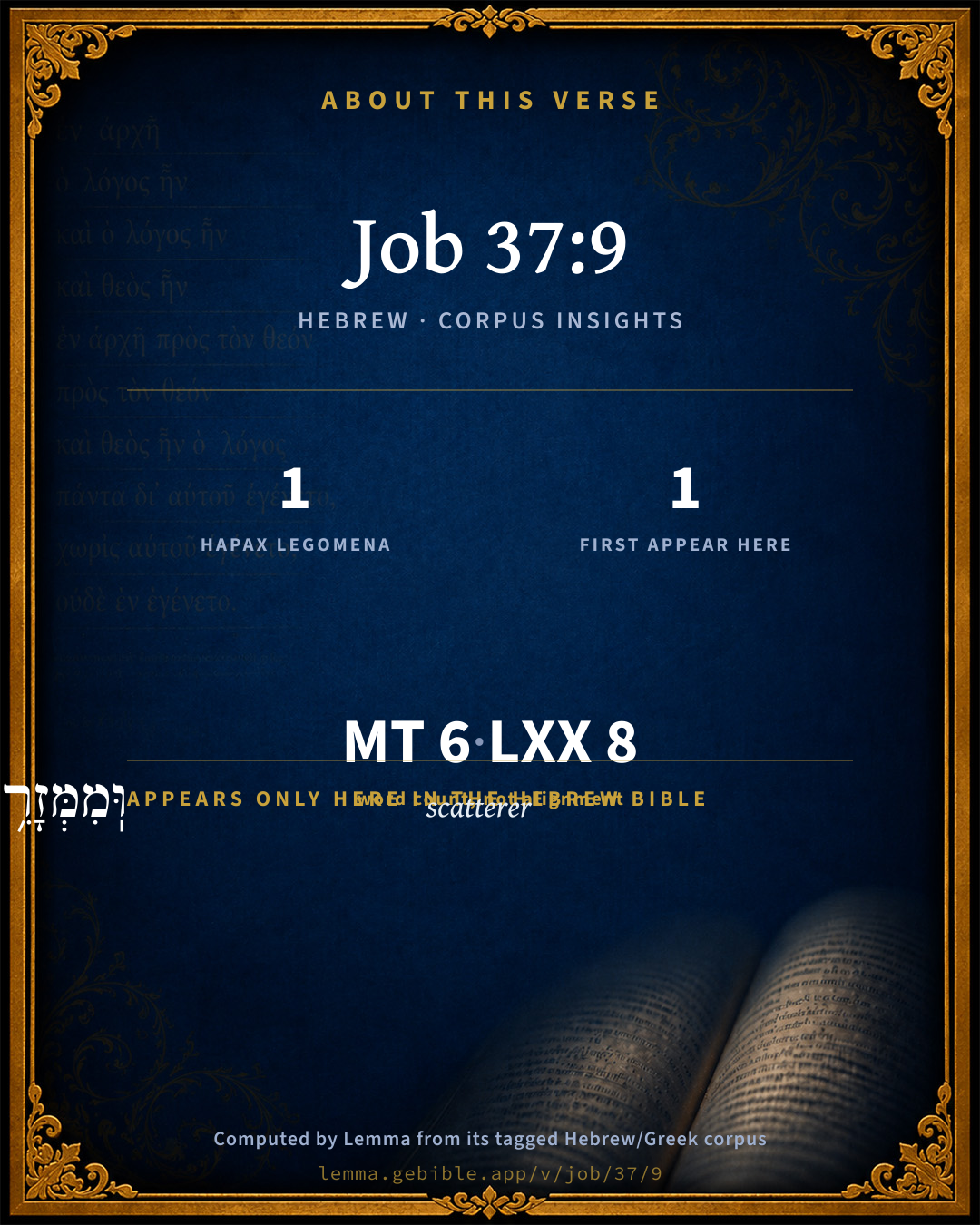
  • 1 hapax legomenon — only here in the Hebrew Bible
  • 1 first appearance in the Hebrew Bible
Full analysis ↓
Download a study sheet

One document with this verse’s original text, its word-by-word gloss line, the meaning frame, cross-references with their text, attributed commentary, and full source and license credits — printable, and it pastes into notes with its structure intact.

This verse Autodidact and up

Study sheet (.html) Plain text (.txt)

A passage Seminary Student

Up to 50 verses in one chapter. A passage sheet keeps up to 6 commentary sources and 12 cross-references per verse, in the order this page ranks them, and says so on the sheet whenever that leaves anything out. Ask for a single verse and you get the Autodidact verse sheet above.

Everything on this page stays free to read, with no account — the sheet is a download of what is already on screen, not access to it.

Want to remove ads? Support Godless Engineer
Compare translations 3

The same verse in 3 English versions, stacked beneath the original-language interlinear above. Click any original word for its lexicon entry.

Each is an independent rendering of the whole verse — the interlinear is not word-aligned to these translations.

Highlighted words mark where these versions differ — a whole-verse word diff, not a word-by-word alignment.

  • World English Bible Public Domain
    Out of its chamber comes the storm, And cold out of the north.
  • King James Version Public Domain
    Out of the south cometh the whirlwind: and cold out of the north.
  • unfoldingWord Literal Text CC BY-SA 4.0
    The storm comes from the chamber, and the cold from the north winds.

unfoldingWord Literal Text — © unfoldingWord, licensed CC BY-SA 4.0. Word-aligned USFM3 via Door43 (git.door43.org/unfoldingWord/en_ult).

Versions to compare (up to 4)

3 of 4 selected

Show all 18 translations

Every available English version of this verse, each an independent rendering of the whole verse.

  • World English Bible Public Domain
    Out of its chamber comes the storm, And cold out of the north.
  • Berean Standard Bible Public Domain
    The tempest comes from its chamber, and the cold from the driving north winds.
  • Majority Standard Bible Public Domain
    The tempest comes from its chamber, and the cold from the driving north winds.
  • King James Version Public Domain
    Out of the south cometh the whirlwind: and cold out of the north.
  • American Standard Version (1901) Public Domain
    Out of the chamber `of the south' cometh the storm, And cold out of the north.
  • Revised Version (1885) Public Domain
    Out of the chamber of the south cometh the storm: and cold out of the north.
  • Geneva Bible (1599) Public Domain
    The whirlewind commeth out of the South, and the colde from the North winde.
  • Douay-Rheims (1899) Public Domain
    Out of the inner parts shall a tempest come, and cold out of the north.
  • Young's Literal Translation Public Domain
    From the inner chamber cometh a hurricane, And from scatterings winds -- cold,
  • Literal Standard Version CC BY-SA 4.0
    From the inner chamber comes a windstorm, || And from scatterings winds—cold,
  • Unlocked Literal Bible CC BY-SA 4.0
    The storm comes from its chamber in the south and the cold from the scattering winds in the north.
  • unfoldingWord Literal Text CC BY-SA 4.0
    The storm comes from the chamber, and the cold from the north winds.
  • Darby Bible Public Domain
    From the chamber [of the south] cometh the whirlwind; and cold from the winds of the north.
  • World Messianic Bible Public Domain
    Out of its room comes the storm, and cold out of the north.
  • Webster's Bible Public Domain
    From the south cometh the whirlwind: and cold from the north.
  • Free Bible Version CC BY-SA 4.0
    The south wind blows in storms, while the north wind blows in cold weather.
  • Bible in Basic English Public Domain
    Out of its place comes the storm-wind, and the cold out of its store-houses.
  • JPS Tanakh (1917) Public Domain
    Out of the Chamber cometh the storm; and cold out of the north.

Literal Standard Version (2020), Covenant Press — licensed CC BY-SA 4.0. Text via the HelloAO Bible API (eBible.org). Unlocked Literal Bible (unfoldingWord) — licensed CC BY-SA 4.0. Text via the HelloAO Bible API (eBible.org). unfoldingWord Literal Text — © unfoldingWord, licensed CC BY-SA 4.0. Word-aligned USFM3 via Door43 (git.door43.org/unfoldingWord/en_ult). Free Bible Version, Dr. Jonathan Gallagher — licensed CC BY-SA 4.0. Text via the HelloAO Bible API (eBible.org).

Word by word

More ways to search: Search by grammar → Find every occurrence → Compare this word →

Practice this passage: Drill this verse → Learn its vocabulary →

About this verse

These counts appear in no published source. They are computed here, from the morphology-tagged text and Lemma’s own curated glosses. What Lemma adds →

6
words
6
distinct lemmas
Wisdom
section

Notable vocabulary

1 hapax legomenon — a word that appears only here in the entire Hebrew Bible:

  • וּֽמִמְּזָרִ֥ים scatterer H4215

First appearance in Scripture

This word makes its first canonical appearance in the Hebrew Bible here:

  • וּֽמִמְּזָרִ֥ים scatterer H4215

Shared distinctive vocabulary

קָרָֽה cold H7135 occurs in 5 verses of the Hebrew Bible. Also found in:

Grammatical profile

  • 1 verb
  • 4 nouns
  • 1 preposition

Verb forms

  • תָּב֣וֹא Qal · Imperfect

Hebrew & Septuagint length

In English translation the verse runs 13 words from the Hebrew and 13 from the Septuagint (LXX English) — the same length.

A rough comparison of the two English renderings, which tokenize alike — not a word-level alignment.

Word counts can differ between the Hebrew and the Greek without any difference in meaning — e.g. the Hebrew direct-object marker אֵת has no separate Greek word, and Greek often adds the article ὁ.

In the original languages it is 6 Hebrew tokens and 8 Greek tokens — but the two are counted differently (Hebrew bundles its prefixes and suffixes into one token; the Greek is in lemma form), so that isn’t a like-for-like length.

Cross-references

5

Topical passages linked to Job 37:9 in the Treasury of Scripture Knowledge — connected by theme and wording, ordered by reader-vote popularity; previews shown in the World English Bible.

  • Job 9:9 Who makes the Bear, Orion, and the Pleiades, And the chambers of the south;
  • Psalms 104:3 He lays the beams of his chambers in the waters. He makes the clouds his chariot. He walks on the wings of the wind.
  • Isaiah 21:1 The burden of the wilderness of the sea. As whirlwinds in the South sweep through, it comes from the wilderness, from an awesome land.
  • Job 38:1 Then Yahweh answered Job out of the whirlwind,
  • Zechariah 9:14 Yahweh will be seen over them; And his arrow will go flash like lightning; And the Lord Yahweh will blow the trumpet, And will go with whirlwinds of the south.

Cross-references courtesy of OpenBible.info (CC BY 4.0).

Hebrew and Greek witnesses Masoretic Hebrew ↔ Greek Septuagint

The same verse in the two great witnesses to the Old Testament, shown verse-for-verse.

These are two independent witnesses, not word-aligned to each other, and the Septuagint is shown in lemma (dictionary) form.

Hebrew Job 37:9 Masoretic · Westminster Leningrad Codex

מִן הַ֭חֶדֶר תָּב֣וֹא סוּפָ֑ה וּֽמִמְּזָרִ֥ים קָרָֽה

Out of its chamber comes the storm, And cold out of the north.

World English Bible · Public Domain

Greek LXX Job 37:9 Septuagint · lemma form

ἐκ ταμιεῖον ἐπιἔρχομαι δίνη ἀπό δέ ἀκρωτήριον ψῦχος

Troubles come on out of the secret chambers, and cold from the mountain-tops.

LXX2012 (modern English Septuagint) · Public Domain

On this verse, Joseph Benson's Commentary discusses the Septuagint’s reading. Read the note in Commentary ↓

Hebrew: Westminster Leningrad Codex (CC BY 4.0). Greek: Septuagint (public domain); English from LXX2012 (modern English Septuagint) (Public Domain). How the Septuagint differs from the Hebrew →

Commentary

Notes on Job 37:9 from classic Christian and Jewish commentators (each source and its license shown beneath its notes). The classic Christian expositions comment on the surrounding passage and are grouped to its opening verse, so a note may address several verses; the Jewish commentaries on the Tanakh (Rashi and others) are per-verse, so they appear only where the commentator wrote on this verse.

Lemma curates 59 commentaries, every one of them public domain or Creative Commons licensed, each selected and text-cleaned for this edition rather than reprinted as found. About our sources →

Trapp's Complete Commentary

John Trapp

Job 37:9 Out of the south cometh the whirlwind: and cold out of the north.

Ver. 9. Out of the south cometh the whirlwind] Which is a wonderful wind indeed; τυφων the Greeks call it (as they do a like wind at sea ευροκλυδων, the mariner’s mischief), the Latins, vortex, because it turns up trees by the roots, houses by the foundation, Job 1:19, and turbo, as breeding great trouble; for which cause also Pope Urban was called Turban. It suddenly ariseth and as suddenly ceaseth, but doth much mischief, and especially in strait and narrow places. In allusion whereunto the apostle would not have people to be wherried and whirled about with every wind of doctrine, Eph 4:14, as unstable souls use to be. Illebius, for instance; who, as a Protestant, first turned Antinomian, and afterwards a Papist. So the old Illuminati, boasting at first of a certain angelic purity, fell suddenly to the very counterpoint of justifying beastiality (Spec. Europ.). For prevention of this pernicious lightness, "It is good" (saith the apostle) "that the heart be established with grace," Heb 13:9. That men be sound in the faith, well principled, bottomed and ballasted.

And cold out of the north] Heb. out of the scattered winds. North winds scatter the clouds, clear the sky, and so bring on fair cold weather, Kαι Bορεης αιθρηγενετης (Hom. Odyss.). By mezerim here some understand certain stars toward the north pole; Arcturus, the Vulgate Latin rendereth it.

John Trapp, A Commentary or Exposition upon All the Books of the Old and New Testament (1647–1656) — public domain. Text from a community e-Sword module.

Joseph Benson's Commentary

Job 37:9-10. Out of the south — Hebrew, מן החרד, min ha-chered: εκ ταμειων: de promptuariis, out of the store-houses, LXX.; ab interioribus, from the inner chambers, Vulgate Latin. The same with the chambers of the south, Job 9:9. Or the southern part of the world, so called, because in a great part it was unknown to those of the northern hemisphere, in which Job and his friends lived. Cometh the whirlwind — Violent and stormy winds; which, in those parts, most frequently came out of the south, whence they are called whirlwinds of the south, Zec 9:14; Isa 21:1. And cold out of the north — That is, cold and freezing winds, which generally come from that quarter. “From one quarter of the heavens blow turbulent winds; and, from the opposite quarter, those cold blasts, which clear and purify the air again.” By the breath of God frost is given, &c. — “By the like sharp blasts God sends the frost; and binds up the waters so fast that they cannot flow.” — Bishop Patrick. Or, as the latter clause, ורחב מים במוצק, verechab maim be-mutzak, may be rendered, He swelleth the waters by the thaw.

Joseph Benson's Commentary on the Old and New Testaments (1811–1818) — public domain. Text from a community e-Sword module.

Geneva Bible (1599)

Geneva Bible translators

In Hebrew it is called the scattering wind, because it driveth away the clouds and purgeth the air.

Geneva Bible (1599) marginal notes — public domain. Text via Bolls.life.

Jamieson, Fausset & Brown

Robert Jamieson, A. R. Fausset & David Brown

south--literally, "chambers"; connected with the south (Job 9:9). The whirlwinds are poetically regarded as pent up by God in His southern chambers, whence He sends them forth (so Job 38:22; Psa 135:7). As to the southern whirlwinds (see Isa 21:1; Zac 9:14), they drive before them burning sands; chiefly from February to May.

the north--literally, "scattering"; the north wind scatters the clouds.

Jamieson, Fausset & Brown — Commentary Critical and Explanatory on the Whole Bible (1871) — public domain (CC PDM 1.0). Text via the HelloAO Bible API.

Adam Clarke's Commentary

Verse 9. Out of the south cometh the whirlwind] See Clarke on Job 9:9. What is rendered south here, is there rendered chambers. Mr. Good translates here, the utmost zone. The Chaldee: - "From the supreme chamber the commotion shall come; and from the cataracts of Arcturus the cold." What the whirlwind, סופה suphah, is, we know not. It might have been a wind peculiar to that district; and it is very possible that it was a scorching wind, something like the simoom.

Adam Clarke's Commentary on the Bible (1810–1826) — public domain. Text from a community e-Sword/MySword module.

Ellicott's Commentary for English Readers

(9) Out of the south.—Rather, out of its chamber (see Job_9:9) cometh the whirlwind, or typhoon: and cold from the northern constellations, from the quarter of the heavens where they shine.

A Bible Commentary for English Readers, edited by Charles John Ellicott (1878–1897) — public domain. Text from a community e-Sword module.

The Cambridge Bible for Schools and Colleges

gen. ed. J. J. S. Perowne

9. The rendering of this verse in the A.V. is free and in some measure conjectural.

the south] lit. the chamber. In ch. Job_9:9 reference was made to the “chambers of the south,” and it has been assumed that the same is the meaning here. There is no reason, however, why the southern heavens should be called “chamber” more than any other quarter of the sky; and the passage appears to refer to the season of winter, while the south wind brings heat, Job_37:17. The term “chamber” is most probably used in the sense of “treasury” (ch. Job_38:22), as Psa_135:7, “He bringeth the wind out of his treasuries.” The meaning probably is, out of its (or, his) chamber cometh the whirlwind.

the north] The word is of uncertain meaning. It may signify, the scattering (winds), that is, possibly the north winds that scatter the clouds and bring frost.

9–10. Frost and ice.

The Cambridge Bible for Schools and Colleges (gen. ed. J. J. S. Perowne; Cambridge University Press, 1878–1918) — public domain. Text from a community e-Sword module.

John Gill's Exposition

Out of the south cometh the whirlwind,.... Or "from the chamber" (n); from the chamber of the cloud, as Ben Gersom, from the inside of it; or from the treasury of God, who bringeth the wind out of his treasures; alluding to chambers where treasures are kept; or from the heavens, shut up and veiled around with clouds like a pavilion: but because we read of the chambers of the south, Job 9:9; and the southern pole was like a secret chamber, shut up, unseen, and unknown very much to the ancients; hence we render it, and others interpret it, of the south; from whence in these countries came whirlwinds. Hence we read of the whirlwinds of the south, Isa 21:1;

and cold out of the north; cold freezing winds from thence; or "from the scatterers" (o): Aben Ezra interprets them of stars, the same with the "Mazzaroth", Job 38:32; stars scattered about the Arctic or northern pole, as some: or rather the northern winds are designed which scatter the clouds, drive away rain, Pro 25:23; and bring fair weather, Job 37:22. Wherefore Mr. Broughton renders the word,

"fair weather winds;''

and, in a marginal note,

"the scatterers of clouds (p).''

(n) "de penetali", Montanus; so Junius and Tremellius, Piscator, Cocceius, Schultens. (o) "a dispergentibus", Montanus, Vatablus, Junius & Tremellius, Piscator; "a sparsoribus", Schultens. (p) So David de Pomis, Lexic. fol. 7. 3.

John Gill's Exposition of the Whole Bible (1746–1763) — public domain (CC PDM 1.0). Text via the HelloAO Bible API.

Albert Barnes' Notes on the Bible

Out of the south - Margin, “chamber.” Jerome, “ab interioribus - from the interior,” or “inner places.” Septuagint, ἐκ ταυείων ek taueiōn - “from their chambers issue sorrows” - ὀωύνας othunas. The Hebrew word used here (חדר cheder) denotes properly “an apartment,” or “chamber,” especially an inner apartment, or a chamber in the interior of a house or tent: Gen 43:30; Jdg 16:9, Jdg 16:12. Hence, it means a bed-chamber, 2Sa 4:7, or a female apartment or harem, Son 1:4; Son 3:4. In Job 9:9, it is connected with the “south” - “the chambers of the south” (see the notes at that place), and means some remote, hidden regions in that quarter. There can be little doubt that the word “south “is here also to be understood, as it stands in contrast with a word which properly denotes the north. Still there may have been reference to a supposed opinion that whirlwinds had their origin in deep, hollow caves, and that they were owing to the winds which were supposed to be pent up there, and which raged tumultuously until they broke open the doors of their prison, and then poured forth with violence over the earth; compare the description of the storm in Virgil, as quoted above in Job 37:5. There are frequent allusions in the Scriptures to the fact that whirlwinds come from the South; see the notes at Isa 21:1; compare Zec 9:14. Savary says of the south wind, which blows in Egypt from February to May, that it fills the atmosphere with a fine dust, rendering breathing difficult, and that it is filled with an injurious vapor. Sometimes it appears in the form of a furious whirlwind, which advances with great rapidity, and which is highly dangerous to those who traverse the desert. It drives before it clouds of burning sand; the horizon appears covered with a thick veil, and the sun appears red as blood. Occasionally whole caravans are buried by it in the sand. It is possible that there may be reference to such a whirlwind in the passage before us; compare Burder, in Rosenmuller’s Alte u. neue Morgenland. No. 765.

The whirlwind - See Job 1:19, note; Job 30:22, note.

And cold out of the north - Margin, “scattering” winds. The Hebrew word used here (מזרים mezâriym) means literally, “the scattering,” and is hence used for the north winds, says Gesenius which scatter the clouds, and bring severe cold. Umbreit thinks the word is used to denote the north, because we seem to see the north winds strewed on the clouds. Probably the reference is to the north wind as scattering the snow or hail on the ground. Heated winds come from the south; but those which scatter the snow, and are the source of cold, come from the north. In all places north of the equator it is true that the winds from the northern quarter are the source of cold. The idea of Elihu is, that all these things are under the control of God, and that these various arrangements for heat and cold are striking proofs of his greatness.

Albert Barnes' Notes on the Bible (1834–1885) — public domain. Text from a community e-Sword/MySword module.

Haydock's Catholic Bible Commentary

Parts. The south, (chap. ix. 9.) whence storms commonly came in that country, (Calmet) from the sea or desert of Idumea. (Haydock) (Psalm lxxvii. 26., and Zacharias ix. 14., and Isaias xxi. 1.) --- North wind or pole. (Worthington) --- Yet the south seems to be designated; (ver. 17., and chap. xxxviii. 32.) though cold comes from the north, in Idumea as well as here. (Calmet) --- Mezarim, is rendered by Protestants "north." Marginal note, "scattering winds." Septuagint Greek: akroterion, "summits" of mountains.

George Leo Haydock (1774–1849), Haydock's Catholic Family Bible and Commentary, 1859 edition — public domain. Excludes Psalms (Douay-Rheims chapter numbering differs from Protestant) and Deuterocanonical books (Catholic canon only).

Matthew Poole's English Annotations

Out of the south, Heb. out of the inner chamber; as the southern part of the world is called, because in a great part it was and is hid and unknown to those who live in the northern hemisphere, in which Job’s habitation lay. Or, out of the chambers of the south, as it is more largely expressed, Job 9:9; for this is opposed to the north in the following clause.

The whirlwind; violent and stormy winds which in those parts most frequently came-out of the south, whence they are called whirlwinds of the south, Zec 9:14. So also Isa 21:1.

Cold, i.e. cold and freezing winds, which generally come from that quarter.

Matthew Poole's English Annotations on the Holy Bible (1683–1685) — public domain. Text from a community e-Sword/MySword module.

Whedon's Commentary on the Bible

Daniel D. Whedon

9. Out of the south — Not unlike the Greek, the Oriental imagined a secret chamber, or home, for the whirlwind, from which God summoned it forth. Careering over the broad Arabian desert, which lay to the south, these storms acquired a fearful momentum. See note on Job_1:19. The north — Hebrew, mezarim, Furst supposes to mean the constellations of the north; others, as in the margin, the scatterers, the name given to the winds in the Koran.

Daniel D. Whedon (gen. ed.), Commentary on the Old and New Testaments (1874–1909) — public domain. Text from a community e-Sword module.

The Pulpit Commentary

Out of the south cometh the whirlwind; rather, out of the secret chamberthe storehouse where God keeps his tempests. Nothing is said of "the south" here, though elsewhere, no doubt, whirlwinds are said to come especially from that quarter. (see Isa_21:1 and Zec_9:14) And cold out of the north; rather, and cold from the scatterers. "The scatterers" seem to be the violent winds which clear the heavens of clouds, and bring in a clear frosty atmosphere. Or the word used may designate a constellation. (comp. Job_38:32)

The Pulpit Commentary (1880–1919), ed. H.D.M. Spence-Jones & Joseph S. Exell — public domain. Text from a community e-Sword module.

John Wesley's Explanatory Notes

Cold - Freezing winds.

John Wesley, Explanatory Notes Upon the Whole Bible (1754–1765) — public domain. Text via the GEBible commentary corpus.

Rashi

Rabbi Shlomo Yitzchaki (Rashi)

and from Mezarim There is a treasury, named Mezarim.

Rashi on the Tanakh — English translations: “The Judaica Press complete Tanach with Rashi, translated by A. J. Rosenberg” (CC BY 4.0); “Pentateuch with Rashi's commentary by M. Rosenbaum and A.M. Silbermann, 1929-1934” (public domain); “The Metsudah Tanach series, Lakewood, N.J” (CC BY 4.0); and “The Book of Joshua, Metsudah Publications, 1997” (CC BY 4.0). Text via Sefaria.

Lesson kit

Teaching starters — assembled from the data on this page, not authored interpretation. Every prompt links to the verse data it draws on. Edit before teaching.

Job, in the Wisdom, opens this verse with 6 words (6 distinct Hebrew lemmas). Its most distinctive word is mᵉzâreh (“scatterer”). A historical commentator’s framing appears above. Read the whole chapter for the surrounding context.

Discussion questions

  1. The word mᵉzâreh carries the sense “scatterer.” How does it shape the verse?
  2. This verse holds 1 word here found nowhere else in the Hebrew Bible. What might the rare word draw attention to?
  3. The word “scatterer” first appears here in Scripture. What is being introduced at this debut?
  4. Job 24:7 shares the word «cold» with this verse. How do the two illuminate each other?
  5. These translations render this verse differently; the difference is in the English rendering, not the original. What questions does that raise?
  6. The verb «תָּב֣וֹא» is Qal Imperfect. How does its form color the action?
  7. Reading how Trapp's Complete Commentary and Joseph Benson's Commentary read this verse, where do the two commentators agree and where do they part?

Things to notice

Reading settings

Reading text

Shown beneath each verse's original-language words.

Old Testament
Old Testament edition

Read the OT as the Masoretic Hebrew (MT) or the Greek Septuagint (LXX).

English shown for the Greek Septuagint (in the Hebrew ↔ Greek comparison).

Comparing translations? Open the Compare panel on any verse page to stack up to four side by side.