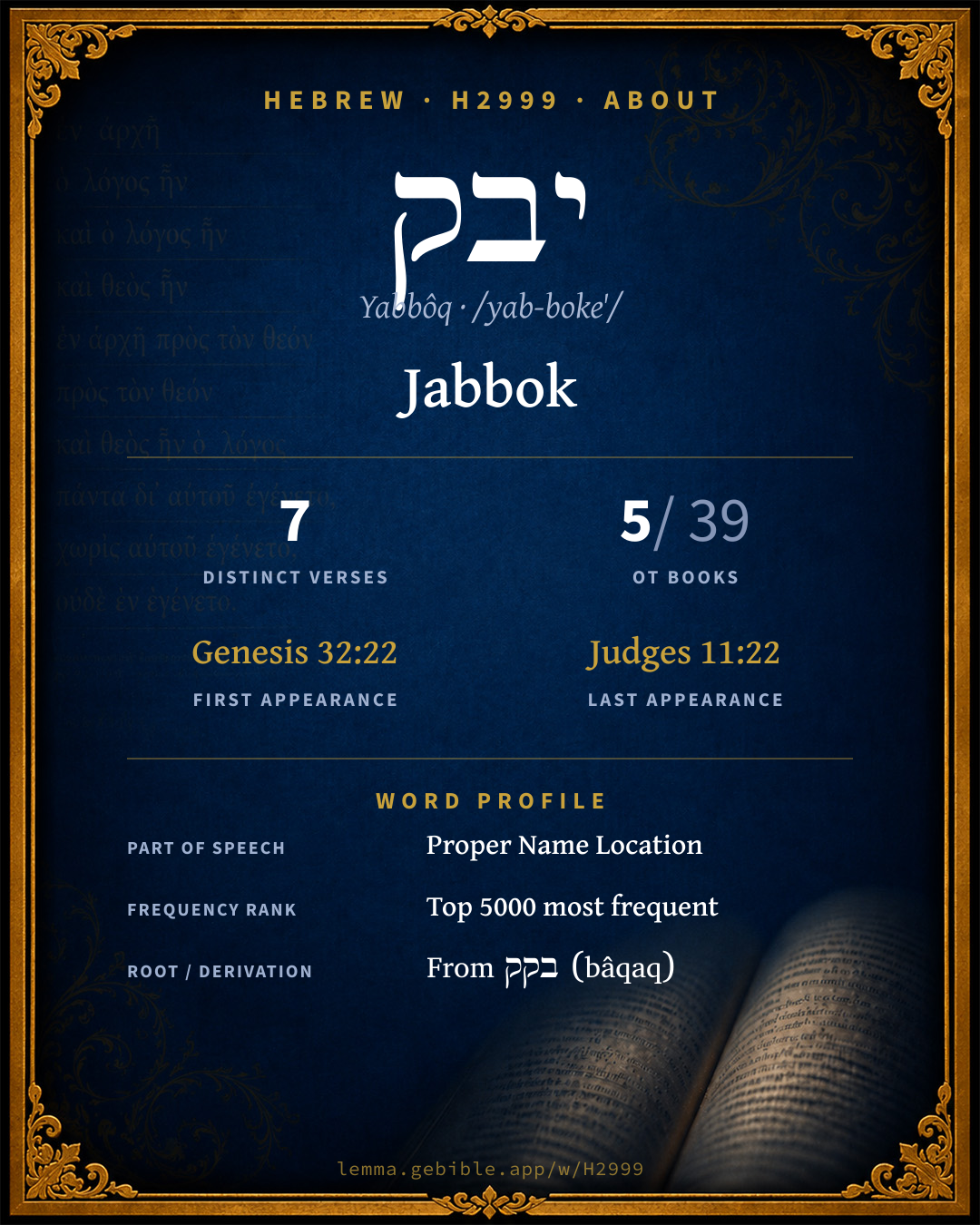
יַבֹּק
Jabbok
BDB lists 2 entries for ‘Jabbok’ fuller range ↓
Full lexicon entry — Brown-Driver-Briggs (BDB)
From Brown-Driver-Briggs (BDB)
Where this word appears
Grammar key — what these labels mean
Part of speech
- Noun
- A naming word — a person, place, thing, or idea.
Noun type
- Proper
- A name of a specific person, place, or people (e.g. Abraham, Zion, Israel).
Every verse where H2999 appears — 7 distinct verses across 5 books. Click any verse to open its interlinear word-by-word view. Verse text shown in the World English Bible for context — . Each verse’s Hebrew form is shown with its reference; the English is not keyword-highlighted, since the data carries no word-level English alignment. Use “Compare translations” on any verse to read it across multiple English versions. This concordance covers the Hebrew Bible; Septuagint (Greek Old Testament) occurrences are not indexed here.
Genesis 1 verse
Numbers 1 verse
Deuteronomy 2 verses
- Deuteronomy 2:37 יַבֹּק֙ n Proper only to the land of the children of Ammon you didn't come near; all the side of the river Jabbok, and the cities of the hill-country, and wherever Yahweh our God forbade us.
- Deuteronomy 3:16 יַבֹּ֣ק n Proper To the Reubenites and to the Gadites I gave from Gilead even to the valley of the Arnon, the middle of the valley, and the border [of it], even to the river Jabbok, which is the border of the children of Ammon;
Joshua 1 verse
Judges 2 verses
- Judges 11:13 הַ/יַּבֹּ֖ק ptcl def.art + n Proper The king of the children of Ammon answered to the messengers of Jephthah, Because Israel took away my land, when he came up out of Egypt, from the Arnon even to the Jabbok, and to the Jordan: now therefore restore those [lands] again peaceably.
- Judges 11:22 הַ/יַּבֹּ֔ק ptcl def.art + n Proper They possessed all the border of the Amorites, from the Arnon even to the Jabbok, and from the wilderness even to the Jordan.
About this entry
At a glance — auto-summarized from this page’s data, not written by a person. Every figure links to its source below. This summary describes the numbers; it doesn’t interpret them.
יבק — transliterated Yabbôq — is a Hebrew name carrying the sense “Jabbok.” Debuting at Genesis 32:22, it then recurs through the corpus. With 7 verses in 5 books, it is an uncommon word in the Hebrew Bible. Its uses concentrate in Deuteronomy (29% of all occurrences). Each statement above links to its evidence; the full detail follows below.
Gloss history
Strong's 1890 vs modern scholarship
About this word
Strong's H2999 catalogs a Hebrew word from the Hebrew Old Testament.
These counts are not copied from any lexicon or concordance. They are computed here, from the morphology-tagged Hebrew Old Testament. What Lemma adds →
- 7
- distinct verses
- The word appears in 7 distinct verses.
- 5 / 39
- OT books
- The word appears in 5 of 39 Old Testament books.
- #2,835
- by frequency
- Top 5000 most frequent Hebrew words (rank 2,835 of 8,640 Hebrew words by occurrence).
View all 7 occurrences in the concordance →
Most concentrated in
- Deuteronomy 2 verses 29%
- Judges 2 verses 29%
- Genesis 1 verse 14%
By section of the Old Testament
By traditional corpus
Conventional, traditional groupings — biblical authorship is debated, so this is a traditional corpus grouping, not an authorship claim. Each share is this word’s portion of its verses in that division of the Hebrew canon. Each figure is a share of the word’s 7 distinct verses.
- Torah (Pentateuch) 4 verses · 57%
- Prophets (Nevi'im) 3 verses · 43%
How translations render this word
Counts come from each version’s own published word-to-Strong’s tagging or interlinear alignment — an approximate guide to how each version renders this word, not a word-level alignment the data otherwise carries. Because each total is that version’s own tagged count, the per-version totals vary from one another and need not match the appearance or distinct-verse counts above. These counts may also differ from a printed concordance because Lemma counts each distinctly tagged rendering and does not collapse phrase taggings into a single head-word total. This is a fixed set of word-tagged versions (KJV, ASV, BSB, ULT) and does not change with the reading translation you choose elsewhere. Each version’s license is shown beside its name below (and on Sources).
BDB lists this Strong’s number as 2 distinct words (homographs). Each count above pools all of them and is not split by sense — see the Senses section below. A low-frequency rendering may belong to a different one of those words, not the primary meaning.
- King James Version†: Jabbok 7×
- American Standard Version†: Jabbok 6×
- Berean Standard Bible†: Jabbok 7×
- unfoldingWord Literal Text†: Jabbok 7×
King James Version Public Domain
Renders H2999 across 7† tagged occurrences — most commonly:
American Standard Version Public Domain
Renders H2999 across 7† tagged occurrences — most commonly:
Plus 1 rendering that appears only once — usually multi-word phrases or single function words the recovered tagging swept in, not distinct renderings.
Berean Standard Bible Public Domain
Renders H2999 across 7† tagged occurrences — most commonly:
unfoldingWord Literal Text CC BY-SA 4.0
Renders H2999 across 7† tagged occurrences — most commonly:
Senses in BDB
The 2 senses BDB distinguishes for this word, in lexicon order (not ranked by frequency or importance). The full entry — with sub-senses — is in the Lexicon Entry tab.
- Jabbok = "emptying"
- a stream which intersects the mountain range of Gilead…
Word origin
I. n.pr.fl. (√ prob. בקק; so Thes after Simonis, Sam. Di) מַעֲבַר (ה)יבק Gn 32:23 (where perhaps connected with אבק = יאבק); נַ֫חַל יַבּ׳ Dt 2:37, יַבּ׳ הַנַּחַל Dt 3:16 Jos 12:2, יַבֹּק Nu 21:24 (‖ אַרְנֹן, cf. Dt 3:16 Jos 12:2), הַיַּבֹּק Nu 11:13, 22 (in both, ‖ ארנון); it empties into Jordan from East, in latitude of Shechem; called (southern) boundary of Ammon Shiloh; N. border of Amorites, Nu 21:24 (v. Di), Ju 11:22; in its upper course it runs S. to N., hence (W.) border of Ammon, Dt 3:16 and (northern) of Amorites (cf. 2:37), Jos 12:2; but some confusion (Di Nu 21:24 Dt 2:37);—mod. Wady Zerqa BdPal. 181.
II. v. sub בקק p. 132b supr.
— Brown-Driver-Briggs (Oxford 1906, public domain), digitized via Sefaria, supplemented by the OpenScriptures HebrewLexicon (CC BY 4.0). See Sources.
Derived from בקק (bâqaq) (H1238) — to empty.
Forms in the corpus
The 5 distinct written forms H2999 takes in the Hebrew Bible, most frequent first — each parse links to that state’s occurrences in the concordance. Hebrew forms include their vowel points and cantillation, so a single lemma takes many written forms.
| Form | Parsing | Example | Uses |
|---|---|---|---|
| יַבֹּ֣ק | Noun, Proper | Deuteronomy 3:16 | 2 |
| יַבֹּק֙ | Noun, Proper | Deuteronomy 2:37 | 2 |
| הַ/יַּבֹּ֔ק | Noun, Proper | Judges 11:22 | 1 |
| הַ/יַּבֹּ֖ק | Noun, Proper | Judges 11:13 | 1 |
| יַבֹּֽק | Noun, Proper | Genesis 32:22 | 1 |
Same root — word family
Other BDB entries built from the same root as H2999, grouped by Strong’s listed origin. These share a root / origin per the lexicon — not necessarily a shared meaning. Each links to that word’s own entry.
Derives from
Shares the same root
Proper names from this root
People and places named from this root — a name, not an additional meaning of the word.
Compare all same-root words → Showing 4 of 5 — not the complete family. 2 of the same-root words are proper names (people or places). They share a root, not necessarily a meaning.
Bible dictionary
Public-domain dictionary articles matched to this entry by name (Jabbok). A biblical name can be shared by more than one person or place, so an article may treat several.
Easton's Bible Dictionary · M. G. Easton, 1897
A pouring out, or a wrestling, one of the streams on the east of Jordan, into which it falls about midway between the Sea of Galilee and the Dead Sea, or about 45 miles below the Sea of Galilee. It rises on the eastern side of the mountains of Gilead, and runs a course of about 65 miles in a wild and deep ravine. It was the boundary between the territory of the Ammonites and that of Og, king of Bashan (Josh. 12:1-5; Num. 21:24); also between the tribe of Reuben and the half tribe of Manasseh (21:24; Deut. 3:16). In its course westward across the plains it passes more than once underground. "The scenery along its banks is probably the most picturesque in Palestine; and the ruins of town and village and fortress which stud the surrounding mountain-side render the country as interesting as it is beautiful." This river is now called the Zerka, or blue river.
Smith's Bible Dictionary · William Smith, 1863
(emptying), a stream which intersects the mountain range of Gilead, comp. (Joshua 12:2,5) and falls into the Jordan on the east about midway between the Sea of Galilee and the Dead Sea. It was anciently the border of the children of Ammon. (Numbers 21:24; 2:37; 3:16) It was on the south bank of the Jabbok that the interview took place between Jacob and Esau, (Genesis 32:22) and this river afterward became, toward its western part, the boundary between the kingdoms of Sihon and Og. (Joshua 12:2,5) Its modern name is Wady Zurka .
Hitchcock's Bible Names Dictionary · Roswell D. Hitchcock, 1869
evacuation; dissipation; wrestling
Classic public-domain reference works; full attribution on Sources.
Septuagint verse parallels
This word appears in 7 verses that also exist in the Greek Old Testament (Septuagint), out of the 7 Hebrew verses it occurs in. You can read those verses in Greek by switching the Old Testament edition to the Septuagint.
Read these verses in the Septuagint
This is a verse-level parallel only — the same verses exist in both the Hebrew and Greek Old Testaments. No word-level Hebrew↔Greek correspondence is claimed: the data carries no such alignment, so no Greek word is shown as this Hebrew word’s translation. Coverage is not total — the Septuagint omits the deuterocanon and renumbers the Psalms, so some Hebrew verses have no direct Greek parallel.