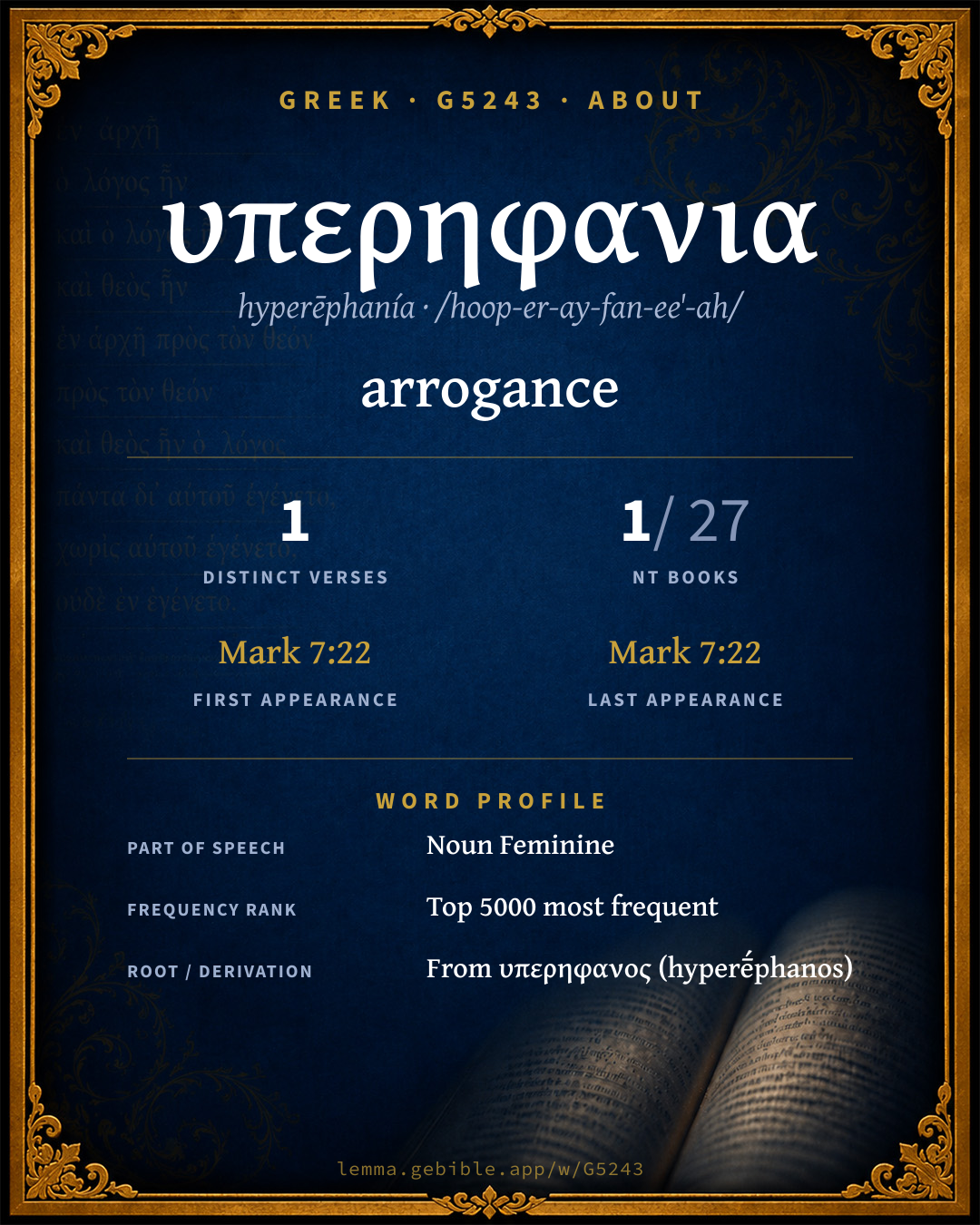
ὑπερηφανία
arrogance
also: pride, haughtiness fuller range ↓
Full lexicon entry — Thayer's Greek Lexicon
From Thayer's Greek Lexicon
Where this word appears
Grammar key — what these labels mean
Part of speech
- Noun
- A naming word — a person, place, thing, or idea.
Case
- Nominative
- The case of the subject (and the predicate nominative).
Gender
- Feminine
- Grammatically feminine.
Number
- Singular
- One.
Every verse where G5243 appears — 1 distinct verse across 1 book. Click any verse to open its interlinear word-by-word view. Verse text shown in the World English Bible for context — . Each verse’s Greek form is shown with its reference; the English is not keyword-highlighted, since the data carries no word-level English alignment. Use “Compare translations” on any verse to read it across multiple English versions. This concordance covers the Greek New Testament; Septuagint (Greek Old Testament) occurrences of this word are not indexed here.
Mark 1 verse
About this entry
At a glance — auto-summarized from this page’s data, not written by a person. Every figure links to its source below. This summary describes the numbers; it doesn’t interpret them.
The Greek noun υπερηφανια centers on the idea of “arrogance.” It occurs a mere 1 verse across Scripture. Mark dominates its distribution — 1 of 1 verses. A true hapax — its single appearance is Mark 7:22. Thayer's distinguishes 2 senses; alongside “arrogance” it spans “pride” and “haughtiness”. Dig into 1-verse concordance and the renderings breakdown below.
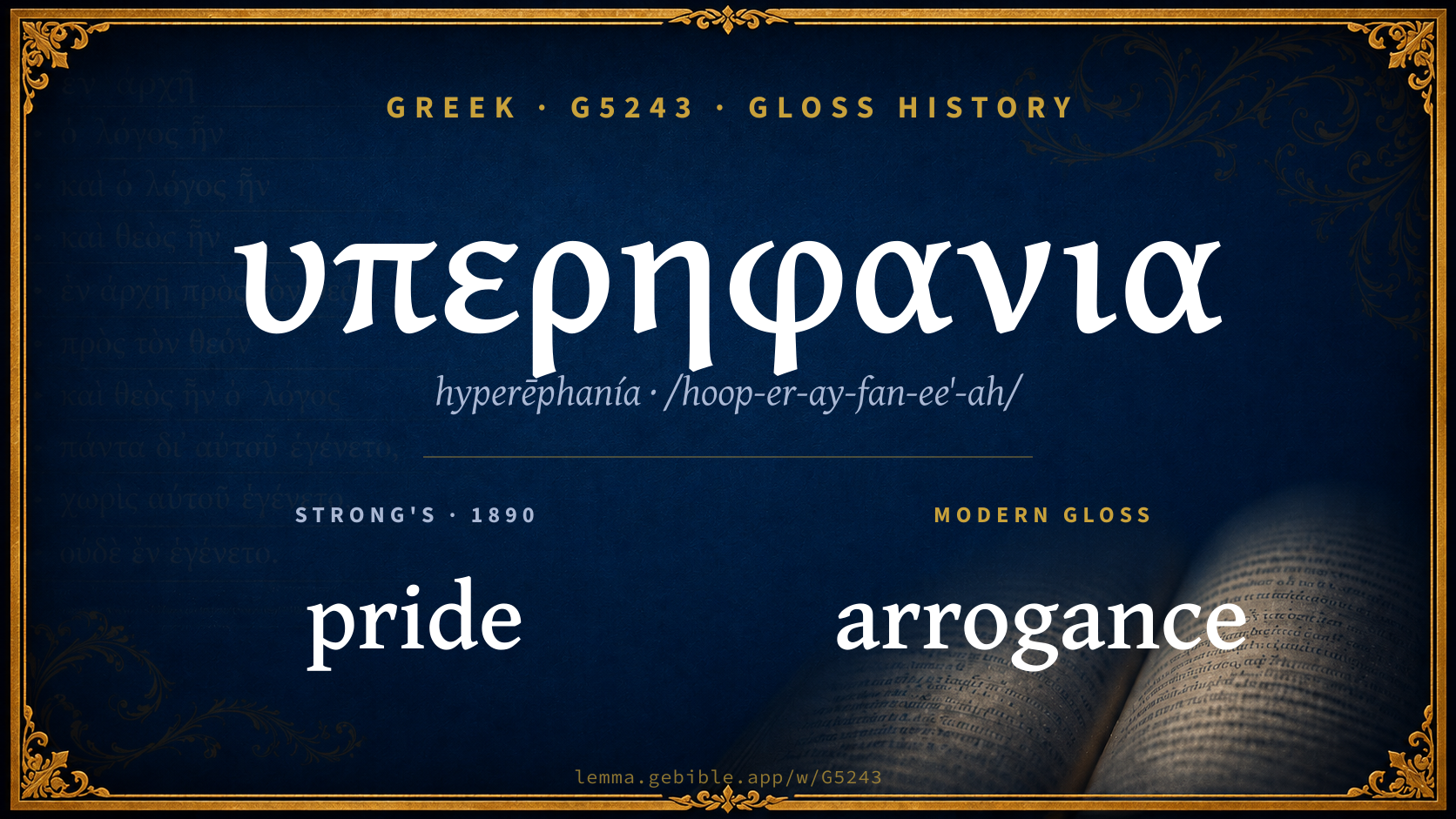
Gloss history
Strong's 1890 vs modern scholarship
About this word
Strong's G5243 catalogs a Greek word from the Greek New Testament.
These counts are not copied from any lexicon or concordance. They are computed here, from the morphology-tagged Greek New Testament. What Lemma adds →
- 1
- distinct verses
- The word appears in 1 distinct verse.
- 1 / 27
- NT books
- The word appears in 1 of 27 New Testament books.
- #3,503
- by frequency
- Top 5000 most frequent Greek words (rank 3,503 of 5,347 Greek words by occurrence).
View all 1 occurrence in the concordance →
Most concentrated in
- Mark 1 verse 100%
By section of the New Testament
By traditional corpus
Conventional, traditional groupings — biblical authorship is debated, so this is a traditional corpus grouping, not an authorship claim. Some books belong to more than one corpus (Luke is in both the Gospels and the Lukan corpus, and so on), so these shares overlap and need not total 100%. Each figure is a share of the word’s 1 distinct verse.
- Gospels 1 verse · 100%
How translations render this word
Counts come from each version’s own published word-to-Strong’s tagging or interlinear alignment — an approximate guide to how each version renders this word, not a word-level alignment the data otherwise carries. Because each total is that version’s own tagged count, the per-version totals vary from one another and need not match the appearance or distinct-verse counts above. These counts may also differ from a printed concordance because Lemma counts each distinctly tagged rendering and does not collapse phrase taggings into a single head-word total. This is a fixed set of word-tagged versions (KJV, ASV, BSB, ULT) and does not change with the reading translation you choose elsewhere. Each version’s license is shown beside its name below (and on Sources).
- King James Version: Pride 1×
- American Standard Version: Pride 1×
- Berean Standard Bible: Arrogance 1×
- unfoldingWord Literal Text: Pride 1×
King James Version Public Domain
Renders G5243 across 1 tagged occurrence — most commonly:
American Standard Version Public Domain
Renders G5243 across 1 tagged occurrence — most commonly:
Berean Standard Bible Public Domain
Renders G5243 across 1 tagged occurrence — most commonly:
unfoldingWord Literal Text CC BY-SA 4.0
Renders G5243 across 1 tagged occurrence — most commonly:
Senses in Thayer's
The 2 senses Thayer's distinguishes for this word, in lexicon order (not ranked by frequency or importance). The full entry — with sub-senses — is in the Lexicon Entry tab.
- pride, haughtiness, arrogance
- the character of one who…
Word origin
Derived from υπερηφανος (hyperḗphanos) (G5244) — haughty.
From G5244 ; haughtiness : - pride.
— Strong’s Exhaustive Concordance (1890), public domain.
Septuagint usage
The same Greek word υπερηφανια appears 22 times in the Greek Old Testament (Septuagint), across 22 verses in 12 books.
- 22
- LXX occurrences
- Tagged occurrences of this Greek word in the Septuagint.
- 22
- verses
- Distinct Septuagint verses containing this word.
- 12 / 39
- OT books
- The word appears in 12 of the 39 Old Testament books.
Sample Septuagint occurrences
- Exodus 18:21 ὑπερηφανία
- Leviticus 26:19 ὑπερηφανία
- Numbers 15:30 ὑπερηφανία
- Deuteronomy 17:12 ὑπερηφανία
- Psalms 16:10 ὑπερηφανία
- Proverbs 8:13 ὑπερηφανία
- Isaiah 16:6 ὑπερηφανία
- Jeremiah 31:29 ὑπερηφανία
- Ezekiel 7:20 ὑπερηφανία
- Daniel 4:15 ὑπερηφανία
- Amos 8:7 ὑπερηφανία
- Obadiah 1:3 ὑπερηφανία
Septuagint occurrences (same lexeme)
Every verse where the same Strong’s number (G5243) appears in the Greek Septuagint. Verse text shown in the World English Bible for context; the Greek form is the matched word — the English is not keyword-highlighted.
- Exodus 18:21 ὑπερηφανία Moreover you shall provide out of all the people able men, such as fear God: men of truth, hating unjust gain; and place such over them, to be rulers of thousands, rulers of hundreds, rulers of fifties, and rulers of tens.
- Leviticus 26:19 ὑπερηφανία I will break the pride of your power, and I will make your sky like iron, and your soil like brass;
- Numbers 15:30 ὑπερηφανία But the soul who does anything with a high hand, whether he is home-born or a foreigner, the same blasphemes Yahweh; and that soul shall be cut off from among his people.
- Deuteronomy 17:12 ὑπερηφανία The man who does presumptuously, in not listening to the priest who stands to minister there before Yahweh your God, or to the judge, even that man shall die: and you shall put away the evil from Israel.
- Psalms 16:10 ὑπερηφανία For you will not leave my soul in Sheol, Neither will you allow your holy one to see corruption.
- Psalms 30:19 ὑπερηφανία
- Psalms 30:24 ὑπερηφανία
- Psalms 35:12 ὑπερηφανία They reward me evil for good, To the bereaving of my soul.
- Psalms 58:13 ὑπερηφανία
- Psalms 72:6 ὑπερηφανία He will come down like rain on the mown grass, As showers that water the earth.
- Psalms 73:3 ὑπερηφανία For I was envious of the arrogant, When I saw the prosperity of the wicked.
- Psalms 73:23 ὑπερηφανία Nevertheless, I am continually with you. You have held my right hand.
- Psalms 100:7 ὑπερηφανία
- Proverbs 8:13 ὑπερηφανία The fear of Yahweh is to hate evil. I hate pride, arrogance, the evil way, and the perverse mouth.
- Isaiah 16:6 ὑπερηφανία We have heard of the pride of Moab, [that] he is very proud; even of his arrogance, and his pride, and his wrath; his boastings are nothing.
- Jeremiah 31:29 ὑπερηφανία In those days they shall say no more, The fathers have eaten sour grapes, and the children's teeth are set on edge.
- Ezekiel 7:20 ὑπερηφανία As for the beauty of his ornament, he set it in majesty; but they made the images of their abominations [and] their detestable things therein: therefore have I made it to them as an unclean thing.
- Ezekiel 16:49 ὑπερηφανία Behold, this was the iniquity of your sister Sodom: pride, fullness of bread, and prosperous ease was in her and in her daughters; neither did she strengthen the hand of the poor and needy.
- Ezekiel 16:56 ὑπερηφανία For your sister Sodom was not mentioned by your mouth in the day of your pride,
- Daniel 4:15 ὑπερηφανία Nevertheless leave the stump of its roots in the earth, even with a band of iron and brass, in the tender grass of the field; and let it be wet with the dew of the sky: and let his portion be with the animals in the grass of the earth:
- Amos 8:7 ὑπερηφανία Yahweh has sworn by the pride of Jacob, "Surely I will never forget any of their works.
- Obadiah 1:3 ὑπερηφανία The pride of your heart has deceived you, you who dwell in the clefts of the rock, whose habitation is high, who says in his heart, 'Who will bring me down to the ground?'
These are occurrences of the same Greek lexeme (G5243) in the Septuagint — not a translation of any one Hebrew word. The store carries no word-level Hebrew↔Greek alignment, so no Hebrew original is asserted here. Counts come from the recovered LXX Strong's tagging — high-frequency vocabulary is well covered, while rare or late forms may be untagged — so they reflect tagged occurrences and may slightly undercount.