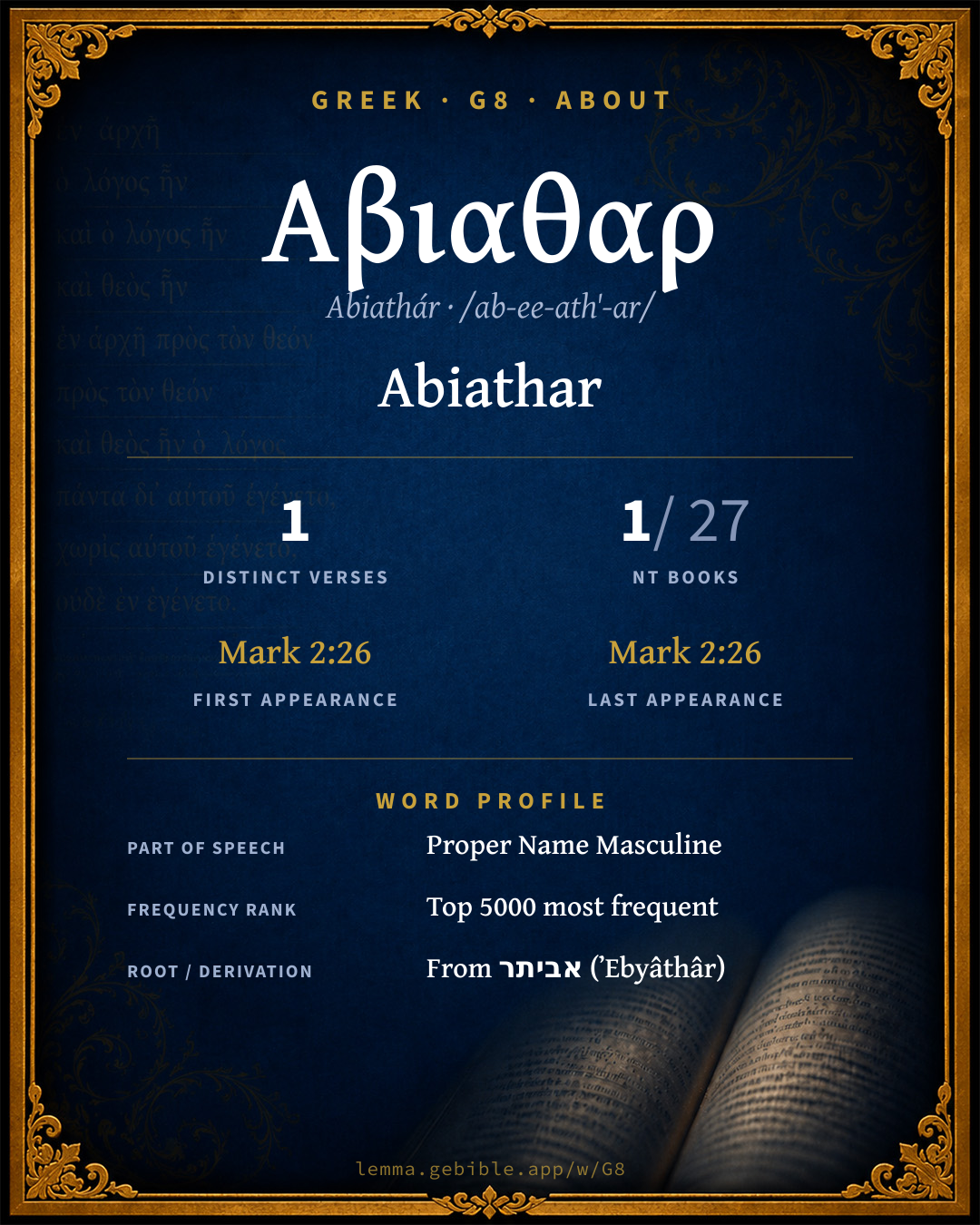
Ἀβιάθαρ
Abiathar
Thayer's lists 2 entries for ‘Abiathar’ fuller range ↓
Full lexicon entry — Thayer's Greek Lexicon
From Thayer's Greek Lexicon
Where this word appears
Every verse where G8 appears — 1 distinct verse across 1 book. Click any verse to open its interlinear word-by-word view. Verse text shown in the World English Bible for context — . Each verse’s Greek form is shown with its reference; the English is not keyword-highlighted, since the data carries no word-level English alignment. Use “Compare translations” on any verse to read it across multiple English versions. This concordance covers the Greek New Testament; Septuagint (Greek Old Testament) occurrences of this word are not indexed here.
Mark 1 verse
About this entry
At a glance — auto-summarized from this page’s data, not written by a person. Every figure links to its source below. This summary describes the numbers; it doesn’t interpret them.
Αβιαθαρ (Abiathár) is a Greek name most often rendered “Abiathar.” With only 1 verse it sits in the long tail of Greek New Testament vocabulary. Mark dominates its distribution — 1 of 1 verses. A true hapax — its single appearance is Mark 2:26. See 1-verse concordance and the renderings breakdown below.
Gloss history
Strong's 1890 vs modern scholarship
About this word
Strong's G8 catalogs a Greek word from the Greek New Testament.
These counts are not copied from any lexicon or concordance. They are computed here, from the morphology-tagged Greek New Testament. What Lemma adds →
- 1
- distinct verses
- The word appears in 1 distinct verse.
- 1 / 27
- NT books
- The word appears in 1 of 27 New Testament books.
- #3,503
- by frequency
- Top 5000 most frequent Greek words (rank 3,503 of 5,347 Greek words by occurrence).
View all 1 occurrence in the concordance →
Most concentrated in
- Mark 1 verse 100%
By section of the New Testament
By traditional corpus
Conventional, traditional groupings — biblical authorship is debated, so this is a traditional corpus grouping, not an authorship claim. Some books belong to more than one corpus (Luke is in both the Gospels and the Lukan corpus, and so on), so these shares overlap and need not total 100%. Each figure is a share of the word’s 1 distinct verse.
- Gospels 1 verse · 100%
How translations render this word
Counts come from each version’s own published word-to-Strong’s tagging or interlinear alignment — an approximate guide to how each version renders this word, not a word-level alignment the data otherwise carries. Because each total is that version’s own tagged count, the per-version totals vary from one another and need not match the appearance or distinct-verse counts above. These counts may also differ from a printed concordance because Lemma counts each distinctly tagged rendering and does not collapse phrase taggings into a single head-word total. This is a fixed set of word-tagged versions (KJV, ASV, BSB, ULT) and does not change with the reading translation you choose elsewhere. Each version’s license is shown beside its name below (and on Sources).
- King James Version: Abiathar 1×
- American Standard Version: Abiathar 1×
- Berean Standard Bible: Abiathar 1×
- unfoldingWord Literal Text: Abiathar 1×
King James Version Public Domain
Renders G8 across 1 tagged occurrence — most commonly:
American Standard Version Public Domain
Renders G8 across 1 tagged occurrence — most commonly:
Berean Standard Bible Public Domain
Renders G8 across 1 tagged occurrence — most commonly:
unfoldingWord Literal Text CC BY-SA 4.0
Renders G8 across 1 tagged occurrence — most commonly:
Senses in Thayer's
The 2 senses Thayer's distinguishes for this word, in lexicon order (not ranked by frequency or importance). The full entry — with sub-senses — is in the Lexicon Entry tab.
- Abiathar = "father of abundance"
- the name of a high priest
Word origin
Derived from אביתר (ʼEbyâthâr) (H54) — Abiathar.
Of hebrew origin [ H54 ]; Abiathar an Israelite : - Abiathar.
— Strong’s Exhaustive Concordance (1890), public domain.
Bible dictionary
Public-domain dictionary articles matched to this entry by name (Abiathar). A biblical name can be shared by more than one person or place, so an article may treat several.
Easton's Bible Dictionary · M. G. Easton, 1897
Father of abundance, or my father excels, the son of Ahimelech the high priest. He was the tenth high priest, and the fourth in descent from Eli. When his father was slain with the priests of Nob, he escaped, and bearing with him the ephod, he joined David, who was then in the cave of Adullam (1 Sam. 22:20-23; 23:6). He remained with David, and became priest of the party of which he was the leader (1 Sam. 30:7). When David ascended the throne of Judah, Abiathar was appointed high priest (1 Chr. 15:11; 1 Kings 2:26) and the "king's companion" (1 Chr. 27:34). Meanwhile Zadok, of the house of Eleazar, had been made high priest. These appointments continued in force till the end of David's reign (1 Kings 4:4). Abiathar was deposed (the sole historical instance of the deposition of a high priest) and banished to his home at Anathoth by Solomon, because he took part in the attempt to raise Adonijah to the throne. The priesthood thus passed from the house of Ithamar (1 Sam. 2:30-36; 1 Kings 1:19; 2:26, 27). Zadok now became sole high priest. In Mark 2:26, reference is made to an occurrence in "the days of Abiathar the high priest." But from 1 Sam. 22, we learn explicitly that this event took place when Ahimelech, the father of Abiathar, was high priest. The apparent discrepancy is satisfactorily explained by interpreting the words in Mark as referring to the life-time of Abiathar, and not to the term of his holding the office of high priest. It is not implied in Mark that he was actual high priest at the time referred to. Others, however, think that the loaves belonged to Abiathar, who was at that time (Lev. 24:9) a priest, and that he either himself gave them to David, or persuaded his father to give them.
Smith's Bible Dictionary · William Smith, 1863
(father of abundance, i.e. liberal), High priest and fourth in descent from Eli. (B.C. 1060-1012.) Abiathar was the only one of the all the sons of Ahimelech the high priest who escaped the slaughter inflicted upon his father's house by Saul, in revenge for his father's house by Saul, in revenge of his having inquired of the Lord for David and given him the shew-bread to eat. (1 Samuel 22:1) ... Abiathar having become high priest fled to David, and was thus enabled to inquire of the Lord for him. (1 Samuel 23:9; 30:7; 2 Samuel 2:1; 5:19) etc. He adhered to David in his wanderings while pursued by Saul; he was with him while he reigned in Hebron, and afterwards in Jerusalem. (2 Samuel 2:1-3) He continued faithful to him in Absalom's rebellion. (2 Samuel 15:24,29,35,36; 17:15-17; 19:11) When, however, Adonijah set himself up fro David's successor on the throne, in opposition to Solomon, Abiathar sided with him, while Zadok was on Solomon's side. For this Abiathar was deprived of the high priesthood. Zadok had joined David at Hebron, (1 Chronicles 12:28) so that there was henceforth who high priests in the reign of David, and till the deposition of Abiathar by Solomon, when Zadok became the sole high priest.
Hitchcock's Bible Names Dictionary · Roswell D. Hitchcock, 1869
excellent father; father of the remnant
Classic public-domain reference works; full attribution on Sources.
Septuagint usage
The same Greek word Αβιαθαρ appears 29 times in the Greek Old Testament (Septuagint), across 28 verses in 4 books.
- 29
- LXX occurrences
- Tagged occurrences of this Greek word in the Septuagint.
- 28
- verses
- Distinct Septuagint verses containing this word.
- 4 / 39
- OT books
- The word appears in 4 of the 39 Old Testament books.
Sample Septuagint occurrences
- 1 Samuel 22:20 αβιαθαρ
- 2 Samuel 8:17 αβιαθαρ
- 1 Kings 1:7 αβιαθαρ
- 1 Chronicles 15:11 αβιαθαρ
Septuagint occurrences (same lexeme)
Every verse where the same Strong’s number (G8) appears in the Greek Septuagint. Verse text shown in the World English Bible for context; the Greek form is the matched word — the English is not keyword-highlighted.
- 1 Samuel 22:20 αβιαθαρ One of the sons of Ahimelech, the son of Ahitub, named Abiathar, escaped, and fled after David.
- 1 Samuel 22:21 αβιαθαρ Abiathar told David that Saul had slain Yahweh's priests.
- 1 Samuel 22:22 αβιαθαρ David said to Abiathar, I knew on that day, when Doeg the Edomite was there, that he would surely tell Saul: I have occasioned [the death] of all the persons of your father's house.
- 1 Samuel 23:6 αβιαθαρ It happened, when Abiathar the son of Ahimelech fled to David to Keilah, that he came down with an ephod in his hand.
- 1 Samuel 23:9 αβιαθαρ David knew that Saul was devising mischief against him; and he said to Abiathar the priest, Bring here the ephod.
- 1 Samuel 30:7 αβιαθαρ David said to Abiathar the priest, the son of Ahimelech, Please bring me here the ephod. Abiathar brought there the ephod to David.
- 2 Samuel 8:17 αβιαθαρ and Zadok the son of Ahitub, and Ahimelech the son of Abiathar, were priests; and Seraiah was scribe;
- 2 Samuel 15:24 αβιαθαρ Behold, Zadok also [came], and all the Levites with him, bearing the ark of the covenant of God; and they set down the ark of God; and Abiathar went up, until all the people had done passing out of the city.
- 2 Samuel 15:27 αβιαθαρ The king said also to Zadok the priest, "Aren't you a seer? Return into the city in peace, and your two sons with you, Ahimaaz your son, and Jonathan the son of Abiathar.
- 2 Samuel 15:29 αβιαθαρ Zadok therefore and Abiathar carried the ark of God again to Jerusalem: and they abode there.
- 2 Samuel 15:35 αβιαθαρ Don't you have Zadok and Abiathar the priests there with you? therefore it shall be, that whatever thing you shall hear out of the king's house, you shall tell it to Zadok and Abiathar the priests.
- 2 Samuel 15:36 αβιαθαρ Behold, they have there with them their two sons, Ahimaaz, Zadok's son, and Jonathan, Abiathar's son; and by them you shall send to me everything that you shall hear.
- 2 Samuel 17:15 αβιαθαρ Then said Hushai to Zadok and to Abiathar the priests, Thus and thus did Ahithophel counsel Absalom and the elders of Israel; and thus and thus have I counseled.
- 2 Samuel 19:12 αβιαθαρ You are my brothers, you are my bone and my flesh: why then are you the last to bring back the king?
- 2 Samuel 20:25 αβιαθαρ and Sheva was scribe; and Zadok and Abiathar were priests;
- 1 Kings 1:7 αβιαθαρ He conferred with Joab the son of Zeruiah, and with Abiathar the priest: and they following Adonijah helped him.
- 1 Kings 1:19 αβιαθαρ and he has slain oxen and fatlings and sheep in abundance, and has called all the sons of the king, and Abiathar the priest, and Joab the captain of the host; but he hasn't called Solomon your servant.
- 1 Kings 1:25 αβιαθαρ For he is gone down this day, and has slain oxen and fatlings and sheep in abundance, and has called all the king's sons, and the captains of the host, and Abiathar the priest; and, behold, they are eating and drinking before him, and say, [Long] live king Adonijah.
- 1 Kings 1:42 αβιαθαρ While he yet spoke, behold, Jonathan the son of Abiathar the priest came: and Adonijah said, Come in; for you are a worthy man, and bring good news.
- 1 Kings 2:22 αβιαθαρ King Solomon answered his mother, Why do you ask Abishag the Shunammite for Adonijah? ask for him the kingdom also; for he is my elder brother; even for him, and for Abiathar the priest, and for Joab the son of Zeruiah.
- 1 Kings 2:26 αβιαθαρ To Abiathar the priest said the king, Get you to Anathoth, to your own fields; for you are worthy of death: but I will not at this time put you to death, because you bear the ark of the Lord Yahweh before David my father, and because you were afflicted in all in which my father was afflicted.
- 1 Kings 2:27 αβιαθαρ So Solomon thrust out Abiathar from being priest to Yahweh, that he might fulfill the word of Yahweh, which he spoke concerning the house of Eli in Shiloh.
- 1 Kings 2:35 αβιαθαρ The king put Benaiah the son of Jehoiada in his room over the host; and Zadok the priest did the king put in the room of Abiathar.
- 1 Kings 4:4 αβιαθαρ and Benaiah the son of Jehoiada was over the host; and Zadok and Abiathar were priests;
- 1 Chronicles 15:11 αβιαθαρ David called for Zadok and Abiathar the priests, and for the Levites, for Uriel, Asaiah, and Joel, Shemaiah, and Eliel, and Amminadab,
- 1 Chronicles 18:16 αβιαθαρ and Zadok the son of Ahitub, and Abimelech the son of Abiathar, were priests; and Shavsha was scribe;
- 1 Chronicles 24:6 αβιαθαρ Shemaiah the son of Nethanel the scribe, who was of the Levites, wrote them in the presence of the king, and the princes, and Zadok the priest, and Ahimelech the son of Abiathar, and the heads of the fathers' [houses] of the priests and of the Levites; one fathers' house being taken for Eleazar, and one taken for Ithamar.
- 1 Chronicles 27:34 αβιαθαρ and after Ahithophel was Jehoiada the son of Benaiah, and Abiathar: and the captain of the king's host was Joab.
These are occurrences of the same Greek lexeme (G8) in the Septuagint — not a translation of any one Hebrew word. The store carries no word-level Hebrew↔Greek alignment, so no Hebrew original is asserted here. Counts come from the recovered LXX Strong's tagging — high-frequency vocabulary is well covered, while rare or late forms may be untagged — so they reflect tagged occurrences and may slightly undercount.