Mark 13:37

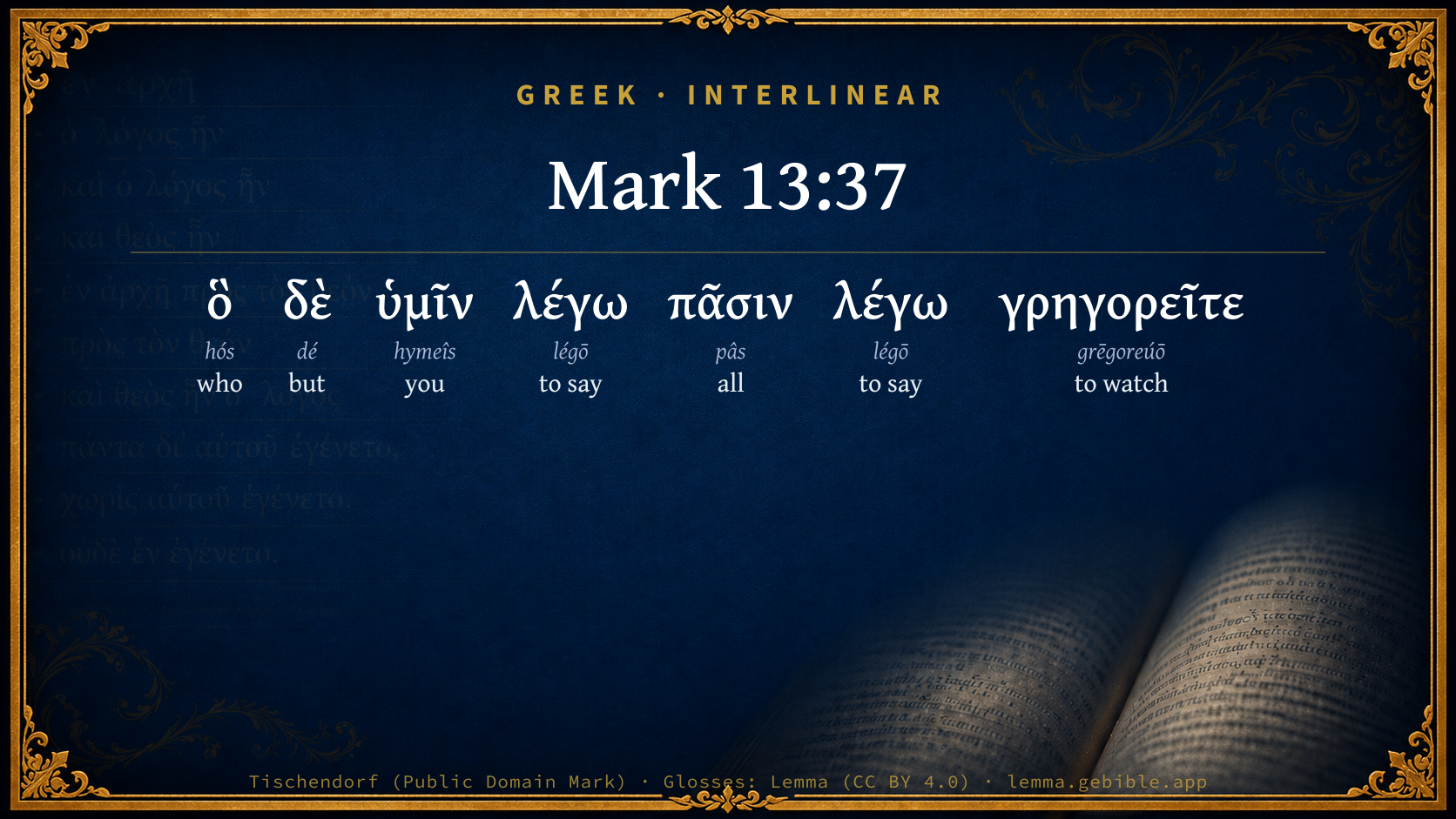
Greek (Tischendorf 8th ed.) Mark 13:37 appears in the Greek New Testament. The text above is from the Tischendorf 8th edition. Each word links to its Strong’s number and a concise gloss. Click any word for its full Thayer’s Greek Lexicon entry.
Download image
Cite this verse

Mark 13:37 (World English Bible). Public Domain. Lemma interlinear Bible study tool, https://lemma.gebible.app/v/mark/13/37.

Show BibTeX & RIS
BibTeX
RIS
English Translation
What I tell you, I tell all: Watch."
World English Bible · Public Domain
Download a study sheet

One document with this verse’s original text, its word-by-word gloss line, the meaning frame, cross-references with their text, attributed commentary, and full source and license credits — printable, and it pastes into notes with its structure intact.

This verse Autodidact and up

Study sheet (.html) Plain text (.txt)

A passage Seminary Student

Up to 50 verses in one chapter. A passage sheet keeps up to 6 commentary sources and 12 cross-references per verse, in the order this page ranks them, and says so on the sheet whenever that leaves anything out. Ask for a single verse and you get the Autodidact verse sheet above.

Everything on this page stays free to read, with no account — the sheet is a download of what is already on screen, not access to it.

Want to remove ads? Support Godless Engineer
Compare translations 3

The same verse in 3 English versions, stacked beneath the original-language interlinear above. Click any original word for its lexicon entry.

Each is an independent rendering of the whole verse — the interlinear is not word-aligned to these translations.

Highlighted words mark where these versions differ — a whole-verse word diff, not a word-by-word alignment.

  • World English Bible Public Domain
    What I tell you, I tell all: Watch."
  • King James Version Public Domain
    And what I say unto you I say unto all, Watch.
  • unfoldingWord Literal Text CC BY-SA 4.0
    But what I say to you I say to all: Stay alert!”

unfoldingWord Literal Text — © unfoldingWord, licensed CC BY-SA 4.0. Word-aligned USFM3 via Door43 (git.door43.org/unfoldingWord/en_ult).

Versions to compare (up to 4)

3 of 4 selected

Show all 19 translations

Every available English version of this verse, each an independent rendering of the whole verse.

  • World English Bible Public Domain
    What I tell you, I tell all: Watch."
  • Berean Standard Bible Public Domain
    And what I say to you, I say to everyone: Keep watch!”
  • Majority Standard Bible Public Domain
    And what I say to you, I say to everyone: Keep watch!”
  • King James Version Public Domain
    And what I say unto you I say unto all, Watch.
  • American Standard Version (1901) Public Domain
    And what I say unto you I say unto all, Watch.
  • Revised Version (1885) Public Domain
    And what I say unto you I say unto all, Watch.
  • Geneva Bible (1599) Public Domain
    And those things that I say vnto you, I say vnto all men, Watch.
  • Douay-Rheims (1899) Public Domain
    And what I say to you, I say to all: Watch.
  • Young's Literal Translation Public Domain
    and what I say to you, I say to all, Watch.'
  • Literal Standard Version CC BY-SA 4.0
    and what I say to you, I say to all, Watch!”
  • Unlocked Literal Bible CC BY-SA 4.0
    What I say to you I say to everyone: Watch!”
  • unfoldingWord Literal Text CC BY-SA 4.0
    But what I say to you I say to all: Stay alert!”
  • Darby Bible Public Domain
    But what I say to you, I say to all, Watch.
  • World Messianic Bible Public Domain
    What I tell you, I tell all: Watch!”
  • Webster's Bible Public Domain
    And what I say to you, I say to all, Watch.
  • Free Bible Version CC BY-SA 4.0
    What I'm telling you, I'm telling everyone: Watch!”
  • Bible in Basic English Public Domain
    And what I say to you, I say to all, Keep watch.
  • Text-Critical English NT CC BY 4.0
    What I say to you, I say to everyone: Keep watch!”
  • Tyndale New Testament (1534) Public Domain
    And that I saye vnto you I saye vnto all men watche.

Literal Standard Version (2020), Covenant Press — licensed CC BY-SA 4.0. Text via the HelloAO Bible API (eBible.org). Unlocked Literal Bible (unfoldingWord) — licensed CC BY-SA 4.0. Text via the HelloAO Bible API (eBible.org). unfoldingWord Literal Text — © unfoldingWord, licensed CC BY-SA 4.0. Word-aligned USFM3 via Door43 (git.door43.org/unfoldingWord/en_ult). Free Bible Version, Dr. Jonathan Gallagher — licensed CC BY-SA 4.0. Text via the HelloAO Bible API (eBible.org).

Word by word

More ways to search: Search by grammar → Find every occurrence → Compare this word →

Practice this passage: Drill this verse → Learn its vocabulary →

About this verse

These counts appear in no published source. They are computed here, from the morphology-tagged text and Lemma’s own curated glosses. What Lemma adds →

7
words
6
distinct lemmas
Gospels
section

Notable vocabulary

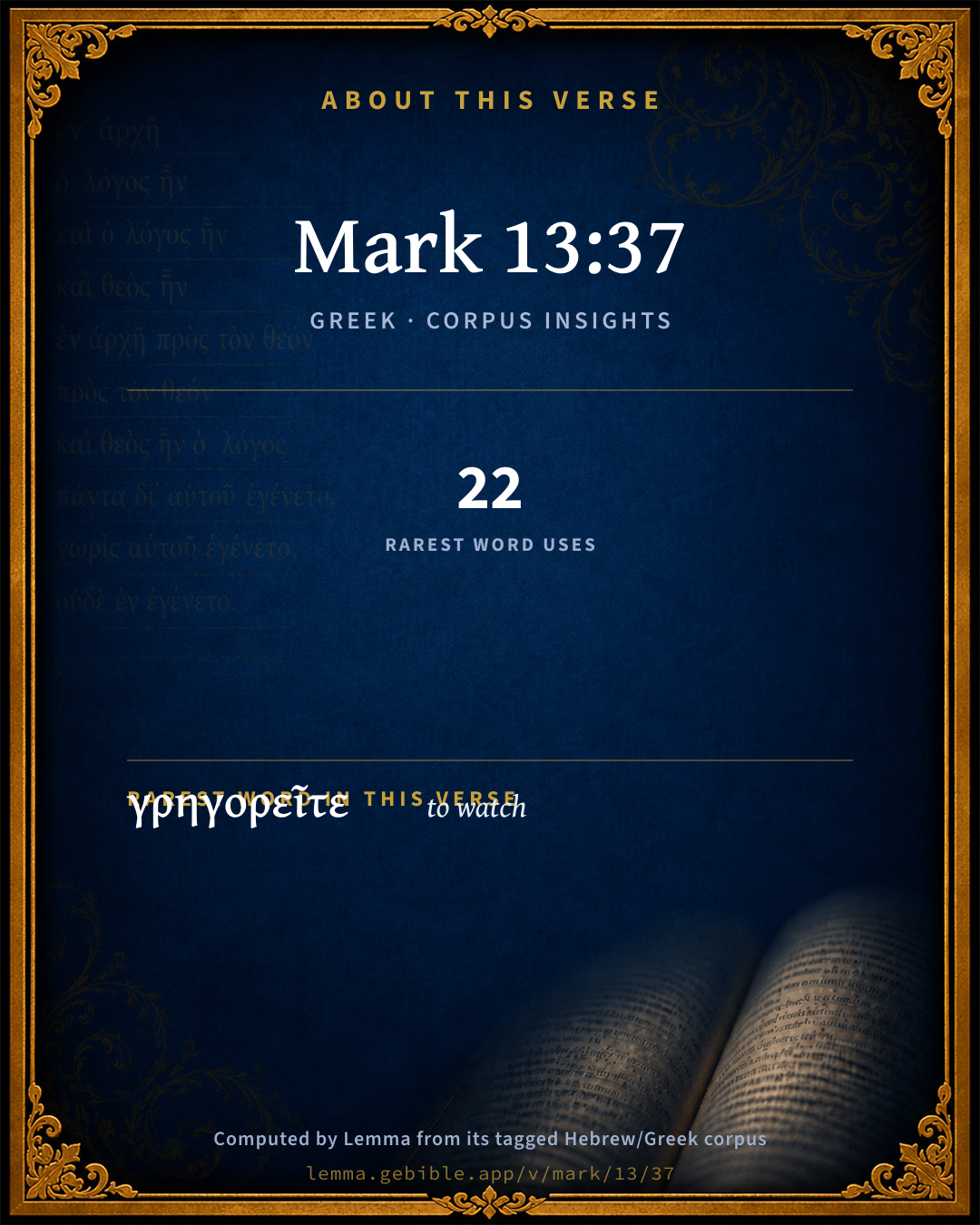
The rarest word here is γρηγορεῖτε to watch G1127 — appearing just 22 times in the whole Greek New Testament.

Shared distinctive vocabulary

γρηγορεῖτε to watch G1127 occurs in 22 verses of the Greek New Testament. Also found in:

Repetition

A word recurs within this verse:

  • λέγω to say G3004 ×2

Cross-references

3

Topical passages linked to Mark 13:37 in the Treasury of Scripture Knowledge — connected by theme and wording, ordered by reader-vote popularity; previews shown in the World English Bible.

  • Luke 12:41–46 Peter said to him, "Lord, are you telling this parable to us, or to everybody?"
  • Mark 13:33 Watch, keep alert, and pray; for you don't know when the time is.
  • Mark 13:35 Watch therefore, for you don't know when the lord of the house is coming, whether at evening, or at midnight, or when the rooster crows, or in the morning;

Cross-references courtesy of OpenBible.info (CC BY 4.0).

Commentary

Notes on Mark 13:37 from classic Christian and Jewish commentators (each source and its license shown beneath its notes). The classic Christian expositions comment on the surrounding passage and are grouped to its opening verse, so a note may address several verses; the Jewish commentaries on the Tanakh (Rashi and others) are per-verse, so they appear only where the commentator wrote on this verse.

Lemma curates 59 commentaries, every one of them public domain or Creative Commons licensed, each selected and text-cleaned for this edition rather than reprinted as found. About our sources →

The Biblical Illustrator

Joseph S. Exell

Mar_13:37

And what I say unto you, I say unto all, Watch.

Watchfulness

I. In what does this watchfulness consist? Consider it in reference to the coming of Christ, and our solemn appearance before Him. In this respect it implies-

1. Thoughtfulness. Sinners are so intent upon buying and selling that they have neither time nor inclination to think of anything else. It would be an interruption and disturbance to them to be told of Christs coming. Every incident of life should bring it to remembrance. When we rise in the morning, it is natural for us to think, Perhaps before night I may be at the end of my journey.

2. But watchfulness also implies preparation.

II. On what account this watchfulness is necessary.

1. Because many are called, and few are chosen, In every field there are tares as well as wheat; in every church sinners and saints are blended together. Watch, therefore, commune with your own heart, and let your spirit make diligent search.

2. Because so many about you are slothful.

3. Because you know not the day, nor the hour, when the Son of Man cometh. Watch, therefore, while ye have the light, lest darkness come upon you.

4. Because blessed are the dead which die ill the Lord. (S. Lavington.)

Watchfulness a safeguard

A prompt resistance of temptation, or a prompt repentance of sin as soon as committed, will commonly extinguish the flames. A few buckets of water dashed on the fire as soon as it kindled in De Koven Street would have saved Chicago from ruin in 1871. Had David exercised, at the right moment, one half of the grace which afterwards penned the fifty-first Psalm, he would have saved his own character and Uriahs life. The same rule of safety applies alike to sin and to fire; the first spark must be extinguished. When a mans whole soul is on fire, and the fabric of his character has been consumed, it is too late for prevention to use its apparatus. The ruined structure may be rebuilt by penitence and prayerful living, but many precious things have perished, never to be restored. A dear friend in St. John writes me that he shall rebuild his house, but the superb library, the pictures, and the keepsakes are gone forever. The reformed inebriate may save the remnant of his life; but the best days of it are in ashes. Wherefore the Omniscient Master has uttered the solemn admonition, I say unto you all, watch! (Dr. Cuyler.)

Always ready

And the words which the German Commentator wrote over his study door in Hanover, Always to be ready, become the motto of Christian lives. And this, because the unusual is forever happening. The providences of storm, accident, and disease; of prosperity and loss, life and death-all or any one of them may come in a day. The contingencies of life therefore must needs be reckoned on in all our estimates. The route of our journeying was mapped out, the trunks were packed and the day of our departure fixed; but a child fell sick, or the mail that morning brought a message of death, and our plans were changed. Or, weary with long labour, and with wealth enough and well invested, we plan to spend the afternoon of life in ease and culture; but a panic comes, the bank fails, and debtors default, and unexpectedly we are pushed back again into the treadmill of anxious toil. Or, we counted on the schedule time and a close connection, but the train was a half hour late, and so we missed the boat and lost the holiday. (W. H. Davis.)

Watching in work

For the smiths apron, the bakers cap, the labourers blue jeans, and the housewifes gown are all suitable material for ascension robes. And he watches best for his Lords coming who does the duty and the service which lie next to him, with fidelity to men and love to God. Be that duty with ploughs or day books, in the office with its briefs, or in the school room with its classes, or busy with railroads and mines, with homes or farms, no matter, if the currents of purpose sweep heavenward and the graces of faith and hope and love are in the heart. As Israel Putnam left the plough in the furrow and mounted a field horse when the bugle sounded for the rallying at Cambridge; as the minute men of Middlesex left workshop and farm at Paul Reveres call to Lexington, so the Master would have men work and watch. (W. H. Davis.)

Watchfulness

I. What is meant by spiritual watchfulness?

1. The mind must be awake, the understanding, the rational powers. In order to this it is essential that the powers should be exercised; in other words, that the man should think. To be mentally awake there must be life, spontaneous action, and coherence in the thoughts. But this is not enough. The mind may be awake in one sense and yet dreaming in another. Some mens minds operate too fast, and some too slow. Some attempt to discover what has not been revealed of the future; some think too late. The mind must think seasonably. It must also act upon the proper objects, or it might just as well not act at all. The powers of many are in active exercise, but they are spent on trifles, on puzzles in theology. It thinks to no practical purpose.

2. The conscience as well as the intellect must be awake-the moral as well as the purely intellectual faculties. There must be perception not only of what is true, but of what is right. There must be liveliness of affection no less than of intellect. We must not only feel bound, but feel disposed to do the will of God. When the man thinks in earnest, seasonably of right objects and to practical purpose-when he feels his obligations and his failures to discharge them-when he earnestly desires, and sincerely loves, what he admits to be true and binding-then he may be said, in the highest spiritual sense, to be awake.

II. Be on your guard. The importance of the charge committed to our care. Although essential, it is not enough to be awake. The sentry is awake; but he is more, he is upon his guard-his mind is full of his important trust. The sentry may look for danger only in one quarter, and be overtaken by it from another direction. The danger is a complex one. He may even find the enemy within the city while he looks without. The soul may expose itself to ruin, not only by actually falling asleep, but by want of proper caution when awake-by forgetting the danger or by underrating it-by admitting its reality, but losing sight of its proximity, by looking for it from one quarter, but forgetting that it may proceed from others, by looking at a distance when the enemy is near at hand. If asked, Who is the enemy against which spiritual vigilance is called for, I reply, His name is Legion.

III. How shall we obey this duty? It is natural to ask, Is there not some safeguard, some tried means of spiritual safety, that will at once secure our vigilance and make it efficacious? Yes, there is such a talisman, and its name is prayer, that settled bent of the affections which makes actual devotion not a rare experience, but the normal condition of the soul. (J. A. Alexander, D. D.)

The nature and obligation of watchfulness

I. We must watch that we may prevent evil.

1. We must watch against sin.

2. We must guard against the world.

3. We must watch against the temptations of the devil.

II. We must watch to do good.

1. We have to discharge all the duties we owe to God, and our fellow Christians and neighbours; to improve all our talents wisely and faithfully.

2. We must watch to do all the good that God has commanded us.

3. We must watch to do good in its proper season.

4. We must watch to do good in the appointed manner.

Application:

1. How naturally prone we are to become secure and careless.

2. That without watchfulness we shall become an easy prey to our worst enemy.

3. Without this we can perform no duty that will be acceptable to God.

4. Let us join prayer to watchfulness. (Sketches of Four Hundred Sermons.)

Helping others to watch

I suppose you never heard of a man of the name of Thomas Bilby. He was the man who wrote that beautiful hymn-

Here we suffer grief and pain,

Here we meet to part again;

In heaven we part no more.

Oh! that will be joyful,

When we meet to part no more!

He wrote it for me. He wrote it for the first childrens service I ever held. That was forty-five years ago, since I held my first childrens service. I was at Chelsea. I may be wrong, but I believe that was the first childrens service ever held in the Church of England. I had heard of catechising before, but I had not heard of childrens services. Mr. Bilby wrote that hymn for me, for my first childrens service. He was my infant schoolmaster. Before then he had been a private in the Coldstream Guards, but he became a religious man, was converted while in the army. There were several religious men in the same regiment, and they were very much observed by all the other soldiers, who watched them to see if they acted in any wrong way, because they called themselves Christians. So they watched that little society, these few religious men in the army, and if ever any one of the little band should see another going to do anything wrong, get into a bad temper, use a bad word, or going to fight with another soldier, he would go and whisper to that man, Watch! No one else could hear it. Mr. Bilby told me that that was the rule among the Christians in the Coldstream Guards. (J. Vaughan, M. A.)

Found at our post

Oh! there are so many places where we must watch. There was a city in Italy, I daresay you know of it, where, more than a thousand years ago, the lava from Mount Vesuvius came all over the city, and covered it completely with thick lava. I have been there, and seen it. A thousand years after that happened, it was discovered, the city was excavated, and they dug out many of the things that were therein. Amongst other things that were discovered, there was a man, a soldier, a sentinel at his post. A thousand years before, that man had been killed at his post by the lava, and there he was found, a sentinel still at his post! A lesson to us. A great deal more than a thousand years after, he was found still at his post. Let us be found at our post, wherever God has placed us, when He comes; when this world is covered, as it will be, with fire, may we be found faithful at our posts! (J. Vaughan, M. A.)

Danger varied and where least expected

Oh! the danger may come in a very different way from the way you expect. Did you ever read AEsops Fables? I will tell you one of a doe that was blind of one eye (have you read the story?); this doe was very cunning and clever, for she knew which eye was blind, and down the path which the doe used to go she always kept her blind eye to the sea and her good eye to the land, because it was from the land the doe thought the danger would come. So the doe always kept the blind eye to the sea and the good eye to the land. One day a poacher, who knew all about that, got a boat and went out in the boat on the sea, and from the boat he shot the poor doe; and as the poor doe was dying, she said, so the fable goes, Unhappy watcher! poor me! My danger came from where I never expected it, and there was no danger where I did expect it! You may be like that poor blind doe: the danger comes where you dont expect it! Do you know where to expect the danger? Watch! I believe a hare when it lies in the grass always tries to see out of its eyes backwards; he thinks the danger will come from behind, therefore he so fixes his eyes and puts his ears back that he cannot see what is before; he is always looking back. Your danger comes every way. Another thing I want you to watch against is wandering thoughts. (J. Vaughan, M. A.)

Be watchful

I. Our conduct.

II. Our temper.

III. Our words.

IV. Our heart. (T. Heath.)

No disappointment to watchers for Christ

Most persons know what watching is. There are few who have not learned it by experience. In nights of sickness or sleeplessness you have watched for the morning. You have watched for the coming of expected friends. If they have been long separated from you, if they have gone to a far country, how anxiously you await the day of their return! It is a work of love to make your home bright and cheerful for them, and sometimes you gather flowers that they may add their greeting to yours. But, alas! how much of this earthly watching ends in disappointment! The ship that is bringing the absent one home goes down, and the longed-for sound of the familiar step and voice is waited for in vain. Ambitious souls lay plans and watch for success. Oftener than otherwise those plans fail and come to nothing. There has been more than one mother of a Sisera, whose son has gone out into the world flushed with the expectation of victory in some field of noble strife. She has looked through the lattice of her humble retirement for the return of his chariot, and for a division of the honour gained, and kept on gazing and expecting, not knowing that he has fallen a captive to temptation, and that his soul was pierced through, nailed to the earth, and dead … Most of our earthly watching is, after all, sad and fruitless. It always is, provided we look only for what this world can bring and preserve in our keeping. But blessed is he that watches for Jesus, and for His coming. That coming will be indeed a blessed morning, the bringing in of an eternal day, one through all of whose sunny hours no more sickness or pain will be felt. It will restore our absent ones to us, in a home better than any here, a mansion bright and fragrant; with flowers fairer than any of earth. It will mark the victorious return of every true soldier of the Cross, and his joyous coronation. It will reveal the multiplied richness and value of every treasure given into the Lords hand. (E. E. Johnson, M. A.)

The interval between Christs going and coming

The first advent is the pivot on which all turns for the life below; the second advent will be the point round which all will be grouped for the life above. Faith looks back at the Cross, and finds peace. Hope looks forward to the coronation, and gathers strength. Meanwhile the Masters eye and heart are towards His people, and He gives this motto.

I. There are things which suggest watchfulness.

1. The tendency of the body to induce sleep.

2. The influence of the world to beget sloth.

3. The design of the enemy to rob us while we slumber.

II. Things which promote watchfulness.

1. Waiting.

2. Working.

3. Worshipping.

III. Things which repay watchfulness.

1. Marry a glorious sight is missed by those who will not watch.

2. The night watches give an insight into depths of space.

3. The morning watches tell of unthought glories in the Sun of Righteousness.

4. The men who watch look out of self.

IV. Things which encourage watchfulness.

1. Time is too precious to waste in sleep.

2. A restless conscience.

3. A longing desire.

4. A burning hope. (J. Richardson.)

Watch

I. Against sin. Put on the Christian soldiers armour to preserve you from the fiery darts of the wicked. Be in earnest. You may be armed from head to foot, and yet false in your Christianity. Some time since I remember walking across the tesselated pavement of a grand hall in the mansion of one of Englands noblest born. In a niche I saw, by the light which streamed through the painted glass of an oriel window, a statue. I thought at first it was a man. I walked across the pavement, and drew near to examine the figure. He had upon his head a helmet of iron; the vizor was drawn down over his face, concealing the features; he held on his arm a long shield that reached to the very ground; in his hand was grasped an iron sword, double edged; he wore on his bosom a strong breastplate; his limbs were covered with greaves and rings; his feet were also shod with iron. I drew near, and began to examine this well-protected figure. Presently, to my surprise, I saw something protruding; it was a piece of straw. On walking round, I saw some more straw sticking out through the greaves of the armour. I soon found this was a man in armour-if you will,-but stuffed with straw. And so, there may be many armed with the spiritual panoply-ready to quote texts, apt with religious arguments, apparently respectable and sincere,-whose religion is false, hollow, and worthless. Unless you are watching against all inroads of the enemy, and pressing onward in the battle, you are none of Christs.

II. Against temptation. Satan comes in many guises. Be on the lookout. Dont let him deceive you with specious arguments and seductions.

III. For souls. Seek to turn others into the right way. Draw them by love and with care. Do not let an opportunity slip, or you will regret it forever. There was one whose hand I held in mine; with whom I trod-the narrow way that leadeth unto life? No-the broad road that leadeth unto hell; and he has departed, he has been removed beyond the reach of my voice. I will tell you how it was. Bred early to a knowledge of God, I became a backslider, and I wandered with him for years in the road that leads to hell. I left this country, and wandered over the shores of Mexico, Texas, the West Indies, and through the Caribbean Seas; and then returned home, after having been a long while away. I went to where my friend lived, and asked, Where is so and so? The person hesitated. Where is he? Is he here, or in another part of the country? The person turned pale. I said, Tell me-I must have it-where is he? Well, was the reply, he is dead. Dead! I felt petrified. Then I demanded, Where did he die? The person said, He went up to London; there he ran a course of dissipation, and then he was suddenly cut off by the hand of God. Now, do you know, I have never lost the remembrance of that. Sometimes I close my door and go on my knees in prayer, and beseech God to blot out the black mark. And sometimes, when I lie down to sleep, I see staring at me through the gloom a pale face that I know-it is the face of that damned man. Aye, methinks, if he might speak, he would curse me; he would say, God curse you! Why? Because you might have preached to me Christ Jesus; and now I am lost. Let not this reproach be cast upon you.

IV. For Christ. With affection. With patience. With perseverance. (H. G. Guinness.)

Watch for death

There is nothing more certain than death; nothing more uncertain than the time of dying. I will therefore be prepared for that at all times which may come at any time, and must come at one time or another. I shall not hasten my death by being still ready, but sweeten it. It makes me not die the sooner, but the better. (A. Warwick.)

Watch:-Men hear these warnings as general discourses, and let them pass so; they apply them not; or, if they do, it is readily to some other person. But they are addressed to all, that each one may regulate himself by them: and so these Divine truths are like a well-drawn picture, which looks particularly upon everyone, amongst the great multitude, that looks at it. (Archbishop Leighton.)

.

The Biblical Illustrator, edited by Joseph S. Exell (c. 1880s–1900s) — public domain. Text from a community e-Sword module.

Tyndale Open Study Notes

Tyndale Open Resources

13:37 The passage, originally addressed to the disciples (you, see also 13:5), is also directed to all readers of Mark’s Gospel (everyone). • Watch for him! Although 13:32-37 warns about being ready, the early church experienced this vigilance as a joyous anticipation of “that wonderful day when the glory of our great God and Savior, Jesus Christ, will be revealed” (Titus 2:13). Even Greek Christians in the first century repeated the Aramaic prayer, Marana tha (“Come, Lord,” see 1 Cor 16:22; Rev 22:20) and today, we still “eagerly look forward to his appearing” (2 Tim 4:8).

Tyndale Open Study Notes — © Tyndale Open Resources, licensed CC BY-SA 4.0. Text via the HelloAO Bible API.

Bengel's Gnomon

Johann Albrecht Bengel

Mar 13:37. Πᾶσι, unto all) Even to those of after ages. [ὑμῖν, unto you) In antithesis to πᾶσι, viz., the Apostles, and their contemporaries.—V. g.]

Bengel's Gnomon of the New Testament — English translation (T&T Clark, Edinburgh, 1860) — public domain. Text from a community e-Sword module.

Ellicott's Commentary for English Readers

(37) Watch.—The impression which this command made on the hearts of Christians, is seen in a striking manner in the use of such names as Gregory, Vigilius, and the like.

A Bible Commentary for English Readers, edited by Charles John Ellicott (1878–1897) — public domain. Text from a community e-Sword module.

The Cambridge Bible for Schools and Colleges

gen. ed. J. J. S. Perowne

37. Watch] Observe in this chapter the emphasis given to Christ’s exhortation, “Watch!” The Apostle, under whose eye St Mark wrote his Gospel, would seem to wish us to notice in spite of what frequent warnings he himself failed to watch and fell. St Matthew tells us how the Lord sought to impress these lessons of watchfulness and faithfulness still more deeply by the Parables of the “Ten Virgins” (Mat_25:1-13), and the “Talents” (Mat_25:14-30), and closed all with a picture of the Awful Day, when the Son of Man should separate all nations one from another as the shepherd divideth his sheep from the goats (Mat_25:31-46). So ended the great discourse on the Mount of Olives, and the sun set, and the Wednesday of Holy Week had already begun before the little company entered the hamlet of Bethany.

The Cambridge Bible for Schools and Colleges (gen. ed. J. J. S. Perowne; Cambridge University Press, 1878–1918) — public domain. Text from a community e-Sword module.

Trapp's Complete Commentary

John Trapp

36 Lest coming suddenly he find you sleeping.

37 And what I say unto you I say unto all, Watch.

Ver. 37. Watch] What Cerbidius Scevola was wont to say of the civil law, holds more true of the divine law: Ius civile scriptum est vigilantibus, non dormitantibus. The law was written for those that observe to obey it. And that very good counsel that Bucer gives upon this text, Merito semper sonare auribus nostris debet haec vox, vigilate. This word watch should be ever sounding in our ears, running in our minds. Let it be our constant care, that death do not surprise us suddenly. No guest comes unawares to him that keeps a constant table.

John Trapp, A Commentary or Exposition upon All the Books of the Old and New Testament (1647–1656) — public domain. Text from a community e-Sword module.

Albert Barnes' Notes on the Bible

I say unto all, Watch - This command was proper, not only for those who were expecting the calamities that were soon to come upon the Jews, but for all who are soon to die and to go to the judgment. We know not the time of our death. We know not how soon we shall be called to the judgment. The Son of man may come at any moment, and we should therefore be ready. If we are his friends; if we have been renewed and pardoned; if we have repented of our sins, and have believed on him. and are leading a holy life, we “are” ready. If not, we are unprepared, and soon - probably while we are not expecting it - the cold hand of death will be laid on us, and we shall be hurried to the place where is weeping, and wailing, and gnashing of teeth. Oh how important it is to be ready, and to escape the awful sufferings of an eternal hell!

Albert Barnes' Notes on the Bible (1834–1885) — public domain. Text from a community e-Sword/MySword module.

Whedon's Commentary on the Bible

Daniel D. Whedon

37. What I say unto you — The few disciples who now hear me. I say unto all — Who do not hear me. For they were representative men. Through them our Saviour addressed all ages. His words speak to the congregated Church — to you, reader, and to me — Watch. So that these words do not literally intimate that our Lord expected the judgment day to come in that generation. See supplementary note to Matthew 25.

Daniel D. Whedon (gen. ed.), Commentary on the Old and New Testaments (1874–1909) — public domain. Text from a community e-Sword module.

The People's New Testament

B. W. Johnson

37. Watch. Observe in this chapter the emphasis given to Christ's exhortation, “Watch!” Matthew tells us how the Lord sought to impress these lessons of watchfulness and faithfulness still more deeply by the parables of the “Ten Virgins” (Matt. 25:1–13), and the “Talents” (Matt. 25:14–30), and closed all with a picture of the awful day when the Son of man should separate all nations from one another, as the shepherd divideth his sheep from the goats (Matt. 25:31–46).

B. W. Johnson's The People's New Testament with Notes (1889–1891) — public domain. Electronic text from the Christian Classics Ethereal Library (CCEL) ThML edition.

Cambridge Greek Testament for Schools and Colleges

37. πᾶσιν λέγω. “No one may think that the warning given to a few disciples is no concern of his; the warning is given to all believers.” It was probably given more than once and in more than one form. It has been preserved in more than one form and in a variety of settings, but this and Mar 14:38 are the only places in Mk, who in this chapter may have included words spoken on other occasions. Cf. Mat 24:37-51; Mat 25:1-13; Luk 12:35-40; Luk 17:26-35; Luk 21:34-36. Contrast Eze 3:16-21; Eze 33:1-9, where the responsibility is laid on the Prophet.

In his Introduction to Revelation 1-3 (p. xiii) Hort says: “It has long been a favourite idea with some Continental writers, an entirely mistaken one, I believe, that the record of our Lord’s own apocalyptic discourse in the first three Gospels includes a kernel or core transcribed from a purely Jewish Apocalypse.”

The latest theory with regard to Mark 13 is of a different character: it is stated with great ability by Mr Streeter, Studies in the Synoptic Problem (edited by Dr Sanday), pp. 180–183, 428–436. It is there argued that Mk has accepted as a genuine record of a discourse by Christ what is really a Christian Apocalypse, composed shortly after the fall of Jerusalem, to encourage the despondent by showing that the delay of the Coming had been foreseen by the Master, and especially to warn believers against Anti-Christs and false Christs. It is admitted that this composition contains a few genuine Sayings of our Lord, e.g. Mar 13:1-2; Mar 13:11; Mar 13:15-16, and most of 28–32; also that Mt. derived his version of the discourse from Mk, and not from another recension of this Christian Apocalypse.

The theory is very far from being proved, and being entirely destitute of documentary evidence it is incapable of proof. As an hypothesis it is not required. Even those who deny that Christ had any supernatural insight into the future cannot point to anything which must have been written after the event. The one solid fact is that some Sayings of our Lord as reported by Mt. “conform more closely to the conventional apocalyptic pattern” than similar Sayings as reported by Mk, and that there is still less of this conventional apocalyptic element in the Sayings which are reported by both Mt. and Lk. But, as Mr Streeter himself admits in a later volume (Foundations, p. 112), “the conclusions I was then inclined to draw from it were, I now think, somewhat too sweeping.” There is nothing in the substance of the discourse which is unworthy of the Master, and there is nothing in the wording of it that is conspicuously unlike the style of the Evangelist. In this respect it is very unlike the last twelve verses of Chap. 16, which cannot have been written by Mk. Even in those verses which are supposed to contain no genuine Sayings of Christ there are things which are characteristic of Mk’s style; e.g. the conversational ἐπηρώτα in the sing. (Mar 13:3); ἤρξατο (Mar 13:5); freq. asyndeton (Mar 13:7-9); the superfluous ἥν ἔκτισεν ὁ θεός (Mar 13:19), and οὓς ἐξελέξατο (Mar 13:20), and ἐπὶ θύραις (Mar 13:29), and ἀφεὶς τὴν οἰκίαν αὐτοῦ (Mar 13:34); asyndeton (Mar 13:23); the forcible but illogical combination of earth and heaven (Mar 13:27); asyndeton (Mar 13:33-34); the combination of participles, ἀφεὶς … καὶ δούς (Mar 13:34); loose constructions (Mar 13:34-35). It is hardly likely that so many features of Mk’s style would have been found in a discourse, all of which was taken from a source which ex hypothesi was already in writing. Mr Streeter himself points out that Mk “would not have composed the Apocalypse but, accepting it as authentic, inserted it whole.” It is more to the point to remark with Milligan (N.T. Documents, p. 146), that we here see to how large an extent Christ “availed Himself of current Jewish imagery in His teaching.” We may also remark that throughout the prediction it is the destruction of the Temple and of Jerusalem that is prominent; about Christ’s own death there is nothing.

Cambridge Greek Testament for Schools and Colleges (Cambridge University Press, 1896; 21 vols, various authors incl. Carr, Maclear, Plummer, Farrar, Lumby, Moule, M. R. James, Simcox) — public domain. Text from a community e-Sword module.

International Critical Commentary

37. ὃ δὲ ὑμῖν λέγω, πᾶσι λέγω, Γρηγορεῖτε—and what I say to you, I say to all, Watch. What Jesus had said before applied especially to the apostles, whose duties, like those of porter in a house, required special watchfulness. But in the kingdom of God, this watchfulness is required of all, though it is specially necessary in those left in charge of things. It is not intended to carry out the comparison any further than this, that the apostles, like a doorkeeper in a house, needed specially to be on the watch.

1 Mat 24:1, Luk 21:5.

2 ποταποί is a later form for the Greek ποδαποί. On the etymology of the word, see Liddell and Scott, Thay.-Grm. Lex. Properly, the word denotes origin—from what country?—but from Demos. on, it has also the meaning, of what sort? Here, it is exclamatory, calling attention to the greatness of the temple buildings.

Bib. Dic. Smith’s Dictionary of the Bible (1st or 2d edition).

Tisch. Tischendorf.

Treg. Tregelles.

WH. Westcott and Hort.

RV. Revised Version.

אԠCodex Sinaiticus.

B Codex Vaticanus.

L Codex Regius.

33 Codex Regius.

Lat. Vet. Vetus Latina.

Egyptt. Egyptian Versions.

Pesh. Peshito.

D Codex Ephraemi.

M Codex Campianus.

U Codex Nanianus.

Δ̠Codex Sangallensis

G Codex Wolfi A.

Γ̠Codex Tischendorfianus

Π̠Codex Petropolitianus

1 .Codex Basiliensis

13 Codex Regius.

28 Codex Regius.

69 Codex Leicestrensis.

3 On this use of εἰς with a verb of rest, see Thay.-Grm. Lex.

4 See 3:16-18.

Harcl. Harclean.

marg. Revided Version marg.

346 Codex Ambrosianus.

5 The imper. εἰπόν is from sec. aor. εἶπα.

6 The plural is used because this event is complex, including in itself a multiplied series of events.

1 On this unclassical use of βλέπειν, see Thay.-Grm. Lex.

2 A late meaning of the word, which means properly, do not make an outcry.

3 Notice the asyndetic character of the entire discourse, so peculiar to Mk.’s abrupt style.

1 On this distributive use of κατὰ, see Win. 49 d, b).

Memph. Memphitic.

Vulg. Vulgate.

K Codex Cyprius.

S Codex Vaticanus.

2 So Erasmus, Tyndale, Meyer, Treg. Morison. The more common interpretation makes εἰς συναγωγὰς a pregnant construction after δαρήσεσθε—you will be (taken) into synagogues (and) beaten. Meyer points out that to leave δαρήσεσθε standing disconnected agrees admirably with the general asyndetic character of the discourse.

1 See Schürer II. 1, § 23, 11.; II, 2, § 27.

A Codex Alexandrinus.

H Codex Wolfi B.

2 This verb is found only here in the N.T., and elsewhere only in ecclesiastical writings.

209 An unnamed, valuable manuscript.

1 On this form, see Win. 13, 1.

F Codex Borelli.

2 On this redundancy, see Win. 22, 4b.

C Codex Bezae.

3 ἐκολόβωσεν is used in the Greek only of physical mutilation. In the N.T., it is used only here and in the parallel passage in Mt., of cutting short time. A striking instance of the interdependence of the Synoptics.

1 Win. 42, 2 b; Mey. on Mat 24:22.

2 On this redundancy, and the similar fulness of expression in κτίσεως ἣν ἔκτισεν, creation which he created, v. 19, see Meyer’s Note.

E Codex Basiliensis.

V Codex Mosquensis.

3 Words compounded with ψευδο- are common in later Greek, but not in the classical period. ψευδόμαντις is the Greek word for false prophet.

4 τέρατα occurs only here and in the parallel passage in Mt., in the Synoptics. Its most frequent use is in the Acts.

5 ἀποπλανᾷν occurs elsewhere in the N.T. only in 1Ti 6:10.

6 Win. 49 h.

Thay.-Grm. Thayer’s Grimm.

1 ἀγρυπνεῖτε is compounded of α privative and ὕπνος, and means literally be sleepless. This and the parallel passage, Luk 21:36, are the only places where the word occurs in the Gospels, so that this is another instance of the quite certain interdependence of the Synoptical Gospels.

1 This word belongs to later Greek.

2 See Thay.-Grm. Lex. ἀλεκτροφωνία.

3 On this use of the acc. to denote approximately the time of an event, see Win. 36, 2.

International Critical Commentary — older volumes (1896–1929), various authors — public domain. Text from a community e-Sword module.

Vincent's Word Studies in the New Testament

Marvin R. Vincent

Watch. The closing and summary word is the stronger word of verse 35 Be awake and on guard.

Marvin R. Vincent, Word Studies in the New Testament (1887–1900) — public domain. Text from a community e-Sword/MySword module.

Lesson kit

Teaching starters — assembled from the data on this page, not authored interpretation. Every prompt links to the verse data it draws on. Edit before teaching.

Mark, in the Gospels, opens this verse with 7 words (6 distinct Greek lemmas). Its most distinctive word is grēgoreúō (“to watch”). A historical commentator’s framing appears above. Read the whole chapter for the surrounding context.

Discussion questions

  1. What does “to watch” (grēgoreúō) contribute to the verse as a whole?
  2. How does Matthew 24:42, which shares the word «to watch», read alongside this verse?
  3. What does the repetition of “to say” (2× in this one verse) do in this verse?
  4. These translations render this verse differently. What is at stake in choosing one wording over another?
  5. Compare how The Biblical Illustrator and Tyndale Open Study Notes read this verse. Where do they agree or differ?

Things to notice

  • These translations choose different wording for 5 words in this verse.
  • “to say” occurs 2× in this single verse.
  • 6 distinct Greek lemmas span 7 words in this verse.

Reading settings

Reading text

Shown beneath each verse's original-language words.

Old Testament
Old Testament edition

Read the OT as the Masoretic Hebrew (MT) or the Greek Septuagint (LXX).

English shown for the Greek Septuagint (in the Hebrew ↔ Greek comparison).

Comparing translations? Open the Compare panel on any verse page to stack up to four side by side.