

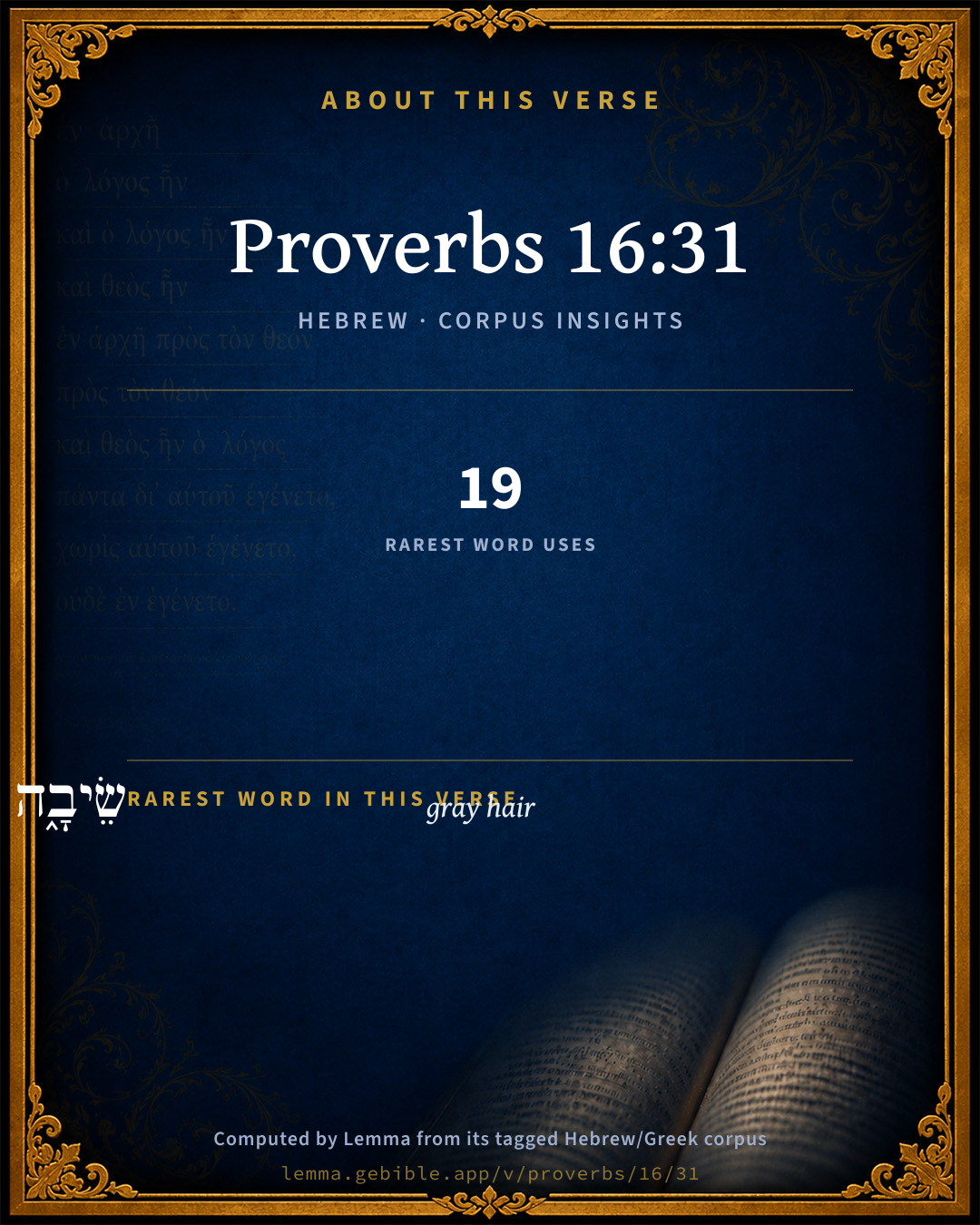
Proverbs 16:31

Hebrew (Westminster Leningrad Codex) Proverbs 16:31 appears in the Hebrew Old Testament. The text above is from the Westminster Leningrad Codex. Each word links to its Strong’s number, a concise gloss, and parsing drawn from the Open Scriptures Hebrew Bible morphology. Click any word for its full Brown-Driver-Briggs (BDB) entry.
Download image
Cite this verse

Proverbs 16:31 (World English Bible). Public Domain. Lemma interlinear Bible study tool, https://lemma.gebible.app/v/proverbs/16/31.

Show BibTeX & RIS
BibTeX
RIS
English Translation
Gray hair is a crown of glory. It is attained by a life of righteousness.
World English Bible · Public Domain
Download a study sheet

One document with this verse’s original text, its word-by-word gloss line, the meaning frame, cross-references with their text, attributed commentary, and full source and license credits — printable, and it pastes into notes with its structure intact.

This verse Autodidact and up

Study sheet (.html) Plain text (.txt)

A passage Seminary Student

Up to 50 verses in one chapter. A passage sheet keeps up to 6 commentary sources and 12 cross-references per verse, in the order this page ranks them, and says so on the sheet whenever that leaves anything out. Ask for a single verse and you get the Autodidact verse sheet above.

Everything on this page stays free to read, with no account — the sheet is a download of what is already on screen, not access to it.

Want to remove ads? Support Godless Engineer
Compare translations 3

The same verse in 3 English versions, stacked beneath the original-language interlinear above. Click any original word for its lexicon entry.

Each is an independent rendering of the whole verse — the interlinear is not word-aligned to these translations.

Highlighted words mark where these versions differ — a whole-verse word diff, not a word-by-word alignment.

  • World English Bible Public Domain
    Gray hair is a crown of glory. It is attained by a life of righteousness.
  • King James Version Public Domain
    The hoary head is a crown of glory, if it be found in the way of righteousness.
  • unfoldingWord Literal Text CC BY-SA 4.0
    Gray hair a crown of splendor; on the road of righteousness it is found.

unfoldingWord Literal Text — © unfoldingWord, licensed CC BY-SA 4.0. Word-aligned USFM3 via Door43 (git.door43.org/unfoldingWord/en_ult).

Versions to compare (up to 4)

3 of 4 selected

Show all 18 translations

Every available English version of this verse, each an independent rendering of the whole verse.

  • World English Bible Public Domain
    Gray hair is a crown of glory. It is attained by a life of righteousness.
  • Berean Standard Bible Public Domain
    Gray hair is a crown of glory; it is attained along the path of righteousness.
  • Majority Standard Bible Public Domain
    Gray hair is a crown of glory; it is attained along the path of righteousness.
  • King James Version Public Domain
    The hoary head is a crown of glory, if it be found in the way of righteousness.
  • American Standard Version (1901) Public Domain
    The hoary head is a crown of glory; It shall be found in the way of righteousness.
  • Revised Version (1885) Public Domain
    The hoary head is a crown of glory, it shall be found in the way of righteousness.
  • Geneva Bible (1599) Public Domain
    Age is a crowne of glory, when it is founde in the way of righteousnes.
  • Douay-Rheims (1899) Public Domain
    Old age is a crown of dignity, when it is found in the ways of justice.
  • Young's Literal Translation Public Domain
    A crown of beauty `are' grey hairs, In the way of righteousness it is found.
  • Literal Standard Version CC BY-SA 4.0
    Grey hairs [are] a crown of beauty, || It is found in the way of righteousness.
  • Unlocked Literal Bible CC BY-SA 4.0
    Gray hair is a crown of glory; it is gained by living the right way.
  • unfoldingWord Literal Text CC BY-SA 4.0
    Gray hair a crown of splendor; on the road of righteousness it is found.
  • Darby Bible Public Domain
    The hoary head is a crown of glory, [if] it is found in the way of righteousness.
  • World Messianic Bible Public Domain
    Gray hair is a crown of glory. It is attained by a life of righteousness.
  • Webster's Bible Public Domain
    The hoary head is a crown of glory, if it is found in the way of righteousness.
  • Free Bible Version CC BY-SA 4.0
    Gray hair is a glorious crown; it's achieved by living right.
  • Bible in Basic English Public Domain
    The grey head is a crown of glory, if it is seen in the way of righteousness.
  • JPS Tanakh (1917) Public Domain
    The hoary head is a crown of glory, it is found in the way of righteousness.

Literal Standard Version (2020), Covenant Press — licensed CC BY-SA 4.0. Text via the HelloAO Bible API (eBible.org). Unlocked Literal Bible (unfoldingWord) — licensed CC BY-SA 4.0. Text via the HelloAO Bible API (eBible.org). unfoldingWord Literal Text — © unfoldingWord, licensed CC BY-SA 4.0. Word-aligned USFM3 via Door43 (git.door43.org/unfoldingWord/en_ult). Free Bible Version, Dr. Jonathan Gallagher — licensed CC BY-SA 4.0. Text via the HelloAO Bible API (eBible.org).

Word by word

More ways to search: Search by grammar → Find every occurrence → Compare this word →

Practice this passage: Drill this verse → Learn its vocabulary →

About this verse

These counts appear in no published source. They are computed here, from the morphology-tagged text and Lemma’s own curated glosses. What Lemma adds →

6
words
6
distinct lemmas
Wisdom
section

Notable vocabulary

The rarest word here is שֵׂיבָ֑ה gray hair H7872 — appearing just 19 times in the whole Hebrew Bible.

Shared distinctive vocabulary

שֵׂיבָ֑ה gray hair H7872 occurs in 19 verses of the Hebrew Bible. Also found in:

Grammatical profile

  • 1 verb
  • 5 nouns

Verb forms

  • תִּמָּצֵֽא Niphal · Imperfect

Hebrew & Septuagint length

In English translation the verse runs 15 words from the Hebrew and 16 from the Septuagint (LXX English) — closely comparable.

A rough comparison of the two English renderings, which tokenize alike — not a word-level alignment.

Word counts can differ between the Hebrew and the Greek without any difference in meaning — e.g. the Hebrew direct-object marker אֵת has no separate Greek word, and Greek often adds the article ὁ.

Cross-references

12

Topical passages linked to Proverbs 16:31 in the Treasury of Scripture Knowledge — connected by theme and wording, ordered by reader-vote popularity; previews shown in the World English Bible.

  • Proverbs 20:29 The glory of young men is their strength. The splendor of old men is their gray hair.
  • Leviticus 19:32 You shall rise up before the gray head, and honor the face of an old man, and you shall fear your God. I am Yahweh.
  • Proverbs 3:1–2 My son, don't forget my teaching; But let your heart keep my commandments:
  • 1 Samuel 12:2–5 Now, behold, the king walks before you; and I am old and gray-headed; and, behold, my sons are with you: and I have walked before you from my youth to this day.
  • Proverbs 17:6 Children's children are the crown of old men; The glory of children are their parents.
  • Genesis 47:7–10 Joseph brought in Jacob, his father, and set him before Pharaoh, and Jacob blessed Pharaoh.
  • Ecclesiastes 4:13 Better is a poor and wise youth than an old and foolish king who doesn't know how to receive admonition any more.
  • Luke 1:6 They were both righteous before God, walking blamelessly in all the commandments and ordinances of the Lord.
  • Luke 2:29–38 "Now you are releasing your servant, Master, According to your word, in peace;
  • Philemon 1:9 yet for love's sake I rather beg, being such a one as Paul, the aged, but also a prisoner of Jesus Christ.
  • 1 Chronicles 29:10–25 Therefore David blessed Yahweh before all the assembly; and David said, You are blessed, Yahweh, the God of Israel our father, forever and ever.
  • Job 32:6–7 Elihu the son of Barachel the Buzite answered, "I am young, and you are very old; Therefore I held back, and didn't dare show you my opinion.

Cross-references courtesy of OpenBible.info (CC BY 4.0).

Hebrew and Greek witnesses Masoretic Hebrew ↔ Greek Septuagint

The same verse in the two great witnesses to the Old Testament, shown verse-for-verse.

These are two independent witnesses, not word-aligned to each other, and the Septuagint is shown in lemma (dictionary) form.

Hebrew Proverbs 16:31 Masoretic · Westminster Leningrad Codex

עֲטֶ֣רֶת תִּפְאֶ֣רֶת שֵׂיבָ֑ה בְּדֶ֥רֶךְ צְ֝דָקָ֗ה תִּמָּצֵֽא

Gray hair is a crown of glory. It is attained by a life of righteousness.

World English Bible · Public Domain

Greek LXX Proverbs 16:31 Septuagint · lemma form
Old age is a crown of honor, but it is found in the ways of righteousness.

LXX2012 (modern English Septuagint) · Public Domain

Hebrew: Westminster Leningrad Codex (CC BY 4.0). Greek: Septuagint (public domain); English from LXX2012 (modern English Septuagint) (Public Domain). How the Septuagint differs from the Hebrew →

Commentary

Notes on Proverbs 16:31 from classic Christian and Jewish commentators (each source and its license shown beneath its notes). The classic Christian expositions comment on the surrounding passage and are grouped to its opening verse, so a note may address several verses; the Jewish commentaries on the Tanakh (Rashi and others) are per-verse, so they appear only where the commentator wrote on this verse.

Lemma curates 59 commentaries, every one of them public domain or Creative Commons licensed, each selected and text-cleaned for this edition rather than reprinted as found. About our sources →

Trapp's Complete Commentary

John Trapp

Pro 16:31 The hoary head [is] a crown of glory, [if] it be found in the way of righteousness.

Ver. 31. The hoary head is a crown of glory.] Old age and honour are of great affinity in the Greek tongue. {a} God gave order that the aged should be honoured. {Lev 19:32} {See Trapp on "Lev 19:32"}

“ Credebant hoc grande nefas, et morro piandum,

Si iuvenis vetulo non assurrexerat. ”

- Juvenal, sat. 13.

There is a certain plant (which our herbalists call herbam impiam, or wicked cudweed) {b} whose younger branches still yield flowers to overtop the elder. Such weeds grow too rife abroad. It is an ill soil that produceth them.

If it be found in the way of righteousness.] Canities tunc venerabilis est, quando ea gerit quae canitiem decent, &c., saith old Chrysostom. {c} Hoariness is then only honourable when it doth such things as become such an age; else it is mucor potius quam canities, rather filthy mouldiness than venerable hoar headedness. Manna, the longer it was kept against the command of God, the more it stank. What can be more odious than an old goat, an old fornicator? &c. What more ridiculous than puer centum annorum, a child, of fourscore or a hundred years old? Turpis et ridieulosa res est elementarius senex, saith Seneca. {d} An A B C old man is a shameful sight. Nectarius, that succeeded Nazianzen at Antioch, had little else to commend him to the place but a goodly gray beard and a graceful countenance. {e} Whereas of Abraham it is reported that he went to his grave in a good old age, or, as the Hebrew hath it, with a good gray head. Pluck out the gray hairs of virtue, and the gray head cannot shine with any great glory.

{a} Cognata sunt, γηρας et γερας, ut ηθος et εθος.

{b} The common name for the genus Gnaphalium of composite plants, having chaffy scales surrounding the flower heads; originally proper to G. sylvaticum; extended to other plants, of allied genera, or similar appearance.

{c} In Epist. ad Heb., ser. 7. Arsatius succeeded Chrysostom, being an old dotal of eighty years, " quem pisces facundia ranae agilitate superabant."

{d} Sen. Epist. 62, ad Lucil.

{e} Veneranda canities, et vultus sacerdote dignus - Baron.

John Trapp, A Commentary or Exposition upon All the Books of the Old and New Testament (1647–1656) — public domain. Text from a community e-Sword module.

The Biblical Illustrator

Joseph S. Exell

Pro_16:31

The hoary head is a crown of glory, if it be found in the way of righteousness.

On the duties and consolations of the aged

To every age there belongs a distinct propriety of behaviour. There arises from it a series of duties peculiar to itself.

I. Some counsels concerning the errors which are most incident to the aged.

1. Almost all of them may be traced up to the feebleness and distresses peculiar to that time of life. Life is then contracted within a narrow and barren circle. Year after year steals somewhat away from their store of comfort, deprives them of some of their ancient friends, blunts some of their powers of sensation, or incapacitates them for some function of life. The aged should consider that to bear the infirmities of age with becoming patience is as much their duty as is that of the young to resist the temptations of youthful pleasure. Though querulous temper may be regarded as a natural infirmity, no apology can be made for that peevish disgust at the manners, and that malignant censure of the enjoyments of the young, which is sometimes found to accompany declining years. Nothing can be more unjust than to take offence at others on account of their partaking of pleasures which it is past your time to enjoy.

2. One of the vices of old age, which appears the most unaccountable, is that covetous attachment to worldly interest with which it is often charged. As vigour of body and mind declines, timidity may be expected to increase. Hence the old sometimes over-value riches, as securing them from danger. But though their apprehensions may justify a cautious frugality, they can by no means excuse a sordid avarice. As increasing years debilitate the body, so they weaken force, and diminish the warmth of affections. Chilled by the hand of time, the heart loses that tender sensibility with which it once entered into the concerns and sorrows of others.

II. The duties which peculiarly belong to old age.

1. A timely retreat from the world. It is only in the shade that the virtues of old age can flourish. By this is not meant a total cessation from worldly enjoyment. The aged should loosen their communication with active life.

2. They should quit the pursuit of such pleasures as are unsuitable to their years. Cheerfulness, in old age, is graceful. It is the natural concomitant of virtue. But the cheerfulness of age is widely different from the levity of youth.

3. A material part of the duty of the aged consists in studying to be useful to the race who are to succeed them: to impart to the young the fruit of their long experience; to instruct them in the proper conduct, and to warn them of the various dangers of life.

4. Let the aged not forget those religious employments which their own state particularly requires.

III. The consolations which belong to old age. Such as arise from patient submission; from the respect rendered by others; from the many enjoyments that remain; from the love and service of those bound to them in family relationships; from the favour of God. (Hugh Blair, D.D.)

The duties of the aged

Long life all men desire: and yet to most no part of life seems to have much happiness in it; and that part least of all, to which living long brings them. And yet, if life is a blessing, long life must be a greater blessing. Old age may be both honourable and happy.

I. What assistance virtue and piety contribute towards making old age honourable and happy.

1. Laying proper foundations in the former part. Neglect of right conduct in our early years is the main reason that our advanced ones are despicable and miserable. See the influence of youthful irregularities; idle expenses; neglect of attaining knowledge; early indulgence of ill-temper; forgetting the Creator in the days of youth. Wisdom is the grey hair unto men, and an unspotted life is old age.

2. Directing to proper behaviour when old age comes. Avoiding the faults to which men are then peculiarly subject. Such are artfulness and insensibility, selfishness and avarice. A mean and penurious behaviour. Sparing and accumulating, without reason or use, is both sin and folly. Another fault is, giving improperly and inequitably what they give, whether in their lives or at their deaths. The aged are sometimes imposed upon by artful people, who supplant those naturally dependent on them. Or they let little piques and preferences influence them, contrary to the justest motives and their own former kind intentions.

Another danger of the aged is ill-temper. Sometimes a consequence of loss of strength, and bodily pain.

1. The aged should therefore anxiously endeavour to preserve a composed and even mind.

2. To practise the duties to which they are peculiarly bound. One is serious reflection on their past conduct, accompanied with earnest endeavours to undo, as far as they can, whatever they have done amiss, and rectify the errors of their busier and warmer days. The more piously and virtuously men have lived, the less necessity will they have in their old age for so minute a review of their ways; but then they will receive the greatest, the most seasonable comfort from it. Another duty is that of religious exercises and contemplations. Another duty is to imprint, on those who come within the sphere of their influence, the same right sentiments of life and conduct which they have acquired for themselves.

II. The directions which virtue and religion furnish are effectual to the desired end. As long as persons in years can enjoy anything, the regard paid by those about them to their established character must support and revive them to a great degree. Those who have proceeded so far in life with innocence must feel from it the highest joy; they who have truly repented cannot fail to be sensible of much consolation. Recollection of their life associations and experiences must be a fruitful source of improving amusement to them, and relating them an acceptable entertainment and instruction to others. (T. Seeker.)

On the relative duties of the aged and the young

We contemplate the aged with sentiments that might be profitable to us, and that are likely to make some impression on the heart. But we cannot consider the hoary head a crown of glory unless it be stored with that wisdom which time and reflection are hourly instilling into the mind, in order to wean us from the world, and prepare us for heaven. A young person has reason to expect from the aged information. They have long sojourned in the land of discipline. To the aged the young apply, as to experienced travellers, that can direct their course through stormy seas or perplexing wilds. The aged cannot acquit themselves of negligence and folly if it should appear that they are unable to warn youth of unexpected dangers, and to point out the path that leads to safety. Life has been of little advantage to him who derives no wisdom from its variety, and no virtue from its trials. It is a mans duty to become practically wise, through a right use of the experiences of life. It should be the care of the aged to communicate to the young only that which is good. Too often they only inculcate a sort of worldly prudence, and selfish kind of knowledge, which chokes the seed of every growing virtue, and disqualifies the child of immortality for heaven. Another moral excellence, which it is the duty of the aged to acquire, is a proper regulation of the passions. Time, and often-repeated experience of sorrow, will often accomplish, in this respect, what reason and religion have attempted in vain. The experience of life should produce settled habits of virtue; it should establish some determined pursuit of good; it should show that life has not been squandered away without improvement. From a proper regulation of the passions would arise that complacent dignity, which is the characteristic of true greatness; and that charity and humility, that mildness and forbearance, which are the ornaments of true religion. It is so ordered by the wisdom of Providence, that the most effectual means of good should, by the perversion of sin, become the most dangerous instruments of evil. There is nothing more pernicious to the morals of youth, or so likely to spread depravity through the different orders of society, as a vicious old man. A number of minor vices and imperfections of character often deprive the aged of honour, and prevent them from being extensively useful. There is sometimes a severity in their conversation, and a moroseness in their disposition, which spoil their influence on the young. Age should be averse to violence and disorder of every kind. The tempests of the mind should be no more; neither the emotions of anger, the murmurings of discontent, nor the bitterness of wrath, should disturb the calm evening of our days. The aged should avoid that querulousness and discontent which they are so often apt to indulge. The religion which administers comfort in age must be cultivated in the days of our youth. It is a mockery of devotion to serve that great and gracious God in the moment of fear only who requires that His service should be perfect freedom. (J. Hewlett, B.D.)

The way of righteousness

I. Describe the way of righteousness. Righteousness here includes the whole rule of our duty towards God and man. Way, in a moral sense, is expressive of a persons course of behaviour, or his ordinary conduct. The way of righteousness is a course of behaviour or conduct prescribed by the Divine Word, that perfect rule of righteousness. It is the way wherein Christ walked. On it rests the Divine approbation. A godly life is neither a light matter nor easy attainment. All who walk in this way must deny themselves. In this way holiness is visible. It shall be called the way of holiness.

II. What is implied in being found in the way of righteousness? It is to be found accustoming oneself to obey the Divine commands, being employed in the practice of religion, and of all virtue. It is a way wherein a person usually walks; that which is his ordinary practice. A man is denominated by the general tenor of his conversation. Being found in a way implies that the conduct of the professor is taken notice of by others. Only the person who is following after righteousness can properly be said to be found in the way of it.

III. The beauty, honour, and dignity which are upon an aged disciple of Christ. There is the beauty of true wisdom and understanding age. Spiritual wisdom, the graces of the Holy Spirit, are ornaments far more honourable than chains of gold. Such disciples are honoured now with the approbation of heaven. Use this subject--

1. To correct mistakes often made concerning religion.

2. To encourage those who desire to walk in this way.

3. To exhort to constancy those who have, through grace, entered the way of righteousness.

4. To awaken all to a sense of their duty. They ought to enter and walk in this way. (Thomas Flower.)

The honour of aged piety

It is a dictate of natural conscience, that reverence is due to the aged merely on account of their age. The general practice of the heathen, both ancient and modern, confirms and illustrates this dictate of nature. And the Scriptures command us to show respect to the aged. When wisdom and piety accompany old age, it is peculiarly venerable.

I. On what accounts aged piety is peculiarly honourable.

1. It began early. This must be supposed. It is implied in the expression found in the way of righteousness. Such a one hath been long walking in that way. Where persons have, with good Obadiah, feared the Lord from their youth, and walked in His fear all their days, they claim peculiar respect. They have indeed lived--lived to a good purpose. This will command honour from others.

2. Their piety is founded on knowledge and experience. Knowledge is gained by observation, reflection, reading, and converse. Our stock of knowledge naturally increaseth with advancing years. It will be more or less according to mens natural abilities, education, and pains taken in improving their understandings. The aged are not always wise, but they frequently are so, and always much wiser than younger persons of equal capacities, advantages, and applications. Aged saints are peculiarly honourable, because their knowledge is of the best kind, and applied to the best purposes. Their wisdom is an ornament of grace to them.

3. The piety of aged Christians is approved and steadfast. Many put on an appearance of piety to serve some secular purpose. But the piety of the aged Christian has been severely tested and proved, in the long and severe experiences of life. An aged saint is like a tree arrived at maturity, that, having brought forth fruit many years, in its season, stood many storms, and taken root the faster, is known by all around to be very valuable. He is rooted in the faith, grounded and settled.

4. The piety of the aged is attended with great usefulness. God is glorified when Christians bring forth much fruit: and in proportion to mens usefulness will be their honour. The piety of an aged Christian is much to the glory of God, as it shows the excellency of His dispensations. Aged saints are useful to mankind. They shine as lights in a dark world, and produce a secret veneration for religion in the hearts of those who will not be persuaded to pursue it They are living witnesses to the kindness of Gods providence, the riches of His grace, and His faithfulness to His promises. They are patterns of patience, contentment, and thankfulness. Their prayers are serviceable to the world and to the Church. They are capable of giving excellent counsel.

5. Their piety renders them peculiarly ripe for glory. Graces shine brighter through the wrinkles that deform the countenance.

II. Useful instructions from this subject.

1. The hoary head is a disgrace and reproach to an old sinner.

2. Aged saints ought be reverenced. Let us speak of them and to them with the greatest respect; tenderly pity, and patiently bear with, their weaknesses, and consider the excellences of their characters, as casting a lustre even over their infirmities.

3. Aged saints should proceed in the ways of righteousness, with thankfulness and courage.

4. It is the wisdom of young persons to enter on the ways of righteousness. There is very little hope for those who forget God in their youthful days. (J. Orton.)

The distinguished honour of aged piety

There is no beauty or comeliness like that of holiness. Nothing tends more to adorn or recommend a person. Here holiness is presented under the notion of a most excellent and comely ornament which suits persons of any age or condition. Some think these words are a proposal of the most likely course men can take to prolong their days. Others think that the duty of the aged is here prescribed. We take it thus: Then is the hoary head more especially an ornament and glory when it is found in the way of righteousness. There is somewhat venerable in old age.

1. The knowledge of the aged may be supposed to be very considerable, by reason of the long time they have had for acquiring it.

2. The virtue and sincerity of the aged is more tried and approved than of those who have but lately set out and engaged in religion.

3. As the virtue and holiness of the aged is more tried and approved through their long standing, so it is more considerable in the degree and measure. There is a double improvement which we may suppose Christians to make, the one by becoming more confirmed and established in their holy religion, and the other by their abounding more in the fruits of righteousness.

4. Such persons are eminent instruments of bringing glory to God and of usefulness to His Church. The more conspicuous the power of goodness in such people, the more God is glorified by them.

5. The hoary head that is found in the way of righteousness is ripe for glory and just ready to enter into it. Infer--

(1) The unreasonableness of the contempt that young persons sometimes show to those who are old, even mocking at their infirmities.

(2) The reasonableness of the apostolic rule, Ye younger, submit yourselves unto the elder.

(3) Persons should make preparation for the honour and comfort of old age, even by choosing the ways of righteousness while they are young. (W. Pierce.)

Christian experience

Some of the distinguishing features in the experience of aged disciples.

1. They have a greater knowledge and more enlarged experience--knowledge of the Scriptures, and of Gods providence, and of the world. They have learned much in the school of affliction.

2. Another feature in the experience of the fathers in Christ is their deadness to the world. Years have taught them to moderate their estimate of what the world can do for them. They sit loose from the world, knowing that they must soon leave it.

3. Heavenly-mindedness is another feature. This appears in their contemplating passing events, chiefly in their reference to the spiritual and eternal world, and in the interest they take in what has a special reference to the Church, and in spending their time in retirement and meditation.

4. Humility is another feature. In looking back over the way in which God has led them they see much to keep them humble.

5. A calm, composed, and peaceful state of mind is another feature. They are now, in great measure, freed from the turbulence of unruly passions within.

6. Their being in a waiting posture is another feature. They resign business details to younger hands.

7. A joyful anticipation of the blessedness and glory awaiting them is another feature; This is intended to present a high standard of the distinguishing features in the experience of far-advanced Christians. (George Muirhead, D.D.)

Honourable old age

I. What is the way of righteousness in which the old man is supposed to be found?

1. It is supposed that the old man has spent the preceding part of his life in devotional exercises.

2. It is supposed that the old man has, in the preceding part of his life, practised self-control, and regulated his pursuits and pleasures by the discipline of religion. It is the remembrance of his good deed which awakens our esteem and love.

3. It is supposed that the old man has been a useful member of society. To those insignificant beings who have contributed nothing to the benefit of mankind we owe, when they arrive at old age, not honour, but pity.

II. That honour is due to the old man who is found in the way of righteousness.

1. He is a man, the sincerity of whose religion is placed beyond suspicion by the long trial which it has sustained.

2. He is a man who, through Divine assistance, has fulfilled the end of his creation.

3. He is a man who is qualified, by the wisdom which he has acquired, to be the instructor and guide of his inferiors in years.

4. He is a man who stands high in the favour of God.

5. He is a man who is about to receive the reward of his labours. (John Dick, D.D.)

The glory of aged piety

1. That righteousness is conducive to old age. This is a fact sustained both by philosophy and history.

2. That piety is conducive to honour.

I. It is the glory of spiritual ripeness. There is something glorious in maturation. The seed ripened into an autumnal crop, the youth ripened into mature manhood, the student ripened into the accomplished scholar, are all objects of admiration. In an old saint there is a truly glorious ripeness. There you have all the seeds of truth and holiness as sown by holy teachers, cultured by experience, fostered by the sunbeam and the showers of God, tried and strengthened in their roots by the storms of adversity, hanging in rich clusters on the boughs ready to be gathered in. Thou shalt come to thy grave in a full age, like as a shock of corn cometh in in his season (Job_5:26).

II. It is the glory of spiritual command. Even Egypts proud despot bowed before it. And Joseph brought in Jacob his father and set him before Pharaoh, and Jacob blessed Pharaoh (Gen_47:7-10). Samuel was an old saint when he died (1Sa_25:1; 2Ch_24:15-16).

III. It is the glory of spiritual prospects. Now lettest Thou Thy servant depart in peace, etc. We conclude with the utterance of a modern author: As ripe fruit is sweeter than green fruit, so is age sweeter than youth, provided the youth were grafted into Christ. As harvest-time is a brighter time than seed-time, so is age brighter than youth; that is, if youth were a seed-time for good. As the completion of a work is more glorious than the beginning, so is age more glorious than youth; that is, if the foundation of the work of God were laid in youth. As sailing into port is happier than the voyage, so is age happier than youth; that is, when the voyage from youth is made with Christ at the helm. (D. Thomas, D.D.)

The old age of the righteous, honourable

This is a just aphorism and beautifully expressed. Old age is, in a figurative and poetical manner, described by one of its concomitants, and by one which does not directly imply any of its infirmities, but rather is in its very appearance venerable.

I. The old age of the virtuous is honourable on account of the life which has preceded it. It is the termination of a wise, a well-spent, and a useful life. Such a life reflects great glory on the person who has accomplished it.

1. In a religious and virtuous old man we behold one who has long been exposed to the temptations of the world and has overcome them.

2. A virtuous old age is the termination of a life which has been filled up with worthy and useful actions.

II. The old age of the virtuous is honourable in itself.

1. The character which a pious and virtuous old person exhibits to our view is that of goodness, genuine, improved, and useful; of all characters the most respectable. This character was acquired by the conduct of the whole life, and therefore naturally turns our eye backward to its course; but when we consider it as now possessed in its maturity, and actuating the aged person in all his motions, it is, in itself, and without regard to the life which preceded it, a glorious ornament.

2. In old age virtue is naturally accompanied by wisdom and prudence, derived from long experience.

III. The old age of good men is honourable in respect of the prospects which attend it. These are the principal causes of that firmness and cheerfulness under their infirmities which procures them reverence; and these reflect honour upon them in other ways. Old age is the termination of this mortal life; but to good men it is the immediate prelude to immortality. A person who early began to follow holiness, and has persisted in it to an advanced age, is ripe for the glory and happiness of heaven. His hoary head is a natural emblem and the direct forerunner of that everlasting crown which he is ready to receive. Practical reflections:

1. This subject gives us a striking view of the excellence of religion, of the importance of true goodness, fit to recommend it to our love and to engage us in the practice of it. It alone can preserve us innocent and blameless in our younger and gayer days and render us useful in our maturity.

2. It instructs the young in the duty which they owe to their elders. Their years give them superiority, their experience gives them prudence, and, if they have exercised themselves unto godliness, the length of their exercise has rendered them proficients in holiness: these are all natural motives to respect, esteem, and honour. The subject of this discourse suggests to the young instructions likewise of a more extensive nature; it urges them to begin early a religious and holy life. Would you establish your claim to honour when you shall arrive at old age? Be good betimes: begin early, and persist steadily.

3. In the subject of this discourse the old are particularly interested. Are any of you, ye aged, yet strangers to the way of righteousness? Your hoary head is your disgrace. At every age vice is the greatest folly, for at every age men may be hurried in a moment to suffer the punishment of vice; but in old age vice is perfect madness, for the hoary sinner must quickly be summoned to his doom. How dreadfully dangerous is your state! (Alex. Gerard, D.D.)

Ideal age

I. Its characteristics.

1. Established faith.

(1) His saving trust is perfected.

(2) His theological convictions are consolidated.

2. Beautiful spirit.

(1) Devoutness.

(2) Humility.

(3) Patience.

(4) Cheerfulness.

(5) Liberality.

(6) Wisdom.

(7) Resignation.

(8) Hopefulness.

3. Continued usefulness.

(1) Sympathy.

(2) Counsel.

(3) Prayer.

(4) Work.

II. Its glory.

1. The glory of rich experience. Has learnt among other lessons--

(1) To believe in the love of God in spite of all contrary appearances.

(2) To always do right irrespective of possible consequences.

(3) To be kind to all, but to place confidence only in the select few.

(4) To sit loose to earthly possessions.

(5) To receive advice, but act with an independent judgment.

(6) To seek right conclusions, uninfluenced by conventional notions.

(7) To put the best probable construction on doubtful actions.

(8) To make allowances for the infirmities of others.

2. The glory of pleasing memories.

(1) Memories of blessings thankfully received.

(2) Memories of work faithfully done.

3. The glory of deserved honour.

4. The glory of thrilling hopes.

(1) Hope of a happy departure from earth.

(2) Hope of a blessed existence in paradise to the end of time.

(3) Hope of a glorious resurrection to eternal life. (T. Baron.)

The Biblical Illustrator, edited by Joseph S. Exell (c. 1880s–1900s) — public domain. Text from a community e-Sword module.

Joseph Benson's Commentary

Pro 16:31. The hoary head is a crown of glory — A great honour and ornament, as it is a singular blessing of God, and a token of great experience and prudence; if it be found in the way of righteousness — If it be accompanied with true piety, otherwise an old sinner is accursed, Isa 65:20. “Old age,” says Bishop Patrick, “is very venerable, when a man’s past life has been truly virtuous and useful; which is the best way also to prolong one’s days, and bring one to that great honour, which is due to those who have long done much good to mankind.”

Joseph Benson's Commentary on the Old and New Testaments (1811–1818) — public domain. Text from a community e-Sword module.

The Preacher's Complete Homiletical Commentary

Joseph S. Exell (gen. ed.)

MAIN HOMILETICS OF Pro_16:31

A CROWN OF GLORY

I. Hoary heads may be found which are not in the way of righteousness. A hoary head in the way of ungodliness is one of the saddest sights that a thoughtful mind can look upon.

1. Because in such a man the tendency towards evil has been strengthened by the habits of a long life. In childhood there is a condition of comparative innocency to start with, and there is hope that this freedom from actual transgression may develop into a tried virtue in the passage from youth to old age. But when childhood has passed away, the condition of comparative innocence has passed away too, and if the evil tendencies of human nature are not resisted they grow stronger as the man grows in years, and old age finds him more under the dominion of sinful habit than any former period of his life. An ungodly man is more ungodly when he is old than he has ever been before, and is therefore a sadder object of contemplation then than he was in his youth or in his prime. Such a hoary-headed sinner often wishes that it was now as easy to do right as it was in his youth, but he finds that it is not so. “To will” may be “present” with him (Rom_7:18), but he finds that by reason of his long indulgence in sinful habits it is less easy now to perform that which he wills than it was when his locks were black and his form unbent. The man whose limbs are palsied by age finds that they do not move in obedience to his will so readily as they did in the days of his health, and the aged man finds also that his moral actions are not so easily controlled as they were when he was young—the vessel does not answer to her helm so quickly as it did then. It is always sad to look upon a slave, even upon one who is only a slave in body. But it is far sadder to see a man who is in spiritual bondage—one who is “taken captive by the devil at his will” (2Ti_2:26), and we look upon such an one whenever we look upon a hoary head in the way of ungodliness.

2. Because such a man is growing old in soul as well as in body. When he was a child the seeds of perpetual youth were implanted within him; if he had then given himself up to holy influences old age would have found him as young in heart as when he was a boy, because although the outer man of all men perishes daily, the inner man of the godly is renewed day by day (2Co_4:16). But ungodliness deprives a man of the blessedness of being for ever young—of retaining to the latest hour of life the freshness of feeling which characterises the young, and of leaving the world with a certainty that all his mental and spiritual powers will be renewed throughout eternity. His soul sympathises with his body, and the weakness and decay of the shell is a symbol of what is going on within.

3. Because he is nearing the mysterious exodus from this world which must be accomplished by all without being prepared for it. All men are near to death—men of all ages are uncertain whether they will be here on the morrow, but the old man knows certainly that his race is almost run—that he must shortly put off this tabernacle. And there is nothing more depressing to a man than to feel that he is utterly unprepared to meet the demands of a great crisis in his life which is near—that he has soon to meet a person who holds his destinies in his hand and that he has nothing to hope, but everything to fear from him—that he has to embark on a voyage to a distant land without any knowledge of what shall befall him when he arrives there. And if a long course of ungodliness has blunted his capability of seeing his own true position, it is clear to thoughtful onlookers, and the sight fills them with sadness.

II. But a hoary head in the way of righteousness is a kingly head. There is nothing kingly in old age considered in itself. An old man’s body is not such a kingly object to look upon as a young man’s—it does not give us the idea of so much power and capability. And an ungodly old man—as we have seen—is not a king but a slave—a slave to sinful habits, to the infirmities of age, and to the fear of death. But the hoary head of a righteous man—

1. Tells a tale of conquest. It speaks of many temptations met, and wrestled with, and overcome. His passions are not his masters, but his servants—he has learned to bring into subjection even his thoughts; he reigns as king over himself, and so his hoary hairs are a symbol of his kingship.

2. It is a sign of spiritual maturity. In all the works of God we expect the best and the most perfect results at the last. There is a glory and a beauty in the field covered with the green blades of early spring, but the period of its perfection is not in the spring, but in the autumn, when the full corn in the ear stands ready for the sickle. The mind of the youthful philosopher may be mighty in its power, but its capabilities are greater when he has spent a long life in developing them. It is in harmony with all the methods of God’s working that all that is of real worth in a man should be nearer perfection the longer he lives, and it is so with all those who are willing to bring their lives into harmony with the Divine will. If an old man is a godly man, he is more like God in his character and disposition in his old age than he ever was before, and this spiritual maturity invests him with a kingly dignity.

3. It is an earnest of a brighter crown which is awaiting him. To him death is not an unwelcome visitor, and God is a Being in whose presence he expects to realise “fulness of joy” (Psa_16:11), and the country beyond the grave a place to which he often longs to depart. All such hoary-headed servants of God can adopt the language of the aged Paul, and say, “I am now ready to be offered, and the time of my departure is at hand. I have fought a good fight, I have finished my course, I have kept the faith. Henceforth there is laid up for me a crown of righteousness, which the Lord, the righteous Judge, shall give me at that day” (2Ti_4:7-8). To all such it is especially fit that kingly honours should be paid. “Thou shalt rise up before the hoary head, and honour the face of the old man” (Lev_19:32).

OUTLINES AND SUGGESTIVE COMMENTS

We honour them whose heads have been encircled with crowns by the hands of men, and will we refuse honour to those whom God himself hath crowned with silver hairs?—Lawson.

The word if is a supplement. The verse may be read, “The hoary head is a crown of glory: it shall be found in the way of righteousness.” Two things are implied:—The conduciveness of righteousness to the attainment of old age, and its conduciveness to the respectability and honour of old age.—Wardlaw.

The hoary head is the old man’s glory and claim for reverence. God solemnly links the honour of it with His own fear (Lev_19:32). “The ancient” are numbered with “the honourable” (Isa_9:15). The sin of despising them is marked (Isa_3:5), and, when shown towards His own prophet, was awfully punished (2Ki_2:23-24). Wisdom and experience may be supposed to belong to them (Job_12:12), and the contempt of this wisdom was the destruction of a kingdom (1Ki_12:13-20). But the diamond in the crown is, when it is found in the way of righteousness. Even a heathen monarch did homage to it (Gen_47:7-10); an ungodly nation and king paid to it the deepest respect (1Sa_25:1; 2Ki_13:14). The fathers of the Old and New Testament reflected its glory. The one died in faith, waiting the Lord’s salvation; the other was ready to “depart in peace” at the joyous sight of it (Luk_2:28-29). Zacharias and Elizabeth walked in all the ordinances of the Lord blameless; Anna, “a widow indeed,” in the faith and hope of the Gospel; Polycarp, with his fourscore and six years, in his Master’s service. Crowns of glory were their hoary heads, shining with all the splendour of royalty. Earnestly does the holy Psalmist plead this crown for usefulness to the Church (Psa_71:18); the Apostle, for the cause of his converted slave (Philippians 2).—Bridges.

The old age is to be reverenced most which is white, not with gray hairs only, but with heavenly graces. Commendable old age leaneth upon two staves—the one a remembrance of a life well led, the other a hope of eternal life. Take away these two staves, and old age cannot stand with comfort; pluck out the gray hairs of virtues, and the gray head cannot shine with any bright glory.… The gray head is a glorious ornament, for, first, hoary hairs do wonderfully become the ancient person, whom they make to look the more grave, and to carry the greater authority in his countenance; secondly, they are a garland or diadem, which not the art of man, but the finger of God, hath fashioned and set on the head.—Muffet.

Hoariness is only honourable when found in a way of righteousness. A white head, accompanied with a holy heart, makes a man truly honourable. There are two glorious sights in the world: the one is a young man walking in his uprightness, and the other is an old man walking in ways of righteousness. It was Abraham’s honour that he went to his grave in a good old age, or rather, as the Hebrew hath it, with a good grey head (Gen_25:8). Many there be that go to their graves with a grey head, but this was Abraham’s crown, that he went to his grave with a good grey head. Had Abraham’s head been never so grey, if it had not been good it would have been no honour to him.… When the head is as white as snow, and the soul is as black as hell, God usually gives up such to scorn and contempt.… But God usually reveals Himself most to old disciples, to old saints: “With the ancient is wisdom; and in length of days understanding” (Job_12:12). God usually manifests most of Himself to aged saints. They usually pray most and pay most, they labour most and long most after the choicest manifestations of Himself and of His grace, and therefore He opens His bosom most to them, and makes them of His cabinet council. “And the Lord said, shall I hide from Abraham that thing which I do,” etc. (Gen_18:17-19). Abraham was an old friend, and therefore God makes him both of His court and council. We usually open our hearts most freely, fully, and familiarly, to old friends. So doth God to His ancient friends.—Brooks.

Age is not all decay; it is the ripening, the swelling of the fresh life within that withers and bursts the husk.—George Macdonald.

Aged piety is peculiarly honourable.

1. It hath long continued. When it is said “If it be found,” etc., intimates that such a one has been long walking in that way.

2. It is founded on knowledge and experience. They are well acquainted with the suitableness and sufficiency of the Redeemer. They have made many useful observations on the methods of providence towards themselves, their families, and the Church of God. They know much of the evil of sin, of the nature of temptations, and of the many devices of Satan.

3. It is proved and steadfast. The aged Christian is “rooted in the faith,” grounded and settled, his habits of piety are become quite natural.

4. It is attended with much usefulness. The piety of an aged Christian is much to the glory of God, as it shows especially the Gospel’s power to bear the Christian on through difficulties and temptations. And aged saints are very useful to mankind. Their steadfast piety puts to silence the ignorance of foolish men who complain of the restraints of religion as unreasonable and intolerable, and of the Redeemer’s laws as impracticable. They are living witnesses to mankind of the kindness of God’s providence and the riches of His grace.—Job Orton.

The Preacher's Complete Homiletical Commentary (gen. ed. Joseph S. Exell; Funk & Wagnalls, c. 1892) — public domain (pre-1929). A full-Bible homiletical/sermon-outline anthology covering 65 of 66 books (2 John is absent from the source module). Text from a community e-Sword module.

Keil & Delitzsch

C. F. Keil & F. Delitzsch

Pro 16:31

31 A bright diadem is a hoary head,

In the way of righteousness it is found -

namely, this bright diadem, this beautiful crown (Pro 4:8), which silver hair is to him who has it as the result of his advanced age (Pro 20:29), for "thou shalt rise up before the hoary head," Lev 19:32; and the contrast of an early death is to die in a good old age, Gen 15:15, etc., but a long life is on one side a self-consequence, and on another the promised reward of a course of conduct regulated by God's will, God's law, and by the rule of love to God and love to one's neighbour. From the N.T. standpoint that is also so far true, as in all the world there is no better established means of prolonging life than the avoidance of evil; but the clause corresponding to the O.T. standpoint, that evil punishes itself by a premature death, and that good is rewarded by long life, has indeed many exceptions arising from the facts of experience against it, for we see even the godless in their life of sin attaining to an advanced old age, and in view of the veiled future it appears only as a one-sided truth, so that the words, Wisd. 4:9, "discretion is to man the right grey hairs, and an unstained life is the right old age," which is mediated by life experiences, such as Isa 57:1., stand opposed to the above proverb as its reversed side. That old Solomonic proverb is, however, true, for it is not subverted; and, in contrast to self-destroying vice and wickedness; calling forth the judgment of God, it is and remains true, that whoever would reach an honoured old age, attains to it in the way of a righteous life and conduct.

Pro 16:32

32 Better one slow to anger than a hero in war;

And whoever is master of his spirit, than he who taketh a city.

Regarding ארך אפּים, vid., Pro 14:29, where קצר־רוּח was the parallel of the contrast. The comparison is true as regards persons, with reference to the performances expressed, and (since warlike courage and moral self-control may be united in one person) they are properly those in which the טוב determines the moral estimate. In Pirke Aboth iv. 1, the question, "Who is the hero?" is answered by, "he who overcomes his desire," with reference to this proverb, for that which is here said of the ruling over the passion of anger is true of all affections and passions.

"Yet he who reigns within himself, and rules

Passions, desires, and fears, is more a king

Which every wise and virtuous man attains."

(Note: Milton's Paradise Regained, ii. 466-8.)

On the other side, the comparison is suggested:

Break your head, not so sore;

Break your will - that is more.

(Note: "Zerbrich den Kopf dir nicht so sehr; Zerbreich den Willen - das ist mehr." - Matth. Claudius)

Pro 16:33

33 One casts the lot into the lap;

But all its decision cometh from Jahve.

The Tra knows only in one instance an ordeal (a judgment of God) as a right means of proof, Num 5:12-31. The lot is nowhere ordained by it, but its use is supported by a custom running parallel with the Mosaic law; it was used not only in private life, but also in manifold ways within the domain of public justice, as well as for the detection of the guilty, Jos 7:14., Sa1 14:40-42. So that the proverb Pro 18:18 says the same thing of the lot that is said in the Epistle to the Heb; Heb 6:16, of the oath. The above proverb also explains the lot for an ordeal, for it is God who directs and orders it that it fall out thus and not otherwise. A particular sanction of the use of the lot does not lie in this, but it is only said, that where the lot is cast, all the decision that results from it is determined by God. That is in all cases true; but whether the challenging of the divine decision in such a way be right in this or that case is a question, and in no case would one, on the contrary, venture to make the person of the transgressor discoverable by lot, and let it decide regarding human life. But antiquity judged this matter differently, as e.g., the Book of Jonah (chap. 1) shows; it was a practice, animated by faith, in God's government of the world, which, if it did not observe the boundary between faith and superstition, yet stood high above the unbelief of the "Enlightenment." Like the Greek κόλπος, חיק (from חוּק, Arab. ḥaḳ, khaḳ, to encompass, to stretch out) means, as it is commonly taken, gremium as well as sinus, but the latter meaning is the more sure; and thus also here it is not the lap as the middle of the body, so that one ought to think on him who casts the lot as seated, but also not the lap of the garment, but, like Pro 6:27, cf. Isa 40:11, the swelling, loose, external part of the clothing covering the bosom (the breast), where the lot covered by it is thrown by means of shaking and changing, and whence it is drawn out. The construction of the passive הוּטל (from טוּל = Arab. tall, to throw along) with the object. accus. follows the old scheme, Gen 4:18, and has its reason in this, that the Semitic passive, formed by the change of vowels, has not wholly given up the governing force of the active. משׁפּט signifies here decision as by the Urim and Thummim, Num 27:21, but which was no lot-apparatus.

Keil & Delitzsch — Biblical Commentary on the Old Testament (1861–1891) — public domain (CC PDM 1.0). Text via the HelloAO Bible API. (Old Testament only.)

Tyndale Open Study Notes

Tyndale Open Resources

16:31 Godly people grow in wisdom as they grow older, so their gray hair is a crown (cp. 4:9; 12:4; 17:6).

Tyndale Open Study Notes — © Tyndale Open Resources, licensed CC BY-SA 4.0. Text via the HelloAO Bible API.

Geneva Bible (1599)

Geneva Bible translators

That is, when it is joined with virtue: or else the elder that the wicked are, the more they are to be abhorred.

Geneva Bible (1599) marginal notes — public domain. Text via Bolls.life.

Matthew Henry's Commentary

Note, 1. It ought to be the great care of old people to be found in the way of righteousness, the way of religion and serious godliness. Both God and man will look for them in that way; it will be expected that those that are old should be good, that the multitude of their years should teach them the best wisdom; let them therefore be found in that way. Death will come; the Judge is coming; the Lord is at hand. That they may be found of him in peace, let them be found in the way of righteousness (Pe2 3:14), found so doing, Mat 24:46. Let old people be old disciples; let them persevere to the end in the way of righteousness, which they long since set out in, that they may then be found in it. 2. If old people be found in the way of righteousness, their age will be their honour. Old age, as such, is honourable, and commands respect (Thou shalt rise up before the hoary head, Lev 19:32); but, if it be found in the way of wickedness, its honour is forfeited, its crown profaned and laid in the dust, Isa 65:20. Old people therefore, if they would preserve their honour, must still hold fast their integrity, and then their gray hairs are indeed a crown to them; they are worthy of double honour. Grace is the glory of old age.

Matthew Henry's Commentary on the Whole Bible (1708–1710) — public domain (CC PDM 1.0). Text via the HelloAO Bible API.

Jamieson, Fausset & Brown

Robert Jamieson, A. R. Fausset & David Brown

(Compare Pro 20:29).

if--or, which may be supplied properly, or without it the sense is as in Pro 3:16; Pro 4:10, that piety is blessed with long life.

Jamieson, Fausset & Brown — Commentary Critical and Explanatory on the Whole Bible (1871) — public domain (CC PDM 1.0). Text via the HelloAO Bible API.

Adam Clarke's Commentary

Verse 31. The hoary head is a crown of glory] The latter part of the verse is very well added, for many a sinner has a hoary head.

Adam Clarke's Commentary on the Bible (1810–1826) — public domain. Text from a community e-Sword/MySword module.

Ellicott's Commentary for English Readers

(31) If it be found in the way of righteousness.—Rather, it is found; old age being promised as the reward of obedience. (Comp. Pro_3:1-2; Pro_3:16; Pro_4:10; Pro_9:11; Pro_10:27.)

A Bible Commentary for English Readers, edited by Charles John Ellicott (1878–1897) — public domain. Text from a community e-Sword module.

The Cambridge Bible for Schools and Colleges

gen. ed. J. J. S. Perowne

31. if it be found] Rather, it shall be found, R.V. text. “Decus et ornamentum est senectus, senectus vero præmium virtutis,” Maur. Comp. Pro_3:2; Pro_3:16.

The Cambridge Bible for Schools and Colleges (gen. ed. J. J. S. Perowne; Cambridge University Press, 1878–1918) — public domain. Text from a community e-Sword module.

John Gill's Exposition

He that is slow to anger is better than the mighty,.... Than a mighty warrior or conqueror; as Alexander who conquered his enemies, and even all the world, and yet in his wrath slew his best friends: a man that is slow to anger is esteemed by the Lord, respected by men, and is happy in himself; and is preferable to the strongest man that is not master of himself and of his passions;

and he that ruleth his spirit than he that taketh a city; one that has the command of his temper, that can govern himself, and not suffer his passions to exceed due bounds, is superior in strength to him that can storm a castle or take a fortified city; it is easier to do the one than the other; courage of mind joined with wisdom, and assisted by a proper number of persons, may do the one; but it requires the grace of God, and the assistance of his spirit, thoroughly to do the other. Cicero says (t), in all ages

"fewer men are found who conquer their own lusts than that overcome the armies of enemies.''

(t) Epist. l. 5. Ep. 4.

John Gill's Exposition of the Whole Bible (1746–1763) — public domain (CC PDM 1.0). Text via the HelloAO Bible API.

Albert Barnes' Notes on the Bible

Omit “if.” Literally, “it (i. e., the hoary head) is found in the way of righteousness,” comes as the reward of righteousness.

Albert Barnes' Notes on the Bible (1834–1885) — public domain. Text from a community e-Sword/MySword module.

Haydock's Catholic Bible Commentary

Justice. To the just longevity is promised. (Calmet)

George Leo Haydock (1774–1849), Haydock's Catholic Family Bible and Commentary, 1859 edition — public domain. Excludes Psalms (Douay-Rheims chapter numbering differs from Protestant) and Deuterocanonical books (Catholic canon only).

Matthew Poole's English Annotations

A crown of glory; a great honour and ornament, as it is a singular blessing of God, a token of great experience and prudence, as it comes nearest to God, who is called

the Ancient of days, Dan 7:9. If it be found in the way of righteousness; if it be accompanied with true piety, otherwise an old sinner is accursed, Isa 65:20. Heb. it shall be found, &c. This is a privilege promised to righteous persons, Exo 20:12; Pro 3:16; 4:22; whereas ungodly men shall not live out half their days, Psa 55:23.

Matthew Poole's English Annotations on the Holy Bible (1683–1685) — public domain. Text from a community e-Sword/MySword module.

Whedon's Commentary on the Bible

Daniel D. Whedon

31. A crown of glory — A glorious, splendid, or beautiful crown.

Found… righteousness — There is no conditional particle in the original; hence some read without the condition, as much as to say, to walk in the way of righteousness will secure a good old age — long life. But it may, without violence to grammar, be rendered as in our version, or with Stuart, “should it be found,” etc. Patrick, as usual where there is any ambiguity, combines both senses. “Gray hairs, to be a crown of glory, must be found in the way of righteousness.” — Miller.

Daniel D. Whedon (gen. ed.), Commentary on the Old and New Testaments (1874–1909) — public domain. Text from a community e-Sword module.

The Pulpit Commentary

The hoary head is a crown of glory. (Pro_20:29) (For "crown," see on Pro_17:6) Old age is the reward of a good life, and therefore is an honour to a man. (comp. Pro_3:2, 16 4:10 9:11 10:27) If it be found rather, it shall be foundin the way of righteousness; the guerdon of obedience and holiness; whereas "bloody and deceitful men shall not live out half their days". (Psa_55:23) It is well said in the Book of Wisdom (4, 5, etc.), "Honourable age is not that which standeth in length of time, nor that is measured by number of years. But wisdom is the grey hair unto men, and an unspotted life is old age.

The glory of old age.

I OLD AGE MAY BE CROWNED WITH GLORY IN THE COMPLETION OF LIFE. it is not natural to die in youth. We talk of the bud gathered before it has opened on earth, that it may bloom with perfection in heaven, etc.; but we must confess that there is a great mystery in the death of children. If God so wills it, it is better to live through the whole three score years and ten into full old age. The broken column is the symbol of the unfinished life. "Such a one as Paul the aged" could say, "I have finished my course.

1. Life is good. It may be sorrow stricken and it may be wrecked on the rocks of sin. Then, indeed, it is evil. There was one of whom it was said, "It had been good for that man if he had not been born". (Mat_26:24) But in itself life is good. Men in mental sanity prize it. The Old Testament idea of the value of a full long life is more healthy than the sickly sentimentalism that fancies an early death to be a Heaven-sent boon.

2. Time is for service. Therefore the longer the time allotted to one, the more opportunity is there for doing good. This, again, may be abused and misspent in sin. But the old age of a good man means the completion of a long day"s work. Surely it is an honour to be called into the field in the early morning of life, and to be permitted to toil on till the shadows descend on a long summer evening.

II OLD AGE MAY BE CROWNED WITH GLORY IN ITS OWN ATTAINMENTS. A bad old age presents a hideous picture. A hoary-headed sinner is, indeed, a spectacle of horror. Mere old age is not venerable in itself. Reverence for years implies a belief that the years have gathered in a harvest of venerable qualities. Old age has its defects, not only in bodily frailty, but in a certain mental stiffening. Thus Lord Bacon says, "Men of age object too much, consult too long, adventure too little, repent too soon, and seldom drive business home to the full period, but content themselves with a mediocrity of success;" and Madame de Stael says, "To resist with success the frigidity of old age, one must combine the body, the mind, and the heart; to keep these in parallel vigour one must exercise, study, and love." But, on the other hand, there are inward attainments of a ripe and righteous old age that give to the late autumn of life a mellow flavour which is quite unknown in its raw summer. "Age is not all decay," says a modern novelist; "it is the ripening, the swelling, of the fresh life within, that withers and bursts the husk." It has been remarked that women are most beautiful in youth and in old age. The wisdom, the judiciousness, the large patience with varieties of opinion which should come with experience, are not always round in old people, who sometimes stiffen into bigotry and freeze into dreary customs. But when these graces are found in a large and healthy soul, no stage of life can approach the glory of old age. Even when there is not capacity for such attainments, there is a beautiful serenity of soul that simpler people can reach, and that makes their very presence to be a benediction.

III OLD AGE MAY BE CROWNED WITH GLORY IN ITS PREPARATION FOR THE FUTURE. In unmasking the horrible aspect of death and revealing the angel face beneath, Christianity has shed a new glory over old age. It is the vestibule to the temple of a higher life. The servant of God has been tried and disciplined by blessing, suffering, and service. At length he is "meet for the inheritance of the saints in light." He can learn to resist the natural melancholy of declining powers with the vision of renewed energy in the heavenly future. Or, if he cares for rest, he may know that it will be a rest with Christ, and he can say, with the typical aged saint Simeon, "Lord, now lettest thou thy servant depart in peace, for mine eyes have seen thy salvation.

Vers. 31, 32. The gentle life.

Portrayed with exquisite sweetness and beauty.

I AN HONOURED AGE. The biblical pictures of the aged pious are very charming, and Polycarp, with his eighty-six years upon him, passing to another crown, that of martyrdom, is sublime; also "Paul the aged and the prisoner." The text points out what we must all recognize for an aesthetic truth, that it is the association of age with. goodness which makes it truly respectable, venerable, beautiful.

II MORAL HEROISM. The heathen type of heroism was strength of arm bodily strength, manly courage against an outward foe. The spiritual and the Christian type is in strength of will against evil, self mastery, self-conquest, sublime patience. Better than to be members of any knightly order, "Companions" of the Bath, or any similar society speaking of the lower and carnal virtues, to be "companions in tribulation, and in the kingdom and patience of Jesus Christ. J.

The crown of old age.

Many are the crowns which, in imagination, we see upon the head. Many are eagerly desired and diligently sought; such are those of fame, of rank, of wealth, of power, of beauty. These are well enough in their way; but

(1) that which is spent in winning them is often far more valuable than the good for which the sacrifice is made; and

(2) the crown, when it is worn, usually weighs heavier and gives less satisfaction than was imagined in the ardour of pursuit. Old age is a crown. It is natural that men should desire it, for two reasons.

1. It means a prolongation of life; and life, under ordinary conditions, is greatly desired, so that men cling to it even tenaciously.

2. It means the completion of the course of life. Age is one of its natural stages. It has its privations, but it has also its own honours and enjoyments; those who have passed through life"s other experiences may rightly wish to complete their course by wearing the hoary head of old age. But in connection with age, there is

I THE CROWN OF SHAME. For it is not always found in the way of righteousness. An old man who is still ignorant of those truths which he might have learned, but has neglected to gather; or who is addicted to dishonourable indulgences which he has had time to conquer, but has not subdued; or who yields to unbeautiful habits of the spirit which he should long ago have expelled from his nature and his life; or who has not yet returned unto that Divine Father who has been seeking and calling him all his days; such an old man, with his grey hairs, wears a crown of dishonour rather than of glory. But while we may feel that he is to be condemned, we feel far more inclined to pity than to blame. For what is age not found in the way of righteousness age without excellency, age without virtue, age uncrowned with faith and hope? Surely one of the most pitiable spectacles the world presents to our eyes. It is pleasant, indeed, to be able to regard

II THE CROWN OF HONOUR. When old age is found in the way of righteousness, it is a crown of honour, in that:

1. It has upon it the reflection of an honourable past. It speaks of past virtues that have helped to make it the "green old age" it is; of past successes that have been gained in the battle of life; of past services that have been diligently and faithfully rendered; of past sorrows that have been meekly borne; of past struggles that have been bravely met and passed; for it was in the rendering and in the bearing and in the meeting of these that the hair has been growing grey from year to year.

2. It has the special excellency of the present. "A crown of beauty" (marginal reading). In the "hoary head" and in the benignant countenance of old age there is a beauty which is all its own; it is a beauty which may not be observable to every eye, but which is there nevertheless; it is the beauty of spiritual worth, of trustfulness and repose, of calmness and quietness; it is a beauty if not the beauty, of holiness. He who does not recognize in the aged that have grown old in the service of God and in the practice of righteousness something more than the marks of time, fails to see a crown of beauty that is visible to a more discerning eye.

3. It has the blessed anticipation of the future. It looks homeward and heavenward. A selfish and a worldly old age is grovelling enough; it "hugs its gold to the very verge of the churchyard mould;" but the age that is found in the ways of righteousness has the light of a glorious hope in its eyes; it wears upon its brows the crown of a peaceful and blessed anticipation of a rest that remains for it, of a reunion with the beloved that have gone on before, of a beatific vision of the Saviour in his glory, of a larger life in a nobler sphere, only a few paces further on. C.

The Pulpit Commentary (1880–1919), ed. H.D.M. Spence-Jones & Joseph S. Exell — public domain. Text from a community e-Sword module.

Bridges on Proverbs

Charles Bridges

The hoary head is the old man’s glory (Pro 20:29 ), and claim for reverence.†1 God solemnly links the honour of it with his own fear.†2 "The ancient" are numbered with "the honourable." (Isa 9:15 .) The sin of despising them is marked (Isa 3:5 ), and, when shewn towards his own prophet, was awfully punished.†3 Wisdom and experience may justly be supposed to belong to them;†4 and the contempt of this wisdom was the destruction of a kingdom.†5

But the diamond in the crown is, when it is found in the way of righteousness. Even an Heathen Monarch did homage to it (Gen 47:7-10 ); an ungodly nation and King paid to it the deepest respect.†6 The Fathers of the Old and New Testament reflected its glory. The one died in waiting faith in the Lord’s salvation. The other was ready to "depart in peace" in the joyous sight of it.†7 "Zacharias and Elizabeth walked in all the ordinances of the Lord blameless;"†8 Anna — "a widow indeed" in the faith and hope of the Gospel;†9 Polycarp, with his fourscore and six years in his Master’s service.†10 — Crowns of glory were their hoary heads shining with all the splendour of royalty. Earnestly does the holy Psalmist plead this crown for usefulness to the Church (Psa 71:18 ); the Apostle, for the cause of his converted slave. (Phm 1:9 .) And who more honourable than those, who, having been "planted" in youth within the courts of the Lord, grow up to "bring forth fruit in old age," manifesting the glory of the Lord’s faithfulness and love? (Psa 92:13-15 .) Truly is an old man’s ’diadem that, which not the art of man, but the kingdom of God, hath fashioned and set on his head.’†11 And is not the earthly glory brightened by its nearness to the unfading, everlasting crown?

But separate the heavenly virtue from the hoary head. "The crown is fallen." It lies dishonoured in the dust. For what is a more lamentable spectacle, than a graceless old man, only gaining by his score of years a proportionate share of guilt? Time is no empty duration. It is filled up with talents for eternity, a field for their exercise, helps for their improvement, and account for their neglect or abuse. The white hairs of ungodliness bespeak ripeness for wrath — "wrath treasured up" with every day’s uninterrupted increase "against the day of wrath." (Rom 2:5 .) "The sinner being an hundred years old shall be accursed."†12

Footnotes:

†1 Pro 23:22. 2Sa 19:32, 2Sa 19:39 .

†2 Lev 19:32. The Roman satirist intimates, that the neglect of "rising up before the hoary head" was punishable with death. — Juven. Satire, 13, 54-56. The reverence paid by the Lacedaemonians to the hoary head is well known. They probably borrowed this law from the Egyptians, who inculcated this respect to its full extent. Herod. Lib. ii. c.26. Compare also Ovid, Fasti, v. 57, 58. See a serious and instructive paper in the Rambler, No. 50.

†3 2Ki 2:23-24 .

†4 Job 12:12; Job 32:4-7 .

†5 1Ki 12:13-20 .

†6 Samuel, 1Sa 25:1 . Elisha, 2Ki 13:14 . Jehoiada, 2Ch 24:15-16 .

†7 Gen 49:18. Luk 2:28-29 .

†8 Luk 1:6.

†9 Luk 2:36-37.

†10 Euseb. Lib. iv. c. 15. Milner’s Church History, i. p. 16.

†11 Muffet in loco.

†12 Isa 65:20. ’There is not on earth a more venerable and delightful spectacle than that of an aged pilgrim walking with God; and a more affecting and deeply melancholy sight can hardly, on the contrary, be imagined, than that of a hoary-headed sinner, who has lived his fourscore years "with God in the world," — all that time God calling and he refusing, and the Almighty "angry with him every day:" his body now bowed down beneath the weight of years; all his powers of action and of enjoyment decaying; every hour likely to be his last; time all behind him, and eternity all before him; and his soul still "dead in trespasses and sins;" the hour of his departure come, and no readiness for the world to which he is bound. O! with what opposite emotions do we contemplate old age in this character, and in the saint of God; who in approaching the close of his earthly pilgrimage is drawing near to what has been the goal of his hopes and desires; who, while outwardly decaying, is inwardly maturing for heaven; in whom every symptom of coming death is but a symptom of approaching life; and who, in the final exhaustion of nature, bids adieu to the world in the words of aged Simeon — "Lord, now lettest thou thy servant depart in peace, for mine eyes have seen thy salvation." ’ — Wardlaw, on Ecc 12:7 .

Charles Bridges, An Exposition of the Book of Proverbs (1846) — public domain. Text from a community e-Sword module.

Kretzmann's Popular Commentary

Paul E. Kretzmann

v. 31. The hoary head, the white hair of an old person, is a crown of glory, like a splendid diadem, a shining ornament, if it be found in the way of righteousness, for only then will an old person be regarded with approval by the Lord.

Paul E. Kretzmann, Popular Commentary of the Bible (1921–1924) — public domain. Text from a community e-Sword module.

unfoldingWord translationNotes

Door43 World Missions Community

Gray hair is a crown of glory

The writer speaks of gray hair as if it were a crown. "Gray hair" is a metonym for old age. AT: "A person who has lived long enough to have gray hair is like one who wears a glorious crown on his head" (See: Metaphor and Metonymy)

it is gained

This can be stated in active form. AT: "a person gains it" (See: Active or Passive)

one who rules his spirit

The writer speaks of a person being able to control his own temper and emotions as if he ruled over his spirit like a king rules his people. AT: "one who controls his temper" (See: Metaphor)

translationWords

crown

glory

life

anger

spirit

unfoldingWord translationNotes — © Distant Shores Media and the Door43 World Missions Community, licensed CC BY-SA 4.0. Source: git.door43.org/Door43/en_tn.

Rashi

Rabbi Shlomo Yitzchaki (Rashi)

it will be found in the way of righteousness Through righteousness, they live long.

Rashi on the Tanakh — English translations: “The Judaica Press complete Tanach with Rashi, translated by A. J. Rosenberg” (CC BY 4.0); “Pentateuch with Rashi's commentary by M. Rosenbaum and A.M. Silbermann, 1929-1934” (public domain); “The Metsudah Tanach series, Lakewood, N.J” (CC BY 4.0); and “The Book of Joshua, Metsudah Publications, 1997” (CC BY 4.0). Text via Sefaria.

Lesson kit

Teaching starters — assembled from the data on this page, not authored interpretation. Every prompt links to the verse data it draws on. Edit before teaching.

Proverbs, in the Wisdom, opens this verse with 6 words (6 distinct Hebrew lemmas). Its most distinctive word is sêybâh (“gray hair”). A historical commentator’s framing appears above. Read the whole chapter for the surrounding context.

Discussion questions

  1. How does “gray hair” (sêybâh) shape what this verse is saying?
  2. Genesis 15:15 shares the word «gray hair» with this verse. How do the two illuminate each other?
  3. The translations on this page render this verse differently — a whole-verse word diff, not a word-by-word alignment. What might account for the different wordings?
  4. The verb «תִּמָּצֵֽא» is Niphal Imperfect. How does its form color the action?
  5. Reading how Trapp's Complete Commentary and The Biblical Illustrator read this verse, where do the two commentators agree and where do they part?

Things to notice

Reading settings

Reading text

Shown beneath each verse's original-language words.

Old Testament
Old Testament edition

Read the OT as the Masoretic Hebrew (MT) or the Greek Septuagint (LXX).

English shown for the Greek Septuagint (in the Hebrew ↔ Greek comparison).

Comparing translations? Open the Compare panel on any verse page to stack up to four side by side.