
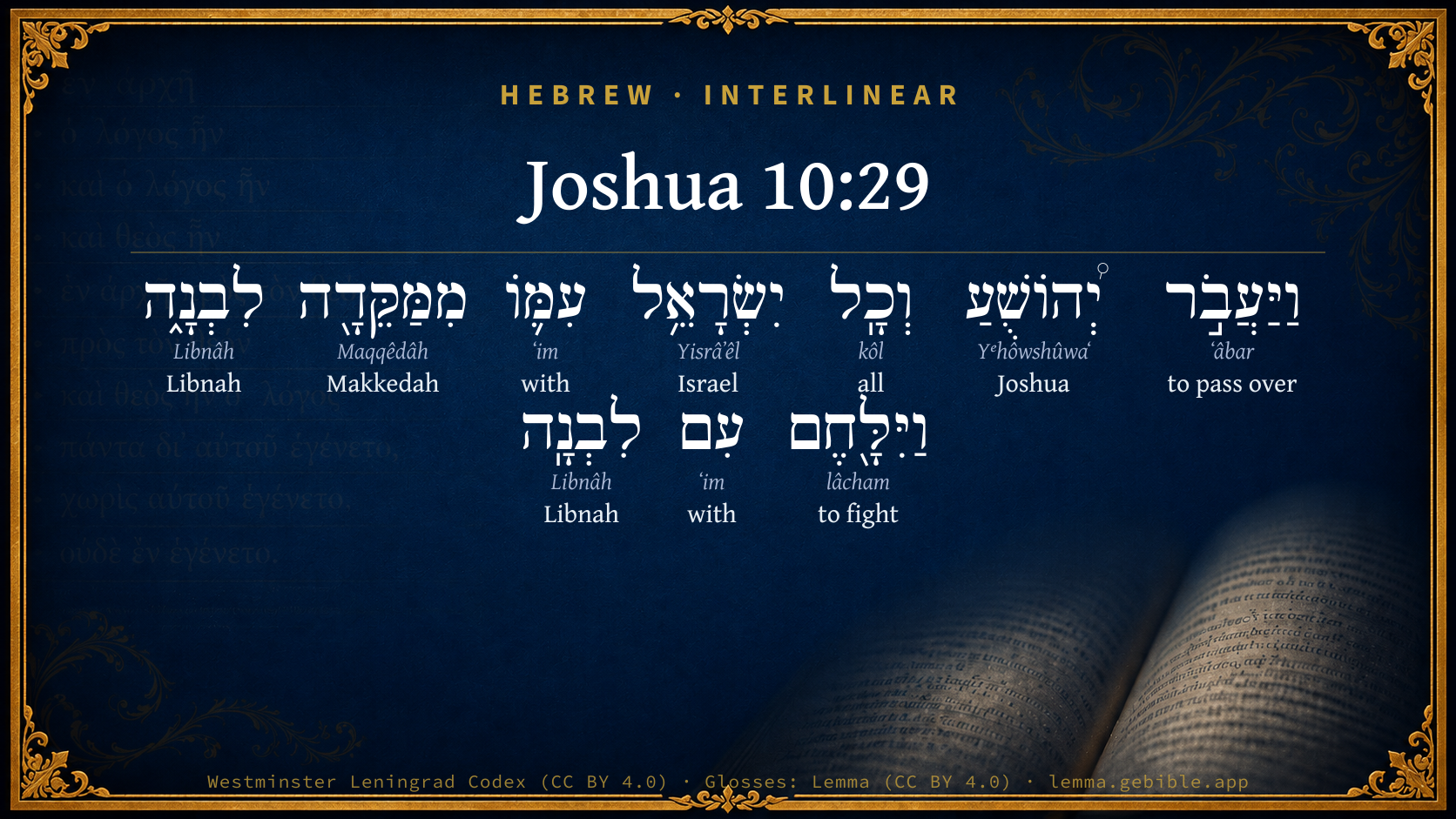
Joshua 10:29

Hebrew (Westminster Leningrad Codex) Joshua 10:29 appears in the Hebrew Old Testament. The text above is from the Westminster Leningrad Codex. Each word links to its Strong’s number, a concise gloss, and parsing drawn from the Open Scriptures Hebrew Bible morphology. Click any word for its full Brown-Driver-Briggs (BDB) entry.
Download image
Cite this verse

Joshua 10:29 (World English Bible). Public Domain. Lemma interlinear Bible study tool, https://lemma.gebible.app/v/joshua/10/29.

Show BibTeX & RIS
BibTeX
RIS
English Translation
Joshua passed from Makkedah, and all Israel with him, to Libnah, and fought against Libnah:
World English Bible · Public Domain
Download a study sheet

One document with this verse’s original text, its word-by-word gloss line, the meaning frame, cross-references with their text, attributed commentary, and full source and license credits — printable, and it pastes into notes with its structure intact.

This verse Autodidact and up

Study sheet (.html) Plain text (.txt)

A passage Seminary Student

Up to 50 verses in one chapter. A passage sheet keeps up to 6 commentary sources and 12 cross-references per verse, in the order this page ranks them, and says so on the sheet whenever that leaves anything out. Ask for a single verse and you get the Autodidact verse sheet above.

Everything on this page stays free to read, with no account — the sheet is a download of what is already on screen, not access to it.

Want to remove ads? Support Godless Engineer
Compare translations 3

The same verse in 3 English versions, stacked beneath the original-language interlinear above. Click any original word for its lexicon entry.

Each is an independent rendering of the whole verse — the interlinear is not word-aligned to these translations.

Highlighted words mark where these versions differ — a whole-verse word diff, not a word-by-word alignment.

  • World English Bible Public Domain
    Joshua passed from Makkedah, and all Israel with him, to Libnah, and fought against Libnah:
  • King James Version Public Domain
    Then Joshua passed from Makkedah, and all Israel with him, unto Libnah, and fought against Libnah:
  • unfoldingWord Literal Text CC BY-SA 4.0
    And Joshua and all of Israel with him passed over from Makkedah to Libnah, and he fought with Libnah.

unfoldingWord Literal Text — © unfoldingWord, licensed CC BY-SA 4.0. Word-aligned USFM3 via Door43 (git.door43.org/unfoldingWord/en_ult).

Versions to compare (up to 4)

3 of 4 selected

Show all 18 translations

Every available English version of this verse, each an independent rendering of the whole verse.

  • World English Bible Public Domain
    Joshua passed from Makkedah, and all Israel with him, to Libnah, and fought against Libnah:
  • Berean Standard Bible Public Domain
    Then Joshua and all Israel with him moved on from Makkedah to Libnah and fought against Libnah.
  • Majority Standard Bible Public Domain
    Then Joshua and all Israel with him moved on from Makkedah to Libnah and fought against Libnah.
  • King James Version Public Domain
    Then Joshua passed from Makkedah, and all Israel with him, unto Libnah, and fought against Libnah:
  • American Standard Version (1901) Public Domain
    And Joshua passed from Makkedah, and all Israel with him, unto Libnah, and fought against Libnah:
  • Revised Version (1885) Public Domain
    And Joshua passed from Makkedah, and all Israel with him, unto Libnah, and fought against Libnah:
  • Geneva Bible (1599) Public Domain
    Then Ioshua went from Makkedah, and all Israel with him vnto Libnah, and fought against Libnah.
  • Douay-Rheims (1899) Public Domain
    And he passed from Maceda with all Israel to Lebna, and fought against it:
  • Young's Literal Translation Public Domain
    And Joshua passeth over, and all Israel with him, from Makkedah `to' Libnah, and fighteth with Libnah;
  • Literal Standard Version CC BY-SA 4.0
    And Joshua passes over, and all Israel with him, from Makkedah [to] Libnah, and fights with Libnah;
  • Unlocked Literal Bible CC BY-SA 4.0
    Joshua and all Israel passed on from Makkedah to Libnah. He went into battle against Libnah.
  • unfoldingWord Literal Text CC BY-SA 4.0
    And Joshua and all of Israel with him passed over from Makkedah to Libnah, and he fought with Libnah.
  • Darby Bible Public Domain
    And Joshua passed, and all Israel with him, from Makkedah to Libnah, and fought against Libnah.
  • World Messianic Bible Public Domain
    Joshua passed from Makkedah, and all Israel with him, to Libnah, and fought against Libnah.
  • Webster's Bible Public Domain
    Then Joshua passed from Makkedah, and all Israel with him, to Libnah, and fought against Libnah:
  • Free Bible Version CC BY-SA 4.0
    Then Joshua and the Israelite army left Makkedah and went to attack Libnah,
  • Bible in Basic English Public Domain
    Then Joshua and all Israel with him went on from Makkedah and came to Libnah, and made an attack on it;
  • JPS Tanakh (1917) Public Domain
    And Joshua passed from Makkedah, and all Israel with him, unto Libnah, and fought against Libnah.

Literal Standard Version (2020), Covenant Press — licensed CC BY-SA 4.0. Text via the HelloAO Bible API (eBible.org). Unlocked Literal Bible (unfoldingWord) — licensed CC BY-SA 4.0. Text via the HelloAO Bible API (eBible.org). unfoldingWord Literal Text — © unfoldingWord, licensed CC BY-SA 4.0. Word-aligned USFM3 via Door43 (git.door43.org/unfoldingWord/en_ult). Free Bible Version, Dr. Jonathan Gallagher — licensed CC BY-SA 4.0. Text via the HelloAO Bible API (eBible.org).

Word by word

More ways to search: Search by grammar → Find every occurrence → Compare this word →

Practice this passage: Drill this verse → Learn its vocabulary →

מִמַּקֵּדָ֖ה
Maqqêdâh
H4719
“from · Makkedah”
Preposition + Noun, Proper
Part of Speech
Preposition + Noun
Type
Proper
Full BDB Definition

Origin: from the same as H5348 in the denominative sense of herding (compare H5349 )

TWOT: None

Makkedah = "place of shepherds" - the location of a cave in Judah where Joshua captured and executed five Canaanite kings during the conquest; located near Bethhoron and Libnah
  1. וַיַּעֲבֹ֣ר ʻâbar H5674 “and · to pass over” Conjunction + Verb, Qal, Sequential Imperfect, 3rd Person, Masculine, Singular
  2. יְ֠הוֹשֻׁעַ Yᵉhôwshûwaʻ H3091 “Joshua” Noun, Proper
  3. וְכָֽל kôl H3605 “and · all of” Conjunction + Noun, Common, Masculine, Singular, Construct
  4. יִשְׂרָאֵ֥ל Yisrâʼêl H3478 “Israel” Noun, Proper
  5. עִמּ֛וֹ ʻim H5973 “with · him” Preposition + Suffix, Personal, 3rd Person, Masculine, Singular
  6. לִבְנָ֑ה Libnâh H3841 “Libnah” Noun, Proper
  7. וַיִּלָּ֖חֶם lâcham H3898 “and · to fight” Conjunction + Verb, Niphal, Sequential Imperfect, 3rd Person, Masculine, Singular
  8. עִם ʻim H5973 “with” Preposition
  9. לִבְנָֽה Libnâh H3841 “Libnah” Noun, Proper

About this verse

These counts appear in no published source. They are computed here, from the morphology-tagged text and Lemma’s own curated glosses. What Lemma adds →

10
words
8
distinct lemmas
Historical
section

Notable vocabulary

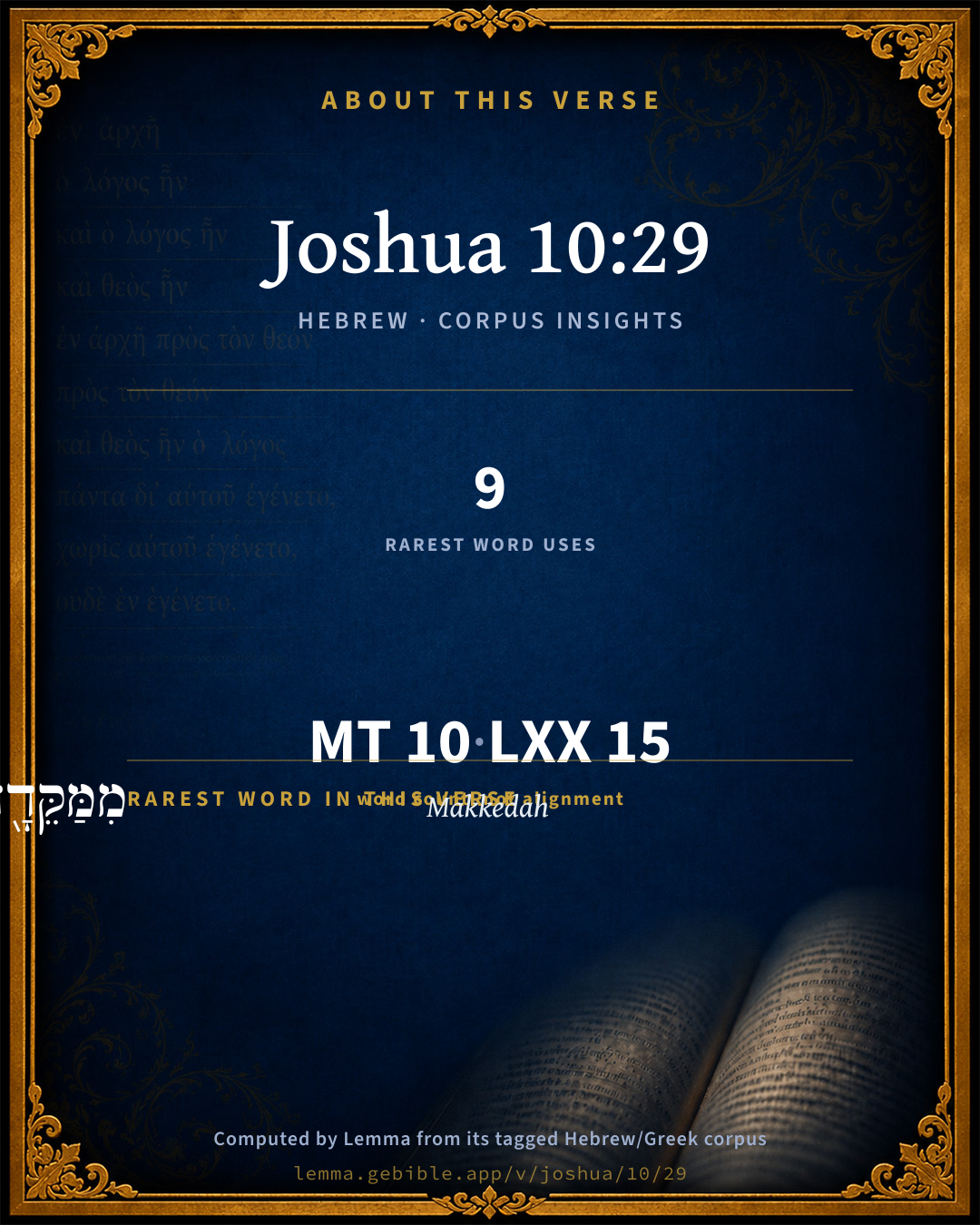
The rarest word here is מִמַּקֵּדָ֖ה Makkedah H4719 — appearing just 9 times in the whole Hebrew Bible.

Shared distinctive vocabulary

מִמַּקֵּדָ֖ה Makkedah H4719 occurs in 8 verses of the Hebrew Bible. Also found in:

Grammatical profile

  • 2 verbs
  • 6 nouns
  • 2 prepositions

Verb forms

  • וַיַּעֲבֹ֣ר Qal · Sequential Imperfect
  • וַיִּלָּ֖חֶם Niphal · Sequential Imperfect

Repetition

Words recur within this verse — often emphatic in Hebrew:

  • לִבְנָ֑ה Libnah H3841 ×2
  • עִמּ֛וֹ with H5973 ×2

Hebrew & Septuagint length

In English translation the verse runs 15 words from the Hebrew and 16 from the Septuagint (LXX English) — closely comparable.

A rough comparison of the two English renderings, which tokenize alike — not a word-level alignment.

Word counts can differ between the Hebrew and the Greek without any difference in meaning — e.g. the Hebrew direct-object marker אֵת has no separate Greek word, and Greek often adds the article ὁ.

In the original languages it is 10 Hebrew tokens and 15 Greek tokens — but the two are counted differently (Hebrew bundles its prefixes and suffixes into one token; the Greek is in lemma form), so that isn’t a like-for-like length.

Cross-references

11

Topical passages linked to Joshua 10:29 in the Treasury of Scripture Knowledge — connected by theme and wording, ordered by reader-vote popularity; previews shown in the World English Bible.

  • Joshua 21:13 To the children of Aaron the priest they gave Hebron with its suburbs, the city of refuge for the manslayer, and Libnah with its suburbs,
  • Joshua 15:42 Libnah, and Ether, and Ashan,
  • Numbers 33:20 They traveled from Rimmon Perez, and encamped in Libnah.
  • Joshua 6:21 They utterly destroyed all that was in the city, both man and woman, both young and old, and ox, and sheep, and donkey, with the edge of the sword.
  • Joshua 8:2 You shall do to Ai and her king as you did to Jericho and her king: only the spoil of it, and the cattle of it, shall you take for a prey to yourselves: set you an ambush for the city behind it.
  • Joshua 8:29 The king of Ai he hanged on a tree until the evening: and at the going down of the sun Joshua commanded, and they took his body down from the tree, and cast it at the entrance of the gate of the city, and raised thereon a great heap of stones, to this day.
  • Joshua 10:28 Joshua took Makkedah on that day, and struck it with the edge of the sword, and the king of it: he utterly destroyed them and all the souls who were therein; he left none remaining; and he did to the king of Makkedah as he had done to the king of Jericho.
  • Joshua 12:15 the king of Libnah, one; the king of Adullam, one;
  • 2 Kings 8:22 So Edom revolted from under the hand of Judah to this day. Then did Libnah revolt at the same time.
  • 2 Kings 19:8 So Rabshakeh returned, and found the king of Assyria warring against Libnah; for he had heard that he was departed from Lachish.
  • Jeremiah 52:1 Zedekiah was twenty-one years old when he began to reign; and he reigned eleven years in Jerusalem: and his mother's name was Hamutal the daughter of Jeremiah of Libnah.

Cross-references courtesy of OpenBible.info (CC BY 4.0).

Hebrew and Greek witnesses Masoretic Hebrew ↔ Greek Septuagint

The same verse in the two great witnesses to the Old Testament, shown verse-for-verse.

These are two independent witnesses, not word-aligned to each other, and the Septuagint is shown in lemma (dictionary) form.

Hebrew Joshua 10:29 Masoretic · Westminster Leningrad Codex

וַיַּעֲבֹ֣ר יְ֠הוֹשֻׁעַ וְכָֽל יִשְׂרָאֵ֥ל עִמּ֛וֹ מִמַּקֵּדָ֖ה לִבְנָ֑ה וַיִּלָּ֖חֶם עִם לִבְנָֽה

Joshua passed from Makkedah, and all Israel with him, to Libnah, and fought against Libnah:

World English Bible · Public Domain

Greek LXX Joshua 10:29 Septuagint · lemma form

καί ἀποἔρχομαι ἰησοῦς καί πᾶς ἰσραήλ μετά αὐτός ἐκ μακηδα εἰς λεβνα καί πολιορκέω λεβνα

And Joshua and all Israel with him departed out of Makeda to Lebna, and besieged Lebna.

LXX2012 (modern English Septuagint) · Public Domain

Hebrew: Westminster Leningrad Codex (CC BY 4.0). Greek: Septuagint (public domain); English from LXX2012 (modern English Septuagint) (Public Domain). How the Septuagint differs from the Hebrew →

Targum (Aramaic paraphrase)

1

The Targum is the ancient Jewish Aramaic paraphrase of the Hebrew Scriptures — an interpretive translation, not the Hebrew text itself. Onkelos (literal) and Pseudo-Jonathan (expansive) render the Torah, and Jonathan the Prophets. Coverage is partial: where no permissively-licensed English translation exists for a verse, only the Aramaic is shown. This is verse-level text, not a word-by-word alignment to the Hebrew.

  1. Targum Jonathan Prophets (Joshua–Malachi)
    וַעֲבַר יְהוֹשֻׁעַ וְכָל יִשְׂרָאֵל עִמֵיהּ מִמַקֵדָה לְלִבְנָה וְאַגִיחַ קְרָבָא עִם לִבְנָה:

    (no public-domain English translation for this verse)

    Targum Jonathan — Aramaic: “Mikraot Gedolot” (public domain). English: “Sefaria Community Translation” (CC0 1.0 (public-domain dedication)); “London "Chaldee Paraphrase," 1871” (public domain). Text via Sefaria.

Commentary

Notes on Joshua 10:29 from classic Christian and Jewish commentators (each source and its license shown beneath its notes). The classic Christian expositions comment on the surrounding passage and are grouped to its opening verse, so a note may address several verses; the Jewish commentaries on the Tanakh (Rashi and others) are per-verse, so they appear only where the commentator wrote on this verse.

Lemma curates 59 commentaries, every one of them public domain or Creative Commons licensed, each selected and text-cleaned for this edition rather than reprinted as found. About our sources →

Trapp's Complete Commentary

John Trapp

Jos 10:29 Then Joshua passed from Makkedah, and all Israel with him, unto Libnah, and fought against Libnah:

Ver. 29. Then Joshua passed, &c.] Like a wise general he pursueth his victories; which if Hannibal had done after the battle at Cannae, he might have taken Rome, which afterwards he would have done but could not. Hence one said of him, Vincere scis Hannibal, victoria uti nescis: Hannibal knew how to get a victory, but not how to use it.

John Trapp, A Commentary or Exposition upon All the Books of the Old and New Testament (1647–1656) — public domain. Text from a community e-Sword module.

The Preacher's Complete Homiletical Commentary

Joseph S. Exell (gen. ed.)

CRITICAL NOTES.—

Jos_10:29. Libnah] Another of the cities belonging to the Shephelah, or low country of Judah. It was besieged by Sennacherib (2Ki_19:8), and it was probably in this neighbourhood that the 185,000 Assyrians were slain, in one night, by the angel of the Lord. Dean Stanley and Van de Velde differ as to the site of Libnah—the former placing it at Tell es-Safieh, five miles N.W. of Eleutheropolis, and the latter, with more confidence, at Arâk el-Meushȋyeh, four miles W. of Eleutheropolis.

Jos_10:32. On the second day] On the second day of the siege. Thus, even in the days of Joshua, Lachish gave indications of the strength, as a fortified town, which was manifested in its subsequent history.

Jos_10:33. Gezer] This city is not said to have been destroyed. Judging by 1Ki_9:16, some have concluded that it “was not subdued till Solomon’s days.” This is obviously a mistake, for with “none remaining” of the inhabitants, what could there have been left to subdue? The city, as was the case in other instances, was no doubt speedily re-occupied by the fugitive Canaanites, and thus re-inhabited it was spared, and made to “serve under tribute” (cf. chap. Jos_16:10; Jos_21:21; Jdg_1:28-29). Twice in the history of David’s time it is called Gazer. “Perhaps the strongest claims for identity with Gezer are put forward by a village called Yasûr, four or five miles east of Joppa, on the road to Ramleh and Lydd” [Smith’s Bib. Dict.]

Jos_10:38. Debir] The same as Kirjath-sepher, “the city of the Oracle,” or the “Book.” Sometimes called Kirjath-sannah, from its palm trees. It was near Hebron. There were two other places called Debir.

Jos_10:37-39. And all the cities thereof] Shewing that both Hebron and Debir had smaller cities under their respective governments.

Jos_10:40. “The hills] i.e., the mountain country; the south] i.e., the Negeb, or land on the southern slopes toward the desert; the vale] i.e., the Shephelah or Philistine plain; the springs] i.e., the ravines on the borders between the mountain country and the Shephelah” [Crosby]. He left none remaining] Many, however, fled into Philistia and elsewhere, and returned as soon as they were able to do so.

Jos_10:41. From Kadesh-barnea even unto Gaza] The southernmost line of the land of Canaan, from about twenty miles below the Dead Sea to Gaza, on the Mediterranean coast. The site of Kadesh-barnea is unknown. Goshen even unto Gibeon] Goshen is also unknown. It was possibly so named by the Israelites in memory of their dwelling-place in Egypt, and apparently must have been somewhere south of Hebron. It is again named in chapters Jos_11:16; Jos_15:51. The two lines of description, one on the extreme south, and the other through the midst of this part of the land, are evidently meant to describe Joshua’s complete conquest of all southern Canaan.

OUTLINES AND COMMENTS ON THE PARAGRAPH.—Jos_10:29-43

Jos_10:30. Of Makkedah and Libnah, and of the remaining cities whose destruction is recorded in this chapter, it is particularly said that Joshua smote “all the souls that were therein.” Joshua did this under the special and emphatic commandment of the Lord. In the overthrow of Jericho, in the hail storm and the miraculous extension of the day at Beth-horon, God made this war manifestly His own. These solemn records seem to have a special claim to notice, and a peculiar value at the present time. In days when so many are disposed to make the wrath of the Lord unreal, we shall do well to remember that this wrath has a history. In is not merely a doctrine of that which is to come; it is also recorded as that which has been. When the arguments which go to depreciate the anger of Jehovah have been urged to the utmost, these terrible histories will still remain. If they serve to warn any who are too prone to believe in unlimited mercy, and thus to bring them to Him through whom alone mercy is proclaimed, they will prove, a undoubtedly they will, that they also are a part of the good tidings of the God of love.

Some men are typical both in sin and punishment. They are ensamples unto them who believe not. Thus, for the second time, we read of these acts of Joshua, “as he did unto the king of Jericho.” Great grace causes some men to be known as pillars of the Church; great infamy in the rejection of grace makes the names of others to become by-words in the way of wickedness.

Jos_10:33. It is not enough to help men; we must help them in the way of righteousness. Compassion and sympathy may be misplaced, and may but lead to ruin. Sin has its patriots and its volunteers, as well as righteousness. How hard is the yoke of Satan, under which even generous service, like this rendered by Horam, leads to death! how easy is the yoke of Christ, where even a cup of cold water, given in the name and spirit of a disciple, shall in no wise lose its reward!

Jos_10:36-37. PAST, PRESENT, AND FUTURE.

I. The fame of the past has no guarantee against degradation in the present. A great history of godly names, even in these early days, already stood connected with Hebron. The city itself was famed for its antiquity (Num_13:22); better still, the names of holy men of old were associated with its history. Nearly four hundred and seventy years before, Abraham came and dwelt here, and fifty years after his settlement he purchased of Ephron the Hittite the field of Machpelah. Here Abraham, Isaac, Jacob, Sarah, Rebekah, and Leah, were all buried. Not far from Hebron was Mamre, beneath the famous terebinth of which Abraham had entertained the angels unawares. Near to this very Hebron Abraham had poured forth his holy prayer for Sodom, and long before that he had built in the outskirts of the city an altar to the Lord (Genesis 18, Gen_13:18). Formerly the place was redolent of God; now it was the seat of an abominable idolatry. This degeneration which stands associated with a city, is no less true of individual men. No man can afford to rely on his past. That which has been offers but small assurance of that which will be.

II. The degradation of the present is no sufficient reason for despairing of an honourable future.

1. Hebron again became great. It was given as an inheritance to one of the godliest of the Israelites (chap. Jos_15:13), and was made one of the six cities of refuge (chap. Jos_20:7). Later in the history it became the capital from which David ruled over Judah for seven years and a half (2Sa_2:11). Under the guidance of men like Caleb and David, Hebron would have often resounded with the voice of prayer and praise, instead of echoing to the orgies of the old idolatry.

2. Hebron became great and honourable only through the intervention of God. It is because God is merciful, and loves to interpose His saving arm, that there is hope even for “the dark places of the earth which are full of the habitations of cruelty.” It is because of this Divine mercy that no degraded man need despair of himself, and no good man of the most degraded community.

III. The honourable history of the past should stimulate us in attempting to redeem the present. Right before these Israelites, as they pressed upon Hebron in the battle, was the cave of Machpelah, wherein lay the bodies of the fathers and mothers of all the host of Israel. Dean Stanley says, “The cave of Machpelah is concealed, beyond all reasonable doubt, by the mosque at Hebron.… And marvellous, too, to think that within the massive enclosure of that mosque lies possibly, not merely the last dust of Abraham and Isaac, but the very body—the mummy—the embalmed bones of Jacob, brought in solemn state from Egypt to this (as it then was) lonely and beautiful spot.” [Sinai and Palestine, pp. 149, 102.] At the time of this assault on the city, no mosque covered the cave; but there, close by these Israelites in their strife, was the cave, and in the cave all that was left of the bodies of Abraham, Isaac, and Jacob. How the very thought of that, doubtless made known to them all, must have nerved their arms for the fight! In his “Lays of Ancient Rome,” Macaulay has made Horatius ask with thrilling patriotism,

“And how can man die better

Than facing fearful odds

For the ashes of his fathers

And the temples of his gods?”

Similarly must these warriors of Israel have been moved against their foes, as they pressed upon them at Hebron. Every man in the army of Joshua might feel that the grave of the fathers of all the host was almost beneath his feet; and as to the religious inspiration, the place all around was sacred by the prayers of Abraham, the altar of Mamre had stood hard by, and the very God whom Abraham had worshipped there now bade these children of Abraham to “be of good courage, and fear not.” While the history of the past is insufficient, in itself, to keep us, yet should the memories and traditions of what has been greatly honourable make us thirst to see old glory re-established. To a true heart, “Ichabod” should be nothing less than a trumpet call to earnest prayer and holy strife.

IV. The victory of to-day gives no certain promise of peace to-morrow. Caleb had this city of Hebron to take a second time (chap. Jos_15:14; Jdg_1:10). No sooner had Joshua withdrawn than the fugitive Canaanites seem to have re-established themselves in the city. This was the case in other towns taken by the Israelites. Our present victories, however apparently complete, are never more than partial. “Let him that thinketh he standeth take heed lest he fall.” All our earthly victories must go with watchfulness. He who would have us to triumph finally, says, “Hold fast that which thou hast; let no man take thy crown.”

Jos_10:40-43. THE RAPID PROWESS OF THE OBEDIENT. The secret of Joshua’s invincible prowess and rapid victories lay in the fact that he was doing the will of God, and that God was with him. So, if we fight the good fight of faith in full accord with the will of our heavenly Father, we may look for victory no less certainly, and, perhaps, no less rapidly. God Himself says, “I change not.” We have the same Heart on our side that Joshua had—a heart loving us, and hating our sins; we have, no less, the same Arm of power to contend for us. Why should we not go forth to victory with equal confidence? “Just so far as a Christian is led by the Spirit,” said F. W. Robertson, “he is a conqueror. A Christian in full possession of his privileges is a man whose very step ought to have in it all the elasticity of triumph, and whose very look ought to have in it all the brightness of victory.” It is because we so often go to our conflicts with doubting hearts and trembling steps, that our victories are so slowly won; it is because we so often go unled of God, that we have so repeatedly to mourn defeat. God is as potent in the spiritual realm as in the physical; it is only because we fail to get thoroughly into accord with His will and His aims that we fall short of Joshua’s rapid and continuous victories. The more marvellous are our victories for God, the more readily shall we give glory to God (Jos_10:40). Those who do but little are tempted to call their triumphs their own; the man of many victories cannot but confess that in all cases the battle has been the Lord’s.

The Preacher's Complete Homiletical Commentary (gen. ed. Joseph S. Exell; Funk & Wagnalls, c. 1892) — public domain (pre-1929). A full-Bible homiletical/sermon-outline anthology covering 65 of 66 books (2 John is absent from the source module). Text from a community e-Sword module.

Tyndale Open Study Notes

Tyndale Open Resources

10:29-30 Libnah was probably about six miles north of Lachish. Because the location of Makkedah is uncertain, how far it was from Libnah is also unknown.

Tyndale Open Study Notes — © Tyndale Open Resources, licensed CC BY-SA 4.0. Text via the HelloAO Bible API.

Adam Clarke's Commentary

Verse 29. Fought against Libnah] This city was near Makkedah, see Jos 15:42, and fell to the tribe of Judah, Jos 10:20; Jos 10:42, and was given to the priests, Jos 21:13. Sennacherib besieged it, after he had been obliged to raise the siege of Lachish. See 2Kg 19:8; Isa 37:8.

Adam Clarke's Commentary on the Bible (1810–1826) — public domain. Text from a community e-Sword/MySword module.

John Calvin's Commentaries

29. Then Joshua. passed, etc We have now a description of the taking of the cities, out of which the army of the enemy had been raised; and herein God displayed his power no less wonderfully than in the open field, especially when the rapidity is considered. For although those who had fled hither in trepidation might have produced some degree of panic, still, when the fear was allayed, they might be useful for defense. The garrison had been increased by their numbers. When, therefore, in a short period of time, Joshua takes all the cities, and gains possession of the smaller towns, the presence of God was conspicuously manifested in a success no less incredible than unexpected. For had they, when attacked, only shut their gates, as Joshua had not brought either ladders by which he might scale the walls, or engines by which he might throw them down, each siege might have been attended with considerable fatigue and delay. Therefore, when he takes one the following day, and another the very day after attacking it, these continued, easy, and rapid victories, are evidently beyond human agency.

Not without cause, then, in the end of the chapter, is the goodness of God expressly celebrated, as it had been made manifest that he was fighting for Israel, when Joshua at once took and vanquished so many kings, with their territories. Indeed, he could never, even in a course of inspection, have passed so quickly from city to city, had not a passage been divinely opened by the removal of obstacles. The miracle was increased when the king of Geser, who had come to the help of others, doubtless with full confidence in the result, was suddenly put to rout, almost without an effort, and did not even delay the advance of the Israelites. Those who were slain in the cities represent, as in a mirror, those whose punishment the Almighty holds suspended, while he actually takes vengeance on others. For though they plume themselves on the reprieve thus afforded them, their condition is worse than if they were immediately dragged to death. It looks as if it would have been a dire calamity to fall in the field of battle; and making their escape, they seek safety within their walls. But what awaited them there was much more dreadful. Their wives and their children are butchered in their sight, and their own death is more ignominious than if they had perished sword in hand. Hence there is no reason to envy the reprobate the short time which the Lord sometimes grants them, because when they have begun to promise themselves safety, sudden destruction will come upon them. (1 Thessalonians 5:3.) Meanwhile, let us learn not to abuse the patience of God when he defers to execute his judgment, and, instead of indulging in self-complacency when we seem to have been delivered from any danger, or when means of escape from it present themselves, let us reflect on the words of Jeremiah, (Jeremiah 24:2) that while the basket of early figs had at least some savor, the other was so sour that they could not be eaten.

John Calvin's Commentaries (1540-1563) — public domain. Text from the Calvin Translation Society English edition (1840s-50s) via the Christian Classics Ethereal Library (ccel.org). Calvin's coverage is partial (roughly two-thirds of the Bible); uncommented books and verses are honest gaps, never fabricated. The 19th-century editor's footnotes and remarks are omitted so the notes are faithfully Calvin's own voice.

Ellicott's Commentary for English Readers

(29) Then.—Better, simply and. The operations against Libnah are the commencement of a further stage of the campaign. Libnah has not been identified; but see Jos_15:42.

A Bible Commentary for English Readers, edited by Charles John Ellicott (1878–1897) — public domain. Text from a community e-Sword module.

The Cambridge Bible for Schools and Colleges

gen. ed. J. J. S. Perowne

29. unto Libnah] In a westerly direction. Libnah belonged to the district of the Shephelah, the maritime lowland of Judah, and we find it enumerated among the cities of this district (Jos_15:42). With its suburbs it was appropriated to the priests (Jos_21:13; 1Ch_6:57), but revolted from Judah in the reign of Jehoram the son of Jehoshaphat (2Ki_8:22; 2Ch_21:10). On account of the accordance of the name Libnah (“white”) with the “Blanche-garde” of the Crusaders, Dean Stanley would place it at Tell es-Safieh, about 5 miles north-west of Beit-Jibrín. Others would place it 4 miles west of the same spot, at Arak el Menshîyeh.

The Cambridge Bible for Schools and Colleges (gen. ed. J. J. S. Perowne; Cambridge University Press, 1878–1918) — public domain. Text from a community e-Sword module.

John Gill's Exposition

And the Lord delivered it also, and the king thereof, into the hand of Israel,.... At once, no opposition being made that we read of:

and he smote it with the edge of the sword, and all the souls that were therein, he let none remain in it; that is, Israel smote it, or Joshua, and indeed both; and this was according to the orders given them to be observed with respect to all the cities and nations of Canaan; and that because of their abominable sins and wickedness, and to make way and room for the people of Israel, Deu 7:1,

but did unto the king thereof as he did unto the king of Jericho: slew him with the inhabitants.

John Gill's Exposition of the Whole Bible (1746–1763) — public domain (CC PDM 1.0). Text via the HelloAO Bible API.

Albert Barnes' Notes on the Bible

Libnah - The word means “white” or “distinct,” and undoubtedly points to some natural feature of the spot, perhaps the “Garde Blanche” of the Crusaders, a castle which stood on or near the white cliffs which bound the plain of Philistia to the east opposite to Ascalon. It was in the southern part of the hill-country of Judah Jos 15:42, and was one of the cities afterward assigned to the priests Jos 21:13.

Albert Barnes' Notes on the Bible (1834–1885) — public domain. Text from a community e-Sword/MySword module.

Matthew Poole's English Annotations

All Israel, to wit, who were with him in this expedition.

Libnah, a city of Judah, Jos 15:42

Matthew Poole's English Annotations on the Holy Bible (1683–1685) — public domain. Text from a community e-Sword/MySword module.

Whedon's Commentary on the Bible

Daniel D. Whedon

29. Libnah, according to Stanley and Robinson, is the present Tel-el-Safieh, which is only a mile from Eleutheropolis, in the plain of Judah; but Van de Velde, with more probability, identifies it with Arak el-Menshyeh, a hill about five miles west of Eleutheropolis, and showing signs of having been an ancient fortified place. But the identity is far from certain. It was a city of Judah (Jos_15:42) appropriated to the priests, Jos_21:13. In the reign of Jehoram it revolted from Judah, (2Ki_8:22,) and still later was besieged by Sennacherib. 2Ki_19:8.

Daniel D. Whedon (gen. ed.), Commentary on the Old and New Testaments (1874–1909) — public domain. Text from a community e-Sword module.

The Pulpit Commentary

All Israel. The expression is not to be pressed in a literal sense. "All Israel" is simply equivalent to "all his disposable troops." Libnah. This belonged to the lowlands of Palestine. See note on Jos 9:1Jo Jos_15:42. It became a Levitical city. It revolted from Judah in the reign of Joram. (2Ki_8:22) It seems to have returned to its allegiance, since we find it not included in the conquest of Israel by Shalmaneser, while, on the other hand, it undergoes a siege among the fenced cities of Judah. (2Ki_18:13 2Ki_19:8) The cause (see also Blunt "Undesigned Coincidences," part 2:27) of this return is not far to seek. The Levites cast off the authority of Joram "because he had forsaken the Lord God of his fathers". (2Ch_21:10, 2Ch_21:11) It probably remained independent for it was not likely to have joined itself to Israel, either from geographical position or religious principles until the accession of Joash terminated the connection between the royal house of Judah and the descendants of the wicked Ahab. Libnah, or the white city, has been identified with Tell es Safieh, the Blanche Garde of the Crusaders. See Stanley, "Sinai and Palestine," pp. 207, 258. Lieut. Conder, however, supposes it to have been Eleutheropolis, now Beit Jibrin, and Capt. Warren believes he has found it at Ibna. Vanclevelde suggests yet another site. But Lieut. Conder"s description of the hill on which Tell es Safieh stands as "a white precipice of many hundred feet" ("Pal. Expl. Fund, Quart. Paper," July, 1875), would account for the name Libnah.

The Pulpit Commentary (1880–1919), ed. H.D.M. Spence-Jones & Joseph S. Exell — public domain. Text from a community e-Sword module.

John Wesley's Explanatory Notes

All Israel - Namely, who were with him in this expedition.

John Wesley, Explanatory Notes Upon the Whole Bible (1754–1765) — public domain. Text via the GEBible commentary corpus.

unfoldingWord translationNotes

Door43 World Missions Community

Libnah

This is the name of a city. (See: How to Translate Names)

gave it into the hand of Israel

Here "hand" means "control of." AT: "gave control of it to Israel" (See: Metonymy)

translationWords

Joshua

Israel

Yahweh

king

creature

sword

Jericho

unfoldingWord translationNotes — © Distant Shores Media and the Door43 World Missions Community, licensed CC BY-SA 4.0. Source: git.door43.org/Door43/en_tn.

Lesson kit

Teaching starters — assembled from the data on this page, not authored interpretation. Every prompt links to the verse data it draws on. Edit before teaching.

Joshua, in the Historical, opens this verse with 10 words (8 distinct Hebrew lemmas). Its most distinctive word is Maqqêdâh (“Makkedah”). A historical commentator’s framing appears above. Read the whole chapter for the surrounding context.

Discussion questions

  1. The word Maqqêdâh carries the sense “Makkedah.” How does it shape the verse?
  2. Joshua 10:10 shares the word «Makkedah» with this verse. How do the two illuminate each other?
  3. “Libnah” occurs 2× in this one verse. What is the effect of the repetition?
  4. These translations render this verse differently. What is at stake in choosing one wording over another?
  5. The verb «וַיַּעֲבֹ֣ר» is Qal Sequential Imperfect. How does its form color the action?
  6. Reading how Trapp's Complete Commentary and The Preacher's Complete Homiletical Commentary read this verse, where do the two commentators agree and where do they part?

Things to notice

Reading settings

Reading text

Shown beneath each verse's original-language words.

Old Testament
Old Testament edition

Read the OT as the Masoretic Hebrew (MT) or the Greek Septuagint (LXX).

English shown for the Greek Septuagint (in the Hebrew ↔ Greek comparison).

Comparing translations? Open the Compare panel on any verse page to stack up to four side by side.