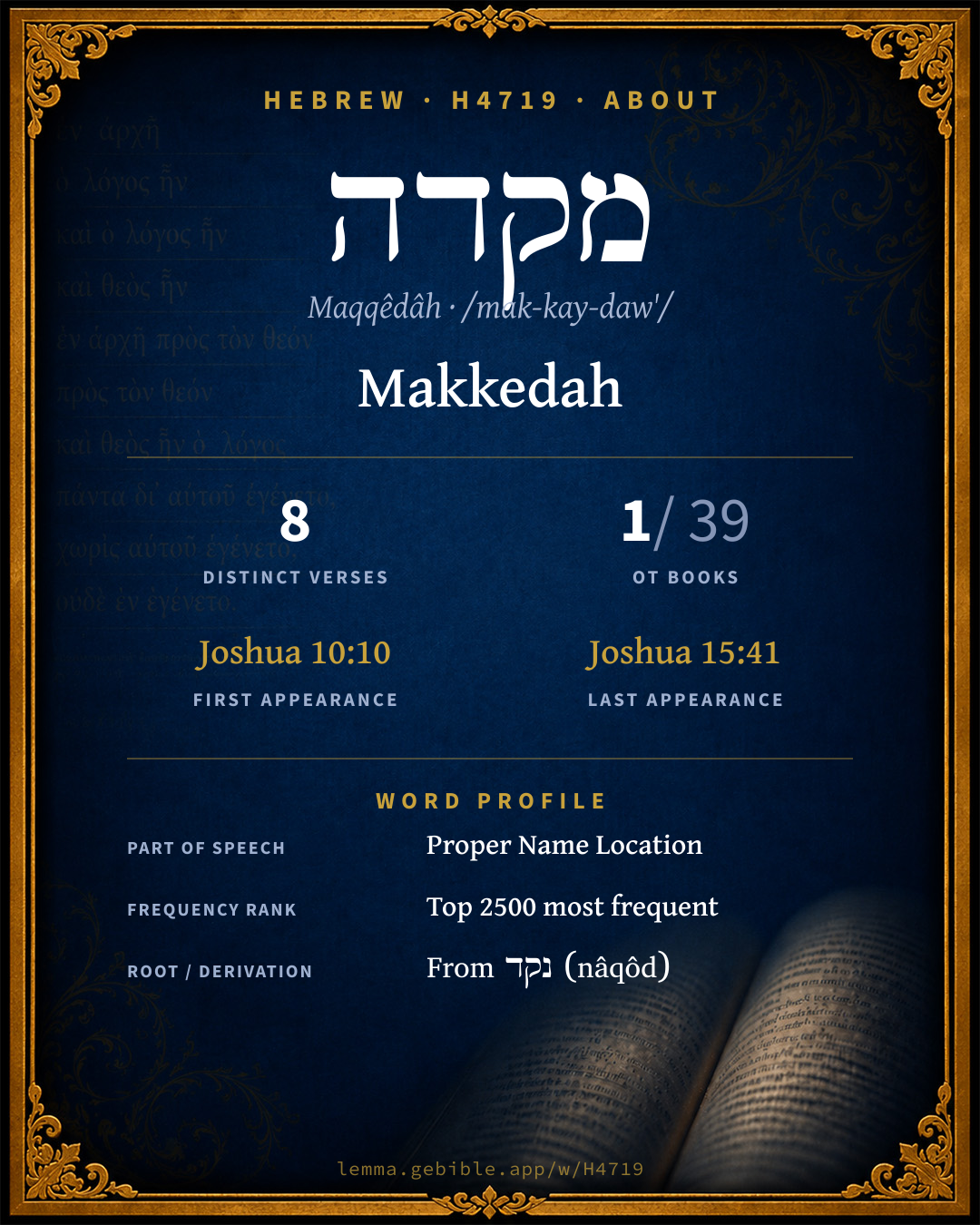
מַקֵּדָה
Makkedah
BDB lists 2 entries for ‘Makkedah’ fuller range ↓
Full lexicon entry — Brown-Driver-Briggs (BDB)
From Brown-Driver-Briggs (BDB)
Where this word appears
Grammar key — what these labels mean
Part of speech
- Noun
- A naming word — a person, place, thing, or idea.
Noun type
- Proper
- A name of a specific person, place, or people (e.g. Abraham, Zion, Israel).
Every verse where H4719 appears — 8 distinct verses across 1 book. Click any verse to open its interlinear word-by-word view. Verse text shown in the World English Bible for context — . Each verse’s Hebrew form is shown with its reference; the English is not keyword-highlighted, since the data carries no word-level English alignment. Use “Compare translations” on any verse to read it across multiple English versions. This concordance covers the Hebrew Bible; Septuagint (Greek Old Testament) occurrences are not indexed here.
Joshua 8 verses
- Joshua 10:10 מַקֵּדָֽה n Proper Yahweh confused them before Israel, and he killed them with a great slaughter at Gibeon, and chased them by the way of the ascent of Beth Horon, and struck them to Azekah, and to Makkedah.
- Joshua 10:16 בְּ/מַקֵּדָֽה prep + n Proper These five kings fled, and hid themselves in the cave at Makkedah.
- Joshua 10:17 בְּ/מַקֵּדָֽה prep + n Proper It was told Joshua, saying, The five kings are found, hidden in the cave at Makkedah.
- Joshua 10:21 מַקֵּדָ֖ה n Proper that all the people returned to the camp to Joshua at Makkedah in peace: none moved his tongue against any of the children of Israel.
- Joshua 10:28 מַקֵּדָה֩ מַקֵּדָ֔ה n Proper n Proper Joshua took Makkedah on that day, and struck it with the edge of the sword, and the king of it: he utterly destroyed them and all the souls who were therein; he left none remaining; and he did to the king of Makkedah as he had done to the king of Jericho.
- Joshua 10:29 מִ/מַּקֵּדָ֖ה prep + n Proper Joshua passed from Makkedah, and all Israel with him, to Libnah, and fought against Libnah:
- Joshua 12:16 מַקֵּדָה֙ n Proper the king of Makkedah, one; the king of Bethel, one;
- Joshua 15:41 וּ/מַקֵּדָ֑ה conj + n Proper and Gederoth, Beth Dagon, and Naamah, and Makkedah; sixteen cities with their villages.
About this entry
At a glance — auto-summarized from this page’s data, not written by a person. Every figure links to its source below. This summary describes the numbers; it doesn’t interpret them.
מקדה (Maqqêdâh) is a Hebrew name most often rendered “Makkedah.” It clusters heavily in Joshua, which alone accounts for 100% of its uses. It turns up in 8 verses across 1 book, an uncommon footprint. It first appears in Joshua 10:10. The sections below give every occurrence and version rendering.
Gloss history
Strong's 1890 vs modern scholarship
About this word
Strong's H4719 catalogs a Hebrew word from the Hebrew Old Testament.
These counts are not copied from any lexicon or concordance. They are computed here, from the morphology-tagged Hebrew Old Testament. What Lemma adds →
- 8
- distinct verses
- The word appears in 8 distinct verses.
- 1 / 39
- OT books
- The word appears in 1 of 39 Old Testament books.
- #2,481
- by frequency
- Top 2500 most frequent Hebrew words (rank 2,481 of 8,640 Hebrew words by occurrence).
View all 8 occurrences in the concordance →
Most concentrated in
- Joshua 8 verses 100%
By section of the Old Testament
By traditional corpus
Conventional, traditional groupings — biblical authorship is debated, so this is a traditional corpus grouping, not an authorship claim. Each share is this word’s portion of its verses in that division of the Hebrew canon. Each figure is a share of the word’s 8 distinct verses.
- Prophets (Nevi'im) 8 verses · 100%
How translations render this word
Counts come from each version’s own published word-to-Strong’s tagging or interlinear alignment — an approximate guide to how each version renders this word, not a word-level alignment the data otherwise carries. Because each total is that version’s own tagged count, the per-version totals vary from one another and need not match the appearance or distinct-verse counts above. These counts may also differ from a printed concordance because Lemma counts each distinctly tagged rendering and does not collapse phrase taggings into a single head-word total. This is a fixed set of word-tagged versions (KJV, ASV, BSB, ULT) and does not change with the reading translation you choose elsewhere. Each version’s license is shown beside its name below (and on Sources).
- King James Version: Makkedah 9×
- American Standard Version: Makkedah 9×
- Berean Standard Bible: Makkedah 9×
- unfoldingWord Literal Text: Makkedah 9×
King James Version Public Domain
Renders H4719 across 9 tagged occurrences — most commonly:
American Standard Version Public Domain
Renders H4719 across 9 tagged occurrences — most commonly:
Berean Standard Bible Public Domain
Renders H4719 across 9 tagged occurrences — most commonly:
unfoldingWord Literal Text CC BY-SA 4.0
Renders H4719 across 9 tagged occurrences — most commonly:
Senses in BDB
The 2 senses BDB distinguishes for this word, in lexicon order (not ranked by frequency or importance). The full entry — with sub-senses — is in the Lexicon Entry tab.
- Makkedah = "place of shepherds"
- the location of a cave in Judah where Joshua captured and executed five Canaanite kings during the conquest…
Word origin
n.pr.loc. in Judah Jos 15:41, near Beth Horon Jos 10:10, and Libnah v 29, where was a cave v 16, 17, cf. v 21, captured by Joshua v 28, with a king v 28; 12:16. 𝔊 Μακηδα. Site dubious, WarrenSurvey Mem. ii. 411 ff., 427 comp. El-mughâr, c. 2¾ miles SW. from Ekron.
— Brown-Driver-Briggs (Oxford 1906, public domain), digitized via Sefaria, supplemented by the OpenScriptures HebrewLexicon (CC BY 4.0). See Sources.
Derived from נקד (nâqôd) (H5348) — speckled.
Jastrow Dictionary
A second Hebrew/Aramaic lexicon for comparison, covering Aramaic and post-biblical (Talmudic, Targumic, Midrashic) usage that the biblical-Hebrew BDB does not. Matched by lemma rather than by Strong’s number, so a lemma may carry more than one Jastrow headword (shown separately below), and the entries cover usage well beyond the Bible.
מַקֵּדָה
- , v. מַקֵּידָה
מַקֵּידָה
- (יָקַד) fire-pot, fragment of a vessel used for carrying fire. Sifra M’tsor., Par. 1, ch. I אי חרס יכול מ׳ וכ׳ from the word ḥeres (Lev. XIV, 5) I might infer that a fragment of a vessel was meant, therefore it says ‘a vessel’. Y. Sot. II, 17ᵈ bot. מאן דמר … לא במ׳ בשניטל וכ׳ he who says … you must not use a maḳḳeda, means a vessel the larger portion of which is missing. Num. R. s. 9; Sot. 9ᵃ מ׳ של חרס a piece of an earthen vessel, opp. כוסות משובחין; ib. 32ᵇ. Sabb. XXIV, 5; a. fr. e.g. Leviticus 14:5
A Dictionary of the Targumim, the Talmud Babli and Yerushalmi, and the Midrashic Literature (Marcus Jastrow; London, Luzac, 1903) — Public Domain. Digitized via Sefaria. Digitized via Sefaria. Full attribution on Sources.
Forms in the corpus
The 8 distinct written forms H4719 takes in the Hebrew Bible, most frequent first — each parse links to that state’s occurrences in the concordance. Hebrew forms include their vowel points and cantillation, so a single lemma takes many written forms.
| Form | Parsing | Example | Uses |
|---|---|---|---|
| בְּ/מַקֵּדָֽה | Noun, Proper | Joshua 10:16 | 2 |
| וּ/מַקֵּדָ֑ה | Noun, Proper | Joshua 15:41 | 1 |
| מִ/מַּקֵּדָ֖ה | Noun, Proper | Joshua 10:29 | 1 |
| מַקֵּדָ֔ה | Noun, Proper | Joshua 10:28 | 1 |
| מַקֵּדָ֖ה | Noun, Proper | Joshua 10:21 | 1 |
| מַקֵּדָֽה | Noun, Proper | Joshua 10:10 | 1 |
| מַקֵּדָה֙ | Noun, Proper | Joshua 12:16 | 1 |
| מַקֵּדָה֩ | Noun, Proper | Joshua 10:28 | 1 |
Same root — word family
Other BDB entries built from the same root as H4719, grouped by Strong’s listed origin. These share a root / origin per the lexicon — not necessarily a shared meaning. Each links to that word’s own entry.
Derives from
Shares the same root
Proper names from this root
People and places named from this root — a name, not an additional meaning of the word.
Compare all same-root words → Showing 4 of 6 — not the complete family. 1 of the same-root words is a proper name (a person or place). They share a root, not necessarily a meaning.
Bible dictionary
Public-domain dictionary articles matched to this entry by name (Makkedah). A biblical name can be shared by more than one person or place, so an article may treat several.
Easton's Bible Dictionary · M. G. Easton, 1897
Herdsman's place, one of the royal cities of the Canaanites (Josh. 12:16), near which was a cave where the five kings who had confederated against Israel sought refuge (10:10-29). They were put to death by Joshua, who afterwards suspended their bodies upon five trees. It has been identified with the modern village called Sumeil, standing on a low hill about 7 miles to the north-west of Eleutheropolis (Beit Jibrin), where are ancient remains and a great cave. The Palestine Exploration surveyors have, however, identified it with el-Mughar, or "the caves," 3 miles from Jabneh and 2 1/2 southwest of Ekron, because, they say, "at this site only of all possible sites for Makkedah in the Palestine plain do caves still exist." (See ADONI-ZEDEC.)
Smith's Bible Dictionary · William Smith, 1863
(place of shepherds), a place memorable in the annals of the conquest of Canaan as the scene of the execution by Joshua of the five confederate kings, (Joshua 10:10-50) who had hidden themselves in a cave at this place. (It was a royal city of the Canaanites, in the plains of Judah. Conder identifies it with the modern el-Moghar, 25 miles northwest of Jerusalem, where are two caves large enough to contain five men each. Schaff says that "one cave has, curiously enough, five loculi rudely scooped in its side, and an enthusiast might contend that this was the very place of sepulchre of the five kings."-ED.)
Hitchcock's Bible Names Dictionary · Roswell D. Hitchcock, 1869
worshiping; burning; raised; crookedness
Classic public-domain reference works; full attribution on Sources.
Septuagint verse parallels
This word appears in 8 verses that also exist in the Greek Old Testament (Septuagint), out of the 8 Hebrew verses it occurs in. You can read those verses in Greek by switching the Old Testament edition to the Septuagint.
Read these verses in the Septuagint
This is a verse-level parallel only — the same verses exist in both the Hebrew and Greek Old Testaments. No word-level Hebrew↔Greek correspondence is claimed: the data carries no such alignment, so no Greek word is shown as this Hebrew word’s translation. Coverage is not total — the Septuagint omits the deuterocanon and renumbers the Psalms, so some Hebrew verses have no direct Greek parallel.