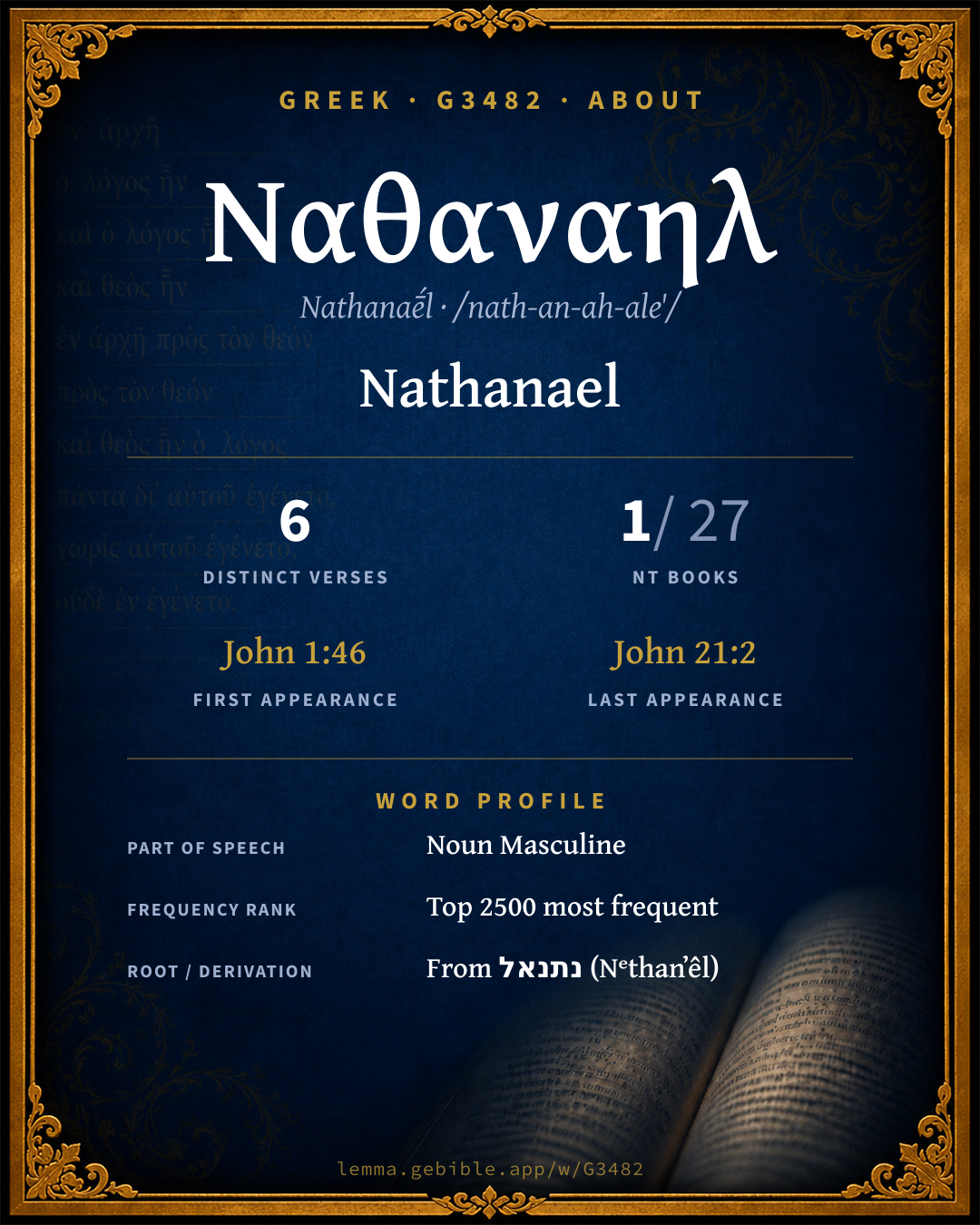
Ναθαναήλ
Nathanael
Thayer's lists 2 entries for ‘Nathanael’ fuller range ↓
Full lexicon entry — Thayer's Greek Lexicon
From Thayer's Greek Lexicon
Where this word appears
Every verse where G3482 appears — 6 distinct verses across 1 book. Click any verse to open its interlinear word-by-word view. Verse text shown in the World English Bible for context — . Each verse’s Greek form is shown with its reference; the English is not keyword-highlighted, since the data carries no word-level English alignment. Use “Compare translations” on any verse to read it across multiple English versions. This concordance covers the Greek New Testament; Septuagint (Greek Old Testament) occurrences of this word are not indexed here.
John 6 verses
- John 1:46 Ναθαναὴλ n proper indecl Nathanael said to him, "Can any good thing come out of Nazareth?" Philip said to him, "Come and see."
- John 1:47 Ναθαναήλ n proper indecl Jesus saw Nathanael coming to him, and said about him, "Behold, an Israelite indeed, in whom is no deceit!"
- John 1:48 Ναθαναὴλ n proper indecl Nathanael said to him, "How do you know me?" Jesus answered him, "Before Philip called you, when you were under the fig tree, I saw you."
- John 1:49 Ναθαναήλ n proper indecl Nathanael answered him, "Rabbi, you are the Son of God! You are King of Israel!"
- John 1:50 Ναθαναήλ n proper indecl Jesus answered him, "Because I told you, 'I saw you underneath the fig tree,' do you believe? You will see greater things than these!"
- John 21:2 Ναθαναὴλ n proper indecl Simon Peter, Thomas called Didymus, Nathanael of Cana in Galilee, and the sons of Zebedee, and two others of his disciples were together.
About this entry
At a glance — auto-summarized from this page’s data, not written by a person. Every figure links to its source below. This summary describes the numbers; it doesn’t interpret them.
Ναθαναηλ — transliterated Nathanaḗl — is a Greek name carrying the sense “Nathanael.” Its uses cluster heavily in John (100% of all occurrences). Spanning 6 verses in 1 book, it ranks among the uncommon words of the Greek New Testament. Debuting at John 1:46, it then recurs through the corpus. Each statement above links to its evidence; the full detail follows below.
Gloss history
Strong's 1890 vs modern scholarship
About this word
Strong's G3482 catalogs a Greek word from the Greek New Testament.
These counts are not copied from any lexicon or concordance. They are computed here, from the morphology-tagged Greek New Testament. What Lemma adds →
- 6
- distinct verses
- The word appears in 6 distinct verses.
- 1 / 27
- NT books
- The word appears in 1 of 27 New Testament books.
- #1,476
- by frequency
- Top 2500 most frequent Greek words (rank 1,476 of 5,347 Greek words by occurrence).
View all 6 occurrences in the concordance →
Most concentrated in
- John 6 verses 100%
By section of the New Testament
By traditional corpus
Conventional, traditional groupings — biblical authorship is debated, so this is a traditional corpus grouping, not an authorship claim. Some books belong to more than one corpus (Luke is in both the Gospels and the Lukan corpus, and so on), so these shares overlap and need not total 100%. Each figure is a share of the word’s 6 distinct verses.
- Gospels 6 verses · 100%
- Johannine 6 verses · 100%
How translations render this word
Counts come from each version’s own published word-to-Strong’s tagging or interlinear alignment — an approximate guide to how each version renders this word, not a word-level alignment the data otherwise carries. Because each total is that version’s own tagged count, the per-version totals vary from one another and need not match the appearance or distinct-verse counts above. These counts may also differ from a printed concordance because Lemma counts each distinctly tagged rendering and does not collapse phrase taggings into a single head-word total. This is a fixed set of word-tagged versions (KJV, ASV, BSB, ULT) and does not change with the reading translation you choose elsewhere. Each version’s license is shown beside its name below (and on Sources).
- King James Version: Nathanael 6×
- American Standard Version: Nathanael 6×
- Berean Standard Bible: Nathanael 6×
- unfoldingWord Literal Text: Nathaniel 6×
King James Version Public Domain
Renders G3482 across 6 tagged occurrences — most commonly:
American Standard Version Public Domain
Renders G3482 across 6 tagged occurrences — most commonly:
Berean Standard Bible Public Domain
Renders G3482 across 6 tagged occurrences — most commonly:
unfoldingWord Literal Text CC BY-SA 4.0
Renders G3482 across 6 tagged occurrences — most commonly:
Senses in Thayer's
The 2 senses Thayer's distinguishes for this word, in lexicon order (not ranked by frequency or importance). The full entry — with sub-senses — is in the Lexicon Entry tab.
- Nathanael = "gift of God"
- an intimate disciple of Jesus Christ, he is commonly thought to be the same person as Bartholomew
Word origin
Derived from נתנאל (Nᵉthanʼêl) (H5417) — Nethaneel.
Of hebrew origin [ H5417 ]; Nathanael (that is Nathanel ) an Israelite and Christian : - Nathanael.
— Strong’s Exhaustive Concordance (1890), public domain.
Forms in the corpus
Bible dictionary
Public-domain dictionary articles matched to this entry by name (Nathanael). A biblical name can be shared by more than one person or place, so an article may treat several.
Easton's Bible Dictionary · M. G. Easton, 1897
Given or gift of God, one of our Lord's disciples, "of Cana in Galilee" (John 21:2). He was "an Israelite indeed, in whom was no guile" (1:47, 48). His name occurs only in the Gospel of John, who in his list of the disciples never mentions Bartholomew, with whom he has consequently been identified. He was one of those to whom the Lord showed himself alive after his resurrection, at the Sea of Tiberias.
Smith's Bible Dictionary · William Smith, 1863
(gift of God), a disciple of Jesus Christ, concerning whom, under that name at least, we learn from Scripture little more than his birthplace, Cana of Galilee, (John 21:2) and his simple, truthful character. (John 1:47) The name does not occur in the first three Gospels; but it is commonly believed that Nathanael and Bartholomew are the same person. The evidence for that belief is as follows: St, John who twice mentions Nathanael, never introduces the name of Bartholomew at all. St. Matthew, (Matthew 10:3) St. Mark, (Mark 3:18) and St. Luke, (Luke 8:14) all speak of Bartholomew but never of Nathanael. If was Philip who first brought Nathanael to Jesus, just as Andrew had brought his brother Simon.
Hitchcock's Bible Names Dictionary · Roswell D. Hitchcock, 1869
the gift of God
Classic public-domain reference works; full attribution on Sources.
Septuagint usage
The same Greek word Ναθαναηλ appears 13 times in the Greek Old Testament (Septuagint), across 13 verses in 4 books.
- 13
- LXX occurrences
- Tagged occurrences of this Greek word in the Septuagint.
- 13
- verses
- Distinct Septuagint verses containing this word.
- 4 / 39
- OT books
- The word appears in 4 of the 39 Old Testament books.
Sample Septuagint occurrences
- Numbers 1:8 ναθαναηλ
- 1 Chronicles 2:14 ναθαναηλ
- 2 Chronicles 17:7 ναθαναηλ
- Ezra 10:22 ναθαναηλ
Septuagint occurrences (same lexeme)
Every verse where the same Strong’s number (G3482) appears in the Greek Septuagint. Verse text shown in the World English Bible for context; the Greek form is the matched word — the English is not keyword-highlighted.
- Numbers 1:8 ναθαναηλ Of Issachar: Nethanel the son of Zuar.
- Numbers 2:5 ναθαναηλ Those who encamp next to him shall be the tribe of Issachar: and the prince of the children of Issachar shall be Nethanel the son of Zuar.
- Numbers 7:18 ναθαναηλ On the second day Nethanel the son of Zuar, prince of Issachar, gave his offering.
- Numbers 7:23 ναθαναηλ and for the sacrifice of peace offerings, two oxen, five rams, five male goats, five male lambs a year old. This was the offering of Nethanel the son of Zuar.
- Numbers 10:15 ναθαναηλ Over the host of the tribe of the children of Issachar was Nethanel the son of Zuar.
- 1 Chronicles 2:14 ναθαναηλ Nethanel the fourth, Raddai the fifth,
- 1 Chronicles 15:24 ναθαναηλ Shebaniah, and Joshaphat, and Nethanel, and Amasai, and Zechariah, and Benaiah, and Eliezer, the priests, did blow the trumpets before the ark of God: and Obed-edom and Jehiah were doorkeepers for the ark.
- 1 Chronicles 24:6 ναθαναηλ Shemaiah the son of Nethanel the scribe, who was of the Levites, wrote them in the presence of the king, and the princes, and Zadok the priest, and Ahimelech the son of Abiathar, and the heads of the fathers' [houses] of the priests and of the Levites; one fathers' house being taken for Eleazar, and one taken for Ithamar.
- 1 Chronicles 26:4 ναθαναηλ Obed-edom had sons: Shemaiah the firstborn, Jehozabad the second, Joah the third, and Sacar the fourth, and Nethanel the fifth,
- 2 Chronicles 17:7 ναθαναηλ Also in the third year of his reign he sent his princes, even Ben Hail, and Obadiah, and Zechariah, and Nethanel, and Micaiah, to teach in the cities of Judah;
- 2 Chronicles 35:9 ναθαναηλ Conaniah also, and Shemaiah and Nethanel, his brothers, and Hashabiah and Jeiel and Jozabad, the chiefs of the Levites, gave to the Levites for the Passover offerings five thousand [small cattle], and five hundred oxen.
- Ezra 10:22 ναθαναηλ Of the sons of Pashhur: Elioenai, Maaseiah, Ishmael, Nethanel, Jozabad, and Elasah.
- Ezra 22:21 ναθαναηλ
These are occurrences of the same Greek lexeme (G3482) in the Septuagint — not a translation of any one Hebrew word. The store carries no word-level Hebrew↔Greek alignment, so no Hebrew original is asserted here. Counts come from the recovered LXX Strong's tagging — high-frequency vocabulary is well covered, while rare or late forms may be untagged — so they reflect tagged occurrences and may slightly undercount.