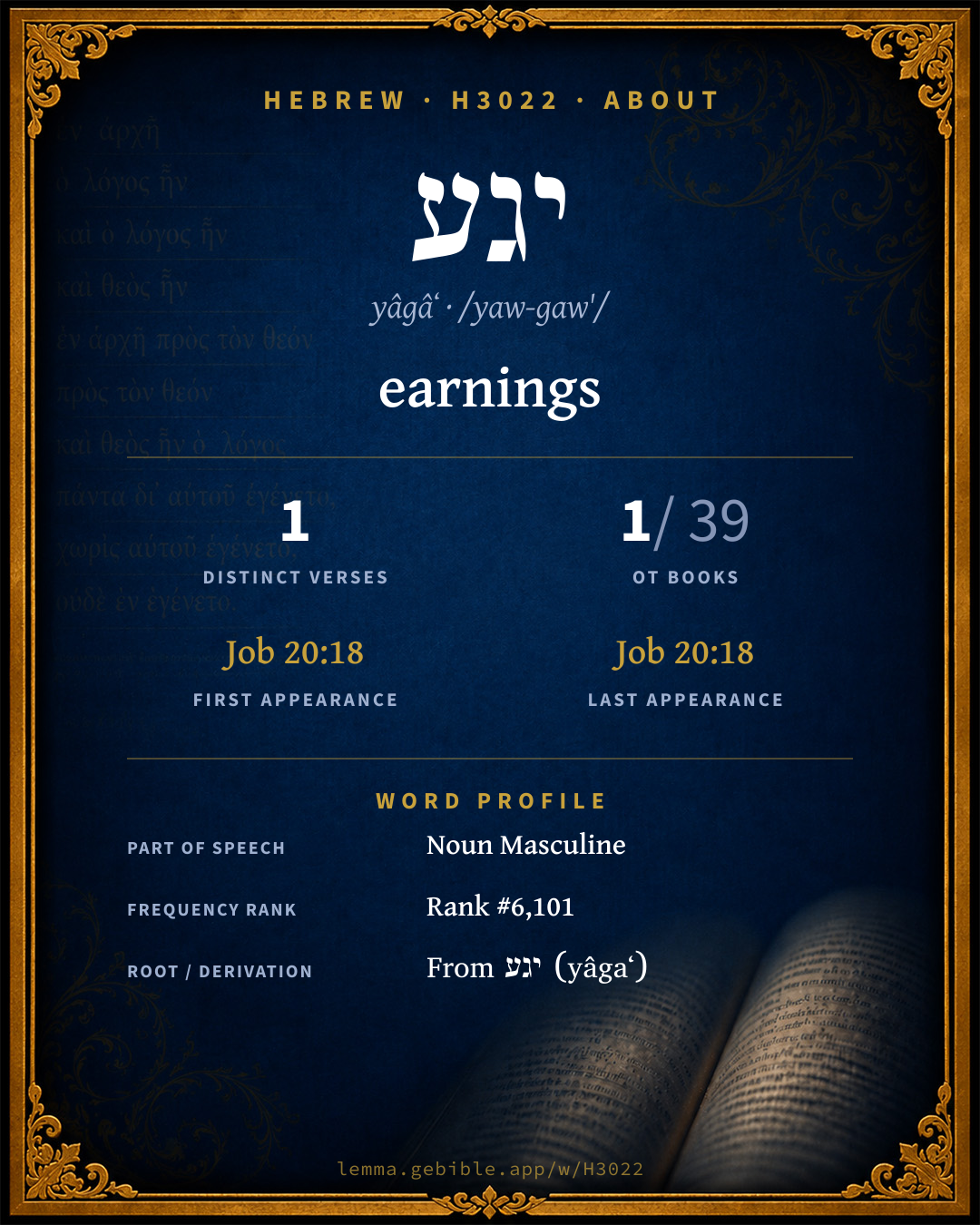
יָגָע
earnings
Full lexicon entry — Brown-Driver-Briggs (BDB)
From Brown-Driver-Briggs (BDB)
Where this word appears
Grammar key — what these labels mean
Part of speech
- Noun
- A naming word — a person, place, thing, or idea.
Noun type
- Common
- A common noun — a general class of person, place, or thing (“king,” “city,” “water”), not a specific name.
State
- Absolute
- The independent form of a noun, not bound to a following word.
Gender
- Masculine
- Grammatically masculine.
Number
- Singular
- One.
Every verse where H3022 appears — 1 distinct verse across 1 book. Click any verse to open its interlinear word-by-word view. Verse text shown in the World English Bible for context — . Each verse’s Hebrew form is shown with its reference; the English is not keyword-highlighted, since the data carries no word-level English alignment. Use “Compare translations” on any verse to read it across multiple English versions. This concordance covers the Hebrew Bible; Septuagint (Greek Old Testament) occurrences are not indexed here.
Job 1 verse
About this entry
At a glance — auto-summarized from this page’s data, not written by a person. Every figure links to its source below. This summary describes the numbers; it doesn’t interpret them.
יגע — transliterated yâgâʻ — is a Hebrew noun carrying the sense “earnings.” It occurs a mere 1 verse across Scripture. Its uses cluster heavily in Job (100% of all occurrences). Found nowhere else but Job 20:18. Sharing its root, it stands alongside יגע, יגיע and יגיע. See the sense tree, 1-verse concordance, and the renderings breakdown below.
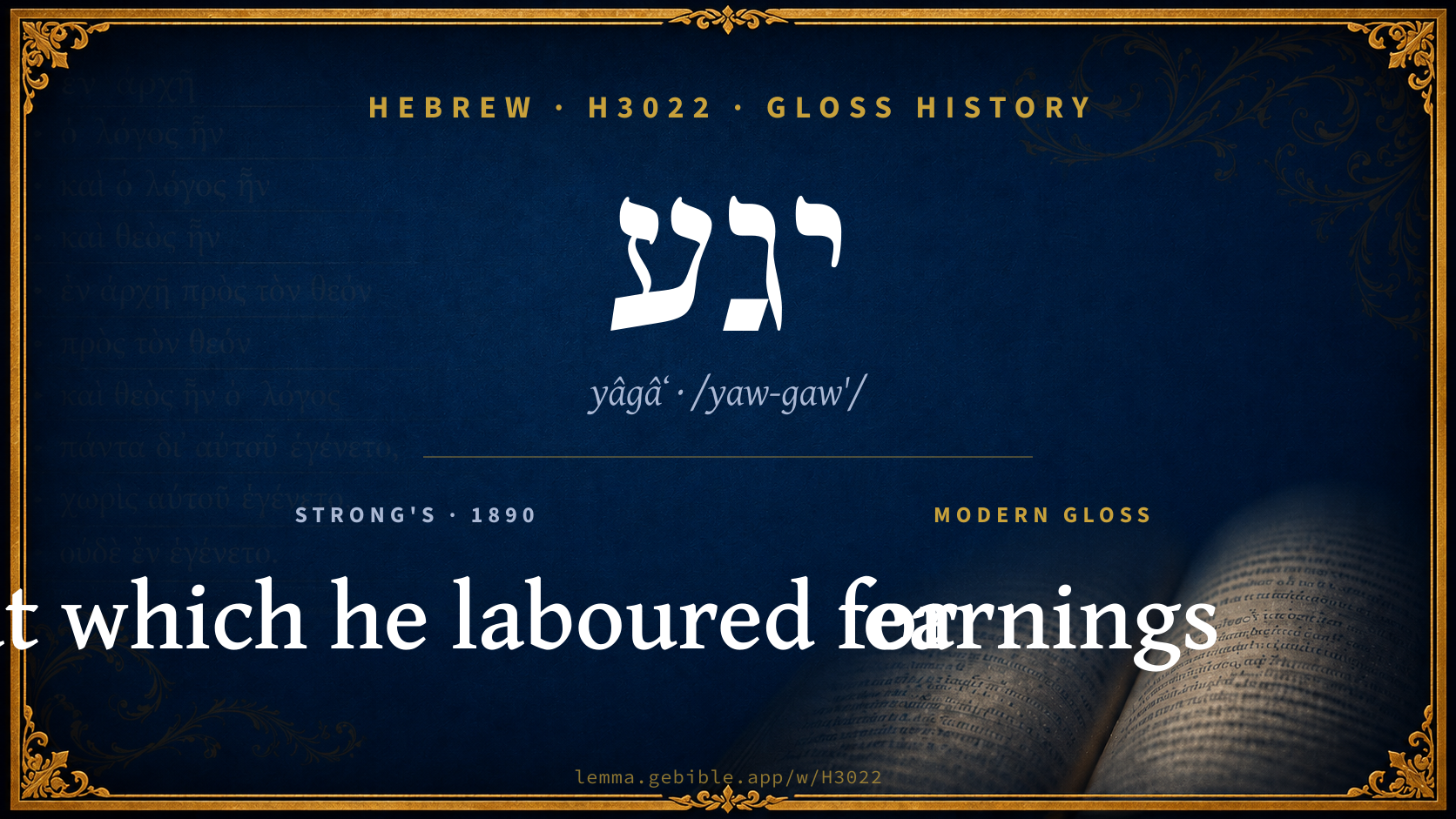
Gloss history
Strong's 1890 vs modern scholarship
About this word
Strong's H3022 catalogs a Hebrew word from the Hebrew Old Testament.
These counts are not copied from any lexicon or concordance. They are computed here, from the morphology-tagged Hebrew Old Testament. What Lemma adds →
- 1
- distinct verses
- The word appears in 1 distinct verse.
- 1 / 39
- OT books
- The word appears in 1 of 39 Old Testament books.
- #6,101
- by frequency
- Rank #6,101 (rank 6,101 of 8,640 Hebrew words by occurrence).
View all 1 occurrence in the concordance →
Most concentrated in
- Job 1 verse 100%
By section of the Old Testament
By traditional corpus
Conventional, traditional groupings — biblical authorship is debated, so this is a traditional corpus grouping, not an authorship claim. Each share is this word’s portion of its verses in that division of the Hebrew canon. Each figure is a share of the word’s 1 distinct verse.
- Writings (Ketuvim) 1 verse · 100%
How translations render this word
Counts come from each version’s own published word-to-Strong’s tagging or interlinear alignment — an approximate guide to how each version renders this word, not a word-level alignment the data otherwise carries. Because each total is that version’s own tagged count, the per-version totals vary from one another and need not match the appearance or distinct-verse counts above. These counts may also differ from a printed concordance because Lemma counts each distinctly tagged rendering and does not collapse phrase taggings into a single head-word total. This is a fixed set of word-tagged versions (KJV, ASV, BSB, ULT) and does not change with the reading translation you choose elsewhere. Each version’s license is shown beside its name below (and on Sources).
- King James Version: He laboured 1×
- American Standard Version: He labored 1×
- Berean Standard Bible: Fruit of his labor 1×
- unfoldingWord Literal Text: Gain 1×
King James Version Public Domain
Renders H3022 across 1 tagged occurrence — most commonly:
American Standard Version Public Domain
Renders H3022 across 1 tagged occurrence — most commonly:
Berean Standard Bible Public Domain
Renders H3022 across 1 tagged occurrence — most commonly:
unfoldingWord Literal Text CC BY-SA 4.0
Renders H3022 across 1 tagged occurrence — most commonly:
Senses in BDB
The 1 sense BDB distinguishes for this word, in lexicon order (not ranked by frequency or importance). The full entry — with sub-senses — is in the Lexicon Entry tab.
- earnings, gain (product of labour)
Word origin
n.[m.] gain (= product of labour)—יָגָע Jb 20:18 (‖ תְּמוּרָה).
— Brown-Driver-Briggs (Oxford 1906, public domain), digitized via Sefaria, supplemented by the OpenScriptures HebrewLexicon (CC BY 4.0). See Sources.
Derived from יגע (yâgaʻ) (H3021) — to toil.
Jastrow Dictionary
A second Hebrew/Aramaic lexicon for comparison, covering Aramaic and post-biblical (Talmudic, Targumic, Midrashic) usage that the biblical-Hebrew BDB does not. Matched by lemma rather than by Strong’s number, so a lemma may carry more than one Jastrow headword (shown separately below), and the entries cover usage well beyond the Bible.
יָגַע
- [to feel pain,] to take pains, to labor; to be tired. Ber. 58ᵃ, v. יְגִיעָה. Y. ib. V, 5ᶜ אנו יָגַעְנוּ וכ׳ we have been busy at work for an entire day. Ib. י׳ זה לשתי וכ׳ this one has worked (accomplished) more in two hours &c.; Ib. כך י׳ … בתורה וכ׳ so has R. Bun accomplished in studies in the twenty eight years (of his life) &c.; Cant. R. to VI, 2; Koh. R. to V, 11. Meg. 6ᵇ אם יאמר … יָגַעְתִּי וכ׳ if one tells thee, ‘I have toiled (studied) and achieved nothing’, do not believe; ‘I have not toiled and have achieved’, do not believe &c.—Y. Ber. IX, end, 14ᵈ צריך לִיגַע בתורה must study the Law. Midr. Till. to Ps. XII, beg. חדלו מליגע בתורה they ceased from studying the Law; a. fr.
- to put to trouble, to weary. Sot. II, 1 (14ᵃ) כדי לְיַגְּעָהּ (Rashi: לְיַי׳) in order to wear her out (so that she may be induced to confess). Sifra Vayikra, Ḥobah, Par. 5, ch. VII אבל אם היה מְיַגְּעָן וכ׳ but if after having troubled them (the judges) an entire day, he says finally &c.; Yalk. Lev. 469 היה מונע (corr. acc.); Tosef. Toh. VI, 14 ומשהגיע (read ומשהִגִּיעָן Hif.). Y. Bets. II, 61ᶜ bot. מתוך שאתה מְיַיגְּעוֹ וכ׳ because you put him to special trouble (by ordering a special form of cakes) &c.—Ex. R. s. 41 התלמיד … יִגַּעְתִּיךָ the pupil says to the teacher, I have wearied thee; Yalk. Sam. 161; a. fr.—Part. pass. מְיוּגָּע, pl. מְיוּגָּעִים, מְיוּגָּעִין. Keth. 8ᵇ ואתם אחינו המ׳ המדוכאין וכ׳ and you, our brethren, who are worn out and crushed by this bereavement.
- (הִגִּיעַ) same. Tosef. Toh. VI, 14, v. supra. Midr. Till. to Ps. XXXIX, beg. (ref. to Mal. II, 17) הוֹגַעְתֶּם לי במעשיכם וכ׳ (ed. Bub., differ.) it does not say, you wore me out with your doings, but with your words. Midr. Till. to Ps. XVIII, 36 והרב … רב לך כי הוֹגַעְתִּיךָ and the teacher will say to the pupil, thou hast enough now, for I have wearied thee?; a. e. e.g. Malachi 2:17
- , Nithpa. נִתְיַיגֵּעַ to be tired, to take pains. Gitt. 70ᵃ הבא בדרך ונ׳ who has been travelling and is tired. Pesik. Shub., p. 164ᵃ שלא תִתְיַיגֵּעַ בחזירה that you may not get tired on your way back. Pesik. R. s. 14 אני נִתְיַיגַּעְתִּי בה וכ׳ I took pains with her and smote her &c.; a. fr.
יָגֵעַ
- preced.) wearied, painstaking. Ex. R. s. 13, beg. במה אני יי׳ of whom am I wearied?—Y. Ḥag. II, 77ᵇ bot. זה הוא הלשון שהיה י׳ וכ׳ is this the tongue which was wearing itself out with teaching the Law?; a. fr.—Pl. יְגֵעִים, יְגֵעִין, יְגֵי׳. Midr. Till. to Ps. XII, beg. י׳ בתורה studying the Law. Y. Peah I, 15ᵇ bot. ref. to Deut. XXXII, 47) ואם רק הוא מכם למה שאין אתם י׳ בו and if it (the word of the Law) seems to you empty, it is your fault, … because you do not study it carefully; אימתי בשעה שאתם י׳ בו when (is it your life)? When you are busy studying it; Y. Succ. IV, beg. 54ᵇ; a. fr. e.g. Deuteronomy 32:47
יָגָע
- m. (b. h.) = יְגִיעָה. Gen. R. s. 10, end, v. יְגִיעָה
A Dictionary of the Targumim, the Talmud Babli and Yerushalmi, and the Midrashic Literature (Marcus Jastrow; London, Luzac, 1903) — Public Domain. Digitized via Sefaria. Digitized via Sefaria. Full attribution on Sources.
Same root — word family
Other BDB entries built from the same root as H3022, grouped by Strong’s listed origin. These share a root / origin per the lexicon — not necessarily a shared meaning. Each links to that word’s own entry.
Derives from
Shares the same root
Compare all same-root words → Showing 4 of 5 — not the complete family. They share a root, not necessarily a meaning.
Septuagint verse parallels
This word appears in 1 verse that also exists in the Greek Old Testament (Septuagint), out of the 1 Hebrew verse it occurs in. You can read those verses in Greek by switching the Old Testament edition to the Septuagint.
Read these verses in the Septuagint
This is a verse-level parallel only — the same verses exist in both the Hebrew and Greek Old Testaments. No word-level Hebrew↔Greek correspondence is claimed: the data carries no such alignment, so no Greek word is shown as this Hebrew word’s translation. Coverage is not total — the Septuagint omits the deuterocanon and renumbers the Psalms, so some Hebrew verses have no direct Greek parallel.