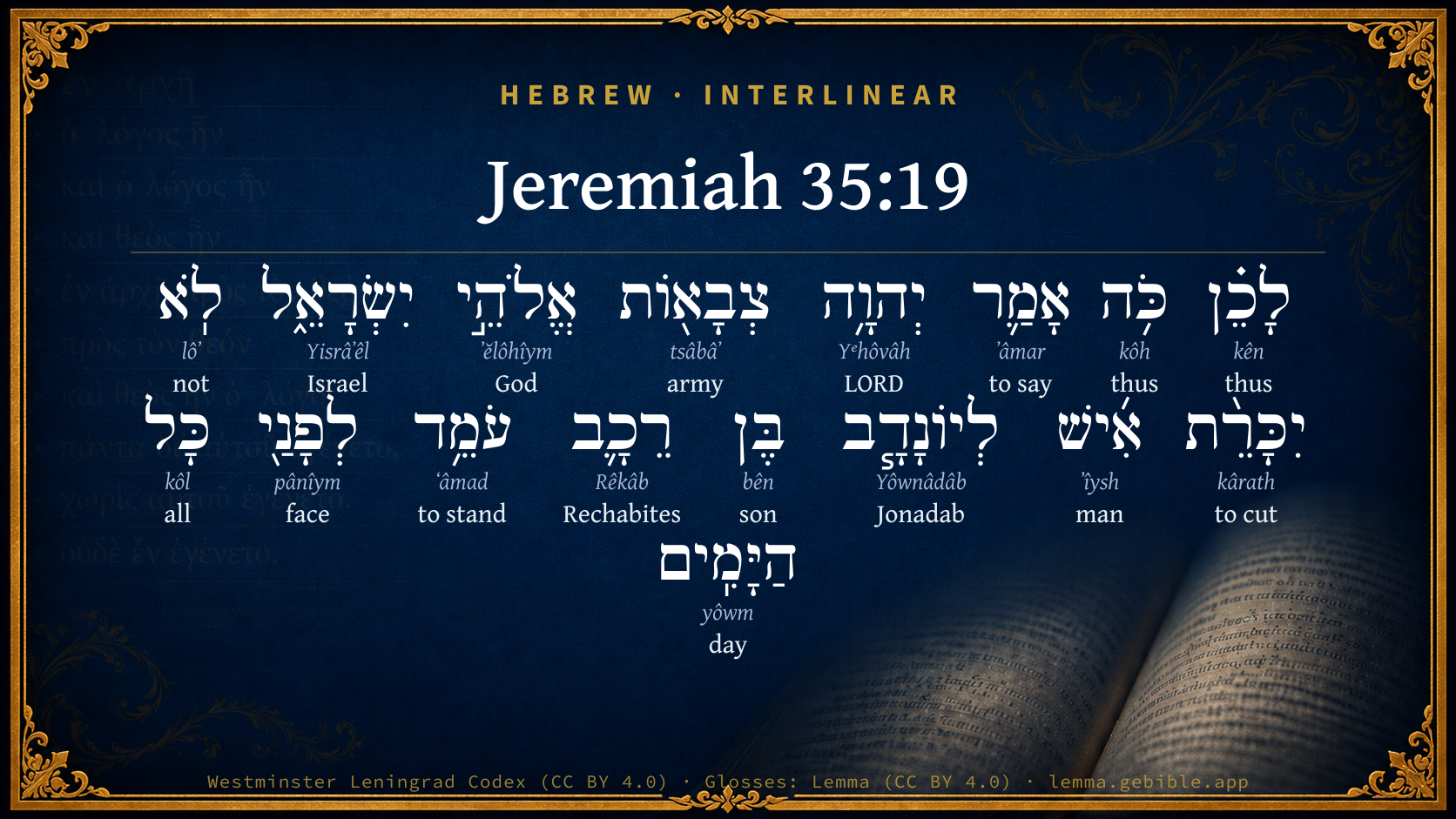
Jeremiah 35:19

Hebrew (Westminster Leningrad Codex) Jeremiah 35:19 appears in the Hebrew Old Testament. The text above is from the Westminster Leningrad Codex. Each word links to its Strong’s number, a concise gloss, and parsing drawn from the Open Scriptures Hebrew Bible morphology. Click any word for its full Brown-Driver-Briggs (BDB) entry.
Download image
Cite this verse

Jeremiah 35:19 (World English Bible). Public Domain. Lemma interlinear Bible study tool, https://lemma.gebible.app/v/jeremiah/35/19.

Show BibTeX & RIS
BibTeX
RIS
English Translation
therefore thus says Yahweh of Hosts, the God of Israel: Jonadab the son of Rechab shall not want a man to stand before me forever.
World English Bible · Public Domain
Download a study sheet

One document with this verse’s original text, its word-by-word gloss line, the meaning frame, cross-references with their text, attributed commentary, and full source and license credits — printable, and it pastes into notes with its structure intact.

This verse Autodidact and up

Study sheet (.html) Plain text (.txt)

A passage Seminary Student

Up to 50 verses in one chapter. A passage sheet keeps up to 6 commentary sources and 12 cross-references per verse, in the order this page ranks them, and says so on the sheet whenever that leaves anything out. Ask for a single verse and you get the Autodidact verse sheet above.

Everything on this page stays free to read, with no account — the sheet is a download of what is already on screen, not access to it.

Want to remove ads? Support Godless Engineer
Compare translations 3

The same verse in 3 English versions, stacked beneath the original-language interlinear above. Click any original word for its lexicon entry.

Each is an independent rendering of the whole verse — the interlinear is not word-aligned to these translations.

Highlighted words mark where these versions differ — a whole-verse word diff, not a word-by-word alignment.

  • World English Bible Public Domain
    therefore thus says Yahweh of Hosts, the God of Israel: Jonadab the son of Rechab shall not want a man to stand before me forever.
  • King James Version Public Domain
    Therefore thus saith the LORD of hosts, the God of Israel; Jonadab the son of Rechab shall not want a man to stand before me for ever.
  • unfoldingWord Literal Text CC BY-SA 4.0
    so Yahweh of hosts, God of Israel, says this, ‘There will always be someone descended from Jonadab son of Rekab to serve me.’”

unfoldingWord Literal Text — © unfoldingWord, licensed CC BY-SA 4.0. Word-aligned USFM3 via Door43 (git.door43.org/unfoldingWord/en_ult).

Versions to compare (up to 4)

3 of 4 selected

Show all 18 translations

Every available English version of this verse, each an independent rendering of the whole verse.

  • World English Bible Public Domain
    therefore thus says Yahweh of Hosts, the God of Israel: Jonadab the son of Rechab shall not want a man to stand before me forever.
  • Berean Standard Bible Public Domain
    this is what the LORD of Hosts, the God of Israel, says: Jonadab son of Rechab will never fail to have a man to stand before Me.’”
  • Majority Standard Bible Public Domain
    this is what the LORD of Hosts, the God of Israel, says: Jonadab son of Rechab will never fail to have a man to stand before Me.’”
  • King James Version Public Domain
    Therefore thus saith the LORD of hosts, the God of Israel; Jonadab the son of Rechab shall not want a man to stand before me for ever.
  • American Standard Version (1901) Public Domain
    therefore thus saith Jehovah of hosts, the God of Israel: Jonadab the son of Rechab shall not want a man to stand before me for ever.
  • Revised Version (1885) Public Domain
    therefore thus saith the LORD of hosts, the God of Israel: Jonadab the son of Rechab shall not want a man to stand before me for ever.
  • Geneva Bible (1599) Public Domain
    Therefore thus saith the Lord of hostes, the God of Israel, Ionadab the sonne of Rechab shall not want a man, to stand before me for euer.
  • Douay-Rheims (1899) Public Domain
    Therefore thus saith the Lord of host the God of Israel: There shall not be wanting a man of the race of Jonadab the son of Rechab, standing before me for ever.
  • Young's Literal Translation Public Domain
    therefore, thus said Jehovah of Hosts, God of Israel, Of Jonadab son of Rechab one standing before me is not cut off all the days.'
  • Literal Standard Version CC BY-SA 4.0
    therefore, thus said YHWH of Hosts, God of Israel: A man of Jonadab son of Rechab is not cut off [from] standing before Me all the days.”
  • Unlocked Literal Bible CC BY-SA 4.0
    so Yahweh of hosts, God of Israel, says this, 'There will always be someone descended from Jonadab son of Rekab to serve me.'”
  • unfoldingWord Literal Text CC BY-SA 4.0
    so Yahweh of hosts, God of Israel, says this, ‘There will always be someone descended from Jonadab son of Rekab to serve me.’”
  • Darby Bible Public Domain
    therefore thus saith Jehovah of hosts, the God of Israel, There shall not fail to Jonadab the son of Rechab a man to stand before me, for ever.
  • World Messianic Bible Public Domain
    therefore the LORD of Hosts, the God of Israel, says: ‘Jonadab the son of Rechab will not lack a man to stand before me forever.’”
  • Webster's Bible Public Domain
    Therefore thus saith the LORD of hosts, the God of Israel; Jonadab the son of Rechab shall not want a man to stand before me for ever.
  • Free Bible Version CC BY-SA 4.0
    this is what the Lord Almighty, the God of Israel, says: Jonadab son of Rechab will always have someone who will be in my presence serving me.
  • Bible in Basic English Public Domain
    For this reason the Lord of armies, the God of Israel, has said, Jonadab, the son of Rechab, will never be without a man to take his place before me.
  • JPS Tanakh (1917) Public Domain
    therefore thus saith the LORD of hosts, the God of Israel: There shall not be cut off unto Jonadab the son of Rechab a man to stand before Me for ever.'

Literal Standard Version (2020), Covenant Press — licensed CC BY-SA 4.0. Text via the HelloAO Bible API (eBible.org). Unlocked Literal Bible (unfoldingWord) — licensed CC BY-SA 4.0. Text via the HelloAO Bible API (eBible.org). unfoldingWord Literal Text — © unfoldingWord, licensed CC BY-SA 4.0. Word-aligned USFM3 via Door43 (git.door43.org/unfoldingWord/en_ult). Free Bible Version, Dr. Jonathan Gallagher — licensed CC BY-SA 4.0. Text via the HelloAO Bible API (eBible.org).

Word by word

More ways to search: Search by grammar → Find every occurrence → Compare this word →

Practice this passage: Drill this verse → Learn its vocabulary →

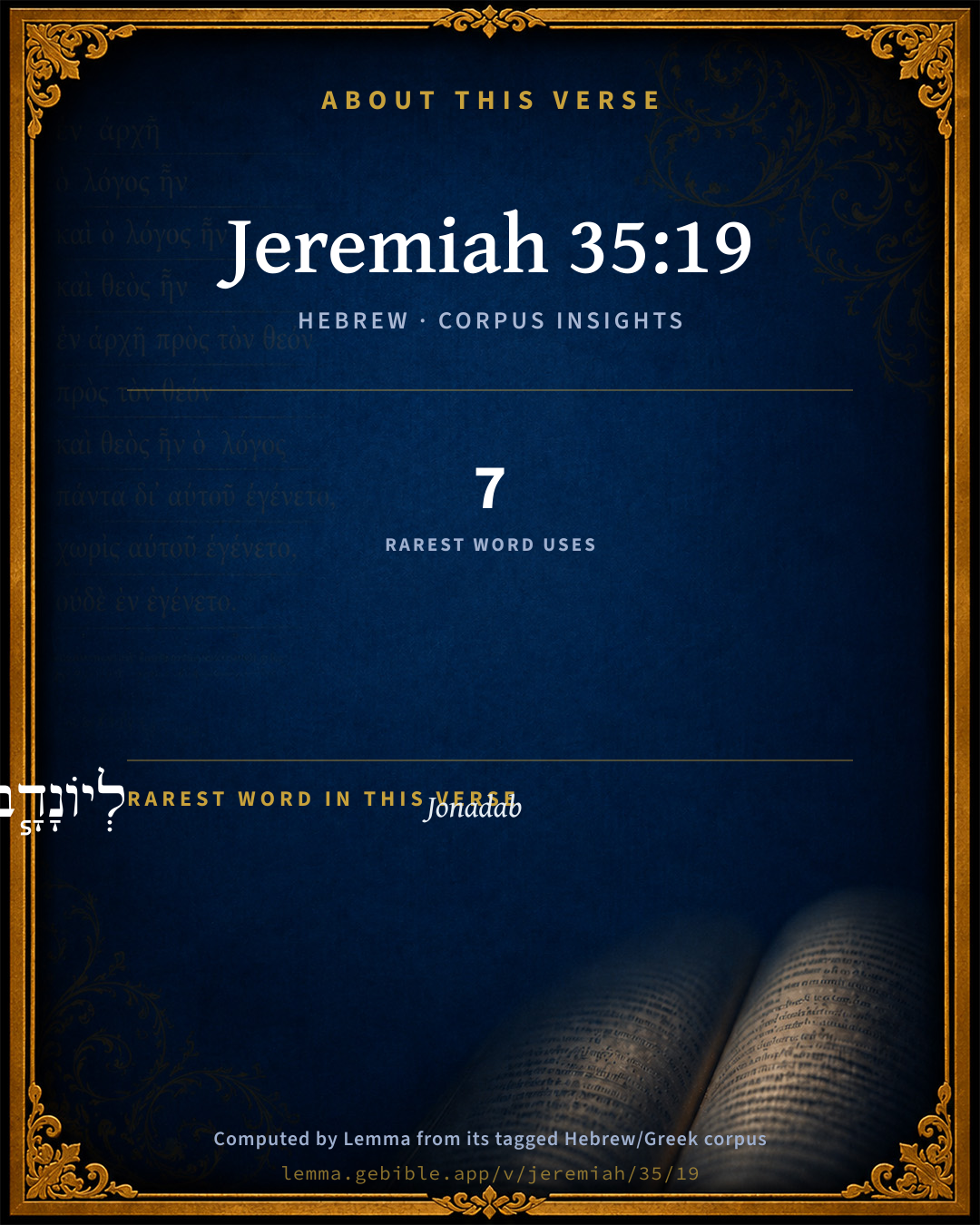
לְיוֹנָדָ֧ב
Yôwnâdâb
H3122
“to/for · Jonadab”
Preposition + Noun, Proper
Part of Speech
Preposition + Noun
Type
Proper
Full BDB Definition

Origin: a form of H3082

TWOT: None

Jonadab or Jehonadab = "Jehovah is willing" - a son of Rechab, chief of the Rechabites, in the time of Jehu and Ahab - a nephew of David
  1. לָכֵ֗ן kên H3651 “to/for · thus” Preposition + Adverb
  2. כֹּ֥ה kôh H3541 “thus” Adverb
  3. אָמַ֛ר ʼâmar H559 “to say” Verb, Qal, Perfect, 3rd Person, Masculine, Singular
  4. יְהוָ֥ה Yᵉhôvâh H3068 “LORD” Noun, Proper
  5. צְבָא֖וֹת tsâbâʼ H6635 “armies” Noun, Common, Both, Plural, Absolute
  6. אֱלֹהֵ֣י ʼĕlôhîym H430 “God(s) of” Noun, Common, Masculine, Plural, Construct
  7. יִשְׂרָאֵ֑ל Yisrâʼêl H3478 “Israel” Noun, Proper
  8. לֹֽא lôʼ H3808 “not” Particle, Negative
  9. יִכָּרֵ֨ת kârath H3772 “to cut” Verb, Niphal, Imperfect, 3rd Person, Masculine, Singular
  10. אִ֜ישׁ ʼîysh H376 “man” Noun, Common, Masculine, Singular, Absolute
  11. בֶּן bên H1121 “son of” Noun, Common, Masculine, Singular, Construct
  12. רֵכָ֛ב Rêkâb H7394 “Rechabites” Noun, Proper
  13. עֹמֵ֥ד ʻâmad H5975 “standing” Verb, Qal, Participle Active, Masculine, Singular, Absolute
  14. לְפָנַ֖י pânîym H6440 “to/for · face(s) · my” Preposition + Noun, Common, Both, Plural, Construct + Suffix, Personal, 1st Person, Common, Singular
  15. כָּל kôl H3605 “all of” Noun, Common, Masculine, Singular, Construct
  16. הַיָּמִֽים yôwm H3117 “the · days” Particle, Definite Article + Noun, Common, Masculine, Plural, Absolute

About this verse

These counts appear in no published source. They are computed here, from the morphology-tagged text and Lemma’s own curated glosses. What Lemma adds →

17
words
17
distinct lemmas
Prophets
section

Notable vocabulary

The rarest word here is לְיוֹנָדָ֧ב Jonadab H3122 — appearing just 7 times in the whole Hebrew Bible.

Shared distinctive vocabulary

לְיוֹנָדָ֧ב Jonadab H3122 occurs in 6 verses of the Hebrew Bible. Also found in:

Grammatical profile

  • 3 verbs
  • 11 nouns
  • 2 adverbs
  • 1 particle

Verb forms

  • אָמַ֛ר Qal · Perfect
  • יִכָּרֵ֨ת Niphal · Imperfect
  • עֹמֵ֥ד Qal · Participle Active

Cross-references

6

Topical passages linked to Jeremiah 35:19 in the Treasury of Scripture Knowledge — connected by theme and wording, ordered by reader-vote popularity; previews shown in the World English Bible.

  • Jeremiah 15:19 Therefore thus says Yahweh, If you return, then will I bring you again, that you may stand before me; and if you take forth the precious from the vile, you shall be as my mouth: they shall return to you, but you shall not return to them.
  • Luke 21:36 Therefore be watchful all the time, asking that you may be counted worthy to escape all these things that will happen, and to stand before the Son of Man."
  • Psalms 5:5 The arrogant shall not stand in your sight. You hate all workers of iniquity.
  • Jeremiah 33:17–18 For thus says Yahweh: David shall never want a man to sit on the throne of the house of Israel;
  • Jude 1:24 Now to him who is able to keep them from stumbling, and to present you faultless before the presence of his glory in great joy,
  • 1 Chronicles 2:55 The families of scribes who lived at Jabez: the Tirathites, the Shimeathites, the Sucathites. These are the Kenites who came of Hammath, the father of the house of Rechab.

Cross-references courtesy of OpenBible.info (CC BY 4.0).

Hebrew and Greek witnesses Masoretic Hebrew ↔ Greek Septuagint

The same verse in the two great witnesses to the Old Testament, shown verse-for-verse.

These are two independent witnesses, not word-aligned to each other, and the Septuagint is shown in lemma (dictionary) form.

Hebrew Jeremiah 35:19 Masoretic · Westminster Leningrad Codex

לָכֵ֗ן כֹּ֥ה אָמַ֛ר יְהוָ֥ה צְבָא֖וֹת אֱלֹהֵ֣י יִשְׂרָאֵ֑ל לֹֽא יִכָּרֵ֨ת אִ֜ישׁ לְיוֹנָדָ֧ב בֶּן רֵכָ֛ב עֹמֵ֥ד לְפָנַ֖י כָּל הַיָּמִֽים

therefore thus says Yahweh of Hosts, the God of Israel: Jonadab the son of Rechab shall not want a man to stand before me forever.

World English Bible · Public Domain

Greek LXX Structure differs

In the Septuagint, Jeremiah is about an eighth shorter than the Hebrew and arranges its material differently — the Oracles Against the Nations (Hebrew chapters 46–51) appear in the middle of the Greek book, after 25:13. Because the chapter and verse boundaries do not line up, a verse-for-verse comparison with the Hebrew is not shown.

A verse-for-verse comparison isn’t shown here because the chapters and verses don’t line up. Switch to the LXX edition with the MT / LXX toggle above to read the Greek directly.

On this verse, Ellicott's Commentary for English Readers discusses the Septuagint’s reading. Read the note in Commentary ↓

Hebrew: Westminster Leningrad Codex (CC BY 4.0). Greek: Septuagint (public domain); English from a public-domain English Septuagint. How the Septuagint differs from the Hebrew →

Targum (Aramaic paraphrase)

1

The Targum is the ancient Jewish Aramaic paraphrase of the Hebrew Scriptures — an interpretive translation, not the Hebrew text itself. Onkelos (literal) and Pseudo-Jonathan (expansive) render the Torah, and Jonathan the Prophets. Coverage is partial: where no permissively-licensed English translation exists for a verse, only the Aramaic is shown. This is verse-level text, not a word-by-word alignment to the Hebrew.

  1. Targum Jonathan Prophets (Joshua–Malachi)
    בְּכֵן כִּדְנַן אֲמַר יְיָ צְבָאוֹת אֱלָהָא דְיִשְׂרָאֵל לָא יִפְסוֹק גְבַר לְיוֹנָדָב בַּר רֵכָב מְשַׁמֵשׁ קֳדָמַי כָּל יוֹמַיָא:

    (no public-domain English translation for this verse)

    Targum Jonathan — Aramaic: “Mikraot Gedolot” (public domain). English: “Sefaria Community Translation” (CC0 1.0 (public-domain dedication)); “London "Chaldee Paraphrase," 1871” (public domain). Text via Sefaria.

Commentary

Notes on Jeremiah 35:19 from classic Christian and Jewish commentators (each source and its license shown beneath its notes). The classic Christian expositions comment on the surrounding passage and are grouped to its opening verse, so a note may address several verses; the Jewish commentaries on the Tanakh (Rashi and others) are per-verse, so they appear only where the commentator wrote on this verse.

Lemma curates 59 commentaries, every one of them public domain or Creative Commons licensed, each selected and text-cleaned for this edition rather than reprinted as found. About our sources →

Ellicott's Commentary for English Readers

(19) Jonadab the son of Rechab shall not want a man to stand before me for ever.—Taking the words in their simplest literal sense, they find a fulfilment in the strange unlooked-for way in which the name and customs of the Rechabites have cropped up from time to time. The Jewish historian Hegesippus (see Euseb. Hist. Eccl. ii. 23), in his account of the martyrdom of James the Just, names the sons of the Rechabites as looking on in reverential sympathy with one whose life, like their own, carried the Nazarite type to its highest perfection. In the account which Diodorus Siculns (xix. 94) gives of the Nabathæans as neither sowing seed, nor planting fruit-trees, nor building houses, and enforcing this rule of life under pain of death, we can scarcely fail to recognise the Rechabite type. Benjamin of Tudela, in the twelfth century, reports that he found 100,000 Jews who were named Rechabites, and who lived after their fashion near El Jubar, and that they were governed by a prince of the house of David. More recent travellers, Dr. Wolff (Journal, 1829, ii. 334; 1839, p. 389) and Signor Pierotti (Transactions of British Association, 1862), report that they have met tribes near Mecca, on the Dead Sea, or in Yemen and Senaar, who observed the rule of Jonadab, claimed to be his descendants, referred to Jer_35:19 as fulfilled in them, and led the life of devout Jews. It is probable, however, that in these later instances we may trace the effect of the Wahabee ascetic movement among the Mahomedan Arabs, identifying its rule with the old practice of the son of Rechab (Burckhardt: Bedouins and Wahabys, p. 283).

The words “stand before” have, however, in Hebrew a distinct secondary meaning. It was a definitely liturgical expression for the ministrations of the Levites who were chosen to “stand before” the Lord (Deu_10:8; Deu_18:5; Deu_18:7), and a like meaning is prominent in Jer_7:10; Jer_15:19; Gen_18:22; Jdg_20:28; Psa_134:1. The Targum of this passage, indeed, actually gives “ministering before me” as its paraphrase. The natural inference would be that the Rechabites were by these words admitted, in virtue of their Nazarite character, to serve as Levites in the Temple—to be, in fact, a higher class of Nethinim (see Notes on 1Ch_9:2; Ezr_2:43)—and this view is confirmed (1) by the fact that the LXX. ascribes Psalms 71 to “the sons of Jonadab, the first that were led captive;” (2) that a son of Rechab is associated in Neh_3:14 with priests and Levites and nobles in repairing the walls of Jerusalem; (3) in 1Ch_2:55 the Rechabites have become scribes, and in the Vulgate (evidence of a Jewish tradition as to the meaning of the words), the proper names of the English version, “Tirathites, Shimeathites, and Sucathites,” which add nothing to our knowledge, are represented by “canentes et resonantes et in tabernaculis commorantes” (“singing, and playing instruments, and dwelling in tents”), which unite the functions of Levites with the mode of life of the Rechabites. So Hegesippus (as above) speaks of priests who were of the sons of Rechab in the Apostolic age.

A Bible Commentary for English Readers, edited by Charles John Ellicott (1878–1897) — public domain. Text from a community e-Sword module.

Trapp's Complete Commentary

John Trapp

Jer 35:19 Therefore thus saith the LORD of hosts, the God of Israel; Jonadab the son of Rechab shall not want a man to stand before me for ever.

Ver. 19. Jonadab the son of Rechab shall not want a man to stand before me for ever,] i.e., To be beloved by me, and to be in special favour with me, lifting up pure hands in all places of their abode. Captive they were carried among the Jews; but they returned also again with them (as appears 1Ch 2:55), erantque Deo cordi et curae and they were dear to God.

John Trapp, A Commentary or Exposition upon All the Books of the Old and New Testament (1647–1656) — public domain. Text from a community e-Sword module.

Tyndale Open Study Notes

Tyndale Open Resources

35:19 One of the descendants of Jehonadab son of Recab apparently returned from Babylon after the Exile and helped to rebuild the wall of Jerusalem (see Neh 3:14).

Tyndale Open Study Notes — © Tyndale Open Resources, licensed CC BY-SA 4.0. Text via the HelloAO Bible API.

Geneva Bible (1599)

Geneva Bible translators

His posterity shall continue and be in my favor forever.

Geneva Bible (1599) marginal notes — public domain. Text via Bolls.life.

Jamieson, Fausset & Brown

Robert Jamieson, A. R. Fausset & David Brown

not want a man to stand before me--There shall always be left representatives of the clan to worship Me (Jer 15:1, Jer 15:19); or, "before Me" means simple existence, for all things in existence are in God's sight (Psa 89:36). The Rechabites returned from the captivity. WOLFF found traces of them in Arabia.

Next: Jeremiah Chapter 36

Jamieson, Fausset & Brown — Commentary Critical and Explanatory on the Whole Bible (1871) — public domain (CC PDM 1.0). Text via the HelloAO Bible API.

Adam Clarke's Commentary

Verse 19. Thus saith the Lord - Jonadab - shall not want a man to stand before me for ever.] His name shall ever be honourable, and his posterity shall enjoy my continual protection, and there shall never be found a time in which men of his spirit shall be wanting as patterns of genuine simplicity, filial obedience, purity of manners, and deadness to the world. True Christians may be considered as the genuine successors of these ancient Rechabites; and some suppose that the Essenes, in our Lord's time, were literally their descendants, and that these were they who followed our Lord particularly, and became the first converts to the Gospel. If so, the prophecy is literally fulfilled: they shall never want a man to stand before God, to proclaim his salvation, and minister to the edification and salvation of others, as long as the earth shall endure.

Adam Clarke's Commentary on the Bible (1810–1826) — public domain. Text from a community e-Sword/MySword module.

John Calvin's Commentaries

So then God now, in order to excite and rouse the Jews, promises to bless the Rechabites, because they had been obedient to their father, There shall not be cut off a man from Jonadab, that is, from the offspring of Jonadab, standing (literally) before my face; but as the conciseness of the verse renders it obscure and ambiguous, I have introduced an addition, — but that he may stand before my face And he says that they would stand before his face, not that they were to be priests or Levites, as some of the Rabbins have said, who have applied this passage to the priesthood, because it is often said in Scripture both of the Levites and the priests, that they stood before the face of God. They, therefore, think that the same thing is meant here when spoken of the Rechabites. But this is a strained meaning. God simply intimates, that some of Jonadab’s offspring would be always living, and that through his special favor, that their obedience might not appear to be without its just reward. This is the meaning. Now follows, —

John Calvin's Commentaries (1540-1563) — public domain. Text from the Calvin Translation Society English edition (1840s-50s) via the Christian Classics Ethereal Library (ccel.org). Calvin's coverage is partial (roughly two-thirds of the Bible); uncommented books and verses are honest gaps, never fabricated. The 19th-century editor's footnotes and remarks are omitted so the notes are faithfully Calvin's own voice.

The Cambridge Bible for Schools and Colleges

gen. ed. J. J. S. Perowne

19. to stand before me] It is by no means necessary to understand the expression here as implying priestly functions (cp. Jer_15:19), although the hint that the Rechabites were employed in some capacity in connexion with the Temple is supported by (i) the LXX heading of Psalms 71; (ii) the account of the martyrdom of James the Just (Eusebius, Eccles. Hist. II. 23) where “priests of the sons of Rechab” are spoken of. Benjamin of Tudela, a Jewish traveller of the 12th century, mentions a body of Jews who were called Rechabites, and whose customs corresponded with those detailed in Jeremiah. Dr Wolff (Journal, 1829) describes a body of Rechabites near Mecca who claimed to be sons of Jonadab. But it is by no means clear that the title in these three cases meant anything more than a certain amount of asceticism.

The Cambridge Bible for Schools and Colleges (gen. ed. J. J. S. Perowne; Cambridge University Press, 1878–1918) — public domain. Text from a community e-Sword module.

John Gill's Exposition

Therefore thus saith the Lord of hosts, the God of Israel,.... Who has enjoined children obedience to their parents, and has promised to reward it, and does:

Jonadab the son of Rechab shall not want a man to stand before me for ever; which may be understood of a long time, of ages to come; or as long as the people of the Jews were a people, or the world should stand, the posterity of this man should continue: or, "a man shall not be cut off from Jonadab &c." (h); his offspring shall never fail. It is certain that some of this family returned from the captivity, Ch1 2:55; and, according to Scaliger (i), the Hasidaeans sprung from them. And, if any credit could be given to Benjamin Tudelensis, there were Rechabites in the twelfth century, since the times of Christ; for he tells (k) us, that in his travels he found a place where Jews dwelt, who were called Rechabites. The phrase, "to stand before me", is by the Targum paraphrased,

"ministering before me;''

serving and worshipping God, for they were religious people; that is, in their own families, carrying on religious worship among themselves, and not in the temple, where they had no office, and did no service; though some think they had, because called scribes, Ch1 2:55. Kimchi says that some of their Rabbins asserted that the daughters of these people married priests, and so some of their children's children offered sacrifice on the altar. And if what Eusebius reports from Hegesippus is true, there were priests of this family after the times of Christ; for he says (l), that when the Jews were stoning James the just, a priest of the sons of Rechab cried out, saying, stop, what are ye doing? but these testimonies are not to be depended on; however, we may be sure of this, that the promise of God shall not fail, but be certainly accomplished. Very appropriate are the words of the learned Alting (m) upon this subject:

"not only the Lord promises length of life to the obedient, which proselytes, equally with Israelites, have the promise of; but, particularly, that the posterity of Jonadab should not perish, should have a place in the church of God, and an admission to the gracious enjoyment of God; not as priests and Levites, but as other Israelites and strangers, Isa 56:4; so that the posterity of Jonadab must still continue, and hope of restoration of them with the Israelites remains; as in Jer 31:36; but in the same way and manner; so that being equally sharers in exile, they are to be restored after a long interruption. Indeed, the family is not at this day known; but from the ignorance of men, to the denial of a thing, there is no available argument. Families cannot be confounded, since they descend by the fathers; mothers do not belong to them; and as is the father as to tribe, so also is the son and grandson, and so on. A genealogical series may perish from the knowledge of men, but not from the nature of things, and the knowledge of God. Though the seeds of wheat, barley, and other things, may be mixed together, that men cannot distinguish them, yet their distinction does not perish; and God not only knows it, but also discovers it, when he makes every seed to rise in its own body, Co1 15:37; so must we judge concerning families.''

Perhaps, since these Rechabites were proselytes, and not Israelites, the conversion of the Gentiles may be respected; who are priests in a spiritual sense, and minister before the Lord, offering up, through Christ, the spiritual sacrifices of prayer and praise; and such a generation to serve the Lord will never be wanting.

(h) "non exidetur vir Jonadabo", Junius & Tremellius, Piscator, Schmidt, &c. (i) Elench. Trihaeres. c. 24, (k) Itinerarium, p. 82. (l) Eccles. Hist. l. 2. c. 23. (m) Apud Witsii Exercitat. 9. de Rechabitis in Miscell. Sacr. tom. 2. p. 235, 236.

Next: Jeremiah Chapter 36

John Gill's Exposition of the Whole Bible (1746–1763) — public domain (CC PDM 1.0). Text via the HelloAO Bible API.

Albert Barnes' Notes on the Bible

Travelers bear witness to the existence of a large tribe who represent themselves as the descendants of the Rechabites. The prediction was also literally fulfilled in the Rechabites being in some way incorporated into the tribe of Levi, whose office especially it was to “stand before” Yahweh Deu 10:8.

Albert Barnes' Notes on the Bible (1834–1885) — public domain. Text from a community e-Sword/MySword module.

Haydock's Catholic Bible Commentary

Before me, in an honourable situation (1 Paralipomenon ii. 55.) about the temple. It was not requisite that they should be Levites. (Calmet) --- For ever. Their reward shall be eternal bliss. (Haydock) --- This they sought for, as they were strangers of Madian in the country, ver. 7. (Menochius)

George Leo Haydock (1774–1849), Haydock's Catholic Family Bible and Commentary, 1859 edition — public domain. Excludes Psalms (Douay-Rheims chapter numbering differs from Protestant) and Deuterocanonical books (Catholic canon only).

Matthew Poole's English Annotations

For ever here signifies the ever of the Jewish state or church; whether the promise relates to the abiding of Jonadab’s family, when many families of the Jews were quite rooted out, cut off, and extinct, or to some special favour that God would show them, or to some place of office they should have in or about the temple, (as some judge, because, 1Ch 2:55, it appears they were scribes,) is uncertain. But it is a question of more moment, How God promiseth a reward to these sons’ of Jonadab for obeying the command of their father, and whether they had sinned if they had not obeyed this command of Jonadab; which brings in another question, Whether parents have a power to oblige their children in matters which God hath left at liberty. To which I answer,

1. God might reward these Rechabites for their reverence and obedience to Jonadab their father, though these were not strictly, by the Divine law, obliged thus far to have obeyed him; as he rewarded David for his thoughts in his heart to build him a house, though it was not God’s will that he should do it; so as God’s promise of the reward doth not prove their obedience in this particular to have been their duty. Admit that it remained still a matter of liberty, yet the general honour and reverence they testified might be rewarded by God.

2. Unquestionably parents have not a power to determine children in all things as to which God hath left them a liberty, for then they have a power to make their children slaves, and to take away all their natural liberty. To marry or not, and to this or that person, is matter of liberty. Parents cannot in this case determine their children; Bethuel, Gen 24:58, asketh Rebekah if she would go with Abraham’s servant before he would send her.

3. In matters of civil concernment they have a far greater power than in matters of religion. All souls are God’s, and conscience can be under no other dominion than that of God.

4. In civil things parents have a great power, during the nonage of children, and after also in matters which concern their parents’ good, as to command them to assist them, to help to supply their necessities, &c.

5. Parents being set over children, and instead of God to them, as it is their duty to advise their children to the best of their ability for their good; so it is the duty of children to receive their advice, and not to depart from it, unless they see circumstances so mistaken by parents, or so altered by the providence of God, as they may reasonably judge their parents, had these known or foreseen it, would not have so advised. But that parents have an absolute power to determine children in all things as to which God hath not forbidden them, and that children by the law of God are obliged to an obedience to all such commands, however they may see their parents mistaken, or God by his providence may have altered circumstances, I see no reason to conclude. Jonadab had prudently advised his sons as before mentioned; they were things they might do, and which by experience they found not hurtful to them, but of great profit and advantage, and that with reference to all the ends of man’s life: herein they yield obedience, and pay a reverence to their parent; this pleaseth God, he promiseth to reward them with the continuance of their family, according to what he had said, Exo 20:12, in the fifth commandment, which the apostle calleth the first commandment with promise.

Matthew Poole's English Annotations on the Holy Bible (1683–1685) — public domain. Text from a community e-Sword/MySword module.

Whedon's Commentary on the Bible

Daniel D. Whedon

19. Shall not want a man to stand before me, etc. — The phrase “stand before me” may be technical and liturgical, as a writer in Smith’s Dictionary suggests, and this may have been fulfilled in that the Rechabites became in some way incorporated into the tribe of Levi. (See the title of Psalm lxxii, in the Septuagint: “To David of the sorts of Jonadab, and the first who were taken captive.”) A son of Rechab is mentioned in Neh_3:14, in connexion with priests and Levites. But the better explanation is, that it means simply divine care. Existence and service are suggested, but not necessarily sacerdotal service.

Daniel D. Whedon (gen. ed.), Commentary on the Old and New Testaments (1874–1909) — public domain. Text from a community e-Sword module.

John Wesley's Explanatory Notes

For ever - For ever here signifies the ever of the Jewish state, or church.

John Wesley, Explanatory Notes Upon the Whole Bible (1754–1765) — public domain. Text via the GEBible commentary corpus.

Lesson kit

Teaching starters — assembled from the data on this page, not authored interpretation. Every prompt links to the verse data it draws on. Edit before teaching.

Jeremiah, in the Prophets, opens this verse with 17 words (17 distinct Hebrew lemmas). Its most distinctive word is Yôwnâdâb (“Jonadab”). A historical commentator’s framing appears above. Read the whole chapter for the surrounding context.

Discussion questions

  1. The word Yôwnâdâb carries the sense “Jonadab.” How does it shape the verse?
  2. How does 2 Samuel 13:3, which shares the word «Jonadab», read alongside this verse?
  3. These translations render this verse differently. What is at stake in choosing one wording over another?
  4. «אָמַ֛ר» is a Qal Perfect verb. How does that grammatical form shape the action described?
  5. Compare how Ellicott's Commentary for English Readers and Trapp's Complete Commentary read this verse. Where do they agree or differ?

Things to notice

Reading settings

Reading text

Shown beneath each verse's original-language words.

Old Testament
Old Testament edition

Read the OT as the Masoretic Hebrew (MT) or the Greek Septuagint (LXX).

English shown for the Greek Septuagint (in the Hebrew ↔ Greek comparison).

Comparing translations? Open the Compare panel on any verse page to stack up to four side by side.