Romans 16:22

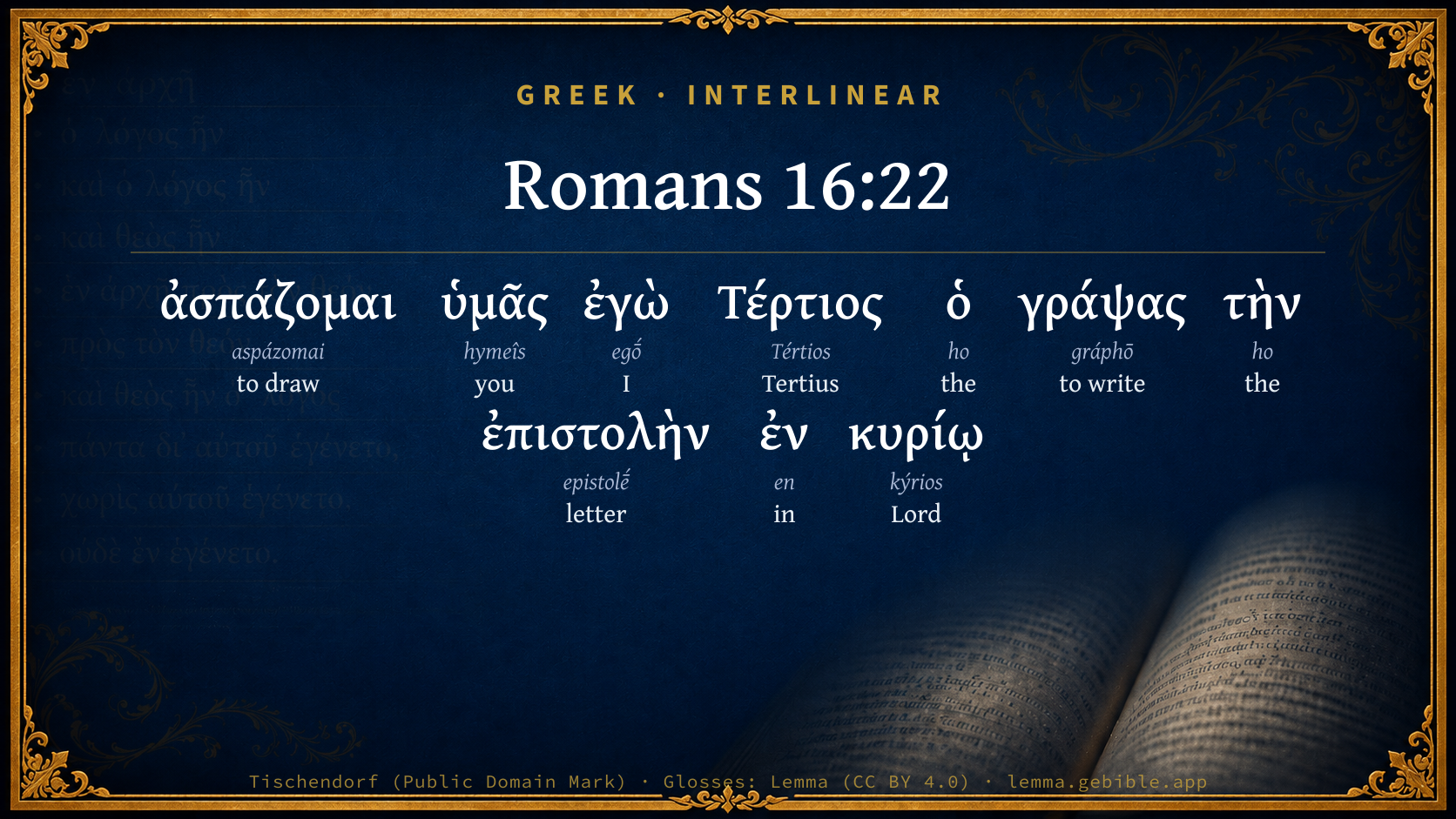
Greek (Tischendorf 8th ed.) Romans 16:22 appears in the Greek New Testament. The text above is from the Tischendorf 8th edition. Each word links to its Strong’s number and a concise gloss. Click any word for its full Thayer’s Greek Lexicon entry.
Download image
Cite this verse

Romans 16:22 (World English Bible). Public Domain. Lemma interlinear Bible study tool, https://lemma.gebible.app/v/romans/16/22.

Show BibTeX & RIS
BibTeX
RIS
English Translation
I, Tertius, who write the letter, greet you in the Lord.
World English Bible · Public Domain
Highlights
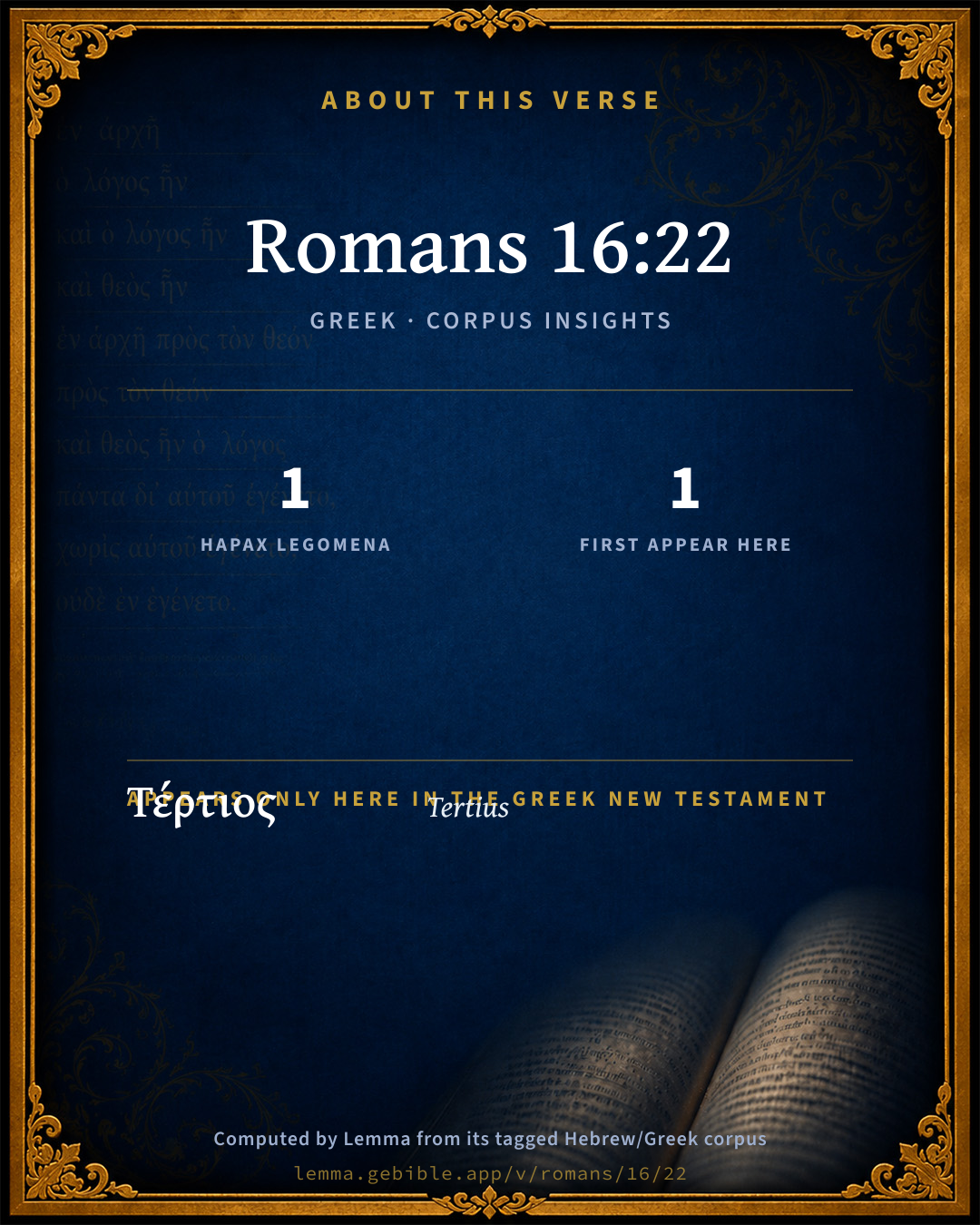
  • 1 hapax legomenon — only here in the Greek New Testament
  • 1 first appearance in the Greek New Testament
Full analysis ↓
Download a study sheet

One document with this verse’s original text, its word-by-word gloss line, the meaning frame, cross-references with their text, attributed commentary, and full source and license credits — printable, and it pastes into notes with its structure intact.

This verse Autodidact and up

Study sheet (.html) Plain text (.txt)

A passage Seminary Student

Up to 50 verses in one chapter. A passage sheet keeps up to 6 commentary sources and 12 cross-references per verse, in the order this page ranks them, and says so on the sheet whenever that leaves anything out. Ask for a single verse and you get the Autodidact verse sheet above.

Everything on this page stays free to read, with no account — the sheet is a download of what is already on screen, not access to it.

Want to remove ads? Support Godless Engineer
Compare translations 3

The same verse in 3 English versions, stacked beneath the original-language interlinear above. Click any original word for its lexicon entry.

Each is an independent rendering of the whole verse — the interlinear is not word-aligned to these translations.

Highlighted words mark where these versions differ — a whole-verse word diff, not a word-by-word alignment.

  • World English Bible Public Domain
    I, Tertius, who write the letter, greet you in the Lord.
  • King James Version Public Domain
    I Tertius, who wrote this epistle, salute you in the Lord.
  • unfoldingWord Literal Text CC BY-SA 4.0
    I, Tertius, the one having written this epistle, greet you in the Lord.

unfoldingWord Literal Text — © unfoldingWord, licensed CC BY-SA 4.0. Word-aligned USFM3 via Door43 (git.door43.org/unfoldingWord/en_ult).

Versions to compare (up to 4)

3 of 4 selected

Show all 19 translations

Every available English version of this verse, each an independent rendering of the whole verse.

  • World English Bible Public Domain
    I, Tertius, who write the letter, greet you in the Lord.
  • Berean Standard Bible Public Domain
    I, Tertius, who wrote down this letter, greet you in the Lord.
  • Majority Standard Bible Public Domain
    I, Tertius, who wrote down this letter, greet you in the Lord.
  • King James Version Public Domain
    I Tertius, who wrote this epistle, salute you in the Lord.
  • American Standard Version (1901) Public Domain
    I Tertius, who write the epistle, salute you in the Lord.
  • Revised Version (1885) Public Domain
    I Tertius, who write the epistle, salute you in the Lord.
  • Geneva Bible (1599) Public Domain
    I Tertius, which wrote out this Epistle, salute you in the Lord.
  • Douay-Rheims (1899) Public Domain
    I Tertius, who wrote this epistle, salute you in the Lord.
  • Young's Literal Translation Public Domain
    I Tertius salute you (who wrote the letter) in the Lord;
  • Literal Standard Version CC BY-SA 4.0
    I, Tertius, greet you (who wrote the letter) in the LORD;
  • Unlocked Literal Bible CC BY-SA 4.0
    I, Tertius, who write this epistle down, greet you in the Lord.
  • unfoldingWord Literal Text CC BY-SA 4.0
    I, Tertius, the one having written this epistle, greet you in the Lord.
  • Darby Bible Public Domain
    I Tertius, who have written this epistle, salute you in [the] Lord.
  • World Messianic Bible Public Domain
    I, Tertius, who write the letter, greet you in the Lord.
  • Webster's Bible Public Domain
    I Tertius, who wrote this epistle, salute you in the Lord.
  • Free Bible Version CC BY-SA 4.0
    Tertius—who wrote down this letter—also sends you greetings in the Lord.
  • Bible in Basic English Public Domain
    I, Tertius, who have done the writing of this letter, send love in the Lord.
  • Text-Critical English NT CC BY 4.0
    I, Tertius, who wrote down this letter, greet you in the Lord.
  • Tyndale New Testament (1534) Public Domain
    I Tertius salute you which wrote this epistle in the Lorde.

Literal Standard Version (2020), Covenant Press — licensed CC BY-SA 4.0. Text via the HelloAO Bible API (eBible.org). Unlocked Literal Bible (unfoldingWord) — licensed CC BY-SA 4.0. Text via the HelloAO Bible API (eBible.org). unfoldingWord Literal Text — © unfoldingWord, licensed CC BY-SA 4.0. Word-aligned USFM3 via Door43 (git.door43.org/unfoldingWord/en_ult). Free Bible Version, Dr. Jonathan Gallagher — licensed CC BY-SA 4.0. Text via the HelloAO Bible API (eBible.org).

Word by word

More ways to search: Search by grammar → Find every occurrence → Compare this word →

Practice this passage: Drill this verse → Learn its vocabulary →

About this verse

These counts appear in no published source. They are computed here, from the morphology-tagged text and Lemma’s own curated glosses. What Lemma adds →

10
words
9
distinct lemmas
Pauline Epistles
section

Notable vocabulary

1 hapax legomenon — a word that appears only here in the entire Greek New Testament:

  • Τέρτιος Tertius G5060

First appearance in Scripture

This word makes its first canonical appearance in the Greek New Testament here:

  • Τέρτιος Tertius G5060

Shared distinctive vocabulary

ἐπιστολὴν letter G1992 occurs in 23 verses of the Greek New Testament. Also found in:

Repetition

A word recurs within this verse:

Cross-references

4

Topical passages linked to Romans 16:22 in the Treasury of Scripture Knowledge — connected by theme and wording, ordered by reader-vote popularity; previews shown in the World English Bible.

  • Galatians 6:11 See with what large letters I write to you with my own hand.
  • Romans 16:8 Greet Amplias, my beloved in the Lord.
  • 1 Corinthians 16:21 This greeting is by me, Paul, with my own hand.
  • Colossians 3:17 Whatever you do, in word or in deed, do all in the name of the Lord Jesus, giving thanks to God the Father, through him.

Cross-references courtesy of OpenBible.info (CC BY 4.0).

Commentary

Notes on Romans 16:22 from classic Christian and Jewish commentators (each source and its license shown beneath its notes). The classic Christian expositions comment on the surrounding passage and are grouped to its opening verse, so a note may address several verses; the Jewish commentaries on the Tanakh (Rashi and others) are per-verse, so they appear only where the commentator wrote on this verse.

Lemma curates 59 commentaries, every one of them public domain or Creative Commons licensed, each selected and text-cleaned for this edition rather than reprinted as found. About our sources →

Joseph Benson's Commentary

Rom 16:22-24. I Tertius, who wrote this epistle — While the apostle dictated it to me; or he might mean that he transcribed it from the apostle’s autograph: salute you in the Lord — The Lord Christ, our common Master. This sentence Tertius inserted by the apostle’s advice, or at least, permission. Gaius, mine host, by whom I am entertained here at Corinth; see 1Co 1:14 : and of the whole church — To all the members of which he shows great hospitality. Or the meaning may be, that the members of the church at Corinth met for some time in his house. Erastus the chamberlain of the city — Namely, of Corinth, saluteth you — The original expression, οικονομος της πολεως, is, literally, the steward of the city; but in the Vulgate version it is translated, arcarius civitatis, treasurer of the city. And Quartus a brother — That is, a Christian brother; or, as some think the expression implies, a Christian minister: doubtless he was a person of some note among the first Christians, otherwise his name would not have been inserted here. The grace of our Lord, &c., be with you all — This apostolical benediction, (which the apostle here repeats to testify still further his great affection for them, and his earnest desire of their welfare,) he always wrote with his own hand, to distinguish his genuine epistles from those that were forged in his name, 2Th 3:17; and he commonly ended his letters with it. But on this occasion he added also, (it seems in his own hand-writing,) that grand doxology contained in the three following verses; in which he offers a solemn thanksgiving to God for the calling of the Gentiles by the apostle’s preaching Christ to them, according to the revelation of that mystery made to him, and according to God’s express commandment in the prophetic writings of the Jews. And as he had explained these subjects in the foregoing epistle, this doxology was placed at the conclusion of it with great propriety, and could not but be very acceptable to all the Gentiles.

Joseph Benson's Commentary on the Old and New Testaments (1811–1818) — public domain. Text from a community e-Sword module.

MacLaren's Expositions of Holy Scripture

Alexander MacLaren

Romans

TERTIUS

Rom 16:22.

One sometimes sees in old religious pictures, in some obscure corner, a tiny kneeling figure, the portrait of the artist. So Tertius here gets leave to hold the pen for a moment on his own account, and from Corinth sends his greeting to his unknown brethren in Rome. Apparently he was a stranger to them, and needed to introduce himself. He is never heard of before or since. For one brief moment he is visible, like a star of a low magnitude, shining out for a moment between two banks of darkness and then swallowed up. Judging by his name, he was probably a Roman, and possibly had some connection with Italy, but clearly was a stranger to the Church in Rome. We do not know whether he was a resident in Corinth, where he wrote this epistle, or one of Paul’s travelling companions. Probably he was the former, as his name never recurs in any of Paul’s letters. One can understand the impulse which led him for one moment to come out of obscurity and to take up personal relations with those who had so long enjoyed his pen. He would fain float across the deep gulf of alienation a thread of love which looked like gossamer, but has proved to be stronger than centuries and revolutions.

This humble and modest greeting is an expression of a sentiment which the world may smile at, but which, being ‘in the Lord,’ partakes of immortality. No doubt the world’s hate drove more closely together all the disciples in primitive times; but the yearning of Tertius for some little corner in the love of his Roman brethren might well influence us to-day. There ought to be an effort of imagination going out towards unknown brethren. Christian love is not meant to be kept within the limits of sight and personal knowledge; it should overleap the narrow bounds of the communities to which we belong, and expatiate over the whole wide field. The great Shepherd has prescribed for us the limits to the very edge of which our Christian love should consciously go forth, and has rebuked the narrowness to which we are prone, when He has said, ‘Other sheep I have which are not of this fold.’ We are all too prone to let identities of opinion and of polity, or even the accident of locality, set bounds to our consciousness of brotherhood; and the example of this little gush of affection, that reaches out a hand across the ocean and grasps the hands of unknown partakers in the common life of the one Lord, may well shame us out of our narrowness, and quicken us into a wide perception and deepened feeling towards all who in every place call up Jesus Christ as their Lord-’both their Lord and ours.’

Another lesson which we may learn from Tertius’ characterisation of himself is the dignity of subordinate work towards a great end. His office as amanuensis was very humble, but it was quite as necessary as Paul’s inspired fervour. It is to him that we owe our possession of the Epistle; it is to him that Paul owed it that he was able to record in imperishable words the thoughts that welled up in his mind, and would have been lost if Tertius had not been at his side. The power generated in the boilers does its work through machines of which each little cog-wheel is as indispensable as the great shafts. Members of the body which seem to be ‘more feeble, are necessary.’ Every note in a great concerted piece of music, and every instrument, down to the triangle and the little drum in the great orchestra, is necessary. This lesson of the dignity of subordinate work needs to be laid to heart both by those who think themselves to be capable of more important service, and by those who have to recognise that the less honourable tasks are all for which they are fit. To the former it may preach humility, the latter it may encourage. We are all very ignorant of what is great and what is small in the matter of our Christian service, and we have sometimes to look very closely and to clear away a great many vulgar misconceptions before we can clearly discriminate between mites and talents. ‘We know not which may prosper, whether this or that’; and in our ignorance of what it may please God to bring out of any service faithfully rendered to Him, we had better not be too sure that true service is ever small, or that the work that attracts attention and is christened by men ‘great’ is really so in His eyes. It is well to have the noble ambition to ‘desire earnestly the greater gifts,’ but it is better to ‘follow the more excellent way,’ and to seek after the love which knows nothing of great or small, and without which prophecy and the knowledge of all mysteries, and all conspicuous and all the shining qualities profit nothing.

We can discern in Tertius’ words a little touch of what we may call pride in his work. No doubt he knew it to be subordinate, but he also knew it to be needful; and no doubt he had put all his strength into doing it well. No man will put his best into any task which he does not undertake in such a spirit. It is a very plain piece of homely wisdom that ‘what is worth doing at all is worth doing well.’ Without a lavish expenditure of the utmost care and effort, our work will tend to be slovenly and unpleasing to God, and man, and to ourselves. We may be sure there were no blots and bits of careless writing in Tertius’ manuscript, and that he would not have claimed the friendly feelings of his Roman brethren, if he had not felt that he had put his best into the writing of this epistle. The great word of King David has a very wide application. ‘I will not take that which is thine for the Lord, nor offer burnt offerings without cost.’

Tertius’ salutation may suggest to us the best thing by which to be remembered. All his life before and after the hours spent at Paul’s side has sunk in oblivion. He wished to be known only as having written the Epistle. Christian souls ought to desire to live chiefly in the remembrance of those to whom they have been known as having done some little bit of work for Jesus Christ. We may well ask ourselves whether there is anything in our lives by which we should thus wish to be remembered. All our many activities will sink into silence; but if the stream of our life, which has borne along down its course so much mud and sand, has brought some grains of gold in the form of faithful and loving service to Christ and men-these will not be lost in the ocean, but treasured by Him. What we do for Jesus and to spread the knowledge of His name is the immortal part of our mortal lives, and abides in His memory and in blessed results in our own characters, when all the rest that made our busy and often stormy days has passed into oblivion. All that we know of Tertius who wrote this Epistle is that he wrote it. Well will it be for us if the summary of our lives be something like that of his!

Alexander MacLaren, Expositions of Holy Scripture (1904–1910) — public domain. Text from a community e-Sword module.

Tyndale Open Study Notes

Tyndale Open Resources

16:22 Tertius was the scribe (or amanuensis) who wrote the letter as Paul dictated. Most ancient letter writers employed such a scribe.

Tyndale Open Study Notes — © Tyndale Open Resources, licensed CC BY-SA 4.0. Text via the HelloAO Bible API.

Bengel's Gnomon

Johann Albrecht Bengel

Rom 16:22. Ἀσπάζομαι, I salute) Tertius either by the advice or good-natured permission of Paul put in this salutation. Paul dictated, from which it is evident, how ready the apostles were in producing their books, without the trouble of premeditation.—Τέρτις, Tertius) a Roman name. An amanuensis no doubt well known to the Romans.—ἐν, in) construed with I who wrote; an implied confession of faith.

Bengel's Gnomon of the New Testament — English translation (T&T Clark, Edinburgh, 1860) — public domain. Text from a community e-Sword module.

Meyer's Critical & Exegetical Commentary

Heinrich August Wilhelm Meyer

Rom_16:22. Tertius, probably an Italian with whom the readers were acquainted, was at that time with Paul in Corinth, and wrote the letter, which the apostle dictated to him. The view that he made a fair copy of the apostolic draught (Beza, Grotius) is the more groundless, since Paul was wont to dictate his epistles (1Co_16:21; Gal_6:11; Col_4:16; 2Th_3:17). In his own name Tertius writes his greeting; for it was very natural that, when he called the apostles attention to his personal wish to send a greeting, his own greeting (which Grotius and Laurent, without sufficient ground, relegate to the margin) would not be dictated by the apostle, but left to himself to express. In Rom_16:23, Paul again proceeds with his dictation. Quite groundlessly, Olshausen (following Eichhorn) thinks that Paul wrote the doxology immediately after Rom_16:20, and did so on a small separate piece of parchment, the other blank side of which the scribe Tertius used, in order to write on it in his own name Rom_16:21-24. But how incontestably ὁ συνεργός μου, Rom_16:21, points to Paul himself!

ἐν κυρίῳ] To be referred to ἀσπ.; the Christian salutation, offered in the consciousness of living fellowship with Christ. Comp. 1Co_16:19.

Meyer — Critical and Exegetical Commentary on the New Testament — English translation by Peter Christie, edited by Frederick Crombie (T&T Clark, 1880) — public domain. Text from a community e-Sword module.

Expositor's Greek Testament

ed. W. Robertson Nicoll

Rom 16:22 . ἐγὼ Τέρτιος ὁ γράψας τὴν ἐπιστολήν : the use of the first person is a striking indication of Paul’s courtesy. To have sent the greeting of his amanuensis in the third person would have been to treat him as a mere machine (Godet). ἐν Κυρίῳ goes with ἀσπάζομαι : it is as a Christian, not in virtue of any other relation he has to the Romans, that Tertius salutes them.

The Expositor's Greek Testament, edited by W. Robertson Nicoll (1897–1910) — public domain. Text from a community e-Sword module.

Geneva Bible (1599)

Geneva Bible translators

Wrote it as Paul uttered it.

Geneva Bible (1599) marginal notes — public domain. Text via Bolls.life.

Jamieson, Fausset & Brown

Robert Jamieson, A. R. Fausset & David Brown

I, Tertius, who wrote this--"the"

epistle--as the apostle's amanuensis, or penman.

salute you in the Lord--So usually did the apostle dictate his epistles, that he calls the attention of the Galatians to the fact that to them he wrote with his own hand (Gal 6:11). But this Tertius would have the Romans to know that, far from being a mere scribe, his heart went out to them in Christian affection; and the apostle, by giving his salutation a place here, would show what sort of assistants he employed.

Jamieson, Fausset & Brown — Commentary Critical and Explanatory on the Whole Bible (1871) — public domain (CC PDM 1.0). Text via the HelloAO Bible API.

Adam Clarke's Commentary

Verse 22. I Tertius, who wrote this epistle] Some eminent commentators suppose Tertius to be the same with Silas-the companion of St. Paul. If this were so, it is strange that the name which is generally given him elsewhere in Scripture should not be used in this place. I have already noticed (Preface, page v.) that some learned men have supposed that St. Paul wrote this epistle in Syriac, and that Tertius translated it into Greek; but this can never agree with the declaration here: I Tertius, who wrote, γραψας την επιστολην, this epistle; not translated or interpreted it. It appears that St. Paul dictated it to him, and he wrote it down from the apostle's mouth; and here introduces himself as joining with St. Paul in affectionate wishes for their welfare.

Salute you in the Lord.] I wish you well in the name of the Lord: or, I feel for you that affectionate respect which the grace of the Lord Jesus inspires. It is not clear whether the two following verses be the words of Tertius or St. Paul.

Adam Clarke's Commentary on the Bible (1810–1826) — public domain. Text from a community e-Sword/MySword module.

Ellicott's Commentary for English Readers

(22) Tertius.—The Apostle’s amanuensis. It was the custom of St. Paul to add a few words of parting benedictory encouragement or admonition in his own handwriting, partly as a mark of his own personal interest in his readers, and partly as a precaution against forgery. (See especially Gal_6:11, and 2Th_3:17.) We have observed in the course of this Commentary how frequently the involved and broken style is to be accounted for by this habit of dictation, and, as it would seem, not very punctilious revision. We have the thoughts and words of the Apostle as they came warm from his own mind.

A Bible Commentary for English Readers, edited by Charles John Ellicott (1878–1897) — public domain. Text from a community e-Sword module.

The Cambridge Bible for Schools and Colleges

gen. ed. J. J. S. Perowne

22. I Tertius, &c.] This ver. may be read, I Tertius greet you, who wrote the Epistle in the Lord; i.e., who wrote it, (as the Apostle’s amanuensis,) in the spirit of a Christian, as a work of holy privilege and love. But the E. V. is also justified by the Greek, and is the more probable on the whole.

Tertius had a Latin name, and was perhaps a Roman, personally known to the Church at Rome. There is something strangely real and life-like in this sudden interposition of the amanuensis, with his own personal greeting.

who wrote this epistle] Letter-writing by amanuensis was very common in the days of St Paul; and if St Paul suffered in his eyes, as is not unlikely[49], he would be doubly sure to use such help. It was his custom (in his earliest Epistles, at least,) to write a few words at the close with his own hand. See 2Th_3:17.—Cp. Gal_6:11; where render, “See in what large letters I write to you, with my own hand.”

[49] See Introduction, i. § 32.

The Cambridge Bible for Schools and Colleges (gen. ed. J. J. S. Perowne; Cambridge University Press, 1878–1918) — public domain. Text from a community e-Sword module.

John Gill's Exposition

Gaius mine host,.... There was one Gaius a Macedonian, that was with the apostle at Ephesus, Act 19:29; and another Gaius of Derbe, that accompanied him into Asia, Act 20:4; whether either of these, as the latter seems more probable, was this person, is not certain. However, it seems very likely that it is the same Gaius the apostle baptized at Corinth, Co1 1:14; and some have thought him to be the same that the Apostle John wrote his third epistle to, and indeed the characters of hospitality and generosity there given him well agree with this, who was not only the apostle's host that entertained him in a kind and liberal manner, but of all the saints:

and of the whole church, saluteth you; that is, of the church at Corinth, to whom he was kind and hospitable, even to as many as stood in need of his assistance; or of the church of Christ in general, being beneficent and liberal to all Christian strangers that came that way, lodged them at his house, and provided every thing proper and convenient for them. Dr. Lightfoot thinks that there was a public hospital or receptacle for strangers at Corinth, in imitation of the Jews, who had a place adjoining to their synagogues to entertain travellers in; and that Gaius was the chief officer and overseer of this house, who, discharging his trust well, is deservedly commended. That the Jews had places near their synagogues for such a purpose is, certain. It is said (b),

"why do they sanctify (or consecrate the day?) that travellers may do their duty, who eat, and drink, and sleep in the synagogue.''

The gloss on it is,

"not the synagogue itself, but the chambers which were near the synagogue, are called the synagogue, and from thence they heard the consecration.''

And elsewhere (c) it is said,

"in the synagogues they neither eat nor drink--but there is a place near the synagogue where travellers used to sleep and eat;''

and then follows what is said before. And Maimonides (d) observes,

"there is no sanctification (of the sabbath) but in the place where the meal is eaten; so a man may not sanctify in one house, and eat in another; but if he sanctifies in this, he must eat in this; but why do they sanctify in the synagogue? because of travellers who eat and drink there.''

Upon which his commentator remarks (e), that

"they do not eat in the synagogue at all, but they eat, , "in a house near the synagogue", where they sit at the time of hearing the sanctification.''

But whether there was such an house at Corinth near the place of public worship, or any where else for this purpose, is not certain; and to make Gains only an overseer over such an house, though a faithful one, greatly sinks his character; since one would conclude from hence, that his entertainment of the apostle, and other saints, was at his own expense.

Erastus the chamberlain of the city saluteth you; whom the apostle is said to leave at Corinth, Ti2 4:20, and at another time to send along with Timotheus into Macedonia, if the same person is intended; for these do not seem so well to accord with his being in such an office, which must require attendance, and would not admit of going from place to place with the apostle, or of being sent by him. The city, of which he was chamberlain, was the city of Corinth, where the apostle and this Erastus were, when this epistle was wrote. The word translated "chamberlain", is often used for a steward; and here it signifies such an officer as had the care of the city chest or coffer, and distributed the public money; and seems to answer to the "quaestor urbanus", or city treasurer, among the Romans, whose business it was to receive the city accounts, and disburse at all occasions of public expenses; so that this was a place of honour and trust; hence it appears, that though not many, yet some rich and honourable were called by grace, and embraced the Gospel. His name signifies beloved, and is the same with David in Hebrew. What nation he was of is not certain, whether a Roman, a Greek, or Jew; one of this name is reckoned among the seventy disciples, and it said to be bishop of Paneas, or of the Philippians; See Gill on Luk 10:1.

Quartus a brother; not of Tertius, nor of Erastus, nor of the apostle according to the flesh, as some have thought, but a brother in a spiritual relation. This man, as appears from his name, was a Roman; probably had before lived at Rome, and therefore sends his salutations to the Christians there: he is mentioned among the seventy disciples, and said to be bishop of Berytus; See Gill on Luk 10:1.

(b) T. Bab. Pesachim, fol. 101. 1. (c) Gloss. in T. Bab. Bava Bathra, fol. 3. 2. (d) Hilchot Sabbat, c. 29. sect. 8. (e) Maggid. Misnah in ib.

John Gill's Exposition of the Whole Bible (1746–1763) — public domain (CC PDM 1.0). Text via the HelloAO Bible API.

Trapp's Complete Commentary

John Trapp

22 I Tertius, who wrote this epistle, salute you in the Lord.

Ver. 22. I Tertius who wrote, &c.] Either from the apostle’s mouth, or rather out of his foul papers.

John Trapp, A Commentary or Exposition upon All the Books of the Old and New Testament (1647–1656) — public domain. Text from a community e-Sword module.

Albert Barnes' Notes on the Bible

I Tertius - Of Tertius nothing more is known than is mentioned here.

Who wrote this - It is evident that Paul employed an amanuensis to write this Epistle, and perhaps he commonly did it. Tertius, who thus wrote it, joins with the apostle in affectionate salutations to the brethren at Rome. To the Epistle, Paul signed his own name, and added a salutation in his own hand-writing. Col 4:18, “The salutation by the hand of me Paul;” and in 2Th 3:17, he says that this was done in every epistle, 1Co 16:21.

In the Lord - As Christian brethren.

Albert Barnes' Notes on the Bible (1834–1885) — public domain. Text from a community e-Sword/MySword module.

Haydock's Catholic Bible Commentary

This Tertius was the amanuensis, or secretary of St. Paul, and wrote this epistle as St. Paul dictated. It is not on that account less divinely inspired than the rest. (Estius)

George Leo Haydock (1774–1849), Haydock's Catholic Family Bible and Commentary, 1859 edition — public domain. Excludes Psalms (Douay-Rheims chapter numbering differs from Protestant) and Deuterocanonical books (Catholic canon only).

Matthew Poole's English Annotations

Tertius; this was the apostle’s scribe or amanuensis,

who wrote this Epistle, either from his mouth, or from his papers: he put in this salutation by the apostle’s licence.

Salute you in the Lord; i.e. I wish you safety from the Lord.

Matthew Poole's English Annotations on the Holy Bible (1683–1685) — public domain. Text from a community e-Sword/MySword module.

Whedon's Commentary on the Bible

Daniel D. Whedon

22. Tertius—A Roman name signifying third, as Quartus below signifies fourth.

Wrote—As amanuensis to Paul.

Daniel D. Whedon (gen. ed.), Commentary on the Old and New Testaments (1874–1909) — public domain. Text from a community e-Sword module.

John Wesley's Explanatory Notes

I Tertius, who wrote this epistle, salute you - Tertius, who wrote what the apostle dictated, inserted this, either by St. Paul's exhortation or ready permission. Caius - The Corinthian, 1 Cor. i, 14. My host, and of the whole church - Who probably met for some time in his house.

John Wesley, Explanatory Notes Upon the Whole Bible (1754–1765) — public domain. Text via the GEBible commentary corpus.

Godbey's Commentary on the New Testament

William B. Godbey

22. “I Tertius, the one having written the epistle in the Lord, salute you.” This short verse is not the dictation of Paul, but of Tertius, his amanuensis, on his own responsibility. “Gaius my host, and that of the whole church, saluteth you.” Paul enjoyed the kind hospitality of Gaius while he dictated this letter to Tertius. “Erastus, the chamberlain of the city, and brother Quartus salute you.” While the Corinthian church was the largest in all the vast Pauline diocese, the members were nearly all poor in temporal circumstances, with a few exceptions of Gaius, here mentioned as the host of Paul and the whole church, Erastus, the chamberlain of the city, and Crispus, the chief ruler of the synagogue.

William B. Godbey, Commentary on the New Testament (1896–1900) — public domain. Text from a community e-Sword module.

McGarvey & Pendleton's Commentaries

J. W. McGarvey

I Tertius, who write the epistle, salute you in the Lord . [Paul habitually used amanuenses ( Gal_6:11 ; Col_4:18 ; 2Th_3:7 ). Tertius, the penman of this Epistle, and known to us only here, shows to us by his salutation that he was no mere hireling in this service.]

J. W. McGarvey (with Philip Y. Pendleton), Commentaries on the New Testament (The Fourfold Gospel, 1914; Acts; and the epistles) — public domain. Text from a community e-Sword/MySword module.

The People's New Testament

B. W. Johnson

22. I, Tertius. Otherwise unknown. Paul dictated the letter, and Tertius acted as scribe.

B. W. Johnson's The People's New Testament with Notes (1889–1891) — public domain. Electronic text from the Christian Classics Ethereal Library (CCEL) ThML edition.

Cambridge Greek Testament for Schools and Colleges

22. Τέρτιος ὁ γράψας κ.τ.λ. On S. Paul’s use of an amanuensis cf. 1Co 16:21; Gal 6:11; Col 4:18; 2Th 3:17. S. H.

Cambridge Greek Testament for Schools and Colleges (Cambridge University Press, 1896; 21 vols, various authors incl. Carr, Maclear, Plummer, Farrar, Lumby, Moule, M. R. James, Simcox) — public domain. Text from a community e-Sword module.

Alford’s Greek Testament

Henry Alford

22.] There is nothing strange (as Olsh. supposes) in this salutation being inserted in the first person. It would be natural enough that Tertius the amanuensis, inserting ἀσπάζεται ὑμ. Τέρτ. ὁ γρ. τ. ἐπ. ἐν κυρ., should change the form into the first person, and afterwards proceed from the dictation of the Apostle as before. Beza and Grot. suppose him to have done this on transcribing the Epistle. Thol. notices this irregularity as a corroboration of the genuineness of the chapter. On the supposed identity of Tertius with Silas see note on Act 15:22.

Henry Alford, The Greek Testament (1849–1861) — public domain. Text from a community e-Sword module.

International Critical Commentary

22. ὁ γράψας. St. Paul seems generally to have employed an amanuensis, see 1Co 16:21; Col 4:18; 2Th 3:17, and cf. Gal 6:11 ἴδετε πηλίκοις ὑμῖν γράμμασιν ἔγραψα τῇ ἐμῇ χειρί.

International Critical Commentary — older volumes (1896–1929), various authors — public domain. Text from a community e-Sword module.

Vincent's Word Studies in the New Testament

Marvin R. Vincent

I Tertius. Paul 's amanuensis. See on Gal 6:11.

Wrote [γραψας] . Better Rev., write. The epistolary aorist. See on 1Jo 2:13. Godet remarks upon Paul 's exquisite courtesy in leaving Tertius to salute in his own name. To dictate to him his own salutation would be to treat him as a machine.

Marvin R. Vincent, Word Studies in the New Testament (1887–1900) — public domain. Text from a community e-Sword/MySword module.

Godet's Commentaries

Frédéric Louis Godet

Vv. 22. But Paul had beside him at this very time a fellow-laborer of a different kind, to whom he must also give a place. This was the friend who had lent him the help of his pen in his long work, the Tertius of this verse. Only, could he dictate to him his own salutation as he had dictated the preceding? No, that would have been to treat him as a simple machine. The apostle had too exquisite a sense of propriety to follow such a course. He ceases to dictate, and leaves Tertius himself to salute in his own name: “I Tertius.” This detail, insignificant in appearance, is not without its value. It lets us see what St. Paul was better than many graver actions. Here we have what may be called the politeness of the heart. Would a forger have thought of this?

Frédéric Louis Godet — Commentaries on Luke, John, Romans, and 1 Corinthians — English translation (T&T Clark, Edinburgh, 1870s–1890s) — public domain. Text from a community e-Sword module.

Hodge's Commentary on Romans, Ephesians & First Corinthians

Charles Hodge

Rom_16:21-24

These verses contain the salutations of the apostles companions to the Roman Christians, and a repetition of the prayer just mentioned. I Tertius, who wrote this epistle, salute you in the Lord. Tertius was Pauls amanuensis. The apostle seldom wrote his epistles with his own hand; hence he refers to the fact of having himself written the letter to the Galatians as something unusual; Gal_6:11, Ye see how large a letter I have written unto you with my own hand. In order to authenticate his epistles, he generally wrote himself the salutation or benediction at the close; 1Co_16:21, The salutation of me Paul, with mine own hand; 2Th_3:17, The salutation of Paul with mine own hand; which is the token in every epistle: so I write. Gaius mine host, and of the whole church, i.e. Gaius, who not only entertains me, but Christians generally; or, in whose house the congregation is accustomed to assemble. Erastus the chamberlain of the city, (οἰκονόμος) the treasurer of the city, the quaestor.

Charles Hodge — Commentary on Romans (1835), First Corinthians (1857), and Ephesians (1856) — public domain. Text from a community e-Sword module.

Lesson kit

Teaching starters — assembled from the data on this page, not authored interpretation. Every prompt links to the verse data it draws on. Edit before teaching.

Romans, in the Pauline Epistles, opens this verse with 10 words (9 distinct Greek lemmas). Its most distinctive word is Tértios (“Tertius”). A historical commentator’s framing appears above. Read the whole chapter for the surrounding context.

Discussion questions

  1. How does “Tertius” (Tértios) shape what this verse is saying?
  2. 1 word here appears nowhere else in the Greek New Testament. Why might the author reach for such rare wording?
  3. This is the first place “Tertius” appears in Scripture (first appears here). What does its debut here establish?
  4. How does Acts 9:2, which shares the word «letter», read alongside this verse?
  5. What does the repetition of “the” (2× in this one verse) do in this verse?
  6. The translations on this page render this verse differently — a whole-verse word diff, not a word-by-word alignment. What might account for the different wordings?
  7. Compare how Joseph Benson's Commentary and MacLaren's Expositions of Holy Scripture read this verse. Where do they agree or differ?

Things to notice

  • 1 word in this verse appears nowhere else in the Greek New Testament.
  • 1 word makes its first canonical appearance in Scripture here.
  • These translations choose different wording for 10 words in this verse.
  • “the” occurs 2× in this single verse.
  • 9 distinct Greek lemmas span 10 words in this verse.

Reading settings

Reading text

Shown beneath each verse's original-language words.

Old Testament
Old Testament edition

Read the OT as the Masoretic Hebrew (MT) or the Greek Septuagint (LXX).

English shown for the Greek Septuagint (in the Hebrew ↔ Greek comparison).

Comparing translations? Open the Compare panel on any verse page to stack up to four side by side.