
Jeremiah 24:4

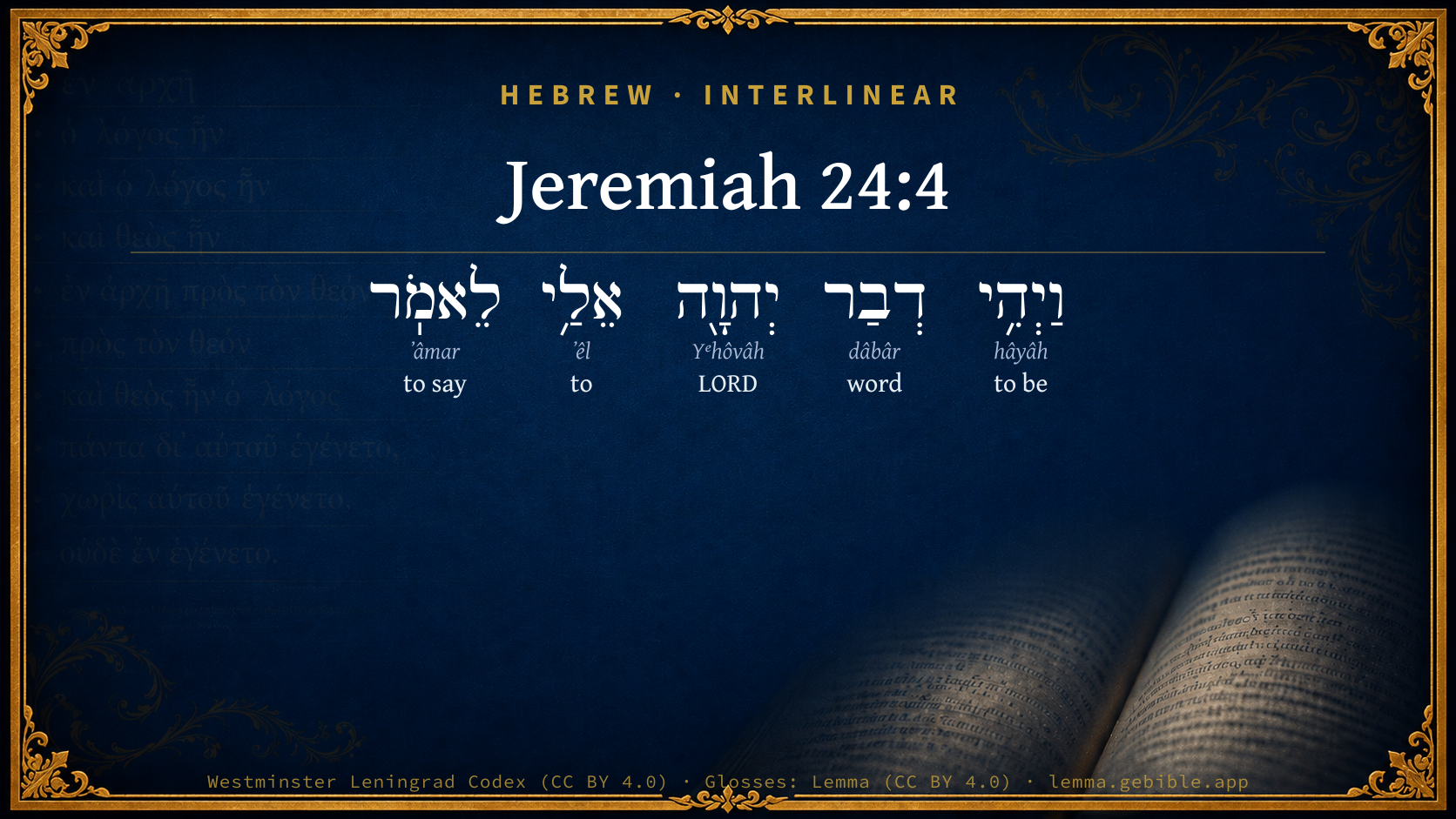
Hebrew (Westminster Leningrad Codex) Jeremiah 24:4 appears in the Hebrew Old Testament. The text above is from the Westminster Leningrad Codex. Each word links to its Strong’s number, a concise gloss, and parsing drawn from the Open Scriptures Hebrew Bible morphology. Click any word for its full Brown-Driver-Briggs (BDB) entry.
Download image
Cite this verse

Jeremiah 24:4 (World English Bible). Public Domain. Lemma interlinear Bible study tool, https://lemma.gebible.app/v/jeremiah/24/4.

Show BibTeX & RIS
BibTeX
RIS
English Translation
The word of Yahweh came to me, saying,
World English Bible · Public Domain
Download a study sheet

One document with this verse’s original text, its word-by-word gloss line, the meaning frame, cross-references with their text, attributed commentary, and full source and license credits — printable, and it pastes into notes with its structure intact.

This verse Autodidact and up

Study sheet (.html) Plain text (.txt)

A passage Seminary Student

Up to 50 verses in one chapter. A passage sheet keeps up to 6 commentary sources and 12 cross-references per verse, in the order this page ranks them, and says so on the sheet whenever that leaves anything out. Ask for a single verse and you get the Autodidact verse sheet above.

Everything on this page stays free to read, with no account — the sheet is a download of what is already on screen, not access to it.

Want to remove ads? Support Godless Engineer
Compare translations 3

The same verse in 3 English versions, stacked beneath the original-language interlinear above. Click any original word for its lexicon entry.

Each is an independent rendering of the whole verse — the interlinear is not word-aligned to these translations.

Highlighted words mark where these versions differ — a whole-verse word diff, not a word-by-word alignment.

  • World English Bible Public Domain
    The word of Yahweh came to me, saying,
  • King James Version Public Domain
    Again the word of the LORD came unto me, saying,
  • unfoldingWord Literal Text CC BY-SA 4.0
    And the word of Yahweh came to me, saying,

unfoldingWord Literal Text — © unfoldingWord, licensed CC BY-SA 4.0. Word-aligned USFM3 via Door43 (git.door43.org/unfoldingWord/en_ult).

Versions to compare (up to 4)

3 of 4 selected

Show all 18 translations

Every available English version of this verse, each an independent rendering of the whole verse.

  • World English Bible Public Domain
    The word of Yahweh came to me, saying,
  • Berean Standard Bible Public Domain
    Then the word of the LORD came to me, saying,
  • Majority Standard Bible Public Domain
    Then the word of the LORD came to me, saying,
  • King James Version Public Domain
    Again the word of the LORD came unto me, saying,
  • American Standard Version (1901) Public Domain
    And the word of Jehovah came unto me, saying,
  • Revised Version (1885) Public Domain
    And the word of the LORD came unto me, saying,
  • Geneva Bible (1599) Public Domain
    Againe the worde of the Lord came vnto me, saying,
  • Douay-Rheims (1899) Public Domain
    And the word of the Lord came to me, saying:
  • Young's Literal Translation Public Domain
    And there is a word of Jehovah unto me, saying:
  • Literal Standard Version CC BY-SA 4.0
    And there is a word of YHWH to me, saying,
  • Unlocked Literal Bible CC BY-SA 4.0
    Then the word of Yahweh came to me, saying,
  • unfoldingWord Literal Text CC BY-SA 4.0
    And the word of Yahweh came to me, saying,
  • Darby Bible Public Domain
    And the word of Jehovah came unto me, saying,
  • World Messianic Bible Public Domain
    The LORD’s word came to me, saying,
  • Webster's Bible Public Domain
    Again the word of the LORD came to me, saying,
  • Free Bible Version CC BY-SA 4.0
    Then a message from the Lord came to me, saying,
  • Bible in Basic English Public Domain
    And the word of the Lord came to me, saying,
  • JPS Tanakh (1917) Public Domain
    And the word of the LORD came unto me, saying:

Literal Standard Version (2020), Covenant Press — licensed CC BY-SA 4.0. Text via the HelloAO Bible API (eBible.org). Unlocked Literal Bible (unfoldingWord) — licensed CC BY-SA 4.0. Text via the HelloAO Bible API (eBible.org). unfoldingWord Literal Text — © unfoldingWord, licensed CC BY-SA 4.0. Word-aligned USFM3 via Door43 (git.door43.org/unfoldingWord/en_ult). Free Bible Version, Dr. Jonathan Gallagher — licensed CC BY-SA 4.0. Text via the HelloAO Bible API (eBible.org).

Word by word

More ways to search: Search by grammar → Find every occurrence → Compare this word →

Practice this passage: Drill this verse → Learn its vocabulary →

About this verse

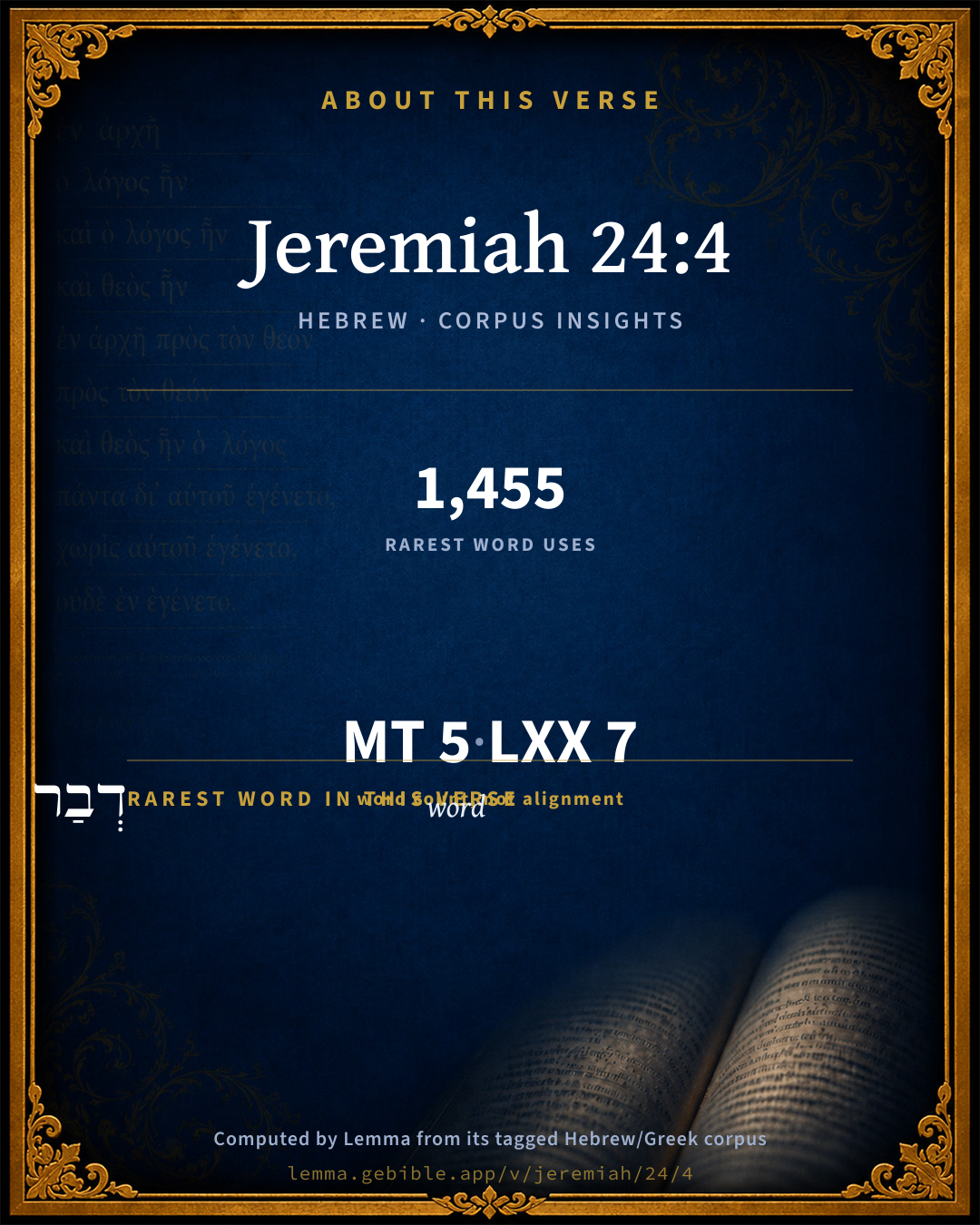
These counts appear in no published source. They are computed here, from the morphology-tagged text and Lemma’s own curated glosses. What Lemma adds →

5
words
5
distinct lemmas
Prophets
section

Grammatical profile

  • 2 verbs
  • 2 nouns
  • 1 preposition

Verb forms

  • וַיְהִ֥י Qal · Sequential Imperfect
  • לֵאמֹֽר Qal · Infinitive Construct

Hebrew & Septuagint length

In the original languages it is 5 Hebrew tokens and 7 Greek tokens — but the two are counted differently (Hebrew bundles its prefixes and suffixes into one token; the Greek is in lemma form), so that isn’t a like-for-like length.

Hebrew and Greek witnesses Masoretic Hebrew ↔ Greek Septuagint

The same verse in the two great witnesses to the Old Testament, shown verse-for-verse.

These are two independent witnesses, not word-aligned to each other, and the Septuagint is shown in lemma (dictionary) form.

Hebrew Jeremiah 24:4 Masoretic · Westminster Leningrad Codex

וַיְהִ֥י דְבַר יְהוָ֖ה אֵלַ֥י לֵאמֹֽר

The word of Yahweh came to me, saying,

World English Bible · Public Domain

Greek LXX Structure differs

In the Septuagint, Jeremiah is about an eighth shorter than the Hebrew and arranges its material differently — the Oracles Against the Nations (Hebrew chapters 46–51) appear in the middle of the Greek book, after 25:13. Because the chapter and verse boundaries do not line up, a verse-for-verse comparison with the Hebrew is not shown.

A verse-for-verse comparison isn’t shown here because the chapters and verses don’t line up. Switch to the LXX edition with the MT / LXX toggle above to read the Greek directly.

On this verse, John Gill's Exposition discusses the Septuagint’s reading. Read the note in Commentary ↓

Hebrew: Westminster Leningrad Codex (CC BY 4.0). Greek: Septuagint (public domain); English from a public-domain English Septuagint. How the Septuagint differs from the Hebrew →

Targum (Aramaic paraphrase)

1

The Targum is the ancient Jewish Aramaic paraphrase of the Hebrew Scriptures — an interpretive translation, not the Hebrew text itself. Onkelos (literal) and Pseudo-Jonathan (expansive) render the Torah, and Jonathan the Prophets. Coverage is partial: where no permissively-licensed English translation exists for a verse, only the Aramaic is shown. This is verse-level text, not a word-by-word alignment to the Hebrew.

  1. Targum Jonathan Prophets (Joshua–Malachi)
    וַהֲוָה פִּתְגַם נְבוּאָה מִקָדָם יְיָ עִמִי לְמֵימָר:

    (no public-domain English translation for this verse)

    Targum Jonathan — Aramaic: “Mikraot Gedolot” (public domain). English: “Sefaria Community Translation” (CC0 1.0 (public-domain dedication)); “London "Chaldee Paraphrase," 1871” (public domain). Text via Sefaria.

Commentary

Notes on Jeremiah 24:4 from classic Christian and Jewish commentators (each source and its license shown beneath its notes). The classic Christian expositions comment on the surrounding passage and are grouped to its opening verse, so a note may address several verses; the Jewish commentaries on the Tanakh (Rashi and others) are per-verse, so they appear only where the commentator wrote on this verse.

Lemma curates 59 commentaries, every one of them public domain or Creative Commons licensed, each selected and text-cleaned for this edition rather than reprinted as found. About our sources →

Trapp's Complete Commentary

John Trapp

Jer 24:4 Again the word of the LORD came unto me, saying,

Ver. 4. Again the word of the Lord.] Transitio ad Anagogen: the interpretation followeth, whereby will appear the different judgment made of persons and things by God and men.

John Trapp, A Commentary or Exposition upon All the Books of the Old and New Testament (1647–1656) — public domain. Text from a community e-Sword module.

Whedon's Commentary on the Bible

Daniel D. Whedon

THE INTERPRETATION OF THE SYMBOL, Jer_24:4-10.

4, 5. Like… good figs — These figs represent those Judahites who have been carried away into captivity. They are “good” — not absolutely, but comparatively.

Daniel D. Whedon (gen. ed.), Commentary on the Old and New Testaments (1874–1909) — public domain. Text from a community e-Sword module.

Tyndale Open Study Notes

Tyndale Open Resources

24:4-7 The people exiled from Jerusalem had a better future than those who remained in the land, because the Lord would plant the exiles as a new community of reformed people (see 1:10).

Tyndale Open Study Notes — © Tyndale Open Resources, licensed CC BY-SA 4.0. Text via the HelloAO Bible API.

Ellicott's Commentary for English Readers

(4) Again the word of the Lord came unto me.—The words seem to imply an interval, during which the prophet was left to ponder over the symbols that he had thus seen. At last “the word of the Lord came” and made their meaning clear.

A Bible Commentary for English Readers, edited by Charles John Ellicott (1878–1897) — public domain. Text from a community e-Sword module.

The Cambridge Bible for Schools and Colleges

gen. ed. J. J. S. Perowne

4–10. See introd. summary to section.

The Cambridge Bible for Schools and Colleges (gen. ed. J. J. S. Perowne; Cambridge University Press, 1878–1918) — public domain. Text from a community e-Sword module.

John Gill's Exposition

Again the word of the Lord came unto me, saying. As follows; where an explanation is given of the above vision, to which this is a transition.

Again the word of the Lord came unto me, saying. As follows; where an explanation is given of the above vision, to which this is a transition.

Jeremiah 24:5

jer 24:5

jer 24:5

jer 24:5Thus saith the Lord, the God of Israel,.... Of all the tribes of Israel; of the ten tribes that had been carried captive long ago by the king of Assyria; and of the other two tribes, part of whom were in Babylon, and the other in Judea, who were not wholly cut off by the Lord; but he still had a regard for them; and therefore introduces what he was about to say in this manner:

like those good figs, so will I acknowledge them that are carried away captive of Judah; that they are good men, and like those good rigs, even those that were; and though they are carried captive: or, "I will know them" (d); take notice of them; show an affectionate love to them, and care of them; make himself known unto them, and own them for his, in the furnace of affliction:

whom I have sent out of this place into the land of the Chaldeans for their good; or "for good things", as the Septuagint and other versions; for their temporal good; some were raised to great honours, as Daniel, and his associates; others got and possessed estates in Babylon, and some returned with favours and riches: and this was also for their spiritual good; to bring them to a sense of their sins, to repentance for them, and acknowledgment of them; and particularly to cure them of idolatry, which it effectually did; so the Lord makes all "things to work together for good", to them that love him, Rom 8:28; and it may be observed, that though the Chaldeans carried the Jews captive out of their own land, and the city of Jerusalem, meant by "this place", into the land of Babylon, yet they were only instruments; it was the Lord's doing; he sent them thither. Jarchi connects the phrase "for good" with the word "acknowledge", supposing a transposition of the words, thus, "I will acknowledge them for good".

(d) "cognoscam", V. L. Gataker.

John Gill's Exposition of the Whole Bible (1746–1763) — public domain (CC PDM 1.0). Text via the HelloAO Bible API.

Albert Barnes' Notes on the Bible

The complete fulfillment of this prophecy belongs to the Christian Church. There is a close analogy between Jeremiah at the first destruction of Jerusalem and our Lord at the second. There the good figs were those converts picked out by the preaching of Christ and the Apostles; the bad figs were the mass of the people left for Titus and the Romans to destroy.

Jer 24:5

Acknowledge ... for their good - Specially their spiritual good. Put a comma after Chaldaeans.

Jer 24:8

That dwell in the land of Egypt - Neither those carried captive with Jehoahaz into Egypt, nor those who fled there, are to share in these blessings. The new life of the Jewish nation is to be the work only of the exiles in Babylon.

Albert Barnes' Notes on the Bible (1834–1885) — public domain. Text from a community e-Sword/MySword module.

Keil & Delitzsch

C. F. Keil & F. Delitzsch

The interpretation of the symbol. Jer 24:5. Like the good figs, the Lord will look on the captives in Chaldea for good ("for good" belongs to the verb "look on them"). The point of resemblance is: as one looks with pleasure on good figs, takes them and keeps them, so will I bestow my favour on Judah's captives. Looking on them for good is explained, Jer 24:6 : the Lord will set His eye on them, bring them back into their land and build them up again. With "build them," etc., cf. Jer 1:10. The building and planting of the captives is not to consist solely in the restoration of their former civil well-being, but will be a spiritual regeneration of the people. God will give them a heart to know Him as their God, so that they may be in truth His people, and He their God. "For they will return," not: when they return (Ew., Hitz.). The turning to the Lord cannot be regarded as the condition of their receiving favour, because God will give them a heart to know Him; it is the working of the knowledge of the Lord put in their hearts. And this is adduced to certify the idea that they will then be really the Lord's people.

Keil & Delitzsch — Biblical Commentary on the Old Testament (1861–1891) — public domain (CC PDM 1.0). Text via the HelloAO Bible API. (Old Testament only.)

unfoldingWord translationNotes

Door43 World Missions Community

the word of Yahweh came to me, saying, "Yahweh

This idiom is used to introduce a special message from God. See how you translated it in Jeremiah 1:4. AT: "Yahweh gave me a message. He said, 'Yahweh" or "Yahweh spoke this message to me: 'Yahweh" (See: Idiom)

I will look on the exiles of Judah for their benefit

Here "look on" is an idiom that means Yahweh will take care of them. AT: "I will take good care of the exiles of Judah" (See: Idiom)

just like these good figs

The good figs represent those Judean exiles sent to the land of Chaldea. (See: Simile)

I will set my eyes on them for good

Here "set my eyes" means he will see them. Seeing them is a metonym for caring for them. AT: "I will bless them" (See: Metonymy)

I will build them up, and not tear them down. I will plant them, and not uproot them

These two metaphors have similar meanings. The second one strengthens the thought in the first. AT: "I will help them to prosper in Chaldea" (See: Parallelism)

I will build them up, and not tear them down

Yahweh speak of the exiles as a building which Yahweh will build and not tear down. AT: "I will help them flourish in the land, and not ruin them" (See: Metaphor)

I will plant them, and not uproot them

Yahweh speak of the exiles as plants which Yahweh will plant in good soil and not pull out. AT: "I will establish them in the land, and not remove them" (See: Metaphor)

I will give them a heart to know me

Here "a heart" refers to their desires. AT: "I will cause them to desire to know me" (See: Metonymy)

they will turn to me with all their heart

Here "all their heart is an idiom that means "completely." AT: "they will turn to me completely" or "they will turn to me without reservation" (See: Idiom)

translationWords

word of God

God

Israel

exile

send

Chaldea

good

restore

heart

know

people of God

turn

unfoldingWord translationNotes — © Distant Shores Media and the Door43 World Missions Community, licensed CC BY-SA 4.0. Source: git.door43.org/Door43/en_tn.

Lesson kit

Teaching starters — assembled from the data on this page, not authored interpretation. Every prompt links to the verse data it draws on. Edit before teaching.

Jeremiah, in the Prophets, opens this verse with 5 words (5 distinct Hebrew lemmas). Its most distinctive word is dâbâr (“word”). A historical commentator’s framing appears above. Read the whole chapter for the surrounding context.

Discussion questions

  1. How does “word” (dâbâr) shape what this verse is saying?
  2. These translations render this verse differently. What is at stake in choosing one wording over another?
  3. «וַיְהִ֥י» is a Qal Sequential Imperfect verb. How does that grammatical form shape the action described?
  4. Compare how Trapp's Complete Commentary and Whedon's Commentary on the Bible read this verse. Where do they agree or differ?

Things to notice

Reading settings

Reading text

Shown beneath each verse's original-language words.

Old Testament
Old Testament edition

Read the OT as the Masoretic Hebrew (MT) or the Greek Septuagint (LXX).

English shown for the Greek Septuagint (in the Hebrew ↔ Greek comparison).

Comparing translations? Open the Compare panel on any verse page to stack up to four side by side.