Genesis 25:4

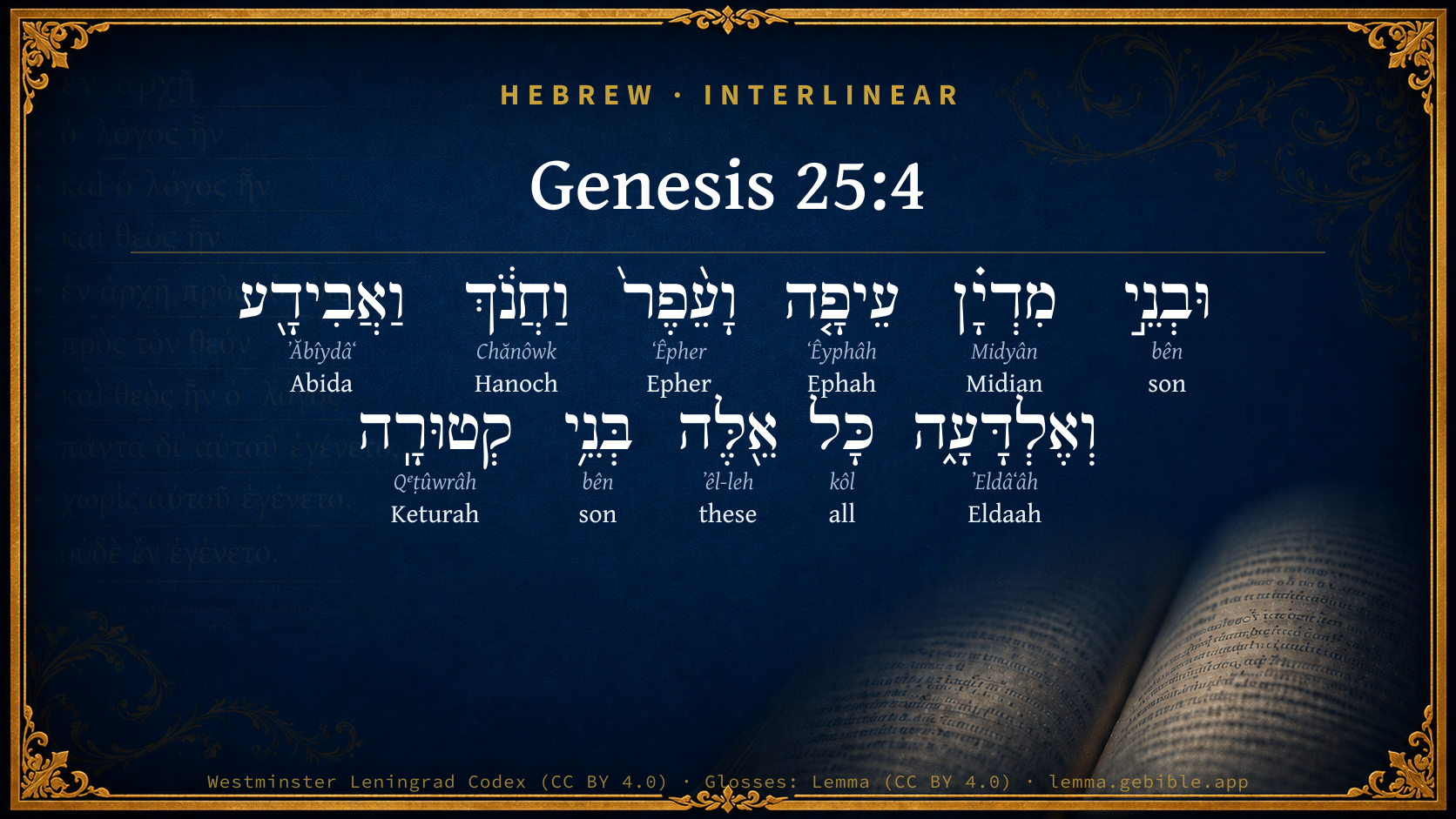
Hebrew (Westminster Leningrad Codex) Genesis 25:4 appears in the Hebrew Old Testament. The text above is from the Westminster Leningrad Codex. Each word links to its Strong’s number, a concise gloss, and parsing drawn from the Open Scriptures Hebrew Bible morphology. Click any word for its full Brown-Driver-Briggs (BDB) entry.
Download image
Cite this verse

Genesis 25:4 (World English Bible). Public Domain. Lemma interlinear Bible study tool, https://lemma.gebible.app/v/genesis/25/4.

Show BibTeX & RIS
BibTeX
RIS
English Translation
The sons of Midian: Ephah, Epher, Hanoch, Abida, and Eldaah. All these were the children of Keturah.
World English Bible · Public Domain
Highlights
  • 4 first appearances in the Hebrew Bible
Full analysis ↓
Download a study sheet

One document with this verse’s original text, its word-by-word gloss line, the meaning frame, cross-references with their text, attributed commentary, and full source and license credits — printable, and it pastes into notes with its structure intact.

This verse Autodidact and up

Study sheet (.html) Plain text (.txt)

A passage Seminary Student

Up to 50 verses in one chapter. A passage sheet keeps up to 6 commentary sources and 12 cross-references per verse, in the order this page ranks them, and says so on the sheet whenever that leaves anything out. Ask for a single verse and you get the Autodidact verse sheet above.

Everything on this page stays free to read, with no account — the sheet is a download of what is already on screen, not access to it.

Want to remove ads? Support Godless Engineer
Compare translations 3

The same verse in 3 English versions, stacked beneath the original-language interlinear above. Click any original word for its lexicon entry.

Each is an independent rendering of the whole verse — the interlinear is not word-aligned to these translations.

Highlighted words mark where these versions differ — a whole-verse word diff, not a word-by-word alignment.

  • World English Bible Public Domain
    The sons of Midian: Ephah, Epher, Hanoch, Abida, and Eldaah. All these were the children of Keturah.
  • King James Version Public Domain
    And the sons of Midian; Ephah, and Epher, and Hanoch, and Abidah, and Eldaah. All these were the children of Keturah.
  • unfoldingWord Literal Text CC BY-SA 4.0
    And the sons of Midian Ephah and Epher and Hanoch and Abida and Eldaah. All of those the descendants of Keturah.

unfoldingWord Literal Text — © unfoldingWord, licensed CC BY-SA 4.0. Word-aligned USFM3 via Door43 (git.door43.org/unfoldingWord/en_ult).

Versions to compare (up to 4)

3 of 4 selected

Show all 18 translations

Every available English version of this verse, each an independent rendering of the whole verse.

  • World English Bible Public Domain
    The sons of Midian: Ephah, Epher, Hanoch, Abida, and Eldaah. All these were the children of Keturah.
  • Berean Standard Bible Public Domain
    The sons of Midian were Ephah, Epher, Hanoch, Abida, and Eldaah. All these were descendants of Keturah.
  • Majority Standard Bible Public Domain
    The sons of Midian were Ephah, Epher, Hanoch, Abida, and Eldaah. All these were descendants of Keturah.
  • King James Version Public Domain
    And the sons of Midian; Ephah, and Epher, and Hanoch, and Abidah, and Eldaah. All these were the children of Keturah.
  • American Standard Version (1901) Public Domain
    And the sons of Midian: Ephah, and Epher, and Hanoch, and Abida, and Eldaah. All these were the children of Keturah.
  • Revised Version (1885) Public Domain
    And the sons of Midian; Ephah, and Epher, and Hanoch, and Abida, and Eldaah. All these were the children of Keturah.
  • Geneva Bible (1599) Public Domain
    Also the sonnes of Midian were Ephah, and Epher, and Hanoch, and Abida, and Eldaah all these were the sonnes of Keturah.
  • Douay-Rheims (1899) Public Domain
    But of Madian was born Epha, and Opher, and Henoch, and Abida, and Eldaa: all these were the children of Cetura.
  • Young's Literal Translation Public Domain
    and the sons of Midian `are' Ephah, and Epher, and Hanoch, and Abidah, and Eldaah: all these `are' sons of Keturah.
  • Literal Standard Version CC BY-SA 4.0
    and the sons of Midian [are] Ephah, and Epher, and Enoch, and Abidah, and Eldaah: all these [are] sons of Keturah.
  • Unlocked Literal Bible CC BY-SA 4.0
    Midian's sons were Ephah, Epher, Hanok, Abida, and Eldaah. All these were Keturah's descendants.
  • unfoldingWord Literal Text CC BY-SA 4.0
    And the sons of Midian Ephah and Epher and Hanoch and Abida and Eldaah. All of those the descendants of Keturah.
  • Darby Bible Public Domain
    And the sons of Midian were Ephah, and Epher, and Enoch, and Abida, and Eldaah. All these were sons of Keturah.
  • World Messianic Bible Public Domain
    The sons of Midian were Efah, Epher, Hanoch, Abida, and Eldaah. All these were the children of Keturah.
  • Webster's Bible Public Domain
    And the sons of Midian; Ephah, and Epher, and Hanoch, and Abidah, and Eldaah. All these were the children of Keturah.
  • Free Bible Version CC BY-SA 4.0
    The sons of Midian were Ephah, Epher, Hanoch, Abida, and Eldaah. These were all descendants of Keturah.
  • Bible in Basic English Public Domain
    And from Midian came Ephah and Epher and Hanoch and Abida and Eldaah. All these were the offspring of Keturah.
  • JPS Tanakh (1917) Public Domain
    And the sons of Midian: Ephah, and Epher, and Hanoch, and Abida, and Eldaah. All these were the children of Keturah.

Literal Standard Version (2020), Covenant Press — licensed CC BY-SA 4.0. Text via the HelloAO Bible API (eBible.org). Unlocked Literal Bible (unfoldingWord) — licensed CC BY-SA 4.0. Text via the HelloAO Bible API (eBible.org). unfoldingWord Literal Text — © unfoldingWord, licensed CC BY-SA 4.0. Word-aligned USFM3 via Door43 (git.door43.org/unfoldingWord/en_ult). Free Bible Version, Dr. Jonathan Gallagher — licensed CC BY-SA 4.0. Text via the HelloAO Bible API (eBible.org).

Word by word

More ways to search: Search by grammar → Find every occurrence → Compare this word →

Practice this passage: Drill this verse → Learn its vocabulary →

About this verse

These counts appear in no published source. They are computed here, from the morphology-tagged text and Lemma’s own curated glosses. What Lemma adds →

11
words
10
distinct lemmas
Pentateuch
section

Notable vocabulary

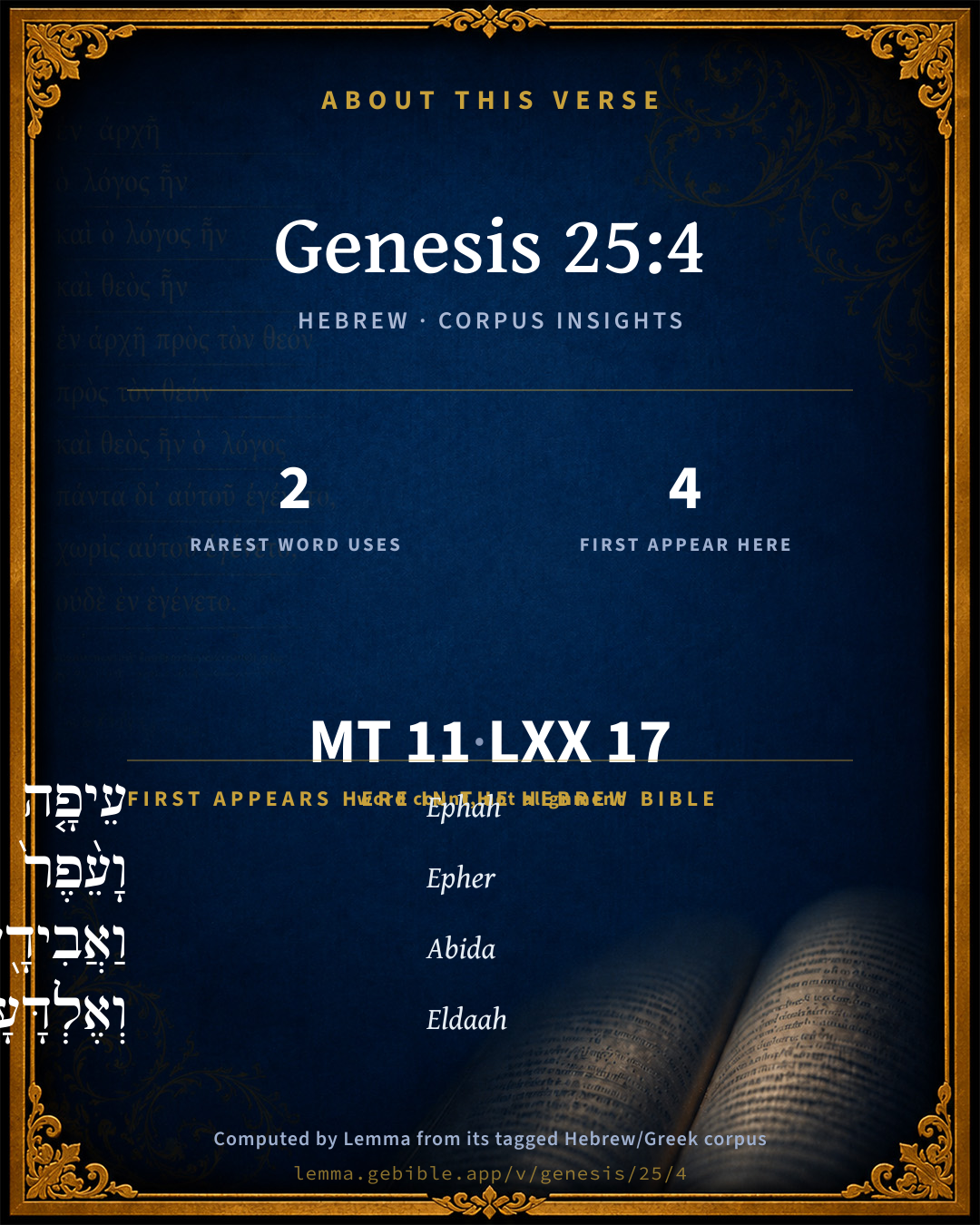
The rarest word here is וַאֲבִידָ֖ע Abida H28 — appearing just 2 times in the whole Hebrew Bible.

First appearance in Scripture

These words make their first canonical appearance in the Hebrew Bible here:

  • עֵיפָ֤ה Ephah H5891
  • וָעֵ֨פֶר֙ Epher H6081
  • וַאֲבִידָ֖ע Abida H28
  • וְאֶלְדָּעָ֑ה Eldaah H420

Shared distinctive vocabulary

וַאֲבִידָ֖ע Abida H28 occurs in 2 verses of the Hebrew Bible. Also found in:

Grammatical profile

  • 10 nouns
  • 1 pronoun

Repetition

A word recurs within this verse — often emphatic in Hebrew:

  • וּבְנֵ֣י son H1121 ×2

Hebrew & Septuagint length

In English translation the verse runs 17 words from the Hebrew and 21 from the Septuagint (LXX English) — closely comparable.

A rough comparison of the two English renderings, which tokenize alike — not a word-level alignment.

Word counts can differ between the Hebrew and the Greek without any difference in meaning — e.g. the Hebrew direct-object marker אֵת has no separate Greek word, and Greek often adds the article ὁ.

In the original languages it is 11 Hebrew tokens and 17 Greek tokens — but the two are counted differently (Hebrew bundles its prefixes and suffixes into one token; the Greek is in lemma form), so that isn’t a like-for-like length.

Cross-references

1

Topical passages linked to Genesis 25:4 in the Treasury of Scripture Knowledge — connected by theme and wording, ordered by reader-vote popularity; previews shown in the World English Bible.

  • Isaiah 60:6 The multitude of camels shall cover you, the dromedaries of Midian and Ephah; all they from Sheba shall come; they shall bring gold and frankincense, and shall proclaim the praises of Yahweh.

Cross-references courtesy of OpenBible.info (CC BY 4.0).

Hebrew and Greek witnesses Masoretic Hebrew ↔ Greek Septuagint

The same verse in the two great witnesses to the Old Testament, shown verse-for-verse.

These are two independent witnesses, not word-aligned to each other, and the Septuagint is shown in lemma (dictionary) form.

Hebrew Genesis 25:4 Masoretic · Westminster Leningrad Codex

וּבְנֵ֣י מִדְיָ֗ן עֵיפָ֤ה וָעֵ֨פֶר֙ וַחֲנֹ֔ךְ וַאֲבִידָ֖ע וְאֶלְדָּעָ֑ה כָּל אֵ֖לֶּה בְּנֵ֥י קְטוּרָֽה

The sons of Midian: Ephah, Epher, Hanoch, Abida, and Eldaah. All these were the children of Keturah.

World English Bible · Public Domain

Greek LXX Genesis 25:4 Septuagint · lemma form

υἱός δέ μαδιαμ γαιφα καί αφερ καί ενωχ καί αβιρα καί ελραγα πᾶς οὗτος εἰμί υἱός χεττουρα

And the sons of Madiam were Gephar and Aphir, and Enoch, and Abeida, and Eldaga; all these were sons of Chettura.

LXX2012 (modern English Septuagint) · Public Domain

Hebrew: Westminster Leningrad Codex (CC BY 4.0). Greek: Septuagint (public domain); English from LXX2012 (modern English Septuagint) (Public Domain). How the Septuagint differs from the Hebrew →

Targum (Aramaic paraphrase)

2

The Targum is the ancient Jewish Aramaic paraphrase of the Hebrew Scriptures — an interpretive translation, not the Hebrew text itself. Onkelos (literal) and Pseudo-Jonathan (expansive) render the Torah, and Jonathan the Prophets. Coverage is partial: where no permissively-licensed English translation exists for a verse, only the Aramaic is shown. This is verse-level text, not a word-by-word alignment to the Hebrew.

  1. Targum Onkelos Torah (Genesis–Deuteronomy)
    וּבְנֵי מִדְיָן עֵיפָה וָעֵפֶר וַחֲנוֹךְ וַאֲבִידָע וְאֶלְדָּעָה כָּל אִלֵּין בְּנֵי קְטוּרָה

    (no public-domain English translation for this verse)

    Targum Onkelos — Aramaic: “Onkelos Genesis” (public domain); “Onkelos Exodus” (public domain); “Onkelos Leviticus” (public domain); “Onkelos Numbers” (public domain); “Onkelos Deuteronomy” (public domain). English: “Sefaria Community Translation” (CC0 1.0 (public-domain dedication)); “J.W. Etheridge. The Targums of Onkelos and Jonathan Ben Uzziel on the Pentateuch. London: Longmans, Green, 1862” (public domain). Text via Sefaria.

  2. Targum Pseudo-Jonathan Torah (Genesis–Deuteronomy)
    וּבְנוֹי דְמִדְיָן עֵיפָא וְעֵפֶר וַחֲנוֹךְ וַאֲבִידָע וְאֶלְדְעָה כָּל אִלֵין בְּנָהָא דִקְטוּרָה

    And the sons of Midyan, Eipher, and Ephher, and Honok, and Abida, and Aldaah, all these were the sons of Keturah.

    Targum Pseudo-Jonathan — Aramaic: “Targum Jonathan on Genesis” (public domain); “Targum Jonathan on Exodus” (public domain); “Targum Jonathan on Leviticus” (public domain); “Targum Jonathan on Numbers” (public domain); “Targum Jonathan on Deuteronomy” (public domain). English: “The Targum of Jonathan ben Uzziel, trans. J. W. Etheridge, London, 1862” (public domain). Text via Sefaria.

Commentary

Notes on Genesis 25:4 from classic Christian and Jewish commentators (each source and its license shown beneath its notes). The classic Christian expositions comment on the surrounding passage and are grouped to its opening verse, so a note may address several verses; the Jewish commentaries on the Tanakh (Rashi and others) are per-verse, so they appear only where the commentator wrote on this verse.

Lemma curates 59 commentaries, every one of them public domain or Creative Commons licensed, each selected and text-cleaned for this edition rather than reprinted as found. About our sources →

Trapp's Complete Commentary

John Trapp

Gen 25:4 And the sons of Midian; Ephah, and Epher, and Hanoch, and Abida, and Eldaah. All these [were] the children of Keturah.

Ver. 4. Ephah, and Epher.] These five were, haply, the founders of the families of those five kings of Midian mentioned in Num 31:8.

John Trapp, A Commentary or Exposition upon All the Books of the Old and New Testament (1647–1656) — public domain. Text from a community e-Sword module.

Adam Clarke's Commentary

Verse 4. Ephah, and Epher, c.] Of these we know no more than of the preceding an abundance of conjectures is already furnished by the commentators.

Adam Clarke's Commentary on the Bible (1810–1826) — public domain. Text from a community e-Sword/MySword module.

John Gill's Exposition

And the sons of Midian,.... The fourth son of Abraham by Keturah; he had five sons next mentioned, who were heads of so many tribes or families in Midian: hence we read of five kings of Midian; Num 31:8; their names follow:

Ephah, and Epher, and Hanoch, and Abidah, and Eldaah: the two first of these, whom Cleodemus (t) calls Aphra and Apher, and makes them to be sons of Abraham by Keturah, when they were his grandsons, he says, from them the city Aphra, and all Africa, had their names, and that these accompanied Hercules into Lybia, he having married a daughter of Aphra. Ephah is mentioned along with Midian in Isa 60:6; but of the rest no notice is taken in Scripture. Ptolemy (u) makes mention both of a mountain, and of a village, near Madiana in Arabia Felix, called Hippos, which perhaps had their name from this man. Some trace of Epher is thought to be in Taphuron which Philostorgius says (w) was the metropolis of the Homerites, before mentioned; and Arrianus, as Bishop Patrick observes, expressly says, the metropolis of the Homerites, is called Aphar: to which may be added, that Ptolemy (x) speaks of a people called Tappharites, near the Homerites. Hanoch, the next son, is thought to have some footsteps of his name in Cane, a mart, which Ptolemy (y) places in the country of the Adramites in Arabia Felix, and also in the country of Canauna in Arabia, mentioned by, Pliny (z): near Cananua is placed, by the same writer, the island Devadae, called by Philostorgius (a) "Divus", in which it is supposed there is some trace of the name of Abidah, by an inversion of the two last syllables; and perhaps also in Abissa, which Ptolemy (b) places in the country of the Sachalites in Arabia Felix. As for Eldaah, Bishop Patrick thinks there are no remains of this name, unless in the city of Elana, from whence there was a gulf called Elanites, and a people that lived there Elanitae; but one would think there are some traces of it in the cities Alata, Lattha, and Leaththa, all, according to Ptolemy (c), in Arabia Felix:

all these were the children of Keturah; her children and grandchildren.

(t) Apud Euseb. ut supra. (Praepar. Evangel. l. 9. c. 20. p. 432.) (u) Ut supra. (Geograph. l. 6. c. 7.) (w) Eccl. Hist. l. 3. sect. 4. 478. (x) Ut supra. (u)) (y) lb. (z) Nat. Hist. l. 6. c. 28. (a) Ut supra, (w)) sect. 3. (b) Ut supra. (u)) (c) lb.

John Gill's Exposition of the Whole Bible (1746–1763) — public domain (CC PDM 1.0). Text via the HelloAO Bible API.

Matthew Poole's English Annotations

Ephah; of whom see Isa 60:6. From Epher some think Africa received its name.

Matthew Poole's English Annotations on the Holy Bible (1683–1685) — public domain. Text from a community e-Sword/MySword module.

The Pulpit Commentary

And the sons of Midian; Ephah, (vide Isa_60:6) and Epher (Bent Ghifar in Hejas), and Hanoch (Hanakye, three days north of Medinah), and Abidah, and Eldaah the tribes of Abide and Vadaa in the neighborhood of Asir. Keil adds that all these identifications are uncertain. All these were the children of Keturah six sons, seven grandsons, three great grandsons; in all sixteen descendants.

The Pulpit Commentary (1880–1919), ed. H.D.M. Spence-Jones & Joseph S. Exell — public domain. Text from a community e-Sword module.

Lesson kit

Teaching starters — assembled from the data on this page, not authored interpretation. Every prompt links to the verse data it draws on. Edit before teaching.

Genesis, in the Pentateuch, opens this verse with 11 words (10 distinct Hebrew lemmas). Its most distinctive word is ʼĂbîydâʻ (“Abida”). A historical commentator’s framing appears above. Read the whole chapter for the surrounding context.

Discussion questions

  1. How does “Abida” (ʼĂbîydâʻ) shape what this verse is saying?
  2. 4 words make their first appearance in Scripture here. What does this debut establish?
  3. How does 1 Chronicles 1:33, which shares the word «Abida», read alongside this verse?
  4. What does the repetition of “son” (2× in this one verse) do in this verse?
  5. These translations render this verse differently; the difference is in the English rendering, not the original. What questions does that raise?
  6. Compare how Trapp's Complete Commentary and Adam Clarke's Commentary read this verse. Where do they agree or differ?

Things to notice

Reading settings

Reading text

Shown beneath each verse's original-language words.

Old Testament
Old Testament edition

Read the OT as the Masoretic Hebrew (MT) or the Greek Septuagint (LXX).

English shown for the Greek Septuagint (in the Hebrew ↔ Greek comparison).

Comparing translations? Open the Compare panel on any verse page to stack up to four side by side.