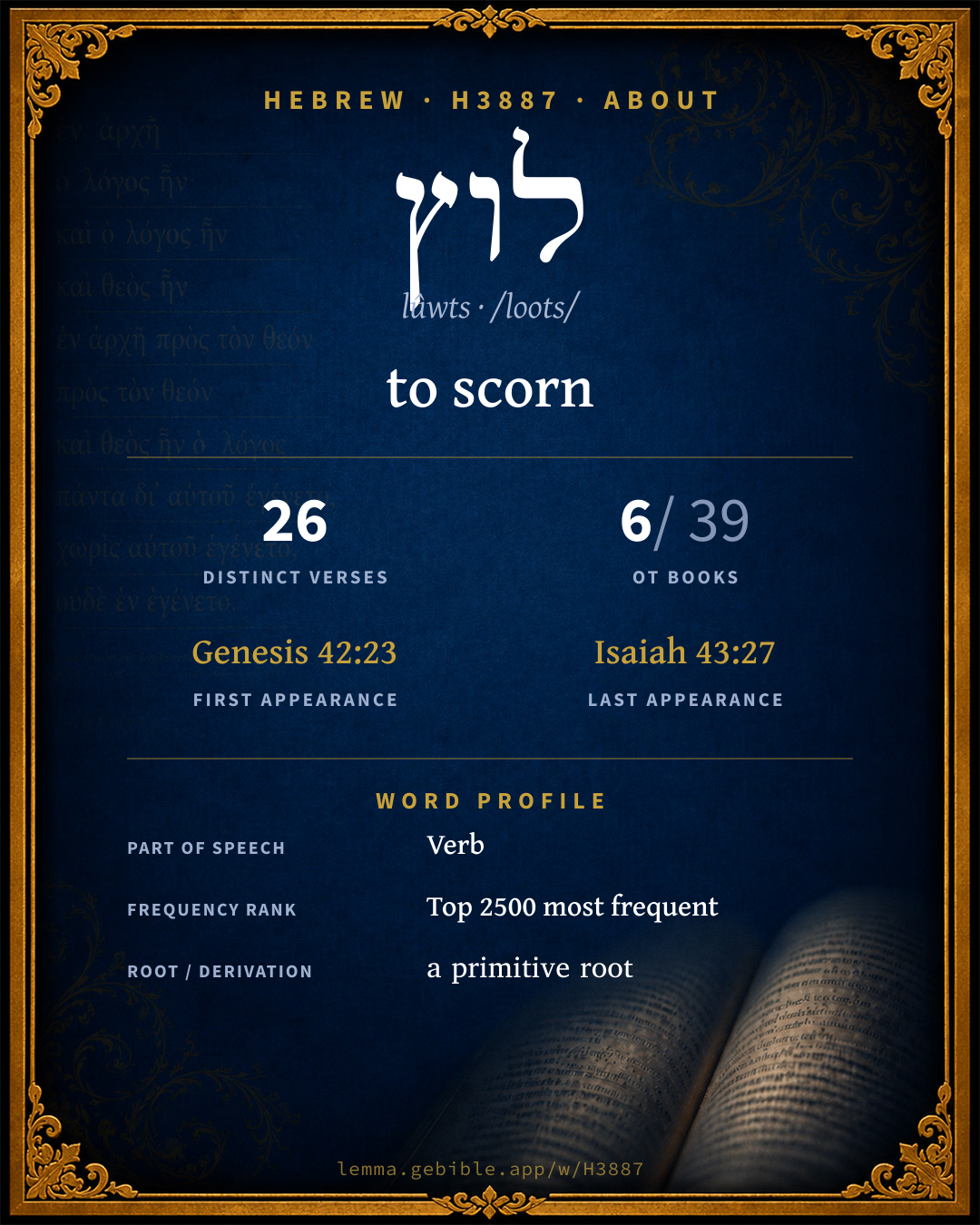
לִיץ
to scorn
also: make mouths at, talk arrogantly fuller range ↓
Full lexicon entry — Brown-Driver-Briggs (BDB)
From Brown-Driver-Briggs (BDB)
Where this word appears
See every Absolute-state word in the Hebrew Bible →
Grammar key — what these labels mean
Part of speech
- Adjective
- A word that describes or qualifies a noun.
- Verb
- An action or state-of-being word.
Stem
- Hiphil
- The causative active stem (“he caused / brought about”).
- Qal
- The basic, simple active stem — the plain form of the verb (“he wrote”).
- Hithpolel
- The reflexive counterpart of the Polel.
Form
- Imperfect
- An incomplete, ongoing, or future action (“he will / would write”).
- Participle Active
- A verbal adjective expressing ongoing or characteristic action (“writing / one who writes”).
- Perfect
- A completed action or state — Hebrew marks aspect (completeness) more than strict tense (“he wrote”).
- Jussive
- A third- or second-person volitional form expressing wish or command (“let him write”).
State
- Absolute
- The independent form of a noun, not bound to a following word.
- Construct
- A noun bound to a following noun in a possessive / “of” relationship (the construct chain).
Person
- 3rd Person
- The one spoken about (“he / she / it / they”).
- 2nd Person
- The one addressed (“you”).
Gender
- Masculine
- Grammatically masculine.
- Common
- Either gender — not distinguished for this form.
Number
- Singular
- One.
- Plural
- More than one (in Hebrew, generally three or more).
Grammatical forms
- Adjective, Adjective, Masculine, Singular, Absolute 12 times (44%)
- Adjective, Adjective, Masculine, Plural, Absolute 4 times (15%)
- Verb, Hiphil, Imperfect, 3rd Person, Masculine, Singular 3 times (11%)
- Verb, Hiphil, Participle Active, Masculine, Plural, Construct 3 times (11%)
- Verb, Hiphil, Participle Active, Masculine, Singular, Absolute 2 times (7%)
- Verb, Qal, Perfect, 2nd Person, Masculine, Singular 1 time (4%)
- Verb, Hiphil, Perfect, 3rd Person, Common, Plural 1 time (4%)
- Verb, Hithpolel, Jussive, 2nd Person, Masculine, Plural 1 time (4%)
Parsed forms decoded from the imported morphology (morphhb / Westminster Leningrad Codex — WLC text public domain, morphhb tagging CC BY 4.0), counted across 27 parsed occurrences — not distinct verses.
Every verse where H3887 appears — 26 distinct verses across 6 books. Click any verse to open its interlinear word-by-word view. Verse text shown in the World English Bible for context — . Each verse’s Hebrew form is shown with its reference; the English is not keyword-highlighted, since the data carries no word-level English alignment. Use “Compare translations” on any verse to read it across multiple English versions. This concordance covers the Hebrew Bible; Septuagint (Greek Old Testament) occurrences are not indexed here.
Genesis 1 verse
2 Chronicles 1 verse
Job 2 verses
Psalms 2 verses
Proverbs 17 verses
- Proverbs 1:22 וְ/לֵצִ֗ים conj + Adjective Adjective mp "How long, you simple ones, will you love simplicity? How long will mockers delight themselves in mockery, And fools hate knowledge?
- Proverbs 3:34 לַ/לֵּצִ֥ים יָלִ֑יץ prep det + Adjective Adjective mp Hiphil impf 3ms Surely he mocks the mockers, But he gives grace to the humble.
- Proverbs 9:7 לֵ֗ץ adj Adjective ms He who corrects a mocker invites insult. He who reproves a wicked man invites abuse.
- Proverbs 9:8 לֵ֭ץ adj Adjective ms Don't reprove a scoffer, lest he hate you. Reprove a wise man, and he will love you.
- Proverbs 9:12 וְ֝/לַ֗צְתָּ conj + Qal pf 2ms If you are wise, you are wise for yourself. If you mock, you alone will bear it.
- Proverbs 13:1 וְ֝/לֵ֗ץ conj + Adjective Adjective ms A wise son listens to his father's instruction, But a scoffer doesn't listen to rebuke.
- Proverbs 14:6 לֵ֣ץ adj Adjective ms A scoffer seeks wisdom, and doesn't find it, But knowledge comes easily to a discerning person.
- Proverbs 14:9 יָלִ֣יץ Hiphil impf 3ms Fools mock at making atonement for sins, But among the upright there is good will.
- Proverbs 15:12 לֵ֭ץ adj Adjective ms A scoffer doesn't love to be reproved; He will not go to the wise.
- Proverbs 19:25 לֵ֣ץ adj Adjective ms Flog a scoffer, and the simple will learn prudence; Rebuke one who has understanding, and he will gain knowledge.
- Proverbs 19:28 יָלִ֣יץ Hiphil impf 3ms A corrupt witness mocks justice, And the mouth of the wicked gulps down iniquity.
- Proverbs 19:29 לַ/לֵּצִ֣ים prep det + Adjective Adjective mp Penalties are prepared for scoffers, And beatings for the backs of fools.
- Proverbs 20:1 לֵ֣ץ adj Adjective ms Wine is a mocker, and beer is a brawler; Whoever is led astray by them is not wise.
- Proverbs 21:11 לֵ֭ץ adj Adjective ms When the mocker is punished, the simple gains wisdom; When the wise is instructed, he receives knowledge.
- Proverbs 21:24 לֵ֣ץ adj Adjective ms The proud and haughty man, "scoffer" is his name; He works in the arrogance of pride.
- Proverbs 22:10 לֵ֭ץ adj Adjective ms Drive out the mocker, and strife will go out; Yes, quarrels and insults will stop.
- Proverbs 24:9 לֵֽץ adj Adjective ms The schemes of folly are sin. The mocker is detested by men.
Isaiah 3 verses
- Isaiah 28:22 תִּתְלוֹצָ֔צוּ Hithpolel juss 2mp Now therefore don't you be scoffers, lest your bonds be made strong; for a decree of destruction have I heard from the Lord, Yahweh of Hosts, on the whole earth.
- Isaiah 29:20 לֵ֑ץ adj Adjective ms For the terrible one is brought to nothing, and the scoffer ceases, and all those who watch for iniquity are cut off;
- Isaiah 43:27 וּ/מְלִיצֶ֖י/ךָ conj + Hiphil ptcp.act mp cs + sfx pers 2ms Your first father sinned, and your teachers have transgressed against me.
About this entry
At a glance — auto-summarized from this page’s data, not written by a person. Every figure links to its source below. This summary describes the numbers; it doesn’t interpret them.
“to scorn” is the headline sense of the Hebrew verb לוץ (lûwts). It clusters heavily in Proverbs, which alone accounts for 65% of its uses. With 26 verses in 6 books, it is a moderately common word in the Hebrew Bible. Lexicons map it across 2 senses — beyond “to scorn” it also covers “make mouths at” and “talk arrogantly”. Translators differ — “scorner” in the King James Version, then “mocker” (Berean Standard Bible), as the renderings breakdown shows. See the sense tree, 26-verse concordance, and the renderings breakdown below.
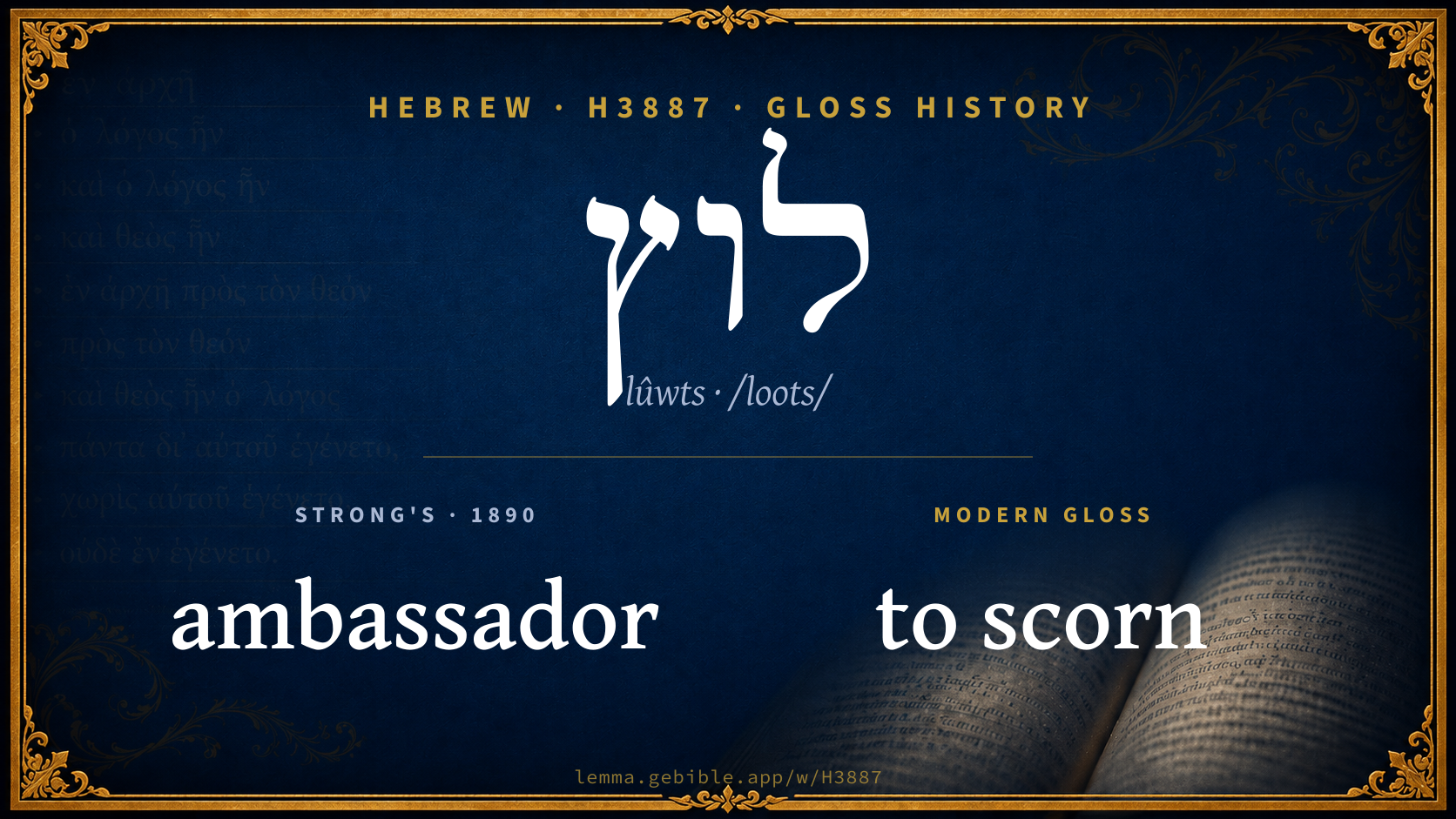
Gloss history
Strong's 1890 vs modern scholarship
About this word
Strong's H3887 catalogs a Hebrew word from the Hebrew Old Testament.
These counts are not copied from any lexicon or concordance. They are computed here, from the morphology-tagged Hebrew Old Testament. What Lemma adds →
- 26
- distinct verses
- The word appears in 26 distinct verses.
- 6 / 39
- OT books
- The word appears in 6 of 39 Old Testament books.
- #1,226
- by frequency
- Top 2500 most frequent Hebrew words (rank 1,226 of 8,640 Hebrew words by occurrence).
View all 26 occurrences in the concordance →
By section of the Old Testament
By traditional corpus
Conventional, traditional groupings — biblical authorship is debated, so this is a traditional corpus grouping, not an authorship claim. Each share is this word’s portion of its verses in that division of the Hebrew canon. Each figure is a share of the word’s 26 distinct verses.
- Writings (Ketuvim) 22 verses · 85%
- Prophets (Nevi'im) 3 verses · 12%
- Torah (Pentateuch) 1 verse · 4%
How translations render this word
Counts come from each version’s own published word-to-Strong’s tagging or interlinear alignment — an approximate guide to how each version renders this word, not a word-level alignment the data otherwise carries. Because each total is that version’s own tagged count, the per-version totals vary from one another and need not match the appearance or distinct-verse counts above. These counts may also differ from a printed concordance because Lemma counts each distinctly tagged rendering and does not collapse phrase taggings into a single head-word total. This is a fixed set of word-tagged versions (KJV, ASV, BSB, ULT) and does not change with the reading translation you choose elsewhere. Each version’s license is shown beside its name below (and on Sources).
- King James Version: Scorner 11×, Scorners 3×
- American Standard Version: Scoffer 10×, Scoffers 4×, Mocketh 2×
- Berean Standard Bible: Mocker 10×, Mockers 4×, Mock 2×
- unfoldingWord Literal Text: Mocker 10×, Mockers 3×, Interpreter 2×
King James Version Public Domain
Renders H3887 across 27 tagged occurrences — most commonly:
Plus 13 renderings that appear only once — usually multi-word phrases or single function words the recovered tagging swept in, not distinct renderings.
American Standard Version Public Domain
Renders H3887 across 27 tagged occurrences — most commonly:
Plus 11 renderings that appear only once — usually multi-word phrases or single function words the recovered tagging swept in, not distinct renderings.
Berean Standard Bible Public Domain
Renders H3887 across 28 tagged occurrences — most commonly:
Plus 10 renderings that appear only once — usually multi-word phrases or single function words the recovered tagging swept in, not distinct renderings.
unfoldingWord Literal Text CC BY-SA 4.0
Renders H3887 across 31 tagged occurrences — most commonly:
Plus 12 renderings that appear only once — usually multi-word phrases or single function words the recovered tagging swept in, not distinct renderings.
Senses in BDB
The 2 senses BDB distinguishes for this word, in lexicon order (not ranked by frequency or importance). The full entry — with sub-senses — is in the Lexicon Entry tab.
- to scorn, make mouths at, talk arrogantly
(Hiphil)
- (Hithpalpel) to be inflated, scoff, act as a scorner, show oneself a mocker
Word origin
Origin: a primitive root
Jastrow Dictionary
A second Hebrew/Aramaic lexicon for comparison, covering Aramaic and post-biblical (Talmudic, Targumic, Midrashic) usage that the biblical-Hebrew BDB does not. Matched by lemma rather than by Strong’s number, so a lemma may carry more than one Jastrow headword (shown separately below), and the entries cover usage well beyond the Bible.
לוּץ
- to talk, esp. to scorn, scoff. Ab. Zar. 18ᵇ (ref. to Ps. I, 1) אם ישב סופו לָלוּץ if he sits (with scorners), he will finally scoff; ואם לץ וכ׳ and if he scoffs, the Scripture says of him &c.; Midr. Till. to Ps. I, 1. e.g. Psalms 1:1
- 1. (with (with אחר) to talk behind a person, sneer, deride. Ex. R. s. 52 beg. היו מְלִיצִין אחריו they derided him (Moses); (Yalk. ib. 417 מִתְלוֹצְצִים עליו). Ib. מְלִיצִים אחר משה (Yalk. l. c. מתלוצצים); a. e.
- 2. (with בעד) to speak in behalf of; to defend; to interpret.—Gen. R. s. 91 (ref. to Gen. XLII, 23) המֵלִיץ זה מנשה ‘the interpreter’ that means Manasseh. e.g. Genesis 42:23
- to talk frivolously, make light of, scoff. Ab. Zar. l. c. כל המִתְלוֹצֵץ ייסורין וכ׳ whoever speaks frivolously will be visited with suffering. Ib. (in Chald. dict.) I beg you דלא תִתְלוֹצְצוּ not to scoff. Kidd. 81ᵃ הוה מתלוצץ בעוברי עבירה (Rashi: בעבירה) made light of sinners (Rashi: of sin) (spoke as though temptation could never have power over him). Yalk. Ex. l. c., v. supra. Midr. Prov. to I, 6, v. מְלִיצָה; a. e.
A Dictionary of the Targumim, the Talmud Babli and Yerushalmi, and the Midrashic Literature (Marcus Jastrow; London, Luzac, 1903) — Public Domain. Digitized via Sefaria. Digitized via Sefaria. Full attribution on Sources.
Forms in the corpus
The 20 distinct written forms H3887 takes in the Hebrew Bible, most frequent first — each parse links to that stem’s occurrences in the concordance. Hebrew forms include their vowel points and cantillation, so a single lemma takes many written forms.
Same root — word family
Other BDB entries built from the same root as H3887, grouped by Strong’s listed origin. These share a root / origin per the lexicon — not necessarily a shared meaning. Each links to that word’s own entry.
Derived from this word
Compare all same-root words → They share a root, not necessarily a meaning.
Septuagint verse parallels
This word appears in 25 verses that also exist in the Greek Old Testament (Septuagint), out of the 26 Hebrew verses it occurs in. You can read those verses in Greek by switching the Old Testament edition to the Septuagint.
Read these verses in the Septuagint
This is a verse-level parallel only — the same verses exist in both the Hebrew and Greek Old Testaments. No word-level Hebrew↔Greek correspondence is claimed: the data carries no such alignment, so no Greek word is shown as this Hebrew word’s translation. Coverage is not total — the Septuagint omits the deuterocanon and renumbers the Psalms, so some Hebrew verses have no direct Greek parallel.