
Psalms 109:27

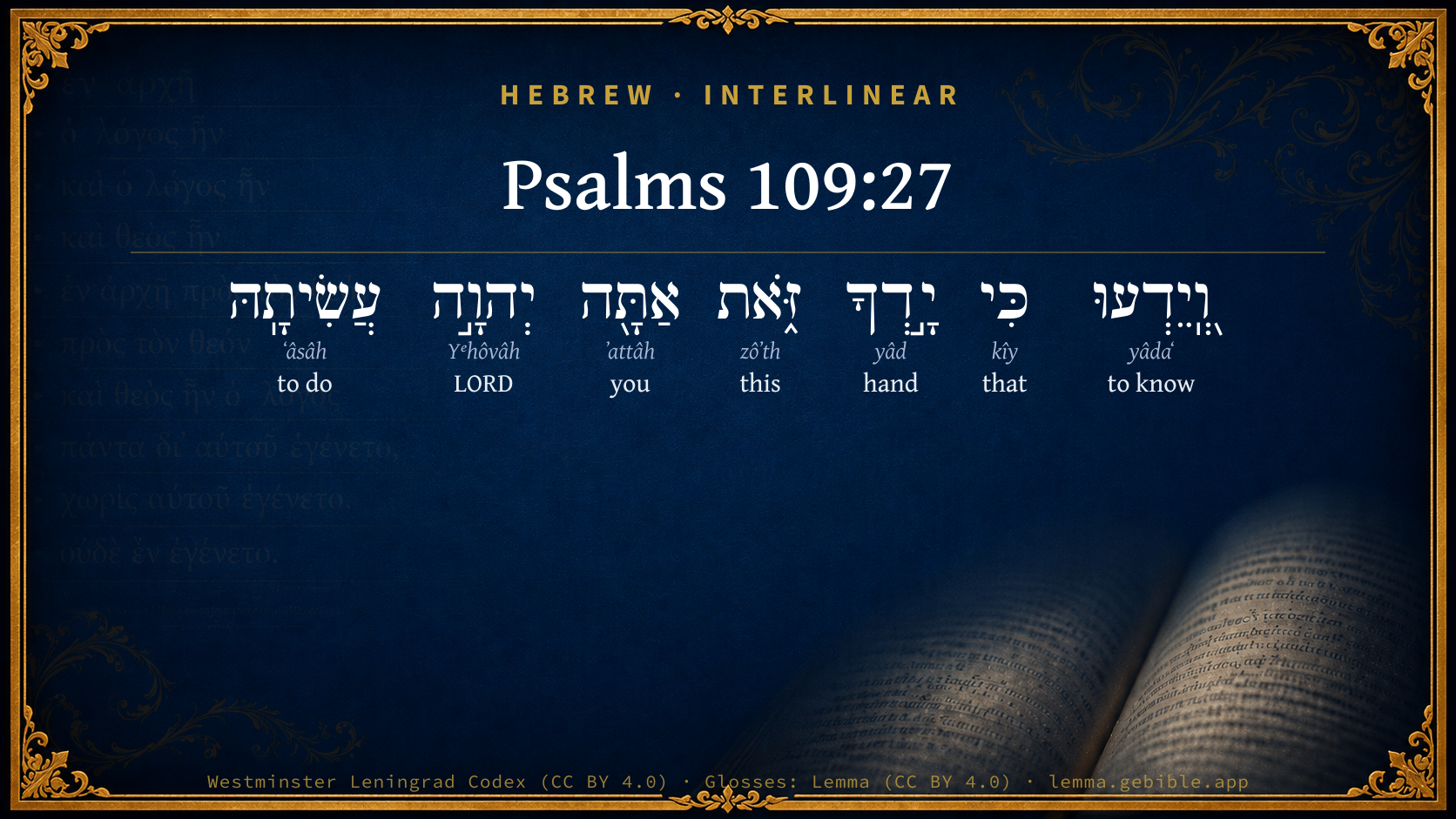
Hebrew (Westminster Leningrad Codex) Psalms 109:27 appears in the Hebrew Old Testament. The text above is from the Westminster Leningrad Codex. Each word links to its Strong’s number, a concise gloss, and parsing drawn from the Open Scriptures Hebrew Bible morphology. Click any word for its full Brown-Driver-Briggs (BDB) entry.
Download image
Cite this verse

Psalms 109:27 (World English Bible). Public Domain. Lemma interlinear Bible study tool, https://lemma.gebible.app/v/psalms/109/27.

Show BibTeX & RIS
BibTeX
RIS
English Translation
That they may know that this is your hand; That you, Yahweh, have done it.
World English Bible · Public Domain
Download a study sheet

One document with this verse’s original text, its word-by-word gloss line, the meaning frame, cross-references with their text, attributed commentary, and full source and license credits — printable, and it pastes into notes with its structure intact.

This verse Autodidact and up

Study sheet (.html) Plain text (.txt)

A passage Seminary Student

Up to 50 verses in one chapter. A passage sheet keeps up to 6 commentary sources and 12 cross-references per verse, in the order this page ranks them, and says so on the sheet whenever that leaves anything out. Ask for a single verse and you get the Autodidact verse sheet above.

Everything on this page stays free to read, with no account — the sheet is a download of what is already on screen, not access to it.

Want to remove ads? Support Godless Engineer
Compare translations 3

The same verse in 3 English versions, stacked beneath the original-language interlinear above. Click any original word for its lexicon entry.

Each is an independent rendering of the whole verse — the interlinear is not word-aligned to these translations.

Highlighted words mark where these versions differ — a whole-verse word diff, not a word-by-word alignment.

  • World English Bible Public Domain
    That they may know that this is your hand; That you, Yahweh, have done it.
  • King James Version Public Domain
    That they may know that this is thy hand; that thou, LORD, hast done it.
  • unfoldingWord Literal Text CC BY-SA 4.0
    so that they know that this your hand; you, Yahweh, you have done it.

unfoldingWord Literal Text — © unfoldingWord, licensed CC BY-SA 4.0. Word-aligned USFM3 via Door43 (git.door43.org/unfoldingWord/en_ult).

Versions to compare (up to 4)

3 of 4 selected

Show all 18 translations

Every available English version of this verse, each an independent rendering of the whole verse.

  • World English Bible Public Domain
    That they may know that this is your hand; That you, Yahweh, have done it.
  • Berean Standard Bible Public Domain
    Let them know that this is Your hand, that You, O LORD, have done it.
  • Majority Standard Bible Public Domain
    Let them know that this is Your hand, that You, O LORD, have done it.
  • King James Version Public Domain
    That they may know that this is thy hand; that thou, LORD, hast done it.
  • American Standard Version (1901) Public Domain
    That they may know that this is thy hand; `That' thou, Jehovah, hast done it.
  • Revised Version (1885) Public Domain
    That they may know that this is thy hand; that thou, LORD, hast done it.
  • Geneva Bible (1599) Public Domain
    And they shall know, that this is thine hand, and that thou, Lord, hast done it.
  • Douay-Rheims (1899) Public Domain
    And let them know that this is thy hand: and that thou, O Lord, hast done it.
  • Young's Literal Translation Public Domain
    And they know that this `is' Thy hand, Thou, O Jehovah, Thou hast done it.
  • Literal Standard Version CC BY-SA 4.0
    And they know that this [is] Your hand, || You, O YHWH, You have done it.
  • Unlocked Literal Bible CC BY-SA 4.0
    May they know that this is your doing, that you, Yahweh, have done this.
  • unfoldingWord Literal Text CC BY-SA 4.0
    so that they know that this your hand; you, Yahweh, you have done it.
  • Darby Bible Public Domain
    That they may know that this is thy hand; that *thou*, Jehovah, hast done it.
  • World Messianic Bible Public Domain
    that they may know that this is your hand; that you, LORD, have done it.
  • Webster's Bible Public Domain
    That they may know that this is thy hand; that thou, LORD, hast done it.
  • Free Bible Version CC BY-SA 4.0
    May they recognize that this is what you are doing—that you are the one who saves me.
  • Bible in Basic English Public Domain
    So that they may see that it is the work of your hand; that you, Lord, have done it.
  • JPS Tanakh (1917) Public Domain
    That they may know that this is Thy hand; that Thou, LORD, hast done it.

Literal Standard Version (2020), Covenant Press — licensed CC BY-SA 4.0. Text via the HelloAO Bible API (eBible.org). Unlocked Literal Bible (unfoldingWord) — licensed CC BY-SA 4.0. Text via the HelloAO Bible API (eBible.org). unfoldingWord Literal Text — © unfoldingWord, licensed CC BY-SA 4.0. Word-aligned USFM3 via Door43 (git.door43.org/unfoldingWord/en_ult). Free Bible Version, Dr. Jonathan Gallagher — licensed CC BY-SA 4.0. Text via the HelloAO Bible API (eBible.org).

Word by word

More ways to search: Search by grammar → Find every occurrence → Compare this word →

Practice this passage: Drill this verse → Learn its vocabulary →

זֹּ֑את
zôʼth
H2063
“this”
Pronoun, Demonstrative, Feminine, Singular
Part of Speech
Pronoun
Type
Demonstrative
Gender
Feminine
Number
Singular
Full BDB Definition

Origin: irregular of H2089

TWOT: 528

this, this one, here, which, this...that, the one...the other, such - (alone) - this one - this...that, the one...the other, another - (appos to subst) - this - (as predicate) - this, such - (enclitically) - then - who, whom - how now, what now - what now - wherefore now - behold here - just now - now, now already - (poetry) - wherein, which, those who - (with prefixes) - in this (place) here, then - on these conditions, herewith, thus provided, by, through this, for this cause, in this matter - thus and thus - as follows, things such as these, accordingly, to that effect, in like manner, thus and thus - from here, hence, on one side...on the other side - on this account - in spite of this, which, whence, how
  1. וְֽ֭יֵדְעוּ yâdaʻ H3045 “and · to know” Conjunction + Verb, Qal, Imperfect, 3rd Person, Masculine, Plural
  2. כִּי kîy H3588 “that” Conjunction
  3. יָ֣דְךָ yâd H3027 “hand · your” Noun, Common, Both, Singular, Construct + Suffix, Personal, 2nd Person, Masculine, Singular
  4. אַתָּ֖ה ʼattâh H859 “you” Pronoun, Personal, 2nd Person, Masculine, Singular
  5. יְהוָ֣ה Yᵉhôvâh H3068 “LORD” Noun, Proper
  6. עֲשִׂיתָֽהּ ʻâsâh H6213 “to do · her” Verb, Qal, Perfect, 2nd Person, Masculine, Singular + Suffix, Personal, 3rd Person, Feminine, Singular

About this verse

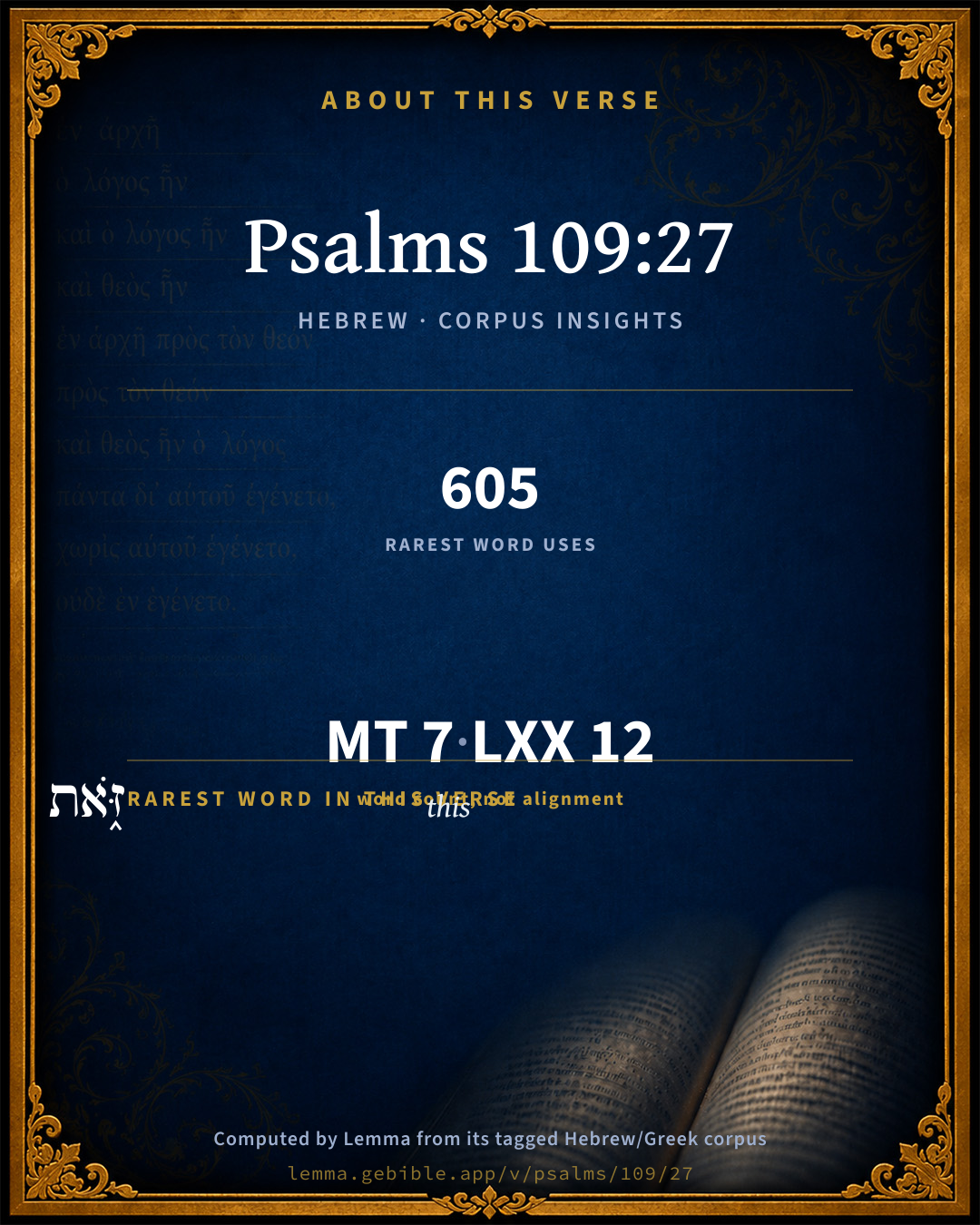
These counts appear in no published source. They are computed here, from the morphology-tagged text and Lemma’s own curated glosses. What Lemma adds →

7
words
7
distinct lemmas
Wisdom
section

Grammatical profile

  • 2 verbs
  • 2 nouns
  • 2 pronouns
  • 1 conjunction

Verb forms

  • וְֽ֭יֵדְעוּ Qal · Imperfect
  • עֲשִׂיתָֽהּ Qal · Perfect

Hebrew & Septuagint length

In English translation the verse runs 15 words from the Hebrew and 16 from the Septuagint (LXX English) — closely comparable.

A rough comparison of the two English renderings, which tokenize alike — not a word-level alignment.

Word counts can differ between the Hebrew and the Greek without any difference in meaning — e.g. the Hebrew direct-object marker אֵת has no separate Greek word, and Greek often adds the article ὁ.

In the original languages it is 7 Hebrew tokens and 12 Greek tokens — but the two are counted differently (Hebrew bundles its prefixes and suffixes into one token; the Greek is in lemma form), so that isn’t a like-for-like length.

Cross-references

10

Topical passages linked to Psalms 109:27 in the Treasury of Scripture Knowledge — connected by theme and wording, ordered by reader-vote popularity; previews shown in the World English Bible.

  • Job 37:7 He seals up the hand of every man, That all men whom he has made may know it.
  • 1 Kings 18:36–37 It happened at the time of the offering of the [evening] offering, that Elijah the prophet came near, and said, Yahweh, the God of Abraham, of Isaac, and of Israel, let it be known this day that you are God in Israel, and that I am your servant, and that I have done all these things at your word.
  • Exodus 8:19 Then the magicians said to Pharaoh, "This is the finger of God:" and Pharaoh's heart was hardened, and he didn't listen to them; as Yahweh had spoken.
  • 1 Samuel 17:46–47 This day will Yahweh deliver you into my hand; and I will strike you, and take your head from off you; and I will give the dead bodies of the host of the Philistines this day to the birds of the sky, and to the wild animals of the earth; that all the earth may know that there is a God in Israel,
  • Psalms 17:13–14 Arise, Yahweh, Confront him, cast him down. Deliver my soul from the wicked by your sword;
  • Psalms 64:8–9 Their own tongues shall ruin them. All who see them will shake their heads.
  • Psalms 126:2 Then our mouth was filled with laughter, And our tongue with singing. Then they said among the nations, "Yahweh has done great things for them."
  • Acts 2:32–36 This Jesus God raised up, to which we all are witnesses.
  • Acts 4:16 saying, "What shall we do to these men? Because indeed a notable miracle has been done through them, as can be plainly seen by all who dwell in Jerusalem, and we can't deny it.
  • Numbers 16:28–30 Moses said, Hereby you shall know that Yahweh has sent me to do all these works; for [I have] not [done them] of my own mind.

Cross-references courtesy of OpenBible.info (CC BY 4.0).

Hebrew and Greek witnesses Masoretic Hebrew ↔ Greek Septuagint

The same verse in the two great witnesses to the Old Testament, shown verse-for-verse.

You’re reading Greek Psalm 108 (Hebrew Psalm 109). The Septuagint counts the superscription, so verse numbers can differ from the Hebrew — chapter-level alignment, not verse-by-verse. Numbering follows Rahlfs.

These are two independent witnesses, not word-aligned to each other, and the Septuagint is shown in lemma (dictionary) form.

Hebrew Psalms 109:27 Masoretic · Westminster Leningrad Codex

וְֽ֭יֵדְעוּ כִּי יָ֣דְךָ זֹּ֑את אַתָּ֖ה יְהוָ֣ה עֲשִׂיתָֽהּ

That they may know that this is your hand; That you, Yahweh, have done it.

World English Bible · Public Domain

Greek LXX Greek Psalm 108:27 Septuagint · lemma form

καί γιγνώσκω ὅτι ὁ χείρ σύ οὗτος καί σύ κύριος ποιέω αὐτός

And let them know that this is your hand; and that you, Lord, have wrought it.

LXX2012 (modern English Septuagint) · Public Domain

Hebrew: Westminster Leningrad Codex (CC BY 4.0). Greek: Septuagint (public domain); English from LXX2012 (modern English Septuagint) (Public Domain). How the Septuagint differs from the Hebrew →

Commentary

Notes on Psalms 109:27 from classic Christian and Jewish commentators (each source and its license shown beneath its notes). The classic Christian expositions comment on the surrounding passage and are grouped to its opening verse, so a note may address several verses; the Jewish commentaries on the Tanakh (Rashi and others) are per-verse, so they appear only where the commentator wrote on this verse.

Lemma curates 59 commentaries, every one of them public domain or Creative Commons licensed, each selected and text-cleaned for this edition rather than reprinted as found. About our sources →

Trapp's Complete Commentary

John Trapp

Psa 109:27 That they may know that this [is] thy hand; [that] thou, LORD, hast done it.

Ver. 27. That they may know] That I am delivered merely by thy presence and power. It is the ingenuity of the saints, in all their desired or expected mercies, to study God’s ends more than their own.

John Trapp, A Commentary or Exposition upon All the Books of the Old and New Testament (1647–1656) — public domain. Text from a community e-Sword module.

J. A. Alexander on Psalms

Joseph Addison Alexander

27. (Psa 109:27) And they shall know that this (is) thy hand; thou, Jehovah, hast done it. The optative construction, let them know, and the subjunctive one, that they may know, are really involved in the more exact translation, they shall know. The subject of the verb may be men in general, or the persecuting adversaries in particular, more probably the latter, because they are referred to both before and after. This is thy hand, i.e. this deliverance is the product of thy power. Compare Psa 59:13.

Joseph Addison Alexander, The Psalms Translated and Explained (1850) — public domain. Text from a community e-Sword module.

Adam Clarke's Commentary

Verse 27. That they may know that this is thy hand] Let thy help be so manifest in my behalf, that they may see it is thy hand, and that thou hast undertaken for me. Or, if the words refer to the passion of our Lord, Let them see that I suffer not on my own account; "for the transgression of my people am I smitten."

Adam Clarke's Commentary on the Bible (1810–1826) — public domain. Text from a community e-Sword/MySword module.

The Cambridge Bible for Schools and Colleges

gen. ed. J. J. S. Perowne

27. that this is thy hand] That thou hast interposed for the deliverance of Thy servant. With hast done it cp. Psa_109:21, lit. do thou with me.

The Cambridge Bible for Schools and Colleges (gen. ed. J. J. S. Perowne; Cambridge University Press, 1878–1918) — public domain. Text from a community e-Sword module.

John Gill's Exposition

Let them curse, but bless thou,.... Let them curse me, as Shimei did David, the type of Christ; let them curse themselves, as they did; or my people: or "let them be cursed", as the Syriac version; cursed in life and at death, and to all eternity: but "bless thou me", the Messiah; as he did, when he raised him front the dead, set him at his right hand, and gave him a name above everyone, and made him most blessed for evermore; and bless my people with all spiritual blessings of grace, and with eternal glory and happiness. Or "be thou blessed"; let honour, blessing, and praise, be continually ascribed to thee; if God does but bless, it is no matter if wicked men curse, so Aben Ezra and Kimchi interpret it; see Sa2 16:11.

When they arise, let them be ashamed; be suffered to do those things which may bring shame and disgrace upon them; or let them be disappointed and so confounded, as the Jews were; who though they so far gained their point as to bring Christ to the dust of death and the grave, yet to their great confusion he arose again from the dead; or let them be ashamed at the last day, as they will be when Christ shall come in the clouds of heaven and be their Judge, who will then be glad to shelter themselves in rocks and caves. This is imprecated to be done

when they shall arise: rise up against Christ to take away his life; rise up against his disciples to persecute them, against his Gospel to contradict and blaspheme it, and against his cause and interest to crush it; or against the Romans, to shake off their yoke, when they were brought to great shame and confusion; or when they shall arise at the resurrection of the dead, which will be to shame and everlasting contempt, Dan 12:2.

But let thy servant rejoice; the Messiah, who appeared in the form of a servant; came not as a temporal lord and prince, to be ministered unto, but as a servant, to minister to others; and who is a servant of God's choosing, calling, and sending, and whom he faithfully served; and who, as prayed for, did rejoice in the strength of the Lord, given him as man; and in the salvation wrought for and by him, Psa 21:1, in the work of the Lord prospering in his hand; in his victory over sin, Satan, the world, and death; in the presence of God he was made glad with, and in the glory promised him, which he had with his Father before the world was, Psa 16:11.

John Gill's Exposition of the Whole Bible (1746–1763) — public domain (CC PDM 1.0). Text via the HelloAO Bible API.

Albert Barnes' Notes on the Bible

That they may know that this is thy hand - That this has been done by thee; that it has all occurred under thy direction, or has been ordered by thee. The reference seems to be particularly to God’s interposition: “Let it be manifest to all that thou hast interposed in my behalf; that thou hast undertaken for me; that thou art my Friend.” He desired an interposition from God that he might be vindicated before all his enemies.

That thou, Lord, hast done it - Let it be such an interposition that it will be manifest to all that no other one but God could have done this.

Albert Barnes' Notes on the Bible (1834–1885) — public domain. Text from a community e-Sword/MySword module.

Matthew Poole's English Annotations

Know; being convinced of the eminency, and singularity, and strangeness of the work.

Matthew Poole's English Annotations on the Holy Bible (1683–1685) — public domain. Text from a community e-Sword/MySword module.

The Treasury of David

Charles H. Spurgeon

Ver. 27. That they may know that this is thy hand. Dolts as they are, let the mercy shown to me be so conspicuous that they shall be forced to see the Lord's agency in it. Ungodly men will not see God's hand in anything if they can help it, and when they see good men delivered into their power they become more confirmed than ever in their atheism; but all in good time God will arise and so effectually punish their malice and rescue the object of their spite that they will be compelled to say like the Egyptian magicians, "this is the finger of God."

That thou, LORD, hast done it. There will be no mistaking the author of so thorough a vindication, so complete a turning of the tables.

Psalms 109:28*

Charles H. Spurgeon's The Treasury of David (1869–1885) — public domain. Psalms only. Text from a community e-Sword/MySword module.

Whedon's Commentary on the Bible

Daniel D. Whedon

27. That this is thy hand—Here again appears the pious end sought in all the psalmist’s prayers for help, or against his enemies. Both his sufferings and his deliverances were providential, and this he wished might be made to appear, for his own and the divine vindication.

Daniel D. Whedon (gen. ed.), Commentary on the Old and New Testaments (1874–1909) — public domain. Text from a community e-Sword module.

The Pulpit Commentary

That they may know that this is thy hand. (comp. Psa_59:13) "Deliver me," prays the psalmist, "in some signal way, so that my enemies may be forced to recognize thy hand in my deliverance, and to confess that thou, Lord, hast done it."

The Pulpit Commentary (1880–1919), ed. H.D.M. Spence-Jones & Joseph S. Exell — public domain. Text from a community e-Sword module.

Lesson kit

Teaching starters — assembled from the data on this page, not authored interpretation. Every prompt links to the verse data it draws on. Edit before teaching.

Psalms, in the Wisdom, opens this verse with 7 words (7 distinct Hebrew lemmas). Its most distinctive word is zôʼth (“this”). A historical commentator’s framing appears above. Read the whole chapter for the surrounding context.

Discussion questions

  1. What does “this” (zôʼth) contribute to the verse as a whole?
  2. How does Job 37:7, which shares this passage’s theme, read alongside this verse?
  3. These translations render this verse differently; the difference is in the English rendering, not the original. What questions does that raise?
  4. «וְֽ֭יֵדְעוּ» is a Qal Imperfect verb. How does that grammatical form shape the action described?
  5. Compare how Trapp's Complete Commentary and J. A. Alexander on Psalms read this verse. Where do they agree or differ?

Things to notice

Reading settings

Reading text

Shown beneath each verse's original-language words.

Old Testament
Old Testament edition

Read the OT as the Masoretic Hebrew (MT) or the Greek Septuagint (LXX).

English shown for the Greek Septuagint (in the Hebrew ↔ Greek comparison).

Comparing translations? Open the Compare panel on any verse page to stack up to four side by side.