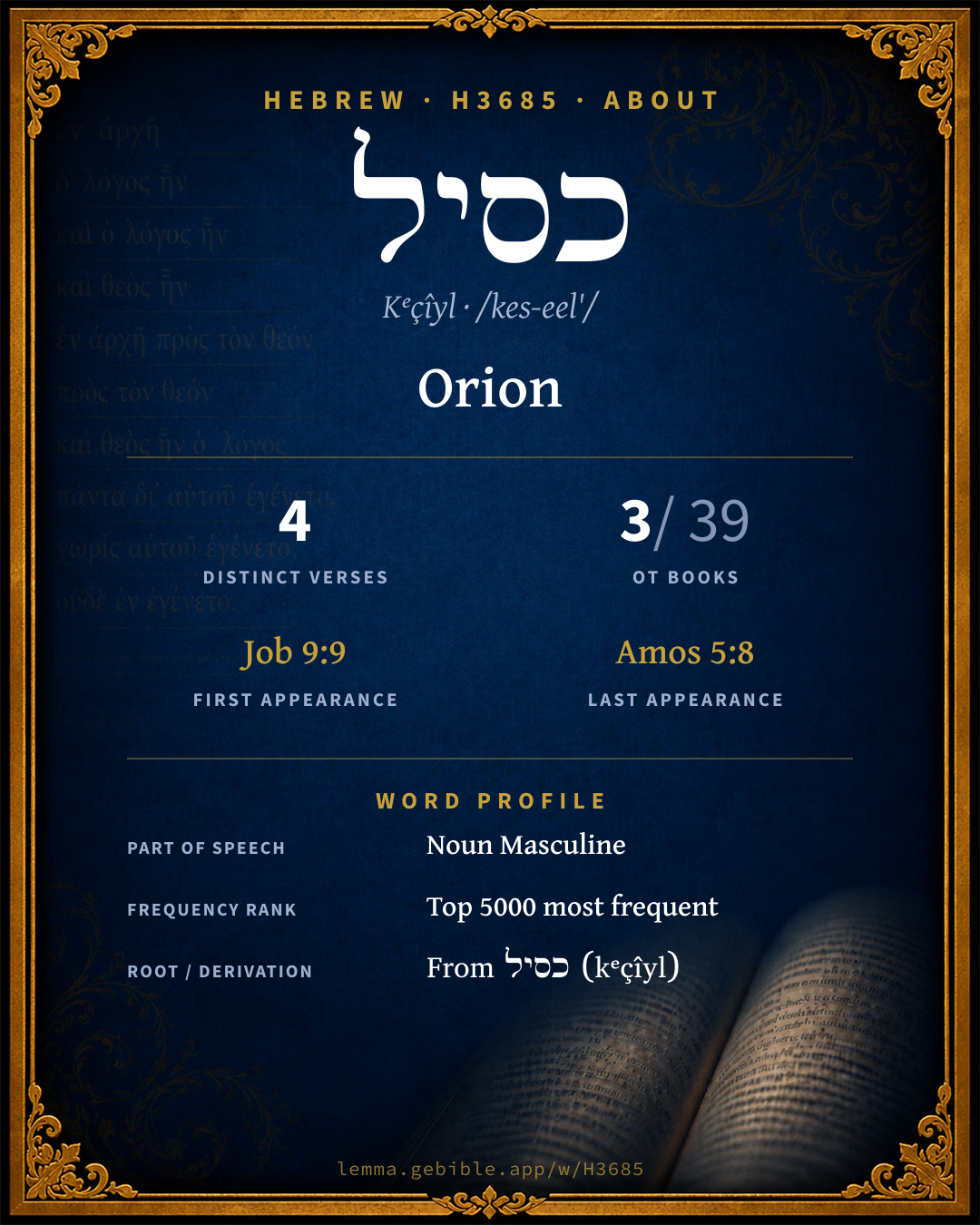
כְּסִיל
Orion
BDB lists 3 entries for ‘Orion’ fuller range ↓
Full lexicon entry — Brown-Driver-Briggs (BDB)
From Brown-Driver-Briggs (BDB)
Where this word appears
See every Absolute-state word in the Hebrew Bible →
Grammar key — what these labels mean
Part of speech
- Noun
- A naming word — a person, place, thing, or idea.
Noun type
- Common
- A common noun — a general class of person, place, or thing (“king,” “city,” “water”), not a specific name.
- Proper
- A name of a specific person, place, or people (e.g. Abraham, Zion, Israel).
State
- Absolute
- The independent form of a noun, not bound to a following word.
- Construct
- A noun bound to a following noun in a possessive / “of” relationship (the construct chain).
Gender
- Masculine
- Grammatically masculine.
Number
- Singular
- One.
- Plural
- More than one (in Hebrew, generally three or more).
Grammatical forms
- Noun, Common, Masculine, Singular, Absolute 2 times (50%)
- Noun, Common, Masculine, Plural, Construct 1 time (25%)
- Noun, Proper 1 time (25%)
Parsed forms decoded from the imported morphology (morphhb / Westminster Leningrad Codex — WLC text public domain, morphhb tagging CC BY 4.0), counted across 4 parsed occurrences — not distinct verses.
Every verse where H3685 appears — 4 distinct verses across 3 books. Click any verse to open its interlinear word-by-word view. Verse text shown in the World English Bible for context — . Each verse’s Hebrew form is shown with its reference; the English is not keyword-highlighted, since the data carries no word-level English alignment. Use “Compare translations” on any verse to read it across multiple English versions. This concordance covers the Hebrew Bible; Septuagint (Greek Old Testament) occurrences are not indexed here.
Job 2 verses
Isaiah 1 verse
Amos 1 verse
About this entry
At a glance — auto-summarized from this page’s data, not written by a person. Every figure links to its source below. This summary describes the numbers; it doesn’t interpret them.
At its core, כסיל (Kᵉçîyl) means “Orion.” With only 4 verses it sits in the long tail of Hebrew Bible vocabulary. Its uses cluster heavily in Job (50% of all occurrences). It first appears in Job 9:9. Each statement above links to its evidence; the full detail follows below.
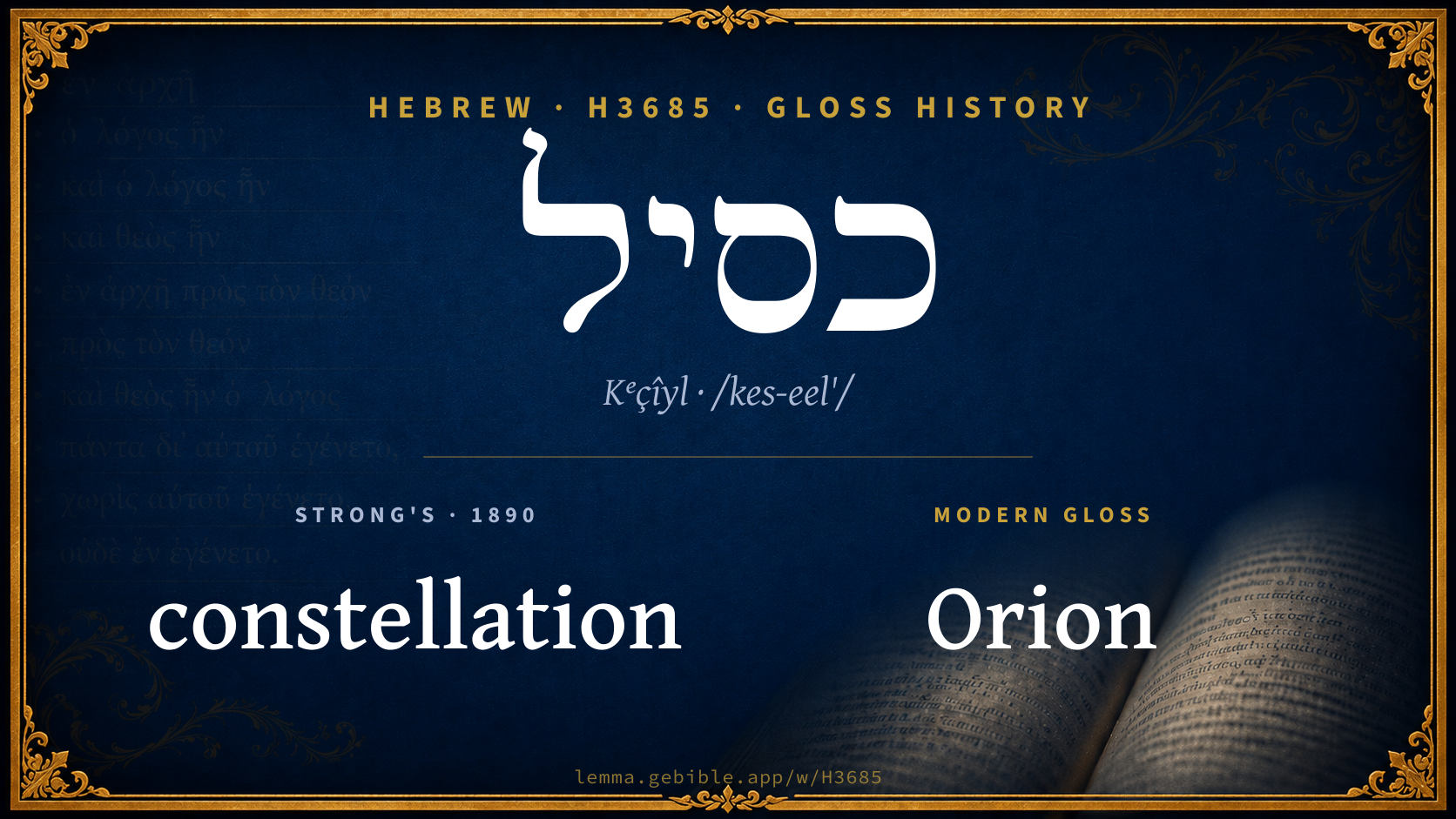
Gloss history
Strong's 1890 vs modern scholarship
About this word
Strong's H3685 catalogs a Hebrew word from the Hebrew Old Testament.
These counts are not copied from any lexicon or concordance. They are computed here, from the morphology-tagged Hebrew Old Testament. What Lemma adds →
- 4
- distinct verses
- The word appears in 4 distinct verses.
- 3 / 39
- OT books
- The word appears in 3 of 39 Old Testament books.
- #3,696
- by frequency
- Top 5000 most frequent Hebrew words (rank 3,696 of 8,640 Hebrew words by occurrence).
View all 4 occurrences in the concordance →
By section of the Old Testament
By traditional corpus
Conventional, traditional groupings — biblical authorship is debated, so this is a traditional corpus grouping, not an authorship claim. Each share is this word’s portion of its verses in that division of the Hebrew canon. Each figure is a share of the word’s 4 distinct verses.
- Prophets (Nevi'im) 2 verses · 50%
- Writings (Ketuvim) 2 verses · 50%
How translations render this word
Counts come from each version’s own published word-to-Strong’s tagging or interlinear alignment — an approximate guide to how each version renders this word, not a word-level alignment the data otherwise carries. Because each total is that version’s own tagged count, the per-version totals vary from one another and need not match the appearance or distinct-verse counts above. These counts may also differ from a printed concordance because Lemma counts each distinctly tagged rendering and does not collapse phrase taggings into a single head-word total. This is a fixed set of word-tagged versions (KJV, ASV, BSB, ULT) and does not change with the reading translation you choose elsewhere. Each version’s license is shown beside its name below (and on Sources).
BDB lists this Strong’s number as 3 distinct words (homographs). Each count above pools all of them and is not split by sense — see the Senses section below. A low-frequency rendering may belong to a different one of those words, not the primary meaning.
- King James Version†: Orion 3×
- American Standard Version†: Orion 3×
- Berean Standard Bible†: Orion 3×
- unfoldingWord Literal Text†: Orion 3×
King James Version Public Domain
Renders H3685 across 4† tagged occurrences — most commonly:
Plus 1 rendering that appears only once — usually multi-word phrases or single function words the recovered tagging swept in, not distinct renderings.
American Standard Version Public Domain
Renders H3685 across 4† tagged occurrences — most commonly:
Plus 1 rendering that appears only once — usually multi-word phrases or single function words the recovered tagging swept in, not distinct renderings.
Berean Standard Bible Public Domain
Renders H3685 across 4† tagged occurrences — most commonly:
Plus 1 rendering that appears only once — usually multi-word phrases or single function words the recovered tagging swept in, not distinct renderings.
unfoldingWord Literal Text CC BY-SA 4.0
Renders H3685 across 4† tagged occurrences — most commonly:
Plus 1 rendering that appears only once — usually multi-word phrases or single function words the recovered tagging swept in, not distinct renderings.
Senses in the full BDB
What do BDB’s symbols mean?
BDB uses these scholarly abbreviations:
| Symbol | Meaning |
|---|---|
| 𝔊 | the Septuagint (the ancient Greek translation, LXX) |
| 𝔙 | the Vulgate (the Latin translation) |
| 𝔖 | the Syriac version (the Peshitta) |
| 𝔗 | the Targum (the Aramaic translation) |
| ψ | the Psalms |
| √ | root (the underlying root or stem) |
| ‖ | parallel passage (a synonymous or contrasted parallel) |
| † | the dagger: every passage where the word occurs is cited |
The 0 senses and sub-senses the full Brown-Driver-Briggs lexicon distinguishes for this word, in lexicon order (not ranked by frequency), with BDB’s own verbatim wording and sub-sense lettering. Shown in Hebrew script with BDB’s own scholarly abbreviations. The condensed entry is in the Lexicon Entry tab. See also the Forms in the corpus table below.
כסיל I stupid fellow, dullard, fool
כסיל II Orion (relation to above √ obscure)
כסיל III loc. in S of tribe of Judah Jos 15
Senses from the full Brown-Driver-Briggs lexicon (Brown, Driver, Briggs; Oxford 1906 — public domain), digitized via Sefaria, supplemented by the OpenScriptures HebrewLexicon (CC BY 4.0). Full attribution on Sources.
Word origin
I. n.m. stupid fellow, dullard, fool;—כ׳ ψ 49:11 + 44 times; pl. כְּסִילִים ψ 94:8 + 25 times;—‖ בער ψ 49:11; 92:7; 94:8, elsewhere only in WisdLt; he hates knowledge Pr 1:22; delights not in understanding 18:2; it is his sport to do mischief 10:23; his heart proclaimeth אִוֶּלֶת 12:23; his mouth poureth it forth 15:2, and feedeth on it 15:14.
II. n.m. Orion (relation to above √ obscure);—Am 5:8 Jb 9:9; also משְׁכוֹת כ׳ תְּפַתֵּחַ 38:31 the cords of Orion wilt (canst) thou let out? (appar. some mythological allusion, v. Di Che, to giant bound in skies; cf. Hom Ὠρίωνα δοκεύει, and σθένος Ὠρίωνος); both times associated with the Pleiades; sf. כְּסִילֵיהֶם their Orions Is 13:10, Orion and other constellations of the same brilliancy.
III. n.pr.loc. in S of tribe of Judah Jos 15:30, prob. corrupt for בְּתוּל Jos 19:4; see בְּתוּאֵל.
— Brown-Driver-Briggs (Oxford 1906, public domain), digitized via Sefaria, supplemented by the OpenScriptures HebrewLexicon (CC BY 4.0). See Sources.
Derived from כסיל (kᵉçîyl) (H3684) — fool.
Jastrow Dictionary
A second Hebrew/Aramaic lexicon for comparison, covering Aramaic and post-biblical (Talmudic, Targumic, Midrashic) usage that the biblical-Hebrew BDB does not. Matched by lemma rather than by Strong’s number, so a lemma may carry more than one Jastrow headword (shown separately below), and the entries cover usage well beyond the Bible.
כְּסִיל
- (b. h.)
- 1. (a denom. of כֶּסֶל q. v.) [one with thick loins, stout,] (cmp. טִפֵּשׁ) fool, foolish, overbearing. Y. Peah I, 15ᵇ bot.; Yalk. Ex. 415 (ref. to Prov. III, 26) דברים שאתה כ׳ בהם וכ׳ in things in which thou art foolish (ignorant), He will guard thy foot &c.—Pl. כְּסִילִים. Num. R. s. 16 (ref. to Prov. XXVI, 6) עשו עצמן כ׳ they (the spies) made fools of themselves. e.g. Proverbs 3:26
- 2. K’sil, the constellation Orion (v. Winer, Reallex. s. v. Nimrod). Ber. 58ᵇ
A Dictionary of the Targumim, the Talmud Babli and Yerushalmi, and the Midrashic Literature (Marcus Jastrow; London, Luzac, 1903) — Public Domain. Digitized via Sefaria. Digitized via Sefaria. Full attribution on Sources.
Forms in the corpus
The 4 distinct written forms H3685 takes in the Hebrew Bible, most frequent first — each parse links to that state’s occurrences in the concordance. Hebrew forms include their vowel points and cantillation, so a single lemma takes many written forms.
| Form | Parsing | Example | Uses |
|---|---|---|---|
| וּ/כְסִ֗יל | Noun, Proper | Amos 5:8 | 1 |
| וּ/כְסִ֣ילֵי/הֶ֔ם | Noun, Common, Masculine, Plural, Construct | Isaiah 13:10 | 1 |
| כְּסִ֣יל | Noun, Common, Masculine, Singular, Absolute | Job 38:31 | 1 |
| כְּסִ֥יל | Noun, Common, Masculine, Singular, Absolute | Job 9:9 | 1 |
Same root — word family
Other BDB entries built from the same root as H3685, grouped by Strong’s listed origin. These share a root / origin per the lexicon — not necessarily a shared meaning. Each links to that word’s own entry.
Derives from
Shares the same root
Proper names from this root
People and places named from this root — a name, not an additional meaning of the word.
Compare all same-root words → 1 of the same-root words is a proper name (a person or place). They share a root, not necessarily a meaning.
Bible dictionary
Public-domain dictionary articles matched to this entry by name (Orion). A biblical name can be shared by more than one person or place, so an article may treat several.
Easton's Bible Dictionary · M. G. Easton, 1897
Heb. Kesil; i.e., "the fool", the name of a constellation (Job 9:9; 38:31; Amos 5:8) consisting of about eighty stars. The Vulgate renders thus, but the LXX. renders by Hesperus, i.e., "the evening-star," Venus. The Orientals "appear to have conceived of this constellation under the figure of an impious giant bound upon the sky." This giant was, according to tradition, Nimrod, the type of the folly that contends against God. In Isa. 13:10 the plural form of the Hebrew word is rendered "constellations."
Smith's Bible Dictionary · William Smith, 1863
(the giant), a large and bright constellation of 80 stars, 17 large ones, crossed by the equinoctial line. It is named after a mythical personage of the Greeks, of gigantic stature and "the handsomest man in the world." The Arabs called it" the giant," referring to Nimrod, the mighty hunter who was fabled to have been bound in the sky for his impiety. (Job 9:9) Also alluded to in (Job 38:31)
Classic public-domain reference works; full attribution on Sources.
Septuagint verse parallels
This word appears in 4 verses that also exist in the Greek Old Testament (Septuagint), out of the 4 Hebrew verses it occurs in. You can read those verses in Greek by switching the Old Testament edition to the Septuagint.
Read these verses in the Septuagint
This is a verse-level parallel only — the same verses exist in both the Hebrew and Greek Old Testaments. No word-level Hebrew↔Greek correspondence is claimed: the data carries no such alignment, so no Greek word is shown as this Hebrew word’s translation. Coverage is not total — the Septuagint omits the deuterocanon and renumbers the Psalms, so some Hebrew verses have no direct Greek parallel.