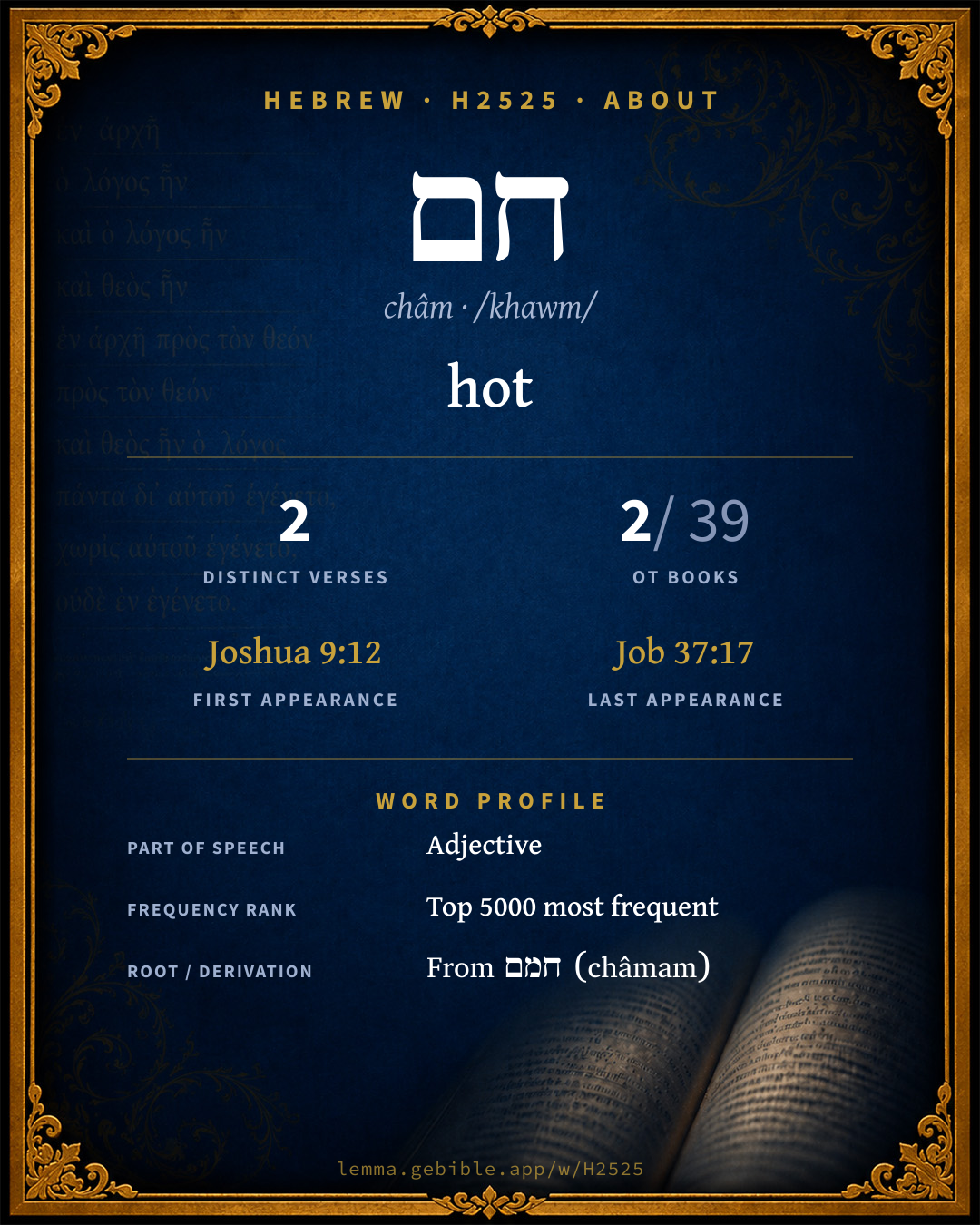
חָם
hot
Full lexicon entry — Brown-Driver-Briggs (BDB)
From Brown-Driver-Briggs (BDB)
Where this word appears
Grammar key — what these labels mean
Part of speech
- Adjective
- A word that describes or qualifies a noun.
State
- Absolute
- The independent form of a noun, not bound to a following word.
Gender
- Masculine
- Grammatically masculine.
Number
- Plural
- More than one (in Hebrew, generally three or more).
- Singular
- One.
Grammatical forms
- Adjective, Adjective, Masculine, Plural, Absolute 1 time (50%)
- Adjective, Adjective, Masculine, Singular, Absolute 1 time (50%)
Parsed forms decoded from the imported morphology (morphhb / Westminster Leningrad Codex — WLC text public domain, morphhb tagging CC BY 4.0), counted across 2 parsed occurrences — not distinct verses.
Every verse where H2525 appears — 2 distinct verses across 2 books. Click any verse to open its interlinear word-by-word view. Verse text shown in the World English Bible for context — . Each verse’s Hebrew form is shown with its reference; the English is not keyword-highlighted, since the data carries no word-level English alignment. Use “Compare translations” on any verse to read it across multiple English versions. This concordance covers the Hebrew Bible; Septuagint (Greek Old Testament) occurrences are not indexed here.
Joshua 1 verse
Job 1 verse
About this entry
At a glance — auto-summarized from this page’s data, not written by a person. Every figure links to its source below. This summary describes the numbers; it doesn’t interpret them.
חם (châm) is a Hebrew adjective most often rendered “hot.” With only 2 verses it sits in the long tail of Hebrew Bible vocabulary. It clusters heavily in Joshua, which alone accounts for 50% of its uses. It first appears in Joshua 9:12. It clusters with חמם, חם and חמה under a shared root. For the data behind this summary, explore the sense tree and the renderings breakdown below.
Gloss history
Strong's 1890 vs modern scholarship
About this word
Strong's H2525 catalogs a Hebrew word from the Hebrew Old Testament.
These counts are not copied from any lexicon or concordance. They are computed here, from the morphology-tagged Hebrew Old Testament. What Lemma adds →
- 2
- distinct verses
- The word appears in 2 distinct verses.
- 2 / 39
- OT books
- The word appears in 2 of 39 Old Testament books.
- #4,807
- by frequency
- Top 5000 most frequent Hebrew words (rank 4,807 of 8,640 Hebrew words by occurrence).
View all 2 occurrences in the concordance →
By traditional corpus
Conventional, traditional groupings — biblical authorship is debated, so this is a traditional corpus grouping, not an authorship claim. Each share is this word’s portion of its verses in that division of the Hebrew canon. Each figure is a share of the word’s 2 distinct verses.
- Prophets (Nevi'im) 1 verse · 50%
- Writings (Ketuvim) 1 verse · 50%
How translations render this word
Counts come from each version’s own published word-to-Strong’s tagging or interlinear alignment — an approximate guide to how each version renders this word, not a word-level alignment the data otherwise carries. Because each total is that version’s own tagged count, the per-version totals vary from one another and need not match the appearance or distinct-verse counts above. These counts may also differ from a printed concordance because Lemma counts each distinctly tagged rendering and does not collapse phrase taggings into a single head-word total. This is a fixed set of word-tagged versions (KJV, ASV, BSB, ULT) and does not change with the reading translation you choose elsewhere. Each version’s license is shown beside its name below (and on Sources).
BDB lists this Strong’s number as 5 distinct words (homographs). Each count above pools all of them and is not split by sense — see the Senses section below. A low-frequency rendering may belong to a different one of those words, not the primary meaning.
- King James Version†: Are warm 1×, We took hot 1×
- American Standard Version†: Are warm 1×, We took hot 1×
- Berean Standard Bible†: Get hot 1×, Ours was warm 1×
- unfoldingWord Literal Text†: Are hot 1×, Hot 1×
King James Version Public Domain
Renders H2525 across 2† tagged occurrences — most commonly:
American Standard Version Public Domain
Renders H2525 across 2† tagged occurrences — most commonly:
Berean Standard Bible Public Domain
Renders H2525 across 2† tagged occurrences — most commonly:
unfoldingWord Literal Text CC BY-SA 4.0
Renders H2525 across 2† tagged occurrences — most commonly:
Senses in the full BDB
What do BDB’s symbols mean?
BDB uses these scholarly abbreviations:
| Symbol | Meaning |
|---|---|
| 𝔊 | the Septuagint (the ancient Greek translation, LXX) |
| 𝔙 | the Vulgate (the Latin translation) |
| 𝔖 | the Syriac version (the Peshitta) |
| 𝔗 | the Targum (the Aramaic translation) |
| ψ | the Psalms |
| √ | root (the underlying root or stem) |
| ‖ | parallel passage (a synonymous or contrasted parallel) |
| † | the dagger: every passage where the word occurs is cited |
The 2 senses and sub-senses the full Brown-Driver-Briggs lexicon distinguishes for this word, in lexicon order (not ranked by frequency), with BDB’s own verbatim wording and sub-sense lettering. Shown in Hebrew script with BDB’s own scholarly abbreviations. The condensed entry is in the Lexicon Entry tab. See also the Forms in the corpus table below.
חם I pers.m. and loc. (cf. Sab. חם Hal243)
- 1. Ham, 2nd son of Noah Gn 5:32; 6:10; 7:13; 9:18(×2) 1 Ch 1:4; called father of Canaan Gn 9:22 and of various peoples 10:1, 6, 20 1 Ch 1:8, cf. מִן־חָם הַיֹּשְׁבִים שָׁם 4:40; these peoples were inhabitants of southern lands, or related historically or politically to such inhabitants; v. כּוּשׁ, כְּנַעַן, מִצְרַיִם, פּוּט, etc. e.g. Genesis 5:32
- 2. in late ψψ a name (coll.) for Egyptians:—אָֽהֳלֵי־ח׳ ψ 78:51; אֶרֶץ־ח׳ 105:23, 27; 106:22 (all ‖ מִצְרַיִם, exc. 105:27).—On historical significance, and attempts at etymol. v. Di Gen. ed. 6, chap. 10, especially pp. 165, 168 f., Hom SV i. 427 BuUrg. 323 WiedemannÄgypt. Gesch. i. 22. e.g. Psalms 78:51
חם II husband’s father, v. חמה.
חם III warm, hot, v. sub חמם.
חם IV husband’s father (NH id., of husband’s or wife’s father, so Aramaic חֲמָא
חם V hot
Senses from the full Brown-Driver-Briggs lexicon (Brown, Driver, Briggs; Oxford 1906 — public domain), digitized via Sefaria, supplemented by the OpenScriptures HebrewLexicon (CC BY 4.0). Full attribution on Sources.
Word origin
I. n.pr.pers.m. and loc. (cf. Sab. חם Hal243)—𝔊 Χαμ:—
II. husband’s father, v. חמה.
I. adj. warm, hot, v. sub חמם.
III. n.m. husband’s father (NH id., of husband’s or wife’s father, so Aramaic חֲמָא; Arabic حَمٌّ husband’s male relation (father, brother, paternal uncle), but also wife’s father, etc.; Ethiopic ሐም Assyrian emu, ZimBP 48);—only sf. חָמִ֫יךָ Gn 38:13, 25, of Judah as Tamar’s father-in-law; חָמִ֫יהָ 1 S 4:19, 21 of Eli, father-in-law of Phinehas’ wife.
II. adj. hot;—לחם חָ֞ם Jos 9:12 hot bread (JE), i.e. freshly baked; בגדים חַמִּים Jb 37:17 of garments heated by south wind.—1. חָם v. supr. p. 325. 2. חָם v. sub חמה.
— Brown-Driver-Briggs (Oxford 1906, public domain), digitized via Sefaria, supplemented by the OpenScriptures HebrewLexicon (CC BY 4.0). See Sources.
Derived from חמם (châmam) (H2552) — to be warm.
Jastrow Dictionary
A second Hebrew/Aramaic lexicon for comparison, covering Aramaic and post-biblical (Talmudic, Targumic, Midrashic) usage that the biblical-Hebrew BDB does not. Matched by lemma rather than by Strong’s number, so a lemma may carry more than one Jastrow headword (shown separately below), and the entries cover usage well beyond the Bible.
חַם
- , perf. of חֲמַם.
חָם I
- (b. h.) pr. n. m. Ham, the son of Noah. Snh. 69ᵇ ח׳ גדול וכ׳ H. was the elder of Japheth by one year &c. Ib. 108ᵇ ח׳ לקה בעורו H. was punished on his skin (was made black); Gen. R. s. 36 יצא ח׳ מפוהם Ḥ. came out (of the ark) blackened; a. e.
חָם II
- warm, hot, boiling. Pes. 75ᵇ, sq.; a. fr.—Nidd. 43ᵃ בשרו חם his membrum excited.—Pl. חַמִּים, חַמִּין (sub. מים) hot water. Sabb. 134ᵇ ח׳ שהוחמו וכ׳ hot water which was made hot on the Sabbath; a. fr.—חַמֵּי טבריה the hot springs of Tiberias, in gen. natural hot water, opp. to חמי האור water heated by fire. Ḥull. 8ᵃ (Neg. IX, 1 מֵי); a. fr.—Fem. חַמָּה. Makhsh. III, 3 פת ח׳ hot bread.
חָם III
- v. Ges. H. Dict.10 s. v.) father-in-law, husband’s father, wife’s father. Yeb. XV, 7 חָמִי my husband’s father. Ib. I, 1 חָמִיו his (the yabam’s) father-in-law. Pes. 87ᵃ כלה בבית חָמִיהָ a bride in the house of her father-in-law (after being conducted to the husband’s home); a. v. fr.—Fem. חָמוֹת q. v.
A Dictionary of the Targumim, the Talmud Babli and Yerushalmi, and the Midrashic Literature (Marcus Jastrow; London, Luzac, 1903) — Public Domain. Digitized via Sefaria. Digitized via Sefaria. Full attribution on Sources.
Forms in the corpus
The 2 distinct written forms H2525 takes in the Hebrew Bible, most frequent first — each parse links to that state’s occurrences in the concordance. Hebrew forms include their vowel points and cantillation, so a single lemma takes many written forms.
| Form | Parsing | Example | Uses |
|---|---|---|---|
| חַמִּ֑ים | Adjective, Adjective, Masculine, Plural, Absolute | Job 37:17 | 1 |
| חָ֞ם | Adjective, Adjective, Masculine, Singular, Absolute | Joshua 9:12 | 1 |
Same root — word family
Other BDB entries built from the same root as H2525, grouped by Strong’s listed origin. These share a root / origin per the lexicon — not necessarily a shared meaning. Each links to that word’s own entry.
Derives from
Shares the same root
Derived from this word
Proper names from this root
People and places named from this root — a name, not an additional meaning of the word.
Compare all same-root words → Showing 4 of 6 — not the complete family. 2 of the same-root words are proper names (people or places). They share a root, not necessarily a meaning.
Septuagint verse parallels
This word appears in 2 verses that also exist in the Greek Old Testament (Septuagint), out of the 2 Hebrew verses it occurs in. You can read those verses in Greek by switching the Old Testament edition to the Septuagint.
Read these verses in the Septuagint
This is a verse-level parallel only — the same verses exist in both the Hebrew and Greek Old Testaments. No word-level Hebrew↔Greek correspondence is claimed: the data carries no such alignment, so no Greek word is shown as this Hebrew word’s translation. Coverage is not total — the Septuagint omits the deuterocanon and renumbers the Psalms, so some Hebrew verses have no direct Greek parallel.