
Numbers 26:20

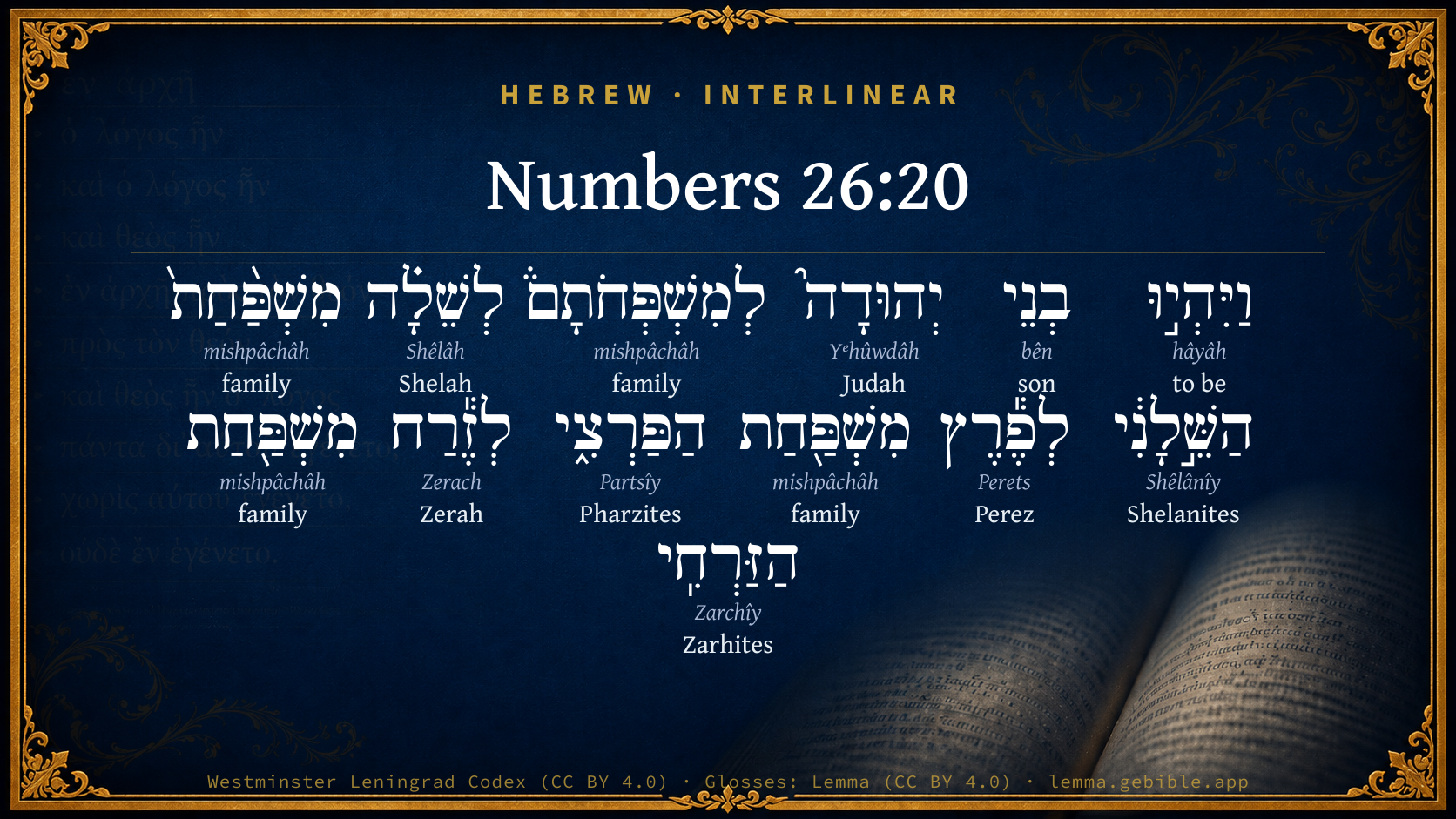
Hebrew (Westminster Leningrad Codex) Numbers 26:20 appears in the Hebrew Old Testament. The text above is from the Westminster Leningrad Codex. Each word links to its Strong’s number, a concise gloss, and parsing drawn from the Open Scriptures Hebrew Bible morphology. Click any word for its full Brown-Driver-Briggs (BDB) entry.
Download image
Cite this verse

Numbers 26:20 (World English Bible). Public Domain. Lemma interlinear Bible study tool, https://lemma.gebible.app/v/numbers/26/20.

Show BibTeX & RIS
BibTeX
RIS
English Translation
The sons of Judah after their families were: of Shelah, the family of the Shelanites; of Perez, the family of the Perezites; of Zerah, the family of the Zerahites.
World English Bible · Public Domain
Highlights Full analysis ↓
Download a study sheet

One document with this verse’s original text, its word-by-word gloss line, the meaning frame, cross-references with their text, attributed commentary, and full source and license credits — printable, and it pastes into notes with its structure intact.

This verse Autodidact and up

Study sheet (.html) Plain text (.txt)

A passage Seminary Student

Up to 50 verses in one chapter. A passage sheet keeps up to 6 commentary sources and 12 cross-references per verse, in the order this page ranks them, and says so on the sheet whenever that leaves anything out. Ask for a single verse and you get the Autodidact verse sheet above.

Everything on this page stays free to read, with no account — the sheet is a download of what is already on screen, not access to it.

Want to remove ads? Support Godless Engineer
Compare translations 3

The same verse in 3 English versions, stacked beneath the original-language interlinear above. Click any original word for its lexicon entry.

Each is an independent rendering of the whole verse — the interlinear is not word-aligned to these translations.

Highlighted words mark where these versions differ — a whole-verse word diff, not a word-by-word alignment.

  • World English Bible Public Domain
    The sons of Judah after their families were: of Shelah, the family of the Shelanites; of Perez, the family of the Perezites; of Zerah, the family of the Zerahites.
  • King James Version Public Domain
    And the sons of Judah after their families were; of Shelah, the family of the Shelanites: of Pharez, the family of the Pharzites: of Zerah, the family of the Zarhites.
  • unfoldingWord Literal Text CC BY-SA 4.0
    And the sons of Judah according to their clans were: of Shelah, the clan of the Shelanite; of Perez, the clan of the Perezite; of Zerah, the clan of the Zerahite.

unfoldingWord Literal Text — © unfoldingWord, licensed CC BY-SA 4.0. Word-aligned USFM3 via Door43 (git.door43.org/unfoldingWord/en_ult).

Versions to compare (up to 4)

3 of 4 selected

Show all 18 translations

Every available English version of this verse, each an independent rendering of the whole verse.

  • World English Bible Public Domain
    The sons of Judah after their families were: of Shelah, the family of the Shelanites; of Perez, the family of the Perezites; of Zerah, the family of the Zerahites.
  • Berean Standard Bible Public Domain
    These were the descendants of Judah by their clans: The Shelanite clan from Shelah, the Perezite clan from Perez, and the Zerahite clan from Zerah.
  • Majority Standard Bible Public Domain
    These were the descendants of Judah by their clans: The Shelanite clan from Shelah, the Perezite clan from Perez, and the Zerahite clan from Zerah.
  • King James Version Public Domain
    And the sons of Judah after their families were; of Shelah, the family of the Shelanites: of Pharez, the family of the Pharzites: of Zerah, the family of the Zarhites.
  • American Standard Version (1901) Public Domain
    And the sons of Judah after their families were: of Shelah, the family of the Shelanites; of Perez, the family of the Perezites; of Zerah, the family of the Zerahites.
  • Revised Version (1885) Public Domain
    And the sons of Judah after their families were; of Shelah, the family of the Shelanites: of Perez, the family of the Perezites: of Zerah, the family of the Zerahites.
  • Geneva Bible (1599) Public Domain
    So were the sonnes of Iudah after their families: of Shelah came the familie of ye Shelanites: of Pharez, the familie of the Pharzites, of Zerah, the familie of the Zarhites.
  • Douay-Rheims (1899) Public Domain
    And the sons of Juda by their kindreds were: Sela, of whom is the family of the Selaites: Phares, of whom is the family of the Pharesites: Zare, of whom is the family of the Zarites.
  • Young's Literal Translation Public Domain
    And sons of Judah, by their families, are: of Shelah the family of the Shelanite; of Pharez the family of the Pharzite; of Zerah the family of the Zarhite;
  • Literal Standard Version CC BY-SA 4.0
    And sons of Judah by their families are: of Shelah the family of the Shelanite; of Perez the family of the Perezite; of Zerah the family of the Zerahite;
  • Unlocked Literal Bible CC BY-SA 4.0
    The clans of Judah's other descendants were these: through Shelah, the clan of the Shelanites, through Perez, the clan of the Perezites, and through Zerah, the clan of the Zerahites.
  • unfoldingWord Literal Text CC BY-SA 4.0
    And the sons of Judah according to their clans were: of Shelah, the clan of the Shelanite; of Perez, the clan of the Perezite; of Zerah, the clan of the Zerahite.
  • Darby Bible Public Domain
    And the sons of Judah, after their families: of Shelah, the family of the Shelanites; of Pherez, the family of the Pharzites; of Zerah, the family of the Zarhites.
  • World Messianic Bible Public Domain
    The sons of Judah after their families were: of Shelah, the family of the Shelanites; of Perez, the family of the Perezites; of Zerah, the family of the Zerahites.
  • Webster's Bible Public Domain
    And the sons of Judah after their families were; of Shelah, the family of the Shelanites: of Pharez, the family of the Pharezites: of Zerah, the family of the Zarhites.
  • Free Bible Version CC BY-SA 4.0
    Shelah, ancestor of the Shelanite family; Perez, ancestor of the Perezite family; Zerah, ancestor of the Zerahite family.
  • Bible in Basic English Public Domain
    And the sons of Judah by their families were: of Shelah, the family of the Shelahites: of Perez, the family of the Perezites: of Zerah, the family of the Zerahites.
  • JPS Tanakh (1917) Public Domain
    And the sons of Judah after their families were: of Shelah, the family of the Shelanites; of Perez, the family of the Perezites; of Zerah, the family of the Zerahites.

Literal Standard Version (2020), Covenant Press — licensed CC BY-SA 4.0. Text via the HelloAO Bible API (eBible.org). Unlocked Literal Bible (unfoldingWord) — licensed CC BY-SA 4.0. Text via the HelloAO Bible API (eBible.org). unfoldingWord Literal Text — © unfoldingWord, licensed CC BY-SA 4.0. Word-aligned USFM3 via Door43 (git.door43.org/unfoldingWord/en_ult). Free Bible Version, Dr. Jonathan Gallagher — licensed CC BY-SA 4.0. Text via the HelloAO Bible API (eBible.org).

Word by word

More ways to search: Search by grammar → Find every occurrence → Compare this word →

Practice this passage: Drill this verse → Learn its vocabulary →

הַשֵּׁ֣לָנִ֔י
Shêlânîy
H8024
“the · Shelanites”
Particle, Definite Article + Noun, Gentilic, Masculine, Singular, Absolute
Part of Speech
Particle + Noun
Type
Gentilic
Gender
Masculine
Number
Singular
State
Absolute
Full BDB Definition

Origin: from H7956

TWOT: None

Shelanites = see Shelah " quietness" - a descendant of Shelah
  1. וַיִּהְי֣וּ hâyâh H1961 “and · to be” Conjunction + Verb, Qal, Sequential Imperfect, 3rd Person, Masculine, Plural
  2. בְנֵי bên H1121 “sons of” Noun, Common, Masculine, Plural, Construct
  3. יְהוּדָה֮ Yᵉhûwdâh H3063 “Judah” Noun, Proper
  4. לְמִשְׁפְּחֹתָם֒ mishpâchâh H4940 “to/for · families · their” Preposition + Noun, Common, Feminine, Plural, Construct + Suffix, Personal, 3rd Person, Masculine, Plural
  5. לְשֵׁלָ֗ה Shêlâh H7956 “to/for · Shelah” Preposition + Noun, Proper
  6. מִשְׁפַּ֨חַת֙ mishpâchâh H4940 “family of” Noun, Common, Feminine, Singular, Construct
  7. לְפֶ֕רֶץ Perets H6557 “to/for · Perez” Preposition + Noun, Proper
  8. מִשְׁפַּ֖חַת mishpâchâh H4940 “family of” Noun, Common, Feminine, Singular, Construct
  9. הַפַּרְצִ֑י Partsîy H6558 “the · Pharzites” Particle, Definite Article + Noun, Gentilic, Masculine, Singular, Absolute
  10. לְזֶ֕רַח Zerach H2226 “to/for · Zerah” Preposition + Noun, Proper
  11. מִשְׁפַּ֖חַת mishpâchâh H4940 “family of” Noun, Common, Feminine, Singular, Construct
  12. הַזַּרְחִֽי Zarchîy H2227 “the · Zarhites” Particle, Definite Article + Noun, Gentilic, Masculine, Singular, Absolute

About this verse

These counts appear in no published source. They are computed here, from the morphology-tagged text and Lemma’s own curated glosses. What Lemma adds →

13
words
10
distinct lemmas
Pentateuch
section

Notable vocabulary

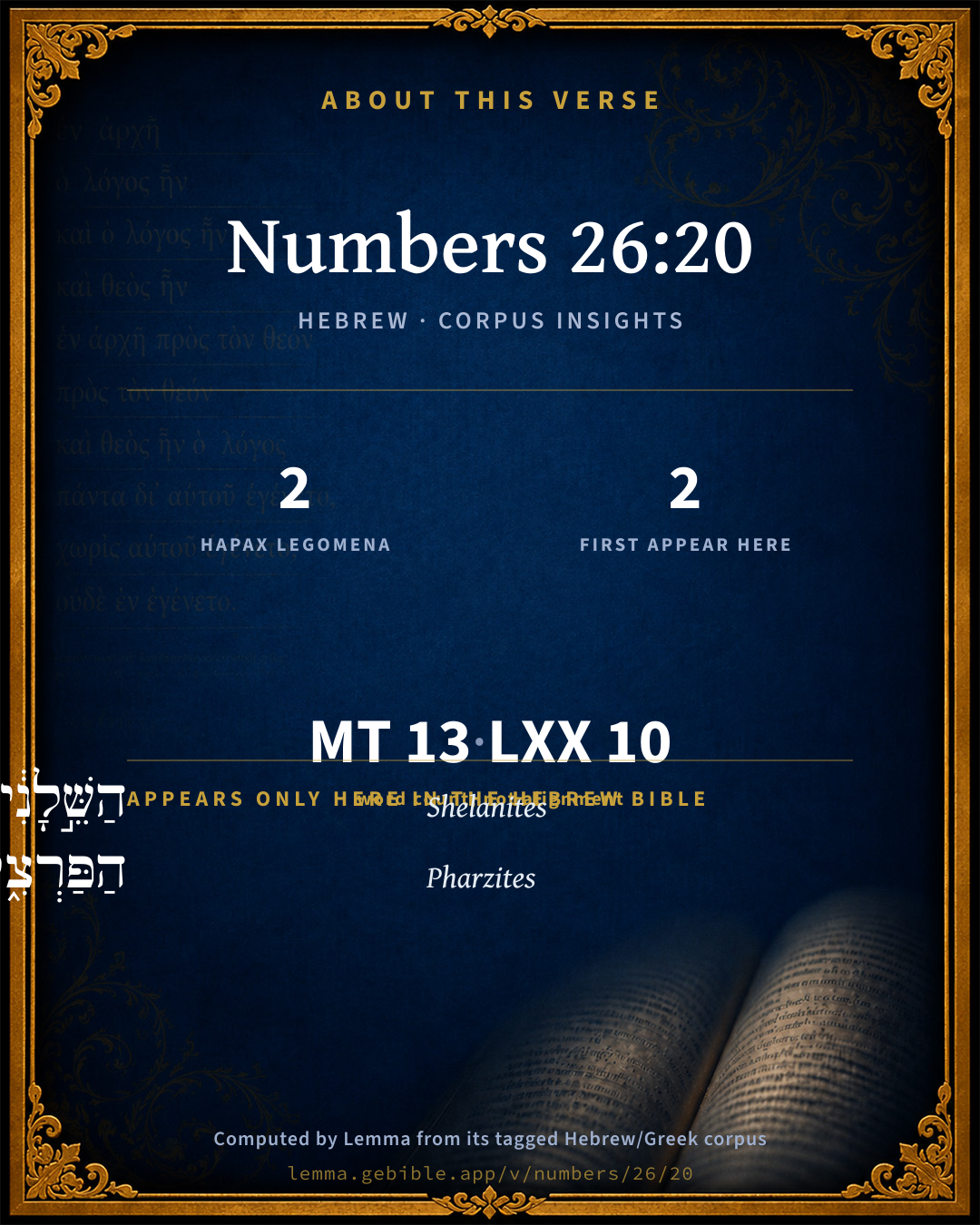
2 hapax legomena — words that appear only here in the entire Hebrew Bible:

  • הַשֵּׁ֣לָנִ֔י Shelanites H8024
  • הַפַּרְצִ֑י Pharzites H6558

First appearance in Scripture

These words make their first canonical appearance in the Hebrew Bible here:

  • הַשֵּׁ֣לָנִ֔י Shelanites H8024
  • הַפַּרְצִ֑י Pharzites H6558

Shared distinctive vocabulary

הַזַּרְחִֽי Zarhites H2227 occurs in 5 verses of the Hebrew Bible. Also found in:

Grammatical profile

  • 1 verb
  • 12 nouns

Verb forms

  • וַיִּהְי֣וּ Qal · Sequential Imperfect

Repetition

A word recurs within this verse — often emphatic in Hebrew:

  • לְמִשְׁפְּחֹתָם֒ family H4940 ×4

Hebrew & Septuagint length

In English translation the verse runs 29 words from the Hebrew and 14 from the Septuagint (LXX English) — the Septuagint runs noticeably shorter here. See the side-by-side →

A rough comparison of the two English renderings, which tokenize alike — not a word-level alignment.

Word counts can differ between the Hebrew and the Greek without any difference in meaning — e.g. the Hebrew direct-object marker אֵת has no separate Greek word, and Greek often adds the article ὁ.

In the original languages it is 13 Hebrew tokens and 10 Greek tokens — but the two are counted differently (Hebrew bundles its prefixes and suffixes into one token; the Greek is in lemma form), so that isn’t a like-for-like length.

Cross-references

13

Topical passages linked to Numbers 26:20 in the Treasury of Scripture Knowledge — connected by theme and wording, ordered by reader-vote popularity; previews shown in the World English Bible.

  • Genesis 46:12 The sons of Judah: Er, Onan, Shelah, Perez, and Zerah; but Er and Onan died in the land of Canaan. The sons of Perez were Hezron and Hamul.
  • Nehemiah 11:24 Pethahiah the son of Meshezabel, of the children of Zerah the son of Judah, was at the king's hand in all matters concerning the people.
  • Genesis 38:5 She yet again bore a son, and named him Shelah: and he was at Chezib, when she bore him.
  • Genesis 38:11 Then Judah said to Tamar, his daughter-in-law, "Remain a widow in your father's house, until Shelah, my son, is grown up;" for he said, "Lest he also die, like his brothers." Tamar went and lived in her father's house.
  • Genesis 38:14 She took off of her the garments of her widowhood, and covered herself with her veil, and wrapped herself, and sat in the gate of Enaim, which is by the way to Timnah; for she saw that Shelah was grown up, and she wasn't given to him as a wife.
  • Genesis 38:26–30 Judah acknowledged them, and said, "She is more righteous than I, because I didn't give her to Shelah, my son." He knew her again no more.
  • Ruth 4:18–22 Now this is the history of the generations of Perez: Perez became the father of Hezron,
  • 1 Chronicles 2:3–8 The sons of Judah: Er, and Onan, and Shelah; which three were born to him of Shua's daughter the Canaanitess. Er, Judah's firstborn, was wicked in the sight of Yahweh; and he killed him.
  • 1 Chronicles 4:21 The sons of Shelah the son of Judah: Er the father of Lecah, and Laadah the father of Mareshah, and the families of the house of those who worked fine linen, of the house of Ashbea;
  • Nehemiah 11:4 In Jerusalem lived certain of the children of Judah, and of the children of Benjamin. Of the children of Judah: Athaiah the son of Uzziah, the son of Zechariah, the son of Amariah, the son of Shephatiah, the son of Mahalalel, of the children of Perez;
  • Nehemiah 11:6 All the sons of Perez who lived in Jerusalem were four hundred sixty-eight valiant men.
  • Matthew 1:3 Judah became the father of Perez and Zerah by Tamar. Perez became the father of Hezron. Hezron became the father of Ram.
  • Luke 3:33 the son of Amminadab, the son of Aram, the son of Joram, the son of Hezron, the son of Perez, the son of Judah,

Cross-references courtesy of OpenBible.info (CC BY 4.0).

Hebrew and Greek witnesses Masoretic Hebrew ↔ Greek Septuagint

The same verse in the two great witnesses to the Old Testament, shown verse-for-verse.

Here the Septuagint runs noticeably shorter than the Hebrew — LXX2012 (modern English Septuagint) 14 words vs World English Bible 29. A rough length comparison of the two English translations, not a word-level alignment — read both below.

These are two independent witnesses, not word-aligned to each other, and the Septuagint is shown in lemma (dictionary) form.

Hebrew Numbers 26:20 Masoretic · Westminster Leningrad Codex

וַיִּהְי֣וּ בְנֵי יְהוּדָה֮ לְמִשְׁפְּחֹתָם֒ לְשֵׁלָ֗ה מִשְׁפַּ֨חַת֙ הַשֵּׁ֣לָנִ֔י לְפֶ֕רֶץ מִשְׁפַּ֖חַת הַפַּרְצִ֑י לְזֶ֕רַח מִשְׁפַּ֖חַת הַזַּרְחִֽי

The sons of Judah after their families were: of Shelah, the family of the Shelanites; of Perez, the family of the Perezites; of Zerah, the family of the Zerahites.

World English Bible · Public Domain

Greek LXX Numbers 26:20 Septuagint · lemma form

ὁ ιασουβ δῆμος ὁ ιασουβι ὁ σαμαραν δῆμος ὁ σαμαρανι

To Jasub, the family of the Jasubites; to Samram, the family of the Samramites.

LXX2012 (modern English Septuagint) · Public Domain

Hebrew: Westminster Leningrad Codex (CC BY 4.0). Greek: Septuagint (public domain); English from LXX2012 (modern English Septuagint) (Public Domain). How the Septuagint differs from the Hebrew →

Targum (Aramaic paraphrase)

2

The Targum is the ancient Jewish Aramaic paraphrase of the Hebrew Scriptures — an interpretive translation, not the Hebrew text itself. Onkelos (literal) and Pseudo-Jonathan (expansive) render the Torah, and Jonathan the Prophets. Coverage is partial: where no permissively-licensed English translation exists for a verse, only the Aramaic is shown. This is verse-level text, not a word-by-word alignment to the Hebrew.

  1. Targum Onkelos Torah (Genesis–Deuteronomy)
    וַהֲווֹ בְנֵי יְהוּדָה לְזַרְעֲיַתְהוֹן לְשֵׁלָה זַרְעִית שֵׁלָה לְפֶרֶץ זַרְעִית פֶּרֶץ לְזֶרַח זַרְעִית זָרַח

    (no public-domain English translation for this verse)

    Targum Onkelos — Aramaic: “Onkelos Genesis” (public domain); “Onkelos Exodus” (public domain); “Onkelos Leviticus” (public domain); “Onkelos Numbers” (public domain); “Onkelos Deuteronomy” (public domain). English: “Sefaria Community Translation” (CC0 1.0 (public-domain dedication)); “J.W. Etheridge. The Targums of Onkelos and Jonathan Ben Uzziel on the Pentateuch. London: Longmans, Green, 1862” (public domain). Text via Sefaria.

  2. Targum Pseudo-Jonathan Torah (Genesis–Deuteronomy)
    וַהֲווֹ בְּנֵי יְהוּדָה לִגְנִיסַתְהוֹן לְשֵׁלָה גְנִיסַת שֵׁלָה לְפֶרֶץ גְנִיסַת פֶּרֶץ לְזֶרַח גְנִיסַת זָרַח

    Of the Beni Jehudah with their families, of Shela, the family of Shela; of Pherez, the family of Pherez; of Zerach, the family of Zerach.

    Targum Pseudo-Jonathan — Aramaic: “Targum Jonathan on Genesis” (public domain); “Targum Jonathan on Exodus” (public domain); “Targum Jonathan on Leviticus” (public domain); “Targum Jonathan on Numbers” (public domain); “Targum Jonathan on Deuteronomy” (public domain). English: “The Targum of Jonathan ben Uzziel, trans. J. W. Etheridge, London, 1862” (public domain). Text via Sefaria.

Commentary

Notes on Numbers 26:20 from classic Christian and Jewish commentators (each source and its license shown beneath its notes). The classic Christian expositions comment on the surrounding passage and are grouped to its opening verse, so a note may address several verses; the Jewish commentaries on the Tanakh (Rashi and others) are per-verse, so they appear only where the commentator wrote on this verse.

Lemma curates 59 commentaries, every one of them public domain or Creative Commons licensed, each selected and text-cleaned for this edition rather than reprinted as found. About our sources →

The Pulpit Commentary

The sons of Judah after their families. The Beni-Judah, or "men of Judah," according to their sub-tribal divisions, are clearly distinguished from the "sons of Judah" as individuals, two of whom are mentioned in the previous verse. Of the families of Judah, three were named after sons, two after grandsons. As the Pharzites remained a distinct family apart from the Hamulites and Hezronites, it may he supposed that Pharez had other sons not mentioned here, or in Gen_46:12, or in 1Ch_2:3, 1Ch_2:4, 1Ch_2:5.

The Pulpit Commentary (1880–1919), ed. H.D.M. Spence-Jones & Joseph S. Exell — public domain. Text from a community e-Sword module.

Lesson kit

Teaching starters — assembled from the data on this page, not authored interpretation. Every prompt links to the verse data it draws on. Edit before teaching.

Numbers, in the Pentateuch, opens this verse with 13 words (10 distinct Hebrew lemmas). Its most distinctive word is Shêlânîy (“Shelanites”). The Greek Septuagint runs shorter here. A historical commentator’s framing appears above. Read the whole chapter for the surrounding context.

Discussion questions

  1. What does “Shelanites” (Shêlânîy) contribute to the verse as a whole?
  2. This verse holds 2 words here found nowhere else in the Hebrew Bible. What might the rare words draw attention to?
  3. 2 words here appear for the first time in Scripture. What is being introduced at this debut?
  4. Numbers 26:13 shares the word «Zarhites» with this verse. How do the two illuminate each other?
  5. “family” occurs 4× in this one verse. What is the effect of the repetition?
  6. Compared with the Hebrew, the Septuagint runs shorter here. What questions does that raise?
  7. These translations render this verse differently; the difference is in the English rendering, not the original. What questions does that raise?
  8. The verb «וַיִּהְי֣וּ» is Qal Sequential Imperfect. How does its form color the action?

Things to notice

  • 2 words in this verse appear nowhere else in the Hebrew Bible.
  • 2 words make their first canonical appearance in Scripture here.
  • This verse counts 13 Hebrew ↔ 10 Greek words.
  • These translations choose different wording for 16 words in this verse.
  • “family” occurs 4× in this single verse.

Reading settings

Reading text

Shown beneath each verse's original-language words.

Old Testament
Old Testament edition

Read the OT as the Masoretic Hebrew (MT) or the Greek Septuagint (LXX).

English shown for the Greek Septuagint (in the Hebrew ↔ Greek comparison).

Comparing translations? Open the Compare panel on any verse page to stack up to four side by side.